INTRODUCTION
In May 2019, Julius Malema, the South African populist firebrand eagerly watched election returns. The final results showed his Economic Freedom Fighters (EFF) cross double digits (10.8%) in a national contest. For years, Malema publicly rebuked and verbally assailed government actors and economic elites. On the one hand, his efforts have been rewarded at the ballot box; but, given the propitious electoral environment, many felt his party should have done even better. His constant supply of populist rhetoric begs the question whether the South African public demands his Manichean discourse. In this paper we ask, do South Africans hold strong populist attitudes? If they do, then do these attitudes shape their political behaviour?
In empirical studies of populism, there is a growing scholarly consensus around the ideational definition (Mudde & Rovira Kaltwasser Reference Mudde and Rovira Kaltwasser2018; Rovira Kaltwasser & van Hauwaert Reference Rovira Kaltwasser and van Hauwaert2020) that posits populism to be a set of ideas about politics. Moving past earlier conceptual disagreements, researchers started examining the presence and prevalence of mass populist attitudes (Akkerman et al. Reference Akkerman, Mudde and Zaslove2014; Elchardus & Spruyt Reference Elchardus and Spruyt2016). Others have linked these attitudes with ideological dispositions (Spruyt et al. Reference Spruyt, Keppens and Van Droogenbroeck2016; Bernhard & Hänggli Reference Bernhard and Hänggli2018), party preferences (Spierings & Zaslove Reference Spierings and Zaslove2017; Hawkins et al. Reference Hawkins, Carlin, Littvay and Rovira Kaltwasser2019) and voting behaviour (van Hauwaert & van Kessel Reference Van Hauwaert and van Kessel2018).
Geographically, empirical studies of populist attitudes have almost entirely concentrated on Western Europe (Akkerman et al. Reference Akkerman, Mudde and Zaslove2014; Bernhard & Hänggli Reference Bernhard and Hänggli2018) and Latin America (Aguilar & Carlin Reference Aguilar and Carlin2017). More recently, scholars have employed cross-national (Van Hauwaert & van Kessel Reference Van Hauwaert and van Kessel2018) and even cross-regional (Rovira Kaltwasser & van Hauwaert Reference Rovira Kaltwasser and van Hauwaert2020) research designs. Although researchers have advocated that conceptualisations and theories of populism ‘travel’ to other regions (Akkerman et al. Reference Akkerman, Mudde and Zaslove2014: 1326; Mudde & Rovira Kaltwasser Reference Mudde and Rovira Kaltwasser2018), there continues to be a dearth of empirical studies on African populism. With the region's hyper-presidential systems, high levels of personalised politics, and rampant poverty and socioeconomic inequality, this seems to be a major lacuna in the populism literature. Our contribution seeks to partially fill the geographic gap and offer, to the best of our knowledge, the first empirical study of mass populist attitudes on the continent.
South Africa also presents an interesting case for the populism literature. The long-ruling African National Congress (ANC) has suffered severe political consequences – lack of trust and legitimacy – for the unheralded levels of corruption and economic mismanagement under its former leader, Jacob Zuma. The EFF has cleverly tapped into deep discontent with a liberation party whose well of political capital seems to have diminished, and perhaps run dry. Given its steady supply of populist rhetoric in the 2019 campaign (Nyenhuis Reference Nyenhuis2020), matched with the crisis conditions needed to ‘activate’ (Hawkins et al. Reference Hawkins, Carlin, Littvay and Rovira Kaltwasser2019) populist attitudes, South Africa provides a fair test of the ideational theory and approach of populism. It may also yield insights into the scope conditions for successful populist mobilisation.
The EFF's lack of electoral success presents a challenge to some of the literature's explanations. Scholars (Hawkins Reference Hawkins2009; Castanho Silva Reference Castanho Silva, Hawkins, Carlin, Littvay and Rovira Kaltwasser2019) assert that populism as a viable electoral strategy is conditional on a country's level of economic development. In underdeveloped countries populists can win office while they usually are smaller third-party movements or upstart parties in developed countries (Hawkins et al. Reference Hawkins, Carlin, Littvay and Rovira Kaltwasser2019: 4). In many Andean countries, charismatic candidates expertly exploited pervasive corruption and rode popular discontent to their countries’ highest executive offices. However, the EFF flips these assertions on their head. Malema's party, in an underdeveloped country, rife with corruption and democratic dissatisfaction, seems to have a more marginal political role similar to European populists (France, the Netherlands and the UK).
This paper has two aims: first, to explore who holds populist attitudes in South Africa, and then to examine the connection between attitudinal predispositions, partisan affiliation and voting behaviour. We hold that these two questions are interrelated, especially if we seek a comprehensive explanation of why the EFF were unable to fully capitalise on the auspicious political moment. The paper follows with a short discussion of African populism and the burgeoning literature on populist attitudes. We contend that the ideational approach does and should ‘travel’ to the region and offer a justification for why South Africa is a good test case of the approach and theory. We then discuss expectations of who are likely to hold populist attitudes, and how these attitudes may interact with other ideologies to explain partisan attachment to and voting behaviour for the EFF. We discuss our data and operationalise our variables. We offer an empirical examination of individual-level determinants of populist attitudes and showcase that the South African ‘populist citizen’ (Rovira Kaltwasser & van Hauwaert Reference Rovira Kaltwasser and van Hauwaert2020) tends to be less educated and poorer, and that race matters. Specifically, Indian and white South Africans, on average, are less likely to hold strong populist attitudes than their black compatriots, while coloured citizens hold strong beliefs that they are politically marginalised and not represented.
We further consider to what degree these attitudes were activated in the 2019 election and if they shaped citizens’ voting behaviour. We find that, contrary to our expectations, the EFF was unable to tap into voters’ attitudes to galvanise support at the ballot box. Part of this lies with the EFF's own vulnerabilities: citizen distrust and its racial exclusivity. Part of the answer lies with the ANC: it adroitly blunted many of the EFF's most radical attacks and changed its leader. The EFF's specific variant of ethnopopulism likely lowered the ceiling for its electoral ambitions. Like other parties in South America that make use of racially or ethnically exclusive rhetoric, the EFF's language cemented its rejection by non-black voters and may even have dissuaded its intended supporters (poor, black South Africans) from considering it as a viable electoral option.
AFRICAN POPULISM
Perhaps not as well-studied as European or Latin American iterations, work on African populism (Hess & Aidoo Reference Hess and Aidoo2014; Cheeseman & Larmer Reference Cheeseman and Larmer2015; Mbete Reference Mbete2015; Nyenhuis Reference Nyenhuis2020) has expanded over the last decade. More recently, individual chapters in cross-regional edited volumes (Resnick Reference Resnick, Ostiguy, Rovira Kaltwasser, Taggart and Ochoa Espejo2017; Cheeseman Reference Cheeseman and de la Torre2018; Mbete Reference Mbete, Ostiguy, Panizza and Moffitt2020; Mutsvairo & Salgado Reference Mutsvairo, Salgado, Tumber and Waisbord2021) have cast long overdue academic light on the continent's cases, developing rich conceptual and theoretical insights for the broader comparative study of populism. These studies chiefly focus on how leaders’ rhetoric and behaviour may appeal to electorates.
Specific to South Africa, scholars have described the antics of Jacob Zuma (Vincent Reference Vincent2011) and Julius Malema (Melber Reference Melber2018; Mbete Reference Mbete, Ostiguy, Panizza and Moffitt2020). Others (Nyenhuis Reference Nyenhuis2020; Fölscher et al. Reference Fölscher, de Jager and Nyenhuis2021) empirically investigated actors’ speeches. In short, (South) African populism studies focus entirely on populism's supply. However, a comprehensive understanding of the phenomenon should also consider its demand (Norris & Inglehart Reference Norris and Inglehart2019: 32). In this article, we explore the demand side (individuals’ populist attitudes), aiming to uncover the phenomenon's micro-level foundations.
Research on populism has proliferated since the late 20th century, but scholars have only recently operationalised, measured and examined populist attitudes. Some have explored who may be the ‘populist citizen’ (Elchardus & Spruyt Reference Elchardus and Spruyt2016; Spruyt et al. Reference Spruyt, Keppens and Van Droogenbroeck2016; Bernhard & Hänggli Reference Bernhard and Hänggli2018; Schulz et al. Reference Schulz, Müller, Schemer, Wirz, Wettstein and Wirth2018; Tsatsanis et al. Reference Tsatsanis, Andreadis and Teperoglou2018; van Hauwaert et al. Reference Van Hauwaert, Schimpf and Dandoy2019; Rovira Kaltwasser & van Hauwaert Reference Rovira Kaltwasser and van Hauwaert2020), how populist attitudes may be ‘activated’ by political entrepreneurs (Aguilar & Carlin Reference Aguilar and Carlin2017; Hawkins et al. Reference Hawkins, Kaltwasser and Andreadis2020), and how these attitudes shape partisan affinity and voting behaviour (Akkerman et al. Reference Akkerman, Zaslove and Spruyt2017; Spierings & Zaslove Reference Spierings and Zaslove2017; van Hauwaert & van Kessel Reference Van Hauwaert and van Kessel2018; Hawkins et al. Reference Hawkins, Carlin, Littvay and Rovira Kaltwasser2019; Hieda et al. Reference Hieda, Zenkyo and Nishikawa2021). The central assumption in studies on populist attitudes is that populism is a set of ideas concerning the world, society and politics writ large (Hawkins Reference Hawkins2009). Scholars offer that populist attitudes include three elements: a Manichean perspective that sees politics as an ‘us’ versus ‘them’ struggle, the moral virtue of the common person, and an anti-elitist outlook. Can and does this version of populism travel to Africa?
Work on African populism coalesces around a conceptual framework that mirrors these elements. Historically, populists (Sankara in Burkina Faso, Rawlings in Ghana, Museveni in Uganda) rode waves of citizen dissatisfaction to office, and strategically appealed to the ‘common person’, persuading them that they had been left behind by the malevolent ruling political class (Resnick Reference Resnick, Ostiguy, Rovira Kaltwasser, Taggart and Ochoa Espejo2017). Although these actors almost always ruled in an autocratic fashion, they simultaneously advocated for more political mechanisms (e.g. referenda) that enhanced popular legitimacy (Rothchild & Gyimah-Boadi Reference Rothchild and Gyimah-Boadi1989; Carbone Reference Carbone2005). Leaders stressed dismantling the ‘elite establishment’ and increasing ‘mass participation in decision-making’ (Chazan et al. Reference Chazan, Lewis, Mortimer, Rothchild and Stedman1999: 166). At its core, populists seek to place the voice of the people front and centre of the political process and commit to this lofty ideal even if it means infringing on the rights of minorities or undermining the existing democratic institutional infrastructure.
One of the strengths of the ideational approach is that it asserts populist ideas can be measured and scored, lending itself to empirical examination, a shortcoming in most existing studies of African populism. Mudde & Rovira Kaltwasser (Reference Mudde and Rovira Kaltwasser2018) suggest that the approach facilitates cross-regional scholarly discussion, enabling scholars to apply concepts across different political contexts. Given the lack of empirical work on African populism, we argue that the ideational approach to populism is abstract enough to travel across geographic locations (Akkerman et al. Reference Akkerman, Mudde and Zaslove2014: 1326). We advance that extending the attitudinal approach to an African case holds considerable theoretical and empirical value. There is, to the best of our knowledge, no study of African populism at the micro-level. We offer a first step in addressing this omission, making geographic, empirical and theoretical contributions.
An additional contribution to using the ideational approach is that it allows for a test of the ‘activation’ element of the theory. Scholars (Aguilar & Carlin Reference Aguilar and Carlin2017; Hawkins et al. Reference Hawkins, Carlin, Littvay and Rovira Kaltwasser2019) put forth that the mere presence of these attitudes is not enough for them to shape political behaviour; rather, they must be ‘activated’ by adroit political actors. Hawkins & Rovira Kaltwasser (Reference Hawkins and Kaltwasser2017) contend that activation requires the right context – specifically, countries with widespread rampant corruption. The aspiring political entrepreneur must then publicly rail against entrenched elites who exploit the masses, frame politics as a struggle between elites and the people, and make selective appeals to elicit emotional (anger, outrage) responses.
In South Africa, these conditions have been more than met. The nefarious dealings of Jacob Zuma ushered in a decade of scandal-ridden (e.g. state capture, Guptas) governance that almost certainly whet the citizenry's populist appetite. Malema has captivated the South African political audience through his and the EFF's antics, vitriolic rhetoric and political spectacles (Mbete Reference Mbete, Ostiguy, Panizza and Moffitt2020; Nyenhuis Reference Nyenhuis2020). Central to Hawkins & Rovira Kaltwasser's (Reference Hawkins and Kaltwasser2017) argument of activation, Malema has met all three conditions: he has blamed the country's failures on a small conniving elite, he has consistently framed problems in Manichean terms, and largely exploited the country's troubled past to stir up feelings of racial animosity and even anger (usually a black vs non-black schism). The ruling ANC, white ‘monopoly class’, and more recently citizens of Indian ethnicity have all been frequent targets of his verbal attacks. Work by Nyenhuis (Reference Nyenhuis2020) and his co-authors (Fölscher et al. Reference Fölscher, de Jager and Nyenhuis2021) illustrates that Malema's rhetoric has been extreme, on par with other global cases of incendiary populism (e.g. Chávez, Roxana Miranda and others).Footnote 1 In short, South Africa provides an excellent test case of the presence of populist attitudes, their possible activation, and the linkage to citizens’ electoral behaviour.
THEORY ON ACTIVATION AND ATTITUDES
A first step in examining populist attitudes is to consider who may harbour them. Past research in Europe and Latin America illustrates that certain demographics are more likely to feel strongly that politics should reflect the people's will. Most scholars have focused on citizens who feel disillusioned, or left behind, by rapid economic and societal changes. The ‘losers of modernisation’ (Betz Reference Betz1993), whether actual or perceived victims, are more likely to desire greater popular sovereignty and distrust established politicians. Researchers have also identified that male (Elchardus & Spruyt Reference Elchardus and Spruyt2016; Bernhard & Hänggli Reference Bernhard and Hänggli2018), older (Tsatsanis et al. Reference Tsatsanis, Andreadis and Teperoglou2018) and less educated (Elchardus & Spruyt Reference Elchardus and Spruyt2016; Aguilar & Carlin Reference Aguilar and Carlin2017) citizens hold stronger populist attitudes. Further, survey respondents who self-report lower personal income levels and lack employment have stronger populist proclivities (Spruyt et al. Reference Spruyt, Keppens and Van Droogenbroeck2016; Aguilar & Carlin Reference Aguilar and Carlin2017). We posit that:
Hypothesis 1a: male, older, less educated South Africans will hold stronger populist attitudes.
Hypothesis 1b: poorer and unemployed South Africans will hold stronger populist attitudes.
Researchers have also explored populism's supply by examining the specific makeup of political parties using populist discourse. In Europe, both left-wing (Greece, Spain) and right-wing (France, Germany, Italy, the Netherlands, Switzerland and the UK) actors utilise Manichean discourse to connect with their supporters (Akkerman et al. Reference Akkerman, Mudde and Zaslove2014; Bernhard & Hänggli Reference Bernhard and Hänggli2018; van Hauwaert & van Kessel Reference Van Hauwaert and van Kessel2018). Others (Castanho Silva Reference Castanho Silva2017; March Reference March2017) have found that more ideologically extreme parties employ higher levels of populist discourse, and that neither left-wing nor right-wing predispositions necessarily dictate their populist degree. Rather, extremism correlates with higher levels of populist rhetoric. In a sort of populist equilibrium, we should then expect their supporters to hold high levels of populist attitudes, a congruence between party leaders’ rhetoric (supply) and party supporters’ attitudes (demand). We posit that:
Hypothesis 2: enthusiasts of more extreme political parties will hold stronger populist attitudes.
In the 2019 South African electoral campaign, Nyenhuis (Reference Nyenhuis2020) found that both the EFF (extreme left) and the Freedom Front Plus (FF+, extreme right) utilised populist appeals most frequently and to the largest degree, echoing the findings of others (Castanho Silva Reference Castanho Silva2017; March Reference March2017). As such, we would expect the supporters of the EFF to hold higher levels of populist attitudes than the loyalists of the ruling ANC and the Democratic Alliance (DA).Footnote 2
In addition to the connection between political party and supporter, studies on populist attitudes have investigated the relation between attitudes and voting behaviour. Hawkins et al. (Reference Hawkins, Carlin, Littvay and Rovira Kaltwasser2019) illustrate that certain contextual conditions are needed to activate these attitudes. Citizens frustrated with democracy's inability to deliver material improvements in their daily lives, compounded by rampant corruption among government officials, provide fertile electoral environments for populists to exploit (Hawkins & Rovira Kaltwasser Reference Hawkins and Kaltwasser2017). Of note, aspiring populists need to frame the country's problems as the result of intentionally malicious behaviour by elected officials; their wantonness coming at the expense of the noble masses.
Central to the masses’ perceptions of illicit behaviour among government officials are widely publicised corruption scandals. Citizens, already frustrated about meagre and non-improving living conditions, are likely to gravitate towards populist actors who cleverly and clearly articulate the causes of their grievances. Blaming the political elites for complex societal issues is overly simplistic, but therein partly lies populist rhetoric's appeal and success (Moffitt Reference Moffitt2015: 198). Political and socioeconomic crises help populist messages resonate with the public, especially among those who already hold these attitudes. In countries with established parties that have been in office for quite some time (the ANC in South Africa), we would expect populists to shake up the system and be easier able to delineate themselves from the political establishment. As such, we posit that:
Hypothesis 3: citizens who hold stronger populist attitudes are more likely to vote for the EFF.
We present the above hypotheses with the acknowledgement that there may be other factors, some specific to our case, that may also shape who holds populist attitudes, and how their political behaviour may be conditioned. For instance, race is usually not an explanatory variable for other regions. Given South Africa's history, with race long shaping politics, we may expect it to affect our findings. Although scholars have moved beyond the early ‘racial census’ (Reynolds Reference Reynolds1999) framework, later efforts have found that race still plays a major role. Voters use race as a cognitive shortcut to select parties they feel will provide them the best descriptive and substantive representation (Ferree Reference Ferree2010; Habib & Schulz-Herzenberg Reference Habib and Schulz-Herzenberg2011). Further, the EFF has injected race squarely into politics, undoing over two decades of the unwritten law of political non-racialism in the ‘rainbow nation’.
DATA AND METHODOLOGY
We make use of the 2019 Comparative National Elections Project (CNEP) public post-election survey administered by Citizen Surveys from 10 August to 6 September 2019. In total, they surveyed 1625 respondents face-to-face in their homes, yielding a nationally representative sample. The timing of the survey in relation to the election (three months after) provides a degree of confidence that our results accurately capture the attitudes and behaviours of respondents. Past studies on populist attitudes usually suffer from a temporal disconnect between data collection and elections, ranging from a few months (Bernhard & Hänggli Reference Bernhard and Hänggli2018) to well over a year (Akkerman et al. Reference Akkerman, Mudde and Zaslove2014) before the election.
The questions used by CNEP are systematic across 20 countries, and thus differ slightly from those commonly used by other ideational populist scholars.Footnote 3 As such, we detail below how the questions we use map onto commonly accepted component parts of populism and follow with an empirical justification of our variables using factor analysis. Throughout the discussion we offer aspects of historical and contemporary African populism to further validate our decisions.
In total, we considered six questions. The first considers to what extent respondents believe electoral victors should compromise when governing. Populists, claiming to represent the general will of the morally good and pure people see compromise as ‘selling out’ (Akkerman et al. Reference Akkerman, Mudde and Zaslove2014: 1327). At its core, populism is inherently moralistic, viewing politics as a cosmic struggle between good and evil, allowing for no moral middle ground (Hawkins Reference Hawkins2009).
Our second component asks whether citizens should have an increased role in decision-making. Central to populists’ appeal is the promise of governing through ‘participatory linkages’ if elected (Barr Reference Barr2009). In the African context, historical populists all established local-level institutions for popular participation, amplifying the voice of the people (Resnick Reference Resnick, Ostiguy, Rovira Kaltwasser, Taggart and Ochoa Espejo2017). Our third question asks if majoritarian governments’ power should be restricted or if they should do whatever the people desire. Ochoa Espejo (Reference Ochoa Espejo and de la Torre2015: 75) convincingly argued that populism's key defining characteristic is its lack of self-limitation, that the will of the people is ‘always indefeasible’. The lack of limitations to one's power is central to populists’ ability to anoint themselves as the virtuous people's true representative.
A fourth element asks if politics is too complicated to understand. Scholars, using the sociocultural or performative approach, argue that populists use vernacular language, simplified language, slang and easy to digest metaphors to connect with their supporters (Moffitt & Tormey Reference Moffitt and Tormey2014; Bischof & Senninger Reference Bischof and Senninger2018). Populism is the ‘flaunting of the low’ (Ostiguy Reference Ostiguy, Ostiguy, Rovira Kaltwasser, Taggart and Ochoa Espejo2017: 73), that generates a feeling that the leader is just like everyone else and can readily understand their struggles in life. In Africa, there are ample cases (Jacob Zuma and Michael Sata) of skilled candidates making use of the vernacular and playing up their humble backgrounds to forge close emotional bonds with enthusiastic followers (Carbone Reference Carbone2005; Larmer & Fraser Reference Larmer and Fraser2007; Resnick Reference Resnick, Ostiguy, Rovira Kaltwasser, Taggart and Ochoa Espejo2017).
The fifth component asks if politicians care about respondents. Populists seek to take advantage of widespread disillusionment with unresponsive elected officials and portray themselves as different from the self-absorbed and corrupt political class. The sixth question probes citizens’ agreement that elected officials care only to defend the interests of the rich and powerful.
In short, these six elements illustrate the central components of populism – a strong opposition towards the elite and a romanticised version of the good common person, a clear division between elites and the common person, perceptions that government is not representative of the people, and unfettered power for the majority (Akkerman et al. Reference Akkerman, Mudde and Zaslove2014: 1331). The six questions may be classified as tapping into two ‘strains’ of populism. The first three consider the way citizens believe politics should be exercised, what we label ‘procedural populism’. The latter three questions tap into citizens’ feelings of democratic representation (or exclusion), or what we label ‘representative populism’.
Factor analysis
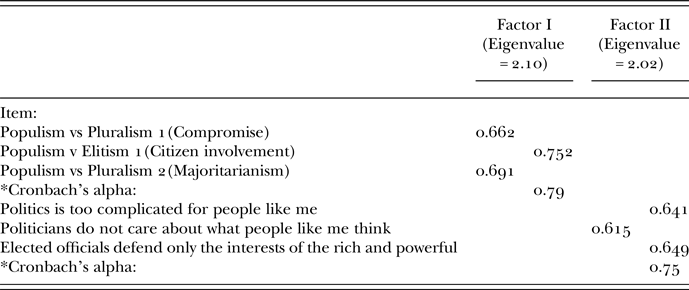
In this subsection we present the results of a principal component analysis (Table I) for our six populist dimensions. The variables above were asked in a batch for two sets of questions in the survey, asked and scored differently. The reliability coefficients for all components are above 0.50, a threshold used in other studies (Akkerman et al. Reference Akkerman, Mudde and Zaslove2014; Castanho Silva et al. Reference Castanho Silva, Hawkins, Carlin, Littvay and Rovira Kaltwasser2019). We have confidence that these measures capture the central components of populism, and if indexed would have reasonable internal validity. Following the standard set by others, we select the specific populist dimensions that have an Eigenvalue well above 1 (2.10 for our first indexed variable, 2.02 for our second).Footnote 4
Results of Factor and Reliability Analysis.

Independent variables and modelling
We employ a multistep analysis that utilises bivariate descriptive statistics and then proceeds to multinomial regression models. We start with descriptive statistics to probe which citizens hold the strongest populist attitudes with a consideration for how certain sociodemographic groups’ levels should have favoured the EFF in the 2019 election. We continue with our examination of South Africans’ voting behaviour by modelling votes for the EFF relative to other political party options. One aim is to examine why the EFF was unable to activate populist attitudes and why its electoral performance was lower than could be expected, given the political environment and widespread presence of populist attitudes. Examining sociodemographic factors, we explore the effects of age, gender, education, employment status, income, geographic location and race.Footnote 5 A full list of all independent variables can be found in the online appendix. We conclude with a few other bivariate descriptive statistics, examining the strongest populists’ evaluations of the EFF and political party leaders. We do so to offer an argument as to why the EFF largely failed to tap into South Africans’ populist attitudes.
ANALYSIS
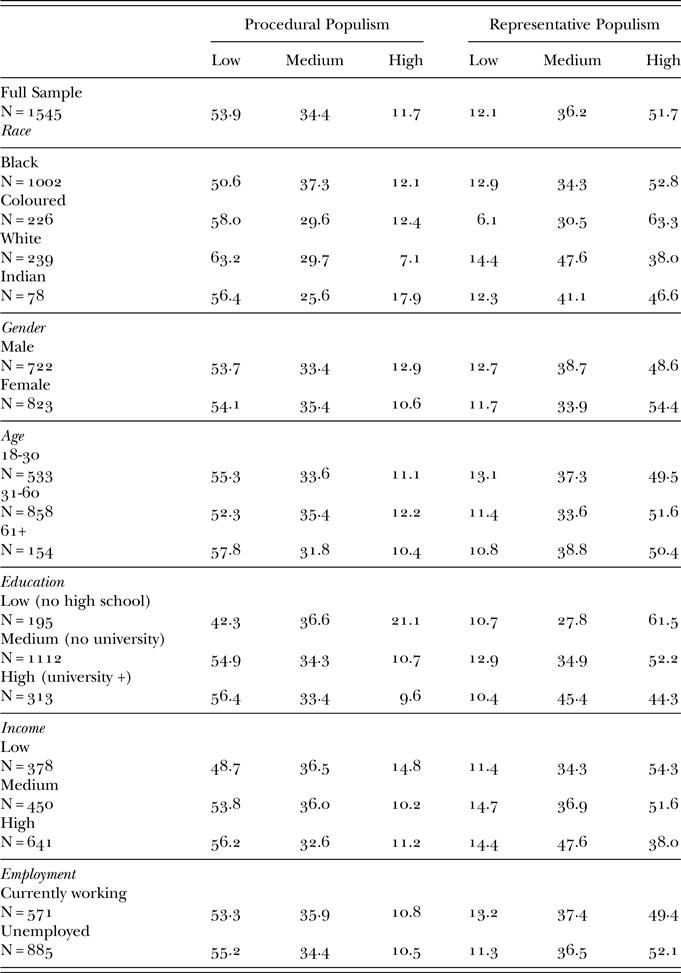
Table II illustrates the level (low, medium, high) of populist attitudes across various sociodemographic groups of interest.Footnote 6 Across the board, South Africans hold quite strong populist attitudes. About 46% of citizens hold medium or high levels of procedural populist attitudes, in that they think electoral victors should not compromise, the majority will should not be restrained in any way, and that citizens not experts should make important government decisions. The above number increases significantly to 87.9% when we consider representative populist attitudes (politics is too complicated, politicians do not care about ordinary citizens and elected officials serve only elite interests), with more than half of survey respondents holding high levels of these beliefs.
Social bases of populist attitudes.

Weighted data from the 2019 Comparative National Elections Project (CNEP), South Africa. Totals may not add exactly due to rounding.
When examining the attitudes along the lines of race, a few patterns stand out. First, black South Africans hold medium and high levels of procedural populist attitudes to a greater degree than their coloured and Indian compatriots, and to a much greater degree than whites. We also see similar racial differences when considering representative populist attitudes. A majority of black and coloured survey respondents held very strong attitudes along these dimensions, with roughly 9 of 10 individuals of these racial groups holding either medium or high levels. Although both white and Indian South Africans also hold strong representative populist ideas, they do so at lower levels of frequency and intensity.
Assessing both age and unemployment status, it is difficult to draw clear and distinctive patterns. The frequency and severity of populist attitudes closely mimic what we see for the full sample, and no noticeable differences emerge between age ranges, or when we compare working with unemployed South Africans. We also see variation along gender lines. Countering what earlier studies found (Elchardus & Spruyt Reference Elchardus and Spruyt2016; Bernhard & Hänggli Reference Bernhard and Hänggli2018), females are more likely to have stronger populist attitudes along the representative dimension. We find roughly similar levels of populist agreement on procedural aspects. All told, in regard to our second hypothesis, we do not find strong support that males, older or unemployed citizens are much more populist than younger respondents, females, or those who have gainful employment.
Conversely, we see distinct associations between populist attitudes and levels of education and income levels. Not surprisingly, less educated, and poorer South Africans hold much stronger populist attitudes, both in the procedural and representative senses, than their wealthier, more educated compatriots. The divide between the wealthiest and poorest groups, and the most and least educated are stark and illustrate that those citizens who are the most vulnerable in the country tend to agree that the majority will should not be compromised or hindered, and that the political system and elected officials have largely left them behind.Footnote 7
The above discussion suggests that South Africans hold quite high levels of populist attitudes, offering rather fertile conditions for adroit populists to exploit. Specific to the EFF, the survey data point to a particularly propitious context for the party. Across sociodemographic groups, the strongest populist attitudes are held by black (to a lesser extent coloured), poorer and less educated respondents. Considering that these groups are the exact blocs of the electorate the EFF routinely targets, there seems to be a growing puzzle of why the EFF, with their consistent supply of populist rhetoric, were not able to tap into these attitudes. Historically, the EFF has struggled to resonate with black female South Africans (Roberts Reference Roberts, Schulz-Herzenberg and Southall2019). Given that an overwhelming majority of the electorate is black and that females hold strong populist attitudes, closer examination of if the EFF were (not) able to activate attitudes among this specific demographic would also yield important clues that help explain the party's electoral fortunes.
Party considerations
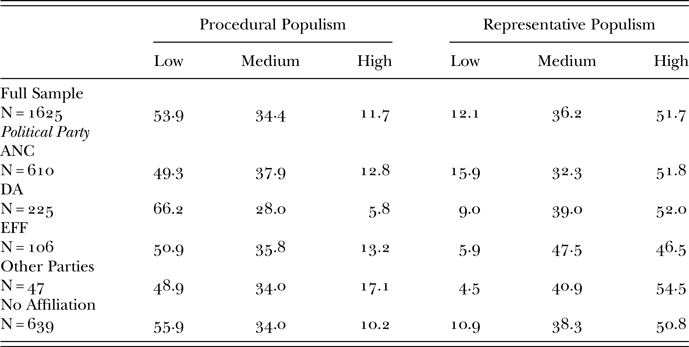
One surprising finding is that the populist attitudes of EFF supporters, by and large, are not significantly different from the ANC and DA's loyalists (Table III). When examining procedural populist attitudes, the DA's partisans hold the lowest scores, while the EFF and ANC are quite similar with the former slightly higher. We expected the DA's followers to be the least populist on the dimension given the party's history as the official opposition, its claim to represent all South Africans, and its stress on technocratic and governing efficiency. We also expected the EFF's stalwarts to hold high levels on this dimension given the party's commitment to combativeness in public and its reluctance to seek compromise. However, this was not the case. Assessing representative populist attitudes, we find that both the DA and EFF's supporters hold strong beliefs than the ANC's partisans. Again, surprisingly, the differences between the DA and EFF are quite minimal. Considering that the DA's leader, Mmusi Maimane, eschewed populist rhetoric in the 2019 campaign, we fail to find evidence that populist attitudes among citizens with a partisan attachment are largely shaped by party leaders’ rhetoric.
Political partisan bases of populist attitudes.

Weighted data from the 2019 Comparative National Elections Project (CNEP), South Africa. Totals may not add exactly due to rounding.
Across all affiliations, those who are supportive of the smallest political parties (the IFP, FF+ and all others), have much stronger populist attitudes than South Africans, in general, and on the questions overall than the supporters of the major political parties.Footnote 8 Given the high level of populist rhetoric used by FF+ leader, Dr Pieter Groenewald, during the electoral campaign, this should not be surprising. We caution reading too much into these results as the sample of supporters (N = 47) for this category is rather limited. As an initial conclusion and finding, we find minimal, if any, support for our above hypothesis that the EFF's and other extreme parties’ supporters hold stronger populist attitudes than the average South African and the partisans of the two largest, more moderate parties. We do not find any consistent patterns across non-partisans, suggesting that they have not shed their party attachments due to strongly held populist beliefs.
The above findings suggest that populist attitudes are not merely or, at least not entirely, shaped by party leaders’ rhetoric. Put differently, South Africans hold strong populist attitudes independently of the influence of elite rhetoric and messaging. This suggests that political parties can try and tap into these attitudes when they campaign for votes, to which we next turn.
Voting behaviour
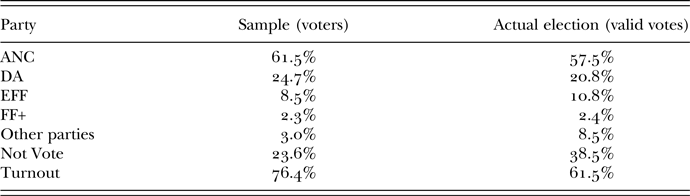
Table IV illustrates the accuracy and external validity of our survey. We acknowledge that our sample is likely plagued by a degree of social desirability bias, with the reported level of turnout well above the actual elections’ figures. However, given that one of our paper's foci is how rather than if or why people voted, we are more concerned with the self-reported results for whom they voted. When looking at these figures, the survey maps onto the reported results quite nicely, an advantage of using the CNEP data for our study.
2019 South African Election Results.

Sources: CNEP (2019) South Africa data, IEC.
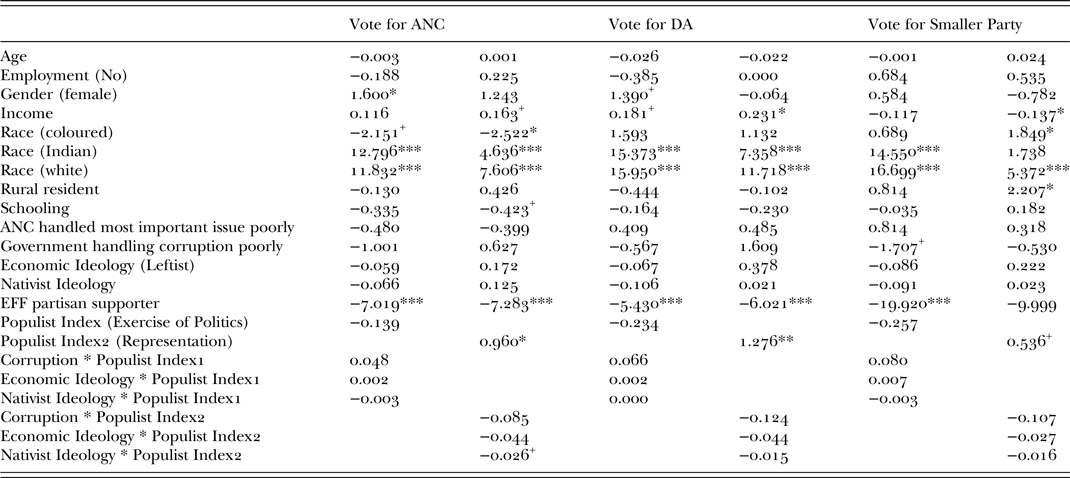
Table V illustrates the multinomial regression results for citizens’ intention to vote for the ANC, the DA and other small parties, relative to voting for the EFF. Given that the EFF has consistently been the most populist party in the political arena, we set it as our reference group in order to examine which factors citizens weighed most strongly when considering a vote for the most populist party. This allows us to best test our third hypothesis. Similar to others, we acknowledge that populist ideas by themselves may not be enough to motivate voters, and that populism is likely to interact with other ideologies that may be context-specific. In our case, the EFF, as their name implies, has a strong orientation towards presenting themselves as the party of economic liberation, advocating for a radical leftist and Marxist programme that favours economic nationalisation and socioeconomic redistribution. We include two questions in our models to capture a leftist economic ideology and interact this variable with our two populist indices.Footnote 9
Multinomial regression results for South Africans’ Voting Behaviour (EFF as reference group).

Note: + p < 0.1, * p < 0.05, ** p < 0.01, *** p < 0.001.
Another element in the populism literature developed in Europe but also applicable to South Africa is a nativist ideology. Populism draws on a feeling of relative deprivation felt among people who sense they are being left behind (both economically and culturally) in a rapidly changing society. Nativist populism harnesses this sense of relative deprivation to exclude others from ‘the demos’ or to scapegoat outsiders such as immigrants for the negative experiences of deprivation (Wodak Reference Wodak2015; Bergmann Reference Bergmann2020). Nativist populism therefore defines ‘the people’ in a much narrower sense than nationalism or populism and can be understood as a ‘xenophobic version of nationalism according to which the state should be inhabited only by members of the native group, and non-native (alien) people are perceived as threatening to the Nation-State’ (Mudde & Rovira Kaltwasser 2013: 168). This rhetoric instils a politics of fear among voters which creates electoral demand for populist parties with strong ethnic exclusion and anti-immigration policies. In South Africa, some leaders in the EFF have narrowly defined ‘the people’ as indigenous Africans, to the exclusion of both white and Indian citizens, and foreign nationals from other African countries.Footnote 10
Testing the activation thesis, we include a variable for citizens’ perceptions that the government is handling corruption poorly. During the Jacob Zuma days, corruption dominated the political agenda for the entirety of his time in office, with several official commissions releasing damning findings. The concept of ‘state capture’ entered the South African lexicon, and the EFF expertly crafted its electoral message around this issue.Footnote 11 We also run interactions between our corruption variable and our two populist indices. We test whether the EFF was viewed as a viable and credible party that could govern the country, a potentially electorally hamstringing consideration. It may be that voters like the EFF's political theatrics and spectacles but do not see them as a feasible electoral alternative. Lastly, to consider to what degree the EFF's populist messaging during the campaign mattered relative to someone already with an affiliation to the party, we include a dummy variable for (EFF) partisan affiliation.Footnote 12
Three major patterns are apparent from the results in Table V. First, our findings illustrate that, across voting options, populist attitudes do not seem to offer much explanatory power in accounting for South Africans’ voting decisions in the 2019 election. As expected, the EFF is the more likely option for voters who prefer a more confrontational and uncompromising style of politics, although none of these associations come close to statistical significance. Quite surprisingly, voters with stronger representative populist attitudes were less likely to support the EFF, relative to the ANC, DA and smaller parties. The former two correlations were both significant at the 0.05 level (0.01 for the DA), with the latter at the 0.1 threshold. More in line with what we had expected, we find that when these attitudinal indices were interacted with corruption, economic ideology and a nativist predisposition, voters were more likely to support the EFF, relative to all other options. However, none of these interactions is significant, and when all evidence is considered we find hardly any evidence to support that voters with strong populist attitudes were more likely to support the EFF on election day.
Second, the EFF continues to struggle to make electoral inroads with female voters. Given that females hold stronger populist attitudes than their male compatriots, this remains a challenge that the EFF has yet to overcome. Third, the EFF's voter bloc continues to be heavily structured along racial lines, with Indian and white voters completely rejecting the party. A surprising finding is that coloured voters were more likely to vote for the EFF than the ANC, when partisan identity was included in the model. This result may illustrate an ability of the EFF to tap into populist attitudes and frustration with the ruling ANC among the coloured community, and it may also reflect the more ‘autonomous’ voting behaviour among this racial group who lack a strong partisan affiliation with the DA (Harris Reference Harris2022).
Failure to launch
Our major conclusion above is that the EFF was unsuccessful in its activation of populist attitudes during the 2019 election. Below we put forth three reasons why and include additional empirical evidence to support our conclusions. First, the EFF appears to be hindered by a lack of credibility in governance. Survey respondents who strongly felt that the ANC has governed poorly on the most important issue and in its handling of corruption did not see the EFF as a much better or clear alternative, compared with the DA and smaller parties. Most damning to the opposition, but especially to the EFF, is the fact that black South Africans still view the ANC as the party most able to improve their lot in life and best deal with unemployment, crime and corruption (Nyenhuis & Krönke Reference Nyenhuis and Krönke2019: 115).Footnote 13 In a country beset by distressing levels of inequality and poverty, South African voters still seem largely motivated by their impressions of which party will deliver results in governance.
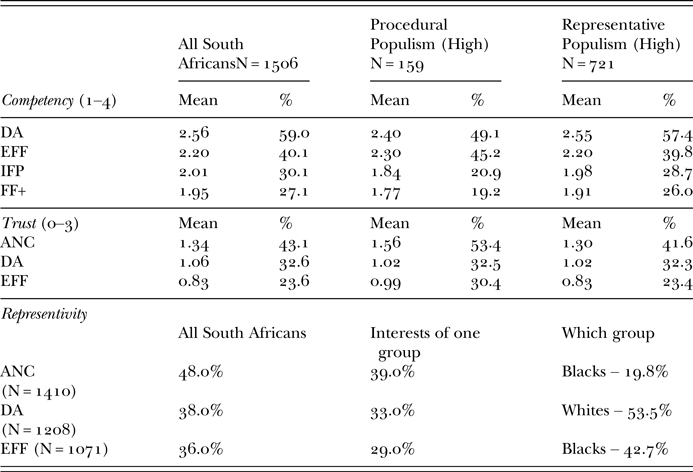
Table VI illustrates citizens’ perceptions of parties’ credibility to govern and the degree to which respondents trust the major parties. When asked about each opposition party's ability to govern well, if elected, the EFF scores considerably lower than the DA among all South Africans. These differences hold when considering survey respondents with the strongest populist attitudes, especially among those with strong representative populist beliefs. This suggests that the EFF has not convinced the most populist citizens that it could deliver in government or provide the democratic representation that they believe is sorely lacking in South African politics. At a minimum, these citizens may appreciate the EFF's rhetorical bluster, but they do not see them as a credible choice to solve the most pressing issues the country faces.
South Africans’ Evaluations of Political Parties.

Weighted data from the 2019 Comparative National Elections Project (CNEP), South Africa. For competency, respondents were asked how they think the party would govern. The percentages equal the sum of those who think the party would be either good or very good in governing, if elected. The variable ranges from 1 (very poor) to 4 (very good). For trust, respondents were asked to what degree they trust each party. The variable ranges from 0 (not at all) to 3 (a great deal). The percentages equal the sum for those who answered quite a lot and a great deal. For representivity, participants answered whether they thought each party represents all South Africans or the interests of one group only. If a respondent answered only one group, they were further asked an open-ended question of which group. The authors calculated the percentages of answers that included racial groups, the modal answer for each party.
Relatedly, and perhaps even more damning for the EFF, Table VI also illustrates that the EFF faces a crisis of trust among citizens. In general, political parties in South Africa struggle with high levels of citizen disdain and mistrust. Compared with both the ANC and the DA, the EFF suffers from a major ‘trust gap’ in survey respondents’ attitudes. Although the EFF does better among citizens who desire a more confrontational and uncompromising approach to politics, it still trails the other two parties among survey participants who hold the strongest populist attitudes. Given that one would expect the most fervent populists would strongly mistrust the long-ruling ANC, the EFF has yet to build a degree of trust among the most sceptical.
The second conclusion we can draw is that the EFF continues to confine itself to a voter base that is almost exclusively comprised of black South Africans. Across all voting options, the EFF fares extremely poorly among coloured, Indian, and white South Africans. Although black South Africans represent a vast majority of the electorate, the EFF's racially exclusive populism has ensured that it is not seen as a viable option for racial minorities. Malema has, in Müller's (Reference Müller2016: 21) words, claimed to ‘truly represent only some part of the people, who are “really the people”’. Malema claims himself to be the sole representative of all black, marginalised citizens. Like other parties in Bolivia and Ecuador, this exclusionary populism along racial and ethnic lines does not seem to be a viable electoral strategy in South Africa (Madrid Reference Madrid2008). Part of the ANC's continued electoral success emanates from its emphasis on political non-racialism, and its ability to effectively depict itself as a large party that represents voters of all races (Ferree Reference Ferree2010). The forging of cross-racial alliances is almost entirely missing from the EFF's repertoire and may limit its future electoral growth.
Table VI also offers evidence about the EFF's racial exclusivity. When asked about whether each party represents all South Africans or only a specific group's interests, the EFF scores far worse than the ANC and slightly worse than the DA on portraying itself as a party for all members of society. However, a closer examination of who respondents believe each party represents illustrates that citizens tend to see the EFF as a party that largely serves the interests of only black South Africans. This perception is nearly as strong as the percentage of citizens who view the DA as a white party, an image that the party has struggled to shake for over two decades, and which has cost it dearly at the ballot box (Schulz-Herzenberg Reference Schulz-Herzenberg, Southall and Daniel2009; Ferree Reference Ferree2010; Habib & Schulz-Herzenberg Reference Habib and Schulz-Herzenberg2011). When compared with the ANC, a significantly greater percentage view the EFF as racially exclusive, suggesting the reputational benefits derived from the incumbent party's politically adroit messaging and the concern that much of the electorate holds when considering the EFF as a feasible electoral choice.
Finally, another answer to why the EFF was unable to electorally mobilise populist attitudes of the South African voter may point to the effective damage control the ANC engaged in before and during the campaign. The removal of Jacob Zuma as ANC president in February 2018 and his replacement by Cyril Ramaphosa likely softened many of the attacks the EFF lodged against the ruling party (Butler Reference Butler, Schulz-Herzenberg and Southall2019). The ‘Ramaphoria’ that accompanied Zuma's removal probably gifted the ANC some electoral breathing room but also illustrated to long-time supporters that the party could change and reform itself (Nyenhuis Reference Nyenhuis2020).
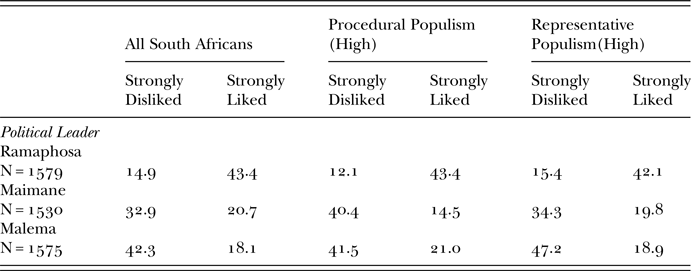
Among citizens with the strongest populist attitudes there was also a clear divide between their perceptions of Cyril Ramaphosa and Julius Malema (also Maimane). With Malema at the helm, it seemed that the face of the party presented a choice incongruent with most South Africans’ electoral desires. Table VII demonstrates survey respondents’ personal assessments of each major party leader. The ‘likability gap’ between Ramaphosa and Malema was quite stark: roughly three times as many South Africans strongly disliked the latter in comparison with the former, and more than double the number of respondents strongly liked Ramaphosa compared with Malema. This relationship held, and even strengthened, when examining the attitudes of those respondents who hold the strongest populist beliefs. One would think, at a minimum, that the gap would narrow. However, the replacement of Zuma with Ramaphosa, in hindsight, was a political masterstroke by the ANC. Most concerning for the EFF's electoral prospects in 2019 and the future is the lack of Malema to present himself as a likable leader and his party as both a credible governing option and a party that citizens can trust.
South Africans’ Evaluations of Political Party Leaders.

Weighted data from the 2019 Comparative National Elections Project (CNEP), South Africa. Respondents were asked how much, on a scale from 0 to 10, they liked each party's leader. Above, we score 0, 1 and 2 as “strongly disliked” and 8, 9 and 10 as “strongly liked”.
CONCLUSION
Scholarly work on African populism trails other global regions but has progressed over the last few years. Examples of radical parties that seek to mobilise certain segments of the electorate can be found across the continent from its southern tip westward to Senegal and eastward to Uganda. This article examines the electoral results driven by the EFF's radical populism in South Africa. The existing literature focuses entirely on populism's supply, considering ways leaders interact with their followers and examining the effects for party systems and countries’ quality of democracy. We hope to contribute empirically and theoretically to the African but also broader literature on populism. We offer the first micro-level examination of populist attitudes in the continent and consider whether these beliefs were activated by the EFF in the 2019 election.
Within the South African case, the political environment seems fertile for populist electoral success. After two and a half decades of ANC rule, the liberation party that delivered freedom to the country's majority has damaged itself after a series of corruption scandals, festering socioeconomic problems and a general malaise about the country's future. Yet, the ANC seems to continue to be able to draw on a relatively deep reservoir of support, however dwindling the levels may be.Footnote 14 The EFF's radical populist rhetoric and disruptive political spectacles have presented a challenge to the ruling party, especially among its core constituency of poor, marginalised black citizens. However, for all its theatrics and political bluster, South Africans still seem to desire a political party at the helm that they believe can improve their lives. They do not wish to gamble on a more radical populist alternative. As such, an electoral challenge is likely to come from a party or political movement that can position itself as effective governors and that can offer solutions to complex sociopolitical problems that have yet to be resolved after nearly three decades of ANC rule.
The EFF, then, may provide a warning to opposition parties around the world who consider employing populist appeals. Its racialised populism mirrors that of radical right populists of the developed world (Western Europe, North America and Australasia), with an emphasis that ‘the people’ have long been victims of foreign exploitation. The lesson may be that, even in a polarised country in which the group to which it appeals is the racial majority, exclusivist appeals have limited utility. Programmatic offerings seem to outweigh radical populist appeals for voters desperately seeking improvements in their daily lives. As such, results seem to trump rhetoric.
SUPPLEMENTARY MATERIAL
To view supplementary material for this article, please visit https://doi.org/10.1017/S0022278X23000046.