Significant outcomes
-
• Emotion-specific impairments were present despite clinical stability.
-
• An emotion recognition deficit for happy faces emerged when decision-making time was limited.
Limitations
-
• Small sample size.
-
• Affective functioning during different mood states was not investigated.
Introduction
Facial emotion recognition is a key facet of social cognition. Deficits in facial emotion processing are associated with poor day-to-day functioning in individuals with bipolar disorder even during clinical stability (Reference Hoertnagl, Muehlbacher and Biedermann1). Understanding such deficits may have implications for improving treatment programmes and enhancing bipolar disorder patients’ quality of life.
Unfortunately, facial emotion-processing deficits in bipolar disorder are not well understood. Whether bipolar patients have difficulty recognising facial emotions, suggesting a specific emotion recognition deficit, or more broad facial features, suggesting a more general cognitive deficit, is inconclusive. Findings have supported both possibilities (Reference Addington and Addington2–Reference Getz, Shear and Strakowski4). In addition, it is unclear whether bipolar patients have difficulty identifying particular emotions. Individual studies have identified impairments in particular emotions, most notably negative emotions such as fear, disgust, and sadness (Reference Martino, Strejilevich, Fassi, Marengo and Igoa5,Reference Lembke and Keter6); however, others argue that evidence of impairment in particular emotions is insufficient (Reference Kohler, Hoffman, Eastman, Healey and Moberg7,Reference Samame, Martino and Strejilevich8). Furthermore, slow processing speed has been implicated in poor facial recognition accuracy in bipolar patients, but the impact of processing speed on the recognition of particular emotions has not been extensively examined (Reference Kieseppa, Tuulio-Henriksson and Haukka9). In summary, further investigation is warranted to better understand facial emotion-processing deficits in bipolar disorder.
This study had three objectives: (1) to determine whether facial emotion recognition is a specific deficit in bipolar patients, (2) to determine whether recognition of certain facial emotions is particularly impaired, and (3) to determine the role of processing speed on facial emotion recognition. Although previous findings are mixed, we hypothesise that (1) facial emotion recognition is a specific deficit not attributable to general cognitive dysfunction, (2) patients will be particularly impaired when identifying negative emotions, and (3) a quicker stimulus presentation and limited response window will be associated with poorer facial emotion recognition accuracy.
Methods
Participants
Seventeen clinically stable patients with bipolar I disorder were recruited from outpatient clinics at the Minneapolis VA Medical Centre and from community support programmes. Fifty controls were recruited from the community. Exclusion criteria were: non-native English speaker, younger than 18, older than 60, mental retardation, current alcohol or drug abuse/dependence, current or past central nervous system condition, past head injury with skull fracture or loss of consciousness over 30 min, and previous electroconvulsive therapy. Controls were additionally excluded if they had a personal or family history of psychosis or bipolar disorder or had ever taken antipsychotics.
Diagnostic interviews were conducted by trained research assistants, graduate students, or PhD-level clinical psychologists. DSM-IV diagnoses were based on a review of medical records and structured interview data (Reference First, Spitzer, Gibbon and Williams10,Reference Nurnberger, Blehar and Kaufmann11). Mood and psychiatric functioning were assessed with the 24-item expanded Brief Psychiatric Rating Scale (BPRS) (Reference Ventura, Lukoff, Nuechterlein, Liberman, Green and Shaner12) using the five factors described by Burger et al.: thinking disorder, withdrawal, anxiety–depression, hostility, and activity (Reference Burger, Calsyn, Morse, Klinkenberg and Trusty13). Cognitive ability was measured with the Wechsler Adult Intelligence Scale – Third Edition (WAIS-III) (Reference Wechsler14). The study's protocol was approved by the Minneapolis VA Medical Centre and the University of Minnesota Institution Review Boards.
Facial recognition task
The facial recognition task was designed after Schneider et al. (Reference Schneider, Gur and Koch15). This task is both simple and engaging for participants, and is thus easy to conduct and appropriate for a psychiatric population. Furthermore, this particular task has been used successfully to reveal a specific deficit in emotion processing in schizophrenia patients (Reference Schneider, Gur and Koch15,Reference Goghari, Macdonald and Sponheim16). Four emotion blocks were presented (anger, fear, happy, and sad). In each emotion block, participants saw different facial expressions (anger, fear, happy, sad, and neutral) and indicated whether each expression was the target emotion for that block. For example, in the happy block, participants saw facial expressions and indicated whether the emotion expressed was happy or not happy. Each block contained 16 faces of the target emotion (e.g. happy), 16 faces of the remaining three non-target emotions, and 28 neutral faces. Target emotion blocks and the order of facial emotions presented within each block were randomised. In an age recognition experimental control condition, participants viewed emotional faces and identified whether each face was above or below 30 years old. This block contained 60 faces: 24 faces below 30 years and 36 faces above 30 years – 32 showed an emotion and 28 showed a neutral expression. Faces equally represented male and female genders and included four races (58–67% Caucasian, 20–28% African American, 3–7% Asian, and 7–12% Hispanic).
Two different stimulus presentation and response windows were used. In the time-limited condition, each face was displayed for 3 s, and then automatically advanced to the next face – participants had to respond within the 3 s. In the time-unlimited condition, the face was displayed until the participant responded.
Analyses
Chi-square and t-tests were used to analyse demographic characteristics. Mixed-model analysis of covariance (ANCOVA), with gender as a covariate, was used to compare accuracy among groups (bipolar, control), facial conditions (emotion, age), and presentation types (time-limited, time-unlimited). Planned individual one-way ANCOVAs, with gender as a covariate, were performed within each presentation type to identify group differences in accuracy in each specific emotion block (anger, fear, happy, and sad), and the age block. Multivariate analysis of covariance (MANCOVA) was performed to investigate misattributions of emotions between groups within blocks that showed significant differences. Pillai's trace test statistic was reported for the MANCOVA. Correlations were conducted to identify associations among psychiatric symptoms and response accuracy in conditions revealing significant effects. Where data violated assumptions of normality and homogeneity of variance, significant findings were confirmed using a log transformation and non-parametric analyses. All between-group analyses were also performed in the male-only sample to address the potential confound of unequal gender representation across bipolar and control samples. Response time analyses are available in supplementary material.
Results
Participants
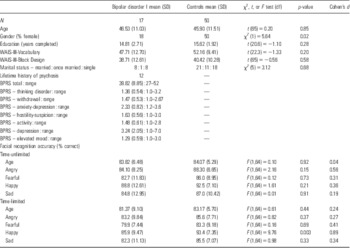
Participant characteristics are presented in Table 1. There were more men in the bipolar group (82%) relative to the control group (50%). All patients were outpatients and generally stable [as confirmed by BPRS ratings (Reference Ventura, Lukoff, Nuechterlein, Liberman, Green and Shaner12,Reference Burger, Calsyn, Morse, Klinkenberg and Trusty13)] at the time of the study. Elevated and depressed mood ratings on the BPRS were also examined specifically: 10 bipolar patients reported mild or less than mild depressed mood, four patients reported moderately depressed mood, and three patients reported severely depressed mood (overall mean = 3.24, SD = 2.05). Most patients (n = 13) reported no mood elevation, and the remaining four patients reported mildly or very mildly elevated mood (overall mean = 1.29, SD = 0.59). Twelve patients endorsed a lifetime history of psychosis (defined as having the presence of a hallucination or delusion other than grandiosity). In the patient sample, mean duration of illness was 23.82 years (SD = 9.03). All but two patients were medicated: eight patients were on antipsychotic medication and 13 were on mood stabilisers (of these patients, six were on both medications). Patients and controls did not differ in cognitive ability, education, age, or marital status. Participants were primarily of European background (84%).
Facial emotion recognition
The mixed-model ANCOVA comparing accuracy by group, facial condition, and presentation type did not reveal significant main effects (F's(1,64) = 0.67–1.87, p's = 0.18–0.42, d's = 0.20–0.35). Analyses in the male-only sample also failed to reveal a significant main effect of group, facial condition, or presentation type (F's(1,37) = 1.07–3.45, p's = 0.07–0.31, d's = 0.35–0.63). In the full sample, a significant interaction was identified between facial condition and the gender covariate (F(1,64) = 5.60, p = 0.02). Follow-up univariate ANOVAs (Bonferroni-adjusted α: 0.0125) revealed that men were less accurate than women in both the time-limited and time-unlimited emotion conditions (F's(1,65) = 9.10–10.53, p's = 0.002–0.004). No significant differences in accuracy were found between men and women in either the time-limited or time-unlimited age conditions (F's(1,65) = 0.04–0.49, p's = 0.48–0.84). No significant two-way interactions were identified between presentation type and group, facial recognition condition and group, or presentation type and facial recognition condition (F's(1,64) =0.01–1.00, p's = 0.32–0.91). The three-way interaction among presentation type, recognition condition, and group was not significant (F(1,65) = 2.22, p = 0.14).
To test the second and third hypotheses (that the recognition of certain facial emotions is particularly impaired, and that processing speed plays a role in emotion recognition), a priori ANCOVAs were performed, with gender as a covariate, within each presentation type (i.e. time-limited and time-unlimited) for the age block and each emotion block (Bonferonni-adjusted α: 0.01; see Table 1). Within the time-unlimited condition, patients and controls did not significantly differ in the age block (F(1,64) = 0.10, p = 0.92) or any of the emotion blocks (F's(1,64) = 0.01–2.16, p's = 0.15–0.91). In the time-limited condition, patients were not significantly impaired in the age block (F(1,64) = 0.61, p = 0.44) or in the angry, fearful, or sad blocks (F's(1,64) = 0.16–0.98, p's = 0.33–0.69), but were less accurate than controls in the happy block (e.g. when responding whether a presented face was happy or not happy; F(1,64) = 9.76, p = 0.003). When only men were considered, patients’ impairment in the happy block neared significance (F(1,37) = 3.80, p = 0.06).
Participant characteristics and facial recognition task accuracy

BPRS, Brief Psychiatric Rating Scale; 24 items, total scores can range from 24 to 168.
Data were missing from one patient and five controls for years of education. WAIS-III, Wechsler Adult Intelligence Scale-Third Edition, raw scores reported.
To ensure the finding in the full sample was not due to violations of ANOVA assumptions, a log 10 transformation was applied; the patient group remained less accurate than the control group, F(1,64) = 14.17, p < 0.001. To ensure our result was not because of unequal sample sizes, a Wilcoxon signed-rank test indicated that the mean rank of patient scores was lower than that of the healthy controls (U = 165.50, Z = −3.77, p < 0.01).
Given the lower accuracy in the time-limited happy block, a MANCOVA, with gender as a covariate, was performed to identify which emotions patients had difficulty differentiating from happy. A significant multivariate main effect for group neared significance (Pillai's Trace = 0.16, F(5,60) = 2.31, p = 0.056). Follow-up univariate ANCOVAs revealed that patients were less accurate than controls in differentiating neutral faces from happy faces (patients M = 80.9%, SD = 30.29, controls M = 91.2%, SD = 17.19; F(1,65) = 5.56, p = 0.02), but were not significantly impaired in differentiating angry, fearful, or sad faces from happy faces (F's(1,65) = 0.79–3.57, p's = 0.06–0.38). When the male-only sample was considered, the MANOVA failed to reveal a multivariate main effect for group (F(5,33) = 1.09, p = 0.38) and the univariate ANOVAs did not reveal group differences in differentiating angry, fearful, neutral, or sad faces from happy faces (F's(1,37) = 0.16–2.21, p's = 0.15–0.69).
Correlations between BPRS factors [thinking disorder, withdrawal, anxiety–depression, hostility, and activity (Reference Burger, Calsyn, Morse, Klinkenberg and Trusty13)] and accuracy on the happy time-limited condition did not reveal any significant associations (r's = 0.004–0.40, p's = 0.11–0.99). Given the variability in depression scores, we correlated the depression score with accuracy on the happy time-limited condition, which was not significant (r = 0.23, p = 0.27). Recognition accuracy in the happy time-limited condition was not influenced by a lifetime history of psychosis (F(1,15) = 1.0, p = 0.33).
Discussion
This study investigated whether bipolar patients have an emotion-specific impairment, especially for particular emotions, and whether that impairment is influenced by processing speed. To investigate whether facial recognition represents a specific deficit, or a more general cognitive deficit in bipolar patients, we explored patients’ ability to recognise emotional versus non-emotional facial features (i.e. face recognition) and patients’ ability to differentiate one emotion from another (i.e., facial emotion recognition). A deficit is considered specific if the recognition difficulty is significantly greater with facial emotions than with overall facial recognition; conversely, a deficit is defined as general if patients have difficulty in recognising both facial emotions and facial features (Reference Pomarol-Clotet, Hynes, Ashwin, Bullmore, Mckenna and Laws17). There were no general significant effects of facial condition, stimulus presentation and response window, or group in this sample. Although this may suggest that an emotion-specific deficit was not generally present, when stimulus presentation and response window were limited, patients were particularly impaired in recognising happy facial expressions. When stimulus presentation and response window were unlimited, patients and controls did not significantly differ in emotion recognition accuracy. These findings suggest that an emotion recognition deficit for happy faces emerges when response time is limited, a recognition deficit not present for age recognition or other emotions.
Our findings are both consistent with, and add to, previous research. It has been noted previously that clinically stable bipolar disorder patients may be impaired in recognising happy faces (Reference Hoertnagl, Muehlbacher and Biedermann1), although a time constraint was not included in that investigation. In a study where time was investigated, manic patients demonstrated a deficit in labelling facial emotions when presented quickly (Reference Getz, Shear and Strakowski4), although clinically stable patients were not investigated. The present study adds to this literature by including a time constraint with clinically stable bipolar patients.
In contrast to our hypothesis and some previous research suggesting that recognising negative emotions is particularly impaired in bipolar disorder (Reference Getz, Shear and Strakowski4–Reference Lembke and Keter6), we found that patients had difficulty recognising happy faces and particularly differentiating neutral from happy faces. However, our participants identified whether a face was a particular emotion, or not a particular emotion (e.g. angry or not angry), whereas other investigations asked participants to identify which, of a group of possible emotions, were applied to a given face (Reference Getz, Shear and Strakowski4–Reference Lembke and Keter6). Narrowing the response possibilities to a binary forced choice might allow for more precision in identifying negative emotions, an effect that may not apply to positive emotions. Conversely, a task that requires the participant to label an emotion from multiple choices may be more difficult than a forced choice task, leading to different accuracy in identifying negative facial expressions.
Our finding that recognition of positive emotions is impaired in bipolar disorder is consistent with Gray et al.'s (Reference Gray, Venn and Montagne18) examination of facial emotion recognition accuracy and sensitivity in 14 depressed and nine manic bipolar outpatients. The depressed group had more difficulty identifying facial expressions as happy, compared with the manic or control groups (Reference Gray, Venn and Montagne18). Although Gray and colleagues did not examine a clinically stable group, our study results suggest that such a group would also show difficulty identifying happy facial expressions.
The identification of a time-related deficit points to the potential contribution of processing speed in facial emotion recognition abilities for bipolar patients. A study comparing bipolar I patients, healthy twins, and unrelated healthy controls identified processing speed as a significant factor in memory-related facial recognition tasks (Reference Kieseppa, Tuulio-Henriksson and Haukka9). Furthermore, in an investigation of manic bipolar patients and healthy controls, speed of response was slower in the patient sample (Reference Getz, Shear and Strakowski4). Constrained processing speed may similarly impact recognition of particular emotions in clinically stable bipolar patients. Indeed, in our sample, patients responded to stimuli more slowly than healthy controls. Future investigations should include measures of processing speed as a potential variable affecting facial emotion recognition in clinically stable bipolar patients. Taken together, further investigation of recognition accuracy in a wider range of positive emotions is warranted, especially under different processing speed conditions (e.g. stimuli presentations and response windows).
Deficits in the ability to accurately identify others’ facial emotions are associated with more negative emotions, less satisfying social relationships, and overall poorer quality of life (Reference Hoertnagl, Muehlbacher and Biedermann1). Such deficits in recognising and therefore responding appropriately to others’ facial emotions contribute to difficulties in social interaction important in obtaining and maintaining employment and functioning well within society (Reference Kee, Green, Mintz and Brekke19). For example, a consistent inability to detect positive feedback from others’ (e.g. a happy facial expression) can contribute to lower mood and overall psychosocial dysfunction. Thus, identifying deficits in facial emotion recognition in bipolar disorder is important, given the known associations between deficits and poor day-to-day functioning (Reference Hoertnagl, Muehlbacher and Biedermann1). Considering that facial expressions in real-life situations are often presented briefly, the discovery that happy emotions may be more difficult for bipolar patients to detect under-time constraints may be useful in interventions aimed at improving social cognition.
The present study could be strengthened by a larger sample of patients. In addition, a larger patient sample would allow a clearer determination of the effects of gender on facial emotion recognition, as the present results may appear to be influenced by the patient group being predominantly male. However, we performed the analyses with gender as a covariate, and in the male-only sample. These analyses revealed very similar effects, suggesting that the gender discrepancy was not accounting for the finding in the time-limited happy recognition condition. Finally, it would be useful to investigate affective functioning during the different mood states to more wholly understand the impact of bipolar disorder on emotion recognition.
In summary, our results add to existing evidence that facial emotion recognition deficits are present in bipolar disorder, and more notably, that emotion recognition ability is impacted by processing speed. These findings also suggest that identification of positive emotions may be impaired in clinically stable bipolar patients, especially with limited time to make a judgement, warranting further research in this area.
Acknowledgements
The authors thank Angus MacDonald, Mallory Skorheim, Olivia Darrah, Stephen Duquette, Anna Docherty, and Danielle Potokar for their help with study implementation.
Author's Contributions
S.R.S. and V.M.G. were responsible for conception and data collection. Data were analysed and interpreted by L.L.S. The manuscript was written by L.L.S., with critical reviews and revisions provided by S.R.S. and V.M.G. All authors reviewed and approved the submitted manuscript.
Financial Support
This work was supported by a Canadian Institutes of Health Research Frederick Banting and Charles Best Canada Graduate Scholarship, the University of Calgary Department of Psychology Graduate Student Scholarship, and an Alberta-Innovates Health Solutions Studentship to L.L.S.; a Thesis Research Grant from the University of Minnesota, PGS Doctoral Award from the Natural Sciences and Engineering Research Council of Canada, Canadian Institutes of Health Research Operating and New Investigator Award, and the University of Calgary Start-up Grant to V.M.G.; and by grants from the Clinical Science Merit Review Program Grant of the Department of Veterans Affairs and the National Institutes of Mental Health (R24 MH069675) to S.R.S.
Conflicts of Interest
None.
Ethical Standards
The authors assert that all procedures contributing to this work comply with the ethical standards of the relevant national and institutional committees on human experimentation and with the Helsinki Declaration of 1975, as revised in 2008.