Implications
Post-weaning intake limitation strategies are now frequently employed in French rabbit breeding systems to reduce the incidence of post-weaning digestive troubles and improve the feed efficiency. Several studies were published recently to analyse the different effects of feed restriction on the growth, digestive physiology and health of the young rabbit. Thus, the present original review aims to summarise the results obtained on digestive function, health, growth and carcass characteristics, but also on feeding behaviour and welfare, in the growing rabbit submitted to different intake limitation strategies, without changes in feed quality.
Introduction
For the young mammal, the weaning and post-weaning periods are particularly important to establish growth and resistance to digestive disorders that are common in piglets, calves and young rabbits between 5 and 10 weeks of age. For instance, infectious digestive disorders account for a high incidence of mortality after rabbit weaning (Marlier et al., Reference Marlier, Dewree, Delleur, Licois, Lassence, Poulipoulis and Vindevogel2003). They may have a multifactorial origin, with a combination of one or several pathogenic agents (bacteria, coccidian, etc.). Moreover, the European ban on antibiotic growth promoters in animal feeds has complicated weaning management. The situation of the young rabbit was most critical, as the first outbreaks in 1997 of the epizootic rabbit enteropathy (ERE) led to high morbidity and mortality rates (up to 70%). Although preventive medication with antibiotics (given under veterinary prescription) helps to control ERE and other previous digestive diseases (e.g. enteropathogenic Escherichia coli, EPEC), there is an urgent need to find alternative solutions to control the disease with a reduced use of drugs. Various solutions, such as the improvement of hygiene, batch breeding and improvement in nutritional and feeding strategies, have been proposed for the growing rabbit in the past 10 years.
Recent reviews outlined the minimal needs of the growing rabbit for different fibre fractions to reduce the risk of digestive troubles, from ERE or EPEC or from non-specific digestive troubles (De Blas et al., Reference De Blas, Garcia and Carabaño1999; Gidenne, Reference Gidenne2003; Carabaño et al., Reference Carabaño, Badiola, Chamorro, García, García-Ruiz, García-Rebollar, Gómez-Conde, Gutiérrez, Nicodemus, Villamide and De Blas2008; Gidenne et al., Reference Gidenne, Garcia, Lebas and Licois2010). Feed intake limitation in the young rabbit was initially studied to analyse the effects on growth and digestive efficiency (Lebas and Delaveau, Reference Lebas and Delaveau1975; Lebas, Reference Lebas1979). However, since 2003, several authors have dealt with the relationship between post-weaning intake level and digestive trouble incidence for the growing rabbit, including studies with experimental infections (either ERE or EPEC) or large-scale studies in the French network of rabbit experimental units.
Post-weaning intake limitation is now widely practised by French rabbit breeders (over 85% of professional breeders; Lebas, Reference Lebas2007), in parallel with the development of new automatic feeding equipment, as beneficial effects have been obtained on resistance to digestive troubles and on feed efficiency.
Various short-term post-weaning restriction strategies have been studied in the rabbit in terms of the duration of the restriction period (1 to 5 weeks), the intensity of the intake limitation (90% to 40% of the voluntary intake) or the method (quantitative feed restriction, water restriction, limited time access to the feeder, etc.). Thus, the present review aims to summarise the results obtained during the past 10 years on digestive function, health, growth and carcass characteristics, and also on feeding behaviour and welfare, in the growing rabbit submitted to different intake limitation strategies, without changes in feed quality.
Limiting feed intake after weaning: different strategies for various aims
Before or after weaning, the young rabbit usually has free access to food and water (ad libitum, AL). Various techniques have been studied to control the feed (or water) intake, with two main aims, including the control of the carcass and meat quality (Perrier and Ouhayoun, Reference Perrier and Ouhayoun1996) and the improvement of the feed efficiency to reduce feeding costs. Two main classes of restriction techniques are used: a quantitative intake limitation and a qualitative restriction. For the latter, nutrient intake is modified through the feed composition. For example, energy intake is frequently reduced by using high-fibre diets for young reproducing females. But here we will deal with quantitative intake limitation without any change in the dietary composition.
A quantitative restriction can be applied in two ways: either the time of access to the feeder or the quantity of feed distributed can be reduced. In addition, this can be done for different periods, such as during growth (e.g. feed restriction after weaning followed by an AL period, or vice versa), or during the production cycle (young females before the first mating). As the growing rabbit takes numerous meals (30 to 40 per day; Prud'hon et al., Reference Prud'hon, Cherubin, Goussopoulos and Carles1975), it is not possible to limit its intake simply by reducing access to the pellets, for example, by reducing the width of the feeder.
The first studies dealing with feed restriction involved observing the level of intake while limiting access to water (Lebas and Delaveau, Reference Lebas and Delaveau1975), with the rabbits being fed a dry feed, such as pelleted feeds. As the pellet intake is directly related to the water consumption, the water restriction has been studied recently to evaluate the effect on digestive health. Feed intake was reduced by 18% when the access to water was reduced to 2 h/day (Boisot et al., Reference Boisot, Duperray, Dugenétais and Guyonvarch2004), by 22% for 1 h 30 min water access (Verdelhan et al., Reference Verdelhan, Bourdillon, Morel-Saives and Audoin2004) and by 23% for 1-h access to water (Boisot et al., Reference Boisot, Duperray and Guyonvarch2005). However, such a severe water restriction is questionable in terms of animal welfare, particularly in hot conditions (Foubert et al., Reference Foubert, Boisot, Duperray and Guyonvarch2007; Ben Rayana et al., Reference Ben Rayana, Ben Amouda and Bergaoui2008). Moreover, an intake reduction obtained through a reduced time of access to the water gave more variable effects on performance and health than a straight feed restriction.
A time-limited access to the feeder, within each day or over the course of a week, is another easy way to restrict the intake. With the latter, it is possible to give 80% of normal intake by distributing the feed during 5 days a week, with none at the weekend (Lebas and Laplace, Reference Lebas and Laplace1982). The same intake level (80% of AL) is obtained with an 8-h daily access to the feeder (Szendrö et al., Reference Szendrö, Szabo and Hullar1988; Jérome et al., Reference Jérome, Mousset, Messager, Deglaire and Marie1998). These two distribution procedures seem to have different effects on the digestive organs’ development: for example, the liver weight was higher in rabbits submitted to an intermittent restriction (5 days out of 7) compared with those continuously restricted with a ration given daily. In addition, for the same restriction level (70% intake), the digestive tract development varied according to the technique used. The entire digestive tract at 67 days of age was 12% heavier (compared with AL) when the feed was given 5 days a week, and 28% heavier when given daily (Lebas and Laplace, Reference Lebas and Laplace1982). As reported by Jérome et al. (Reference Jérome, Mousset, Messager, Deglaire and Marie1998), giving the feed only during the day (0800 to 1800 h) reduced the feed intake by 20% (121 v. 151 g/day for AL), whereas feed access during the night only reduced the intake by 10% and growth by only 5% (v. 12% for day feeding). Feed conversion (FC) was improved only for the day feeding (2.67 v. 2.93 kg/kg gain for AL).
To achieve a correct control of the post-weaning intake, the most precise technique is to give a defined quantity of pelleted feed every day, either manually (such as in experiments) or using automatic feeding equipment (now widespread in French rabbit farms). However, this quantity could be given all at once or as several meals each day. Recent studies showed that giving a ration in 2 meals or even in 13 meals (to simulate the natural feeding behaviour) leads to similar effects in terms of health status improvement or digestion, growth or FC (Gidenne et al., Reference Gidenne, Murr, Travel, Corrent, Foubert, Bebin, Mevel, Rebours and Renouf2009b and Reference Gidenne, Bannelier, Combes and Fortun-Lamothe2009c; Martignon et al., Reference Martignon, Combes and Gidenne2009). Thus, the favourable effect of an intake limitation originates from the feed quantity itself and not from the feed distribution technique.
Furthermore, throughout the fattening period various restriction programs are possible: gradually declining or not, step by step, continuous or alternate restriction periods, etc. The restriction program must thus adapt to the objectives of the breeder: health status improvement, feed costs reduction or even reducing the pellet intake to encourage forage consumption (Yakubu et al., Reference Yakubu, Salako, Ladokun, Adua and Bature2007).
Impact of a post-weaning feed restriction on feeding behaviour and welfare
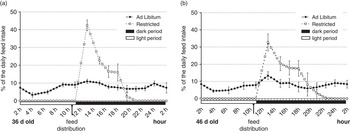
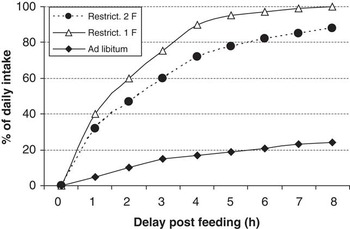
Intake restriction obviously modifies the feeding behaviour, as the total feed intake is completed within 6 to 10 h instead of 24 h (Figure 1). In comparison, rabbits fed freely show relatively regular intake behaviour, with numerous meals, with a maximum of 10% of the daily intake 2 to 4 h after lighting goes off, and a minimal intake 2 to 4 h after lighting comes on, which corresponds to the caecotrophy period (Gidenne and Lebas, Reference Gidenne and Lebas2006). Over the day, the total intake is completed within 8 h for 10-week-old rabbits restricted to 85% of the AL and having one feeder (1F) in their cage (Figure 2; Tudela and Lebas, Reference Tudela and Lebas2006), meaning that the rabbit is starved for 14 h a day. Contrary to what was expected, when the rabbits have two feeders (2F), the competition for feeding is reduced and they eat more slowly, the whole meal being consumed within 12 h instead of 8 h (Tudela and Lebas, Reference Tudela and Lebas2006). Obviously, for higher restriction levels, the duration of the starvation increases, but it also depends on the voluntary intake level of the rabbit. Under a hot climate, for example, Bergaoui et al. (Reference Bergaoui, Kammoun and Ouerdiane2008) reported that the whole meal was consumed within 16 h for an 85% intake level and within 10 h for a 70% intake level.
Feed intake patterns at 36 days (a) and 46 days (b) old, according to the intake level: ad libitum (AL) v. restricted (75% of AL) since weaning at 28 days (Martignon et al., Reference Martignon, Combes and Gidenne2009).

Intake pattern for ad-libitum (AL) and restricted (85% of AL) rabbits (10 weeks old). Restrict. 1 F v. 2 F: feed was given in one time. Restrict. 2 F: feed was given in two times (feed withdrawal from 1100 to 1600 h)

As shown in Figure 1, the rabbit adapts very quickly to a restriction strategy, with a very high intake just after feed distribution that reached 40% of the AL daily intake (within 2 h) only 8 days after the application of the intake restriction, and decreased to 32% 10 days later (Martignon et al., Reference Martignon, Combes and Gidenne2009). Obviously, restricted (R) rabbits showed strong feeding activity during the first hour following feed presentation, with an average of four out of six rabbits eating (Martignon, Reference Martignon2010). Conversely, AL rabbits ate throughout the day, with two main feeding periods, one in the first hour of the dark period (1.7 out of 6 rabbits eating) and another 2 h before the start of the light period (2 out of 6 rabbits). Although the feeder was empty, the R rabbits continued to visit the feeder until the next feed supply. The number of meals and the total time spent eating during a 24-h period were distinctly less for R rabbits than for AL ones: n = 27 for 2 h 30 min, and n = 41 for 3 h 17 min, respectively.
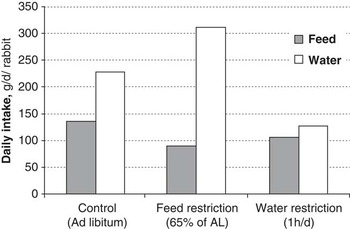
Simultaneously, the number of drinks was also reduced, being 38 and 47 per day for R and AL rabbits, respectively (Martignon, Reference Martignon2010), although the quantity of water consumed was higher for R rabbits. As reported by Boisot et al. (Reference Boisot, Duperray and Guyonvarch2005), the ratio of water to feed is doubled for rabbits restricted to 65% of AL, from 1.68 to 3.46 (Figure 3). These authors also reported that a similar 35% reduction in feed intake could be obtained with a 1-h access to the drinker, and then the ratio water/feed decreased to 1.20. Such a water restriction strategy, used for experimentation, is not encouraged in field conditions, as it is questionable as regards animal welfare and does not fit with the regulations in many countries.
Water and solid feed intake for restricted growing rabbits, either through a reduced quantity of pellets, or through a reduced time of access to water (Boisot et al., Reference Boisot, Duperray and Guyonvarch2005).

Once R rabbits are fed freely, their circadian eating and drinking activity is higher than that of control animals (number of meals per day = 48 for R v. 38 for AL; total meal duration = 4 h 17 min v. 2 h 32 min, respectively; number of drinks per day = 40 for R v. 36 for AL), and they adapt very quickly (within 2 or 3 days) to a classical feeding behaviour, that is, fairly regular over 24 h (Martignon, Reference Martignon2010). Faced with these abrupt changes in feeding behaviour, the faecal excretion pattern, including caecotrophy, is greatly modified, as shown in Figure 4. For R rabbits, the faecal excretion peak occurred between 5 and 8 h after feed was given, or about 3 to 4 h later than the eating peak. The caecotrophy period is thus relocated to about 8 to 10 h after feed distribution, as already observed by Fioramonti and Ruckebusch (Reference Fioramonti and Ruckebusch1974) in adult rabbits fed once a day. However, the ratio of soft to hard faeces seemed to be unaltered (Martignon, Reference Martignon2010). As for R rabbits the competition to reach the feeder is high during the first hour after feed distribution, we expect some hostile or even aggressive behaviour. In fact, Martignon (Reference Martignon2010) did not observe any increase in aggressiveness or lesions in R rabbits.
Faecal excretion pattern (47 days old), according to the intake level: ad libitum (AL) v. restricted (75% of AL) after weaning at 28 days.

Consequently, applying a short-term restriction strategy will not completely follow one of the five rules of the Farm Animal Welfare Council (http://www.fawc.org.uk/freedoms.htm): Freedom from Hunger and Thirst. However, considering a 24-h period, the rabbit expressed a transitory hunger (and not thirst, except for a strategy limiting the access to drinker), and its growth is not greatly impaired for a moderate restriction (under 70% of AL). On the other hand, a limited intake strategy will support the third rule ‘Freedom from Pain, Injury or Disease’, as many studies report an improvement in digestive health of the young rabbit (see the following section).
Impact of a post-weaning feed restriction on growth, FC, organ development and carcass characteristics
Weight gain and FC as affected by intake
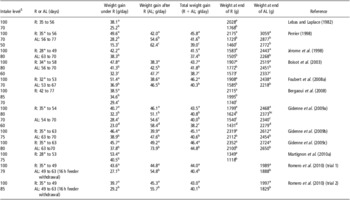
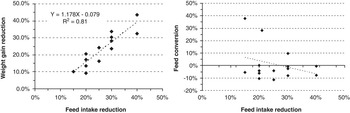
Obviously, an intake reduction leads to a growth reduction during the period of intake restriction (Table 1). This is supported by the results of Gidenne et al. (Reference Gidenne, Combes, Feugier, Jehl, Arveux, Boisot, Briens, Corrent, Fortune, Montessuy and Verdelhan2009a, Reference Gidenne, Murr, Travel, Corrent, Foubert, Bebin, Mevel, Rebours and Renouf2009b, Reference Gidenne, Bannelier, Combes and Fortun-Lamothe2009c and Reference Gidenne, Travel, Murr, Oliveira, Corrent, Foubert, Bebin, Mevel, Rebours, Renouf and Gigaud2009d) obtained from a multisite study (six sites, about 2000 rabbits per treatment) who found a gradual (linear) reduction in the quantity of feed offered to the rabbits over the 3 weeks following weaning (35 days). This led to a proportional linear reduction in growth: for example, when the intake was reduced by 20% of AL (i.e. intake level = 80% of AL) the weight gain was also reduced by 20%. However, this apparently ‘logical’ proportional relationship does not seem to be generalised, as the growth reduction obtained in several studies varied substantially according to several factors, such as the feed composition or health status. As shown in Figure 5 (based on a literature compilation), the growth reduction is usually less than the intake reduction during the post-weaning restriction period, and for a 20% intake reduction the mean growth reduction is 15.6%. For example, at the end of the restriction period the live weight is reduced by 7% to 10% for restriction levels of 15% to 25% (Table 1; Boisot et al., Reference Boisot, Licois and Gidenne2003; Bergaoui et al., Reference Bergaoui, Kammoun and Ouerdiane2008; Gidenne et al., Reference Gidenne, Combes, Feugier, Jehl, Arveux, Boisot, Briens, Corrent, Fortune, Montessuy and Verdelhan2009a and Reference Gidenne, Murr, Travel, Corrent, Foubert, Bebin, Mevel, Rebours and Renouf2009b). In addition, the effect of an intake limitation on weight gain is generally more severe at the beginning of the restriction period (often just after weaning) than later (Gidenne et al., Reference Gidenne, Bannelier, Combes and Fortun-Lamothe2009c; Martignon et al., Reference Martignon, Combes and Gidenne2010a). Moreover, the growth reduction also seemed highest for a high digestible energy (DE) concentration in the feed (Duperray and Gyonvarch, Reference Boisot, Duperray, Dugenétais and Guyonvarch2009; Gidenne et al., Reference Gidenne, Bannelier, Combes and Fortun-Lamothe2009c).
Post-weaning quantitative£ reduction of the feed intake and growth of the rabbit

R = restriction period; AL = ad-libitum period.
a,b,c,d Significant difference between AL and R, within the same study.
£ The limitation of intake is obtained by a daily manual distribution of a defined quantity of pellets.
$ As percent of the voluntary intake (100% = AL).
* Age at weaning.
Growth and feed conversion reduction according to the intake reduction, during the post-weaning restriction phase of the growing rabbit (literature compilation: one point = one study). Data from Table 1, for a usual restriction range of 0% to 40%.

Another interesting point is that the intra-cage variability of individual live weight is not affected by the restriction strategy (Tudela and Lebas, Reference Tudela and Lebas2006). In the same cage, heavy rabbits did not over-eat compared with lighter ones, probably because the daily feeding behaviour of the rabbit is to eat numerous meals (30 to 40 per 24 h; Gidenne and Lebas, Reference Gidenne and Lebas2006). This confirms that the growing rabbit adapts very well to an intake limitation strategy, as shown already for the feeding behaviour (see section ‘Impact of a post-weaning feed restriction on feeding behaviour and welfare’).
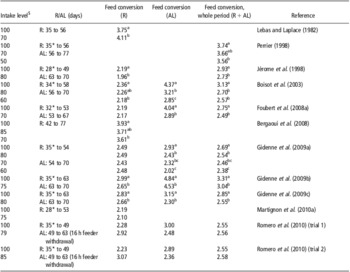
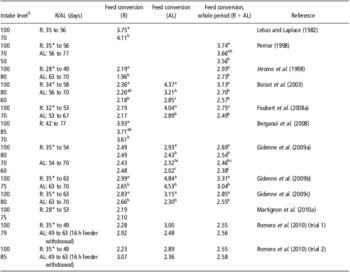
During the restriction period, the FC is generally slightly reduced (5% to 10%) for R rabbits compared with AL ones (Figure 5), with relatively large variations among studies. The effect of an intake reduction on the FC is apparently dependent on the composition of the diet. For instance, for a high DE concentration, Gidenne et al. (Reference Gidenne, Bannelier, Combes and Fortun-Lamothe2009c) did not find any effect of the restriction on FC, whereas for a standard DE content it was reduced by 10% (Table 2).
Post-weaning quantitative£ reduction of the feed intake and feed conversion of the rabbit
R = restriction period; AL = ad-libitum period.
a,b,c Significant difference between AL and R, within the same study.
£ The limitation of intake is obtained by a daily manual distribution of a defined quantity of pellets.
$ As percent of the voluntary intake (100% = AL).
* Age at weaning.
After restriction, when animals are again fed AL, compensatory growth is always observed, whose intensity is related to the intensity of the restriction (Table 1). For a 40% restriction the weight gain is 20% to 30% above that of the control group (always fed AL), and can reach very high values, such as almost 74 g/day (Table 1; Gidenne et al., Reference Gidenne, Bannelier, Combes and Fortun-Lamothe2009c). The remarkable ability of the young rabbit to make compensatory growth after a restriction period was already described almost 30 years ago (Lebas and Laplace, Reference Lebas and Laplace1982; Ledin, Reference Ledin1984b) and more recently using various restriction techniques (Tumova et al., Reference Tumova, Skrivan, Skrivanova and Kacerivska2002, 2003; Matics et al., Reference Matics, Dalle Zotte, Radnai, Kovács, Metzger and Szendrõ2008). Nevertheless, even after 2 weeks of free intake, the slaughter weight of R rabbits remains 5% to 10% below that of the control.
The most interesting point is that the intake of rabbits previously restricted remains generally below or similar to that of the controls. Accordingly, the FC is greatly improved for R animals, reaching a reduction of 40%to 50% for a 30% to 40% restriction (Table 2). The FC improvement was observed irrespective of the diet's composition. After a restriction period, contrary to what was expected, no over-intake was observed, which explains the better FC. Possibly, the rabbits cannot over-eat, even after a severe restriction, because their stomach volume cannot be enlarged quickly and is more adapted to numerous meals (Gidenne and Lebas, Reference Gidenne and Lebas2006).
Therefore, over the whole fattening period (R + AL), and depending on the intake limitation strategy chosen, the final live weight of R rabbits is distinctly lower than that of controls (Table 1). However, after returning to unrestricted feeding, the growth impairment is less than expected, as compensatory growth occurs without over-consumption. Thus, the overall FC is generally improved by 10% to 20% after the application of a post-weaning strategy of intake restriction (Table 2). Consequently, when an intake limitation strategy is applied, the margin on the feed cost is generally improved by 2% to 10% (Duperray and Gyonvarch, Reference Boisot, Duperray, Dugenétais and Guyonvarch2009). However, to reach the market weight, about 2 or 3 additional days of breeding are necessary, which reduce the economic advantage. Besides, in one recent study on a Spanish rabbit breeding system (Romero et al., Reference Romero, Cuesta, Astillero, Nicodemus and De Blas2010), a marked impairment of the growth and FC was found after a 2-week restriction (35 to 49 days, about 80% of AL), casting doubt on the economic value of such a strategy in these conditions.
Organ development, slaughter yield and carcass characteristics
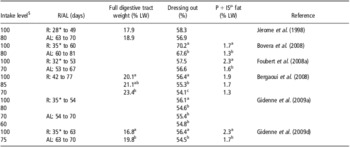
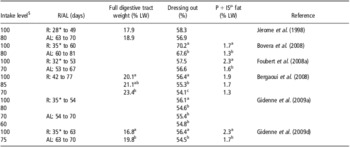
In parallel with a post-weaning growth reduction, a restriction strategy also modifies the body composition. According to the general rule of tissues’ allometry deposition (Cantier et al., Reference Cantier, Vezinhet and Rouvier1969; Dalle Zotte and Ouhayoun, Reference Dalle Zotte and Ouhayoun1998), the restriction leads to differential changes in growth for the internal organs (liver, digestive tract, etc.) and tissues (muscles, fat, etc.). According to Pálsson (Reference Pálsson1955), early developing tissues (bones and digestive tract) should be more impaired during the restriction than late ones (muscles and adipose tissue). The digestive tract development (organ weight) is impaired during the restriction (Schlolaut et al., Reference Schlolaut, Lange and Schluter1978; Perrier and Ouhayoun, Reference Perrier and Ouhayoun1996). After a restriction period, during the compensatory growth associated with free intake (AL), the growth of digestive organs is very rapid (Ledin, Reference Ledin1984a and Reference Ledin1984b). For instance, at slaughter, the stomach and other digestive organs (such as the liver) are proportionately heavier than in AL animals (Lebas and Laplace, Reference Lebas and Laplace1982). However, this increased development of the digestive tract depends on the restriction strategy and the weight gain (Jérome et al., Reference Jérome, Mousset, Messager, Deglaire and Marie1998). Finally, the weight of the entire digestive tract (organ + digesta) is about 10% higher (Table 3) and contributes significantly to the body's compensatory growth. The increase in digesta content seems to be the main contributor to the increased weight of the entire digestive tract. Accordingly, the dressing out (slaughter yield) is reduced by about 2 units (Table 3), and does not seem to be closely dependent on the restriction strategy (duration or level of intake). In addition, a minimum length for the restriction period seems necessary, as Tumova et al. (Reference Tumova, Zita and Stolc2006) did not find any change in dressing-out percentage for a moderate restriction (70% of AL for 1 or 2 weeks and a re-feeding AL period of 2 weeks).
Effect of a post-weaning quantitative£ reduction of the feed intake on the slaughter yield and some carcass characteristics of the rabbit
R = restriction period; AL = ad-libitum period.
a,b,c Significant difference between AL and R, within the same study.
£ The limitation of intake is obtained by a daily manual distribution of a defined quantity of pellets.
$ As percent of the voluntary intake (100% = AL).
* Age at weaning.
μ P + IS = perirenal + interscapular fat.
Conversely, after re-feeding freely, although the growth increase should apply more to late-developing tissues and organs (such as fatty tissues, Ouhayoun, Reference Ouhayoun1998), at slaughter the carcass fattening level remains lower irrespective of the restriction strategy used. The weight of perirenal and interscapular fat is about 0.5% lower, and seemed to be negatively related to the intake level (Table 3). Gondret et al. (Reference Gondret, Lebas and Bonneau2000) showed that changes in the nutritional status (through a feed restriction) regulate intramuscular lipid deposition without changing muscular fibre type composition. A restriction strategy seemed not to modify other carcass characteristics or meat quality, such as carcass conformation, meat colour, cooking losses, meat/bone ratio, water holding capacity, pHU (ultime pH) or muscular fibre type (Perrier, Reference Perrier1998; Dalle Zotte et al., Reference Dalle Zotte, Rémignon and Ouhayoun2005; Tumova et al., Reference Tumova, Zita and Stolc2006; Gidenne et al., Reference Gidenne, Combes, Feugier, Jehl, Arveux, Boisot, Briens, Corrent, Fortune, Montessuy and Verdelhan2009a and Reference Gidenne, Travel, Murr, Oliveira, Corrent, Foubert, Bebin, Mevel, Rebours, Renouf and Gigaud2009d).
Effect of a post-weaning feed restriction on digestion and digestive physiology
Impact of reduced intake on feed digestion and rate of passage
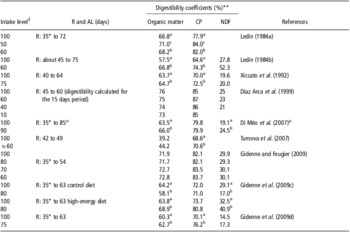
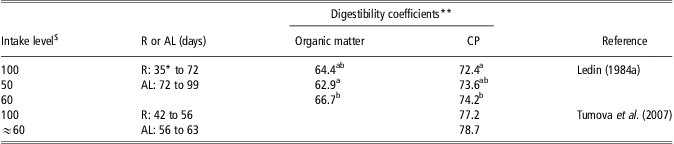
The improvement of FC (Table 2) during the restriction and moreover after restriction (during re-feeding freely) should be associated with improved food digestion. In fact, most studies reported an improvement in the faecal digestibility, either during restriction (Table 4) or after restriction during re-feeding freely (Table 5).
Effect of a post-weaning reduction of the feed intake on the nutrient digestion

R = restriction period; AL = ad-libitum period.
a,b,c Significant difference between AL and R, within the same study.
$ As percent of the voluntary intake (100% = AL).
* Age at weaning.
** Digestibility measured during R.
μ Digestibility calculated at 77 days, with a marker procedure.
Nutrient digestion of the growing rabbit, previously restricted

R = restriction period; AL = ad-libitum period.
a,b Significant difference between AL and R, within the same study.
$ As percent of the voluntary intake (100% = AL).
* Age at weaning.
** Digestibility measured after R, when rabbits are again fed AL.
However, this improvement is not consistent according to the restriction intensity and its duration, nor to the dietary composition. For instance, only 7 days after the application of the restriction strategy, the faecal digestibility coefficient of the organic matter (or energy) was not significantly affected, even for a 40% reduction in the intake level (Gidenne and Feugier, Reference Gidenne and Feugier2009). Without a delay for adaptation, Diaz Arca et al. (Reference Diaz Arca, Perez Alba and Perez Hernandez1999) failed to detect an effect of the intake level on digestion, even when the intake was reduced to 10% of the voluntary food consumption.
During intake restriction, an improvement in the growing rabbit's digestion seems thus to be reached only after an adaptation delay of at least 8 to 10 days. An increase in protein digestion was often observed in growing rabbits (Xiccato et al., Reference Xiccato, Cinetto and Dalle Zotte1992; Gidenne and Feugier, Reference Gidenne and Feugier2009) and adults (Lebas, Reference Lebas1979; Xiccato and Cinetto, Reference Xiccato and Cinetto1988; Fodor et al., Reference Fodor, Fekete, Zoldag, Bersenyi, Gaspardy, Andrasofszky, Kulcsar and Eszes2001). Similarly, in these studies the authors found in R animals a better digestive efficiency for energy, but few improvements in lipid or fibre digestion. After restriction, as the FC is markedly improved, we expected a sharp increase in digestion efficiency. However, few studies deal with this point (Table 5), and the results are inconsistent.
The effect of the restriction seems to be less in heavy or adult rabbits. Ledin (Reference Ledin1984b) found slight changes in digestibility, whereas Gidenne (Reference Gidenne1987) did not find any significant changes in the digestion of high-fibre diets. In contrast, Lebas (Reference Lebas1979) obtained a higher digestibility for restricted pregnant females. As the literature shows large variations for the relationship between digestion and restriction, we can assume that the chemical composition of the feed would play a key role. This was exemplified by the significant interaction found by Gidenne et al. (Reference Gidenne, Bannelier, Combes and Fortun-Lamothe2009c) between intake level and DE dietary concentration on faecal digestibility (Table 4), which needs to be further explained.
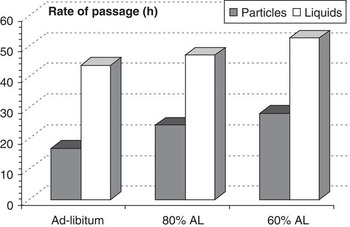
Improvement in digestion could originate from physiological changes in the intestine (enzyme secretion, mucosa absorption, etc.), and for instance in a longer retention time of digesta particles in the caeco-colic segment. A 40% reduction in the intake level led to a 65% increase in the retention time of particles (Figure 6). With similar intake levels, a similar increase in digesta retention was observed by Ledin (Reference Ledin1984b), whereas with more fibrous diets Gidenne et al. (Reference Gidenne, Poncet and Gomez1987) reported only a 25% increase in AL rabbits. The longer retention time in R rabbits originated mainly from the first 24 h of marker excretion (169-Yb). However, the impact of the intake level should be more precisely measured by maintaining a similar delay between marker administration and caecotrophy, which varied between R and AL rabbits (Laplace and Lebas, Reference Laplace and Lebas1975; Gidenne and Lapanouse, Reference Gidenne and Lapanouse1997). Conversely, Fioramonti and Ruckebusch (Reference Fioramonti and Ruckebusch1974) observed no motor activity response of the caecum in the rabbit fed AL, probably because the caecum is always replete. On the other hand, when adapted to single daily meals (and thus restricted), the caecum contracts more frequently before the meal time. Moreover, hungry animals ate a lot of food in a short time, and this prolonged the motor activity of the small intestine (Ruckebusch et al., Reference Ruckebusch, Grivel and Fargeas1971). Therefore, applying a restriction strategy to rabbits probably modifies the motor activity in all segments of the tract, and also leads to a period of digestive vacuity before the next feed distribution.
Rate of passage through the whole gut according to the intake level of the growing rabbit (Gidenne and Feugier, Reference Gidenne and Feugier2009).

Restriction and digestive physiology
Applying a reduced intake after weaning may impair the maturation of the gut that develops quickly in the young rabbit. For instance, the ileal villus height and area, as well as crypt depth, increased after weaning (Gallois et al., Reference Gallois, Gidenne, Fortun-Lamothe and Le Huerou-Luron2005), but were not affected by a 25% reduction in intake from 28 days (weaning) to 53 days of age (Martignon et al., Reference Martignon, Combes and Gidenne2010a). In addition, it is acknowledged that the digestive enzyme secretion is related to substrate availability (i.e. intake level). However, under restriction, ileal maltase activity was not affected (Martignon et al., Reference Martignon, Combes and Gidenne2010a). Further studies should be carried out to elaborate on this point.
As the total feed intake is completed within 6 to 10 h for R rabbits, the flow of digesta in the stomach is rather high just after feed distribution. Thus, in both parts of the stomach (antrum and fundus) a higher pH was found in R animals than AL (Gidenne and Feugier, Reference Gidenne and Feugier2009; Martignon et al., Reference Martignon, Combes and Gidenne2010a). This increase in pH is probably transitory and might be related to a dilution of secreted gastric acid because of the large meal eaten by R animals in a short time. Conversely, 5 to 6 h after a feed distribution, lower caecal pH was observed for R rabbits, related to higher volatile fatty acid (VFA) concentration (Gidenne and Feugier, Reference Gidenne and Feugier2009). Similarly, after offering feed at 0800 h, a rapid flow of digesta enters the caecum at about 1300 h for R animals, leading to a peak of fermentation (Gidenne and Bellier, Reference Gidenne and Bellier1992). On the other hand, Maertens and Peeters (Reference Maertens and Peeters1988) and Taranto et al. (Reference Taranto, Di Meo, Stanco, Piccolo, Gazaneo and Nizza2003) observed a higher pH and a lower VFA concentration in the caecum of young R rabbits, as measurements were recorded in the morning (9 to 10 h) just after meal distribution, and thus before the peak of digestion in the caecum. Therefore, when the caecal sampling occurred within a similar delay from the meal (or the main intake period for AL rabbits), as done by Martignon et al. (Reference Martignon, Combes and Gidenne2010a), the intake limitation seemed not to greatly influence the physico-chemical parameters (pH, VFA) of the caecal biotope, although the redox potential was slightly reduced (by 10%). In addition, the fibrolytic activity of the caecal bacteria is not affected by the intake level (Gidenne and Feugier, Reference Gidenne and Feugier2009; Martignon et al., Reference Martignon, Combes and Gidenne2010a). Similarly, the intake level had no significant effect on the number of bacterial 16S rDNA copies per gram of caecum content, and did not influence the bacterial community structure or diversity (Martignon et al., Reference Martignon, Combes and Gidenne2010a). This lack of effect may be due to both the relatively constant composition of the material entering the caecum, located at the end of the digestive tract, and the buffering capacity of the caecal content. However, the bacterial diversity and structure were approached through a molecular fingerprint analysis that only took into account the major bacterial populations. More targeted analyses of Archaea or of some key bacteria species of the caecal microbiota could reveal changes that were not addressed by the fingerprint approach, and those that may explain the higher resistance of the R rabbits to digestive troubles as described in the following section.
Digestive health of the growing rabbit according to the intake level after weaning
Before reviewing this point, a brief reminder of the method of estimating health status of a group of animals is pertinent with respect to the growing rabbit's digestive health. A common indicator to evaluate the impact of a disease in breeding is the mortality rate. More recently, a morbidity indicator was developed for the growing rabbit to assess more precisely the incidence of the clinical symptoms (Gidenne et al., Reference Gidenne, Garcia, Lebas and Licois2010), and it could be combined with mortality to obtain a health-risk index (HRi, % = morbidity % + mortality rate %). This approach allows a more precise assessment of the health status. Thus, it means that a large number of animals is required to detect a significant difference in mortality between two treatments. For instance, to detect a 10% difference between two mortality rates (at the 5% probability level), more than 90 rabbits are required in each group (and over 300 to detect a 5% difference). Similarly, assessing the morbidity level using clinical symptoms (diarrhoea, caecal impaction, etc.) is relatively easy. However, when only a reduction of growth rate is detectable, a threshold must be defined to classify the animal as morbid or not (such as the mean minus 2 × the standard deviation), and it needs a large set of rabbits within a group to define the mean and its range of variation. Therefore, except for specific trials involving experimental inoculation of a pathogen, we will review only the results of studies using the minimum number of rabbits to assess correctly the health status according to the intake level.
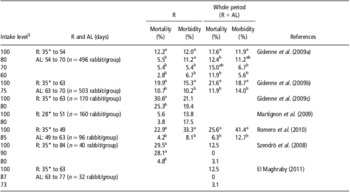
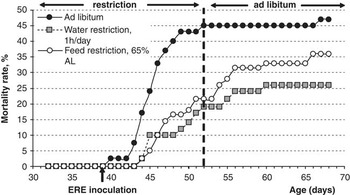
The first large-scale trials dealing with the impact of reducing the intake level on digestive health were performed in 2002 by a French network of six experimental units. First results were published in 2003 (French Rabbit Congress), indicating a halved mortality and morbidity rate from spontaneous ERE or non-specific enteropathy, when rabbits were limited to a 60% intake level for 3 weeks after weaning (Table 6; Gidenne et al., Reference Gidenne, Combes, Feugier, Jehl, Arveux, Boisot, Briens, Corrent, Fortune, Montessuy and Verdelhan2009a). Meanwhile, other trials were performed to assess whether a restriction strategy would be efficient against the ERE. Boisot et al. (Reference Boisot, Licois and Gidenne2003) reported that a 65% intake level (obtained by feed restriction or by limiting the drinking access to 1 h) reduced mortality rate after an ERE inoculation (Figure 7), and this was later confirmed by Foubert et al. (Reference Foubert, Duperray, Boisot and Guyonvarch2008b). More recently, Martignon et al. (Reference Martignon, Reperant and Valat2010b) reported that a restriction to 80% of AL had no significant effect on rabbits infected experimentally with an enteropathogenic E. coli (0128:C6), and they did not detect a favourable effect of the restriction under a spontaneous colibacillosis (Martignon et al., Reference Martignon, Combes and Gidenne2009). Therefore, further studies are necessary to confirm this differential effect of the intake level for these two digestive pathologies and to understand the underlying physiological mechanisms involved.
Effect of a post-weaning reduction of the feed intake on the mortality and morbidity from digestive troubles in the growing rabbit

R = restriction period; AL = ad-libitum period.
a,b Significant difference between AL and R, within the same study.
$ As percent of the voluntary intake (100% = AL).
* Age at weaning.
Mortality rate after ERE inoculation, according to the restriction strategy. ERE = epizootic rabbit enteropathy.

Using a large-scale experimental design (over 400 rabbits per group on several sites), Gidenne et al. (Reference Gidenne, Combes, Feugier, Jehl, Arveux, Boisot, Briens, Corrent, Fortune, Montessuy and Verdelhan2009a) showed a reduction by almost half of the mortality and morbidity for R animals (Table 6) for a minimum level of intake reduction of 20%. This effect was confirmed in a further study (Gidenne et al. (Reference Gidenne, Murr, Travel, Corrent, Foubert, Bebin, Mevel, Rebours and Renouf2009b), where no effect of offering the feed in one or two times was detected on health status. Martignon et al. (Reference Martignon, Combes and Gidenne2009) confirmed that the favourable impact of the restriction originated clearly from the quantity of feed offered and not from the distribution procedure. However, this favourable impact of a reduced intake seems to occur only during the restriction period, and does not continue when animals return to AL intake (Gidenne et al., Reference Gidenne, Combes, Feugier, Jehl, Arveux, Boisot, Briens, Corrent, Fortune, Montessuy and Verdelhan2009a; Romero et al., Reference Romero, Cuesta, Astillero, Nicodemus and De Blas2010). Similar results were also obtained by reducing the intake level through a time-limited access to drinking water (Boisot et al., Reference Boisot, Duperray, Dugenétais and Guyonvarch2004; Verdelhan et al., Reference Verdelhan, Bourdillon, Morel-Saives and Audoin2004; El Maghraby, Reference El Maghraby2011).
As a lower intake led to growth reduction, Gidenne et al. (Reference Gidenne, Bannelier, Combes and Fortun-Lamothe2009c) compared standard feed (9.79 MJ/kg) with high-energy (10.90 MJ/kg) feed, for AL or R growing rabbits, to assess whether it is possible to obtain a favourable effect on health without growth impairment. Unfortunately, the first results indicated that restricting rabbits with a high-energy feed did not seem to be as efficient as the standard feed in preventing digestive troubles. Szendrö et al. (Reference Szendrö, Metzger, Fébel, Hullár, Maertens, Bianchi, Cavani, Petracci, Biró-Németh and Radnai2008) reached similar conclusions using two rabbit lines.
Finally, physiological mechanisms explaining such a favourable effect of reducing the intake level on diarrhoea incidence remained to be explained. Many metabolic parameters are modified under restriction, as reported for the rabbit by Van Harten and Cardoso (Reference Van Harten and Cardoso2010). The immune status of R rabbits was briefly described through some blood characteristics, such as the cell profile. Tumova et al. (Reference Tumova, Zita, Skrivanova, Fucikova, Skrivan and Buresova2007) reported an increased number of lymphocytes in R rabbits. However, there is a dearth of information on the immune status of the growing rabbit. An interdisciplinary approach would be useful to explore more precisely the response of the young rabbit either under R or AL regimens, and to correlate the inflammatory response, the immune status or the microbiota maturation (stability and diversity) with the intake level.
Conclusions and prospects
Post-weaning intake limitation has several effects on the rabbit's digestive physiology and growth. The mechanisms underlying the favourable impact of a short-term reduced intake on digestive troubles remain unexplained, and need further study. The animal welfare considerations are contradictory, as feed restriction leads to hunger but reduces the incidence of post-weaning digestive troubles. Since 2003, strategies for limiting feed intake after weaning have been widely applied in France by rabbit breeders. This has been combined with the improvement of equipment to control the feed distribution, and particularly automatic feeding systems using a chain conveyor for pellets. French private feed companies are improving ways of controlling the intake, such as by a fixed duration of feeding during the night (Weissman et al., Reference Weissman, Troislouches, Picard, Davoust, Leroux and Launay2009).
At present, about 95% of professional breeders are using a restriction strategy with or without automatic feeding equipment. Apart from the advantages for digestive health (particularly for ERE syndrome), French breeders use a restriction strategy to reduce feed costs, as the FC for healthy animals is improved during and particularly after a restriction period because of the compensatory growth. Globally, the margin on the feed cost is estimated at 0.30€ per weaned rabbit. Drug consumption (estimated at about 0.10 to 0.15€ per rabbit in France) is also reduced. However, improved returns also depend on the price of feeds, on the national market and particularly on the slaughter weight. For instance, for light slaughter weights (as in Spain) the economic value of restriction strategies may be reduced (Romero et al., Reference Romero, Cuesta, Astillero, Nicodemus and De Blas2010). In conclusion, beneficial effects of an intake limitation in growing rabbits have been proved in experiments and in field conditions. Various feeding strategies are applied in the majority of the French rabbit breeding units over the past 8 years. To reduce the risk of post-weaning digestive troubles, it is recommended to limit the intake under 80% of AL during 2 weeks after weaning (35 days). However, intake limitation strategies should be adapted to every breeding situation, according to the aims of the farmers: improving health status, reducing feed costs or standardising performances.