

Introduction
The use of non-starch polysaccharide (NSP)-degrading enzymes in poultry diets has previously been shown to improve performance in birds fed wheat-based diets. These enzymes mainly exert their performance-promoting effect by partially degrading water soluble and viscous arabinoxylans, which inhibit nutrient digestion and absorption by raising intestinal viscosity (Bedford and Classen, Reference Bedford and Classen1992). In addition, the breakdown of cell wall polysaccharides possibly releases entrapped starch and protein (Theander et al., Reference Theander, Westerlund, Aman and Graham1989; Wiseman et al., Reference Wiseman, Nicol and Norton2000). The NSP content of feed ingredients is highly variable. Wheat contains 5–8% arabinoxylans which consist of β 1–4 xylan backbone to which single arabinose residues are linked through O-2, O-3 or O-2,3 positions. In addition, up to 1% of β-glucans and 2–3% of cellulose are present (Choct et al., Reference Choct, Kocher, Waters, Pettersson and Ross2004). The total NSP content in soybean meal is around 23–25% (Choct et al., Reference Choct, Dersjant-Li, McLeish and Peisker2010) and canola meal contains 17.9% (Slominski and Campbell, Reference Slominski and Campbell1990), mostly in the form of cellulose and pectic polysaccharides (Knudsen, Reference Knudsen1997). Given that more plant ingredients containing different forms of NSP are being used in the poultry industry, it is reasonable to speculate that enzyme combinations with additional activities, each differing in substrate affinity, may deliver further enhancement in nutrient utilisation than a single xylanase alone can achieve. In addition, nutritional adequacy of the diet has been determined to be an important factor affecting the response to a dietary enzyme (Cowieson, Reference Cowieson2010). Zhou et al. (Reference Zhou, Jiang, Lv and Wang2009) reported that addition of xylanase, amylase, and protease had greater effects on increasing AME of corn-soy diets with lower energy contents compared with diets with higher energy levels fed to broiler chickens. Kocher et al. (Reference Kocher, Choct, Ross, Broz and Chung2003) found that when enzymes were included in a lower-energy corn-soybean meal basal diet, the combination of pectinase, protease, and amylase significantly improved AMEn in comparison to the unsupplemented basal diet. However, a subsequent experiment with a higher energy and protein basal diet failed to show the same improvement when enzymes were added. Thus, responses to exogenous enzyme products would be expected to be greater in diets with lower nutritional quality. This study was conducted to examine the hypothesis that the nutrient density of the diet would affect the response to exogenous carbohydrase supplementation in terms of bird performance and nutrient digestibility.
Materials and methods
Enzyme preparation
The multi-carbohydrase complex (Rovabio® Excel LC, Adisseo Asia Pacific Pte Ltd., Singapore) is a concentrated solution with the main enzymatic activities of xylanase (1,100 visco unit/kg), and β-glucanase (100 AGL units/kg). This product is made from a fermentation broth of Penicillium funiculosum. The multi-carbohydrase complex was applied post-pelleting at a dose rate of 200 ml/tonne of feed. The enzyme recovery from grower diets was analysed by Adisseo Asia Pacific Pte Ltd (PC + multi-carbohydrase: 1163 visco units/kg feed; NC + multi-carbohydrase: 891 visco units/kg feed).
Bird husbandry
A total of 1008 male broiler chicks (1-d-old; Ross 308) were obtained from the Baiada Hatchery, Tamworth, New South Wales and reared in floor pens with hardwood litter with eight nipple drinkers per pen. There were 36 birds per pen, which was 1.5 m x 1.5 m in dimension. Birds were fed 500 g of 1–2 mm starter crumbles followed by 1500 g of a 5 mm pelleted grower feed and the remainder as 5 mm pelleted finisher feed. Birds were weighed on d 10, 24 and 42, and were given starter and grower feed for slightly longer than these time points. Residual feed was weighed on days 10 and 24 was placed back into the feeders. The next phase (pre-weighed) was placed into the feeder on top of the previous phase. Diets and water were offered ad libitum. The lighting program was 24 h of light during the first 3 d, 23 h of light from 4 d to 7 d, 20 h of light from 8 d to 10 d, and 18 h of light thereafter until the end of the experiment. The animal ethics committee of the University of New England approved the study protocol (AEC 11/032).
Diets and experimental design
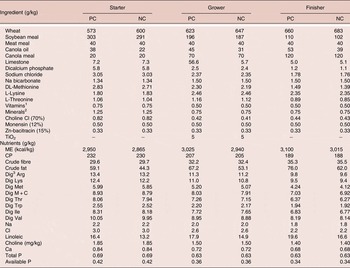
The positive control (PC) was a nutrient adequate wheat-soybean meal based diet formulated to meet the local industry recommendations, varying according to starter, grower and finisher phases. Nutrient levels in the negative control (NC) were 80 kcal/kg ME and 1.5% digestible amino acid (DAA) lower compared to the PC. The diet composition and nutrient content are shown in Table 1. Diets were mixed in a 250 or 500 kg mixer as appropriate and pelleted without steam conditioning at 65 °C. A multi-carbohydrase complex containing 19 carbohydrase activities (Rovabio® Excel LC) was supplemented to both diets to give a 2 × 2 factorial trial arrangement of treatments, i.e. PC or NC with and without enzyme, with seven pen replicates per treatment. Starter feed pellets were crumbled through a roller mill (1 to 2 mm). Grower and finisher diets were fed as 5 mm intact pellets. Pellets were spread onto a clean surface to a depth of 3 cm for cooling. The multi-carbohydrase (liquid form) was sprayed post-pelleting at a rate of 200 ml/tonne feed. The spray was applied as a diluted spray (250 x dilution) of received product to cooled pellets. Each batch of pellets was sprayed evenly twice, turning the pellets over in between applications to ensure even coverage.
Diet composition, nutrient content, ingredient prices used and diet costs

1 Vitamins supplied the following per kilogram of diet in starter, grower and finisher, respectively: vitamin A, 12000 IU, 8000 IU, 8000 IU; cholecalciferol, 5,000 IU, 3333 IU, 3333 IU; vitamin E, 75 IU, 50 IU, 50 IU; vitamin K, 3 mg, 2 mg, 2 mg; vitamin B12, 16 mcg, 11 mcg, 11 mcg; riboflavin, 8 mg, 5 mg, 5 mg; pantothenic acid, 13 mg, 9 mg, 9 mg; nicotinic acid, 55 mg, 37 mg, 37 mg; folic acid, 2 mg, 1.3 mg, 1.3 mg; biotin, 0.2 mg, 0.13 mg, 0.13 mg.
2 Mineral mix supplied the following per kilogram of diet in starter, grower and finisher, respectively: Mn, 120 mg, 71 mg, 71 mg; Zn, 100 mg, 59 mg, 59 mg; Fe, 40 mg, 24 mg, 24 mg; Cu, 16 mg, 9 mg, 9 mg; Se, 0.3 mg, 0.17 mg, 0.17 mg; I, 1.25 mg, 0.74 mg, 0.74 mg.
3 Dig = digestible
Sample collection and laboratory analysis
Three birds per pen were removed at both d 27 and d 42 and euthanised by cervical dislocation. Ileal contents were immediately collected from Meckel's diverticulum to the ileo-caecal junction. Approximately 2 g of pooled fresh digesta was centrifuged (12000 g, 10 min at 20 °C) and viscosity was determined on 0.5 ml supernatant fraction using a Brookfield Model DV-III Rheometer (Brookfield Engineering Laboratories Corp., Stoughton, MA, USA) at 25 °C with a CP40 cone and shear rate of 5–500/s. The samples did not exhibit shear thinning at these shear rates. The remaining samples were placed in plastic tubes with covers and frozen at −20 °C. Proventriculus, gizzard, liver, pancreas and small intestine were collected for the calculation of the relative organ weight (organ weight g/live bird weight kg).
The Dumas combustion method was applied to determine the crude protein content [N × 6.25] of both diet and ileal digesta samples (Etheridge et al., Reference Etheridge, Pesti and Foster1998). Nitrogen liberated by combustion at high temperature in pure oxygen was measured by thermal conductivity detection and converted to equivalent protein. Starch was determined colorimetrically as glucose using a glucose oxide and proxidase method (Megazyme Total Starch Kit, Megazyme International Ireland Ltd., Bray, Ireland). Titanium dioxide was determined based on the method of Short et al. (Reference Short, Gorton, Wiseman and Boorman1996). The free sugar, soluble NSP and insoluble NSP contents of ileal digesta was tested by the Uppsala method (Theander and Westerlund, Reference Theander, Westerlund and Spiller1993)
Ileal digestibility values were calculated using the following equation
 $${\rm AND}_{\rm x} = {\rm} 1{\rm} -{\rm} \left[ {\left( {{\rm T}_{\rm i} /{\rm T}_{\rm o}} \right){\rm} \times {\rm} \left( {{\rm X}_{\rm o} /{\rm X}_{\rm i}} \right)} \right]$$
Here, ANDx is apparent nutrient digestibility for ileal samples expressed as a percentage; Ti is the concentration of TiO2 present in the diet; To is the concentration of TiO2 present in the ileal digesta; Xo is the nutrient concentration present in the ileal digesta; and Xi is the nutrient concentration present in the diet. All values for Ti, To, Xo, Xi were expressed as a percentage of dry matter.
Statistical Analysis
All data were analysed using SPSS software. One-way ANOVA and the general linear model procedure were used to determine the significance of the main effects and any interactions, where appropriate. Duncan's multiple-range test was used to separate means when significant main effects (P < 0.05) were detected by one-way ANOVA.
Results
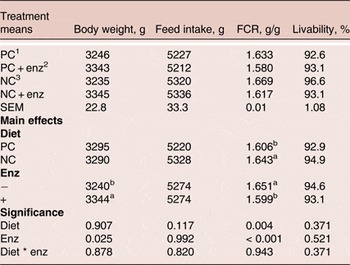
From 0 to 42 d diet had no effect on body weight (BW), feed intake, and livability (P > 0.05). However, feeding the NC diet negatively impacted FCR (P < 0.01) by 3.7 points compared to birds fed the PC diets. Across diet types, the inclusion of multi-carbohydrase increased BW by 3.2% (P < 0.05) and improved FCR by 5.2 points (P < 0.001) but had no effect on feed intake or livability. No interaction was observed between the two factors. Results are shown in Table 2.
Performance of broilers from 0 to 42 d

a,b means within a column with different superscripts are significantly different (P < 0.05)
1PC = positive control
2Enz = multi-carbohydrase complex
3NC = negative control
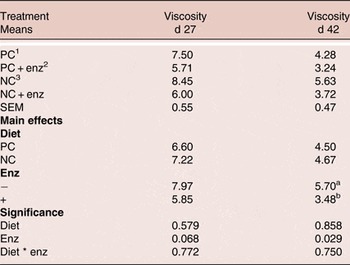
Viscosity values of ileal contents from birds sampled at d 24 and d 42 are presented in Table 3. Viscosity was significantly lower in birds fed diets containing multi-carbohydrase at d 42 (P < 0.05). There was a tendency for reduced viscosity in birds fed diets supplemented with multi-carbohydrase at d 24 (P = 0.068).
Ileal digesta viscosity in birds with or without multi-carbohydrase (mPa.s)

a,b means within a column with different superscripts are significantly different (P < 0.05)
1PC = positive control
2Enz = multi-carbohydrase complex
3NC = negative control
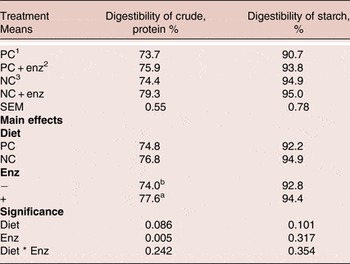
As shown in Table 4, diet did not affect apparent ileal digestibility of protein. However, the multi-carbohydrase improved digestibility of crude protein (P < 0.01). There was no diet by enzyme interaction (P > 0.05). No main effects of diet, enzyme, or their interaction were detected on starch digestibility.
Apparent ileal digestibility of crude protein and starch at d 27

a,b means within a column with different superscripts are significantly different (P < 0.05)
1PC = positive control
2Enz = multi-carbohydrase complex
3NC = negative control
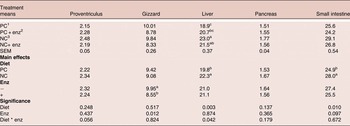
Table 5 shows the relative selected organ weights. The addition of enzyme reduced the relative gizzard weight (P < 0.05) and tended to reduce the relative small intestine weight (P = 0.097) at d 42. The liver (P < 0.01) and small intestine (P < 0.05) of birds fed the NC diet were heavier than that of birds fed the PC diet, respectively. An interaction was detected between nutrient density and multi-carbohydrase for relative weight of liver (P < 0.05).
The relative organ weight (organ weight/ live bird weight, g/kg) at d 42

a-c means within a column with different superscripts are significantly different (P < 0.05)
1PC = positive control
2Enz = multi-carbohydrase complex
3NC = negative control
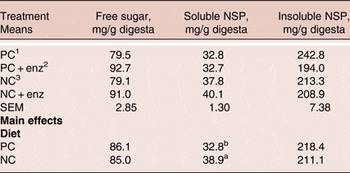
Supplementation of multi-carbohydrase significantly increased the free sugar concentration compared to the non-supplemented group (P < 0.05), and tended to decrease the insoluble NSP concentration (P = 0.095) regardless of the nutrient density. Birds fed NC diet had higher soluble NSP concentration than those fed PC diet (P < 0.05). There was no interaction on free sugar, soluble NSP, or insoluble NSP concentration (Table 6).
Amounts of free sugar, soluble NSP and insoluble NSP (mg/g digesta) in ileal digesta at d 27

a,b means within a column with different superscripts are significantly different (P < 0.05)
1PC = positive control
2Enz = multi-carbohydrase complex
3NC = negative control
Discussion
The mechanisms by which supplemental xylanases improve the nutritive value of wheat-based diets for poultry may be well-documented, but research concerning the effect of nutrient density on responses of birds to carbohydrase supplementation remains scant. It has been suggested the inherent ileal digestibility of starch, protein and lipid in a corn/soy-based diet varies from around 70% to over 95%, and this explains up to 90% of the variance in enzyme response (Cowieson, Reference Cowieson2010). In addition, responses to exogenous enzyme addition are expected to be greater in diets with lower nutritional quality (Kocher, et al., Reference Kocher, Choct, Ross, Broz and Chung2003; Cowieson and Ravindrani, Reference Cowieson and Ravindrani2008; Zhou, et al., Reference Zhou, Jiang, Lv and Wang2009). Zhou et al. (Reference Zhou, Jiang, Lv and Wang2009) reported that supplementation of xylanase, amylase and protease led to an additional increase on AME of corn-soy diets with lower energy contents compared to diets with higher energy levels fed to broiler chickens. Kocher et al. (Reference Kocher, Choct, Ross, Broz and Chung2003) found that the combination of pectinase, protease, and amylase significantly improved AMEn in comparison to the unsupplemented basal diet in a lower-energy corn–SBM diet. However, a subsequent experiment with a higher energy and protein basal diet failed to deliver the same improvement when enzymes were added. However, in the current study, there was no indication that nutrient density affected bird response to supplementation with multi-carbohydrase. Instead, the enzyme improved performance regardless of nutrient density. There was no diet x enzyme interaction for performance variables. This is in agreement with the finding of Neto et al. (Reference Neto, Cozannet and Preynat2015), where they tested the effect of graded levels of DAA on performance of broilers fed corn-based diets, and found that DAA reduction linearly reduced all performance parameters, but the addition of a multi-carbohydrase improved BW gain and FCR regardless of nutritional reduction levels. Moreover, it is possible that the lack of effect of nutrient density on enzyme response may be related to the grain source. Neto et al. (Reference Neto, Cozannet, Rouffineau and Preynat2015) reported that when birds were fed wheat-based diets with different reduction levels of DAA, the addition of a multi-carbohydrase significantly improved growth performance and the deposition of energy and protein regardless of the DAA levels. Unlike the situation in corn-soy diets, supplementation with multi-carbohydrase might be expected to reduce digesta viscosity of wheat-based diets regardless of nutrient density. Wheat pentosans are known to increase the secretion of endogenous amino acids in broiler chicks (Angkanaporn et al., Reference Angkanaporn, Choct, Bryden, Annison and Annison1994). While the nutrient improvements observed with supplemental enzyme may be dependent on the nutritional quality of the basal diet, the ability of carbohydrases to reduce viscosity and ameliorate anti-nutritive properties may not be confined to the nutrient density of the basal diet as supplemental enzymes not only modify the feed, but also the way feed is digested.
The changes brought about by exogenous enzymes on gut physiology, secretion and absorption, and microbial population may be less tangible but their effects on animals should not be overlooked. Such physiological effect might remain irrelevant from a practical nutrition view point (Cowieson, Reference Cowieson2010). In the current study, birds fed the NC diet had a heavier liver and a smaller intestine compared to those fed the PC diet. The addition of multi-carbohydrase decreased the relative weight of gizzard, and tended to reduce the relative weight of small intestine. A diet x enzyme interaction was observed for liver weight, because birds fed NC diet with no enzyme had a heavier liver compared to those fed PC diet without enzyme. With enzyme supplementation there was no difference in the relative weight of liver between birds fed PC and NC diet. This may indicate that the birds fed the NC diet without enzyme produced more bile in order to facilitate the digestion of fat, whereas supplementation improved the mixing of the digestive enzymes with their substrates. In the case of fat digestion, this would increase the effectiveness of micelle formation, leading to the restoration of the normal digestive efficiency and eliminating the requirement for additional bile secretion. While the liver and gut account for only 3% of the BW of chickens, they may contribute up to 26% of the total heat production, which demonstrates that a relatively small GIT size could lead to a significant saving in maintenance energy (Spratt et al., Reference Spratt, McBride, Bayley and Leeson1990). Therefore, the effect of the multi-carbohydrase on the relative weights of small intestine, liver, and gizzard may have been effective in enhancing growth performance by sparing endogenous energy loss, and this sparing effect should be independent from the nutritional quality of the basal diet.
In the current experiment, the ileal viscosity at d 42 was reduced by enzyme supplementation, regardless of the diet type. The effect on intestinal viscosity is generally believed to be a primary mechanism through which NSP-degrading enzymes exert their beneficial effects (Annison, Reference Annison1992; Choct, Reference Choct, Trimble and Annison1994). In addition, the enzyme improved protein digestibility. This may be due to disruption of the cell wall of wheat, leading to the release of previously encapsulated protein as well as a more effective enzyme-substrate mix in the lumen due to a more fluid, less viscous digesta.
The current study demonstrated that multi-carbohydrase supplementation elevated the ileal free sugar concentration. The extra released free sugars, along with oligosaccharides and low molecular weight polysaccharides, would be available for microbial fermentation in the hindgut of broilers, leading to the generation of volatile fatty acids that can be absorbed and utilised as an energy source. The soluble NSP levels in the ileal digesta of birds fed the NC diet was greater than samples from birds fed PC. This may be due to the higher inclusion of wheat in the NC diet. The addition of multi-carbohydrase tended to reduce the insoluble NSP concentration in the ileal digesta, which may partially explain the increased crude protein digestibility.
Conclusions
In summary, it is not surprising that nutritive value of wheat-based diets was enhanced by dietary multi-carbohydrase supplementation, but it is interesting to see that the effect of the enzyme was independent from nutrient density of the diet in this study. The reason may be that the difference between the PC and NC diets was not large enough to demonstrate an effect of diet density x enzyme interaction. The performance of the birds fed the NC diet plus the enzyme was actually superior to that of the PC, which suggested that the nutrient uplift due to enzyme supplementation in the NC diet was actually greater than the 80 kcal/kg and 1.5% reduction in digestible amino acids.
Acknowledgements
The authors wish to express thanks to Shuyu Song, Mark Porter, and Nick Rodgers for their technical assistance. Funding of this study was provided by Adisseo Asia Pacific Pte Ltd.
Declaration of interest
Y.G. Liu is an employee of Adisseo Asia Pacific Pte Ltd.