Introduction
Public visibility of traditional knowledge (TK) associated with plant genetic resources is growing. As defined by the Convention on Biological Diversity (CBD), TK is referred to as
the knowledge, innovations and practices of indigenous and local communities around the world, developed from experience gained over the centuries and adapted to the local culture and environment, and transmitted orally from generation to generation. It tends to be collectively owned and takes several forms from stories, songs, folklore, proverbs, cultural values, beliefs, rituals, community laws, local language and agricultural practices, including the development of plant species and animal breeds (CBD 2001 p. 1).
Several cases associated with enhancing TK using modern biotechnology and then privatizing the resultant genetic material have attracted international attention. Examples include turmeric (Curcuma longa), neem (Azadirachta indica) and Basmati rice, among others. Along with the rising tide of claimed ‘biopiracy’ cases that are perceived to result from the industrial revolution and capitalism, issues related to the enhancement of TK have been brought to the forefront of the broad debate on intellectual property. To some extent, these developments have renewed the North–South divide with respect to the exploitation and ownership rights of indigenous knowledge and genetic resources.
The efforts of individual countries in Southeast Asia to preserve, protect and promote indigenous knowledge and biodiversity have been enormous. The questions addressed in this paper, however, are whether a common regional framework among Southeast Asian countries has been developed, and whether, without a regional solution, it is possible to effectively preserve indigenous knowledge and culture. This paper also provides updates and documentation on current responses from governments, public institutions and specific local communities in the Southeast Asian region. An analysis of the issues is provided, and other suggested measures are enumerated, which may help in developing policy approaches to further preserve and protect TK and plant genetic resources within Association of Southeast Asian Nations (ASEAN) member countries.
TK and plant genetic resources – their interfaces
As the World Intellectual Property Organization (WIPO) puts it, TK is our identity, our future. TK has been recognized as having an important role in the survival of human communities and in diversifying agriculture. TK is often associated with the preservation and enrichment of plant genetic resources, which are very much at the cutting edge of modern scientific and technological experimentation. ‘Genetic resources’ means ‘genetic material’ and form one category of biological resources that are of actual or potential value for humanity (Kadirgamar, Reference Kadirgamar2002). Over the past 12,000 years worldwide, plant genetic resources, the first link in the food chain, have been developed and safeguarded by indigenous peoples, male and female farmers and forest dwellers. They are the product of the first and most fundamental of applied, appropriate technologies – the knowledge and skills used by people to produce the goods and services they require – and the technologies that enabled the development of agriculture, livestock production and aquaculture (AquinoFike 2002). Careful selection of traits has contributed to the creation of the great diversity of varieties, breeds and subspecies of plants, animals and fish, and other aquatic organisms that makes up the combined heritage of agricultural biodiversity. Hence, plant genetic resources now serve as the basis of modern agriculture worldwide, and as a result, life, health and prosperity.
TK and plant genetic resources have become primary targets for commodification – the process by which objects of perceived value become commodities that are bought and sold. As the Crucible II (2000) claimed, the globalization of the commodification process is now having a negative impact on the governance of biological materials. More and more governments, willingly or unwillingly, allow overseas and domestic private enterprise to use biological materials in their research and commercialization efforts. Kate and Laird (Reference Kate and Laird1999) reported that the value of annual global sales of products derived by multinational companies from the manipulation of plant genetic resources lies between US $500 and $800 billion. Likewise, in the recent United Nation's Economic and Social Council meeting, Zhang (2009) revealed that the 2003 total sales of herbal medicines reached €3.7 billion in Europe and $14 billion in China in 2005. In these cases, plant genetic resources controlled and valued by local peoples have now become commodities that are traded on global markets and thus become controlled by foreign private entities. Genetic Resources Action International (GRAIN) and Cervantes (Reference Cervantes2006) claimed that with the potential for these high values, issues associated with TK and plant genetic resources are increasingly addressed in bilateral and regional free-trade agreements.
WIPO (1999) summarized the concerns of TK holders as follows: (1) concern about the loss of traditional lifestyles and knowledge, and the reluctance of the younger members of communities to carry forward traditional practices; (2) concern about the lack of respect for TK and its holders; (3) concern about the misappropriation of TK including use of TK without any benefit sharing or use in a derogatory manner; and (4) lack of recognition of the need to preserve and promote the further use of TK. Correa (Reference Correa2001) more succinctly classified these and other possible reasons for protecting TK as the following: (1) equity considerations – the custodians of TK should receive fair compensation when their indigenous knowledge leads to commercial gain for others; (2) conservation concerns – the protection of TK contributes to the wider objective of conserving the environment, biodiversity and sustainable agricultural practices; (3) preservation of traditional practices and culture – protection of TK should be used to raise its knowledge profile and the people entrusted with it both inside and outside communities; (4) prevention of appropriation by unauthorized parties, i.e. avoiding biopiracy; and (5) promotion of TK use and its importance to development.
Some people are particularly concerned that the expanded scope and extension of International Property Rights (IPRs) to biological materials enable institutions or researchers to effectively appropriate the resources and knowledge of farmers and indigenous communities, especially in the developing world. IPR claims relating to genetic materials have provoked charges of biopiracy in many regions. Biopiracy as defined by Krattiger (2007) is a form of misappropriation, unfair acquisition and inequitable sharing of benefits with respect to biological resources.
The case of turmeric (Curcuma longa), neem (Azadirachta indica A. Juss.), and ayahuasca (Banisteriopsis caapi, a vine native to the Amazon Rain Forest) illustrates issues that can arise when patent protection is granted to inventions relating to TK, which are already in the public domain or exist as a prior art. Patents for these products were revoked on the grounds of their lacking the novelty requirement (Environment News Service, 1999; Raghavan, Reference Raghavan2000; Slack, Reference Slack2004). Another controversial issue settled in 2006 involved the patenting of the plant species Hoodia, which is used by the San peoples of southern Africa for its medicinal properties, and as an appetite suppressant. Here, the issue was not whether or not the patent should have been granted, but whether the San peoples, who had nurtured the TK underpinning the invention, were entitled to receive a fair share of any benefits arising from commercialization (Chennells, Reference Chennells2007). GRAIN and Kalpavriksh Environment Action Group (2002) have documented several other biopiracy cases that affected Asia.
The global community has subsequently acknowledged the role and importance of protecting TK and genetic resources, and maintaining the social and economic context in which they were developed. Foremost among the international policy discussions are those related to the conservation and sustainable use of biodiversity, namely the CBD and the International Treaty on Plant Genetic Resources for Food and Agriculture (ITPGRFA, and now, the FAO International Treaty). These issues are also addressed in arenas related to the rights of indigenous peoples (International Labour Organization, United Nations Commission on Human Rights and United Nations Permanent Forum on Indigenous Issues), intellectual property (WIPO) and culture (United Nations Educational, Scientific and Cultural Organization). More recently, TK has become a topic of discussion in trade-related forums such as the World Trade Organization (WTO) and the United Nations Conference on Trade and Development.
Each of these fora offers its own perspectives, and has objectives that reflect different areas of competence and expertise that may conflict with one another. According to Robinson (Reference Robinson2007), the legal obligations contained in international agreements, specifically the TRIPS, UPOV, the CBD and the ITPGRFA, have created a complex web of obligations for the access to and use of genetic resources, as well as the products and technologies derived from such resources. For instance, the CBD requires that prior informed consent (PIC) be obtained from contracting parties that provide access to genetic resources. PIC is generally described as a consultative process, wherein the potentially affected community engages in an open dialogue with individuals interested in commercializing TK and genetic resources. Another concept derived from CBD is access and benefit sharing (ABS), which is defined as the ‘equitable sharing of the benefits (monetary or non-monetary) arising from the use of genetic resources’. Neither WIPO nor TRIPS recognizes the rights of national governments or local communities to PIC or ABS. The development, interpretation and implementation of these policies influence how national governments and international agricultural research institutes design and implement their activities in managing TK and plant genetic resources' issues (Bioversity International, 2008).
How can TK associated with plant genetic resources really be protected? According to Wekesa (Reference Wekesa2006), the debate has developed from two different perspectives. The first school of thought proposes excluding unauthorized use by third parties, and the second as a tool to preserve local plant genetic resources from uses that may erode its viability or negatively affect the life or culture of communities that have developed and applied these resources. One of the many proposals to protect TK is to register the knowledge in public databases or pursue defensive protection (Tiranutti, Reference Tiranutti2006). The existence of such databases will allow authorities to investigate prior art when reviewing patent applications in order to determine whether they achieve the levels of novelty and inventiveness necessary for being granted IPR protection. Ruiz stated that prior art refers to the complete body of knowledge available to the public before a patent application is filed or, if a priority date is claimed, before that priority date (Ruiz, 2002). Registering TK would also promote documentation, preserve and maintain the knowledge and identify communities possibly entitled to benefit sharing from TK use. The government of India, as cited by Correa (Reference Correa2001), recognizes that the modalities of protecting TK are still emerging and evolving. The nature of entitlement and how to share in benefits are grey areas. Especially, at the international level, as countries grapple to understand the issues, clarity has yet to be achieved.
Regionalism in Southeast Asia and its impact on protecting TK and plant genetic resources
Regional cooperation is a rapidly emerging approach in Asia, especially with respect to harmonizing policies on intellectual property, and as a means for countries to address common problems. Regionalization is the geographical clustering of cross-border economic and social exchanges (Keohane and Nye, Reference Keohane, Nye, Held and McGrew2003) and the clustering of transactions, flows, networks and interactions between functional and geographical groupings of states or societies (Held et al., Reference Held, McGrew, Goldblatt, Perraton, Held and McGrew2003). The United Nations Development Programme (UNDP, 2006) report stated that regional cooperation and integration could help countries promote good governance at home in the context of globalization. Ideally, regionalization should (1) provide an enabling environment for private sector development and strengthen trade integration; (2) develop infrastructure programmes in support of economic growth and strengthen the region's interaction with the world; (3) build regional environmental programmes and contribute to peace and security; and (4) reduce social exclusion and foster an inclusive civil society and thus help to develop strong public sector institutions and good governance. The relationship among ASEAN members is perceived to be a good example of regionalization (Keohane and Nye, Reference Keohane, Nye, Held and McGrew2003).
Because of the wide diversity of medicinal plants in rain forests, Southeast Asia is one of the richest regions in the world in terms of biological and natural resources. These resources have the potential for the development of products, compounds and substances with medicinal, industrial, agricultural and other applications. Southeast Asia has the most varied natural ecosystems in the world (ASEAN Secretariat, 2003) and contains four major biodiversity ‘hot spot’ areas. This is exemplified in the variety of fruits, vegetables, herbs and other products grown or gathered by local farmers, and found in the markets of Manila or Bangkok. As of 2006, the ASEAN region had a human population of about 560 million, a total area of 4.5 million square kilometres, a combined gross domestic product of US $1100 billion and a total trade of US $1400 billion. (ASEAN, 2009). Over the centuries, local experience, farmers' understanding of the broad environment and the need for long-term security have guided traditional farming systems and notions of biodiversity in Southeast Asia. Inhabitants of the region have created a range of sophisticated and traditional farming systems that use diverse species and combinations of management practices. For example, the integrated rice–fish farming methods have resulted in genetically diverse food systems that contribute to food security, agricultural biodiversity and the world's natural and cultural heritage. Local communities have gradually developed and accumulated traditional and indigenous knowledge associated with these farming systems and the use of local genetic resources. Overexploitation of resources has placed stress on ecosystems, resulting in resource degradation and biodiversity loss. WIPO reports that the three main threats to the loss of TK are: (1) loss of the indigenous peoples' territorial base through the destruction of rainforests and their displacement by government projects or through the commercial use of natural resources, which makes it impossible for many indigenous communities to sustain their knowledge; (2) introduction of ‘modern’ practices of agriculture and medicine; and (3) the increasing misappropriation of indigenous knowledge by outside researchers.
ASEAN and its initiatives
ASEAN was founded on August 8 1967, with Indonesia, Malaysia, Philippines, Singapore and Thailand as the founding members. The 41-year-old network now has ten member governments. It is the most established economic grouping in Southeast Asia, was very successful in the early 1990s, but has been experiencing a crisis since the economic downturn in Asia in 1997 (Alvarez, Reference Alvarez, Heath, Antons and Blakeney2004). One of its recent policy objectives is to reduce trade barriers among members. The group is guided by a region-wide development plan as stipulated in the Hanoi Plan of Action towards its Vision 2020, which calls for a regional partnership in dynamic development. The combined area of nature conservation and biodiversity is widely recognized by ASEAN. Local communities have been using products from their local resources for generations. However, increased use has placed pressure on these ecosystems, which has degraded biological resources and weakened biodiversity. Although the loss of biodiversity usually originates locally, its impact eventually becomes region wide. Therefore, ASEAN is encouraging its member countries to pursue policies that balance use and conservation of biological resources. It is in this context that the issues of TK and plant genetic resources arise. In February 1999, ASEAN established the Regional Centre for Biodiversity Conservation to intensify regional cooperation and build on networking and institutional linkages to promote biodiversity conservation.
Another cooperating area for ASEAN is intellectual property as guided by the ASEAN Framework Agreement on Intellectual Property Cooperation signed on 15 December 1995, in Bangkok. The target involves collectively transforming the region into one largely based on knowledge, driven by innovation and sustained by lifelong learning through accelerating the pace and scope of intellectual property asset creation, commercialization and protection. This is achieved through harmonized IPR registration systems and capacity building on intellectual property and IPRs. Habito (2004) reported that there have been concerted efforts made by all member countries to enhance the region-wide protection of IPRs as well as to facilitate ASEAN cooperation on IP matters. Current status and developments in IPR protection among member countries have been actively disseminated, exchanged and updated. Most ASEAN nations are WTO members who have complied with the provision of the TRIPS Agreement of the WTO. The most visible action taken by ASEAN governments has been the formulation of laws and policies at the national level to promote biodiversity conservation through the use of IPR.
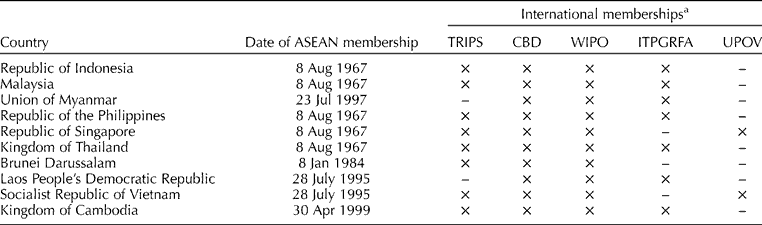
As noted previously, aside from WTO–TRIPS, CBD, the WIPO Convention, International Union for the Protection of New Varieties of Plants (UPOV) and ITPRGFA are the four important international treaties and conventions that affect TK and genetic resources. However, not all countries are members of all five treaties (Table 1).

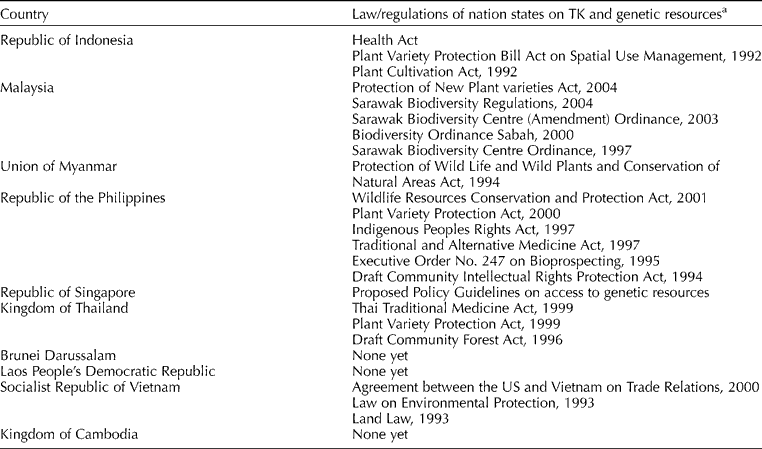
With the exception of Brunei, Cambodia and Laos, the ASEAN members have laws and regulations to help protect and preserve TK and genetic resources (Table 2). These laws were formulated to comply with the various treaty obligations of the member countries. The Philippines has the most extensive regulations regarding TK preservation and protection.
Domestic laws and policies that have an impact on plant genetic resources and related TK in the ASEAN members

a Adopted from GRAIN and Kalpavriksh (2002).
Mechanisms to protect TK in the different countries are typically drawn from existing IPR laws and are tied to environmental issues, particularly genetic resource management. According to Robinson (Reference Robinson2007), some of these countries have utilized the flexibilities in UPOV and TRIPS to include additional elements in their laws to address their own concerns. For example, they have included ‘disclosure of source and/or origin requirements’ (in the Thai, Singaporean and Vietnamese laws), farmers' rights elements (Philippines), PIC procedures and ABS arrangements. Some countries from the region have opted to develop truly unique laws for PVP – most notably Thailand.
A range of other related agrobiodiversity, community and indigenous rights laws is also being developed, which could instigate a broader range of rights-based approaches that offer protection for indigenous and local communities, including control over their TK. In 2000, member countries developed a draft of regulatory framework to regulate access to biological and genetic resources (including associated TK), and to protect ASEAN interests in plant and animal plant genetic resources from biopiracy. Several stakeholders were consulted, including representatives from government agencies, academic institutions, indigenous groups, the private sector and non-governmental organizations (NGOs). One of the ASEAN framework's objectives is to ensure that national access regulations are uniform and consistent, and are in accordance with the minimum requirements set in the framework agreement. Other highlights of the agreement are as follows:
(1) rejection of patents on biological and plant genetic resources and the need to recognize and respect the TK of indigenous and local communities;
(2) development of access instruments determined by each member state and based on respective national policies and legislation in accordance with the minimum terms and conditions laid out in the framework agreement;
(3) creation of a separate regional body, if necessary, to achieve the objectives of the framework agreement; and
(4) creation of a common fund for biodiversity conservation for ASEAN countries that will receive and maintain the revenues accruing from commercializing the use of common and shared resources among the member countries and from charges and fees imposed on access applications.
The framework agreement is meant to contribute to state sovereignty over plant genetic resources as promoted by the CBD. So far, only Laos, the Philippines and Singapore have obtained national clearance to sign this agreement (Heng Gee, Reference Heng Gee2007). Also in 2000, ASEAN released a declaration on cultural heritage, which deals with TK and plant genetic resources. The recognition of community IPR was one of the declaration's highlights:
… recognizes that TK systems and practices including designs, technology and oral literature are collectively owned by their local community of origin. Member-countries shall ensure that traditional communities have access, protection and rights of ownership to their own heritage. ASEAN shall cooperate for the enactment of international laws on intellectual property to recognize indigenous population and traditional groups as the legitimate owners of their own cultural heritage (ASEAN, 2000 p. 4).
In 2002, a joint statement was made by the ASEAN ministers regarding the responsibility for environmental issues to the world summit on sustainable development. This statement called for the speedy implementation of the provisions of the CBD, emphasizing issues of particular importance to resource-rich countries. These include mechanisms for the fair and equitable sharing of benefits derived from research and development on, and use of, biological resources, as well as the protection, promotion and equitable use of TK.
Increasing the role and local participation of NGOs
NGOs, whose numbers are increasing in Southeast Asia, have raised their social status, extended their political influence and are influential in pushing for the formation of pluralistic societies. These organizations have been closely involved in the growing discussion at the national and international levels of the protection, access and use of TK and genetic resources; and have also raised public awareness and concerns on misappropriation and inequity. GRAIN (1991) documented the arguments of the NGOs on the genebank approach, which is fully supported by the International Board for Plant Genetic Resources and donor governments, but ignores locally important plants, uses faulty-collecting strategies and limits access to collections. Most importantly, NGOs have challenged the current patent and IPR system through an array of actions ranging from creative campaigns against multinational companies, not cooperating with insensitive governmental policies, programmes and agencies and intervention in law-making processes at the national and international levels. A small selection of their other campaign initiatives includes community-level conservation, development and sustainable use of plants and animals through the breeding of local varieties by indigenous farming and pastoral communities; promotion of participatory plant breeding; challenging the introduction of GM crops, livestock and fish; fighting against gene flow and cross pollination of GM crops with conventional crops; defending and promoting community and farmers' rights; and establishment and management of community seed banks (ETC, GRAIN and ITDG, 2002). The Southeast Asia Regional Institute for Community Education, along with NGO networks such as the Community Biodiversity Development and Conservation Network, is among the most prominent groups advocating the strengthening of community rights, farmers' rights, the restoration of the ‘culture of the commons’, the recognition and respect for customary and indigenous law and the promotion of the sustainable use of genetic resources.
Meanwhile, communities are seeking to safeguard their bioresources from biopiracy. Among the ASEAN member countries, some local communities in Malaysia, Thailand and the Philippines are advanced in their initiatives to preserve and protect their TK and genetic resources. In Malaysia, the Bidayuh community has become the first ethnic group in Sarawak to document and protect their ethnobiology-related knowledge and practices, with a focus on sugar palm, an essential cash crop, under a pilot project undertaken by the Sarawak Biodiversity Centre (Borneo Post, 2001; Kaushal, Reference Kaushal2006). Leaders at Sahabat Alam Malaysia, through the Borneo Project and with the cooperation of the villagers of Long Sayan and Uma Bawang Keluan, have created botanical conservation sites, which will serve as repositories for many different species of rattan, bamboo, fruit trees and medicinal plants (Pancoast, Reference Pancoast2000; GRAIN, 2002; Benghawan, Reference Benghawan2003). In NE Thailand, the ‘Thai Baan Villagers’ Research' represents a second example of how community members can effectively record plant genetic resources and TK in their communities (Tiranutti, Reference Tiranutti2006). In Bukidnon province in the Philippines, the indigenous Talaandig community (with three organized groups) is one of the major groups in the country bringing life to TK and concerned with the protection of its territory and heritage. This community filed charges against a team of bioprospectors that trespassed on their land without prior consent and illegally acquired samples, paving the way for the creation of the Council of Elders Prior Informed Consent Office in Malaybalay City (GRAIN, 2002).
Viewpoints and concluding thoughts: in defence of TK and plant genetic resources: Is ASEAN there yet?
Despite the current high value placed on technological advances, social transformation and globalization, there exists a growing recognition and respect for the distinctiveness of TK and genetic resources. This has led inter-governmental bodies and nation state governments to modify procedures and policies on the promotion and sustainable management of biological diversity. However, problems and issues surrounding TK and genetic resources remain, and are centred on areas such as scope of protection, rights to be conferred and enforcement. A unified regulatory system for handling TK and plant genetic resources at the regional level has been developed by ASEAN, but has yet to be implemented, and only three member countries have signed the agreement to date. Most of the member countries are adopting a range of approaches to protect TK and genetic resources. Major efforts in this area are geared towards either trying to adapt current IPR systems to the special characteristics of TK on genetic resources, or creating new sui generis systems for TK. Local NGOs are active in community projects and campaigns for TK protection and genetic resources, but their effectiveness is unclear. Overall, the power of regional cooperation in ASEAN with regard to addressing issues related to TK and genetic resources is a work in progress. In an interview made by Khalik (Reference Khalik2008), the Director of the Institute for Southeast Asian Studies in Singapore and noted scholar, K. Kesavapany, admitted that ‘primarily, although the combined members of ASEAN constitute a significant economic force, ASEAN countries differ from each other in almost every respect, in terms of history, culture, religion and forms of government’.
Secondly, ASEAN countries have achieved varying levels of development and the capacity to respond to changes in international norms, policies on trade, modern scientific advances and to the needs of traditional, indigenous communities. This development gap reduces the ability of the region to maximize its potential and increases social and political tensions. Thirdly, ASEAN member countries have defined their respective goals to protect TK and plant genetic resources guided by either legislation on seed law, IPR regimes and/or biodiversity law. These laws have been widely criticized for their conflicting and complicated objectives. There is a stark contrast between the intellectual property infrastructure and respect for IPR among ASEAN countries (IIPI, CUIPI, and KIA 2007). The lack of national legislation related to TK and plant genetic resources to guide Cambodia, Laos and Brunei is a further barrier to implementation.
Managing TK is a complex issue. A single unique model or solution for all ASEAN member countries can hardly be expected to meet the wide range of concerns, objectives and diverse situations to protect TK and genetic resources. The measures required to prevent misappropriation may differ and indeed may be incompatible with those needed to encourage the wider use of TK and plant genetic resources. A multitude of complementary measures will almost certainly be required, many of which will be outside the field of intellectual property. Thus, we advocate a mix of solutions that will include the following aspects: positive IP protection, such as the use of geographical indication and trademarks; disclosure of source/origin requirement; access and benefit-sharing measures; PIC; promotion of local and domestic innovations; and recognition of farmers' rights. Also of significant importance are accessible and clear databases and registries that contain information on genetic resources, their distribution, associated TK and, potentially, associated customary protocols.
ASEAN's rich biodiversity should provide strength and inspiration to its nationals to help one another foster a strong sense of community. ASEAN should allow for greater participation of civil society groups and indigenous and local community groups in many of its regional integration initiatives to encourage cooperation among its member countries. Likewise, it is important to increase participation and consultation of all stakeholders and avoid top-down approaches. A hybrid approach of state and non-state actors, which welcomes the participation of NGOs, would be beneficial. Increased communication between state and non-state actors will improve the size, shape and agenda of ASEAN regional initiatives in TK and genetic resource management. As the UNDP (2006) report emphasized, states should view these as challenges, rather than constraints, in building and enhancing their governance capabilities, particularly if they are committed to greater regional cooperation and integration.
ASEAN should be commended for its realization of consciousness about and efforts towards safeguarding its resources. As awareness and resistance among groups, communities and governments increase, and as those affected become more organized, communities should regain control over their own plants and animals. ASEAN's commitment to addressing TK and plant genetic resources misuse will be a measure of its success in building its regional identity. A true regional cooperation and collective effort in the area of TK and plant genetic resources will further help ASEAN countries to promote good governance at home in the context of globalization. The issues surrounding TK and plant genetic resources can be expected to gain further importance; and as these issues become more complex, they will have the potential to create a lasting impact on local, national and international issues and actors.
Acknowledgements
Comments of Dr Carl-Gustaf Thornström, Associate Professor, Department for Plant Biology and Forest Genetics, Swedish University of Agricultural Sciences and Dr Keith Jones, Director, Office of Intellectual Property, Washington State University, are highly appreciated.