Negative energy balance (NEB) occurs from late gestation up to the end of the high-yielding lactation period (de Vries & Veerkamp, Reference De Vries and Veerkamp2000) i.e. during the transition period. Feed and energy intake are depressed shortly prepartum and free fatty acids are released from adipose tissue even prior to lactation (Bertics et al. Reference Bertics, Grummer, Cadorniga-Valino and Stoddard1992). NEB is reflected in decreased plasma glucose (GLU) and hepatic glycogen concentrations (Rukkwamsuk et al. Reference Rukkwamsuk, Wensing and Gleen1999). Simultaneously, increasing plasma non-esterified fatty acid (NEFA) and β-hydroxybutyrate (BHBA) concentrations (van Knegsel et al. Reference Van Knegsel, van den Brand, Dijkstra, Tamminga and Kemp2005) as well as elevated aspartate aminotransferase (AST) activity (van Winden et al. Reference Van Winden, Jorritsma, Müller and Noordhuizen2003) and depressed plasma insulin (INS) concentrations (Moallem et al. Reference Moallem, Katz, Arieli and Lehrer2007) can be found. NEB is often associated with significant lipid deposition in the liver (Grum et al. Reference Grum, Drackley and Clark2002; Petit et al. Reference Petit, Palin and Doepel2007) and is associated with several disorders such as mastitis, ketosis, retained placenta, various degrees of depressed immunocompetence and reproductive performance, which determine the output of the following lactations (Dann et al. Reference Dann, Morin, Bollero, Murphy and Drackley2005). To avoid such metabolic disorders, additional energy sources such as glucose precursors (Bauman et al. Reference Bauman, Perfield, Harvatine and Baumgard2008) or different rumen-protected dietary fats at variable degrees of saturation such as calcium soaps (Sklan et al. Reference Sklan, Kaim, Moallem and Folman1994), hydrogenated fatty acids (Jenkins & Palmquist, Reference Jenkins and Palmquist1984) and triglycerides (Grummer, Reference Grummer1988) are added to the diet of high-yielding cows. However, van Knegsel et al. (Reference Van Knegsel, van den Brand, Dijkstra, Straalen, Jorritsma, Tamminga and Kemp2007) showed that a glucogenic diet containing higher concentrations of starch was more effective in improving energy balance and decreasing plasma BHBA and liver triacyl glycerides than a lipogenic diet containing palm oil. Garnsworthy et al. (Reference Garnsworthy, Lock, Mann, Sinclair and Webb2008) found a better ovarian function in the dietary conditions with higher proportions of starch. However, milk fat was negatively related to dietary starch and positively to dietary fat concentrations in both studies.
The aim of this experiment was to study the effect of increasing the energy density of the diet with two different chemical derivatives of palm oil, i.e. hydrogenated triglyceride (containing about 95% of saturated fatty acids as triglyceride) and calcium soaps (containing about 60% of unsaturated fatty acids) of palm oil fatty acids on peripartal lactating cows. The rationale for this study was to test the hypothesis that rumen-inert fat supplements added to the diet containing a high proportion of glucogenic, non-fibre carbohydrate (NFC) would increase the energy density of the diet and improve the energy balance of cows without resulting in a depression of milk fat in early lactation. The effect of fats was studied on dry matter intake (DMI), milk production, liver and plasma variables in peripartal dairy cows.
Materials and Methods
Animals and their management
The experiment was carried out on a dairy farm of 800 Holstein-Friesian cows in compliance with the animal welfare regulations authorized by the local Veterinary and Food Control Station (protocol No.: DK 157/2/2007). The experiment was conducted according to a complete randomized design for 125 d. High-yielding (>9500 kg/year) dairy cows (n=30) weighing 682±35·3 kg and in their 2nd to 3rd lactation were included. Cows were loose-housed in groups on straw bedding. They were kept in partially covered pens in the same building in concordant environmental conditions. Fresh feed was offered ad libitum as a total mixed ration (TMR) once daily before calving at 6.00 and twice daily after calving at 6.00 and 18.00. Daily amounts of TMR were adjusted to ensure a 10% feed refusal to achieve ad-libitum feed intake. Cows had unlimited access to water and were milked twice daily.
Experimental design and treatments
Ten cows each were assigned to one of three homogeneous groups 30 d before expected calving date. Cows were randomly assigned on the basis of parity, body condition score and previous lactation performance.
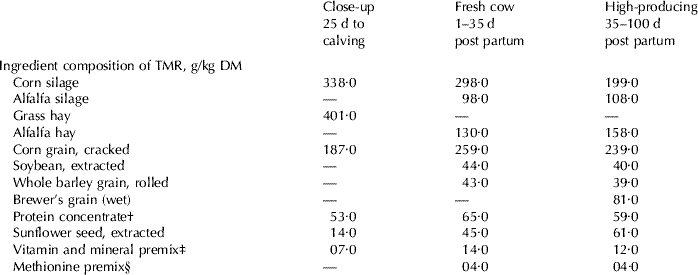
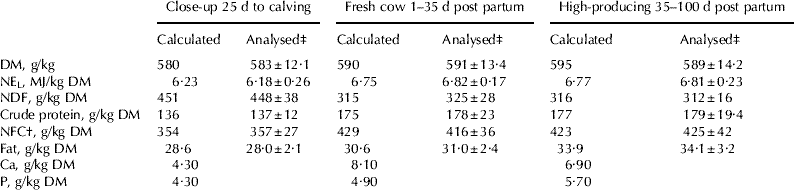
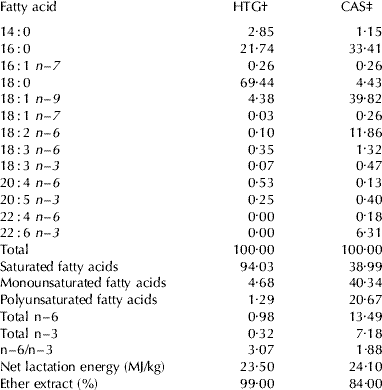
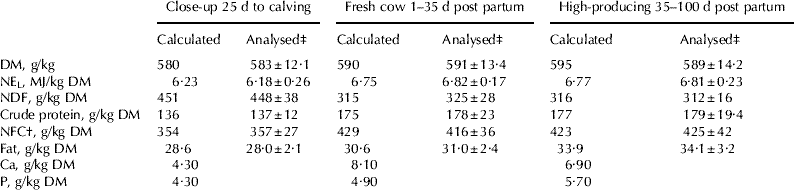
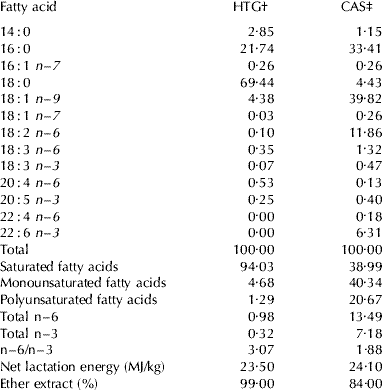
All cows were fed corn silage-based diets (Tables 1 and 2) either without fat supplementation (control), or with 11·75 MJ NEl per day of calcium soaps of palm oil fatty acids (CAS; Magnapack® Norel S.A. 28007 Madrid, Spain) or with 11·75 MJ NEl per day of hydrogenated palm oil triglyceride (HTG; Alifet® ERBO Agro AG, 4922 Bützberg, Switzerland). Chemical compositions of the fats used in the experiment are shown in Table 3. CAS was rich in saturated 16:0, monounsaturated 18:1n-9 and polyunsaturated 18:2n-6 fatty acids, whereas the major fatty acid components of the HTG supplement were 16:0 and 18:0. Supplementary fats were blended with the daily portion of the protein concentrate and mineral and methionine premix and added to the TMR of cows in two equal proportions before feeding. Experimental diets were fed from 25±3 d prior to the expected calving up to 100±5 d post partum. Diets were balanced according to the guidelines of NRC (2001). Energy density of the diets applied in the dry period (close-up diet: 6·23 MJ/kg DM) was increased after calving (fresh cow or high-producing diets: 6·75 and 6·77 NEL MJ/kg DM, respectively) by increasing concentrate proportions.
Composition of control diets
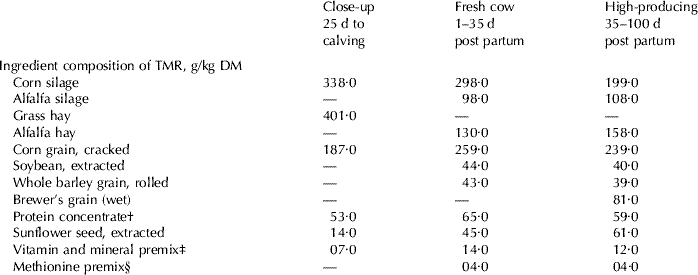
† Natur-Prot, Agronatur Kft., Kapuvár, Hungary (NEL: 7·00 MJ/kg, DM:88·00, rumen-undegraded dietary protein: 45·00, CP:40·00, NDF: 11·5, ADF: 6·5, Fat: 2·8, Lys: 1·50, Met: 0·50, Met+Cys:1·10% DM)
‡ Profisan® TMR, Sano-Modern Takarmányozás Kft., Hungary
§ Smartamine® M, Adisseo France S.A.S. (100 g/cow per day premix contain 88 g bran and 12 g Smartamine® M (75% Met)
Calculated and analysed chemical composition of control diets
† Non-Fibre Carbohydrates
‡ Means of analysed values±sd
Fatty acid composition of the fat supplementations used in the experiment (weight percent of total)
† Hydrogenated triglyceride of palm oil (Alifet®; ERBO Agro AG, 4922 Bützberg, Switzerland)
‡ Calcium soap of palm oil fatty acids (Magnapack®; Norel S.A. 28007 Madrid, Spain)
Collection of samples and chemical analyses
Samples of TMR were collected weekly for analysis. The amount of feed refused was recorded daily per group, collected weekly and sampled for analysis. TMR samples were analysed for DM, crude protein (CP), ether extract and ash by the methods of the AOAC (1997) and for neutral detergent fibre (NDF) according to van Soest et al. (Reference Van Soest, Robertson and Lewis1991). Non-fibre carbohydrate (NFC) content was calculated according to NRC (2001). DM intake (DMI) of the groups was calculated daily from the difference between feed DM offered and feed DM refused. Data were grouped weekly and these weekly subsets were evaluated statistically.
The individual daily milk production was recorded daily and milk samples were taken at both the morning and afternoon milking by Tru Test (Auckland, New Zealand) milk meter on days 7, 35, 63 and 100. Morning and evening milks were mixed in representative proportions and were homogenized by vortexing them for 30 s. Homogenized samples were frozen and stored for fat protein and lactose analyses. Fat-corrected milk yield kg (FCM, containing 40g/kg fat) was calculated using the following equation: FCM=MY×FAT/40 (MY=daily milk yield in kg; FAT=fat content of the milk in g/kg).
At 25±2 d and 15±2 d prepartum, and also on 5±2 d and 25±3 d post partum, liver tissue samples were collected and on the same days, as well as at 100±5 d post partum, blood samples were collected from the jugular vein of each cow into heparinized tubes. Liver samples were taken from the 11th intercostal space by percutaneous biopsy using an aspiration needle of 7-mm diameter (Vekas, 4033 Debrecen, Hungary) under local anaesthesia with 10 ml of 2% lidocaine. Liver and blood samples were stored on ice until the analysis.
Laboratory procedures
Following melting and homogenization (vortexing for 30 s) of milk samples, fat was determined by the method of Folch et al. (Reference Folch, Lees and Sloane-Stanley1957). Nitrogen content was measured by the Kjeldahl method (Helrich, Reference Helrich1990). Lactose was analysed by near infrared spectroscopy using a FOSS 6000 instrument (Foss North America Inc., Eden Praire MN, USA). Total lipid was extracted from the liver samples by the method of Folch et al. (Reference Folch, Lees and Sloane-Stanley1957). Based on the lipid weight, the dry extracts were dissolved in different volumes of isopropanol (range 2 to 8 ml; Piepenbrink & Overton, Reference Piepenbirk and Overton2003) then they were analysed for triglyceride content (TGL) using a commercial test kit (Reanal Fine Chemicals Co., Budapest, Hungary; intra- and interassay CV%: 2·1 and 6·4, respectively) with isopropanol as a blank.
Heparinized blood samples were centrifuged and chemical analyses of the blood plasma were made on the day of blood collection. GLU, AST, blood plasma triglyceride (TGB) and cholesterol (CHOL) were measured by commercial test kits obtained from Diagnosticum Ltd. (Budapest, Hungary). NEFA and BHBA were measured by RANDOX test kits (Randox Ltd., Crumlin, Ireland). Intra-/interassay CV % for blood analyses were as follow: GLU 0·70/1·25; NEFA 1·37/1·81; TGB 0·64/2·8; CHOL 0·72/01·45; BHBA 0·84/1·35; AST 1·93/4·23. For INS measurement, the plasma was kept at −20°C until the end of the experiment and all analyses were performed on the same day. Plasma INS content was quantified as free insulin with a commercial 125I-labelled radioimmunometric sandwich assay kit (BI-Insulin IRMA kit; CIS Bio International Ltd—Subsidiary of Schering S.A., Gif-Sur-Yvette, France; sensitivity: 0·86 pmol/l; intra- and interassay CV: 1·3–5·6% and ⩽8·5%, respectively). The assay had previously been validated for bovine plasma and serum samples (Cavestany et al. Reference Cavestany, Kulcsár, Crepsi, Chilliard, La Manna, Balogh, Keresztes, Delavaud and Huszenicza2009).
Statistical analysis
Milk production and composition, DMI, liver triglyceride, plasma metabolite and hormone concentrations were evaluated by MIXED procedure of SAS (SAS Institute, 2006) for repeated measurements using the following model:

where
Yijk=the dependent variable
μ=overall mean
Ti=treatment effects
A(i)j=random effects of animal within treatments
Dk=effects of sampling date or time,
(T×D)ik=interaction effects of treatments and sampling date or time, and
εijk=the residual error associated with the ijk observation
Mean comparisons were carried out using the Tukey-Kramer test, and differences were considered significant at P<0·05 unless stated otherwise.
Results
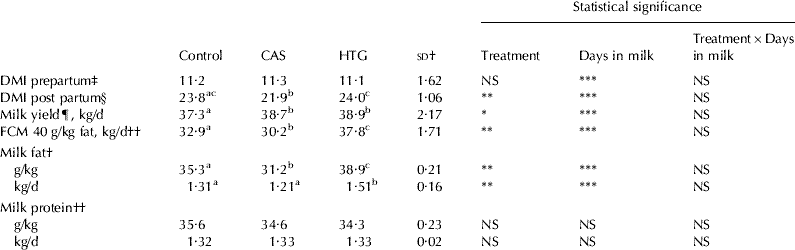
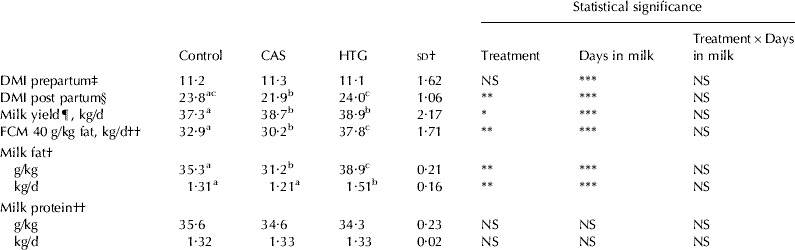
Average values for DMI, milk production, milk composition and yield of milk components are presented in Table 4. No significant effect was found in the prepartum DMI among dietary treatments. However, post-partum DMI was lower (P<0·01) in the CAS group than either in the control or the HTG group. Compared with the control, both CAS and HTG supplementation resulted in an increase (P<0·05) of the average milk yield (Table 4). Milk fat content and FCM yield were higher (P<0·01) in the HTG but lower in the CAS group than in the control. Milk fat production was higher in the HTG group compared with either the control group or the CAS group. Dietary treatments had no effect (P>0·05) on the average milk protein content or on the daily protein yield, as well as on the average milk protein or lactose contents or daily yields. No interactions between treatments and DIM were detected for any variables mentioned above.
Effect of CAS (calcium soap of palm oil fatty acids) and HTG (hydrogenated triglyceride of palm oil) supplementations on dry matter intake (DMI), milk production and milk composition (means, n=10)
† Pooled sd
‡ Corresponds to DMI from 25 d prepartum until calving
§ Corresponds to DMI from calving until 100 days postpartum
¶ Corresponds to samples through 100 days in milk
†† Corresponds to samples on days 7, 21, 42 and 98 after parturition
* P<0·05; ** P<0·01; *** P<0·001
abc Means marked with different letters show significant differences among treatments (P<0·05)
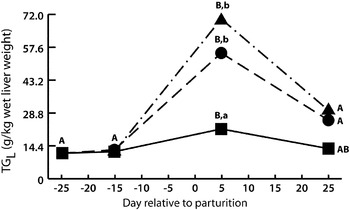
TGL concentrations of the cows are shown in Fig. 1. At 5 d post partum, TGL content of HTG cows was significantly lower than either in the control or in the CAS cows. At 5 d post-partum TGL showed a 6·2-, 4·9- and 1·9-fold increase in the control, CAS-treated and HTG-treated cows respectively relative to the value measured at the beginning of the experiment (−25 d). At 25 d post partum, in CAS and control cows TGL content decreased to about half the concentration measured in both groups at 5 d post partum; however, no significant differences were detected among the dietary treatments at that time.
Liver triglyceride content (g/kg wet weight) in dairy cows fed diets supplemented with calcium salts of palm oil (CAS: ▪), hydrogenated triglycerides of palm oil (HTG: ▴) or without fat supplementation (control: •). Values are means of 10 cows. Pooled sd=12·4, 8·1, and 16·45 g/kg for CAS, HTG, and control, respectively. Treatment by days in milk (DIM) interaction=0·67, DIM=P<0·001 and treatment=P<0·01. Means without a common superscript letter are significantly different (P<0·05): abcbetween dietary treatments; ABCbetween DIM.

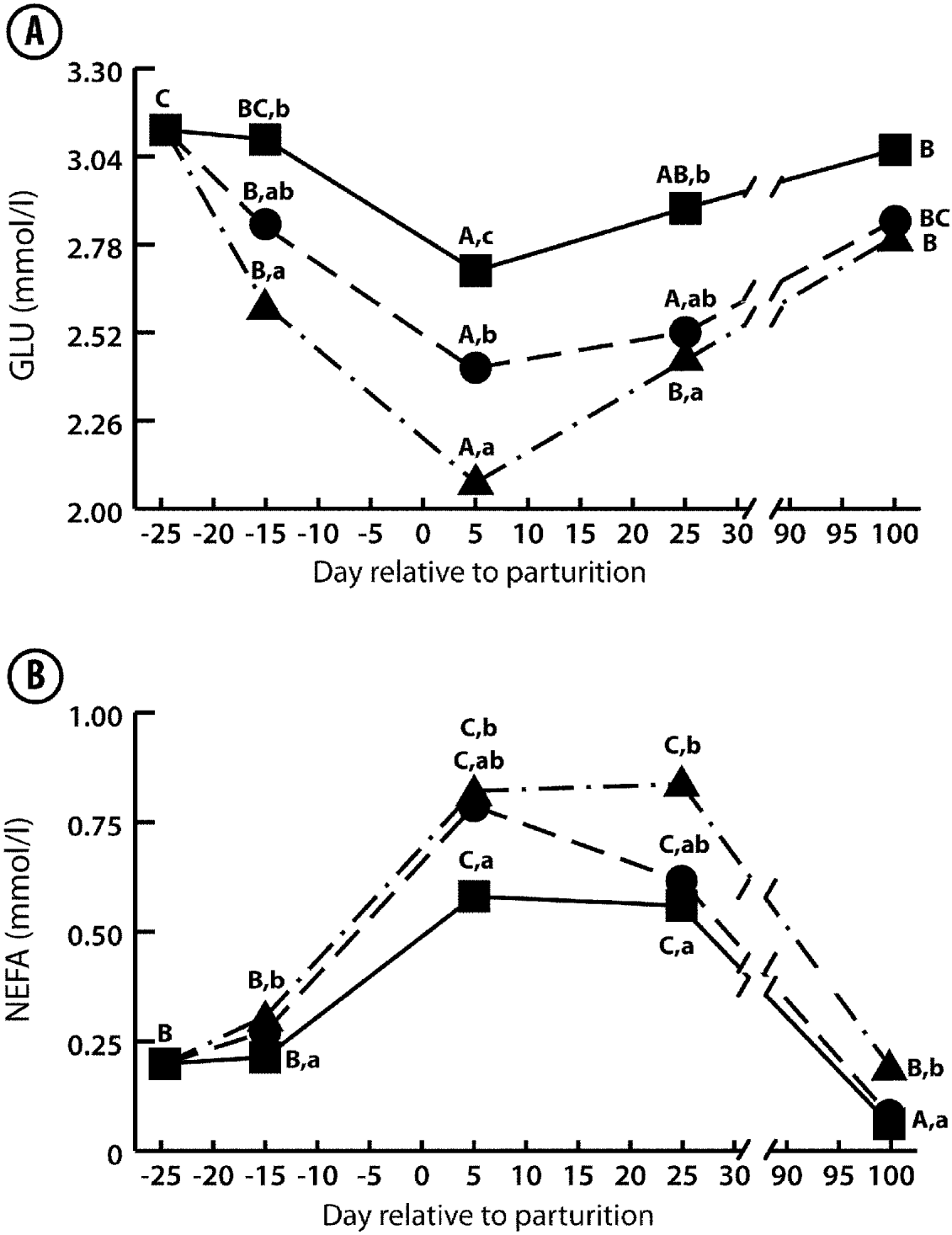
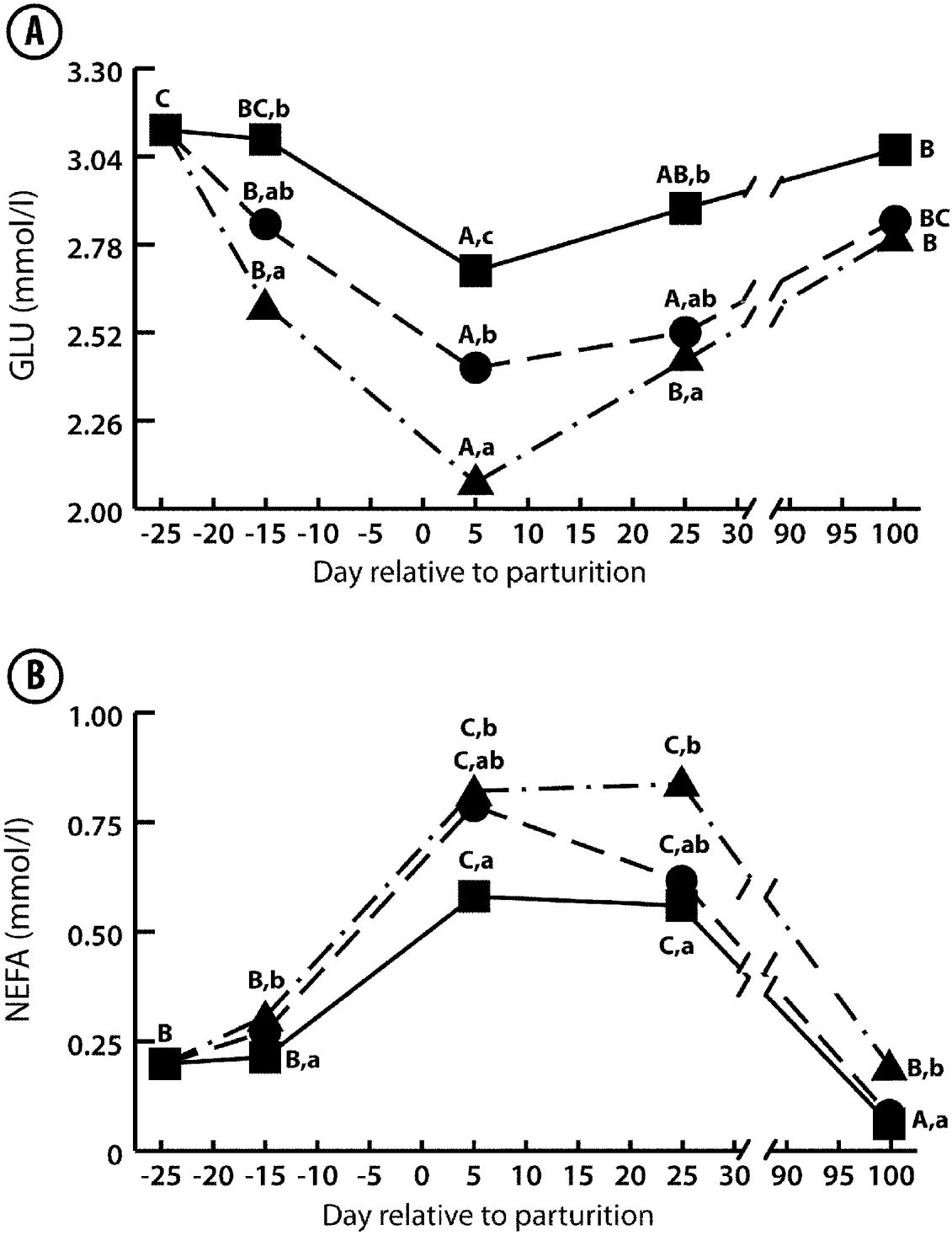
No significant treatment effects were found in TGB and CHOL concentrations. Both HTG and CAS animals had higher (P<0·05) blood GLU concentration than did the control animals at 5 d sampling (Fig. 2). However, a lower GLU concentration was found in CAS than in HTG cows at this time of sampling. GLU concentrations decreased (P<0·01) from 25 d prepartum to 5 d post partum, and increased thereafter. The rate of decrease was about 33% and 23% in the control and CAS group, respectively, while it was only 10% in HTG cows. Lower (P<0·05) NEFA was found in HTG cows than in the other two groups both at 5 d and 25 d post partum. NEFA concentrations showed a 2–4-fold increase from 15 d prepartum to 5 d post partum, remained on the same level up to 25 d post partum and decreased thereafter (Fig. 2).
Plasma glucose (GLU mmol/l: A) and non-esterified fatty acid (NEFA mmol/l: B) concentrations in dairy cows fed diets supplemented with calcium salts of palm oil (CAS: ▪), hydrogenated triglycerides of palm oil (HTG: ▴) or without fat supplementation (control: •). Values are means of 10 cows. Pooled sd for GLU/NEFA=0·34/0·15, 0·40/0·10, and 0·35/0·14 mmol/l for CAS, HTG, and control, respectively. GLU: Treatment by days in milk (DIM) interaction=0·84, DIM=P<0·01 and treatment=P<0·05; NEFA:=0·63, P<0·001, P<0·05. Means without a common superscript letter are significantly different (P<0·05): abcbetween dietary treatments; ABCbetween DIM.
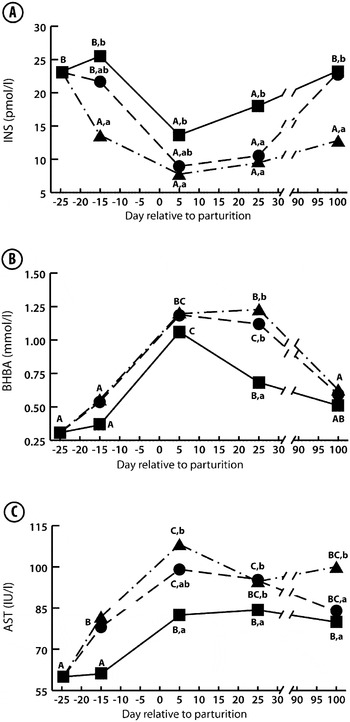
Plasma INS and BHBA concentrations as well as AST activity are shown in Fig. 3. HTG resulted in the highest insulin concentration as compared with the other two treatments at all sampling days post partum. Blood INS decreased from 25 d before calving to 5 d post partum by about 67, 61 and 41% in the control, CAS and HTG cows, respectively. After that day an increase in INS was found in all groups. Dietary effects on plasma BHBA concentrations were detected only at 25 d post partum, when lower concentration (P<0·05) was found in the HTG group than in the control or CAS groups. BHBA concentrations increased from 25 d prepartum to 5 d post partum about 3·5-fold in all cows and remained at that high level at 25 d post partum in control and CAS cows. However, in the HTG group at 25 d, blood BHBA decreased and was about 56% and 62% of that measured in the control and CAS cows, respectively. AST activity in the blood of cows fed the HTG-supplemented diet showed lower values than in the control animals at 5 d and 25 d post partum. Between the two kinds of fat supplementations differences in AST were significant only at 25 d post partum, when HTG cows showed lower values than CAS cows. AST activities also showed an increase in all groups from 25 d prepartum to 5 d post partum. After this time no significant changes were detected in any groups.
Plasma insulin (INS pmol/l: A), beta-hydroxy-butyrate (BHBA mmol/l: B) concentrations and aspartate-aminotransferase (AST IU/l: C) activity in dairy cows fed diets supplemented with calcium salts of palm oil (CAS: ▪), hydrogenated triglycerides of palm oil (HTG: ▴) or without fat supplementation (control: •). Values are means of 10 cows. Pooled sd for INS(pmol/l)/BHBA(mmol/l)/AST(IU/l)=6·4/0·25/17·1, 6·6/0·22/8·5 and 7·2/0·31/13·3 for CAS, HTG, and control, respectively. INS: treatment by days in milk (DIM) interaction=0·94, DIM=P<0·001 and treatment=P<0·05; BHBT: 0·68, P<0·001, P<0·01; AST: 0·96, P<0·001, P<0·01. Means marked without a common superscript letter are significantly different (P<0·05): abcbetween dietary treatments; ABCbetween DIM.

Discussion
Both types of palm oil supplementation used in this study increased the milk yield over the control diet without fat supplementation. However, CAS and HTG had a different effect on DMI, milk fat content and daily milk fat yield. While CAS decreased post-partum DMI and milk fat content and daily fat yield, HTG had no effect on DMI but increased milk fat content and fat yield. In the study of Allen (Reference Allen2000) the effects of fat sources on feed intake were evaluated statistically for several categories of supplemental fat used in different experiments. Significant decreases were observed in DMI for calcium salts of palm oil fatty acids in 22 of the 24 comparisons. Typically, unprotected unsaturated fats have a negative effect on DMI, milk yield and milk fat (Drackley et al. Reference Drackley, Overton, Oritz-Gonzalez, Beaulieu, Barbano, Lynch and Perkins2007). In a previous study Drackley et al. (Reference Drackley, Klusmeyer, Trusk and Clark1992) demonstrated that abomasally infused unsaturated fatty acids, but not saturated fatty acids, were potent inhibitors of DMI. Relling & Reynolds (Reference Relling and Reynolds2007) found that the decrease in DMI observed when supplemental fat was fed was associated with an increase in the plasma concentration of glucagon-like peptide-1 (a gut peptide hormone with hypophagic effects). The concentrations of this hormone were highest when fats high in monounsaturated fatty acids (MUFA) and polyunsaturated fatty acids (PUFA) were fed and DMI was the lowest. In our current experiment MUFA+PUFA proportion in CAS was 61% and that of HTG was only 6%. Differences in DMI between CAS and HTG cows can be related to differences in fatty acid composition between these two types of fats. The higher milk fat concentrations of HTG cows found in this experiment are in agreement with the reports of Mosley et al. (Reference Mosley, Mosley, Hatch, Szasz, Corato, Zacharias, Howes and McGuire2007) who observed a higher milk fat percentage in milk of cows fed a diet supplemented with palm oil fatty acids containing more than 95% of saturated fatty acids. These results prove that HTG supplementation can be used efficiently in high-yielding dairy cows in early lactation, when the energy balance is negative, without resulting in a decrease in DMI.
The two types of dietary fat supplementation had different influences on TGL content and on the metabolic blood variables measured. Compared with the untreated controls, the addition of HTG to the diet resulted in a lower TGL concentration in the cows in the critical post-partum period, 5 d after calving. Cows fed the CAS-supplemented diet did not show this beneficial consequence. These findings in the CAS group confirm the report by Douglas et al. (Reference Douglas, Overton, Bateman and Drackley2004) in which supplemental rumen-active fat containing about 52% unsaturated fatty acids and fed in isocaloric diets containing either similar or different proportions of non-fibre carbohydrate (NFC) did not affect peripartal lipid accumulation in liver tissue. However, there must be a specific and significant effect of feeding fat in the prepartum period. Andersen et al. (Reference Andersen, Ridder and Larsen2008) conclude that supplementing dry cows with a saturated fatty acid source is a positive strategy for priming dairy cows for body fat mobilization in the following early lactation.
In our experiment, plasma GLU concentrations were in the range between 2·1 and 3·1 mm. These values are somewhat lower than those reported in other studies in peripartal dairy cows (3·3–3·5 mm, Moallem et al. Reference Moallem, Katz, Arieli and Lehrer2007); however, they are quite similar to those (2·0–3·4 mm) observed by Rukkwamsuk et al. (Reference Rukkwamsuk, Rungrung, Choothesa and Wensing2005) in Holstein-Friesian cows in early lactation. Fat supplementations resulted in higher blood GLU concentrations than those found in the control cows at 5 d post partum. On the other hand, HTG resulted in higher plasma GLU than CAS. Grummer & Socha (Reference Grummer and Socha1989) also showed that feeding medium-chain saturated triglycerides caused a slight increase in plasma GLU concentration. These results are supported by the findings of Pickett et al. (Reference Pickett, Piepenbrink and Overton2003), who showed that the feeding of fat supplementations elevated the blood GLU concentration during NEB. Contrary to these results, Moallem et al. (Reference Moallem, Katz, Arieli and Lehrer2007) established that feeding fatty acids containing a low proportion of unsaturated or calcium soaps of unsaturated fatty acids to cows in late pregnancy negatively affected the metabolic status of the cows as reflected by plasma metabolites. Hammon et al. (Reference Hammon, Metges, Junghans, Becker, Bellmann, Schneider, Nürnberg, Dubreuil and Lapierre2008) reported a glucose-sparing effect of rumen-protected fat in the diet of dairy cows despite plasma GLU concentrations being lower than those detected in cows fed a diet supplemented with corn starch.
During the transition period, reduced INS concentration is partially in the background of energy mobilization. Hypoinsulinaemia promotes lipid mobilization, hypoinsulinaemia stimulates lipid mobilization and NEFA mobilized from adipose tissue serves as an alternative energy source for tissues to save on glucose, which is preferentially used by the mammary gland to form lactose (Vernon, Reference Vernon, Kaske and Scholz2002). In the HTG group the plasma INS concentrations were higher than in the control group at all the sampling times after the fat supplementations. The higher plasma insulin also explains the higher plasma GLU and the lower plasma NEFA concentration detected in the HTG group and our hypothesis about the better energy balance of these cows. These results indicate a less intensive lipid mobilization from adipose tissue.
The lower plasma AST activity measured in the HTG group can be explained by the less expressed plasma NEFA and TG infiltration in the liver of the HTG cows as compared with animals of the other two groups. Dale et al. (Reference Dale, Vik-Mo and Fjellheim1979) also showed that NEFA concentration was positively correlated with AST activity in high-yielding lactating cows.
Increasing the energy density of the diet has been suggested as a means of improving energy balance (EB) in peripartal high-yielding dairy cows (NRC, 2001). Besides energy density, however, dietary energy source is also an important factor in the prevention of NEB and the related metabolic disorders. The characteristics of NEB-related metabolic problems suggest a role for the balance in the availability of lipogenic and glucogenic nutrients (van Knegsel et al. Reference Van Knegsel, van den Brand, Dijkstra, Tamminga and Kemp2005). Van Knegsel et al. (Reference Van Knegsel, van den Brand, Dijkstra, Straalen, Jorritsma, Tamminga and Kemp2007) found that a glucogenic diet was more effective in improving EB and reducing metabolic disorders in multiparous dairy cows than a lipogenic diet containing palm oil. Post-partum diets with a high proportion of concentrate often contain high proportions of fermentable carbohydrate and low amounts of fibre to maximize energy intake, which increases the risk of ruminal acidosis resulting in decreased milk production, premature culling and increased death loss (Krause & Oetzel, Reference Krause and Oetzel2005). To avoid acidosis and other metabolic problems, the recommended maximum concentration of NFC is approximately 30–40% of ration DM (NRC, 2001). In our experiment, fresh cow and high-producing cow TMR contained 416 and 427 g/kg (DM) NFC, respectively. The results of this experiment show that under such conditions, when NFC concentration is high in the diet, a further increase of energy density with rumen inert fats may be advantageous.
From the metabolic point of view, great differences have been suggested to exist between the different fat supplementations in their physical and chemical properties including their fatty acid composition (Weiss & Wyatt, Reference Weiss and Wyatt2004) or their different degree of saturation (Relling & Reynolds, Reference Relling and Reynolds2007). Furthermore, rumen-protected fats with high proportions of unsaturated fatty acids are more obvious in increasing plasma NEFA concentrations and depressing plasma insulin concentrations than fats with a low proportion of unsaturated fatty acids (Moallem et al. Reference Moallem, Katz, Arieli and Lehrer2007).
This study was financially supported by the National Scientific Research Fund of Hungary (OTKA) projects No. K 61566 and K 68779.