Nomenclature
- AI
-
artificial intelligence
- UAM
-
urban air mobility
- UAV
-
unmanned aerial vehicle
- XAI
-
explainable artificial intelligence
1.0 Introduction
Low-altitude flight technology, particularly unmanned aerial vehicles (UAVs) or drones, has seen widespread global adoption [Reference Shokirov, Abdujabarov, Jonibek, Saytov and Bobomurodov1–Reference Motlagh, Taleb and Arouk3]. From military operations to civilian and commercial applications, and from scientific research to media production, the evolution of low-altitude aircraft has been at the forefront of technological innovation [Reference Huang, Fang, Wu, Wang and Yang4, Reference Srikumar5]. The integration of artificial intelligence (AI) not only enhances aircraft autonomy but also improves the drones’ capabilities in perception, decision-making and task execution [Reference Caballero-Martin, Lopez-Guede, Estevez and Graña6–Reference Suryanarayana8]. AI enables better coordination of low-altitude flights, allowing for the control of multiple drones working in unison within the same airspace [Reference Caballero-Martin, Lopez-Guede, Estevez and Graña6, Reference Buchelt, Adrowitzer, Kieseberg, Gollob, Nothdurft, Eresheim, Tschiatschek, Stampfer and Holzinger7]. Through real-time sensing, intelligent decision-making, and autonomous control, AI-driven drone swarms can efficiently complete tasks in complex low-altitude environments [Reference King9–Reference Liu, Lin, Huang and Yan12]. Initially, drones were primarily used in the military for reconnaissance and strike missions, significantly reducing the risk to soldiers in dangerous zones [Reference Liu, Huang, Yan, Zhang, Liu and Liu13, Reference Lin, Yan, Zhang, Li, Meng and Liu14]. With advances in technology, their use has expanded from military purposes to a broad range of civilian and commercial applications [Reference Rao, Gopi and Maione15–Reference Konert, Smereka and Szarpak17]. Nowadays, drones are common in urban skies, performing a wide range of tasks from delivering packages and conducting surveys to monitoring public safety [Reference Konert, Smereka and Szarpak17, Reference Bamburry18]. In recent years, major companies like Amazon and Google have been heavily invested in developing AI-based low-altitude flight services, including drone-based logistics and air taxis [Reference She and Ouyang19]. To be more specific, AI is revolutionising drone-based logistics and smart urban transportation by enhancing efficiency, safety and scalability. In the field of drone-based logistics, AI algorithms enable autonomous navigation, real-time obstacle detection and dynamic route optimisation, allowing drones to deliver goods swiftly and reliably in complex environments [Reference Caballero-Martin, Lopez-Guede, Estevez and Graña6, Reference Banjar, Jemmali, Melhim, Boulila, Ladhari and Sarhan20]. Machine learning models analyse vast amounts of data to predict demand patterns, optimise inventory management and streamline supply chains, reducing delivery times and operational costs. In the realm of smart urban transportation, AI facilitates the integration of drones with existing infrastructure by managing air traffic control. Additionally, AI-powered systems enhance safety through predictive maintenance, anomaly detection, and automated decision-making, mitigating risks associated with autonomous operations [Reference Illiashenko, Kharchenko, Babeshko, Fesenko and Di Giandomenico21]. By using AI, drone-based logistics and smart urban transportation systems can adapt to evolving urban landscapes, respond to real-time challenges, and provide scalable solutions that address the growing demands of modern cities. For example, Amazon’s Prime Air project aims to deliver packages to customers within 30 minutes, showcasing the enormous potential of drones in the logistics sector. Similarly, Google’s Wing has been actively testing drone delivery services in multiple countries. Meanwhile, companies like Uber and Hyundai Motor are working on air taxi solutions (Urban Air Mobility, UAM), which promise to ease urban traffic congestion while signaling the future of smart urban transportation [Reference Cohen, Shaheen and Farrar22–Reference Rajendran and Srinivas24]. These cases clearly illustrate the immense opportunities the AI brings to the development of low-altitude flight technology.
However, with the widespread application of AI in low-altitude flight, issues such as privacy invasion, security risks and ethical responsibilities have sparked significant societal debate [Reference Huang, Fang, Wu, Wang and Yang4, Reference Yahuza, Idris, Ahmedy, Wahab, Nandy, Noor and Bala25]. The increasing prevalence of drones has exposed individuals to surveillance cameras more frequently, and the low-altitude nature of drone operations has heightened the risk of personal privacy breaches [Reference Jain, Gambhir and Pandey26, Reference Saleh, Jhanjhi and Abdullah27]. Many are concerned about the potential for governments and corporations to misuse drone surveillance technology, infringing on personal privacy rights [Reference Yahuza, Idris, Ahmedy, Wahab, Nandy, Noor and Bala25, Reference Shelley28]. Additionally, technical failures or misjudgements in AI-driven drones could lead to catastrophic consequences, particularly in densely populated urban areas where such incidents may pose severe safety risks. The ethical concerns surrounding AI-driven drones are even more complex [Reference Batabyal29]. For instance, who should be held accountable for the decisions made by AI-driven drones? When drones operate autonomously, is there an ‘ethical decision-making’ mechanism in place? These questions remain unresolved and present significant challenges for the future development of AI applications in low-altitude flight technology.
1.1 Definition of AI-based low-altitude flight
Low-altitude flight typically refers to airspace below 150 meters, a zone that has long been challenging for traditional aircraft like helicopters and fixed-wing planes to navigate effectively due to complex terrain, dense buildings and various obstacles [Reference Motlagh, Taleb and Arouk3, Reference Watkins, Thompson, Loxton and Abdulrahim30, Reference Chen, Zhang, Zhuang and Hu31]. However, with the rapid advancement of UAV technology – particularly the development of AI-driven autonomous flight systems – low-altitude flight has become far more flexible and efficient [Reference Tipaldi, Feruglio, Denis and D’Angelo32]. UAVs can now fully exploit this underutilised airspace to perform a wide range of complex tasks, offering innovative solutions across many sectors of modern society [Reference Bauranov and Rakas33]. AI-based low-altitude flight systems are capable of autonomous flight, real-time environmental perception, and decision-making in dynamic and complex conditions [Reference Suryanarayana8, Reference Jain, Gambhir and Pandey26, Reference Tipaldi, Feruglio, Denis and D’Angelo32–Reference Maguluri, Arularasan and Boopathi34]. These systems often integrate advanced sensors, image processing algorithms, machine learning technologies and global navigation support (such as GPS), enabling drones to operate safely in unpredictable environments. By processing real-time data about their surroundings, drones can automatically avoid obstacles, adapt to changing weather conditions, and autonomously select the optimal path to efficiently complete their assigned tasks [Reference Saeed, Omri, Abdel-Khalek, Ali and Alotaibi35, Reference Shakhatreh, Sawalmeh, Al-Fuqaha, Dou, Almaita, Khalil, Othman, Khreishah and Guizani36].
1.2 Scenarios of AI applications in low-altitude flight
AI-based low-altitude aircraft are being widely adopted across various sectors, including: (a) Logistics and delivery: AI enhances drone logistics by enabling advanced route optimisation, autonomous navigation and real-time decision-making. In congested urban areas, AI algorithms analyse traffic patterns and environmental conditions to determine the most efficient delivery paths, thereby improving delivery speed and reducing carbon emissions. In remote regions, AI-powered drones can autonomously navigate challenging terrains to provide rapid delivery of essential goods and medical supplies. Companies like Amazon’s Prime Air and Google’s Wing leverage AI for predictive maintenance, ensuring drones operate reliably and efficiently during extensive delivery trials [Reference Rejeb, Rejeb, Simske and Treiblmaier37, Reference Perera, Dawande, Janakiraman and Mookerjee38]; (b) urban air traffic: as urbanisation accelerates, AI is essential for managing the increasing complexity of urban air traffic. AI-driven urban air taxis (UAM) utilise machine learning algorithms to coordinate flight schedules, optimise airspace usage and ensure safe and efficient operations. AI systems facilitate autonomous flight capabilities, allowing drones to navigate through densely populated areas while avoiding collisions and minimising noise pollution. Additionally, AI integrates drones into existing transportation infrastructures by managing traffic flow and dynamically adjusting routes based on real-time data, making UAM a viable component of future urban transport systems [Reference Cohen, Shaheen and Farrar22–Reference Rajendran and Srinivas24, Reference Wang, Delahaye, Farges and Alam39]; (c) security and surveillance: in the realm of public safety and surveillance, AI enhances the functionality of drones through intelligent monitoring and threat detection. AI algorithms process vast amounts of real-time data from onboard sensors and cameras to identify suspicious activities, assess threats and make rapid decisions during emergencies. For example, AI-driven drones can perform automated perimeter security, conduct real-time threat assessments, and coordinate emergency response efforts. In disaster zones, AI enables drones to autonomously map affected areas, locate missing persons using pattern recognition and support rescue teams with actionable insights, thereby improving the effectiveness and speed of recovery operations [Reference Završnik40, Reference Mir and Moore41]; (d) military applications: AI-driven drones are transforming modern warfare by providing enhanced autonomy, precision and operational flexibility. In military contexts, AI enables drones to conduct deep reconnaissance missions with minimal human intervention, analysing terrain and enemy movements in real-time to gather intelligence. AI algorithms facilitate autonomous decision-making for precision strikes, allowing drones to identify and engage targets with high accuracy while minimising collateral damage. Additionally, AI enhances the swarm capabilities of military drones, enabling coordinated attacks and complex mission executions that increase combat effectiveness and reduce the risk to human [Reference Adnan and Khamis16, Reference Petrovski, Radovanović and Behlić42]. See Fig. 1 for the application of AI-based low-altitude aircraft.
AI-based low-altitude aircraft are being widely adopted across various sectors.Footnote 1

While AI-based low-altitude flight systems offer immense potential, they also raise significant ethical challenges [Reference Huang, Fang, Wu, Wang and Yang4, Reference Al-Turjman and Zahmatkesh43]. Drones can collect images and videos at any time, raising concerns about privacy infringement by government, corporate or private-owned drones. Additionally, the ethical implications of AI’s autonomous decision-making are complex [Reference Osasona, Amoo, Atadoga, Abrahams, Farayola and Ayinla44, Reference Caro-Burnett and Kaneko45]. For instance, when a drone faces multiple undesirable options during a mission, how should it make ethical choices? This issue becomes especially sensitive in military applications. Can AI-driven drones consider ethical factors like civilian protection during attack missions?
From the studies aforementioned, AI-based low-altitude flight systems are revolutionising numerous industries, but as these technologies advance, society must also address the challenges they bring. While benefiting from the convenience they offer, we must carefully manage issues such as privacy protection, technological failures, and gaps in legal frameworks.
This article aims to thoroughly discuss the opportunities and ethical challenges brought about by AI in low-altitude flight, with a focus on privacy protection, accountability, militarisation risks and legal oversight. It will first discuss the opportunities presented by AI-based low-altitude flight and then delve into its ethical challenges. Finally, the article will propose potential solutions to maintain a balance between innovation and moral responsibility in the future.
2.0 Opportunities brought by AI-based low-altitude flight technology
AI-based low-altitude flight technology has created numerous opportunities, particularly in UAV logistics, urban air traffic and military applications [Reference Suryanarayana8, Reference Rao, Gopi and Maione15, Reference Rajendran and Srinivas24, Reference Li and Kunze46, Reference De Swarte, Boufous and Escalle47]. With the integration of AI in flight control, navigation, decision-making and data processing, low-altitude flight has become smarter, safer and more economically promising. AI fundamentally enhances drone capabilities by enabling higher levels of autonomy, intelligent decision-making and seamless integration with complex systems. This evolution from traditional to AI-enabled drones not only improves performance and reliability but also expands the potential applications of drones in various industries, driving innovation in logistics, urban transportation, environmental monitoring and beyond [Reference Muhammad, Ullah, Lloret, Del Ser and de Albuquerque48].
2.1 AI-based low-altitude flight technology reforms logistics and delivery methods
2.1.1 Technological progress of drone logistics
AI-driven drone logistics technology has been widely adopted in the commercial field, particularly in e-commerce [Reference Rao, Gopi and Maione15, Reference Perera, Dawande, Janakiraman and Mookerjee38, Reference Tsolakis, Zissis, Papaefthimiou and Korfiatis49]. Its rapid rise signifies a profound transformation in logistics and distribution systems. As e-commerce continues to grow, traditional delivery methods have increasingly revealed various bottlenecks, such as long delivery times, traffic congestion-related delays and complex warehouse management challenges. In this context, the emergence of AI-driven drone logistics technology offers a revolutionary solution to these issues. For example, Amazon’s Prime Air project serves as a prominent case of AI-driven drone logistics in action. This initiative aims to provide fast, unmanned express delivery services, particularly focusing on achieving high efficiency in last-mile deliveries. Amazon plans to deliver goods to designated locations within 30 minutes of a customer placing an order [Reference Kocaoglu50, Reference Mandloi, Arya and Verma51]. The autonomous flight capabilities and efficient operations of drones make this project highly promising for saving time and reducing costs.
The role of AI systems in drone logistics is crucial. They not only optimise delivery routes based on real-time data but also analyse vast amounts of environmental information, such as weather conditions, traffic patterns and air congestion, using intelligent algorithms to predict and mitigate potential risks [Reference She and Ouyang19, Reference Rejeb, Rejeb, Simske and Treiblmaier37, Reference Li and Kunze46]. This ensures the safety and efficiency of the delivery process. For instance, if a drone encounters bad weather or a traffic jam, the AI system can automatically adjust the route to avoid delays or accidents. This real-time decision-making capability significantly enhances the flexibility and reliability of drone deliveries [Reference Lin, Lin and Chang52, Reference Benarbia and Kyamakya53]. Additionally, the AI-driven drone logistics system continually optimises its operational efficiency through big data and machine learning technologies. After completing each delivery mission, the drone system automatically records flight data, route information, air traffic conditions, and more, analysing this data to improve future delivery decisions [Reference Krishna Vaddy54]. This self-learning and improvement mechanism allows the drone system to gradually enhance its autonomy and task execution accuracy, paving the way for larger-scale commercial deployment [Reference Chen, Qi, Yin, Chen, Liu and Chen55, Reference Jin, Tian, Shi, Zhao, Duan and Wu56].
AI-driven drone logistics technology also plays a vital role in warehouse management [Reference Ramasamy, Natarajan and Sathyamoorthy57, Reference Manaviriyaphap58]. Unlike traditional logistics, AI-driven drones can seamlessly integrate with warehouse systems to automate the entire process from storage to delivery. Drones can quickly identify and retrieve required goods through the AI system, reducing manual intervention and optimising workflow. This not only enhances the operational efficiency of warehouses but also significantly lowers labor costs and error rates.
2.1.2 Urban and rural logistics needs
Traffic congestion in cities is an increasingly serious problem and has become a common phenomenon in many large cities worldwide. Each year, hundreds of millions of vehicles travel on urban roads, leading to significant resource waste and a decline in quality of life for residents [Reference Batty, Axhausen, Giannotti, Pozdnoukhov, Bazzani, Wachowicz, Ouzounis and Portugali59]. In this context, AI-driven drone logistics holds the potential to alleviate traffic pressure in cities through air transportation [Reference Van Hoang60, Reference Bennani61]. Drones can fly quickly over urban areas, bypassing ground traffic jams and reducing delivery times, particularly during peak hours and in busy neighbourhoods. Their flexibility and efficiency can significantly enhance delivery effectiveness. In addition, rural areas often suffer from inadequate coverage of traditional logistics networks. Many remote regions face material shortages and delivery delays due to insufficient infrastructure and logistics resources. AI-driven drones can bridge this gap by providing faster delivery services, making it easier for residents in these areas to access essential goods and services [Reference Suryanarayana8, Reference Perera, Dawande, Janakiraman and Mookerjee38]. For instance, AI-driven drones can swiftly deliver medical supplies, food and daily necessities to remote villages, greatly improving residents’ quality of life and enhancing emergency response capabilities. For example, in China, JD.com has launched several drone logistics trials aimed at exploring drone applications in rural and remote areas [Reference Xiao, Li, Cao and Xiao62, Reference Li, Shu and Wang63]. The JD.com’s drone delivery network spans multiple provinces, including Guizhou and Shaanxi, successfully addressing delivery challenges faced under traditional logistics models. In some remote mountainous regions, JD drones can quickly deliver supplies to villages despite harsh terrain and weather conditions, significantly improving distribution efficiency and accuracy. Additionally, the JD.com’s drones optimise flight routes and distribution strategies through real-time data analysis, enhancing resource utilisation.
2.1.3 Environmental protection and efficiency advantages in the logistics process
In addition to significantly improving time efficiency, drone logistics has the potential to reduce carbon emissions [Reference Chiang, Li, Shang and Urban64, Reference Goodchild and Toy65]. Traditional vehicle transportation relies on fossil fuels, leading to substantial greenhouse gas emissions and severe environmental impacts. In contrast, the battery-powered design of drone logistics makes it a more environmentally friendly mode of transport, offering unique advantages in promoting sustainable development. By utilising renewable energy sources, such as solar or wind power, to operate drones, reliance on fossil fuels can be further minimised, thereby reducing the carbon footprint of transportation [Reference Chiang, Li, Shang and Urban64–Reference Stolaroff, Samaras, O’Neill, Lubers, Mitchell and Ceperley66].
In both urban and rural delivery contexts, the lightweight design and high efficiency of drones result in significantly lower energy consumption compared to traditional vehicles. Drones do not require the complex structures and heavy engines associated with larger vehicles, enabling them to consume less energy when transporting goods over the same distance. Additionally, the integration of AI technology plays a crucial role in this process. The AI system can analyse transportation routes in real time, predict traffic flow, and intelligently plan flight paths based on weather conditions, helping to avoid unnecessary detours and delays. This enhances transportation efficiency and further reduces energy consumption [Reference Al Duhayyim, Albraikan, Al-Wesabi, Burbur, Alamgeer, Hilal, Hamza and Rizwanullah67].
With environmental protection at its core, AI technology not only facilitates the use of drones in logistics but also offers a new perspective on sustainable development [Reference Krishna Vaddy54]. As global awareness of environmental issues continues to grow, more companies and governments are recognising the importance of green logistics. As an emerging mode of green transportation, the potential of drone logistics lies not only in its economic benefits but also in its significant positive impact on the environment [Reference Chiang, Li, Shang and Urban64–Reference Stolaroff, Samaras, O’Neill, Lubers, Mitchell and Ceperley66].
2.2 AI-based low-altitude flight technology reforms urban air transportation
2.2.1 The current and future developments of flying taxis
Companies such as Uber are developing flying taxis to leverage low-altitude airspace as a solution to the growing challenges of ground transportation [Reference Huang, Fang, Wu, Wang and Yang4, Reference Bauranov and Rakas33, Reference Marzouk68]. These flying taxis can move quickly through dense urban areas, significantly reducing travel time while alleviating ground traffic congestion. With the integration of AI technology, these aircraft will feature automated driving capabilities, which can greatly minimise human error, thereby enhancing passenger safety and travel efficiency [Reference Gordon and Lidberg69]. As computing power increases and sensor technology advances, autonomous driving technology has made significant progress. Current flying taxi prototypes are typically equipped with various sensors, including Laser Imaging Detection and Ranging (LiDAR), cameras and radar, allowing them to collect real-time information about their surrounding environment [Reference Marzouk68, Reference Pan and Alouini70]. Furthermore, AI algorithms process this data and utilise deep learning to achieve autonomy in navigation, obstacle detection and avoidance functions. Through high-precision positioning and dynamic environmental awareness, flying taxis can operate safely within complex urban airspace [Reference Rajendran, Srinivas and Grimshaw71].
In addition, the autonomous driving system continually improves its decision-making capabilities through extensive data training, enabling rapid responses to various emergencies [Reference Muhammad, Ullah, Lloret, Del Ser and de Albuquerque48, Reference Liu, Liu, Tang, Yu, Wang and Shi72]. For example, in the event of adverse weather conditions or equipment failure, the system can automatically select a safe flight path or perform an emergency landing. Advances in these technologies not only enhance the safety and reliability of flying taxis but also lay the foundation for future large-scale applications.
Moreover, to ensure safe and orderly air traffic flow, an AI-based airspace management system is also urgently needed [Reference Tang, Liu and Pan73, Reference Xie, Pongsakornsathien, Gardi and Sabatini74]. This system will monitor aircraft in real time, ensuring that they do not collide or experience other safety incidents during flight. The application of AI technology in airspace management can facilitate automated flight scheduling and route optimisation. By analysing real-time data, the system can predict aircraft operating statuses, automatically adjust routes and avoid potential air conflicts. Additionally, the intelligent airspace management system should be effectively integrated with ground transportation systems to achieve more comprehensive urban traffic management [Reference Shrestha, Oh and Kim75].
2.2.2 Air traffic safety and dispatch
In urban airspace with dense traffic, the real-time data processing capability of AI systems will be crucial for ensuring air traffic safety [Reference Kistan, Gardi and Sabatini76, Reference Degas, Islam, Hurter, Barua, Rahman, Poudel, Ruscio, Ahmed, Begum and Rahman77]. As an increasing number of drones and flying taxis operate over cities, effectively managing and dispatching these aircraft to avoid mid-air collisions and other accidents will be a primary challenge. The introduction of AI technology makes addressing this problem more feasible and efficient.
By integrating real-time data from various aircraft, AI systems can monitor flight statuses in the airspace and collect key parameters such as position, speed, heading, and altitude. This information can be used to dynamically adjust the flight paths of each aircraft, ensuring they maintain a safe distance from one another, thereby effectively reducing the risk of collision [Reference Spandonidis, Giannopoulos, Petsa, Eleftheridis and Sedikos78]. Specifically, AI algorithms can analyse historical data and real-time information using machine learning and deep learning technologies to predict aircraft movement [Reference Dong, Tao, Zhang, Lin and Ai79]. This predictive capability enables the system to make proactive decisions, such as adjusting an aircraft’s altitude or speed when encountering nearby aircraft. Moreover, the AI system can optimise aircraft dispatch based on environmental data (such as weather and wind speed) and traffic flow information, ensuring that flight efficiency and safety are given equal priority.
The application of AI technology extends beyond aircraft dispatch; it also plays a vital role in early warning and handling of potential accidents. Through advanced sensors and monitoring systems, AI can collect real-time information about the surrounding environment, including the location, speed and flight paths of other aircraft. When the AI system detects that the paths of two or more aircraft may intersect, it will immediately issue an alert and automatically adjust the routes of one or more aircraft to avoid a collision [Reference Li, Lin and Jin80]. Additionally, AI can utilise data analysis and simulation technology to construct ‘safe flight’ scenarios. By analysing flight data from various aircraft under different environmental conditions, the AI system can identify the most dangerous flight modes and conditions and formulate response strategies in advance. This data-driven intelligent decision-making can significantly reduce the incidence of air accidents [Reference Chai, Tsourdos, Savvaris, Chai, Xia and Chen81]. To further enhance air traffic safety, AI systems can also facilitate real-time collaboration and information sharing among different aircraft. When an aircraft receives scheduling information from an AI system, it not only adjusts its route accordingly but also relays its flight status and plan updates back to the system [Reference McCormack, Hutchings, Gifford, Yee-King, Llano and D’inverno82, Reference Rosenow, Lee and Li83]. This two-way exchange of information will greatly improve the efficiency of airspace utilisation and ensure that all aircraft can fly safely in dynamically changing environments.
3.0 Ethical challenges brought about by AI-based low-altitude flight
However, with the rapid development of AI in low-altitude flight technology, there are not only a wide range of technical opportunities and social benefits but also many potential ethical challenges [Reference Osasona, Amoo, Atadoga, Abrahams, Farayola and Ayinla44, Reference Caro-Burnett and Kaneko45]. While artificial intelligence has made drones and other low-altitude aircraft more intelligent and efficient, several issues regarding data privacy [Reference Ahmad, Chaturvedi and Masum84], security [Reference Adnan and Khamis16], responsibility distribution [Reference Orr and Davis85, Reference Königs86], and scope of use [Reference Suryanarayana8] remain significant concerns. As these technologies become increasingly prevalent, we must examine these ethical issues with caution to ensure that technological progress aligns with social values and protects the public interest.
3.1 Privacy issues
3.1.1 Drone surveillance and privacy risks
AI-driven drones are capable of efficient wide-area monitoring and are equipped with various sensors, such as high-resolution cameras, infrared imagers and audio acquisition devices, enabling real-time observation of personal activities [Reference Cheng, Wu, Wang, Yin, Li, Chen and Chen87]. While this powerful monitoring capability enhances security, it has also raised widespread concerns about personal privacy [Reference Tan, Zhang, Li and Yu88]. The wide-area monitoring capability of AI-driven drones creates numerous application scenarios, ranging from public safety and traffic monitoring to environmental protection. However, this diversity of monitoring capabilities also introduces potential risks of privacy infringement. Drones can monitor not only public spaces but, in some cases, can illegally enter private areas to collect data, such as in residential neighbourhoods and corporate facilities [Reference Sindiramutty, Jhanjhi, Tan, Yun, Manchuri, Ashraf, Murugesan, Tee and Hussain89, Reference Geldenhuys90]. This intrusion into private spaces may lead to the leakage of personal privacy information. The risks of privacy infringement are primarily manifested in the following aspects:
-
• Illegal storage and dissemination of image data: If the vast amount of image data collected by drones during monitoring is not properly managed, it may be illegally stored or disseminated [Reference Jain, Gambhir and Pandey26, Reference Ajakwe, Kim and Lee91]. If such data falls into the hands of criminals, it could result in the leakage of personal identity information, triggering a series of legal and ethical issues.
-
• Malicious use of data: The data collected by drones may be exploited for malicious purposes, such as tracking specific individuals, harassment, or commercial exploitation. In these cases, the misuse of data not only violates an individual’s right to know and choose but may also cause psychological harm [Reference Yahuza, Idris, Ahmedy, Wahab, Nandy, Noor and Bala25, Reference Benkraouda, Barka and Shuaib92].
-
• Expansion of monitoring scope: As technology advances, the scope of drone monitoring continues to expand. This expansion is not limited to urban public areas but may also encompass rural and remote regions. This pervasive monitoring implies that individuals could be under constant surveillance, further eroding personal privacy [Reference Schlag93, Reference Vacca and Onishi94].
-
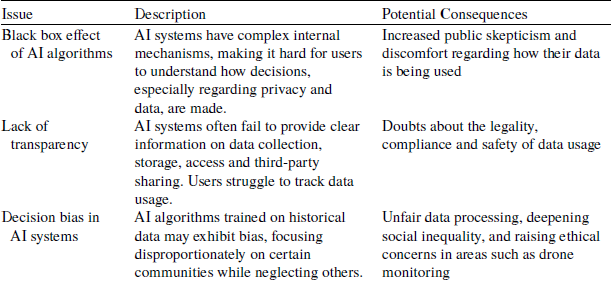
• Data security issues: During the process of collecting and transmitting data, drones face risks of cyberattacks and data leaks. If a drone system is compromised by hackers, sensitive data may be stolen, resulting in broader privacy violations [Reference Yang, Wang, Yin, Wang and Hu95]. See Table 1 for the Privacy issues and their potential consequences of AI-driven drones.
Privacy issues and their potential consequences of AI-driven drones

3.1.2 Transparency of data collection and use
When AI systems operate, they typically collect vast amounts of data, including video, audio and sensor information [Reference Verma, Agrawal, Patel and Patel96]. While this data plays a crucial role in the functioning of AI algorithms, it also raises significant concerns regarding the transparency of data processing [Reference Daneshjou, Smith, Sun, Rotemberg and Zou97, Reference Felzmann, Villaronga, Lutz and Tamò-Larrieux98]. Due to the complexity of the decision-making processes and the ‘black box’ nature of the algorithms, it is often challenging for the public to understand how this data is used or whether it might be shared or sold unlawfully. The opacity of data collection and processing can be reflected in the following aspects:
-
• The black box effect of AI algorithms: AI systems often possess intricate internal mechanisms that make their decision-making processes difficult to comprehend from the outside. This ‘black box’ characteristic hampers ordinary users’ ability to understand how the algorithm arrives at specific decisions, especially concerning personal privacy and data usage, thereby exacerbating public skepticism and unease [Reference Yu and Alì99, Reference Rai100].
-
• Lack of transparency: Most AI systems do not provide adequate transparency in their data collection and processing procedures. Users often struggle to ascertain how their data is utilised, including details about data storage, access rights, intended purposes and potential third-party sharing [Reference Daneshjou, Smith, Sun, Rotemberg and Zou97, Reference Wischmeyer101]. This lack of clarity fosters doubts about the legality and compliance of data usage.
-
• Decision bias in AI systems: Since AI algorithms are typically trained on historical data, they may exhibit bias in certain instances. This algorithmic bias and lack of transparency can undermine the fairness of data processing and negatively impact specific groups [Reference Nadeem, Marjanovic and Abedin102, Reference Ntoutsi, Fafalios, Gadiraju, Iosifidis, Nejdl, Vidal, Ruggieri, Turini, Papadopoulos and Krasanakis103]. For example, in drone monitoring, algorithms may disproportionately focus on certain communities or populations while neglecting others, which not only deepens social inequality but also raises ethical concerns regarding data usage [Reference Corcoran, Denman and Hamilton104]. In particular, we can infer that without transparency, these biases can remain hidden, leading to unfair or discriminatory outcomes in critical applications such as security surveillance, logistics and urban air mobility. For example, in logistics and delivery, biased decision-making could result in inefficient routing that favors certain areas over others, potentially neglecting underserved regions. The lack of transparency also hampers accountability, as it becomes difficult to trace the origins of biased decisions or to implement corrective measures.
See Table 2 for transparency of data collection and their potential consequences of AI-driven drones.
Transparency of data collection and their potential consequences of AI-driven drones

3.2 Security and responsibility allocation
3.2.1 Aircraft loss of control and public safety
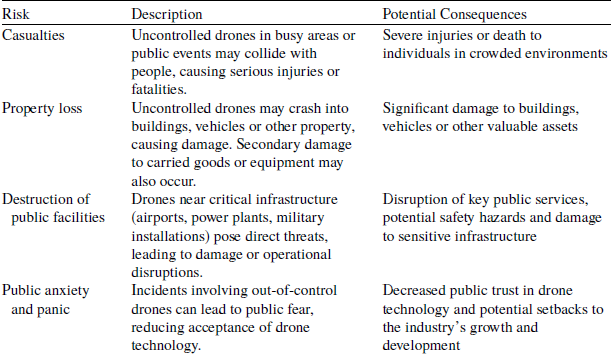
Although AI-driven drones are highly intelligent and automated during flight, they can pose a serious threat to public safety if they lose control, especially in densely populated urban areas or near critical facilities. Such a loss of control can lead to property damage and directly jeopardise personal safety, potentially resulting in catastrophic consequences in the worst-case scenario [Reference Yaacoub, Noura, Salman and Chehab105]. Therefore, ensuring the safe operation of drones – particularly in public spaces – is a crucial issue that demands attention in the current technological landscape. The loss of control of drones can lead to various catastrophic outcomes, including the following:
-
• Casualties: In busy city centres or at public events, an uncontrolled drone may collide with people, resulting in serious injuries or fatalities [Reference Rogers106].
-
• Property loss: A drone that loses control may directly strike buildings, vehicles or other properties, causing significant damage. Additionally, it may result in secondary damage to the goods or equipment it carries [Reference Perritt107].
-
• Destruction of public facilities: Near critical infrastructure – such as airports, power plants or military installations – uncontrolled drones can pose a direct threat to these sensitive areas, leading to damage to facilities or disruptions in operations [Reference Clarke and Moses108]. This not only affects the normal functioning of these facilities but may also create broader safety hazards.
-
• Public anxiety and panic: Incidents involving out-of-control drones can lead to public fear and anxiety, decreasing acceptance of drone technology and potentially hindering the overall development of the drone industry [Reference Hijazi, Ferguson, Richard Ferraro, Hall, Hovee and Wilcox109, Reference Capizzi, Napoli, Russo and Wozniak110]. See Table 3 for security risks and their potential consequences of AI-driven drones.
Security risks and their potential consequences of AI-driven drones

3.2.2 Technical failure and responsibility
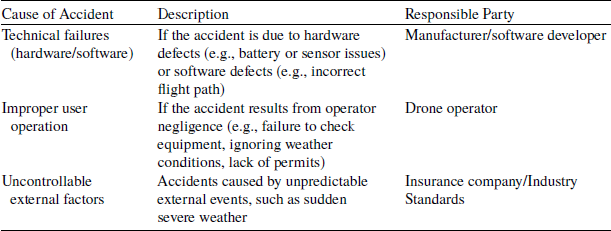
Accidents caused by technical failures during drone flights are increasingly prevalent issues, particularly within AI-driven drone systems. While AI-enabled aircraft boast advanced intelligence and the capability to operate autonomously in complex environments, they remain vulnerable to failures such as loss of GPS signals, sensor malfunctions, algorithmic errors and battery depletion. These AI-specific failures can result in loss of control, crashes or other safety incidents, posing substantial threats to personal safety and property. The integration of AI systems adds complexity to the attribution of responsibility for these accidents. AI-driven drones rely on machine learning algorithms and autonomous decision-making processes, which can obscure the direct causes of failures and complicate the identification of accountable parties [Reference Königs86, Reference Santoni de Sio and Mecacci111]. The following common situations warrant further clarification regarding responsibility:
-
• Accidents caused by technical failures: If the cause of an accident is a defect in hardware design or a quality issue, the manufacturer should bear the corresponding legal responsibility [Reference Susini112, Reference Plioutsias, Karanikas and Chatzimihailidou113]. This responsibility may include recalling the product, providing compensation or implementing other corrective measures. For instance, if a battery underperforms or a sensor malfunctions, it may be deemed the manufacturer’s fault. Conversely, if the accident results from software algorithm defects – such as incorrect flight path planning or environmental misjudgement – the software developer may be held accountable. In such cases, it is crucial to review the software testing processes, update maintenance and how user feedback is handled.
-
• Improper operation by the user: If a drone operator fails to adhere to safe operating procedures and an accident ensues, the responsibility should fall on the user [Reference Sabino, Almeida, de Moraes, da Silva, Guerra, Malcher, Passos and Passos114]. For example, if the operator neglects to conduct regular equipment checks, ignores weather conditions or fails to obtain necessary flight permits, these actions may result in the operator being held responsible for the incident.
-
• Accidents caused by uncontrollable external factors: In certain cases, accidents may occur due to unforeseen external factors, such as sudden severe weather [Reference Oncu and Yildiz115, Reference Han, Yang, Zhao, Guan and Wang116]. In these instances, defining responsibility can be challenging. It may involve the insurance company’s responsibilities or necessitate collective reflection on the incident to promote the establishment of industry standards. See Table 4 for causes of accident evoked by AI-driven drones and the responsible party.
3.3 Militarisation and weaponisation risks
3.3.1 Ethical issues of autonomous combat by AI-driven drones
AI-driven drones are already widely used in military operations, including reconnaissance, surveillance and attack missions [Reference Rashid, Kausik, Al Hassan Sunny and Bappy117, Reference Abaimov and Martellini118]. Since the United States and other countries integrated AI technology into unmanned combat systems, drone tactics have significantly transformed modern warfare. With advancements in technology, the level of automation in military drones continues to increase. In the future, it is possible that manual control may no longer be necessary for conducting combat tasks autonomously. The rise of ‘autonomous combat’ drones has sparked profound questions regarding ‘war ethics’, particularly at ethical, legal, and strategic levels [Reference Mukerji119]. These drones possess the capability to identify targets, make decisions and execute attacks without human intervention, raising concerns about the extent of human control and the risk of fratricide. Without effective human supervision during the target recognition and attack decision-making processes of autonomous drones, civilians or non-combatants may be inadvertently harmed. Such incidents could result in irreparable loss of life, as well as serious international legal and ethical repercussions, damaging the credibility of the combatants involved.
Causes of accident evoked by AI-driven drones and the responsible party

The ethics of warfare demand that harm to civilians and property damage be minimised during military operations [Reference Epps120, Reference Boyle121]. As technology advances, the use of highly automated weapons systems may blur ethical boundaries. The deployment of drones in combat could lead commanders and operators to lose a certain level of control over the direct consequences of their actions, potentially diminishing their careful consideration of the use of force. This lack of human oversight could result in a more frequent application of force in conflicts, normalising warfare and undermining international peace [Reference Boyle121].
3.3.2 Military misuse of civilian technology
Although the AI-driven drone technology is primarily utilised for civilian purposes, its increasing accessibility has lowered the barriers for criminals to acquire or modify drones [Reference Schlag93, Reference Weiss122]. While this trend has made drones more commonplace across various fields, it has also facilitated terrorism and other illegal activities, potentially enabling the use of drones for large-scale attacks [Reference Chen, Meng, Liu, Guo and Mao123]. This not only poses a significant challenge to public safety but also places higher demands on the international community’s anti-terrorism and security management efforts. With the rapid advancement of drone technology, both consumers and companies can easily obtain various types of drones. This accessibility has contributed to the widespread popularity of drones, making it simpler for criminals to acquire, modify, or employ them for unlawful purposes.
4.0 Balancing opportunities and challenges: possible response strategies
4.1 Ethical design principles: from technology development to application
In the rapidly developing field of AI-driven drone technology, exploring the necessity of introducing the concept of ‘ethical design’ during the design and development stages is particularly important [Reference Ienca, Wangmo, Jotterand, Kressig and Elger124, Reference Peters, Vold, Robinson and Calvo125]. This concept not only emphasises functionality and efficiency but also integrates privacy protection and security considerations into the early design of the product. This proactive approach can effectively avoid ethical and legal issues that may arise after the technology is implemented, providing a foundation for the sustainable development of AI-driven drone technology.
Ethical design emphasises the need to consider the impact on society, the environment, and individuals at all stages of technology development [Reference Peters, Vold, Robinson and Calvo125]. For AI-driven drone technology, the ethical issues involved include privacy, data security, decision transparency and algorithm fairness. By incorporating ethical considerations into the design phase, developers can identify potential ethical risks early in the technology implementation process and take measures to mitigate them. The primary goal of introducing ethical design concepts is to implement preventive measures [Reference Ienca, Wangmo, Jotterand, Kressig and Elger124, Reference Baldini, Botterman, Neisse and Tallacchini126]. By considering privacy and security issues during the design phase, developers can avoid subsequent compliance and ethical disputes. Another important aspect of ethical design is to enhance the social acceptance of AI-driven drone technology. People’s acceptance of technology is often closely related to their level of privacy and security protection [Reference Sabino, Almeida, de Moraes, da Silva, Guerra, Malcher, Passos and Passos114]. If privacy considerations are integrated into the design phase of drones, users will be more likely to trust the technology and engage actively in related applications.
In particular, the ethical design primarily needs to focus on privacy and the division of responsibilities [Reference Baldini, Botterman, Neisse and Tallacchini126]. Regarding privacy information, the principle of data minimisation should be adopted in the development process of AI-driven drones, meaning that only the data necessary to fulfill specific tasks should be collected [Reference Witt and De Bruyne127]. This approach can reduce the risk of data leakage and alleviate users’ concerns about privacy violations. Additionally, users should have a clear understanding of how their data is collected, stored and used during drone operations. Providing transparent information can enhance users’ understanding and trust in drone technology, thereby improving its social acceptance [Reference Daneshjou, Smith, Sun, Rotemberg and Zou97, Reference Felzmann, Villaronga, Lutz and Tamò-Larrieux98, Reference Wischmeyer101]. Regarding the division of responsibilities, developers should ensure that the decision-making process of the AI algorithms in drones is explainable [Reference Degas, Islam, Hurter, Barua, Rahman, Poudel, Ruscio, Ahmed, Begum and Rahman77, Reference Rai100, Reference Dwivedi, Dave, Naik, Singhal, Omer, Patel, Qian, Wen, Shah and Morgan128]. For instance, when a drone makes a decision – such as changing its flight path or stopping – the system should be able to provide a reasonable explanation for that decision. This explainability not only helps developers understand the algorithm’s behaviour but also enhances users’ trust. Furthermore, if an error or accident occurs during a drone’s mission, a responsibility-tracing mechanism should be in place to determine whether the issue stems from a technical problem, operational error or system failure. This mechanism helps clarify responsibilities and promotes the continuous improvement and optimisation of technology [Reference Shin129].
4.2 International cooperation and global norms
To reduce the risk of abuse of AI-driven drone technology, it is essential for the international community to develop global norms and standards for its use [Reference Wang, Yu, Li and Jin130, Reference Cheng and Zeng131]. With the rapid expansion of drone technology worldwide, issues such as privacy violations, security risks and military applications have increasingly captured the attention of various countries. This situation calls for the international community to take collaborative action in establishing legal, ethical and technical norms to ensure the lawful, safe and peaceful use of drone technology.
The cross-border use and regulation of AI-driven drone technology necessitate cooperation and coordination among nations. Although drone technology is employed in many countries, the laws, regulations and standards vary significantly, making international collaboration crucial for establishing global standards [Reference Shah and Wu132].
-
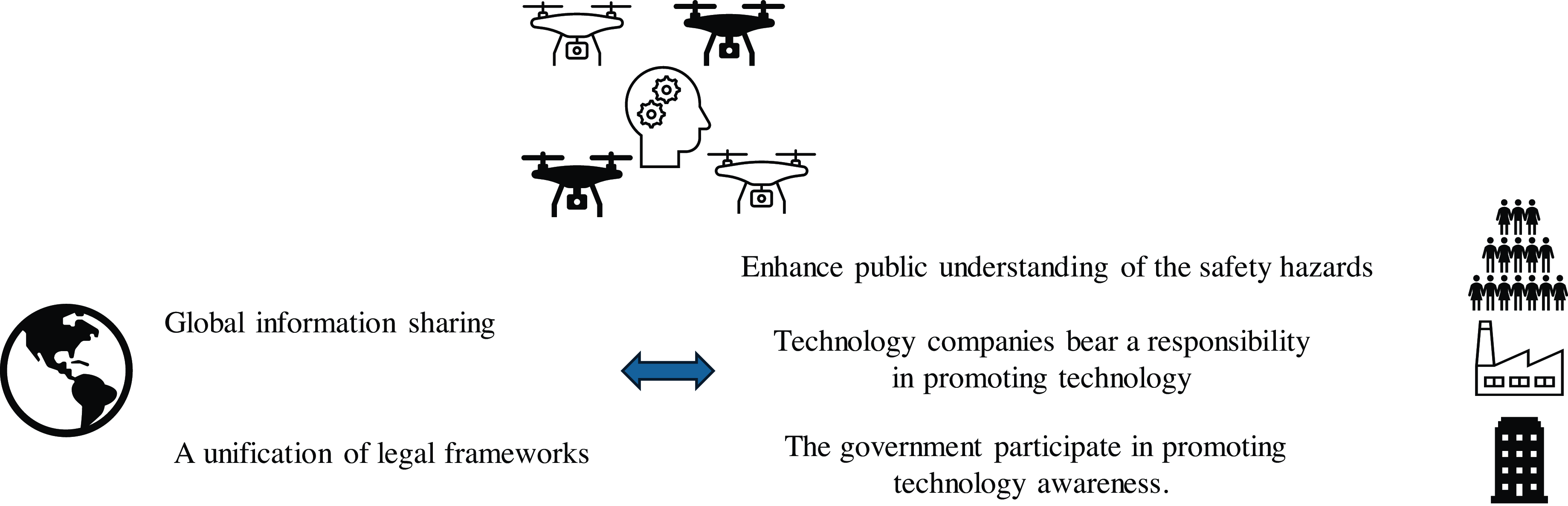
• First, information sharing between countries must be prioritised. To ensure the legal and peaceful use of drone technology, nations should strengthen mechanisms for information sharing, particularly in response to terrorism, criminal activities and illegal drone operations. By establishing an international database to track drone registration, usage and potential security threats, countries can more effectively prevent the misuse of AI-driven drone technology [Reference Du, Wang, Niyato, Kang, Xiong and Kim133].
-
• Second, there must be a unification of legal frameworks. Establishing a global legal framework for drones is vital for ensuring their lawful use [Reference O’Sullivan, Nevejans, Allen, Blyth, Leonard, Pagallo, Holzinger, Holzinger, Sajid and Ashrafian134, Reference Miazi135]. Countries should coordinate their efforts regarding drone management and accountability to avoid cross-border complications. For instance, international standards governing responsibility allocation, flight safety regulations and data privacy protection for AI-driven drones can be achieved through multilateral negotiations and treaties. This would facilitate the legal circulation of drone technology and services in the international market while avoiding technical barriers to international trade.
-
• Third, beyond information sharing and legal harmonisation, countries should jointly undertake collaborative actions concerning drone technology to ensure the safety and compliance of its global use [Reference Alsamhi, Ma, Ansari and Almalki136]. For example, in areas such as cross-border disaster relief, medical transportation and environmental protection, nations can work together through international organisations to deploy AI-driven drones for rescue missions, ensuring that these technologies serve the global public interest.
4.3 Education and public awareness raising
Enhancing public understanding and awareness of AI-based low-altitude flight technology is a crucial step in addressing ethical challenges. Public awareness and participation play vital roles in the development and application of this technology, helping to build a transparent and trustworthy technology ecosystem [Reference Huang, Fang, Wu, Wang and Yang4, Reference Brauner, Hick, Philipsen and Ziefle137]. Through education and outreach, all sectors of society can better understand the potential opportunities and risks associated with this technology, thereby promoting its rational use and development, as well as fostering dialogue and cooperation among technology companies, governments and the public.
Many members of the public have limited knowledge of AI-based low-altitude flight systems, which hinders their ability to fully comprehend both the advantages and potential threats posed by these technologies. Therefore, it is essential to educate the public on the basic principles of drone technology, its practical applications and its impact on society, the economy, privacy and security through targeted education and training activities.
On the one hand, improving public safety awareness is critical. With the widespread use of AI-driven drones, it is imperative to enhance public understanding of the safety hazards associated with drone flights, such as the potential risks posed by low-altitude operations to air traffic and ground personnel [Reference Clarke and Moses108]. Educational initiatives should also inform the public about how to identify and respond to risks related to improper use or loss of control of drones. Furthermore, outreach efforts should guide the public on how to report violations or respond to drone-related accidents or privacy infringements. By promoting education and outreach, the public can be encouraged to participate in technology development, provide suggestions for improvement and express concerns about privacy, ethics and security issues. This feedback mechanism can not only drive the development of technology to better meet societal needs but also enhance public trust in these innovations. Technology companies can engage with various stakeholders – including ordinary citizens, scholars and legal experts – by holding public forums, creating online platforms or establishing collaborative projects.
On the other hand, it is essential to increase the accountability of technology companies and governments. Technology companies bear a significant responsibility in promoting the adoption of AI-driven drone technology [Reference Waqar, Othman, Hamah Sor, Alshehri, Almujibah, Alotaibi, Abuhussain, Bageis, Althoey and Hayat138]. In addition to developing efficient and safe products, they should transparently communicate to the public how their technology operates, how data is processed and how privacy is protected. Such information disclosure can alleviate public distrust and ensure that companies adhere to strict ethical standards in their technology use [Reference Wischmeyer101]. Moreover, the government, as a regulator, should actively participate in promoting technology awareness [Reference Shen, Ghatikar, Lei, Li, Wikler and Martin139, Reference Caerteling, Halman, Song, Dorée and Van Der Bij140]. By establishing clear laws and regulations, the government can ensure that the use of drone technology complies with ethical and legal standards. Additionally, it should support relevant educational initiatives, such as public outreach campaigns on the safe use of technology in public spaces and certification training courses for drone operators. The government can also fund research and development in AI-based low-altitude flight technology through policy support, ensuring that public resources are utilised to address ethical issues related to technology, such as privacy infringement and data misuse. Furthermore, the government can take the lead in facilitating collaboration between the public and private sectors to ensure that technical specifications and ethical standards are widely implemented. Figure 2 shows the possible response strategies for AI-based low-altitude flight.
Possible response strategies for AI-based low-altitude flight.

4.4 Future directions: ethical design principles in AI-driven drone
As the AI-driven drone technology continues to advance, we proposed some future directions based on the challenges, and this particularly involves embedding privacy protection and security measures from the initial design stages, thereby preventing ethical and legal issues before they arise.
First, emphasising data minimisation and transparency ensures that only necessary data is collected and that users are fully informed about data usage, fostering trust and social acceptance. Second, enhancing the explainability of AI algorithms (XAI) and establishing clear responsibility-tracing mechanisms will address concerns related to decision transparency and accountability [Reference Dwivedi, Dave, Naik, Singhal, Omer, Patel, Qian, Wen, Shah and Morgan128]. By proactively addressing privacy, security and ethical considerations, developers can create drones that not only perform efficiently but also align with societal values and legal standards. Third, enhancing public understanding and awareness of AI-based low-altitude flight technology is a crucial step in addressing ethical challenges.
5.0 Conclusion
In summary, AI-based low-altitude flight technology undoubtedly offers a wide range of opportunities for society, spanning logistics and distribution, air traffic management, emergency response and military applications. However, issues related to privacy protection, security, responsibility allocation and ethics are becoming increasingly prominent as this technology develops. To achieve sustainable progress in this field, technology developers, lawmakers and all sectors of society must collaborate to establish a robust regulatory and ethical framework. By promoting ethical design, fostering international cooperation and enhancing public education, we can harness the conveniences brought by technological innovation while mitigating its potential risks and challenges.
Acknowledgment
This work was supported by the National Natural Science Foundation of China (No. 32000769), the Natural Science Foundation of Hunan Province of China (No. 2021JJ10045), the Open Research Subject of State Key Laboratory of Intelligent Game (No. ZBKF-24-01), the Postdoctoral Fellowship Program of CPSF (No. GZB20240989) and the China Postdoctoral Science Foundation (No. 2024M754304).
Competing interests
The authors declare that they have no known competing financial interests or personal relationships that could have appeared to influence the work reported in this paper.