INTRODUCTION
Age is one of the most important life history parameters required to understand the dynamics of mammalian populations (Caughley, Reference Caughley1966; Clutton-Brock, Reference Clutton-Brock1988; York, Reference York1994). In the past, criteria such as body length, degree of fusion of cranial sutures, and tooth wear have been used to estimate age in many species. For marine mammals, growth layers groups (GLGs) deposited in the teeth are a more useful measure because they indicate chronological age (Perrin & Myrick, Reference Perrin and Myrick1980).
All these methods, with exception of the GLGs, are able to identify only groups or age groups of individuals (as adults, subadults and pups), but they do not inform about the absolute age of the specimen. In this context, these methods were widely used until the 1950s (e.g. Laws, Reference Laws1962), when new techniques applied in terrestrial mammals proved to be efficient in age determination of pinnipeds (seals, walruses, fur seals and sea lions). It was possible to estimate the absolute ages by counting of the external rings in canine teeth associated with the counting of the GLGs at dentine and cementum from thin tooth sections (Klevezal, Reference Klevezal, Perrin and Myrick1980; Scheffer & Myrick, Reference Scheffer and Myrick1980).
The GLGs are units of calcified tissue that grows in teeth, which are not necessarily annual layers, but represent a repeating pattern that can be counted. The deposition of these layers of dentine and/or cementum has different degrees of mineralization, thus forming layers (or bands) that alternate between a dark and bright layer that ultimately can be counted. Thereby a GLG is constituted by a dark and a light layer (Scheffer & Myrick, Reference Scheffer and Myrick1980). It is important to mention that a GLG is not equal to one year of age, since they are not necessarily annual layers, but a repeating pattern, that can be counted. Some species of marine mammals have the previous correspondence of a GLG and chronological years, which allowed the estimate of the absolute age in years (e.g. Rosas et al., Reference Rosas, Haimovici and Pinedo1993; Molina-Schiller & Pinedo, Reference Molina-Schiller and Pinedo2004a, Reference Molina-Schiller and Pinedob). Furthermore, the GLG technique requires a histology laboratory with precision equipment such as freezing microtome (a tool used to cut extremely thin slices of teeth), with highly trained researchers or technicians. This technique becomes more expensive and time consuming, because of all these requirements.
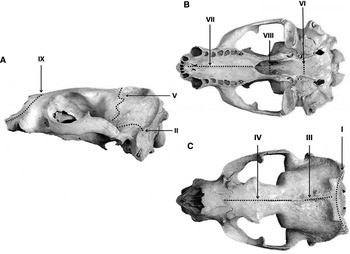
On the other hand, the determination of the cranial suture age (CSA) (Sivertsen, Reference Sivertsen1954) is exclusively based on the analysis of the syncranium degree of fusion of nine skull sutures (see Figure 1) and only needs a reasonable knowledge of skull anatomy [sutures] (see details of this analysis in methods section), with no equipment required. However, the disadvantage is that this method only provides the age category of the specimens – adult, juvenile or pup – and not a chronological age.
Skull views of South American fur seals (Arctocephalus australis) with the indication of the nine cranial sutures analysed in this study: (A) Lateral view: suture II: squamoso-parietal, suture V: coronal, suture IX: premaxillary-maxillary. (B) Ventral view: suture VI: basioccipito-basisphenoid, suture VII: maxillary, suture VIII: basisphenoid-presphenoid. (C) Dorsal view: suture I: occipitoparietal, suture III: interparietal, and suture IV: interfrontal.

Therefore, this study aimed to validate the correlation between the cranial suture age (proposed by Sivertsen, Reference Sivertsen1954) and the chronological age (from GLGs counting) for South American sea lions (Otaria flavescens) and South American fur seals (Arctocephalus australis) as an alternative method to immediately establish the age category in pinnipeds, mainly in adverse situations (for example skulls with no teeth or no authorization to cut a tooth).
MATERIALS AND METHODS
Samples
We examined 37 skulls and teeth sections of O. flavescens (2 females and 35 males) and 52 skulls and teeth of A. australis (4 females and 48 males) from the scientific collection of the Study Group of Aquatic Mammals of Rio Grande do Sul (Grupo de Estudos de Mamíferos Aquáticos do Rio Grande do Sul – GEMARS). This material was collected from 1994 to 2009 during beach surveys along the northern coast of Rio Grande do Sul, southern Brazil.
The specimens were collected with the scientific purpose and were prepared by GEMARS researchers. The skin of each skull was removed using a knife or a scalpel in the field and afterwards placed in a water tank for at least 3 months for tissue maceration. The process continued with another cleaning session with a scalpel followed by a brush using a highly abrasive mechanical soap. Afterwards each skull was dried in sunlight for at least 24 h for whitening.
Age determination based on cranial suture age
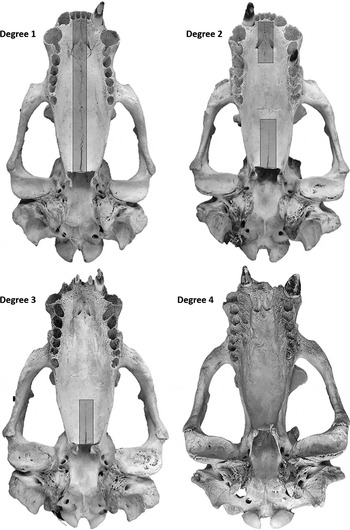
Age determination through the analysis of the cranial suture age (CSA) was based on the degree of fusion of nine cranial sutures (Figure 1), a gradual process that occurs throughout the skull development (Sivertsen, Reference Sivertsen1954). The nine skull sutures are: I – Occipito-parietal, II – Squamoso-parietal, III – Interparietal, IV – Interfrontal, V – Coronal, VI – Basioccipito-basisphenoid, VII – Maxillary, VIII – Basisphenoid-presphenoid and IX – Premaxillary-maxillary. The CSA of a pinniped species has four degrees of fusion (see Figure 2): degree 1: open suture; degree 2: less than half of the suture fused; degree 3: more than half of the suture fused; and degree 4: suture completely fused (Sivertsen, Reference Sivertsen1954).
Four degrees of fusion in cranial sutures of South American sea lions (Otaria flavescens) based on Sivertsen (Reference Sivertsen1954) in palatal view: Degree 1: open suture; Degree 2: less than half of the suture fused; Degree 3: more than half of the suture fused; and Degree 4: suture completely fused. The rectangle shows the proportion of the sutures that remains not fused in each degree.

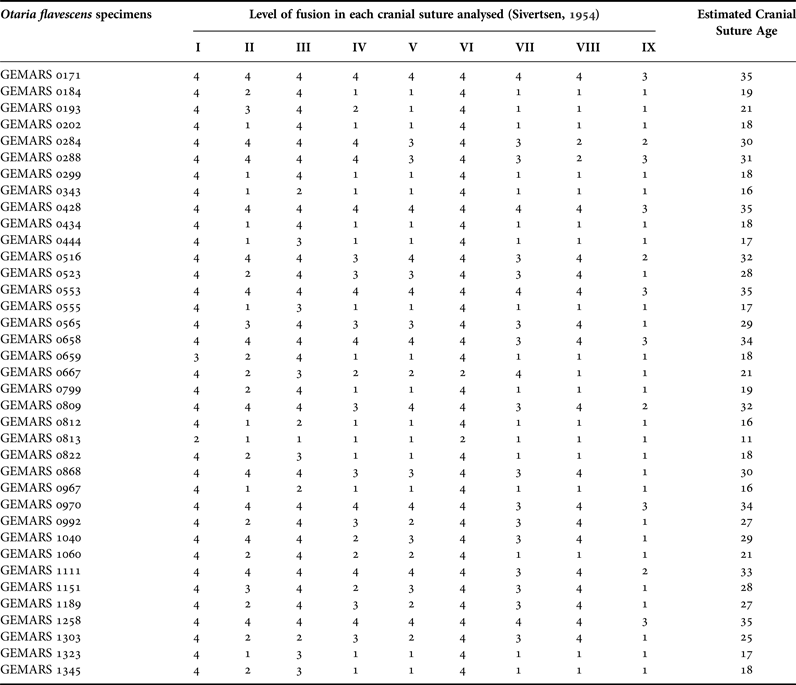
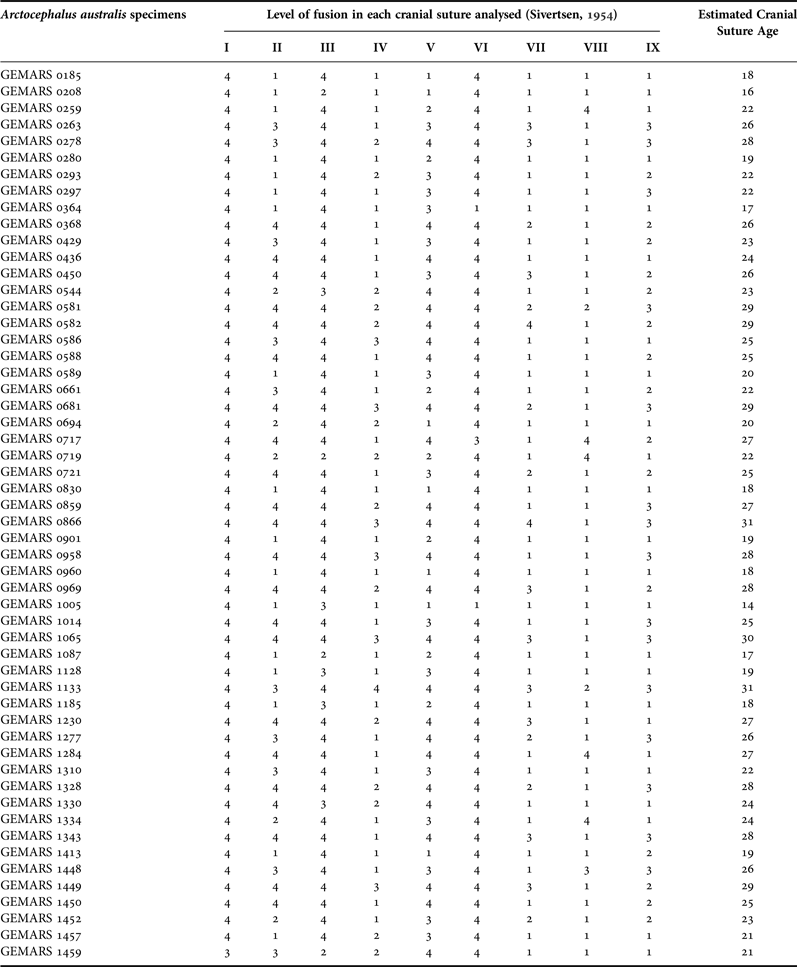
Each specimen had the degree of fusion of its nine skull sutures evaluated by the sum of its degree of fusion, resulting in a suture age value ranging from 9 to 36. According to Sivertsen (Reference Sivertsen1954) the skull suture intervals correspond to the following age categories in pinnipeds: pups (9–10), juveniles (10–18) and adults (19–36). See Tables 1 & 2 for data on the level of fusion of each cranial suture in each analysed specimen, including 37 skulls of O. flavenscens and 52 of A. australis.
Level of fusion of each cranial suture (according to Sivertsen, Reference Sivertsen1954) in each analysed specimen, including 9 sutures and 37 skulls of Otaria flavescens (2 females and 35 males).

Level of fusion of each cranial suture (according to Sivertsen, Reference Sivertsen1954) in each analysed specimen, including 9 sutures and 52 skulls of Arctocephalus australis (4 females and 48 males).

Age determination using growth layer groups (GLGs)
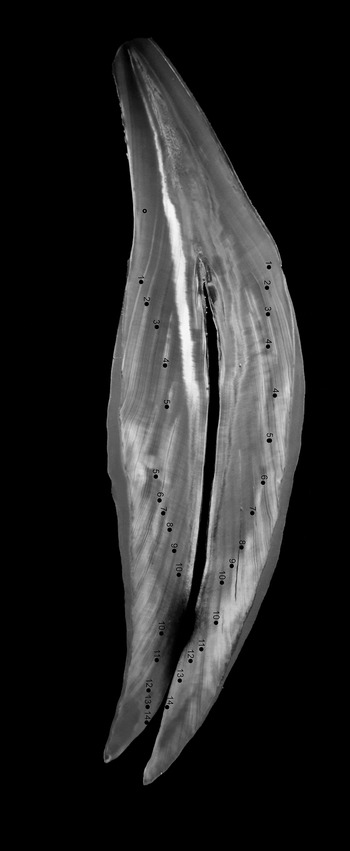
For the chronological age, the specimens had their age estimated by counting GLGs (Figure 3) presented in the dentine to the growth layers from one canine or post-canine tooth (Klevezal, Reference Klevezal, Perrin and Myrick1980; Scheffer & Myrick, Reference Scheffer and Myrick1980). The teeth were stored dried until the moment to cut. The teeth sections for GLG counting were produced by two different techniques depending on the size of the dental piece, as suggested by Crespo et al. (Reference Crespo, Schiavini, Perez-Macri, Reyes and Dans1994). The difference between the methods is that the smaller teeth from A. australis were obtained as thin sections with a freezing microtome, while the larger teeth from O. flavescens were sectioned and then polished with sandpaper to a thickness of 0.1 mm.
Thin section from canine specimen of Arctocephalus australis (GEMARS 1413) in detail 14 GLGs in dentine and neonatal band (n) (photo: Enrique Crespo-LAMAMA/CENPAT).

DECALCIFIED AND STAINED THIN SECTIONS
Initially each tooth was decalcified with RDO® (a fast commercial decalcifier), from 6 to 20 h, depending on the size of the tooth. Once the tooth was decalcified, it was cut sagittally with a CO2 freezing microtome (brand Jung) in a few on-centre sections (35–40 microns). Selected sections were stained in 250 ml Mayer's haematoxylin during 15 min and washed in running water twice, in order to eliminate excess stain. To dehydrate tooth sections they were immersed in alcohol 70%, 96% and 100% for 1 min, respectively. Finally, tooth sections were immersed for 5 s in carbol xylene and mounted on glass slides in pure Canadian balsam (Crespo et al., Reference Crespo, Schiavini, Perez-Macri, Reyes and Dans1994). This technique was used in small tooth pieces of male and female from post-canine teeth of A. australis.
THICK UNSTAINED AND UNDECALCIFIED SECTIONS
Canine sections from mid-longitudinal axis were obtained using a hand saw. A centre thick section was first ground using a grinder machine until the section reached ~3 mm thick. Afterwards each section was polished with 200, 320, 400 and 600 sandpapers until the pulp cavity was completely exposed and the section reached the final thickness of 0.1 mm or less. This technique was used in male and female canines of O. flavescens.
An experienced reader made the counts for each specimen. Dr Enrique Crespo (LAMAMA/CENPAT) has about 30 years of experience in age determination of a variety of South American marine mammals, using longitudinal sections, cementum and dentine, and also stained sections. The GLGs in dentine were counted using a variable-power (14–40×) stereoscopic microscope with reflected light. However, when it was necessary the GLGs were also counted in the cementum, using a compound microscope at 100× under transmitted light.
GLGs were considered to include two incremental growth layers: a broad opaque and a thin translucent layer in dentine (or cementum) by transmitted light or dark and light layers seen on a surface with incident illumination (reflected light) (Perrin and Myrick, Reference Perrin and Myrick1980). This layering pattern was described in A. australis by Schiavini et al. (Reference Schiavini, Lima and Batallés1992) and Crespo et al. (Reference Crespo, Schiavini, Perez-Macri, Reyes and Dans1994) and Molina-Schiller & Pinedo (Reference Molina-Schiller and Pinedo2004a, Reference Molina-Schiller and Pinedob) established that GLGs are annually deposited. Rosas et al. (Reference Rosas, Haimovici and Pinedo1993) also found this same annual GLG pattern in O. flavescens.
According to Molina-Schiller & Pinedo (Reference Molina-Schiller and Pinedo2004a, Reference Molina-Schiller and Pinedob), pups of A. australis have zero or 1 GLG, while juveniles have 1 to 7 GLGs, adult males have 8 or more GLGs, and adult females have 6 or more GLGs. Grandi et al. (Reference Grandi, Dans, García and Crespo2009) considered as pups of O. flavescens specimens with zero or 1 GLG, juveniles between 1 and 8 GLGs, adult males between 9 or more GLGs, and adult females with 5 or more GLGs.
Analysis
All specimens had their age estimated by CSA and chronological age by GLGs counting. Each GLG was interpreted as equivalent to one year's growth according to previous studies for South American sea lions (Crespo, Reference Crespo1988; Rosas et al., Reference Rosas, Haimovici and Pinedo1993; Grandi et al., Reference Grandi, Dans, García and Crespo2009) and South American fur seals (Molina-Schiller & Pinedo, Reference Molina-Schiller and Pinedo2004a, Reference Molina-Schiller and Pinedob). Based on these results, we were able to estimate the absolute age in years and compare it with cranial suture age categories proposed by Sivertsen (Reference Sivertsen1954).
The absolute frequency was calculated based on the individuals who had the same age category suggested by both methods as well as for individuals attributed to different categories by the two methods.
Data for each individual were plotted on a scatter graph (scatterplot) generated by SPSS 17.0 software (SPSS for Windows, Chicago, IL). The Spearman correlation coefficient (r S) was estimated in order to establish whether there is a correlation between cranial suture age (proposed by Sivertsen, Reference Sivertsen1954) and chronological age by counting the GLGs (Perrin & Myrick, Reference Perrin and Myrick1980). This coefficient is used depending on the variables being nonparametric and because data does not form a perfect elliptical cloud (Sokal and Rohlf, Reference Sokal and Rohlf2009).
Finally, an evaluation of the outlier specimens was carried out for both species. The range of each age category proposed by CSA was revised taking into account the total length of each specimen and the development of fusion of the analysed sutures.
RESULTS
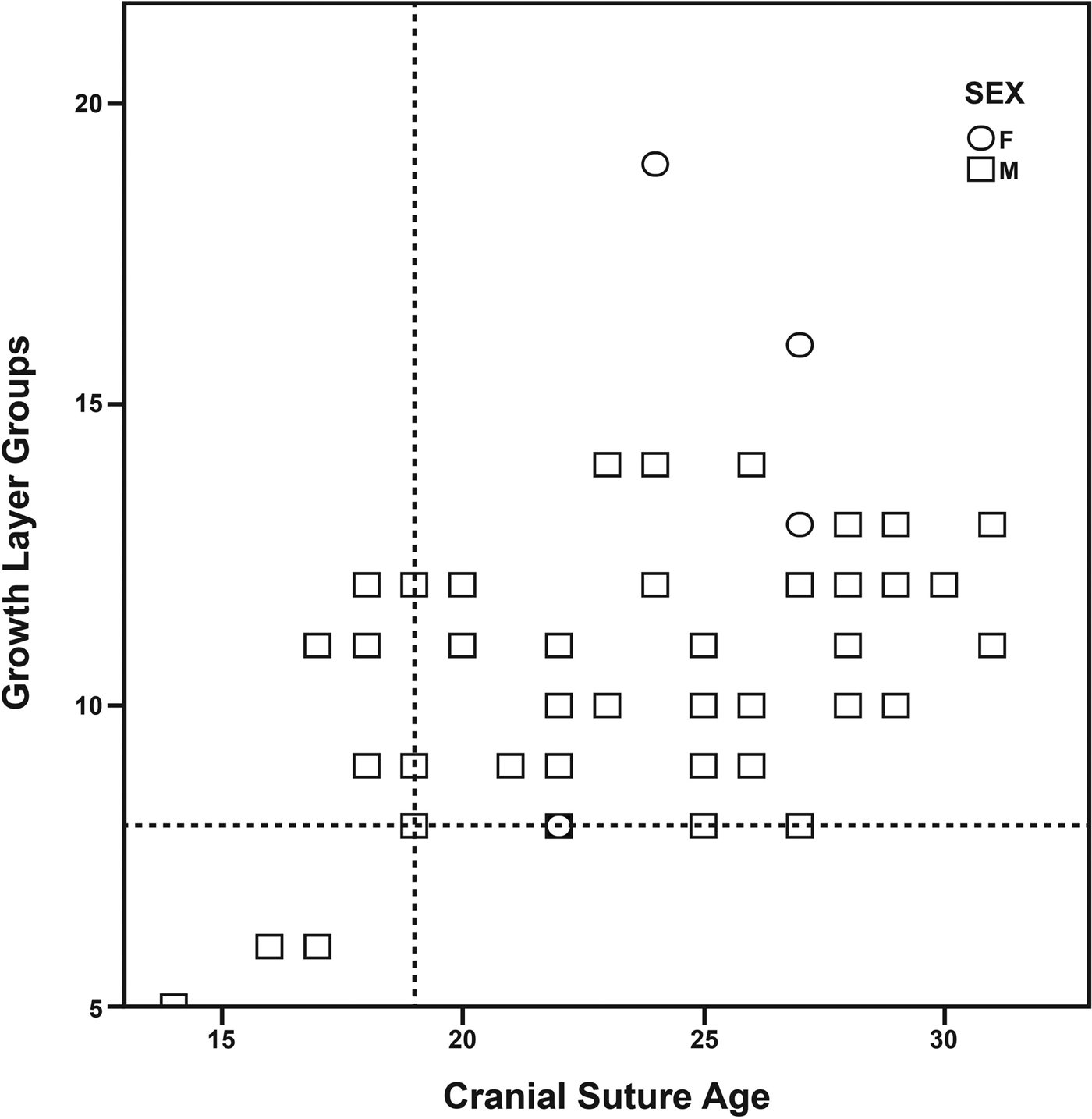
From the 52 skulls of A. australis, 48 were considered adults with suture age of 19 (or more) and 8 GLGs (which corresponds to 8 years old). Therefore, 92.3% of the sample had the age consistently determined by both methods, and only 7.6% had a mismatch age estimation between CSA and GLGs methods (Figure 4). Moreover, there is a moderate but significant value of Spearman's correlation between the age categories suggested by both methods for A. australis (r S = 0.491, P < 0.0001).
Correspondence between cranial suture age and growth layer groups in Arctocephalus australis. Traced lines represent the adult limit for cranial suture age (CSA) (vertical line) and growth layer groups (GLGS) (horizontal line). □: males and ○: females.

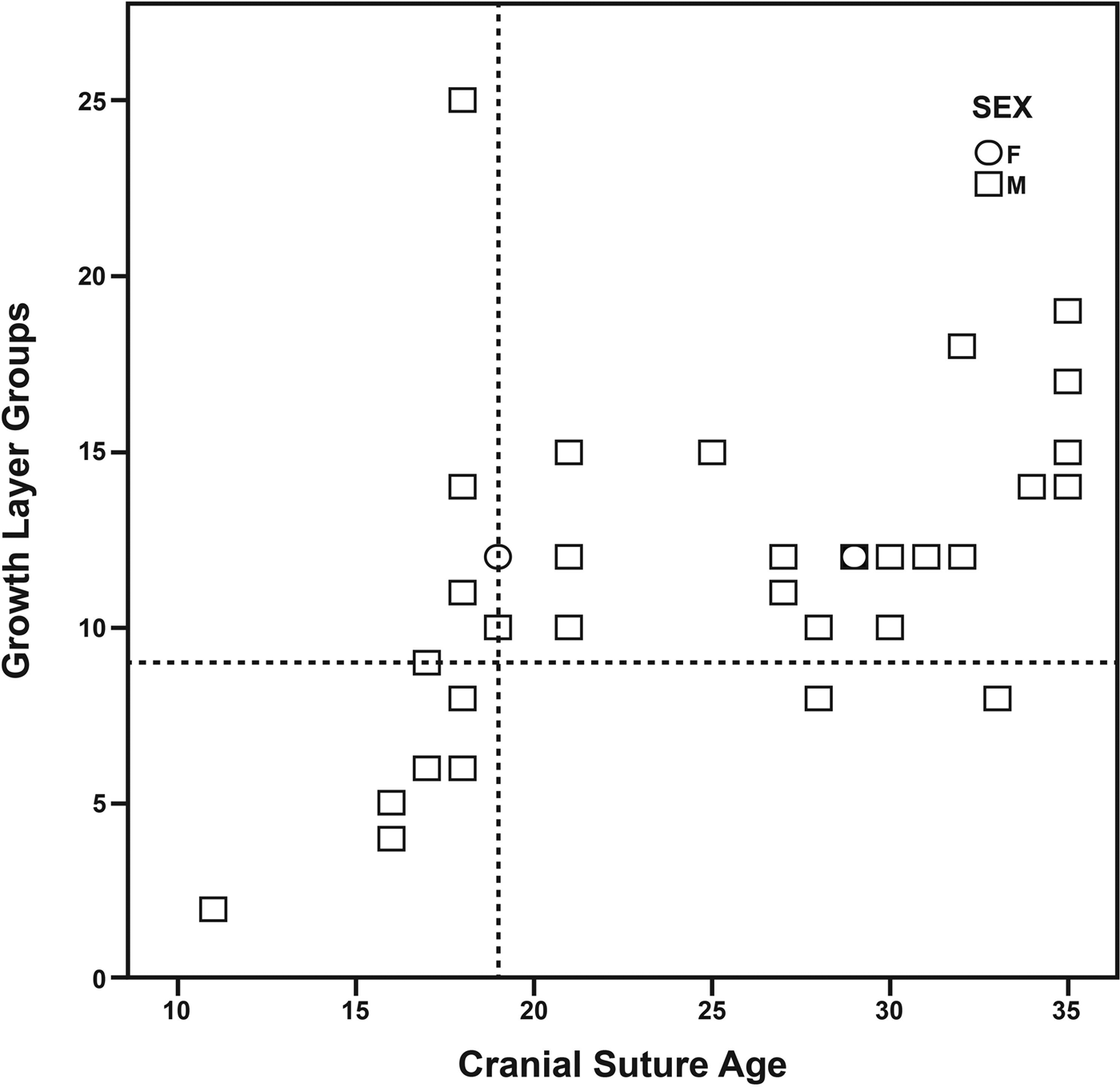
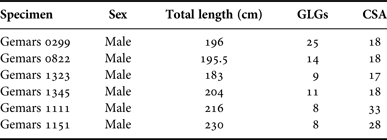
Similar results were observed for O. flavescens, 32 from the 37 skulls being considered as adults by CSA (with a minimum value of 19) and GLGs equal or superior to 9 years old. Approximately 84% of the sample had the same age category supported by both methods (Figure 5). However, 10.8% were classified by CSA as young individuals, while GLGs and total length suggested that these specimens were adults (see Table 3).
Correspondence between the cranial suture and growth layer groups in Otaria flavescens. Traced lines represent the adult limit for cranial suture age (CSA) (vertical line) and growth layer groups (GLGs) (horizontal line). □: males and ○: females.

Biological information of the six specimens of Otaria flavescens that did not obtain correspondence between the cranial suture age (CSA) and the growth layers groups (GLGs).

The remaining 5.4% of the sample did not match, because they were classified by cranial suture age as adults, but the chronological age indicated 8 years old, and thus as subadults (this category does not exist in CSA proposed by Sivertsen, Reference Sivertsen1954). There is a significant value of Spearman's correlation between the age categories suggested by both methods for O. flavescens (r S = 0.675, P < 0.0001).
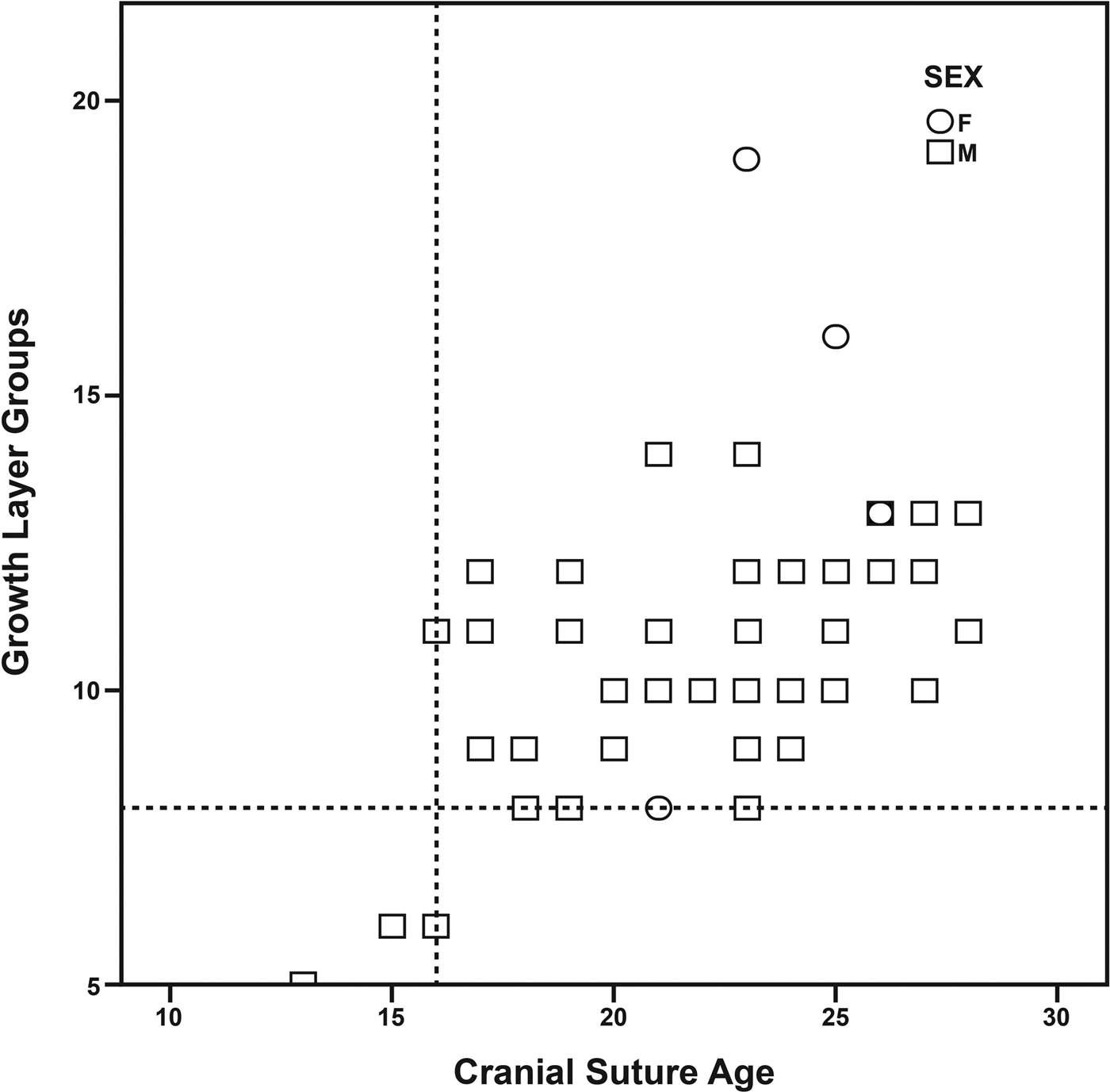
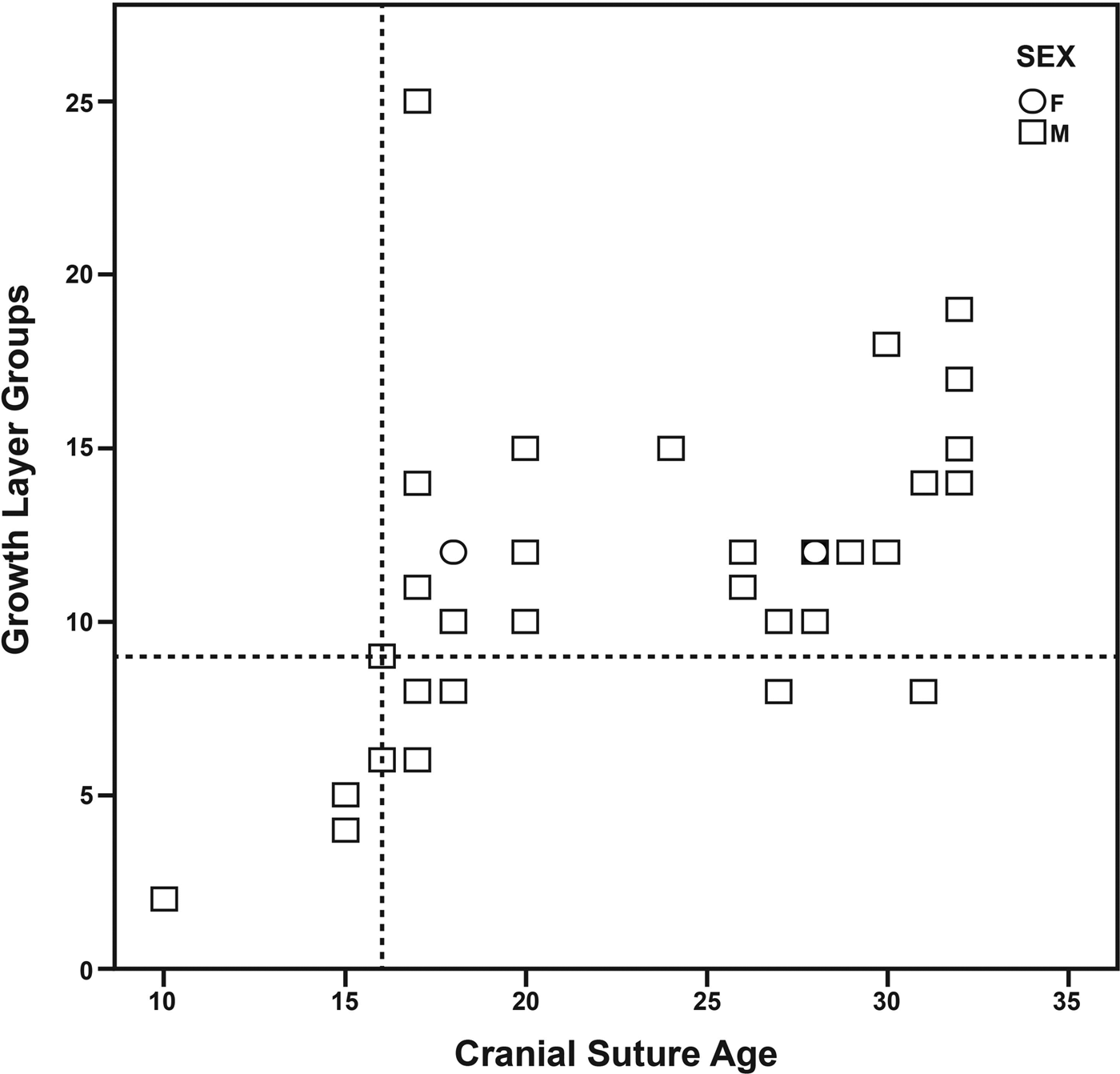
Taking into account the occurrence of mismatch in age estimation between CSA and GLGs methods in 7.6% of skulls of A. australis and 16.2% of O. flavescens (Figures 4 & 5), the cranial sutures of the discrepant specimens were reevaluated in search of a more suitable method. Thus, the degree of fusion of each cranial suture was re-examined in search of sutures not yet fused in adults of both species. As a result, we found that premaxillary-maxillary suture (suture IX in Figure 1) has a later fusion and it is underestimating the CSA of the specimens, which were considered as adults by GLGs. With the exclusion of this suture from the new analysis, the correlation between CSA and GLGs was 100% in A. australis (Figure 6), and 86.4% in O. flavescens (Figure 7). In this context, the analysis would count only with eight cranial sutures and a new CSA interval was proposed for categories: adult (16–32), juvenile (11–15) and pup (8–10).
New correspondence between cranial suture age and growth layer groups in Arctocephalus australis after the exclusion of premaxillary-maxillary suture. Traced lines represent the adult limit for cranial suture age (CSA) (vertical line) and growth layer groups (GLGS) (horizontal line). □: males and ○: females.

New correspondence between cranial suture age and growth layer groups in Otaria flavescens after the exclusion of premaxillary-maxillary suture. Traced lines represent the adult limit for cranial suture age (CSA) (vertical line) and growth layer groups (GLGs) (horizontal line). □: males and ○: females.

DISCUSSION
This study confirmed the existence of correspondence between the cranial suture age (CSA) and chronological age in GLGs in South American sea lions and South American fur seals. In addition, it suggests a modification in the CSA method proposed by Sivertsen (Reference Sivertsen1954), with the exclusion of premaxillary-maxillary suture from the analyses, due to its late fusion or continued somatic growth (Brunner et al., Reference Brunner, Bryden and Shaughnessy2004).
In pinnipeds (seals, walruses, sea lions and fur seals), there are three forms to establish maturity for adults (Bartholomew, Reference Bartholomew1970; Riedman, Reference Riedman1990): physical maturity (when the skull sutures and bone epiphysis are completely fused (Sivertsen, Reference Sivertsen1954; Ericson & Stora, Reference Ericson and Stora1999; Stora, Reference Stora2001); social maturity, when males become capable of keeping harems or protecting territories (Bartholomew, Reference Bartholomew1970; Grandi et al., Reference Grandi, Dans, García and Crespo2009) and sexual maturity, when reproductive cells are completely formed (spermatozoids and ovule) (Miller et al., Reference Miller, Stewart and Stenson1998). Therefore, a classification of a pinniped as an adult can be much more complex than in other taxa. In this sense, the age class based on cranial sutures (physical maturity) could be a direct, fast and accurate method for the adult category because at this time the individual ceases bone growth (Sivertsen, Reference Sivertsen1954; Ericson & Stora, Reference Ericson and Stora1999; Stora, Reference Stora2001).
It was observed that females reach maturity stage before males in both species, a phenomenon known as ‘bimaturism’ (sensu Leigh, Reference Leigh1992), where males can extend a common growth trajectory and mature later than females as well as getting physically larger than females or growing faster in a given period of time. The intersexual skull variation observed along the ontogeny is very well documented in many species of otariid pinnipeds and is strictly related to sexual dimorphism, sexual selection and highly polygynous mating systems (e.g. Berta & Sumich, Reference Berta and Sumich1999; Lindenfors et al., Reference Lindenfors, Tullberg and Biuw2002; Oliveira et al., Reference Oliveira, Hingst-Zaher and Morgante2005). In polygynous groups, male competition for access to females is severe and males can be expected to exhibit traits that would therefore favour them in threat displays or fights with other males over access to females, such as large body size and big canines (Oliveira et al., Reference Oliveira, Hingst-Zaher and Morgante2005). These traits also involve cranial transformations that lead to a performance linked to male-male competition, producing characters highly associated with biting and fighting (e.g. Brunner et al., Reference Brunner, Bryden and Shaughnessy2004; Tarnawski et al., Reference Tarnawski, Flores, Cassini and Cappozzo2015). In general, the development of all mentioned traits, as well as size dimorphism, is related to male encounters in polygynous mating systems, especially those involving resource defence (territorial) and female defence. The establishment and defence of both types involve demonstrations of strength and dominance, which include vocal displays, stereotyped postures and movements, and fights, with death occurring on rare occasions (Riedman, Reference Riedman1990; Campagna, Reference Campagna, Perrin, Würsig and Thewissen2002).
The most accurate method to obtain the absolute age in marine mammals is only provided by the growth layer groups (GLGs), a technique that firstly demands a skull with teeth and the permission of the collection manager to destroy part of a tooth; secondly specific equipment to cut the teeth and finally experienced GLGs readers. On the other hand, the determination of pinniped age by CSA is a quick and inexpensive method for collections that do not have the equipment needed to make cuts and readings of GLGs. In general, the CSA only requires a professional with knowledge of pinniped skull anatomy, who must be trained in reading the different degrees of fusion of cranial sutures (Sivertsen, Reference Sivertsen1954). Usually it takes an hour and a few specimens representing at least four levels of fusion of cranial sutures.
Unquestionably, GLGs are more accurate than CSA as a method of age determination. However, it is important to emphasize the importance of CSA when the researcher is working on a scientific collection and needs to know immediately the age category of the skull. Moreover, there are many skull morphometric studies on pinnipeds, which used cranial suture age combined with condylo-basal length (or not) in order to establish the age category (or at least to select adult specimens) for the analyses (Simões-Lopes et al., Reference Simões-Lopes, Drehmer and Ott1995; Drehmer & Ferigolo, Reference Drehmer and Ferigolo1997; Brunner, Reference Brunner1998; Oliveira, Reference Oliveira1999; Drehmer & Oliveira, Reference Drehmer and Oliveira2000; Brunner et al., Reference Brunner, Bryden and Shaughnessy2004; Oliveira et al., Reference Oliveira, Hingst-Zaher and Morgante2005, Reference Oliveira, Hoffman, Hingst-Zaher, Majluf, Muelbert, Morgante and Amos2008; Jones & Goswami, Reference Jones and Goswami2009).
The first study that used the CSA method to estimate the age categories for the pinnipeds found dead in southern Brazil, was Simões-Lopes et al. (Reference Simões-Lopes, Drehmer and Ott1995), but they did not compare this with the specimens' GLGs. For the same geographic area several studies were carried out, but over an increased sample; Drehmer & Ferigolo (Reference Drehmer and Ferigolo1996) applied this technique for A. australis skull description; Drehmer & Ferigolo (Reference Drehmer and Ferigolo1997) in a comparative analysis including A. australis and A. tropicalis and Sanfelice & Ferigolo (Reference Sanfelice and Ferigolo2008) for A. australis and Otaria flavescens. The CSA method had also been used for several decades in humans in forensic medicine (Meindl & Lovejoy, Reference Meindl and Lovejoy1985).
Jones & Goswami (Reference Jones and Goswami2009) in their analysis of the influences of phylogeny and ecology on phocid and otariid pinnipeds also used only the CSA to determine the age categories of the sample. The age category of the specimens used in the study were primarily identified based on original age data acquired during specimen collection, additional specimens without original data available were identified based on the presence of significantly open sutures in the skull.
The GLGs and the CSA methods were used together by Sanfelice & Freitas (Reference Sanfelice and Freitas2008) in their study of the ontogeny of the skull in three species of Otariidae (A. australis, O. flavescens and Callorhinus ursinus). They used the number of GLGs externally counted to estimate chronological age (according to Schiavini et al., Reference Schiavini, Lima and Batallés1992) and the CSA to determine the ontogenetic stages (juvenile, subadults and adults) (Sivertsen, Reference Sivertsen1954). The analyses were performed considering species, sex and sutural age groups. However, they did not compare the techniques or try to find some correlation between them.
Tarnawski et al. (Reference Tarnawski, Flores, Cassini and Cappozzo2015) analysed the complete ontogenetic series of male skulls of A. australis, A. gazella and A. tropicalis deposited in the systematic collections of Argentina and Brazil, to study skull growth and its allometric patterns in the genus. Their specimens were categorized in two general age stages by CSA, mainly taking into account when the occipitoparietal and sagittal sutures are non-fused (e.g. Drehmer et al., Reference Drehmer, Fabian and Menegheti2004; Molina-Schiller & Pinedo, Reference Molina-Schiller and Pinedo2004a, Reference Molina-Schiller and Pinedob), and by growth layer groups, GLGs. They considered non-adult specimens those between zero and 4 GLGs and non-fused sutures (i.e. occipitoparietal and sagittal sutures), with a sutural index (SI) ranging from 9 to 16. In this study, authors used the two methods of determination of age, but they did not evaluate or test the efficiency of the CSA method alone or its level of correlation with GLGs. Other studies on skull ontogeny (Sanfelice & Freitas, Reference Sanfelice and Freitas2008) or sexual dimorphism (Oliveira et al., Reference Oliveira, Hingst-Zaher and Morgante2005) in pinnipeds did not compare the techniques or try to find some correlation between them.
Grandi et al. (Reference Grandi, Dans, García and Crespo2009) correlated the total length, the maturity of reproductive organs (of both sexes) and age in GLGs to analyse the growth curve of O. flavescens. They determined that a male reaches maturity at 9 years of age and an average of 212 cm of body length, while females become sexually mature at ~5 years old and 147 cm of total length. A similar study analysing specimens of A. australis conducted by Molina-Schiller & Pinedo (Reference Molina-Schiller and Pinedo2004a, Reference Molina-Schiller and Pinedob), suggested that the male could be considered adult at 8 years of age, whereas females were adults at 6 years (absolute age estimated through GLGs). This pattern in pinnipeds, where females reach sexual maturity earlier than males, is a consequence of sexual selection. This phenomenon results in significant sexual dimorphism in this group where females devote parental care to their offspring, while males spend energy only during the breeding season, competing for harems or territories with other males, without getting involved with the pups (Riedman, Reference Riedman1990; Boness, Reference Boness and Renouf1991; Cassini, Reference Cassini1999).
Another important result observed in this study was the predominance of adult males in comparison to adult females in both species analysed. This result is due to the pattern of occurrence of these pinnipeds on the southern Brazilian coast (Pinedo, Reference Pinedo1986; Rosas et al., Reference Rosas, Pinedo, Marmontel and Haimovici1994; Simões-Lopes et al., Reference Simões-Lopes, Drehmer and Ott1995; Oliveira, Reference Oliveira1999, Reference Oliveira, Weber, Roman and Cáceres2013), which is reflected in the number of fur seals and sea lions male specimens deposited in the studied collection. According to the authors, these two species reach the coast of Rio Grande do Sul coming from Uruguayan breeding colonies, searching for food and resting areas but not for reproductive purposes. The majority occurrence of adult males in both species could also be related to the absence of parental care and a larger displacement capacity of males to depart (Pinedo, Reference Pinedo1986; Rosas et al., Reference Rosas, Pinedo, Marmontel and Haimovici1994).
According to the results presented in this study, despite the accuracy of GLGs reading the chronological age, the method proposed by Sivertsen (Reference Sivertsen1954) should be considered valid. It is valid because we observed correlation with the age groups estimated by GLGs, and mainly because it is the most economically viable method. However, we suggested to modify the CSA method through the exclusion of the suture nine (premaxillary-maxillary suture), due to its delayed fusion.
Finally, we would like to reinforce the importance of further studies with a larger sample and without bias (comparing the same number of males and females, as well as the same number of pups, juveniles and adults) to have a better confirmation of the efficiency and ability to estimate precisely the age categories of the species analysed. These would evaluate with more precision the existence of a strong correlation between the CSA and GLGs as methods of age determination.
AUTHORS’ CONTRIBUTIONS
PA carried out the cranial suture analysis as well as the statistical analysis, and had been involved in drafting the manuscript. CJD participated in the cranial suture analysis and revised the manuscript critically. DD participated in the sampling activity, performed the interpretation of data and critically revised the manuscript. LRO conceived and designed the study, besides participating in the sampling activity and in the chronological age determination, and making substantial contributions in drafting the manuscript. All authors read and approved the final manuscript.
ACKNOWLEDGEMENTS
We would like to thank all members of the Grupo de Estudos de Mamíferos Aquáticos do Rio Grande do Sul – GEMARS, who collected the specimens and for the access to the scientific collection. Dr Enrique Alberto Crespo from LAMAMA/CENPAT kindly counted the GLGs and made possible the realization of this project. Finally, the authors are grateful to Fernando Lopes for figure editing support.
FINANCIAL SUPPORT
The Foundation for Research Support of the Rio Grande do Sul State (FAPERGS No. 02/2014 – PQG 2330-2551/14-9 SIAFEM) and National Scientific and Technological Development Council (CNPq Productivity grants No. 303813/2011-3; No. 308650/2014-0) financially supported part of this project. The United Nations Fellowship Program (OEA scholarship) in association with CONICET in Argentina granted a post-doctoral fellowship to LRO.