Introduction
Despite continuing efforts within the framework of early intervention programmes to identify persons at risk, the initial contact with mental health services often coincides with a first episode of schizophrenia (McGorry et al. Reference McGorry, Edwards, Mihalopoulos, Harrigan and Jackson1996; Klosterkötter et al. Reference Klosterkötter, Ruhrmann, Schultze-Lutter, Salokangas, Linszen, Birchwood, Juckel, Morrison, Vazquez-Barquero, Hambrecht and von Reventlow2005; Lester et al. Reference Lester, Birchwood, Freemantle, Michail and Tait2009; Ruhrmann et al. Reference Ruhrmann, Schultze-Lutter, Salokangas, Heinimaa, Linszen, Dingemans, Birchwood, Patterson, Juckel, Heinz, Morrison, Lewis, von Reventlow and Klosterkötter2010). Early treatment reduces the potential for an unfavourable course that comprises persistent symptoms, (re)hospitalizations and deficits in social and vocational functioning (Perkins et al. Reference Perkins, Gu, Boteva and Lieberman2005; Addington et al. Reference Addington, Addington and Patten2007; Barnes et al. Reference Barnes, Leeson, Mutsatsa, Watt, Hutton and Joyce2008; de Koning et al. Reference de Koning, Bloemen, van Amelsvoort, Becker, Nieman, van der Gaag and Linszen2009; Farooq et al. Reference Farooq, Large, Nielssen and Waheed2009; McGorry et al. Reference McGorry, Johanessen, Lewis, Birchwood, Malla, Nordentoft, Addington and Yung2010). First-episode patients benefit from a treatment approach that decreases psychopathological symptoms but also focuses on psychosocial functioning (Penn et al. Reference Penn, Waldheter, Perkins, Mueser and Lieberman2005). In many cases, such functioning has already deteriorated before the exacerbation of the first psychosis; in young people, psychosocial development is impaired by the illness and those persons remain at a low level of functioning (Häfner et al. Reference Häfner, Löffler, Maurer, Hambrecht and an der Heiden1999). Most of the negative changes in social disability attributed to schizophrenia occur in the first 2–5 years of illness (an der Heiden & Häfner, Reference an der Heiden and Häfner2000). Thus, stopping this process is a core component of successful treatment (an der Heiden & Häfner, Reference an der Heiden and Häfner2000). One way to develop better treatment strategies is to monitor changes in treatment needs over time and to identify the conditions under which they arise.
Assessing treatment needs is an established element of clinical practice and service evaluation. In this context, needs are defined as the potential to benefit from (mental) health care (Wiersma, Reference Wiersma2006), that is reversing a deficit by treatment. A more realistic definition states that needs are the prerequisite for maintaining or restoring an acceptable level of social independence and quality of life (McCrone et al. Reference McCrone, Leese, Thornicroft, Schene, Knudsen, Vazquez-Barquero, Tansella and Becker2001). The concept of needs has been criticized because it presupposes an effective, but general, treatment that works for every patient with a given diagnosis, and for confounding the identification of a need with its potential solution (Priebe et al. Reference Priebe, Huxley and Burns1999a). Nevertheless, the widespread use of needs assessment in research and practice calls for critical appraisal.
Several interviews for assessing needs for care have been developed. The most commonly applied are the Needs for Care Assessment (NCA; Brewin et al. Reference Brewin, Wing, Mangen, Brugha and MacCarthy1987) and the Camberwell Assessment of Need (CAN; Phelan et al. Reference Phelan, Slade, Thornicroft, Dunn, Holloway, Wykes, Strathdee, Loftus, McCrone and Hayward1995). The NCA includes an elaborate evaluation of psychopathology and psychosocial status. The NCA and its revised form, the Cardinal Needs Schedule (CNS; Marshall et al. Reference Marshall, Hogg, Gath and Lockwood1995), are more extensive than the CAN, and hence the latter is generally used in larger studies (Kilian et al. Reference Kilian, Bernert, Matschinger, Mory, Roick and Angermeyer2001).
The CAN inquires about 22 potentially problematic areas of living, and differentiates among (1) ‘met needs’ (patient has a specific need and this need is met by treatment), (2) ‘unmet needs’ (specific needs that are not met by treatment), and (3) ‘no needs’ (patient does not have a need in this area of living). Several attempts have been made to establish groupings of the CAN items. However, the results from studies using data reduction techniques have been inconsistent (Wennström et al. Reference Wennström, Sorbom and Wiesel2004; Korkeila et al. Reference Korkeila, Heikkila, Hansson, Sorgaard, Vahlberg and Karlsson2005) and none of the factor solutions have become widely accepted or replicated. Here, we propose an alternative approach in which several classes of patients are identified who show different trajectories of needs over time.
Most research using the CAN considers only patients with a chronic or well-established illness. Our study is the first to adopt that approach in determining needs within first-episode schizophrenia. Treatment of acute episodes can be divided into three phases. The acute phase (weeks or a few months) is followed by a post-acute stabilization phase (3–6 months), and then by a stable phase of (partial) remission (months to years) (DGPPN, 2006). All of these phases should be examined when evaluating the progression of needs in first-episode patients over time.
Aims of the study
Three questions are addressed by the present study:
(1) What is the course of needs over a 12-month period in first-episode patients compared with chronic schizophrenia patients?
(2) Can we identify clusters of patients with different trajectories of unmet needs?
(3) If so, what are the variables associated with those trajectories?
Method
Database
Our study used data from the European First Episode Schizophrenia Trial (EUFEST; Fleischhacker et al. Reference Fleischhacker, Keet and Kahn2005; Kahn et al. Reference Kahn, Fleischhacker, Boter, Davidson, Vergouwe, Keet, Gheorghe, Rybakowski, Galderisi, Libiger, Hummer, Dollfus, Lopez-Ibor, Hranov, Gaebel, Peuskens, Lindefors, Riecher-Rössler and Grobbee2008). In the EUFEST, four second-generation antipsychotics (amisulpride, 200–800 mg; olanzapine, 5–20 mg; quetiapine, 200–750 mg; and ziprasidone, 40–160 mg) were compared against each other and against treatment with a low dose of haloperidol (1–4 mg) (Kahn et al. Reference Kahn, Fleischhacker, Boter, Davidson, Vergouwe, Keet, Gheorghe, Rybakowski, Galderisi, Libiger, Hummer, Dollfus, Lopez-Ibor, Hranov, Gaebel, Peuskens, Lindefors, Riecher-Rössler and Grobbee2008). The main outcome measure was 1-year medication retention rates, that is the proportion of patients who continued with the same medication and the same initial dosage. In addition, a battery of outcome and diagnostic measures was assessed at defined time points for all patients who did not withdraw informed consent or drop out for other reasons. The present study investigated a selection of those measures.
Sample
Fifty mental health centres in 13 European countries and Israel were selected for participation. Altogether, 1047 patients were screened for eligibility between December 2002 and January 2006. Inclusion criteria were ages 18–40 years; a DSM-IV diagnosis of schizophrenia, schizophreniform disorder or schizo-affective disorder; onset of positive symptoms dating back ⩽2 years; use of antipsychotic drugs for ⩽2 weeks in the previous year or for ⩽6 weeks at any time; and no known intolerance or contraindication for one of the study drugs. Diagnoses were confirmed by the Mini International Neuropsychiatric Interview (MINI-Plus; Sheehan et al. Reference Sheehan, Lecrubier, Sheehan, Amorim, Janavs, Weiller, Hergueta, Baker and Dunbar1998). In all, 498 patients gave informed consent and were randomly assigned to five treatment groups. The study protocol was evaluated by local ethics committees or review boards according to country-specific laws.
Attrition rate
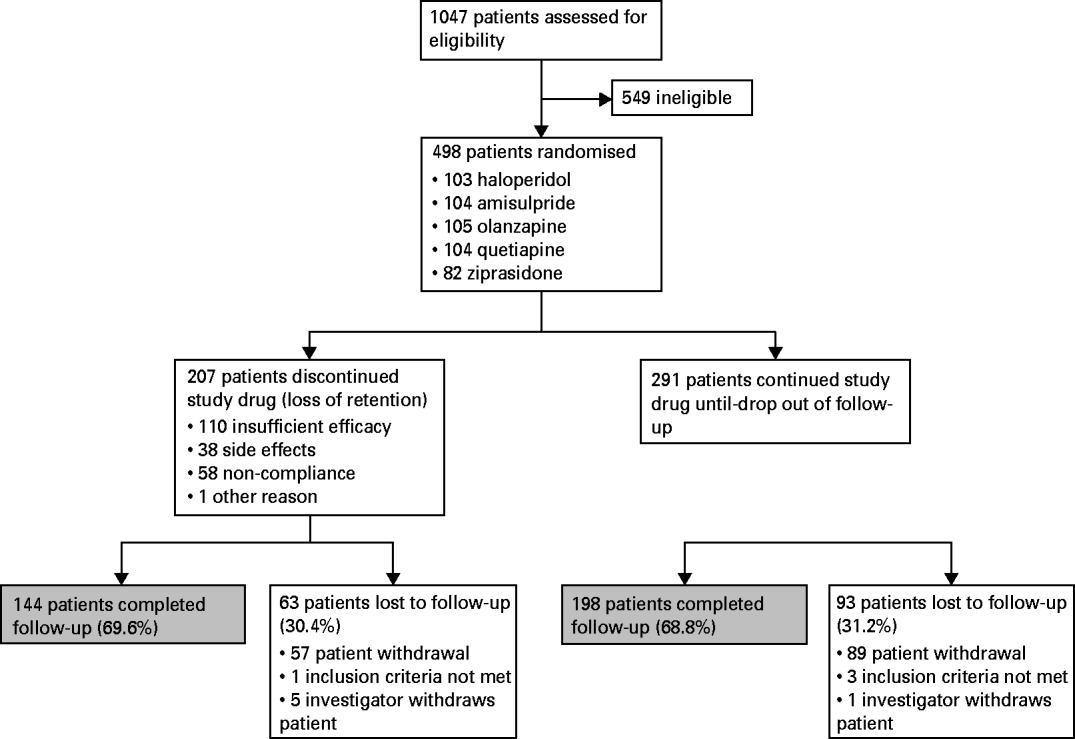
Attrition was not similar to loss of retention of the study drug because patients were followed up beyond loss of retention. Of the 498 patients initially included, 342 (68.7%) completed the assessments scheduled by the study according to protocol. Of the 156 withdrawals (31.3% of the baseline total sample), investigators withdrew six, and another four did not meet the inclusion criteria. The remaining 146 patients decided by themselves not to continue the study by withdrawal of consent or no-show. Fig. 1 presents an adapted flow chart for the sample used in our analyses (shaded boxes). More details about the entire trial are included within the main EUFEST paper (Kahn et al. Reference Kahn, Fleischhacker, Boter, Davidson, Vergouwe, Keet, Gheorghe, Rybakowski, Galderisi, Libiger, Hummer, Dollfus, Lopez-Ibor, Hranov, Gaebel, Peuskens, Lindefors, Riecher-Rössler and Grobbee2008).
Simplified flow chart to illustrate the sample used here. Shaded boxes indicate 342 patients who completed the study according to our protocol (but independently of the trial randomization) and thus were included in the present analyses.

Measures
Met and unmet needs were evaluated according to the CAN (Phelan et al. Reference Phelan, Slade, Thornicroft, Dunn, Holloway, Wykes, Strathdee, Loftus, McCrone and Hayward1995), which assesses ratings by patients and also by therapists, case-workers or research assistants. Because scores can differ substantially between patients and professionals, it is important to consider whose perspective is reported when needs are discussed (Slade et al. Reference Slade, Phelan, Thornicroft and Parkman1996, Reference Slade, Phelan and Thornicroft1998; Issakidis & Teesson, Reference Issakidis and Teesson1999; Priebe et al. Reference Priebe, Huxley and Burns1999a; Lasalvia et al. Reference Lasalvia, Ruggeri, Mazzi and Dall'Agnola2000; Hansson et al. Reference Hansson, Vinding, Mackeprang, Sourander, Werdelin, Bengtsson-Tops, Bjarnason, Dybbro, Nilsson, Sandlund, Sorgaard and Middelboe2001; Macpherson et al. Reference Macpherson, Varah, Summerfield, Foy and Slade2003; Wennström & Wiesel, Reference Wennström and Wiesel2006; Wiersma, Reference Wiersma2006). Validity and reliability were previously established in several studies and deemed acceptable (Phelan et al. Reference Phelan, Slade, Thornicroft, Dunn, Holloway, Wykes, Strathdee, Loftus, McCrone and Hayward1995). In the original paper, inter-rater reliability was r=0.99 (patients) and r=0.98 (staff), and test–retest reliability between r=0.78 (patients) and r=0.71 (staff) (Phelan et al. Reference Phelan, Slade, Thornicroft, Dunn, Holloway, Wykes, Strathdee, Loftus, McCrone and Hayward1995). However, test–retest reliability was not adequate for some single items (Kilian et al. Reference Kilian, Bernert, Matschinger, Mory, Roick and Angermeyer2001), but this could be due to skewed distributions of the respective items (Phelan et al. Reference Phelan, Slade, Thornicroft, Dunn, Holloway, Wykes, Strathdee, Loftus, McCrone and Hayward1995).
We also used the Positive and Negative Syndrome Scale (PANSS; Kay et al. Reference Kay, Fiszbein and Opler1987), the Manchester Short Assessment of Quality of Life (MANSA; Priebe et al. Reference Priebe, Huxley, Knight and Evans1999b), the Calgary Depression Scale for Schizophrenia (CDSS; Addington et al. Reference Addington, Addington and Maticka-Tyndale1993) and the Global Assessment of Functioning (GAF; Jones et al. Reference Jones, Thornicroft, Coffey and Dunn1995). In addition, the Hayward Scale assessed compliance (a one-item seven-point rating scale, with higher scores suggesting better adherence; Kemp et al. Reference Kemp, Kirov, Everitt, Hayward and David1998), and prognosis was evaluated along a six-point scale that ranged from 1=best to 6=bad.
The PANSS measures positive and negative symptoms and the general psychopathology of schizophrenia. Consisting of 30 items, it is scored by a trained rater during a structured interview of 30–40 min. Leucht et al. (Reference Leucht, Kane, Kissling, Hamann, Etschel and Engel2005) proposed that a reduction of 50% (respectively of 25% in treatment-refractory patients) indicates treatment success. We used the 50% criterion, even though the exact level of symptom reduction indicating response has been debated (e.g. Kinon et al. Reference Kinon, Chen, Ascher-Svanum, Stauffer, Kollack-Walker, Sniadecki and Kane2008), because this was only used to describe the sample. The percentage reduction was calculated after subtracting 30 (the minimal score) from the PANSS sum score. The CDSS, a nine-item scale, measures the level of depression in schizophrenia with good reliability (Addington et al. Reference Addington, Addington, Maticka-Tyndale and Joyce1992). A cut-off of seven points refers to a specificity of 82% and a sensitivity of 85% for detecting major depressive episodes (Addington et al. Reference Addington, Addington and Maticka-Tyndale1993).
The 14 participating countries were clustered into two regions: West European (The Netherlands, Belgium, France, Switzerland, Austria, Germany, Sweden, Spain and Italy) and East and Central European (Bulgaria, Poland, Romania and Czech Republic). Because only a few patients were from Israel, that country was added to the West European category to control for cell sizes and confidence intervals in the analyses.
Sociodemographic variables were assessed at the beginning of the study (baseline, 0 months). At each assessment, relapse and psychosocial interventions were described. Episodes of psychosocial treatment were recorded with beginning and ending dates. Compliance with medication was measured at 1, 6 and 12 months. All other measures were assessed at least at baseline, 6 and 12 monthsFootnote 1 Footnote †. Observer-rated measures were assessed by site coordinators or co-investigators, for example psychiatrists (including trainees), research nurses or psychologists.
Statistical analyses
The analyses were preceded by a comparison between the baseline sample characteristics of completers and the baseline characteristics of the complete sample. We used SPSS (PASW Statistics 18.0 for Windows) to calculate t tests for continuous variables (or the non-parametric equivalent Mann–Whitney test for variables with non-normal distributions) and χ2 statistics for categorical variables.
Because we were interested in individual trajectories of unmet needs over three time points, we developed a latent class growth model using Latent Gold 4.5. This modelling technique identifies different types of patients by estimating continuous latent variables for individual intercepts and slopes, in addition to a categorical latent variable that represents groups with similar trajectories (Nagin, Reference Nagin1999). The analysis was based on the sum score of unmet needs. Our aim was to identify groups of patients as determined by maximally distinct trajectories of needs between groups and minimally distinct individual trajectories within groups. The number of groups was obtained statistically by comparing the model-fit indices of models with successive numbers of clusters. Because data were sparse, model significance (p value associated) with the L2 fit statistic was assessed using the bootstrap option within Latent Gold 4.5 rather than with standard χ2 values. Model fit was based upon the Bayesian Information Criterion (BIC). To decide on the final model, statistical fit indices were supplemented by the criteria of suitability for answering the research question, parsimony, theoretical justification, and interpretability (Muthén & Muthén, Reference Muthén and Muthén2000). The sum of unmet needs was defined as a count variable.
Finally, we determined the predictors of membership for latent clusters of unmet-needs trajectories and the outcomes of clusters. Although Latent Gold 4.5 allows predictors to be included directly, that option is restricted to categorical variables. Because the measures used in this EUFEST study were count, ordered-categorical or continuous, we preferred a multinomial logistic regression with cluster membership as the dependent variable. In the bivariate multinomial regressions, associated variables were selected on the basis of their significance (p<0.1 to consider weak effects also). Positive and negative symptoms, insight (one item from the PANSS), gender, region, and age were included by default. In the outcome model, follow-up values for the same longitudinal variables were used, and information was added for the number of relapses and psychosocial intervention (duration of ⩾1 month). In the combined multinomial regression model, variables with a significant Likelihood Quotient Test (LQT; p<0.05) were considered main influences. Those that discerned only one group from another due to a significant odds ratio, but without any significant LQT, are also discussed. Multinomial regression was calculated with SPSS.
Differences in single needs that arose between assessment periods were not subjected to statistical testing because of limited cell sizes.
Results
Sample characteristics
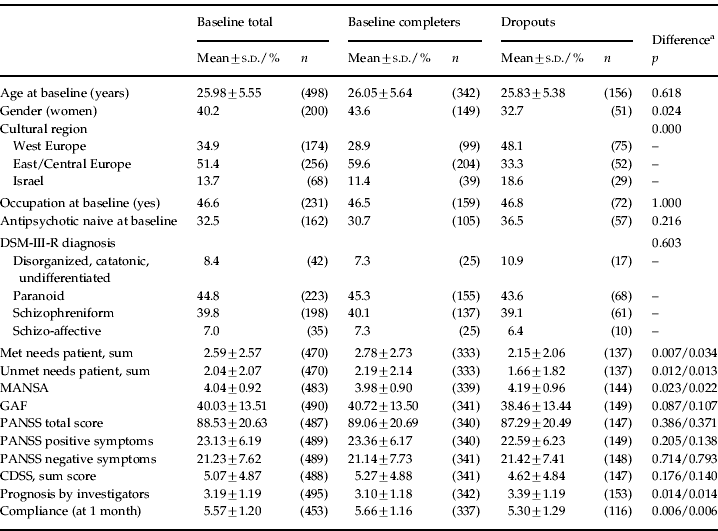
The sample of study completers was used in our analyses. The mean age was 26.1 years at baseline, and more men (56.4%) participated than women (Table 1). More than half of the sample (59.6%) was from Central and East European countries. Paranoid schizophrenia (45.3%) and schizophreniform disorder (40.1%) were the most prevalent diagnostic categories.
Descriptive statistics of selected variables at baseline (total sample, n=498) and sample of completers (n=342)

MANSA, Manchester Short Assessment of Quality of Life; GAF, Global Assessment of Functioning; PANSS, Positive and Negative Syndrome Scale; CDSS, Calgary Depression Scale for Schizophrenia; s.d., standard deviation.
a Dropouts – completers: significance of differences between baseline completers and dropouts was calculated for each continuous/count/ordinal variable with t tests (first p value), to control for non-normal distributions with the Mann–Whitney test (second p value), and with χ2 tests for nominal variables.
Significant, but not large, dropout effects (differences in baseline scores between completers and dropouts) were found for the following variables: gender (more male dropouts), region (fewer dropouts in East and Central European countries), treatment compliance (more adherent patients completed the study), and prognosis (completers had a better prognosis). Finally, completers had more met and unmet needs at baseline than did dropouts.
From baseline to 12 months of follow-up, 78.7% (263 of 334 completers) reached a 50% reduction in their PANSS total scores. At baseline, 36.1% (123/341) had a diagnosis of major depression according to the CDSS score; at 12 months, this was only 3.5% (12/340). Most subjects were part of in-patient treatment settings at the beginning of the study (89.8%; 307/342) versus only 4.7% (16/340) at the 12-month follow-up. About 32.5% of the patients (111/342) had received some psychosocial treatment for at least 1 month.
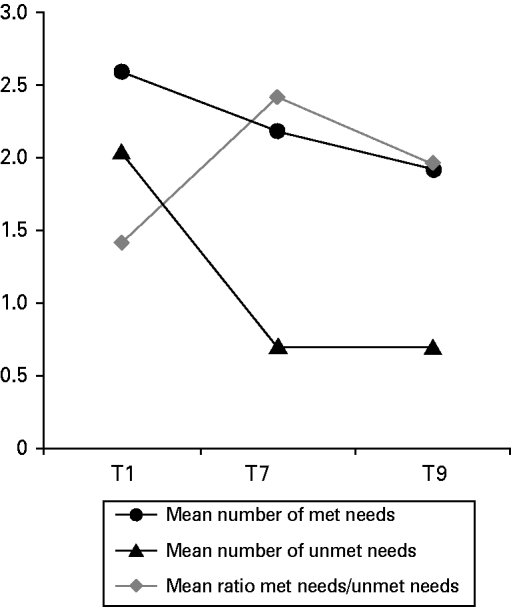
Figure 2 depicts the course of patient-rated met and unmet needs, measured by the CAN. Both clearly decreased from baseline to 6 months. Whereas the number of met needs continued to decline in the second half of the study, the amount of unmet needs tended to remain stable over that period. Compared with baseline findings, at 12 months 65.0% (n=208) patients had fewer unmet needs, 27.5% had an equal number, and 7.5% (24) had more. At baseline, met needs were slightly more frequent than unmet needs (ratio met/unmet=1.41), but after 6 and 12 months, at least two out of three needs were met (ratio met/unmet=2.41 and 1.96 respectively) (Fig. 2).
Means for number of met needs, unmet needs, and ratios for met needs/unmet needs according to patient ratings from baseline (T1) to 6 months (T7) and 12 months (T9) in the European First Episode Schizophrenia Trial (EUFEST). All patients providing Camberwell Assessment of Need (CAN) ratings at the respective assessments were included. If a person indicated no unmet needs, the respective case was set to the ‘system missing’ value. Therefore, the sample from ratios is much smaller than the sample used for sum scores.

Differences in the course of unmet needs between patient classes
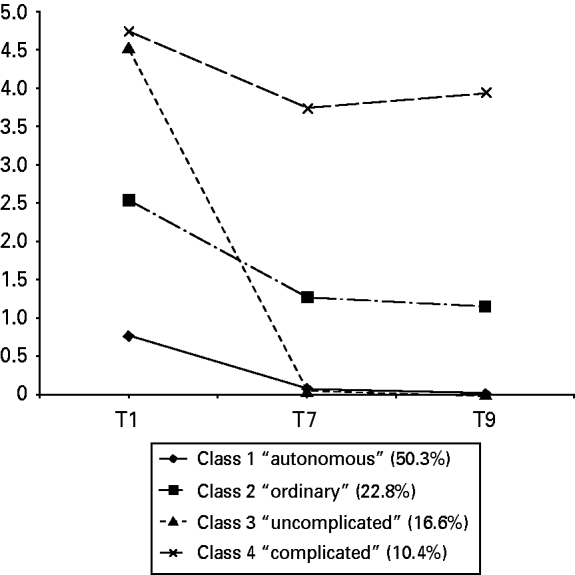
A four-class model describing the course of unmet needs best fitted the data (Fig. 3). This solution fulfilled other criteria of model usability, being practical and easy to explain (Muthén & Muthén, Reference Muthén and Muthén2000). Class 1 (autonomous group) had few unmet needs and a diminishing trend between baseline and 6 months. A second started with a mean of 2.5 unmet needs, then declined sharply to 1.25 from baseline to 6 months and slowly to 1.15 afterwards (ordinary group, class 2). Our uncomplicated group (class 3) started with 4.5 unmet needs, then markedly decreased to nearly zero unmet needs in the first 6 months before showing no other change. Finally, class 4 (complicated group) began with nearly 5.0 unmet needs at baseline, which distinctly dropped to 3.75 at 6 months before increasing to 4.0 unmet needs by month 12.
Four-class model of sum of unmet-need patient ratings (total n=338). The lines represent the mean number of unmet needs in each class. The four-class model was selected according to the Bayesian Information Criterion (BIC). Class sizes were n (class 1)=170, n (class 2)=77, n (class 3)=56, n (class 4)=35. T1, baseline; T7, 6 months; T9, 12 months.

When the ratio of met to unmet needs was considered, change in the first 6 months was greatest in the uncomplicated group, that is from a ratio of 0.74 at baseline, the ratio increased to 4 met needs for every 1 unmet need (n=2). By contrast, ratios for the complicated class remained relatively stable over the three time points (0.80, 1.51, 1.37).
Predictors and outcomes of needs course
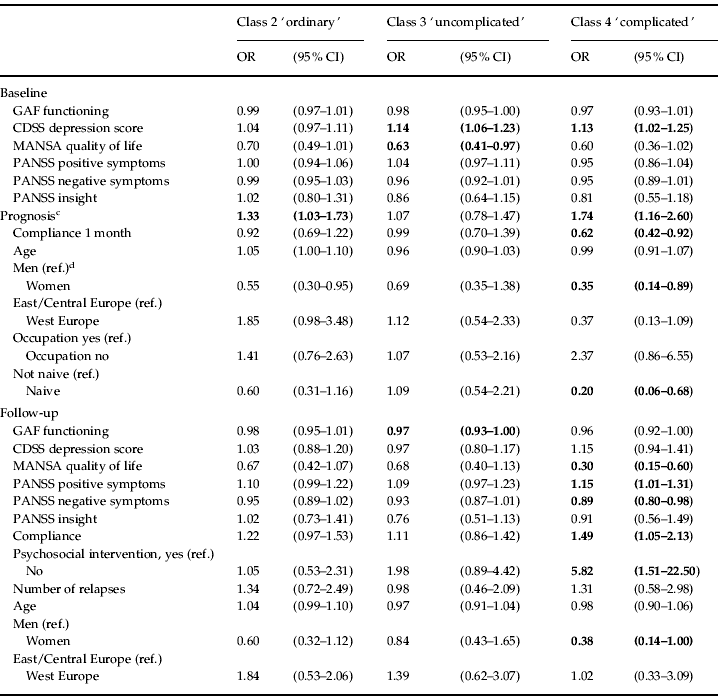
Covariates of the course of unmet needs that were significant at p<0.1 in bivariate analysis were combined in one multinomial regression model. Positive and negative symptoms in addition to the item ‘insight’ from the PANSS were included by default. Table 2 shows our results from the multinomial regression analysis of baseline variables. The autonomous group was chosen as the reference class. From our model, the significant predictors at baseline were depression (means: class 1=4.17, class 2=5.25, class 3=8.00, class 4=6.51), prognosis (class 1=2.92, class 2=3.43, class 3=2.93, class 4=3.60), age (class 1=25.78, class 2=27.26, class 3=25.06, class 4=26.16), region (West Europe and Israel, class 1=33.5%, class 2=53.2%, class 3=41.1%, class 4=37.1%) and being antipsychotic naive (class 1=32.9%, class 2=26.0%, class 3=39.3%, class 4=14.3%) according to the LQT (p<0.05). Patients in the ordinary group had less favourable prognoses than those in the reference group. Persons with an uncomplicated course were distinguished from the autonomous group only by higher depression scores and lower quality of life at baseline. Patients with a complicated-needs course were more often male, had higher baseline depression scores, a less favourable prognosis, and lower compliance. Moreover, they included more patients who had already used antipsychotic medication before the study began. Prognosis at baseline indirectly separated the complicated from the uncomplicated group.
Baseline and follow-up covariates of unmet needs by different trajectory classes (total n=331 at baseline and n=327 at follow-up). Reference class: Class 1 ‘autonomous’ (n=167)Footnote a, Footnote b

GAF, Global Assessment of Functioning; CDSS, Calgary Depression Scale for Schizophrenia; MANSA, Manchester Short Assessment of Quality of Life; PANSS, Positive and Negative Syndrome Scale; OR, odds ratio; CI, confidence interval.
a According to the Likelihood Quotient Test (LQT), the omitting of region, CDSS, being antipsychotic naive at baseline, and prognosis led to significantly different models (p<0.05). Overall model fit: χ2 118.066, degrees of freedom (df) 39, p<0.000. Pseudo R 2: Cox & Snell 0.300, Nagelkerke 0.329, McFaden 0.148.
b According to the LQT, only the omissions of MANSA and psychosocial intervention led to significantly different models. Overall model fit: χ2 104.402, df 36, p<0.000. Pseudo R 2: Cox & Snell 0.273, Nagelkerke 0.300, McFaden 0.131.
c Prognosis is inversely scored: higher scores mean a more unfavourable prognosis.
d Reference category. This parameter is set to zero because it is redundant.
Values for variables used in the baseline model (age, region and gender) were included in the follow-up model (Table 2), as were the number of relapses and psychosocial intervention (duration of ⩾1 month). Psychosocial interventions (class 1=35.3%, class 2=42.9%, class 3=25.0%, class 4=11.4%) and quality of life (class 1=5.06, class 2=4.66, class 3=4.82, class 4=4.16) were significant covariates in the model (LQT p<0.05). None of the follow-up variables differentiated between the autonomous (reference) and the ordinary group. The uncomplicated group had lower functioning scores at follow-up compared with the reference group. The complicated group had fewer psychosocial interventions, lower quality of life, more positive symptoms, fewer negative symptoms, and better compliance than did the autonomous group (Table 2).
Specific unmet needs
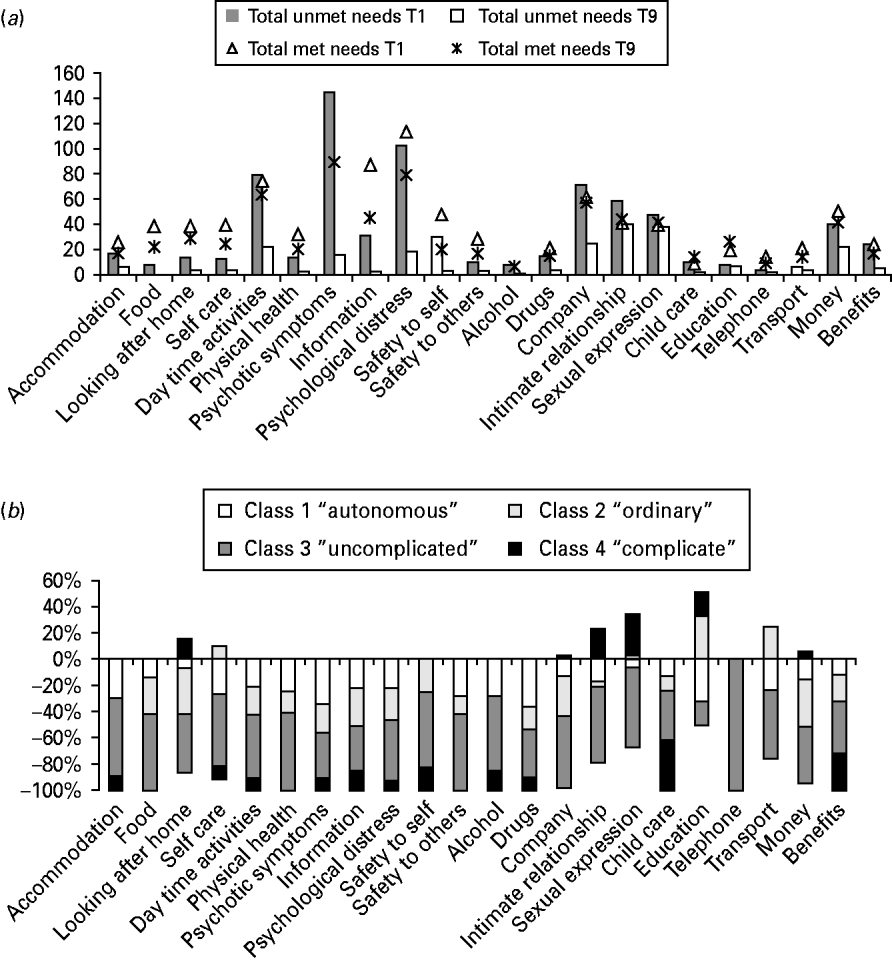
In all four classes, daytime activities, psychotic symptoms, psychological distress and social integration were most often rated as unmet needs (Fig. 4a). In areas of life where unmet needs were prevalent at baseline, some still remained unmet after 12 months. Met needs (Fig. 4a) were more persistent, being associated with hardly any reduction in psychotic symptoms and social integration. Figure 4b depicts the change in specific unmet needs for each class. A bar corresponds to the total change in a particular item in the total sample (=100%). Each bar contains information on change in the four classes. The negative section of the bars represents fewer unmet needs at 12 months than at baseline whereas the positive portion corresponds to an augmentation in unmet needs. For example, ‘intimate relationship’: change in class 1=−6, change in class 2=−1, change in class 3=−18, change in class 4=+7; total change in unmet needs=28 (100%).
(a) Distribution of needs in detail. Bars represent numbers of met (triangles) and unmet (darker bars) needs at baseline (T1); crosses (met needs) and lighter bars (unmet needs) represent numbers of needs at the 12-month follow-up (T9). (b) Percentage change between baseline (T1) and 12-month follow-up (T9) in single unmet needs in the four classes. 100% represents the total change in a particular item in the total sample. The coloured bars represent how much of this change was present in each of the latent classes. Positive values mean more unmet needs, negative values indicate a reduction in unmet needs.

Those needs concerning self-care, sexual expression, education and transport became more frequent in the ordinary group whereas those related to sexual expression, intimate relationship, company, education, looking after home, and money became more frequent in the complicated group.
Discussion
Information is scarce about the course of treatment needs for persons in the early stages of schizophrenia. We analysed patient ratings of needs over a 12-month span in a homogeneous sample of participants suffering from first-episode schizophrenia. It became clear that the first 6 months were of outmost importance to treatment because the largest proportion of change in needs occurred during that period.
The EUFEST sample contains many relatively well-integrated patients who possibly will never become chronically ill. Accordingly, the degree of reduction in unmet needs over time has proven more pronounced in that study than in other research encompassing the same time-span in longer established illness (Priebe et al. Reference Priebe, McCabe, Bullenkamp, Hansson, Rossler, Torres-Gonzales and Wiersma2002). Because the EUFEST sample was homogeneous for the phase of illness at baseline, the majority of patients made a transition from the acute phase of illness to remission after about 6 months. They then reached the stabilization phase during the second half of the study. At least at baseline, all were under neuroleptic medication, which helped to reduce symptoms and contributed to an initial decline in unmet treatment needs in the majority of patients. Neither the duration of medication nor first- versus second-generation neuroleptic medication had a significant impact on the course of unmet needs. However, a floor effect may have been responsible for the relatively stable course of unmet needs between 6 and 12 months.
The overall curve of unmet needs was composed of three groups that differed mainly in their baseline numbers of unmet needs, plus one relatively small group that showed a marked decline in those needs. The largest group had few unmet needs throughout the study. From the beginning, patients from this group had better prognoses than those who remained higher in unmet needs. They also experienced less depression and a better quality of life than did patient groups with more initial unmet needs. This group was called the ‘autonomous’ group because they had fewer unmet needs, even if they did not have more psychosocial interventions. The ‘ordinary’ group had slightly more unmet needs throughout the study compared with the autonomous group, in addition to a less favourable initial prognosis. Accordingly, more patients in this group underwent some type of psychosocial treatment. Although many of their unmet needs had disappeared by month 6, those that concerned education and transport, which might become more important in more stable phases of illness, had increased. Patients in the ‘uncomplicated group’ had relatively numerous unmet needs at the beginning but then showed a very steep decline from baseline until the 6-month assessment, even if they did not have more frequent psychosocial treatment than the other two groups. Strong initial depression and low quality of life might have been reasons for the elevated number of unmet needs at baseline. Patients in the ‘complicated group’, who had fairly elevated levels of unmet needs over the entire time-span, had more initial depression, as was also found with the uncomplicated group. However, they seemed to miss the opportunity for recovery, as evidenced by their greater number of positive symptoms at follow-up compared with other groups. The lack of psychosocial interventions might have been a reason for this because patients' psychosocial needs had increased at the time of follow-up.
Some processes that influence the course of unmet needs merit a closer look. For example, high depression scores at the beginning of our study coincided with a high degree of unmet needs. However, depression did not differ between the uncomplicated group with declining unmet needs and the complicated group that sustained a high level of such unmet needs. Because depression during the follow-up period was no longer associated with various courses of needs, this finding cannot be explained by a self-rating bias of both instruments (Hansson et al. Reference Hansson, Björkman and Priebe2007). Findings that concern predictions of later depressive episodes based upon depression in the prodromal or acute states are unequivocal (an der Heiden & Häfner, Reference an der Heiden and Häfner2000; Birchwood et al. Reference Birchwood, Iqbal, Chadwick and Trower2000; Upthegrove et al. Reference Upthegrove, Birchwood, Ross, Brunett, McCollum and Jones2010). Our results might also be interpreted as evidence that depression in the acute phases does not have to be exactly the same as depression in later phases of schizophrenia. Patients in acute phases of schizophrenia probably do not entirely realize that they need help because of their contemporaneous delusions and grandiosity. By contrast, depression implicates a stronger urge to seek assistance and greater insight into their illness, thereby leading them to a greater recognition of those needs (Mintz et al. Reference Mintz, Dobson and Romney2003; Schennach-Wolff et al. Reference Schennach-Wolff, Obermeier, Seemuller, Jäger, Messer, Laux, Pfeiffer, Naber, Schmidt, Gaebel, Klosterkötter, Heuser, Maier, Lemke, Ruther, Klingberg, Gastpar, Möller and Riedel2011). By the later phases, working alliances might develop and patients may learn to rate their need for treatment independently of depressive symptoms. However, the missing impact of insight revealed in our study discounts this hypothesis.
Surprisingly, neither baseline positive nor negative symptoms were relevant. However, at follow-up, positive and negative symptoms and also functioning differed among the groups. One possible conclusion is that neither psychotic symptoms nor depression and functioning in acute phases could predict whether patients would require more intensive help, especially with social needs. Nevertheless, at follow-up there may have been larger differences among patients (i.e. whether they are in acute or stabilization phase of illness), and therefore stronger effects of psychopathology. A more profound examination of the topic would be interesting. For now, this lies beyond the scope of our paper.
The prognosis of clinical improvement seemed to discern the uncomplicated and complicated needs course in patients with initially high numbers of unmet needs. Thus, the prognosis was fairly exact because patients remaining high in unmet needs also had more positive symptoms or lower functioning scores at follow-up. However, our data did not clearly indicate the basis upon which investigators drew their conclusions concerning prognosis. There, an ad-hoc scale was applied, for which psychometric properties have not been ascertained. Despite the correct prognosis at baseline, patients with a complicated needs course had less frequent psychosocial interventions. This could not have been explained as a failure to recognize their own needs because, at both baseline and follow-up, those patients had indeed expressed psychosocial needs. In general, the persistently high occurrence of unmet social needs in patients with a complicated course demonstrates the necessity to address social and relationship needs during both acute and post-acute phases of illness. Impairments in (social) functioning can also be very stable in the middle and late courses of schizophrenia (Häfner et al. Reference Häfner, Löffler, Maurer, Hambrecht and an der Heiden1999). Antipsychotic treatment alone is not sufficient to improve such functioning (Swartz et al. Reference Swartz, Perkins, Stroup, Davis, Capuano, Rosenheck, Reimherr, McGee, Keefe, McEvoy, Hsiao and Lieberman2007). By attending to unmet social needs at the early stages, the progressive loss of meaningful relationships can be prevented. Although we could not obtain information about why those patients with many needs did not receive help, these results indicate the importance of studying the processes that lead to a clinical prognosis and also the relationship between that prognosis and treatment planning in first-episode patients.
Whereas revealing more unmet needs at follow-up coincided with better compliance, the opposite was true at baseline. Using univariate analysis, we found similar effects of compliance at baseline and follow-up. Therefore, compliance was better in patients with more unmet needs later on, but only with regard to other variables that were included in the follow-up model.
Summary
The results from this study have demonstrated that, in a sample of first-episode patients, strong differences were found among their 1-year courses of treatment needs. An unfavourable course of unmet needs coincided with more positive symptoms. Psychosocial treatment seemed to play a crucial role in influencing the development of unmet needs. Whether investigators are able to predict those courses and whether psychosocial treatment is responsible for an improved needs course should be confirmed by studies that use more elaborate assessments. This may identify those patients at risk for more unfavourable courses, thereby prompting attention to reduce their unmet needs.
Limitations
One limitation to the generalization of these results was participants' attrition. Our results are valid only for patients who completed the study; it is unclear whether the data would have been the same if all patients had been included. We did not use imputation of missing values because they were not randomly distributed. Because unmet needs and several other variables were predictors of missingness, such imputation would have borne a high risk of biasing the results.
A second limitation lay within the analytic strategy. Low levels of unmet needs can be due to generally few needs, but may also be a consequence of many needs being met. The approach we used did not differentiate between those conditions.
Other limitations were due to instruments and study design. For example, the CAN is not devised especially for first-episode schizophrenia. If needs exist that are exclusively relevant in this phase of illness, they may be missed by the CAN. Needs were assessed during a controlled randomized trial that was aimed, instead, at testing different neuroleptic medications. Other factors may have influenced the course of unmet needs that were not addressed in this study.
Appendix
EUFEST Study Group
Steering Committee: R. S. Kahn, Utrecht, The Netherlands; W. W. Fleischhacker, Innsbruck, Austria; H. Boter, Utrecht, The Netherlands; I. P. M. Keet, Amsterdam, The Netherlands; C. Brugman, Utrecht, The Netherlands; M. Davidson, Tel Hashomer, Israel; S. Dollfus, Caen, France; W. Gaebel, Düsseldorf, Germany; S. Galderisi, Naples, Italy; M. Gheorghe, Bucharest, Romania; I. Gonen, Bucharest, Romania; D. E. Grobbee, Utrecht, The Netherlands; L. G. Hranov, Sofia, Bulgaria; M. Hummer, Innsbruck, Austria; J. Libiger, Hradec Králové, Czech Republic; N. Lindefors, Stockholm, Sweden; J. J. López-Ibor, Madrid, Spain; K. Nijssen, Utrecht, The Netherlands; J. Peuskens, Leuven, Belgium; A. Riecher-Rössler, Basel, Switzerland; J. K. Rybakowski, Poznan, Poland; G. Sedvall, Stockholm, Sweden; M. V. Wilmsdorff, Düsseldorf, Germany.
Acknowledgements
The EUFEST trial was supported by the European Group for Research in Schizophrenia (EGRIS) with grants from AstraZeneca, Pfizer and Sanofi-Aventis. We thank all patients who participated in the study.
Declaration of Interest
W.R. has received speaker's honoraria and served as a consultant for Elli Lilly, Janssen-Cilag, AstraZeneca and BMS. R.S.K. has received honoraria for educational programmes and grants, or has served as consultant for Astellas, AstraZeneca, BMS, Eli Lilly, Janssen-Cilag, Pfizer, Roche and Sanofi-Aventis. W.W.F. has received research grants from BMS/Otsuka, Eli Lilly, Janssen-Cilag and Servier; honoraria for educational programmes from AstraZeneca and Pfizer; speaking fees from AstraZeneca, BMS/Otsuka, Janssen-Cilag and Pfizer; and advisory board honoraria from AstraZeneca, BMS/Otsuka, Janssen-Cilag, Servier and Wyeth. S.G. has received fees for educational programmes or advisory boards from AstraZeneca, Innova-Pharma, Bristol-Myers Squibb and Janssen-Cilag. J.L. is a faculty member at the Lundbeck Institute (Lundbeck Neuroscience Foundation); and has also received speaking fees, travel grants or consultancy fees from Eli Lilly, Bristol-Myers Squibb, Lundbeck and Servier.