Introduction
Nasal papillomas are human papilloma virus (HPV) related squamous neoplasms developing from the stratified squamous epithelium of the vestibulum nasi. They usually manifest as verrucous papules showing histologically papillomatous hyperplasia without significant cellular atypia. Three different subtypes of nasal papillomata have been described: everted squamous papilloma (or exophytic squamous papilloma), inverted papilloma and cylindrical cell papilloma (composed of columnar epithelium).Reference Shanmugaratnam and Sobin1
The primary goal of nasal papilloma treatment is destruction and/or removal of the lesions by means of surgical procedures (cryotherapy, electrodessication, surgical excision or laser ablation). Recurrences after removal are not rare, and achieving complete remission may occasionally be a therapeutic challenge. This is particularly the case when nasal papillomata develop in immunosuppressed patients. Furthermore, repeated destructive procedures in the nasal cavities can cause either significant scar formation and/or increased risk of septal perforation or stenosis.
We report herein a human immunodeficiency virus (HIV) positive patient who presented with multiple, recurrent nasal papillomata after repeated surgical procedures. This patient achieved complete, persistent resolution of the lesions following topical treatment with imiquimod cream.
Case report
A 36-year-old man was referred to our hospital for evaluation of persistent nasal obstruction and bilateral discharge. Past medical history included intravenous drug abuse and HIV infection diagnosed in 1998 and treated with lamivudine and zidovudine. A cluster of differentiation four glycoprotein lymphocyte count of 1076/mm3 was detected. The peripheral blood viral load was undetectable.
Physical examination disclosed bilateral, polypoid masses of cauliflower-like appearance, 1.5 cm in diameter, in both nasal cavities. The lesions narrowed the vestibulum nasi and caused moderate obstruction, impairing normal nasal breathing.
A computed tomography (CT) scan of the paranasal sinuses ruled out sinusal polyposes or papillomata.
Resection by endoscopic surgery was performed.
Histopathological study disclosed squamous hyperplasia with a verrucous pattern and koilocytosis. Polymerase chain reaction analysis detected amplification of type 11 HPV. A diagnosis of bilateral nasal papillomatosis was established.
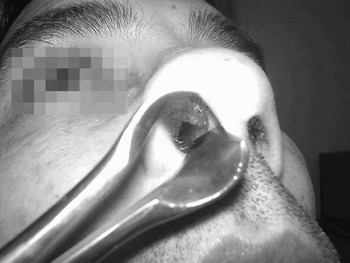
A few weeks after treatment, clinical recurrence of the lesions in both nasal cavities was observed (Figure 1). A further surgical excision was performed.
Warty, polypoid mass seen within the right nasal cavity. Published with patient's permission.

During the following 18 months, three additional clinical recurrences were noted after similar surgical procedures.
Due to the lack of effectiveness of surgical treatment, topical 5 per cent imiquimod cream was prescribed (self-applied, twice daily, three days a week).
Two weeks after the onset of treatment, the patient noticed mild and tolerable discomfort, comprising mild itching, a burning sensation and pain. These local side effects were of mild intensity and did not alter the course of the treatment.
Four weeks after the onset of treatment, anterior rhinoscopy revealed superficial mucosal erosion with mild oedema and crusting.
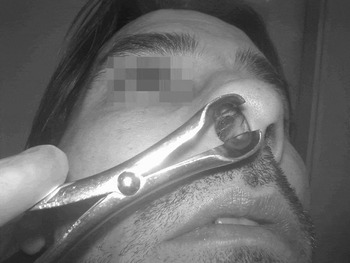
Three months after the onset of treatment, no verrucoid lesions were noted, and only discrete, minimal epithelial hypertrophy was present (Figure 2). Treatment was continued to complete a 20-week schedule.
Clinical appearance of the nasal cavity after three months of imiquimod treatment. Published with patient's permission.

Five months after the onset of imiquimod treatment, a small recurrence, consisting of a solitary papule on the right nasal fossa, was observed; this resolved completely after a new, four-week course of imiquimod treatment.
Over a three-year follow-up period, no additional surgical treatment was performed and only one additional imiquimod treatment was required.
Discussion
Several topical treatments for nasal papillomata have been reported, including podophyllotoxin, salicylic acid, trichloracetic acid, 5-fluorouracil and intralesional administration of interferon injections, each with variable results.Reference Bouscarat, Mahe and Descamps2 Local physical treatments include photodynamic therapy, cryotherapy, surgical excision, or ablation by means of electrocautery or laser therapy.Reference Halvorson and Kuhn3, Reference Drake, Ceily, Cornelison, Dobes, Dorner and Goltz4 Post-operative recurrence of intranasal papillomata as a result of incomplete tumour resection or persistence of HPV infection is estimated to occur in up to 75 per cent of cases.Reference Phillips, Gustafson and Facer5, Reference Kumagai, Endo, Matsunaga, Kida, Sakata and Yamamoto6
In cases of recurrent nasal papillomata, topical imiquimod appears to be an effective therapeutic alternative to surgical excision or other destructive approaches. Imiquimod is a class of non-nucleoside imidazoquinolinamines that activate the immune system through promoting local cytokine release from antigen-presenting cells such as monocytes, macrophages and dendritic cells (interferon-α, interleukin-12 and tumour necrosis factor-α, among others) by binding to Toll-like receptor 7.Reference Hengge and Ruzicka7 As a consequence, a T-h1 dominant cell-mediated response is induced and is effective against both viral infection and tumour formation.
Imiquimod has been approved for use against HPV infection in the treatment of external genital wartsReference Hengge and Ruzicka7 and anal condylomata,Reference Kaspari, Gutzmer, Kaspari, Kapp and Brodersen8 as well as superficial basal cell carcinoma and actinic keratoses.Reference Jorizzo, Dinehart, Matheson, Moore, Ling and Fox9 Imiquimod cream has also been successfully employed in the treatment of in situ squamous cell carcinoma (Bowen's disease and erythroplasia of Queyrat of the glans penis).Reference Arlette and Trotter10 In addition, adjuvant topical imiquimod cream has been proven to reduce recurrences of anal HPV-related infections following ablative surgery.Reference Kaspari, Gutzmer, Kaspari, Kapp and Brodersen8 Small pilot studies suggest that topical imiquimod has provided some benefit in cases of persistent, recalcitrant common cutaneous warts in both immunocompetent and immunosuppressed patients.Reference Harwood, Perret, Brown, Leigh, McGregor and Proby11, Reference Juschka and Hartmann12
• This paper describes the case of a human immunodeficiency virus (HIV) positive patient presenting with multiple, recurrent nasal papillomata after repeated surgical procedures, in whom complete, persistent resolution of the lesions was achieved after topical treatment with imiquimod cream
• Topical imiquimod 5 per cent cream applied for four to 16 weeks may offer some benefit in the management of recurrent nasal papillomata in HIV-positive patients
• Such treatment may be preferable to surgery or destructive therapeutic options when patients are unwilling or are poor surgical candidates; it also avoids potential surgical sequelae (e.g. scar formation or stenosis)
Caversaccio et al. Reference Caversaccio and Aebi13 reported the results of imiquimod treatment in a series of patients presenting with nasal papillomata. Imiquimod 5 per cent cream was applied three times weekly with a cotton tip applicator for four to 16 weeks. Limited erosion and pruritus were the main reported side effects. Complete resolution was observed in five of six patients after 12 weeks of treatment. As far as we are aware, this is the only reported study evaluating the usefulness of imiquimod treatment in immunocompetent patients with nasal papillomata.
Highly aggressive anti-retroviral therapy has markedly improved the life expectancy and survival of HIV-positive patients. However, this therapy has not been observed to reduce HPV infections in these patients. Human papilloma virus related infections are the most prevalent mucocutaneous disorders observed in HIV-positive patients after the introduction of highly aggressive anti-retroviral therapy.Reference Heard, Plalefsky and Kazatchkine14 In this subset of patients, condyloma acuminata, common warts and nasal papillomata show particularly high recurrence rates after many and varied therapeutic approaches.
Topical imiquimod seems to be an additional therapeutic option for recurrent nasal papillomata in HIV-positive patients. It may be preferable to surgery or destructive therapeutic options when patients are unwilling or are poor surgical candidates, and also avoids the potential surgical sequelae of such procedures (i.e. scar formation and stenosis). Additional studies with large series of patients are required to define the role of this therapeutic approach to reducing the recurrence of nasal papillomata, either as an individual treatment or an adjuvant to surgery.