Introduction
Alexithymia is a personality construct first identified in hospitalized psychosomatic patients. It is characterized by an inability to identify and verbalize emotions in the self, a restricted imagination, and an externally oriented thinking style (Sifneos, Reference Sifneos1973). Alexithymia is linked to an increased risk for several mental and physical health problems such as depression, anxiety disorders, and substance abuse (Berthoz, Consoli, Perez-Diaz, & Jouvent, Reference Berthoz, Consoli, Perez-Diaz and Jouvent1999; Dorard et al., Reference Dorard, Bungener, Phan, Edel, Corcos and Berthoz2017; Honkalampi, Hintikka, Tanskanen, Lehtonen, & Viinamäki, Reference Honkalampi, Hintikka, Tanskanen, Lehtonen and Viinamäki2000; Thorberg, Young, Sullivan, & Lyvers, Reference Thorberg, Young, Sullivan and Lyvers2009). Because alexithymic traits show overlap with depressive symptoms, controversy remains regarding their nature as a distinct personality feature: Some researchers claim that alexithymia is a state-dependent phenomenon in depressed or anxious individuals, while others argue that it represents a stable trait increasing vulnerability to mental health disorders (Hiirola et al., Reference Hiirola, Pirkola, Karukivi, Markkula, Bagby, Joukamaa and Mattila2017; Marchesi, Brusamonti, & Maggini, Reference Marchesi, Brusamonti and Maggini2000; Marchesi, Ossola, Tonna, & De Panfilis, Reference Marchesi, Ossola, Tonna and De Panfilis2014).
The etiology of alexithymia is not fully understood. Twin studies suggest a relatively low heritability rate of 30–35%, and therefore environmental effects are likely important (Jørgensen, Zachariae, Skytthe, & Kyvik, Reference Jørgensen, Zachariae, Skytthe and Kyvik2007). One pathway through which the family environment may affect the development of alexithymia, is parent–child attachment formation. Attachment theories hold that children are born with an innate tendency to seek proximity to caregivers in times of need. If parents fail to adequately respond to their child's emotional needs, they may develop a sense of insecurity in human interaction and form negative representations of self and others (Mikulincer & Shaver, Reference Mikulincer and Shaver2012; Pasco Fearon & Roisman Reference Pasco Fearon and Roisman2017). Alexithymia has been proposed to arise from inadequate parental bonding and childhood emotional neglect, possibly leading to an insecure attachment style and emotion regulation deficits (Brown, Fite, Stone, & Bortolato, Reference Brown, Fite, Stone and Bortolato2016; Lyvers, Mayer, Needham, & Thorberg, Reference Lyvers, Mayer, Needham and Thorberg2019; Taylor, Bagby, Kushner, Benoit, & Atkinson, Reference Taylor, Bagby, Kushner, Benoit and Atkinson2014). Retrospective experiences of childhood emotional neglect and problematic parental bonding have been consistently linked to higher alexithymia levels (Aust, Alkan Härtwig, Heuser, & Bajbouj, Reference Aust, Alkan Härtwig, Heuser and Bajbouj2013; Brown et al., Reference Brown, Fite, Stone and Bortolato2016; Lyvers et al., Reference Lyvers, Mayer, Needham and Thorberg2019; Taylor et al., Reference Taylor, Bagby, Kushner, Benoit and Atkinson2014; Thorberg, Young, Sullivan, & Lyvers, Reference Thorberg, Young, Sullivan and Lyvers2011). Indeed, many studies imply that the development of emotional awareness, creative imagination and healthy emotion regulation abilities likely require an emotionally safe rearing environment, and a secure attachment formation with caregivers (Cassidy, Reference Cassidy1994; Moutsiana et al., Reference Moutsiana, Fearon, Murray, Cooper, Goodyer, Johnstone and Halligan2014).
Early-life adversities (EA) such as parental separation, family economic hardship, or childhood maltreatment (CM) in the form of abuse or neglect, have long-lasting adverse effects for child neurocognitive development and later mental health (Cassidy, Reference Cassidy1994; Nemeroff, Reference Nemeroff2016; Pechtel & Pizzagalli, Reference Pechtel and Pizzagalli2011). CM is usually divided into emotional neglect, emotional abuse, physical neglect, physical abuse, and sexual abuse (Infurna et al.Reference Infurna, Reichl, Parzer, Schimmenti, Bifulco and Kaess2016; Mandelli, Petrelli, & Serretti, Reference Mandelli, Petrelli and Serretti2015). Traditionally, studies have measured only one type of CM, most often physical or sexual abuse, while failing to control for the effects of other types (Infurna et al. Reference Infurna, Reichl, Parzer, Schimmenti, Bifulco and Kaess2016). Types of CM tend to be highly co-occurring, which makes it often challenging to distinguish unique effects of individual CM types by statistical methods (Green et al., Reference Green, McLaughlin, Berglund, Gruber, Sampson, Zaslavsky and Kessler2010; Vachon, Krueger, Rogosch, & Cicchetti, Reference Vachon, Krueger, Rogosch and Cicchetti2015). Therefore, it is still unclear how different forms of CM affect mental health outcomes (Cecil, Viding, Fearon, Glaser, & McCrory, Reference Cecil, Viding, Fearon, Glaser and McCrory2017; Vachon et al., Reference Vachon, Krueger, Rogosch and Cicchetti2015). Nonmaltreatment types of EA such as parental separation or low socioeconomic status can also increase the risk for both alexithymia as well as depression in adulthood (Ford, Clark, & Stansfeld, Reference Ford, Clark and Stansfeld2011; Hackman & Farah, Reference Hackman and Farah2009; Karukivi & Saarijärvi, Reference Karukivi and Saarijärvi2014), but it remains elusive whether these effects are independent from CM.
The purpose of this study was twofold: The first aim was to examine how different EAs and adult attachment associate with alexithymia. Although alexithymia is at least partly assumed to arise from emotional neglect in childhood, no studies have controlled for the effects of other EA types. In light of previous findings and attachment theory, we expected alexithymia to be specifically associated with a history of emotional maltreatment (Aust et al., Reference Aust, Alkan Härtwig, Heuser and Bajbouj2013; Brown et al., Reference Brown, Fite, Stone and Bortolato2016), and with adult attachment insecurity. In contrast, as depression is likely a heterogenous syndrome (Goldberg, Reference Goldberg2011; Rantala, Luoto, Krams, & Karlsson, Reference Rantala, Luoto, Krams and Karlsson2018), we expected it to show broader associations with different types of EA. Secondly, we aimed to clarify the connection between depression and alexithymia by analyzing how different EA types impact their respective prevalences, and by comparing depressed individuals with concurrent alexithymia to those without it.
Methods
Study details and participants
This study is based on the FinnBrain Birth Cohort Study (www.finnbrain.fi), a prospective cohort established to study the effects of prenatal and early-life stress exposure on child brain development and health (Karlsson et al., Reference Karlsson, Tolvanen, Scheinin, Uusitupa, Korja and Ekholm2018). Participants were recruited between December 2011 and April 2015 from maternal welfare clinics in the South-Western Hospital District and the Åland Islands in Finland. After recruitment, the participants filled in a set of self-report questionnaires three times during pregnancy, at gestational weeks 14, 24, and 34. After birth, the families are followed up at 3- to 6-month intervals (the first 30 months) or 12-to 36-month intervals (from 36 months onwards) and the study is planned to continue for decades. The initial FinnBrain sample consisted of 3,808 mothers, 2,623 fathers and their babies. The participants for this study consisted of those parents (1,713 mothers and 882 fathers, N = 2595) who filled in all relevant questionnaires. Attrition analyses have been reported elsewhere for those who dropped out of the study before the Toronto Alexithymia Scale (TAS-20) questionnaire was administered (Kajanoja, Scheinin, Karlsson, Karlsson, & Karukivi, Reference Kajanoja, Scheinin, Karlsson, Karlsson and Karukivi2017).
Questionnaire data
Background information included age, and education divided into three classes: (a) high school or lower; (b) vocational/upper secondary school degree; (c) applied sciences/university degree. Questionnaires regarding background information were administered at gestational week 14.
EA: The Trauma and Distress Scale (TADS) (Salokangas et al., Reference Salokangas, Schultze-Lutter, Patterson, von Reventlow, Heinimaa, From and Tuominen2016) was used to assess CM. The TADS is a 43-item self-report questionnaire developed to assess CM retrospectively (exposure before 18 years of age). It includes five subdomains: emotional abuse, physical abuse, sexual abuse, emotional neglect, and physical neglect. The questionnaire measures frequency of maltreatment exposure using a 5-point scale (0 = never, 4 = almost always). When examining impacts of specific types of CM, dichotomized scores of each maltreatment type were used, a method previously validated in a Finnish population (Kajanoja et al., Reference Kajanoja, Scheinin, Karlsson, Karlsson and Karukivi2017). Additionally, raw TADS scores were used to examine intercorrelations between maltreatment types, and when used as control variables. Nonmaltreatment types of EA were assessed by items from the Health 2000 questionnaire (Heistaro, Reference Heistaro2008). Parental common psychiatric disorders (major depression, anxiety disorders, eating disorders, psychotic disorders, bipolar disorder or attention-deficit/hyperactivity disorder (ADHD)), parental substance abuse, as well as parental separation during childhood, were asked as single yes/no questions. Financial problems in the childhood family were also assessed by a single item: “There were long-term financial difficulties in my childhood family,” using a 5-point scale (0 = never, 4 = almost always). This measure was dichotomized in the same way as the TADS maltreatment domains. The TADS and Health 2000 questionnaires were administered at gestational week 14.
The TAS-20 (Bagby, Parker, & Taylor, Reference Bagby, Parker and Taylor1994; Joukamaa et al. Reference Oukamaa, Miettunen, Kokkonen, Koskinen, Julkunen, Kauhanen and Järvelin2001; Taylor, Bagby, & Parker, Reference Taylor, Bagby and Parker2003) is one of the most commonly used self-report scales to measure alexithymic features. It consists of 20 items divided into three subscales: Difficulty Identifying Feelings (DIF), Difficulty Describing Feelings (DDF), and Externally Oriented Thinking (EOT). Items are rated with a 5-point Likert-scale (1 = strongly disagree, 5 = strongly agree). Thus, the total score ranges from 20 to 100. An individual is considered alexithymic if the TAS-20 total score exceeds 60 points. The TAS-20 was administered 6 months after the child's birth.
The Edinburgh Postnatal Depression Scale (EPDS) (Cox, Holden, & Sagovsky, Reference Cox, Holden and Sagovsky1987; Tamminen, Reference Tamminen1990) is a widely used questionnaire for screening prenatal and postnatal depression and has also been validated in men (Matthey, Barnett, Kavanagh, & Howie, Reference Matthey, Barnett, Kavanagh and Howie2001). It is a 10-item self-report scale that asks respondents to rate their mood and other depressive symptoms in the previous 7 days. Questions are scored from 0 to 3 and thus the total score ranges from 0 to 30 points. Depressive symptoms were measured 3 and 6 months after the child's birth. The cut-off score of 9/10 was used, indicating the threshold for possible major or minor depressive disorder (Gibson, McKenzie-McHarg, Shakespeare, Price, & Gray, Reference Gibson, McKenzie-McHarg, Shakespeare, Price and Gray2009). Scoring above the cut-off in either timepoint was interpreted as current depression.
The Experiences in Close Relationships questionnaire (ECR-R) (Fraley, Waller, & Brennan, Reference Fraley, Waller and Brennan2000) was used to assess adult attachment style. The ECR-R is a 36-item questionnaire divided into two dimensions of attachment anxiety and avoidance, designed to assess attachment security in romantic relationships. Items are scored on a 7-point scale from 1 (strongly disagree) to 7 (strongly agree). Higher scores indicate attachment insecurity. The dimension of attachment anxiety reflects preoccupation about the partner's emotional availability, whereas attachment avoidance is characterized by distrust in emotional closeness, and attempts to maintain independence, emotional distance’ and self-reliance (Mikulincer & Shaver, Reference Mikulincer and Shaver2012). The ECR-R was administered in mid-pregnancy.
Statistical methods
All statistical analyses were conducted using the IBM SPSS (version 24.0). Normality of distribution within variables was tested visually and using the cut-off values of larger than 7 for kurtosis and larger than 2 for skewness, indicating a non-normal distribution (Kim, Reference Kim2013). All continuous predictor and outcome variables (TAS-20, EPDS, TADS dimensions, and ECR-R) were non-normally distributed. TAS-20 scores and ECR-R scores were log-transformed, after which they were normally distributed. EPDS and SCL-90 scores were highly skewed and could not be transformed into a normal distribution, therefore nonparametric tests were used. Chi-square test was used to assess differences between categorical variables, and Student's t test (for normally distributed data) or Mann–Whitney U test (for non-normally distributed) between continuous variables. In the intercorrelations between maltreatment types, Spearman's rho (ρ) (non-parametric) or Pearson's r (parametric) were used to quantify the strength of the association. Analysis of variance (ANOVA) was used to examine the association between education level and attachment security. When analyzing attachment insecurity in depression and alexithymia, general linear model (GLM) was used to control for sex, age, and education level. GLM was additionally used when examining associations between non-maltreatment types of EA, and alexithymia levels and depressive symptoms, controlling for the effect of CM. Here, partial ŋ2 was used as a measure of effect size. The significance level in all analyses was set at p < .05 (two tailed).
To disentangle the effects of different types of CM, individuals who reported experiencing only one type of CM were compared to those who reported no maltreatment. This approach enabled us to identify groups that scored high in one specific domain of CM. As sexual abuse rarely occurred alone, controlling for other types of CM was not possible, and therefore sexual abuse was left out of the final analyses. Binary logistic regression analysis was used to assess the impacts of nonmaltreatment types of EA, while controlling for the effects of concurrent CM. Here, raw TADS total scores were used as a continuous control variable. As there were fewer individuals with high alexithymia than current depression, the associations between CM types and alexithymia had wider confidence intervals. We therefore also analyzed associations of EA types, TAS-20 overall scores, and individual TAS-20 dimensions separately, in order to avoid false negative conclusions concerning the relationship between EA types and alexithymia.
Results
Characteristics of the study sample
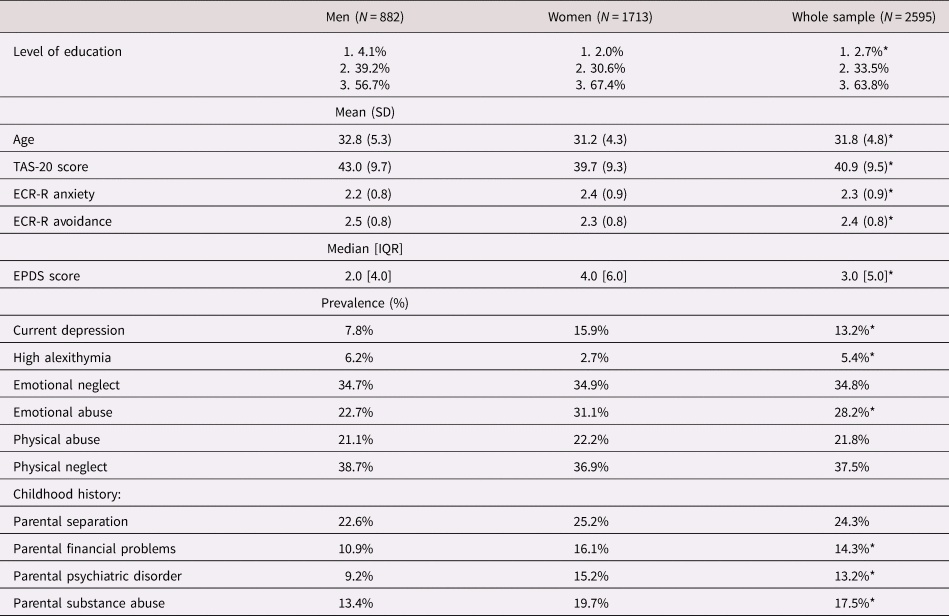
Demographic information on the study sample, as well as prevalence of different EA types, are shown in Table 1. Data showed that 43.5% of the participants reported no history of maltreatment, while 36.2% reported experiencing more than one type of maltreatment. Lower education was associated with all types of maltreatment (p < .020 for all comparisons), parental separation (p < .001), and parental substance abuse (p = .021). Raw scores of maltreatment types were highly correlated with each other (ρ = 0.489 – 0.641, p < .001 for all comparisons). History of parental separation, financial problems, psychiatric disorder, and substance abuse in the childhood family were all associated with every type of CM (p < .005 for all comparisons).
Demographic information, study variables and prevalence of different types of early-life adversity

Level of education: 1. High school or lower; 2. Vocational/upper secondary school degree; 3. Applied sciences/University degree. TAS-20 = Toronto Alexithymia Scale, EPDS = Edinburgh Postnatal Depression Scale, ECR-R = Experiences in Close Relationships.
* Significant difference between men and women (p < .05).
Impacts of EA types on depression and alexithymia
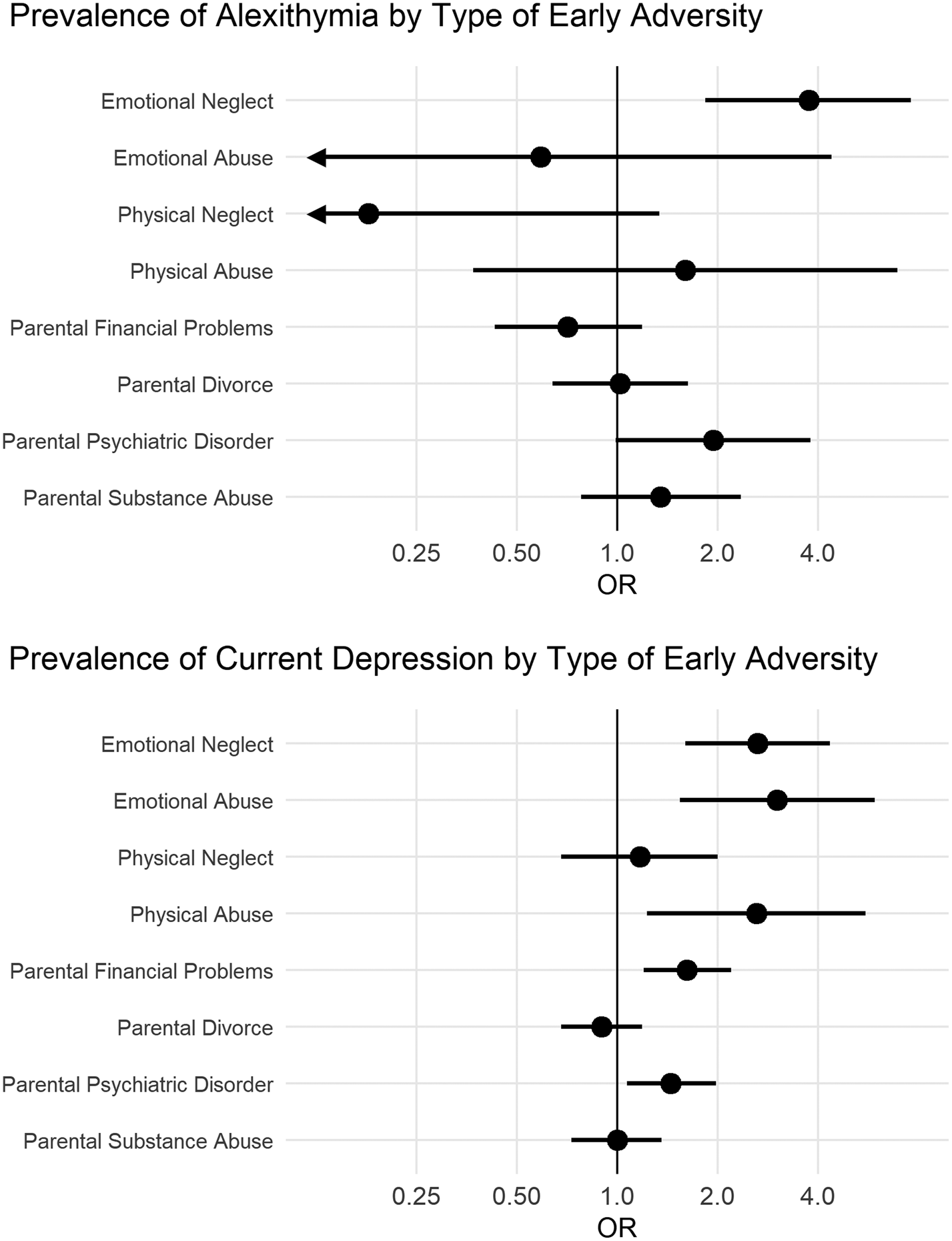
Of the total study sample, 5.7% (N = 148) of participants reported a history of only emotional neglect, 9.1% (N = 236) of only physical neglect, 2.8% (N = 72) of only emotional abuse, 2.1% (N = 55) of only physical abuse, and 0.6% (N = 16) of only sexual abuse. Figure 1 shows the unique contribution of each EA type for current depression and alexithymia. Of individuals with high alexithymia, a total of 65.3% reported a history of emotional neglect, compared to 33.6% of those with low or moderate levels of alexithymia (p < .001).
Associations of specific types of early-life adversity (EA) with depression and alexithymia OR = odds ratio, LCL = lower limit for 95% confidence interval UCL = upper limit for 95% confidence interval. For each type of childhood maltreatment (CM), history of other types of CM has been excluded. For non-maltreatment types of EA, adjusted ORs are displayed, after controlling for the effects of concurrent CM. Graph created by Forest Plot Generator by Evidence Partners.

Analyzing the impacts of EA types on individual alexithymia dimensions and TAS-20 total scores as continuous variables yielded similar results as when using alexithymia as a categorical variable: Emotional neglect was strongly associated with all alexithymia dimensions and total scores (t = 3.237 for DIF, t = 4.328 for DDF, t = 4.915 for EOT, t = 5.9 for total scores, p < .001 for all comparisons). Emotional abuse was additionally weakly associated with DIF (t = 2.307, p = .021) and physical neglect was weakly associated with EOT (t = 2.2, p = .029). All other CM types were unrelated to alexithymia dimensions and total scores.
Parental history of psychiatric disorders, parental substance abuse, and parental separation was unrelated to TAS-20 overall scores (p > .4 for all comparisons). Parental financial problems were positively associated with TAS-20 scores (t = 3.79, p < .001), but this association was not significant after controlling for CM (p = .115). Both parental psychiatric disorder as well as substance abuse were positively associated with DIF (z = 4.66, p < .001 and z = 2.60, p = .009 respectively) and negatively associated with EOT (z = 3.07, p = .002 and z = 5.18, p < .001 respectively). Associations between DIF and parental substance abuse (F = 7.45, p = .006, partial ŋ2 = 0.003), EOT and parental psychiatric disorder (F = 23.70, p < .001, partial ŋ2 = 0.009), as well as EOT and parental substance abuse (F = 4.69, p = .03, partial ŋ2 = 0.002) remained significant after controlling for CM, but effect sizes were marginal.
Because alexithymia, depression, and some types of EA were unevenly distributed across men and women, possible gender-specific associations were also investigated. This approach produced very similar results regarding alexithymia: Emotional neglect was significantly associated with TAS-20 scores in both men (t = 3.1, p = .002) and women (t = 4.5, p < .001). Parental financial problems (F = 7.5, partial ŋ2 = 0.004, p = .006) and substance abuse (F = 6.1, partial ŋ2 = 0.004, p = .014) were weakly and independently associated with higher TAS-20 scores in women only. All other types of CM, as well as parental psychiatric disorders and separation, remained non-significant (p > .1 for all comparisons). For women, parental psychiatric disorders (F = 10.4, partial ŋ2 = 0.006, p = .001), financial problems (F = 6.1, partial ŋ2 = 0.004, p = .014), emotional neglect (z = 4.5, p < .001), and emotional abuse (z = 4.3, p < .001) remained significant predictors of depressive symptoms. In men, only emotional neglect (z = 3.4, p = .001) remained significantly associated with depressive symptoms.
Adult attachment
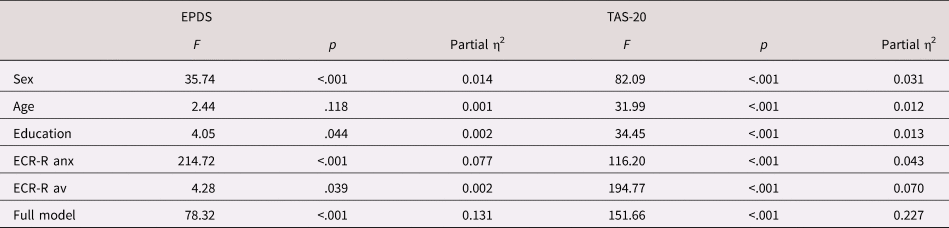
Age was positively correlated with attachment avoidance (Pearson's r = .155, p < .001), but not with attachment anxiety (Pearson's r = .010, p = .624). Women scored higher in attachment anxiety (2.41 vs. 2.23, t = 4.81, p < .001), while men scored higher in attachment avoidance (2.34 vs. 2.49, t = 4.33, p < .001). Lower education was associated with both attachment anxiety (F = 16.46, p < .001) and avoidance (F = 6.07, p = .002). EPDS and TAS-20 scores were both positively correlated with both attachment anxiety (ρ = 0.343, p < .001 for EPDS; ρ = 0.329, p < .001 for TAS-20) and avoidance (ρ = 0.179, p < .001 for EPDS; ρ = 0.379, p < .001 for TAS-20). After controlling for the effects of sex, age, and education level, attachment anxiety was the strongest predictor of depression, while attachment avoidance was the strongest predictor of alexithymia (Table 2).
Results of the general linear model predicting depressive symptoms and alexithymia levels
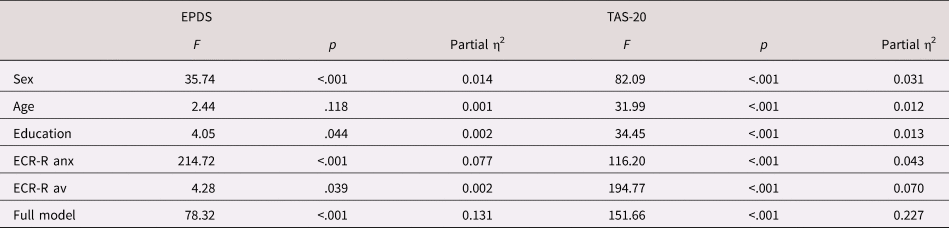
EPDS = Edinburgh Postnatal Depression Scale; TAS-20 = Toronto Alexithymia Scale; ECR-R anx = Attachment Anxiety; ECR-R av = Attachment Avoidance
Overlap and differences between depression and alexithymia
EPDS and TAS-20 scores showed a moderate positive correlation (ρ = 0.367, p < .001). Of individual dimensions of alexithymia, DIF (ρ = 0.528, p < .001) and DDF (ρ = 0.355, p < .001) showed positive correlations, while EOT was not associated with depressive symptoms (ρ = 0.002, p = .918). Of depressed participants, 14% (N = 48) had high levels of alexithymia, these were more likely to be men (30.4% of depressed men vs. 9.9% of depressed women had high alexithymia, p < .001). Depressed men and women did not differ in reported levels of emotional neglect (p > .923) or attachment anxiety (p = .910), but depressed men scored higher in attachment avoidance (t = 3.21, p = .001). Depressed individuals with and without alexithymia did not differ in education level (p = .509). Of depressed individuals with high alexithymia, 81.3% reported childhood emotional neglect, compared to 54.4% of depressed individuals without alexithymia (p < .001). Depression with alexithymia was also associated with higher levels of attachment anxiety (mean scores 3.20 vs. 2.84, t = 2.38, p = .018) and attachment avoidance (mean scores 3.03 vs. 2.52, t = 4.03, p < .001) compared to depression without alexithymia.
Discussion
The main finding of our study was that alexithymia was specifically associated with experiences of childhood emotional neglect, whereas depression was more broadly related to several types of childhood maltreatment, financial problems in childhood family, as well as parental psychiatric disorders. These findings shed light on the nature of childhood experiences in alexithymia, and clarify the overlap and differences between depression and alexithymia.
Self-reported experiences of emotional neglect were associated with a nearly fourfold increase in the prevalence of high alexithymia, and two thirds of alexithymic individuals reported having experienced childhood emotional neglect. These findings are in line with previous research showing a consistent connection between emotional neglect and alexithymia (Aust et al., Reference Aust, Alkan Härtwig, Heuser and Bajbouj2013; Pasco Fearon & Roisman Reference Pasco Fearon and Roisman2017). We extended previous findings showing that this relationship was specific, as no other type of CM was related to the prevalence of alexithymia. This implies an important role of childhood emotional neglect in the etiology of alexithymia, although it alone may not be a sufficient risk factor for its development. Although no definitive conclusions can be drawn regarding causality, as genetic makeup could explain both emotionally neglectful parenting and offspring alexithymia levels, we consider this unlikely, as twin studies have reported low heritability estimates for alexithymia (Jørgensen et al., Reference Jørgensen, Zachariae, Skytthe and Kyvik2007). Brown et al. (Reference Brown, Fite, Stone and Bortolato2016) recently reported similar findings to ours, showing that emotional neglect was the strongest predictor of alexithymia, and alexithymia mediated the relationship between emotional neglect and internalizing symptoms. However, as most individuals with self-reported childhood emotional neglect do not exhibit alexithymic features, future research should address possible protective factors conferring resilience.
Recent theories have hypothesized that alexithymia could result from inadequate parental bonding, leading to an insecure attachment formation in childhood, which in turn may affect the development of emotional awareness and regulation (Thorberg et al., Reference Thorberg, Young, Sullivan and Lyvers2011; Lyvers et al., Reference Lyvers, Mayer, Needham and Thorberg2019). In our sample, attachment anxiety was strongly associated with depression, but attachment avoidance more closely related to alexithymia levels. According to attachment theory, an avoidant attachment style may result from caregivers habitually ignoring the child's emotional needs (Mikulincer & Shaver, Reference Mikulincer and Shaver2012; O'Loughlin, Cox, Kahn, & Wu, Reference O'Loughlin, Cox, Kahn and Wu2018). Avoidantly attached individuals do not seek social support in times of distress, and instead emphasize self-reliance and independence Mikulincer & Shaver, Reference Mikulincer and Shaver2012; O'Loughlin et al., Reference O'Loughlin, Cox, Kahn and Wu2018; Lyvers et al., Reference Lyvers, Mayer, Needham and Thorberg2019). Our results support the view that alexithymia could represent a result from childhood emotional neglect leading to attachment avoidance and impaired emotion regulation. However, as we only measured adult attachment style, reverse causality cannot be ruled out; that is, that the problems in emotional processing related to alexithymia could themselves cause problems in interpersonal relationships and attachment security.
Regarding the overlap between alexithymia and depression, Marchesi et al. (Reference Marchesi, Ossola, Tonna and De Panfilis2014) have previously argued that the TAS-20 might more accurately measure negative affect than ‘true’ alexithymia. Specifically, they found that differences in alexithymia levels between different psychiatric disorders were explained by levels of depression and anxiety. Indeed, alexithymia has been found to strongly correlate with depression in several studies (e.g., Grabe, Spitzer, & Freyberger, Reference Grabe, Spitzer and Freyberger2004; Honkalampi et al., Reference Honkalampi, Hintikka, Tanskanen, Lehtonen and Viinamäki2000; Kajanoja et al., Reference Kajanoja, Scheinin, Karlsson, Karlsson and Karukivi2017), although longitudinal studies have shown TAS-20 scores to be more stable over time compared to depressive symptoms (Luminet, Bagby, & Taylor, Reference Luminet, Bagby and Taylor2001; Saarijarvi, Salminen, & Toikka, Reference Saarijarvi, Salminen and Toikka2006). Similarly, the TAS-20 and two of its subscales (DIF and DDF) were moderately correlated with depressive symptoms in our sample. However, only 14% of currently depressed individuals had high levels of alexithymia. Furthermore, the EOT dimension was not related to depressive symptoms at all. Together, these findings imply that the TAS-20 does not simply measure negative affect but is at least partly an independent phenomenon from depression and anxiety. Bagby, Parker, & Taylor (Reference Bagby, Parker and Taylor2020) have recently argued that the connection between alexithymia and negative affect is consistent with the view that alexithymia represents a cognitive deficit in emotional processing. That is, alexithymic individuals do indeed experience increased negative affect, but their emotions remain undifferentiated and unregulated. Moreover, there were clear differences between depressive individuals with and without alexithymia. Depression with alexithymia was associated with remarkably high levels of reported childhood emotional neglect, attachment anxiety, and particularly attachment avoidance in the current relationship, compared to nonalexithymic depression. Recent evidence implies that depression associated with CM may represent a clinically distinct ‘ecophenotype’, predicting aberrant brain structure and function, as well as poorer outcomes to antidepressant treatment compared to depression without CM (Nemeroff et al., Reference Nemeroff, Heim, Thase, Klein, Rush, Schatzberg and Keller2003; Opel et al., Reference Opel, Redlich, Dohm, Zaremba, Goltermann, Repple and Dannlowski2019; Teicher & Samson, Reference Teicher and Samson2013). Similarly, alexithymic individuals consistently report higher levels of childhood emotional maltreatment (Aust et al., Reference Aust, Alkan Härtwig, Heuser and Bajbouj2013; Brown et al., Reference Brown, Fite, Stone and Bortolato2016; Terock et al., Reference Terock, Van der Auwera, Janowitz, Homuth, Hannemann, Schmidt and Grabe2018), and some evidence indicates they also respond poorly to antidepressant treatment (Ozsahin, Uzun, Cansever, & Gulcat, Reference Ozsahin, Uzun, Cansever and Gulcat2003).
Based on our findings, we hypothesize that alexithymic depression could be considered a specific subtype of depression that may require special attention to impaired emotion regulation and attachment problems. Attachment insecurity has been shown to negatively affect the formation of treatment alliance in psychotherapy (Daniel, Reference Daniel2006). The evidence is unclear about whether and how alexithymia affects psychotherapy treatment outcomes (Cameron, Ogrodniczuk, & Hadjipavlou, Reference Cameron, Ogrodniczuk and Hadjipavlou2014). However, treatments directly targeting alexithymia, for example, by skills-training to increase emotional awareness, or exposure exercises, may be more efficient in treating alexithymia than treatments more heavily relying on verbal expression and self-reflection (Cameron et al., Reference Cameron, Ogrodniczuk and Hadjipavlou2014). A recent systematic review and meta-analysis also found that mindfulness-based interventions may help reduce alexithymia levels, arguably by increasing interoceptive and emotional awareness (Norman, Marzano, Coulson, & Oskis, Reference Norman, Marzano, Coulson and Oskis2019).
Regarding gender differences in childhood adversity, women reported more emotional and sexual abuse compared to men. Other types of CM were equally common among genders. Emotional and physical neglect emerged as the most common maltreatment types in both men and women, and experience of childhood emotional neglect strongly predicted both depression and alexithymia. This is an important finding, as emotional and physical neglect are the least studied forms of childhood maltreatment (Stoltenborgh, Bakermans-Kranenburg, & van Ijzendoorn, Reference Stoltenborgh, Bakermans-Kranenburg and van Ijzendoorn2013a). We found that childhood sexual abuse almost always co-occurred with other types of CM, making its specific contribution to mental health outcomes very difficult to decipher, a conclusion also made by another recent study (Vachon et al., Reference Vachon, Krueger, Rogosch and Cicchetti2015). We further observed some interesting gender differences in depressed individuals. Depressed men had higher levels of alexithymia and attachment avoidance compared to depressed women, and emotional neglect uniquely predicted both depression and alexithymia in men. This suggests that childhood emotional neglect and alexithymia may play a particularly important role in men's depression. This could be explained by an interaction between cultural factors and childhood family environment: Several researchers have argued that the higher alexithymia levels often observed in men may be a result of cultural norms that discourage emotional expression in males (Le, Berenbaum, & Raghavan, Reference Le, Berenbaum and Raghavan2002; Levant, Hall, Williams, & Hasan, Reference Levant, Hall, Williams and Hasan2009; O'Loughlin et al., Reference O'Loughlin, Cox, Kahn and Wu2018). Therefore, men who experience emotional neglect in their childhood families may be especially vulnerable to disturbances in emotional development, as they often also lack cultural support for the expression of emotion.
Limitations: Our study sample consisted of a birth cohort of relatively highly educated parents (Karlsson et al., Reference Karlsson, Tolvanen, Scheinin, Uusitupa, Korja and Ekholm2018). This selection bias, and the fact that pregnancy is likely to affect depressive symptoms and emotional processing especially in women, could imply that the results may not be directly comparable to the general population. However, our results regarding the relationships of EA, alexithymia, and depression resemble previous findings (Aust et al., Reference Aust, Alkan Härtwig, Heuser and Bajbouj2013; Mandelli et al., Reference Mandelli, Petrelli and Serretti2015; Brown et al., Reference Brown, Fite, Stone and Bortolato2016), and alexithymia has been shown to be a relatively stable trait also in the perinatal period (Le, Ramos, & Muñoz, Reference Le, Ramos and Muñoz2007). Regarding attachment, we only examined adult attachment style, which does not directly measure childhood attachment formation. However, attachment styles, although malleable, show robust stability from childhood to adulthood (Waters, Merrick, Treboux, Crowell, & Albersheim, Reference Waters, Merrick, Treboux, Crowell and Albersheim2000; Fraley, Reference Fraley2002). Our prevalences of emotional and physical abuse were also convergent with cross-cultural estimates of prevalence (Stoltenborgh, Bakermans-Kranenburg, Alink, & van IJzendoorn, Reference Stoltenborgh, Bakermans-Kranenburg, Alink and van IJzendoorn2012; Stoltenborgh, Bakermans-Kranenburg, van Ijzendoorn, & Alink, Reference Stoltenborgh, Bakermans-Kranenburg, van Ijzendoorn and Alink2013b). In contrast, prevalences of emotional and physical neglect were higher in our study, as well as in the TADS validation study by Salokangas et al. (Reference Salokangas, Schultze-Lutter, Patterson, von Reventlow, Heinimaa, From and Tuominen2016), compared to global estimates (Stoltenborgh et al., Reference Stoltenborgh, Bakermans-Kranenburg and van Ijzendoorn2013a). Therefore, it seems likely that the TADS is overly sensitive to early neglect. Secondly, although the TADS is a validated questionnaire and has shown good psychometric quality, all retrospective measures of CM are subject to recall bias and seem to correlate poorly with prospective measures of CM (Baldwin, Reuben, Newbury, & Danese, Reference Baldwin, Reuben, Newbury and Danese2019; Colman et al., Reference Colman, Kingsbury, Garad, Zeng, Naicker, Patten and Thompson2016). There is evidence that depression and chronic stress may themselves affect responses concerning history of CM (Colman et al., Reference Colman, Kingsbury, Garad, Zeng, Naicker, Patten and Thompson2016), and the possible effect of alexithymia on retrospective reports of CM is unknown. It is plausible that alexithymia itself could influence the accuracy of recalled childhood experiences, especially those with emotional content. Therefore, we must acknowledge the possibility of recall bias as a limitation of this study. We can only conclude that participants with alexithymia perceived their childhood environment differently compared to those with depression and healthy controls. Despite their limitations, retrospective accounts of CM are widely used in psychopathology research, and they associate with changes in brain limbic system structure and function even after controlling for psychiatric morbidity, giving strong support to their validity (Dannlowski et al., Reference Dannlowski, Stuhrmann, Beutelmann, Zwanzger, Lenzen, Grotegerd and Kugel2012; Opel et al., Reference Opel, Redlich, Dohm, Zaremba, Goltermann, Repple and Dannlowski2019; Teicher, Anderson, & Polcari, Reference Teicher, Anderson and Polcari2012). Regarding our use of the TADS, some information is inevitably lost when dichotomizing raw scores of CM, although this approach has been validated with TADS (Salokangas et al., Reference Salokangas, Schultze-Lutter, Patterson, von Reventlow, Heinimaa, From and Tuominen2016) and is widely used in CM research (Green et al., Reference Green, McLaughlin, Berglund, Gruber, Sampson, Zaslavsky and Kessler2010; Infurna et al., Reference Infurna, Reichl, Parzer, Schimmenti, Bifulco and Kaess2016). We used dichotomized scores because they enabled a more reliable examination of the impact of individual maltreatment types. Statistical controlling continuous maltreatment scores can lead to false results because of high multicollinearity between maltreatment types (Vachon et al., Reference Vachon, Krueger, Rogosch and Cicchetti2015).
Conclusions
Our study sheds light on the impacts of different forms of early-life adversity on adult depression and alexithymia. Together our results suggest at least partly different childhood experiences in alexithymia and depression. Our hypothesis of alexithymic depression as a specific depression subtype warrants further research. Finally, these findings may help in creating targeted interventions to patients suffering from depression with concurrent alexithymia.
Funding
We wish to thank Signe and Ane Gyllenberg foundation, the Finnish Medical Foundation, Satakunta Hospital District, Academy of Finland, and the Turku University Foundation for funding this study.