Introduction
Psychedelic-assisted therapy (PAT), the use of psychedelic medicines in conjunction with psychotherapy, has been of clinical and research interest in patients with serious illness since the 1960s. Early studies showed promise in using lysergic acid diethylamide (LSD) and dimethyltryptamine (DMT) as an adjunct to psychotherapy to decrease distress in patients with serious illness (Grof et al. Reference Grof, Goodman and Richards1973; Kast Reference Kast1966, Reference Kast1967; Kast and Collins Reference Kast and Collins1964; Pahnke et al. Reference Pahnke, Kurland and Goodman1969; Richards et al. Reference Richards, Rhead and Dileo1977). The passage of the federal Controlled Substances Act in the 1970s made these drugs illegal and halted clinical research in this field, contributing to their stigmatization. During this period, the field of palliative care emerged, with a specific emphasis on the psychosocial care of patients with serious illness. More recent research, including three phase 2 randomized controlled trials published between 2011 and 2021, demonstrates rapid, robust, and sustained improvements in psychological and existential distress in patients with serious illness following a single PAT session (Agin-Liebes et al. Reference Agin-Liebes, Malone and Yalch2020; Anderson et al. Reference Anderson, Danforth and Daroff2020; Gasser et al. Reference Gasser, Holstein and Michel2014; Griffiths et al. Reference Griffiths, Johnson and Carducci2016; Grob et al. Reference Grob, Danforth and Chopra2011; Ross et al. Reference Ross, Bossis and Guss2016).
The resurgence of research and public interest in psychedelic use in the setting of serious illness has left clinicians and researchers to reckon with significant gaps in knowledge related to the efficacy of PAT and its integration into existing care practices. In a qualitative study on perspectives of experts in serious illness care and/or PAT on the use of PAT for this population, participants expressed polar views on the therapeutic potential of PAT, ranging from strong beliefs in their medical utility to reluctance about their use in this patient population (Beaussant et al. Reference Beaussant, Sanders and Sager2020). Their perspectives were similar to findings from a recent survey based on a sample of 324 American psychiatrists, in which a quarter of respondents considered psychedelics unsafe, even under medical supervision, while 42.5% viewed psychedelics as promising for the treatment of psychiatric disorders (Barnett et al. Reference Barnett, Beaussant and King2021). We understand little about what informs these views.
The authors of the original study suggested that support for researching PAT may be influenced by the perception of unmet needs and persistent psychosocial and existential distress in this population; professionals’ knowledge about empirical studies of PATs; and prior personal experience of altered states of consciousness – whether induced by psychedelics or not. This is a secondary analysis of factors underpinning experts’ attitudes toward PAT in serious illness care. It is critical to understand how health-care professionals think about PAT to understand why these divergent perspectives exist, identify what areas need further research, and inform educational programs for health-care providers.
Methods
The goal of this secondary analysis was to explore further the factors influencing participants’ perspectives on PAT in serious illness care.
Summary of original article methods
Original data were transcripts of semi-structured interviews with 17 leading experts in oncology, psychosocial oncology, palliative care, and psychiatry, some of them with experience in PAT research, from the US and Canada. The original authors were intentional about sampling participants likely to represent a range of knowledge and perspectives about PAT, until reaching thematic saturation. The interview guide elicited participants’ professional experiences and their knowledge of PAT. In addition, it explored their perspectives on the following issues: (1) the potential roles of PATs in this setting, (2) research priorities relevant to this population, and (3) the potential for integrating PATs into existing delivery models of serious illness care. Interviews were transcribed verbatim, and then thematically coded using template analysis.
Present study methods
For this analysis, the first author (RS) read all transcripts and thematically coded self-identified factors influencing participants’ support, neutrality, or opposition to the role of psychedelics in serious illness care. Interviews were coded in Dedoose qualitative analysis software (version 8.1.10). Both authors RS and YB participated in iterative readings of the transcripts to identify additional factors that influenced participants’ views and together refined the codebook. Factors were categorized using thematic analysis. The factor themes were then analyzed for any overarching relationships.
Results
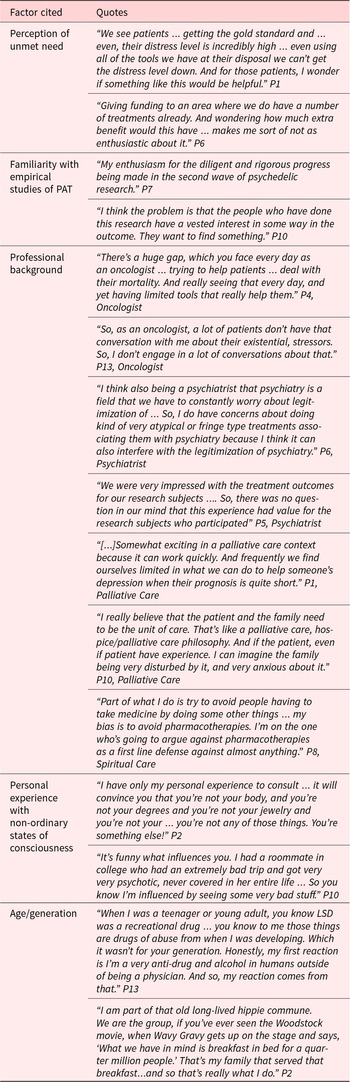
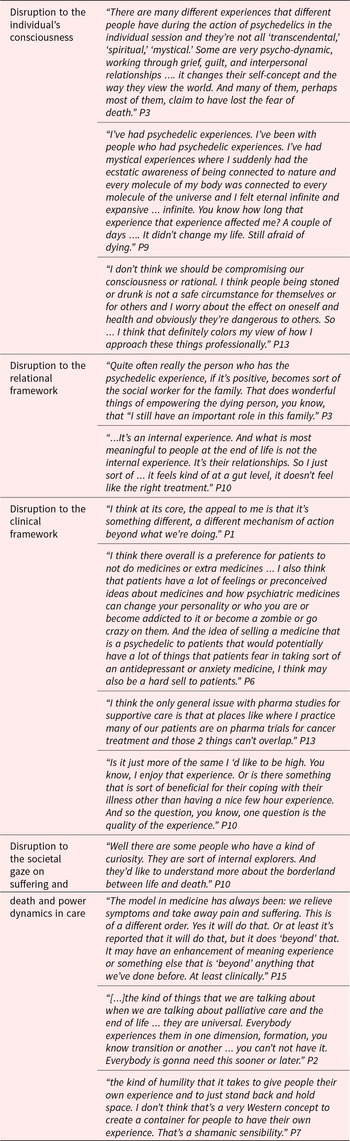
Participants had varying professional backgrounds, age, and exposure to PAT, described in the original paper. In this study, across the interviews, participants cited multiple factors influencing their views on the role of PAT in serious illness care, which are listed below and illustrated with quotes in Table 1. Factors converged on themes related to the potential for disruption at multiple domains of the care continuum (individual, relational, clinical, and societal), as described in the next section and illustrated by the quotes presented in Table 2.
Factors identified as directly influencing experts’ general attitudes toward PAT in serious illness care

Quotes from experts illustrating the themes disruptive potential of PAT in multiple domains of the serious illness care continuum

Perception of unmet need
All experts cited perception of unmet needs in patients with serious illness as influencing their perspectives on PAT. Most felt there was an unmet therapeutic need, describing the distress as being unique in both quality and urgency, and referred to ineffectiveness of existing treatments. Experts who did not feel an unmet need existed, referred to the efficacy of existing treatments, and therefore did not support PAT.
Familiarity with and trust in empirical studies of PAT
Experts related their familiarity with, and opinions on, empirical studies of PAT as directly influencing their perspectives on the role of PAT in serious illness care. While some experts cited lack of knowledge of empirical studies as influencing their skepticism, some who were familiar with empirical studies expressed doubts about their veracity and rigor. Participants who were identified as PAT researchers were familiar with empirical studies and directly cited their first-hand experience treating patients as influencing their support.
Professional background
Some experts cited their professional background a factor influencing their views on PAT. However, participants with shared professional backgrounds expressed diverse attitudes toward psychedelics. By contrast, PATs researchers were consistently supportive of PAT.
Personal experience with psychedelics
Some participants cited personal experience with psychedelics as influential of their perspectives on PAT, but they seemed to do so in different ways. Some described familiarity with the positive effects of non-ordinary state of consciousness (NOSC) and said that this influenced their belief that psychedelics could be of therapeutic value, while others doubted a therapeutic application or worried about harm.
Age and generation
A few participants cited their age and generational influences they experienced as informing their views on PAT. Participants referenced their age and the cultural context in which they grew up (either as familiar or as stigmatizing) as influencing their views both in ways that enhanced their support and in ways that enhanced their reluctance.
Potential for disruption: An integrative theme underlying experts’ views on PAT
Participants referred to PAT as a potential therapeutic disruptor (positive or negative) in serious illness care in 4 domains: (1) patients’ experience of self, illness, and death; (2) patients’ relationships with loved ones and health-care professionals; (3) existing models of serious illness care; and (4) how society views death and dying (Table 2). Overall, participants’ support of or opposition to PAT related to their attitude toward this potential disruptive effect of PAT. Whether experts viewed this potential disruption as an opportunity for improvement or a threat to a stable system, and their belief in adequate structures in place to contain and beneficially leverage this disruptive potential, informed the extent of their support toward PAT.
The individual domain: Effects on patient’s experience of self, illness, and death
Participants emphasized PAT’s potential to profoundly alter individuals’ experience of self and relationship to illness and death, with possible lasting effects. Whether this disruptive potential was viewed as a therapeutic opportunity depended on the knowledge and understanding of the psychotherapeutic framework of PAT. Participants familiar with PAT saw it as a combined pharmacological and psychotherapeutic intervention, where psychotherapy provides safety and support for the patient to harness this disruptive potential in service of self-inquiry and healing. Participants suggested that this unique potential for PAT to help patients reframe narratives around self, illness, and death was central to their potential efficacy in improving psycho-existential outcomes and quality of life.
Among PAT proponents, there was an acknowledgment of the depth and rapidity at which this disruptive effect may occur, informing both therapeutic hopes and cautions. In addition to the risks of adverse events in this medically fragile population, warranting screening and monitoring, they suggested potentially unsettling experiences at psychological or spiritual levels, which could be demanding of patients. In that regard, they emphasized the importance of informed consent, therapeutic alliance and boundaries, and ongoing support and assessment throughout preparation, dosing and post-dosing, integration phases.
Participants who did not emphasize the psychotherapeutic aspect of PAT expressed concerns based on adverse and/or nontherapeutic experiences with psychedelics they had witnessed or personally lived in a naturalistic context. One expert shared remaining afraid of dying despite several mystical-type experiences with LSD in their youth and was concerned that psychedelics might induce delirium in patients at risk. For another expert who mentioned their perspective had been shaped by the stigmatizing views of the war on drugs, psychedelics appeared as an intoxicant harmful to oneself and health, making people “obviously dangerous to others.”
The relational domain: Effects on important relationships
Participants emphasized PAT’s potential to disrupt relationships with families, significant others, clinical care teams, and psychedelic therapists themselves in therapeutic and/or harmful ways. Patients’ relationships with their families and care teams were recognized as critical components of their experience; participants’ conceptions of how PAT may impact patients’ relational frameworks influenced their attitudes.
PAT was seen as potentially affecting patient relationships in a therapeutic way through the sense of growth, connection, and meaning it can promote in supportive contexts. One expert felt that patients might start acting as “the social worker of the family” following psychedelic therapy, referring to discussions and healing that may occur when fear of death is lowered, and grief acknowledged. Experts alluded to psychedelics’ potential to enhance transference and trust toward the therapy team, which could allow for engagement in deeper relationships with providers in a shorter time frame, often a limiting factor for psychotherapeutic interventions in this population with short prognoses.
However, experts also acknowledged that PAT, especially in the context of a serious illness, might be an intense psychological and spiritual process that could disrupt usual functioning within the family and care provider system. For example, one expert worried that PAT might alienate the patient further from their family during a period critical for healing and nurturing important relationships when patients have limited time and energy.
The clinical level: Effects on existing models of serious illness care
Participants highlighted that the use of a NOSC to catalyze a psychotherapeutic process is novel and unfamiliar in contemporary medicine. Psychedelic researchers understood and described the indispensable role of a psychotherapeutic relationship and process in the use of psychedelics and how they are mutually enhancing. Some clinicians who felt helpless in the face of unmet patient needs and limited by ineffective available treatments acknowledged the need for a “new model” and embraced the possibility of PAT challenging the current standard of care.
However, other clinicians struggled to place PAT within the existing model of care, citing existing effective treatments for existential distress and barriers to articulation with other aspects of care, including patients’ reluctance to add “another drug” to a high medication burden, the demands placed by such an intervention on frail patients, and enrollment in PAT trials’ interference with patients’ eligibility for cancer-directed clinical trials. One participant cited skepticism of the accessibility of PAT to patients, given economic demands.
Further, some participants raised the idea that PATs carry stigma that could threaten the legitimacy of psychiatry and palliative care, 2 specialties that have historically struggled to be recognized within modern medicine. One psychiatrist directly stated that psychedelics threaten the legitimacy of psychiatry as a medical profession, citing its reputation of participating in “fringe” treatments and patients’ resistance to psychotropic medications based on the stigma that they “make you a zombie or change your personality.” Some also questioned the therapeutic value of an altered state of consciousness, describing patients just wanting to “trip” or “get high.”
The societal level: Effects on how we die in society
Participants’ discourses emphasized that PAT may disrupt the medical and societal gaze on suffering by focusing on existential growth and maturity as much as on symptom control. Most participants envisioned PAT delivery to happen in the context of a clinical intervention aimed at improving symptoms or distress (depression, anxiety, existential distress, and psychospiritual crises), which remains within the frame of the current medical and societal gaze on suffering and death and dying. However, some also envisioned PATs in a more integrative and holistic way, where the care focuses on patients’ inner capacities such as acceptance, letting go, healing, meaning making, or sense of connection, wonder, and wholeness, or in preventing problems. Participants referenced that “curiosity” patients might feel about their experience as an indication for PAT, indications that go beyond traditional medical diagnoses.
Experts suggested that through cultivation of these inner capacities, PAT could facilitate a shift in global attitudes toward death and, in turn, potentially the relationship and power dynamic between clinicians and patients. The view of the role of the clinician as a peer guide, who also struggles with the same existential concerns and is meant to witness an exploratory existential experience by someone living with and dying from serious illness, challenges the traditional power dynamic that exists between patients and providers. Participants cited the universality of confronting mortality as a reason for their support of psychedelic therapies. One participant invoked a posture of “humility” needed in this work, which privileges the patients’ inner capacities to heal themselves, differing from traditional modes of power in Western clinical practice.
Discussion
This in-depth qualitative analysis identified 5 factors characterizing serious illness care experts’ attitude toward PAT: perception of unmet clinical need, knowledge of empirical studies of PAT, personal experience with NOSC, professional background, and age/generation. An integrative theme emerged underlying these factors: PAT’s disruptive potential, and how participants appraised this disruptive potential. Whether participants characterized it as a therapeutic opportunity to serve unmet needs and personalize care, or an undue risk to patients, influenced their support of or reluctance toward PAT. Our analysis identified disruptive potential in 4 domains: individual, relational, clinical, and societal. How to take advantage of or to mitigate this disruptive potential was a central concern of participants, suggesting areas for further attention and research.
Participants cited concern about acute medical and psychiatric complications – e.g., delirium, suicidality, and psychosis – in this medically complex population in agreeing that we need more safety data for PAT. Furthermore, they agreed we need to better understand characteristics that impart risk and mitigating therapeutic modalities to prevent undue harm. Participants emphasized that patients’ relational systems, including families and clinical care teams, were an essential element in healing and support and that questions exist about the impact PAT could have on these systems. Studying further this impact would not only allow identification of relational systems in need of further attention during PAT but could also inform education of caregivers and clinical care teams in how they can aid in ongoing integration of the psychedelic experience.
Participants identified challenges posed using a NOSC as part of a medical intervention to both the delivery and reputation of clinical care. Participants in the original study characterized the effect of psychedelics on the consciousness in different ways: “tripping,” inducing psychosis or delirium, inducing psychologically useful processes, encountering a spiritual or mystical domain, or even inducing transpersonal encounters (e.g., reuniting with lost loved ones). Some have proposed a Foucauldian discourse analysis as a model of how different conceptions of the psychedelic consciousness are understood and valued (Letcher Reference Letcher2007). The discourse participants applied to the psychedelic consciousness influenced their perspectives in different ways; scientifically based discourses (inducing a pathological state or facilitating observable, psychologically useful, processes) and subjectively oriented discourses (having mystical, transpersonal, or recreational experiences) were cited in both opposing and supporting PAT. Evidence for the role of the NOSC in the therapeutic action of PAT, and providing education to clinicians and patients about this, may provide helpful context for this unique aspect of the intervention.
Participants’ characterization of the psychosocial dimension of serious illness influenced their views on the role of PAT, highlighting a way that PAT could challenge and potentially expand upon societally dominant views on suffering and death as pathological and needing to be eradicated. Those who supported PAT emphasized indications beyond traditional medical diagnosis, while those who opposed PAT tended to reference effective existing treatments for psychiatric disorders (depression and anxiety). While not in every case, participants’ professional backgrounds appeared to inform their lens; those with palliative care backgrounds citing transdiagnostic and growth-oriented indications, while those with psychiatry backgrounds struggling to consider indications beyond pathologies. While more research is needed to determine the ways in which professional background influences views on PAT, this trend suggests philosophical differences, which through better understanding could help us use this aspect of PAT’s disruptive potential to develop the way we conceptualize the experience of suffering and death.
Our data and that of others suggest a more thorough and clear understanding of what influences experts’ views on the role of PAT in serious illness care. Niles et al. interviewed 19 clinicians with interdisciplinary backgrounds who practiced palliative care on their perspectives on the role of PAT and identified themes that articulate with this analysis: perception of unmet clinical need that evades available medicalized approaches, PAT holding promise and needing stronger evidence, particularly given that it does not fit into existing models of treating existential distress (Niles et al. Reference Niles, Fogg and Kelmendi2021). Nielsen and Guss wrote about the potential impact of personal use of psychedelics by clinicians and researchers on views of PAT, proposing PAT’s unique property of inducing a NOSC means that they do not fit into the modern frameworks of psychopharmacology or psychotherapy training (Nielson and Guss Reference Nielson and Guss2018). Further study of the relationship between professional background, personal use of psychedelics, and clinicians’ attitudes and perspectives of PAT at the end of life may inform educational programming for providers as PAT becomes integrated into serious illness care.
This secondary analysis of a qualitative study of experts in serious illness care and PAT identified important associations between perspectives on the role and value of PAT and dimensions of personal and clinical experience. It also identified a theme of disruption across multiple domains. The way participants conceptualized the disruptive potential of psychedelics at individual, relational, clinical, and societal may help inform the further research that is needed to understand how to best integrate them into the current models of care delivery. Recognizing the disruptive potential of PAT can help to understand better the practical and philosophical elements that need to be considered to successfully deliver this novel treatment to patients with serious illness.
Competing interests
None.