INTRODUCTION
Gastrointestinal (GI) nematodes represent one of the main sources of economic losses in farmed ruminants. In sheep, direct and indirect costs of infection amount to tens of millions of pounds each year in the UK alone (Nieuwhof and Bishop, Reference Nieuwhof and Bishop2005) and endanger the sustainability of the food supply chain (Bishop, Reference Bishop2012a ). Historically, nematode infections in domestic ruminants have been successfully controlled through the widespread use of anthelminthic drugs (Epe and Kaminsky, Reference Epe and Kaminsky2013). However, the rise in anthelmintic drug resistance raises concerns over this strategy in the long-term (Falzon et al. Reference Falzon, O'Neill, Menzies, Peregrine, Jones-Bitton and Mederos2014) and alternatives are being explored (e.g. breeding animals for more resistance or tolerance to nematodes; Bishop, Reference Bishop2012b ). The effective exploration of these alternative strategies requires a deep understanding of the within- and between-host sources of variability in the susceptibility and/or resistance of ruminant hosts, including how variations in immune response induction affect transmission via the fecal shedding of nematode eggs (Hayward et al. Reference Hayward, Garnier, Watt, Pilkington, Grenfell, Matthews, Pemberton, Nussey and Graham2014). In this context, theoretical approaches at the interplay of epidemiology and immunology represent powerful tools (Hellriegel, Reference Hellriegel2001).
In sheep infected by the nematode Teladorsagia circumcincta, a wide range of phenotypic estimators have been used to determine infection status and resistance levels (reviewed by Saddiqi et al. Reference Saddiqi, Sarwar, Iqbal, Nisa and Shahzad2012). Among these, fecal egg count (FEC) is probably the most common and selection for resistance (i.e. the ability of the host to actively reduce its worm burden and/or egg production) based on this trait can be successfully performed (e.g. McRae et al. Reference McRae, Good, Hanrahan, Glynn, O'Connell and Keane2014). FEC integrates both the number of mature worms and the fecundity of adult female worms (Stear et al. Reference Stear, Bishop, Henderson and Scott2003), the latter being influenced by the length of the worms (Stear and Bishop, Reference Stear and Bishop1999), but provides little mechanistic insight into how sheep resist nematodes in vivo. There is, however, an increasing body of work on the role of different effectors of the mammalian immune response against nematodes in general (Allen and Maizels, Reference Allen and Maizels2011) and of sheep against T. circumcincta, in particular (reviewed for instance by Venturina et al. Reference Venturina, Gossner and Hopkins2013). Immunity to T. circumcincta manifests itself through prevention of the establishment of incoming larvae, inhibited or delayed maturation of larvae to the adult stage, and the subsequent reduction in the size of the adult produced (Smith et al. Reference Smith, Jackson, Jackson and Williams1983a , Reference Smith, Jackson, Jackson and Williams b , Reference Smith, Jackson, Jackson, Williams and Miller1984; Stear et al. Reference Stear, Bishop, Doligalska, Duncan, Holmes, Irvine, McCririe, McKellar, Sinski and Murray1995). The mode of action is not fully determined, but the best available evidence suggests a crucial role for immunoglobulins (Ig) and in particular immunoglobulins A (IgA) (Halliday et al. Reference Halliday, Routledge, Smith, Matthews and Smith2007) and E (IgE) (Shaw et al. Reference Shaw, Pfeffer and Bischof2009). IgA are indeed able to bind to various third stage larval (L3) and fourth stage larval (L4) antigens (Smith et al. Reference Smith, Nisbet, Meikle, Inglis, Sales, Beynon and Matthews2009; Nisbet et al. Reference Nisbet, Bell, McNeilly, Knox, Maizels, Meikle, Wildblood and Matthews2010; Ellis et al. Reference Ellis, Matthews, Shaw, Paterson, McWilliam, Inglis and Nisbet2014), some of which are now candidates for vaccine development (Nisbet et al. Reference Nisbet, McNeilly, Wildblood, Morrison, Bartley, Bartley, Longhi, McKendrick, Palarea-Albaladejo and Matthews2013). IgE also play a significant role through classical hypersensitivity reactions (e.g. Stear et al. Reference Stear, Bishop, Doligalska, Duncan, Holmes, Irvine, McCririe, McKellar, Sinski and Murray1995). Finally, T-cells are also part of an effective response to T. circumcincta infection (see Venturina et al. Reference Venturina, Gossner and Hopkins2013 for a review). In addition to classical Th2 pathways that promote resistance against nematodes (Allen and Maizels, Reference Allen and Maizels2011), the susceptibility and the subsequent development of pathological changes in sheep infected with T. circumcincta have been linked with an increase in cytokines linked to the activation of the inflammatory Th17 T-cell subset (Gossner et al. Reference Gossner, Venturina, Shaw, Pemberton and Hopkins2012). Interestingly, some of these immunological markers along with FEC have been used to develop indices of resistance to T. circumcincta in lambs (Mair et al. Reference Mair, Matthews, Prada, De Cisneros, Stefan and Stear2015).
This primary role of immunity as a driver of helminth infection dynamics in small ruminants has long been recognized in theoretical frameworks, at the population and individual levels alike. One common approach considers that immunity accumulates with exposure to infective larvae and can wane over time (e.g. Grenfell et al. Reference Grenfell, Dietz, Roberts, Grenfell and Dobson1995a ). Such a description of immunity has been used to develop a variety of modelling approaches (Cornell, Reference Cornell2005). Both the epidemiological cycles and the details of the immune mechanisms built into the models vary, from purely phenomenological to detailed mechanistic models. The phenomenological models have been relatively effective at capturing the aggregation of parasites within hosts (e.g. Grenfell et al. Reference Grenfell, Wilson, Isham, Boyd and Dietz1995b ), but they use an arbitrary fixed value for the increase in the immune function with increasing exposure to larval parasites and require several additional parameters describing, for instance, the establishment of parasites in their hosts. More explicit descriptions of the development of immunity have also been used (e.g. Singleton et al. Reference Singleton, Stear and Matthews2011). Their empirically-driven function of IgA immunity accounts for the half-life of the IgA molecule and the authors used a best fit approach to determine the increase in immunity that larval exposure incurs. However, this model also requires the establishment of larval parasites to depend on some immune component, the parameterization of which is hampered by the lack of empirical data. Because this model can be further modified to include immuno-genetic variations, it has been used to show that plasma IgA titers could represent a better target for selection on resistance to gastro-intestinal (GI) nematodes than FEC (Prada Jiménez de Cisneros et al. Reference Prada Jiménez de Cisneros, Stear, Mair, Singleton, Stefan, Stear, Marion and Matthews2014b ).
At the other end of the complexity spectrum, several highly mechanistic models have been developed to predict the efficacy of control methods of nematodes (Learmount et al. Reference Learmount, Taylor, Smith and Morgan2006, Reference Learmount, Taylor and Bartram2012). These models are very detailed in their construction, and as such, require a large number of parameters. For instance, the epidemiological model used in Learmount et al. (Reference Learmount, Taylor, Smith and Morgan2006) includes details of the pasture and of the host grazing. Immunity in this model is captured through a ‘flock dynamics’ that controls the flow of individuals between different susceptibility classes and allows for seasonal variations in immunity (such as the periparturient relaxation of immunity in female sheep). The main caveat of these models is that not all parameters can be taken from the literature or fitted to experimental data, especially when they need to be tailored to match specific flock situations. In turn, the predictions are likely to be specific to the nematode species and even the flock used for parameterization. Extensive modifications are indeed required to accommodate different management styles in domestic flocks (Guthrie et al. Reference Guthrie, Learmount, VanLeeuwen, Peregrine, Kelton, Menzies, Fernández, Martin, Mederos and Taylor2010). The exact immunity patterns in ewes appeared particularly influential, and this could hamper the use of these models, in particular, in wild vertebrate-nematode systems where detailed seasonal immune dynamics may prove difficult to obtain.
Any successful framework must capture the observed aggregation of parasites, reflected by a negative binomial distribution of burden (Shaw et al. Reference Shaw, Grenfell and Dobson1998). This can be modelled phenomenologically (Anderson and May, Reference Anderson and May1978; Adler and Kretzschmar, Reference Adler and Kretzschmar1992; Gourbière et al. Reference Gourbière, Morand and Waxman2015), via stochastic simulation (Kretzschmar and Adler, Reference Kretzschmar and Adler1993; Galvani, Reference Galvani2003) or (as an intermediate strategy) by developing moment closure (MC) approximations of the full within-host stochastic dynamics. However, modelling such over-dispersion remains a knotty problem. Here, we modify a simple MC modelling framework based on Grenfell et al. (Reference Grenfell, Wilson, Isham, Boyd and Dietz1995b ) by adding a biologically grounded, yet parsimonious, form of immune feedback to the model. We first describe the model and then use data from trickle infections of naïve sheep by Hong et al. (Reference Hong, Michel and Lancaster1987) to parameterize the formulation for both adult worm counts in the sheep and for fecal egg production. We show that simple biology-driven immune feedbacks are sufficient to obtain accurate fits of worm burdens and FEC in sheep infected with T. circumcincta. We discuss how such models could be helpful in eco-epidemiological contexts as tools bridging the existing gap between infectious disease theoreticians and empiricists.
THE MODEL
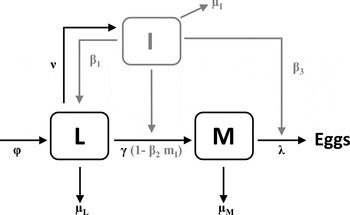
Our model describes the life cycle of T. circumcincta, a directly transmitted strongyle nematode of sheep (Armour, Reference Armour1980; Barger, Reference Barger1999; Morgan and Van Dijk, Reference Morgan and Van Dijk2012; Sargison, Reference Sargison2013). Briefly, hosts ingest infective larvae, which develop, through two moults, to fifth stage larvae (L5) stages within the gastric glands of the abomasum (‘true stomach’ of ruminants). The L5 then emerge, mature to adults and start reproducing and producing eggs. We model this cycle following the core structure of the model described by Grenfell et al. (Reference Grenfell, Wilson, Isham, Boyd and Dietz1995b ; Fig. 1). The within-host model we present here, tracks the number of larval stages (L) – L3, L4 and L5 are not differentiated for sake of simplicity – and the number of mature parasites (M) as well as the production of eggs (E) by the adult worms. Infection rate is described by a Poisson process (ϕ) which allows for variability as it can be decomposed in a mean, m C , and a variance, σ 2 C , that represent, respectively, the mean and the variance in ingested larval parasites. In the case of a trickle infection, the mean can be taken to match a known daily dose and the variance set to 0. In that case, the infection process reduces to an ordinary Poisson process. The effect of variation in the measurement of the trickle infection daily dose could be taken into account, but this would require intensive numerical simulations. In addition, the effects of variations in the infective doses have already been described in a MC framework (Grenfell et al. Reference Grenfell, Wilson, Isham, Boyd and Dietz1995b ). Thus, we will not explore this here. Ingested larvae establish according to an establishment factor (ε) and subsequently develop to adult parasites at a rate γ in the absence of immunity. Adult worms produce eggs with maximal fecundity, λ. Larval and adult parasites die at a natural rate (i.e. not related to immunity of the host) of, respectively, μL and μM . Adult nematodes also increase the death rate of their host according to a virulence parameter α.
Schematic diagram of the epidemiological model describing the infection of sheep by Teladorsagia circumcincta and the production of eggs by the nematodes.

Immunity (I) (and its mean m I ) is assumed to accumulate with exposure to larval parasites, a mechanism similar to what is described for the early dynamics of IgA in sheep exposed to T. circumcincta (e.g. Henderson and Stear, Reference Henderson and Stear2006). Each larval parasite present at a given time results in a linear boost of immunity, described by the parameter, ν. The subsequent immunity naturally decays at a rate, μI. The main changes in our model compared with Grenfell et al. (Reference Grenfell, Wilson, Isham, Boyd and Dietz1995b ) regard the mode of action of immunity. Building on recent information generated on knowledge of the immune response of sheep to T. circumcincta (Halliday et al. Reference Halliday, Routledge, Smith, Matthews and Smith2007; Shaw et al. Reference Shaw, Pfeffer and Bischof2009; Smith et al. Reference Smith, Nisbet, Meikle, Inglis, Sales, Beynon and Matthews2009; Nisbet et al. Reference Nisbet, Bell, McNeilly, Knox, Maizels, Meikle, Wildblood and Matthews2010; Ellis et al. Reference Ellis, Matthews, Shaw, Paterson, McWilliam, Inglis and Nisbet2014), we allow immunity to act in three ways: (i) larval mortality is increased by an immune-dependent mechanism at a rate, β 1 mI ; (ii) the rate of maturation of larvae is reduced with increasing immunity so that the basal rate of maturation, γ, is decreased by a factor of β 2 m I ; (iii) adult fecundity is reduced due to accumulating immunity at a rate, β 3 m I . This latter immune feedback most closely mimics the well-documented effect of IgA on worm length and, hence, on worm fecundity (see Singleton et al. Reference Singleton, Stear and Matthews2011 for a discussion).
Most immuno-epidemiological models track only the mean worm burdens, but this is insufficient to assess inter-individual variations through the lifespan of hosts. One alternative, mathematically developed in Grenfell et al. (Reference Grenfell, Dietz, Roberts, Grenfell and Dobson1995a ), is to track not only the mean burdens but also the higher moments, i.e. the variances and covariances. However, because immunity has non-linear effects on the worm burden, each moment is dependent upon higher moment terms and this approach requires the achievement of ‘MC’. Normal approximations of the higher moments have proved useful in this context (Isham, Reference Isham1991): they are exact in the case of a linear model, but have also been shown to be robust when additional non-linearities, such as immunity, are considered (Isham, Reference Isham1995). In our case, immunity has non-linear effects on the larval burden, L, as well as on the maturation of larval parasites to adults (i.e. the transition from L to M). Following the framework described in Grenfell et al. (Reference Grenfell, Dietz, Roberts, Grenfell and Dobson1995a ) and using the appropriate normal approximation for the higher moments, it is possible to describe our model as a set of ordinary differential equations conditioned on age. The following set of equations is obtained denoting the mean larval and adult burdens m: and m M, respectively:
 $$\eqalign{\displaystyle{{d{m_I}} \over {da}} &= \nu \; {m_L} - {\mu _I}{m_I} - \alpha \; {\sigma _{IM}} \cr \displaystyle{{d{m_L}} \over {da}} &= \varphi \left( a \right){m_C} - \alpha \; {\sigma _{LM}} - \left( {{\mu _L} + \gamma \left( {1 - {\beta _2}{m_I}} \right) + {\beta _1}{m_I}} \right)\cr& \times {m_L} - {\beta _1}{\sigma _{IL}} + {\beta _2}\gamma {\sigma _{IL}} \cr \displaystyle{{d{m_M}} \over {da}} = & - \alpha \; \sigma _M^2 - {\mu _M}{m_M} + \gamma \left( {1 - {\beta _2}{m_I}} \right){m_L} - {\beta _2}\gamma {\sigma _{IL}}\;} $$
their variances, σ 2 x :
 $$\eqalign{\displaystyle{{d\sigma _I^2} \over {da}} = \; & \nu \; {m_L} + {\mu _I}{m_I} + 2\nu {\sigma _{IL}} - 2{\mu _I}\sigma _I^2 \cr \displaystyle{{d\sigma _L^2} \over {da}} &= \varphi \left( a \right)\left( {\sigma _C^2 + m_C^2} \right) + \left( {{\mu _L} + \gamma \left( {1 - {\beta _2}{m_I}} \right) + {\beta _1}{m_I}} \right)\cr& \times ({m_L} - 2\sigma _L^2 ) - ({\beta _1} - {\beta _2}\gamma )(2\; {m_L} - 1){\sigma _{IL}} \cr \displaystyle{{d\sigma _M^2} \over {da}} &= {\mu _M}{m_M} + \gamma \left( {1 - {\beta _2}{m_I}} \right)({1m_L} + 2{\sigma _{LM}}) \cr& - 2{\mu _M}\sigma _M^2 - {\beta _2}\gamma ({\sigma _{IL}} + 2{\sigma _{IM}})} $$
and their covariances, σ x :
 $$\eqalign{\displaystyle{{d{\sigma _{IL}}} \over {da}} &= \nu \sigma _L^2 - \left( {{\beta _1} - {\beta _2}\gamma} \right){m_L}\sigma _I^2 - ({\mu _I} + {\mu _L} + \gamma \cr & \times \left( {1 - {\beta _2}{m_I}} \right) + {\beta _1}{m_I}){\sigma _{IL}} \cr \displaystyle{{d{\sigma _{IM}}} \over {da}} &= \nu {\sigma _{LM}} - \left( {{\mu _I} + {\mu _M}} \right)\cr & \times{\sigma _{IM}} + \; \gamma \left( {1 - {\beta _2}{m_I}} \right){\sigma _{IL}} - {\beta _2}\gamma {m_L}\sigma _I^2 \; \cr \displaystyle{{d{\sigma _{LM}}} \over {da}} &= \gamma \left( {1 - {\beta _2}{m_I}} \right)\left( {\sigma _L^2 - {m_L}} \right) \cr& - \left( {{\mu _L} + {\mu _M} + \gamma \left( {1 - {\beta _2}{m_I}} \right) + {\beta _1}{m_I}} \right){\sigma _{LM}} \cr&- \left( {{\beta _1} - {\beta _2}\gamma} \right){m_L}{\sigma _{IM}} + \gamma {\beta _2}\left( {1 - {m_L}} \right){\sigma _{IL}}} $$
These equations can in turn be used to calculate moment estimates of the negative binomial distribution to describe parasite aggregation patterns by age (Grenfell et al. Reference Grenfell, Wilson, Isham, Boyd and Dietz1995b ). Such calculations are more relevant to natural populations (Grenfell et al. Reference Grenfell, Wilson, Isham, Boyd and Dietz1995b ) and are not pursued further here.
To parameterize this model, we use data from trickle infection experiments of sheep presented by Hong et al. (Reference Hong, Michel and Lancaster1987). Briefly, three groups of naive lambs were exposed daily to larvae of Teladorsagia. Sheep received daily doses of 250, 500 or 1000 larvae, respectively, which we expected could provide insight into any dose-dependence in the acquisition of immunity following Grenfell et al. (Reference Grenfell, Wilson, Isham, Boyd and Dietz1995b ). After infection, groups of 4 animals were sacrificed at 5 time points between 30 and 140 days post-infection and their larval and adult worm burdens were counted. Finally, throughout the study period, FEC was performed. Because all these animals were naïve at the start of the experiment, we will assume for the parameterization of the model that there is no immunity at the beginning of the trickle infection (i.e. m I (0) = 0). Because the experiments involved continuous boosting of the immune system by larval parasites, we will further assume that there is no loss of immunity (μ I = 0). Finally, because of the short time-scale of the experiment, we also consider α = 0.
RESULTS
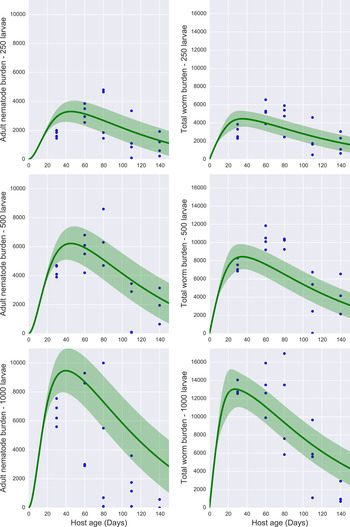
The model was fitted by non-linear least squares to the data by Hong et al. (Reference Hong, Michel and Lancaster1987). We model the trickle infection by allowing a constant infection rate (see Grenfell et al. Reference Grenfell, Wilson, Isham, Boyd and Dietz1995b for details). In general, our rather simple immunological assumptions allow for a good description of the dynamics of the worm burdens (Fig. 2). As expected, the worm burden first rises then falls; this is due to increasing immune feedbacks resulting in a decrease in the number of larval parasites, as well as a reduced larval maturation rate. Eventually, larval parasites are almost fully prevented from maturing (when β 2 m I ≈ 1) and the mortality rate of adult worms allows for a decrease in the mature worm population. This results in a good accuracy at capturing adult burdens, but a less precise description of the larval burdens (as can be seen from the less good fit of total worm burdens in Fig. 2). However, at the highest dose, the model over-predicts mean adult burden but the observed counts, performed on a limited number of individuals, fall reasonably close to one standard deviation of the mean. Possible reasons for this over-prediction are discussed below. Adding a parameter to control the establishment of larvae with a density-dependent effect does not substantially improve the fits at any of the doses and we thus do not consider this phenomenon any further.
Adult (left) and total (right) worm burdens for different trickle infection regimes. Dots represent the worm count data presented in Hong et al. (Reference Hong, Michel and Lancaster1987). Curves represent non-linear least squares fit of dose-dependent immune parameters 250 larvae: ν = 2·7 × 10−5, β 1 = 0·15, β 2 = 0·28; 500 larvae: ν = 2 × 10⁻⁵, β 1 = 0·1, β 2 = 0·19; 1000 larvae: ν = 1·8 × 10−5, β 1 = 0·1, β 2 = 0·14. Establishment rate is taken as ε = 1. Other parameter values: μ L = 0; μ M = 0·02; μ I = 0; γ = 0·1; α = 0.

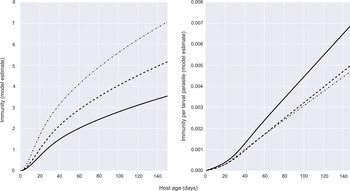
The immune-related parameters (ν, β 1 and β 2) all display similar dose-response dynamics. The increase in immunity per larval parasite (ν) appears stronger at the lowest dose of 250 and decreases with increasing dose. A similar trend is found for the immune-driven delay in larval maturation (β 2), which appears to be stronger per unit of immunity at the 250-larvae dose and subsequently decreasing at higher daily doses. Immune-mediated larval killing (β 1) again appears to be higher at the lowest dose, but similar at the intermediate (500) and at the highest daily infective dose. Interestingly, immune investment is always predicted to be higher at higher doses (i.e. the model predicts higher m I values at higher doses; Fig. 3, left panel). But this relationship reverses in accordance with the dose-response of ν when the number of larval parasites is taken into account (i.e. when looking at m I /m L ; Fig. 3, right panel).
Dynamics of immunity as a function of age: raw model prediction (left) and after normalization by larval parasite burden (right). The different lines correspond to the different infection regimes: plain line – 250 larvae; dashed line – 500 larvae; dotted line – 1000 larvae. All parameters are as in Fig. 2.

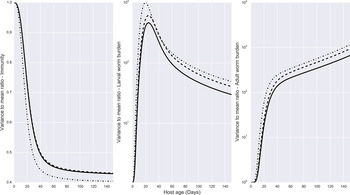
In addition to the mean burden which is usually fitted, the MC framework we use here allows the description of the variability between individuals. This allows the estimation of the variance to mean ratios for the different infection regimes (Fig. 4). Overall, the patterns are similar irrespective of the dose of larvae. With increasing host age, immunological variance decreases before stabilizing. Conversely, variances in parasite counts first increase and then either decrease as the raw numbers of larvae decrease or dampen as immunity becomes more efficient at delaying the emergence of new mature parasites. The main differences are found for larval parasites, which can be expected as they are more directly influenced by dose. It is also interesting to note that despite different values for the immune stimulation parameter, ν, the model predicts relatively similar dynamics in immune responsiveness between individuals.
Variance to mean ratios for immunity (left), larval parasites (centre) and adult worm burdens (right). The different lines correspond to the different infection regimes: plain line – 250 larvae; dashed line – 500 larvae; dotted line – 1000 larvae. All parameters are as in Fig. 2.

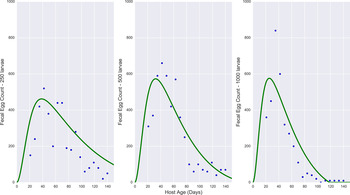
The ability of the model to predict the adult worm burdens results in good descriptions of the FEC (Fig. 5). The model captures relatively well the decay of egg counts with host age, especially at the two highest infection regimes. This demonstrates the importance of accounting for the role of accumulating immunity acting against multiple parasite stages on the dynamics of egg production. However, the peak of egg production is generally under-estimated. This is probably partly due to the existence of variability in the fit of the adult worm burden, with the errors propagating in the fit of the FEC. It may also be partly explained by the fact that the fit was performed on a single FEC value per time-point, which ignores the variability in egg production at that point, and also variability in FEC methodology itself, including inflation introduced by methods that use a multiplication factor to generate the estimated egg count value. It is also interesting to note that, although they show signs of dose-dependence, all the values of fecundity fitted do fall in the range of that reported in a large literature survey of epidemiological parameters (Kao et al. Reference Kao, Leathwick, Roberts and Sutherland2000).
Finally, we tested the robustness of the modelling framework by fitting data from single infection experiments with T. circumcincta (Hong et al. Reference Hong, Michel and Lancaster1986). Overall, we confirmed that our model can adequately predict worm burdens under these different conditions (see online Supplementary Information).
Fecal egg counts from the experiment by Hong et al. (Reference Hong, Michel and Lancaster1987). The curves present the non-linear least squares best fit of fecundity (λ) and immune reduction in egg production (β 3) for each dose separately: 250 larvae: λ = 0·18, β 3 = 0·026; 500 larvae: λ = 0·145, β 3 = 0·026; 1000 larvae: λ = 0·105, β 3 = 0·017. Adult worm burdens are taken as predicted in Fig. 2.

DISCUSSION
Mechanisms of immunity in sheep infected by T. circumcincta are now well-described and here we show that these can be incorporated in a tractable, yet informative, way into otherwise phenomenological frameworks. The model we present accounts for major features of the immune response of sheep to GI nematodes and is able to capture both adult worm burdens and FEC. Importantly, the MC framework that we develop here also offers the possibility to capture variability in the intake of larvae, a feature likely to be of interest to mimic variable L3 exposure of sheep on pastures or of wild ruminants. An interesting insight gained from our model is that the immunity-independent rate at which larval parasites establish has no effect on subsequent dynamics. This parameter has been found to be highly variable between infection regimes, breeds of sheep and experiments (see Kao et al. Reference Kao, Leathwick, Roberts and Sutherland2000; Gaba et al. Reference Gaba, Gruner and Cabaret2006 for reviews). The importance of this parameter has never been evaluated using within-host epidemiological analysis of the dynamics of infection. Modelling establishment has always proved challenging, and many functional relationships have been assumed, including linear (Grenfell et al. Reference Grenfell, Wilson, Isham, Boyd and Dietz1995b ), sigmoidal (Smith and Galligan, Reference Smith and Galligan1988) and immune dependence (Singleton et al. Reference Singleton, Stear and Matthews2011). In our study, it is likely that establishment is captured through the rate of larval killing by immunity. Our model would thus provide support for establishment being mainly immunity-driven, with effectors such as IgA and IgE potentially playing a role. In any case, our study outlines the importance of better understanding this functional relationship, as there might be some dose-dependent effects on the establishment rates. Further insights could be gained by analysing datasets such as the one compiled by Gaba et al. (Reference Gaba, Gruner and Cabaret2006) with within-host epidemiological models such as the MC framework developed here.
Two main caveats have so far limited the application of MC equations models: they require both measures of host heterogeneity and extended time-series of larval and adult nematode burdens for parameterization, which are best obtained through serial cross-sectional sampling of individuals with known exposure histories as in the data of Hong et al. (Reference Hong, Michel and Lancaster1986, Reference Hong, Michel and Lancaster1987) used here. However, in particular in wild systems, the most accessible measure of nematode burden is FEC; actual burdens are rarely accessible (e.g. only at the time of natural death (Gulland, Reference Gulland1992; Craig et al. Reference Craig, Pilkington and Pemberton2006)). It is possible that the model presented here offers a way to approximate immune priming and acquisition of resistance in animals for which FEC might be the only available data. Several validation steps would be needed to assess how robust the model is to inter-individual variations in parasite intake. This could be explored in the current framework by adding variance in the trickle infection intake: because consistently counting nematodes larvae for daily infection is likely to be imprecise, such a modification could further improve the quality of the fits. Pasture larval counts, which can be obtained in domestic and even wild systems such as the well-studied population of Soay sheep in St. Kilda (Scotland) (Wilson et al. Reference Wilson, Grenfell, Pilkington, Boyd, Gulland, Clutton-Brock and Pemberton2004), represent another source of data which could be used to assess the role of variability in the infection process.
The current modelling approach allows the estimation of dose-dependent, stage-specific immune priming parameters. But an important future step would be to directly use immune data to parameterize these components of the model. Such data, in particular measures of IgA and of IgE, are increasingly available and have been produced in a variety of contexts, ranging from vaccination trials (Nisbet et al. Reference Nisbet, McNeilly, Wildblood, Morrison, Bartley, Bartley, Longhi, McKendrick, Palarea-Albaladejo and Matthews2013) and estimation of selection for resistance to nematodes in domestic flocks (e.g. McRae et al. Reference McRae, Good, Hanrahan, Glynn, O'Connell and Keane2014) to predictors of survival of wild sheep populations (Nussey et al. Reference Nussey, Watt, Clark, Pilkington, Pemberton, Graham and McNeilly2014). The mechanistic basis of the action of these antibodies on T. circumcincta is fairly well-understood, but both the timing and the inter- and intra-individual variabilities are still poorly understood. The production of time-series of measures of IgA (and potentially of IgE) only requires longitudinal blood sampling. The relationship between plasma levels of IgA and actual mucosal antinematode activity has been quantified (Prada Jiménez de Cisneros et al. Reference Prada Jiménez de Cisneros, Matthews, Mair, Stefan and Stear2014a ) and there is potential for IgA to be measured using saliva samples (Shaw et al. Reference Shaw, Morris, Wheeler, Tate and Sutherland2012). Whatever the best empirical approach, such data would be very important for theoreticians. For instance, in our model, if the different immune parameters and fecundity of the nematodes can be estimated, FEC could potentially be used to model adult and larval worm burdens. The direct use of immunological data would also aid understanding the apparent dose-dependence predicted in our framework. We would predict that parasite specific IgA and/or IgE levels would be higher in general at higher doses but that, per parasite, these responses would be lowered, as the immune system reaches maximal stimulation levels and/or greater efficiency. Such predictions could be tested by directly allowing dose-dependence in the parameters of the model. The resulting model could be fitted with data on immune responses induced by a range of levels of trickle (or bolus) exposure to larval parasites.
Our model could be further extended to include several other biological aspects of interest to the epidemiology of T. circumcincta in sheep. This could be achieved by for instance including an equation for the L4 larvae and/or by explicitly modelling the egg production of mature parasites. The inclusion of the L4 stage would enable us to study the occurrence of inhibited development, a phenomenon by which larval parasites enter a state of dormancy at some point during their development. In T. circumcincta, experimental evidence supports a role of immunological feedbacks in this phenomenon (Halliday et al. Reference Halliday, Routledge, Smith, Matthews and Smith2007; Smith, Reference Smith2007) but a role of other seasonal variations has also been proposed (Gibbs, Reference Gibbs1986). Given suitably detailed data, it would be possible to model and fit L4 burdens. Other frameworks have explicitly modelled L4s (Learmount et al. Reference Learmount, Taylor, Smith and Morgan2006), but such model expansion would make the MC more complex and beyond the scope of the current study. However, achieving MC in that case would be particularly important as inter-individual variations would help tease apart the relative roles of immune feedbacks and host chemokines in larval inhibition.
Another interesting extension of the model would be to include the longitudinal dynamics of immunity. Here, we avoid dealing with this issue as we focused on naïve lambs. However, older sheep are likely to have been previously exposed and this would be important to incorporate. Accounting for previous immunity would also allow the exploration of the effect of vaccines, which are currently being evaluated as alternatives to anthelmintic treatments. Nisbet et al. (Nisbet et al. Reference Nisbet, McNeilly, Wildblood, Morrison, Bartley, Bartley, Longhi, McKendrick, Palarea-Albaladejo and Matthews2013) showed that immunizing sheep with a combination of several T. circumcincta recombinant antigens reduced both FEC and endpoint worm burdens. However, ideally, repeated measures of worm burdens throughout the trials would be required to adjust the model parameters to the vaccination context. Even if such data cannot be readily obtained, our framework could be modified to explore the consequences of vaccine candidates targeting different aspects of the immune response of the sheep to T. circumcincta. Another interesting avenue of modelling is the role of maternal immunity in the system. From an immunological standpoint, the colostrum of ewes is highly dominated by IgG (Campbell et al. Reference Campbell, Siegel and Knowlton1977). However, by 30 days of lactation, IgA becomes the dominant antibody transferred for animals infected with Trichostrongylus colubriformis (Pfeffer et al. Reference Pfeffer, Shaw, Green and Phegan2005). There has been a distinct lack of evaluation of the importance of maternal antibodies against T. circumcincta (Stear et al. Reference Stear, Bishop, Henderson and Scott2003), but we would expect maternally-derived IgA to act like other secretory IgAs in the abomasum and thus directly interfere with larval T. circumcincta. In our framework, this could be modelled with a temporary enhancement of immunity corresponding to the duration of lactation in sheep. Ideally, this would be compared with time-series of IgA in milk throughout lactation, which might be available or can be gathered in experimental or industrial flocks.
Overall, our study and its potential extensions highlight the need for more integration of epidemiology, ecology and immunology, a problem already addressed by Hellriegel (Reference Hellriegel2001). Measures of immunity are becoming increasingly available, even for wild animal populations (Garnier and Graham, Reference Garnier and Graham2014). Mechanistic yet tractable data could be used by theoreticians to improve the description of immune feedbacks in models of infectious diseases. Conversely, immunologists, in particular, and empiricists, in general, would benefit from making available data that are of interest to modellers. This includes time- series of immune parameters or of worm burdens measured in routine experiments. In addition, a dialog between modellers and immunologists could allow the design of targeted experiments to better parameterize models. Field biologists and theoretical disease ecologists are already cultivating such connections (Restif et al. Reference Restif, Hayman, Pulliam, Plowright, George, Luis, Cunningham, Bowen, Fooks and O'Shea2012), though a number of challenges have been identified (Lessler et al. Reference Lessler, Edmunds, Halloran, Hollingsworth and Lloyd2015). Similar synergies between immunologists and infectious diseases theoreticians would result in great advances. As in quantitative ecology (Gimenez et al. Reference Gimenez, Abadi, Barnagaud, Blanc, Buoro, Cubaynes, Desprez, Gamelon, Guilhaumon and Lagrange2013), there is a need for scientists to interact closely between the laboratory-based and theoretical sciences to help bridge the gap between these disciplines.
SUPPLEMENTARY MATERIAL
To view supplementary material for this article, please visit http://dx.doi.org/10.1017/S0031182015000992.
ACKNOWLEDGEMENTS
We are grateful to Guest Editor A. Fenton for the invitation to contribute this manuscript. We also would like to dedicate this article to the memory of Professor Steve Bishop, whose work on sheep-nematode systems has been inspirational.
FINANCIAL SUPPORT
RG was supported by a Princeton University Health Grand Challenges grant to ALG. ALG and BTG also acknowledge support from the Research and Policy for Infectious Disease Dynamics (RAPIDD) program of the Science and Technology Directorate, US Department of Homeland Security and the Fogarty International Center of the National Institutes of Health. AJN and JBM acknowledge support from the Scottish Government RESAS.