The last decade has witnessed a growing interest in understanding nineteenth-century opera as a global phenomenon. Recent books such as Suzanne Aspden's Operatic Geographies (2019), Jens Hesselager's Grand Opera Outside Paris (2017) and Michael Walter's Oper. Geschichte einer Institution (2016)Footnote 1 have brought new understandings to opera studies from a transnational perspective that is closely related to the emergence of ‘global history’ as an important ground for contemporary historical studies.Footnote 2 But opera, as Roberta Montemorra Marvin suggested in 2006, seems by its own nature to be ‘a historically situated synthesis of means and artistic expressions that can mediate and transcend temporal, geographical and social boundaries’.Footnote 3 Opera is thus now understood as a global rather than local (or European) field of study. Latin America, where opera played a significant role in the nineteenth century, has enjoyed some of that recent scholarly attention, as demonstrated, for example, by the books of both Aspden (see the chapters of Charlotte Bentley and Benjamin Walton) and Walter.
Nevertheless, recent scholarship on opera in Latin America, particularly that originating in the region, has tended to concentrate on the second half of the nineteenth century or the early twentieth century.Footnote 4 There are clear reasons why this should be so: during the 1870s, Latin America had consolidated itself as an attractive market for opera and operatic practices. Networks for impresarios extending across the Atlantic ensured that some of the best-known singers could visit the region, and that successful new European premieres could be swiftly (and profitably) reprised in the Americas. The region thus serves as a clear and significant example for studies of reception, circulation and technologies: it was a consolidated market for Italian opera at a time when, in Italy, production costs meant that opera was losing its market.Footnote 5 The first half of the nineteenth century, however, looks quite different: the genre of opera was still relatively new to local audiences, networks were in formation, technical and economic problems were common, the risks of travelling were profound, audiences were not entirely convinced about the endeavour – and there were not many venues where Italian opera could be properly performed and produced.Footnote 6
The sheer heterogeneity of the early reception and appropriation of Italian opera in Latin America makes its exploration particularly difficult, however. There is little that connects the very specific early operatic experiences of such places as Rio, Havana, Mexico and Lima – and the more we learn about such experiences, the more apparent becomes the need for greater recognition of their individual specificity. Since Katherine K. Preston's Opera on the Road,Footnote 7 the idea of the American operatic market has been shaped mainly by the idea of ‘travelling’ or touring companies.Footnote 8 However, that model is less effective for Latin America before the 1850s. More studies are needed to identify not only the variations between Latin America and the United States of AmericaFootnote 9 but also the internal differences – between Mexico and Chile, and between Brazil and the Spanish Americas. Walter proposes a division into three distinct regions: North America (including Cuba); Mexico and Central America; and the meridional lands, including Argentina, Brazil, Chile and Peru.Footnote 10 My research suggests rather that the opera networks of the period concerning Latin America were: the Caribbean (including part of Mexico and Venezuela, as well as the United States of America), the Atlantic coast (Brazil, Uruguay, Paraguay and Argentina) and the Andean region as accessed from the Pacific (Ecuador, Peru, Bolivia and Chile). Colombia (with Panama then being part of it) was central in connecting the north with the south, but the largest Andean cities were inaccessible to most opera companies, as local scholars have attested.Footnote 11
Broadly, it is at this time that we find the first tantalising steps of the transoceanic and Inter-American networks sometimes taken for granted in later decades. Here we can see how those networks were gradually built, how local people and ideas affected the reception of opera – indeed, how unexpected Italian opera was for most Latin American audiences in a period directly following the devastating Wars of Independence that had raged across the region during the 1810s and 1820s. Importantly, until the 1850s operatic experience in Latin America was shaped not by a steady stream of operatic performances, as occurred in later decades, but rather by a range of diverse practices and opportunities: sporadic or partial stagings of operas by Italian singers, the availability (or otherwise) of vocal scores, the willingness to arrange operas for particular instrumental combinations, or to perform a handful of songs in the middle of a play, or to simply imagine through descriptive statements what opera might or could be.Footnote 12 In my own research on this period, I have been confronted by what could best be described as the complex processes of trial and error in these early efforts to appropriate Italian opera, marked by the influence and intervention of individuals. What I have learned is that the dominant theoretical approaches to date – the presumption of a passive reception history of Italian opera, or the postcolonial critique of European cultural practice – do not sufficiently explain what was happening at the time.Footnote 13
My research on the early operatic networks of the American South Pacific has focused on the coasts of Ecuador, Peru, Bolivia and Chile – an area more than 4,000 kilometres in length, or the equivalent of travelling from Lisbon to Moscow, or from New York to Los Angeles.Footnote 14 This article concerns the initial ten years of the Teatro Victoria, the first opera house in Valparaiso, Chile, which opened with a performance of Bellini's I Capuleti e I Montecchi in December 1844. Aspden has already noted the lack of research on the site of the opera house, particularly its role as a place of interaction and meaning.Footnote 15 A close analysis of an opera house built on the margins of the Italian operatic scene, therefore, serves both as a microhistory of the experiences of practitioners, audiences, critics and impresarios and, more broadly, as a lens through which to view contemporary problems concerning opera, the role of opera houses and opera's reception in this complex period. The Teatro Victoria was the first theatre in the Andean region built primarily as an opera house, an outpost, as I will discuss, for the idea and practice of ‘Italian opera’. As the aims and workings of the opera house and the strategies of its first owner and impresario, Pietro (Pedro) Alessandri, will reveal, the challenge was not only to make an opera house at the end of the world part of a growing, larger network of global opera but also to make it attractive and relevant to local audiences – and profitable.
The Teatro Victoria
In the early 1840s, Valparaiso, a hundred kilometres from the capital, Santiago, was a flourishing port city. The first safe harbour after Cape Horn, Valparaiso was arguably the largest port of the American Pacific before the rise of San Francisco during the 1850s and 1860s. Dealing with a large volume of trade, its centrality remained evident until the opening of the Panama Canal in 1914.Footnote 16 The population grew exponentially after political independence in 1818: while in 1817 the city had a population of approximately 6,000, by 1830 the local government calculated it at 19,000, and a decade later it had doubled to more than 40,000, a large percentage of which were foreigners.Footnote 17 The designation of Valparaiso as a free port (puerto franco) in 1832 was a political masterstroke at a time when Chile was attaining political stability while many of its neighbours were still defining their borders and identity. Valparaiso reshaped Pacific commerce, welcoming growing numbers of immigrants – mostly European entrepreneurs. This new influx of citizens gave the city its cosmopolitan character, which has been celebrated through to the present day, with the city declared a UNESCO World Heritage Site in 2003.
But Valparaiso was a very different city back in the 1840s. Not yet the grand ‘European’-styled port of later decades (which was in any case mostly destroyed by an earthquake in 1906), the city lacked much that foreigners found necessary, including public places for entertainment: there was a cockfighting arena and some buildings were used, sporadically, as makeshift theatres. In the view of John Miers, who visited the city in the 1820s: ‘Independent of the want of society, there exists [in Valparaiso] no public amusement, no theatre, commercial, reading, or news room.’Footnote 18 But, as William Ruschenberger also wrote around that time, there was hope for the future: ‘[the town] improves more rapidly than any other city on this side of Cape Horn. Most of the houses on the main street are good two-storey buildings’.Footnote 19 The city was changing from a local port inside a larger viceroyalty to the main port of a newly prosperous nation, with growing connections to the outer world. Basil Hall, another traveller who visited the city, noticed that ‘at the port, in consequence of the number of arrivals … they know, accordingly, with tolerable precision, not only what is passing in other parts of South America, but have a clearer idea of European affairs’.Footnote 20 This, of course, deeply affected expectations of what a city should be, and what kinds of entertainment it should offer.
The old theatre was a small building, constructed in part from the unfinished edifice of an Augustinian monastery. As had been the custom in much of Latin America since colonial times, the place was leased around 1820 to a businessman, in this case Domingo Arteaga, who managed it on behalf of the city council.Footnote 21 The theatre, known locally as ‘San Agustín’, was expanded in 1826 with a larger stage and a limited set of boxes, including two for the city council and government representatives.Footnote 22 It was in this venue that some of the first Italian singers, including Vincenzo Zappucci in 1828, performed opera in concert fashion in Valparaiso. But the first full stagings of operas, by the company of Domenico Pizzoni and Teresa Schieroni in 1830, took place in the salon of a large house of the Cifuentes family purportedly rented for the season.Footnote 23 Much later, José Santos Tornero, the editor and owner of the local paper El Mercurio, wrote about those buildings ‘roofed with totora leaves’ surrounding Plaza Victoria, including one that ‘tried to resemble a theatre’.Footnote 24
For many years, newspapers had been promoting theatre as an essential part of what gave cities, in the words of one writer, a ‘truly European appearance’.Footnote 25 In 1842 the city council responded to such pressure, discussing how ‘the construction of a theatre is needed more every day, given the large number of foreigners in this city, who find no place for their distraction’.Footnote 26 It was suggested, given the council's lack of sufficient funds, that a subscription could be raised to construct a theatre costing between 30 and 40 thousand pesos. Considering the proposed budget, it seems likely that the city council was planning a rather smaller theatre, along the lines of what was then more common in Chile and the Andean region. Among South American nations, only Brazil had a full-scale opera house: the large and comfortable Real Theatro de São João, built in 1813 when the exiled Portuguese court lived in Rio de Janeiro.
Nevertheless, the theatres of Rio de Janeiro were an exception. Spanish colonial theatres, usually known locally as ‘coliseos’, were rather different from Italian opera houses of the eighteenth century. They were shaped as shoeboxes, or like circular open theatres such as the Shakespearean Globe Theatre in London.Footnote 27 Many early nineteenth-century travellers commented on the shape of those theatres, with their small stages and lack of space for musicians. And many late colonial theatres had no roof: Humboldt famously wrote about the marvel of being able to calculate the movement of Jupiter from his box during a performance in Caracas.Footnote 28 But this also meant that bad weather could easily halt a performance, or even a full season - a serious problem for travelling opera companies. Very few of those theatres survive today. Mexico possesses the largest number, the best known being Durango's Teatro Victoria (1800).Footnote 29 In the Andean region, the only surviving example (as far as I know) is the 1826 Teatro Fénix in Arequipa, Peru. When the first opera company arrived in the city, led by Paolo Ferretti in 1859, it was forced to wait more than a month to start its season because of the rains that summer.Footnote 30
Interest in building a modern theatre, with an orchestra pit and all the necessary machinery to perform operas, was initiated in 1840 by the arrival in Lima of a group of singers led by Raffaele Pantanelli and his wife Clorinda Corradi (then a highly successful singer in Italy and North America). Their company represented the first step towards the creation of a permanent operatic milieu. By then, the staging of Italian opera was still comparatively new in the Andean region, as in other parts of South America. Opera, as a repertoire, was still experienced in the Andes mostly as parlour music performed from vocal scores rather than on stage.Footnote 31 But the Pantanelli opera company was quickly regarded as a sign of modernity, of the potential connection between the Andean region and the outer world. As Heinrich Witt, a resident of Lima, wrote in his diary:
In 1840 the Pacific Steam Navigation Company, for the first time, connected the southern coast. The two first ships were the ‘Peru’ and the ‘Chile’. Around the same time an opera company appeared on the Limenian stage, the prima donnas being Pantanelli and Rossi, and was exceedingly well received, since for many years there had been no operas in this country.Footnote 32
Indeed, in the same way as the arrival of the first two steamers in the American South Pacific reduced the distance from Lima to Valparaiso from a month to less than ten days, the impact of the Pantanelli company reshaped what could be expected in terms of artistic arrival. They were followed during that decade by the likes of Henri Herz and Camilo Sivori, prominent artists with well-known reputations before they arrived in the Southern Cone. The Pantanelli company, while not the first to visit the region (that had been the Schieroni-Pizzoni company in 1830–1), caused a cultural shock, clearly evident in newspapers across the South Pacific between 1840 and 1844. Their presence almost at a stroke created the desire for proper theatres – theatres that would encourage further operatic and artistic visits from abroad, a trend that was felt from Ecuador to Chile.
The Teatro Victoria in Valparaiso was the first, the brainchild of Pietro Alessandri, who arrived in Chile in 1821, performing with a small company of Italian puppeteers.Footnote 33 During his first years in Chile, Alessandri had been interested in the theatre, leasing the old building in Valparaiso in 1825. This was after Arteaga left for Santiago, probably to avoid the increasing conflicts between the city council in Valparaiso and the Augustinians who owned the land.Footnote 34 They continued to do business: when Arteaga tried to build a new theatre in Santiago funded by public subscription, Alessandri was one of the first to support him. In 1842 Alessandri proposed a new theatre to Santiago city council.Footnote 35 The idea was rejected, however, mainly because Alessandri wanted an exemption from taxes for fifteen years, the time he considered necessary to make the theatre profitable.Footnote 36 While the project was being discussed in Santiago, a wildfire consumed large parts of Valparaiso, including the building that sometimes served as a theatre. Alessandri therefore transferred his idea to Valparaiso, where he joined forces with local businessman Pablo Del Río and prepared a new proposal.
Alessandri's plans for Valparaiso featured a large, modern and comfortable theatre for approximately 2,000 people in front of the city's main square, the Plaza de la Victoria. The city took the proposal seriously, giving Alessandri and Del Río the land to build the theatre, without charging any taxes for fifteen years;Footnote 37 the Chilean government also gave 2,000 pesos to Alessandri to modernise the streets surrounding the theatre, considering that ‘a theatre is an urgent necessity for the people of that city’.Footnote 38 The best description of the opinions of both the city council and the local government appears in a letter from José Joaquín Prieto, intendant of Valparaiso in 1843, to the Chilean government:
[We] have concluded that a sacrifice had to be made in economic terms to support a venture whose aim is to improve our customs, to spread civilisation, and to offer to the public of Valparaiso a healthy form of entertainment … until now, the city has lacked a place of such importance, when it is clear that its current circumstances demand the moral nourishment of cities of this rank. When the opportunity arose, we did not hesitate to support them.Footnote 39
The original ledgers of the city council, however, show a much more intense debate than Prieto's description led readers to believe. The Victoria offered a new model with serious political and ethical implications. Until then, theatres had been built, as one city councillor put it, as places of education and enlightenment through entertainment, and thus were protected and controlled by the government.Footnote 40 That control meant that if theatres were profitable, their income was used to support other public institutions, such as hospitals and cemeteries. Alessandri, however, offered the city neither profit nor public control; he might have taken inspiration from the recently opened Teatro Santa Anna (also called Teatro Nacional) in Mexico City, inaugurated at the beginning of that same year. Francisco Arbeu had begun the project of that building in 1840 with an open subscription, which soon ran into difficulty. Succeeding problems were widely reported in the Mexican newspapers, and these were available in Valparaiso at the time. It was finally decided to make the construction of the theatre a private commercial venture.Footnote 41
What is certain is that in the case of Valparaiso many questions and objections were raised by the city councillors: how would such a theatre be regulated? Would the impresarios, for example, hire their own policemen?Footnote 42 Should there be a theatre committee representing the city's interests? And what would such a committee actually do? In the end, the view that triumphed was not that of enlightened education, but rather the pragmatism of early capitalism. As one councillor put it, such a theatre should be ‘no more special than any other business speculation’, allowed to fail or succeed on its own terms.Footnote 43 At the same time, the city council found ways to subvert the capitalist model of Alessandri and Del Río and still use the Victoria as a source of income for charitable projects. For example, Alessandri's original contract with the city council forced him to donate the profits of at least one evening a year to some of the ‘charitable institutions that we have in this city, or that might be established in the future’.Footnote 44 Any fines imposed on the theatre's managers also went towards charitable institutions. For example, for every ten minutes that passed beyond the announced time without the curtain being raised, the theatre was fined $25; the same fine was applied if the intervals went beyond the accepted range of fifteen to twenty minutes.Footnote 45 Sometimes, the owners of the theatre offered benefit concerts for charitable projects; such arrangements promoted a healthy relationship between the theatre and the city's representatives, without jeopardising the desired economic and artistic control.Footnote 46
The most explicit signs of this divergence in the ways of conceiving a theatre were the arguments sustained on the topic of the private boxes for the city council and the central government. Alessandri opposed vehemently having to reserve two boxes for this purpose, without receiving any payment. The debate spilled into the newspapers and the Ministry of Interior compiled a fifty-two-page dossier on the subject.Footnote 47 The debate ended only when the president himself intervened, with an order signed on the same day as the inauguration of the theatre (12 December 1844). It stated: ‘Since the police need to guard the interior of a theatre according to the Constitution … and it cannot be assumed that they should pay tickets to attend performances … the owners of the Teatro de la Victoria in Valparaiso cannot use their licence until they allow members of the city council to enter the theatre without remuneration, and with a box destined for them, as suggested by the government of Valparaiso.’Footnote 48
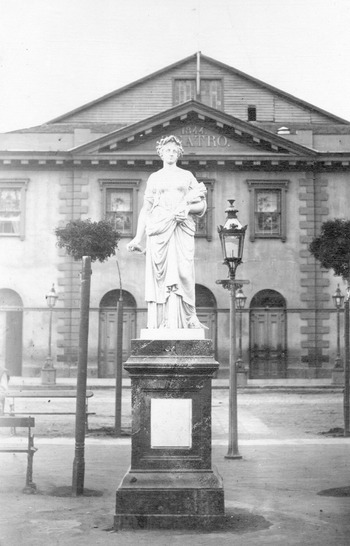
The Victoria, while not as large as originally projected (for 2,000 people), was still much larger than contemporary theatres in the region. Shaped like a modern European (Italian) opera house, it had three tiers of boxes (forty-four in total), an amphitheatre for 100 people (with a few extra boxes), a gallery with 300 seats and stalls providing room for almost 500 people. All seats apart from the boxes were numbered, a novelty often commented on not only by locals, but also by travellers.Footnote 49 While not as handsome as later Chilean theatres (such as the Teatro Municipal or the second Teatro Victoria, built after fire destroyed the first one in 1878), the size and the style of the Victoria, with its large front windows two storeys high and its delicate detailing in brick and other decorations, certainly made it stand out in comparison with neighbouring buildings in the city. Indeed, at the time it was one of the largest buildings in the country (Figure 1). The French architect in charge of the building was Pedro Claveaux,Footnote 50 brother of Antonio Claveaux who worked occasionally as the stage painter for the Teatro Principal in Santiago.Footnote 51 Not much is known of Pedro, but newspaper sources suggest that he had a large house downtown, converted into a hotel in 1850,Footnote 52 and that he was already living in Valparaiso in 1839.Footnote 53 Not everyone agreed with Claveaux's aesthetic choices; for example, the rails of the boxes were almost uniformly considered too high,Footnote 54 while the colour of the city council's box (contrasting heavily with the white interior of the rest of the hall) was criticised in newspapers as a monstrosity (mamarracho).Footnote 55
Victoria Square, representation of agriculture, and the Teatro Victoria in the background. Photograph by George Fowler Hastings, c.1867. Item A-6-165 in City of Vancouver Archives (Public Domain).

The Victoria was built and decorated to create for its audiences the illusion of being transported to Europe.Footnote 56 Indeed, the Victoria served as a model for many of the other opera houses in the region, such as the Teatro Municipal in La Paz (1845, Bolivia), the Teatro de Copiapó in the Chilean city of the same name (1848), the Teatro Variedades in Lima and the Teatro de Lambayeque in Peru, both from 1850, with many more coming in the following decade.Footnote 57 The Victoria's influence on Santiago is made explicit by a letter sent by the Minister of the Interior to the intendant of Valparaiso, asking for the ‘architectural drawings sent from Europe’ for the erection of the Victoria, because ‘this city council [Santiago] now asks to create a similar building here’.Footnote 58
While the theatre was being built, boxes were sold to private proprietors, with ‘full ownership and control’.Footnote 59 The boxes were shown to and discussed with prospective owners from 10 to 20 October, with Alessandri himself confirming the conditions of sale.Footnote 60 According to him, by 1850 twenty boxes had been sold at 4,800 pesos each, which covered the total cost of the building: 90,000 pesos (though not including the 48,000 pesos on furniture).Footnote 61 It was certainly a success, considering the total cost of the theatre was more than three times what the city council had expected in 1842. The earliest contracts reveal that the box owners included Henry Ward (businessman of US American origin), Bartholomew Browne (born in London, he dealt in Lima and Valparaiso as owner of the celebrated Huth & Company firm), Francisco Nebel (German owner of several companies and founder of the fire service in Valparaiso), Juan de Dios Correa (landowner, military man and senator for the Conservative Party) and Eugenio Soler (a Chilean small businessman). Each signed with the same notary, Victorio Martínez, with whom Alessandri made most of his deals.Footnote 62 The social landscape of the boxes, thus, confirms a mixture of foreigners (American, German and British), as well as members of the Chilean elite and local upper-middle class.
The inauguration of the Victoria was in December 1844, but the road to the inauguration took many months. The singers had arrived in Chile in April, aboard the ‘Peru’ steamer from Lima: the passenger documentation lists Raffaele Pantanelli, Clorinda Corradi-Pantanelli, their daughter (Alaide), Luigi Grandi, Teresa Rossi, María España (a Peruvian soprano who joined them in Lima), Paolo Ferretti and Nestor Corradi (Clorinda's brother).Footnote 63 Alessandro Zambaiti had arrived with the previous steamer.Footnote 64 They all accepted contracts to perform in Santiago until the Victoria was finished. In the meantime, El Mercurio de Valparaíso printed articles on the history of opera,Footnote 65 and the same newspaper edited an album with some of the most popular pieces from the repertory of the Pantanelli company: the ‘cavatina’ from Marino Faliero (Donizetti), the ‘polacca’ from I puritani (Bellini), a ‘cavatina’ from Lucia di Lammermoor (Donizetti) and a ‘duo’ from Norma (Bellini), all translated into Spanish by ‘a local poet’.Footnote 66 In November, José Martí, a Cuban singer who had recently arrived in Valparaiso, joined the opera company as the second bass, alongside Ferretti.Footnote 67
After a series of announcements and delays, on 19 November 1844 the city council finally approved the staging of ‘a lyric performance’.Footnote 68 The theatre opened on the evening of 16 December, with ‘three performances that same day and two the day after, as is done in Europe, having chosen the most famous of all of Bellini's operas for the premiere, Romeo y Julieta’.Footnote 69 The first reviews came soon afterwards:
The movement of people, the crowds in the front of the theatre [coming to see] the triumph of Italy and the ostentation of its masterworks. To hear the melodies of the bard of Italy, and his sublime tragedy, performed by Italian voices, on a stage made live by the hand of an Italian painter. Our cosmopolitan town was transported to Italy, the queen of the world.Footnote 70
Alessandri and Del Río, seen as the engine of the project, were praised for their efforts:
They know this is not great business, but have given the theatre in Valparaiso all the capacity, the luxury, the perfection that one would expect of a capital city. … This enterprise cannot be read anymore as a private one, it is indeed NATIONAL; from a political, social, financial and economic perspective, this project concerns the nation.Footnote 71
The Italians in the company described a similar rush of emotions. When they arrived in April 1844, Clorinda Corradi-Pantanelli wrote to her friend, the German painter Moritz Rugendas, about the ‘theatre which is being built, and which will certainly be one of the best in the Americas’.Footnote 72 By November, Clorinda was relating the excitement of the forthcoming inauguration, and that while ‘many here believe Alessandri will lose money, we think that the season will be really well attended, given that many of those who come to the theatre in Santiago will join us in Valparaiso’.Footnote 73 A few months later, Raffaele Pantanelli wrote to his friend Gaetano Fiori in Bologna about the opening night of the ‘magnificent new theatre called Victoria, built by businessman Pietro Alessandri at his own expense’.Footnote 74 In Pantanelli's words, the Victoria was a real sign of the ‘progress that Italian opera is making in the new world’.Footnote 75
Indeed, as reviewers and singers stated, the Victoria was often depicted as a cosmopolitan venue. One traveller who visited the Victoria in the 1840s wrote that:
Santiago might be the capital of Chile, but Valparaiso is the only city to have a proper theatre, large, well decorated, comfortable and with a certain luxury … Alessandri's theatre could rival the finest [des plus beaux] of Europe [and the passion he puts into the project] could make us forget that four thousand leagues separate Valparaiso from Paris.Footnote 76
Yet many descriptions (such as those about the inauguration) tend to address the Victoria as specifically Italian, rather than cosmopolitan in character. It was a view echoed in Italian newspapers, including commentary in the well-known Milanese journal Il pirata announcing the construction of the Victoria by Alessandri as a sign of how ‘our Italian opera is in constant expansion’.Footnote 77
But was it really possible to make a simplistic equivalence between an opera house in Italy or France (even provincial Italy or France) and one in Chile: to think of the latter as a transplanted building and experience? The assumption here is that a new theatre of certain characteristics was an undeniable sign of the expansion of European culture – even given Chile's distance from Italy. More specifically, it was the expansion of Italian opera – the abstract cultural idea of opera, and its repertoire and performing practices. The other notion, implied particularly by Pantanelli's letter, is that of Latin America as a place of passive reception for that expansion. However, both notions are quickly dispelled by primary sources. The triumph and prestige of Italian opera in this early period of its Latin American reception is neither neutral nor automatic: it was built slowly and steadily by local agents and their networks, including performers, impresarios and audience members.
Strategies for an opera house
Pietro Alessandri was the owner of and primary financier behind the Victoria between 1844 and 1854. He was certainly supported by Pablo Del Río, but all contemporary accounts agree that Del Río's interest was purely financial: not involved in the management of the theatre, he left the business in the hands of Alessandri from very early on. Alessandri resigned from his role as owner in 1850, when he transformed the venture into one governed by shareholders. In 1854, he also resigned as manager of the theatre.Footnote 78 He died three years later. The sense of financial and cultural peril in this venture – the idea (voiced in newspapers as much as in private letters) that people might not be interested in opera – was a profound issue that highlights the fact that we cannot take the success of Italian opera in this period for granted. Teresa Rossi, the prima donna who performed alongside the Pantanellis for the opening night of the Victoria, wrote in a private letter that she realised Chilean audiences did not know how to react to Italian opera, that it would take time to ‘educate’ them.Footnote 79
Knowing that his opera house was a precarious undertaking, Alessandri developed several strategies designed to make his theatre attractive and opera an unmissable social and cultural event. While the many Europeans in Valparaiso would form the primary audience of the Victoria, filling the theatre also meant engaging the support of the local population – a task made more difficult as prices were often more expensive than those in Santiago, given both the cost of maintaining a larger theatre and the reinforcements needed for choirs and orchestra members (mostly supplied by the capital's churches).Footnote 80 Alessandri had to use a range of tactics to promote opera and make his opera house profitable: he tried to get a Chilean opera premiered in 1846 (Telésfora, by local composer Aquinas Ried); he lent money to singers who decided to stay in Chile to start a business or create a smaller travelling opera company;Footnote 81 he kept close contact with Luigi Bazzani, who hired new singers in Italy when they were needed to perform in Chile;Footnote 82 he brokered deals with impresarios in Lima to hire singers jointly, enabling a constant rotation of voices and repertoire and thus cementing an Andean operatic scene with a neural centre in the exchange between Lima and Valparaiso.Footnote 83
For the purposes of this article, however, I will limit myself to a discussion of just three of the key strategies employed by Pietro Alessandri to manage his theatre, enthuse audiences and make his venture profitable: the use of masked balls, the support of printed libretti and magazines and the decision to bring a stage painter from Italy to work exclusively for the Victoria. I choose them not only because of the availability of sources but also because documents show that these three areas were central to him. They represent different ways in which he connected his theatre both to the larger city of Valparaiso and to his own background in Italy, as well as the ways in which the audience and society in Valparaiso connected to him and to the project behind the Victoria.
Masked balls
From early on, Alessandri decided to allocate two rooms in the Victoria for rental to local societies as multi-purpose salons. This made perfect sense at a time when the social life of Valparaiso was changing from one mainly lived inside houses on the upper hills (particularly the neighbourhood of El Almendral) to one taking place in the public spaces of the flat downtown. The Sociedad Filarmónica was considered the most ‘aristocratic’ of those public gatherings at the time, the place for the reunion of Valparaiso's ‘high society’.Footnote 84 And, indeed, the society used a room in the Victoria for many years, until they built their own premises in 1853.Footnote 85 In housing the philharmonic society, which was mostly dedicated to dancing, public recitations and concerts led by local amateurs (and select foreign professionals), Alessandri created a convergence of the intimate interests of the elite, and the idea of the theatre as a public place for social life that went beyond opera and other staged performances.
The most explicit sign of the Victoria as a hinge between public and private society was the masked balls organised there by the owners from 1845. In the words of Margaret Butler, masked balls had long served ‘as an extension and expansion of the opera house's dynamic environment, [they] provided another type of visual spectacle [and together they] formed a place-specific entertainment combination that was unified both geographically and aesthetically’.Footnote 86 However, the tradition of masked balls was not one to which people in Chile were accustomed, while for European migrants it was an entirely familiar part of their own theatrical experiences. When the first masked balls were given in Valparaiso, in the early 1840s – in private homes – they were considered by many as a dangerous passing fashion. As one writer stated in 1842:
We know how mothers might feel when they see the virtue of their daughters being imperilled [under the masks], particularly if they cannot follow them in the whirlwind which is a masked ball. … But we have to remember that for the foreigners among us, such a brilliant gathering will always be the reminder of the many similar ones they enjoyed with their wives, sisters and daughters back in Europe.Footnote 87
The European allure of masked balls was often reinforced by the foreign foulletins printed in the newspapers, such as a narrative of ladies in Madrid eagerly preparing their costumes,Footnote 88 the description by Dumas of a masked ball in Paris,Footnote 89 or the role a masked ball played in one of Feval's popular mysteries, ‘The Devil's Son’ (El hijo del diablo).Footnote 90 For many citizens in Valparaiso, as Fernando Silva has suggested, masked balls were a greater concern than in Santiago, given that travellers passing through the city (sometimes for no more than a night) could easily escape from the law.Footnote 91 In a letter to the Minister of the Interior, the intendant also raised other concerns:
The masked balls given in Valparaiso, like any other forms of entertainment where there are people from both sexes, can easily end in disorder against good manners. The liquor … mixed with the stimulation given by the costumes, unavoidably leads to amoral behaviours. … The artisan classes, who normally like less constricted entertainments, enjoy going to such dances with masks like those given by the Teatro Victoria.Footnote 92
There are two different kinds of concern at play here. On the one hand, an expected moral anxiety; on the other, a more complicated social unease. The masks, according to the intendant, would also allow ‘artisans’ (of the lower-middle class) to join the ranks of high society by obscuring their true identities. The disquiet was not only about the mingling of social classes but also a patronising concern (by the authorities) over the financial consequences of participation in the balls: that ‘those from the artisan classes spend an important part of their earnings on expensive costumes’.Footnote 93
Successive intendants created a series of rules to control masked balls, a key feature of the social success of the Teatro Victoria and a practice that changed balls from being private to public affairs. They were limited to four a year, maximum.Footnote 94 In 1850, a decree was printed which stated that ‘masked balls in the Teatro de la Victoria have to be sanctioned by the intendant’, that they always had to start at sundown and end by 3am, that people were not allowed to use masks on the streets, that weapons were not allowed inside the theatre (apart from wooden ones for costume) and – more importantly – that the owner of the theatre had to pay for the policemen to protect the attendants.Footnote 95 The licence given for a masked ball on 3 February 1849 stipulated explicitly that after midnight ‘any person found more than a street away from the theatre, with their mask on, will be fined’.Footnote 96 By 1854, the local government was charging taxes for each ball, at costs of 50 pesos for a public ball, 80 for a fantasy ball without masks and 200 for a masked ball, again with the probable aim of curbing their dangerous success.Footnote 97
Libretti and magazines
However, the theatre's relationship with local society was not only a physical matter, consolidated through balls and boxes, but also present in the more abstract sphere of discourse, facilitated by the rapid spread of publications raising the profile of and interest in Italian opera. Much of the public support for the Teatro Victoria came from El Mercurio, the local newspaper and the main publisher and printer in Valparaiso. The connection between El Mercurio and the Victoria seems to have been one of direct friendship between the two proprietors. Most probably, Alessandri was supported by José Santos Tornero, a Spanish businessman who arrived in Chile in 1834 and from 1842 became the editor and owner of El Mercurio. Tornero, too, was a man of the theatre, dedicating a full chapter of his memoirs to the Victoria and some of its earliest performances and mentioning Alessandri as the first ‘who built a proper theatre’. His descriptions of singers and pieces, often focusing on technicalities (e.g., that Zambaiti could not reach some high notes and had a tendency to overuse falsetto), prove that he was a keen opera enthusiast.Footnote 98
However, it would be misleading to attribute the printing of opera-related materials to mere friendship. As Laura Suárez has recently shown for Mexico in the 1840s, the publication of libretti, alongside much ephemera that has not been preserved, was good business for printers. Libretti could be sold on more than one night, perhaps even years after an opera was premiered, and as they were sold inside the theatre they had a ready market that was inaccessible to authors of short novels or books of poetry.Footnote 99 El Mercurio printed all the libretti for the operas that premiered at the Victoria, and many of them survive in Chile's National Library.Footnote 100 These were handsomely printed bilingual editions, and we know they were also used for performances in Santiago. Much more could be said about the libretti printed during the 1840s, including those associated with specific performances. For example, the libretto of Donizetti's Parisina (printed in 1844 in Valparaiso) includes the words of a different Duetto in scene 7 between Parisina and Ugo; it was taken from Act III of I normanni a Parigi, an opera with words by the same Romani but music by Mercadante, which had premiered in Italy in 1832.Footnote 101 Translators are not often mentioned in the libretti, but in an 1844 Lucia di Lammermoor printed in Santiago (months before the inauguration of the Victoria), the poet and politician Hermógenes de Irisarri and the left-wing writer Jacinto Chacón were acknowledged as the authors.Footnote 102
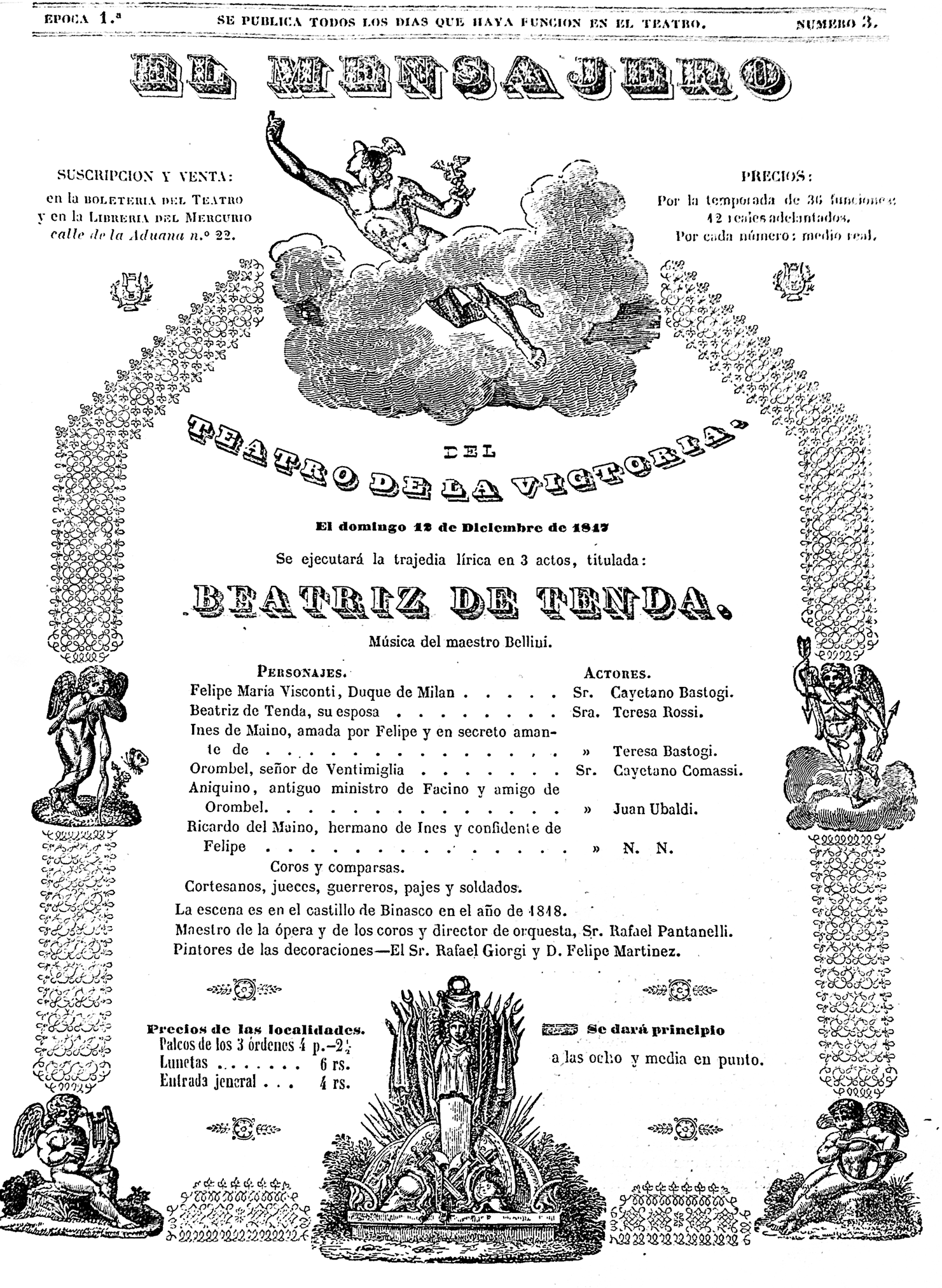
The most interesting project led by El Mercurio was the edition of the magazine El mensajero del Teatro de la Victoria, a lavish publication that looks impressive compared with most newspapers and magazines of the time, with its use of several typographies and well-designed allegorical images related to operas and theatre in general (Figure 2). Consisting of four pages (as for most contemporary newspapers), the magazine ran for more than thirty numbers. Its contents included not only the usual synopsis of an opera and list of performers but also extensive discussion of other topics that helped local audiences understand the repertoire, opera as a genre and operatic practices in general. Thus, one could hypothesise that the magazine was mainly directed to local readers, rather than foreigners, as according to several sources, many Chilean spectators still did not know how to understand or respond to opera.
El mensajero del Teatro de la Victoria, no.3 (12 December 1847), 1. Biblioteca Nacional de Chile. Hemeroteca, 12B; 17–72.

The range of topics covered by the magazine was extensive. Articles addressed the historical context of the operas (such as the religion of druids in Norma, the Borgia family in Donizetti's Lucrezia Borgia, or the Guelphs and Ghibellines in Pia de’ Tolomei);Footnote 103 the compositional techniques and lives of composers (Bellini, Verdi and Donizetti featuring prominently and recurrently); gossip and news from other opera houses around the world (e.g., Meyerbeer's departure from Berlin or a marriage proposal made to Jenny Lind);Footnote 104 premieres of new operas; and technical information about music and drama such as the comparison of a libretto with its sources, or the difference between harmony and melody.Footnote 105 The magazine also served a clear commercial purpose for the owners of El Mercurio: the last page not only almost always included the promotion of new books they printed and imported but also reminded readers that the magazine offered only a short synopsis and that they printed the full libretto for each new opera.
While it is never made entirely explicit, it seems that women were the expected readership of the magazine – if not at the beginning, then at least increasingly so with each passing number.Footnote 106 For example, in issue no. 6 there was a short commentary on the fashions worn by spectators in the boxes of the Victoria, followed by a note that ‘all of these new fabrics can be found in the French store, Planchada Street no. 28’. In issue no. 8, the ‘fashions’ section was expanded to a full page, with broader discussion of summer and dance dresses that were unrelated to opera-going.Footnote 107 Discussions of fashion never entirely left the magazine, even if they remained only in the promotion of new stores and fabrics in the concluding advertising section. Commentaries about the operas tended to adopt a Catholic perspective, as if certain topics would not be entirely comfortable for the audience. Again, this seems related to the Catholic Church's campaigns against opera and women attending the theatre.Footnote 108 For example, when discussing druidic religion in Norma, the writer ends with the comment that ‘as interesting as ancient religious cults might be, Christianity, which intended to destroy them by purifying their moral beliefs, has been the most significant development for humanity’.Footnote 109 Similarly, when discussing the plot of Ernani, there were often suggestions that some disliked it for being an ‘apology for crime’, and therefore counter to the notion of the theatre as a place of enlightenment and education.Footnote 110 The magazine, thus, fulfilled an important role in making opera more palatable to women from conservative families, or to parents who might consider the practice of theatre-going contrary to the moral upbringing of their daughters.
Raffaele Giorgi: stage decorator
While we tend to think about opera houses in this period in terms of singers and audiences, there is still much to be written about the others who were involved, notably the other workers employed at the opera house. In the case of the Teatro Victoria, for example, there was no permanent professional orchestra but rather instrumentalists hired for a season by the impresarios. One set of deals between the musicians and Raffaele Pantanelli in 1854 shows that once contracted, they were not allowed to play in any other orchestras during the season, being required to be available for all rehearsals and performances, and subject to fines by the police if they did not fulfil their obligations.Footnote 111 While the orchestra was deemed good by Clorinda Corradi-Pantanelli, ‘and much better than the one in Lima’,Footnote 112 rehearsals were daily, at least in the very first years.Footnote 113
Perhaps the most crucial of all the workers in the opera house was the stage designer Raffaele Giorgi, who was offered a long-term contract by Alessandri to join the opera house from his previous job in Bologna. His departure was commented on by both the Milanese Il pirata and the Bolognese Teatri, arti e letteratura, showing that he was a relatively well-known figure in Italian operatic circles.Footnote 114 Raffaele Pantanelli wrote of him: ‘The great Bolognese painter, the brave Raffaelle Giorgi, was hired specifically by signor Alessandri, and caused a real furore thanks to the quality of his decorations.’Footnote 115 At the time, European travelling painters – usually portraitists – were hired by local theatres to undertake a standard number of stage designs. That was the case, for example, for Paul Lemétayer in La Paz,Footnote 116 and Antonio Meucci in Lima.Footnote 117 Having a ‘permanent’ artist in this role, however, allowed the level of scenography to reach new heights: the craftsmanship and artistry of Giorgi was quickly recognised by theatres in neighbouring countries. He worked in Valparaiso for almost a decade, before obtaining employment elsewhere in South America, including in Lima,Footnote 118 and Buenos Aires, where he painted the original set designs for the first Teatro Colón.Footnote 119 Later he worked for the Chilean government, making technical drawings in the mining boomtown of Copiapó, on the frontier with Bolivia.Footnote 120
Giorgi's designs became a staple of newspaper comments during his years in Valparaiso, those descriptions sadly being the only surviving sources of his work. However, I would argue that what made Giorgi relevant was not only the perceived quality of his art but also the fact that he was seen as someone who could transport audiences to Europe – before photographs – in ways that sound could not always achieve.Footnote 121 In this way, he was a vital component of Alessandri's wider project. Stage paintings, in this context, served a double role, as Benjamin Walton has explored for Brazil and Calcutta: on the one hand, they work as a mediation of imagined geographies, as part of opera's role in the nineteenth century as a common framework within which to understand the wider world;Footnote 122 on the other hand, stage designs offer a visual ‘portal’, one that constantly confronts notions of authenticity and exoticism and the relationships between centre and periphery.
The staged authenticity of Giorgi's paintings and decorations – their (partially imagined) direct connection with Italy and Europe – was at the heart of their success. The combination of technical ability and Italian upbringing cemented his reputation for authenticity. At one level the effect of a rising moon he created for one of his own benefit performances,Footnote 123 or a windmill with flowing water for La sonnambula, awed audiences.Footnote 124 At another level, because of his Italian upbringing, through his decorations Giorgi created the illusion of a Europe with a certain degree of authenticity, closing the geographical gap that people expected to bridge during their visit to an opera house.Footnote 125 This was the case, in particular, when Giorgi painted Italian landscapes, as, for example, a celebrated version of the square of Syracuse for Tancredi,Footnote 126 or his much admired eruption of Mount Vesuvius for the premiere of La muette de Portici.Footnote 127 This way of reading his work is already apparent during the opening night of the Teatro Victoria, with Bellini's I Capuleti. When the curtain opened on the second act, the audience stopped the music to demand Giorgi's appearance on stage, as one critic noted the following day:
The effect of colour, light and shadow left the audience transported. The moon of the Italian sky, its pale light moving between the columns of the palace in Verona … the architectural beauty of the palace itself was so well presented, that the people in the stalls, as one, stood up to applaud the painter, who came out dressed in the same clothes that he wore when working on such marvels.Footnote 128
The importance of Giorgi's work, then, was not solely technical: it also transported people beyond the action of the play into its imagined geographies. The layers of authenticity carried in his Verona, Syracuse or Vesuvius, smoothed over the gap, the crack that might have been felt in the experience of opera as a European, or particularly Italian, genre. For example, scores were often cut because of the lack of voices to perform all the roles. There were also problems with the standardisation of listening and performing practices: random claps at ‘wrong’ moments were a constant fixture when listening to opera in Valparaiso during the 1840s.Footnote 129 And, more importantly, not all the singers were of the same standard and many secondary and chorus roles were performed by locals. In the words of Tornero, all the ‘laughable mistakes made by the secondary singers of the companies were always compensated for by the magnificent vistas of the famous scenic painter Georgi [sic]’.Footnote 130 Giorgi's artistry was thus key to transforming these performances, with all their shortcomings, into local successes that dissolved the boundaries between ‘foreign’ and ‘home’.
Conclusion
By the end of the 1840s, the Teatro Victoria had become profitable.Footnote 131 When Alessandri, tired of his role as owner and impresario, offered to change the business model to one of shareholders in order to keep the theatre outside the rule of (as he wrote) ‘city councils or public governments’, he provided proof that the cost of the building had been fully covered. By 1850, the Victoria was making a profit of 15,000 pesos a year (roughly 120,000 dollars today).Footnote 132 By the time he retired in 1854, building a theatre and performing operas was no longer viewed as a financially perilous prospect. Many new theatres had opened in the region, and the building of a national opera house in Santiago was underway. That same year, the regulations for theatres and public entertainments were changed in Valparaiso: all venues now had to pay a yearly tax, but the highest payers were ‘theatres, whether built for opera [líricos] or drama [dramáticos]’, an important distinction that shows the Victoria had shaped the new idea of an ‘opera house’.Footnote 133
Indeed, there was room for more than one theatre by then. Alejandro Teisseire, a French singer who had joined Carlos Zuderell in building an opera house in Lima (the imposing Teatro Variedades), was presenting plans to the city council in Valparaiso for a new theatre, following his success in Peru, and clearly believing there was room for more than one private venue.Footnote 134 Teisseire's proposal, while perhaps not significant in itself, nevertheless highlights something important: in less than a decade, Alessandri had created an Andean opera scene with strong connections to the North Pacific, the Caribbean and the Atlantic. The Teatro Victoria had become, like Valparaiso, part of a global network, and opera seasons were now a regular feature in the southern Andes.
Perhaps the best signs of this are the comments made that same year in several Italian publications, following the success in Valparaiso of Il fornaretto, an opera by Gualtiero Sanelli that had achieved little recognition at its premiere in Parma three years before but which had become popular in Chile. A worn-out vocal score of the opera is preserved in the private collection of music of Isidora Zegers, founder of the 1850 National Conservatoire in Santiago and the most prominent salonnière in the country.Footnote 135 Florence's Il bueno gusto commented on the ‘furore a Valparaiso’,Footnote 136 L'Italia musicale noted the specific numbers that the Chilean audience had preferred (such as the overture, La romanza di Clemenza and the Requiem of the first act),Footnote 137 while the Gazzetta musicale di Milano reprinted comments about the ‘novelty and instrumentation of the piece’ by one critic in El Mercurio de Valparaíso. Footnote 138
The success of Sanelli's Il fornaretto in Valparaiso, at the very end of Alessandri's decade as owner, manager and part-time impresario, confronts us with the same questions presented at the beginning of this article. What did it mean for an Italian composer and his work to be successful in Valparaiso? In other words, if we believe Valparaiso was part of the global networks of Italian opera by the 1850s, what was its place and status inside those networks? I do not yet have an answer, just two final interrelated points. First, the reception and appropriation of Italian opera in this period was a complex problem, without homogeneous solutions across the Americas. This is particularly apparent for the Pacific coast, much less known and explored by scholars than the Atlantic coast. As Brian Hamnett has discussed, we need to go beyond the use of ‘transatlantic’ to characterise all Europe-American relationships in this period, the term implies a ‘narrower Atlantic framework’ that cannot cover the totality of the Ibero-American experience; in particular, the complex ‘Andean dimension’ of it alongside the ‘Pacific-coastal trade’.Footnote 139
Second, the history of operatic production and reception is not only one of passive reception, a cultural product from afar imposed on the host community. As I outlined at the beginning, and have explored in this article, there are important considerations about the local importance of appropriation and agency, and the convoluted and sophisticated feedback loops that made opera possible at the time. As in many other cultural fields, opera was used by Latin Americans in ways that, while not necessarily subversive, had a transformative impact on their own customs and convictions. While the models, repertoires and even practitioners might have been Italian, the new context implied a certain level of diversification of operatic practices. Assimilation, consumption and the aims of those agents differed from what might have been expected in, for example, Italian cities at this time. Those differences are sometimes subtle, but their ripples affect operatic practices over time. Opera's emergence in Chile was not only about performing Italian opera abroad but also about making it locally attractive, meaningful and profitable.