Culture pervades our human minds. Much of what populates each of our minds and our behavioral repertoires is assimilated from the particular cultural world we have experienced through our lifetimes, from our languages to our social customs, rituals, technology and all aspects of material culture. Human culture is cumulative, with successive generations building on what went before, and the lofty achievements of this process have allowed our species to spread and reproduce so that billions of us are spread across all major land masses except the poles, whereas each of the other species of primate is restricted to a much more circumscribed ecological niche: for our closest relatives, chimpanzees, for example, this is limited to tropical African forests and woodlands (Henrich, Reference Henrich2015; Pagel, Reference Pagel2012; Whiten, Hinde, Laland, & Stringer, Reference Whiten, Hinde, Laland and Stringer2011).
Human culture is so distinctive that it may appear to set us completely apart from all other species. And so to a large extent it does; no other species comes close to what has evolved in the cultures of Homo sapiens. However, research of the past several decades has shown that many fundamental features of culture and the cognitive capacities that underlie it are nevertheless operating in the lives of other primates and other animal species too (Hoppitt & Laland, Reference Hoppitt and Laland2013; Whiten, Reference Whiten, Mitani, Call, Kappeler, Palombit and Silk2012; Whiten et al., Reference Whiten, Hinde, Laland and Stringer2011). Many other species, including invertebrates like insects, display the key underlying capacity for learning from others, that we call social learning (Galef & Whiten, in press; Leadbeater & Chittka, Reference Leadbeater and Chittka2007). Some of this social learning gives rise to traditions, in which what is learned socially spreads across groups, sometimes between groups, and may pass from generation to generation. Such traditions are the foundation of any concept of culture.
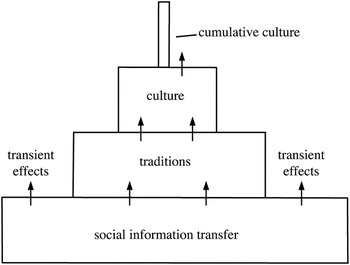
Whiten and van Schaik (Reference Whiten and van Schaik2007) portrayed the basic evolutionary progression as in Figure 1. At the base of this pyramid is social information transfer – the transmission of information, and thence behavior, from individual to individual. This occurs in many species including insects (Leadbeater & Chittka, Reference Leadbeater and Chittka2007), but often has only transient effects – a bee may learn by observing others which flowers are best to visit, but this will last for only a short time. However some socially-learned behavior patterns may be more sustained, even being passed across several (or very many) generations, and then we have the second, smaller layer of the pyramid that represents traditions. Many authors treat ‘culture’ as a synonym for such traditions. Other authors separate these concepts, by various different criteria; Galef (Reference Galef1992) for example, proposed that only transmission serviced by high fidelity mechanisms of imitation or teaching, hallmarks of human culture, should merit the ‘culture’ term and otherwise we should talk only of animal traditions. Whiten and van Schaik (Reference Whiten and van Schaik2007) instead discriminated cultures as constituted, again as in the human case, by multiple traditions of diverse kinds, which as we shall see below, is well illustrated in the great apes. Finally there is cumulative culture, which all authors acknowledge is distinctive in humans; some declare it unique to humans (e.g., Tennie, Call, & Tomasello, Reference Tennie, Call and Tomasello2009), and others appeal to evidence that it occurs in limited forms in some other species (e.g., Whiten, Reference Whiten2011), as discussed further below.
Culture pyramid. The base of the pyramid is broad because it represents social information transfer, shown to be increasingly widespread in the animal kingdom. Some resulting behaviour copying is transient, but other items may be transmitted repeatedly between individuals to become traditions. A third level distinguishes the yet smaller set of cultural phenomena defined by multiple traditions The fourth level denotes cumulative cultural evolution, the speciality of human culture (after Whiten & van Schaik, Reference Whiten and van Schaik2007; see Haidle et al., Reference Haidle, Bolus, Collard, Conard, Garofolli and Whiten2015, for an extension of this series to create an eight-step model to accommodate later stages of human cultural evolution).

The phenomena outlined in Figure 1 provide animals with a ‘second inheritance system’ (Whiten, Reference Whiten2005), built on the shoulders of the genetic inheritance system, that permits what some individuals discover to be inherited by others through social learning, to their benefit. This can make adaptive change possible over much shorter timespans than in the genetic case. An interdisplinary collaboration of authors including psychologists, biologists and archaeologists (Haidle et al., Reference Haidle, Bolus, Collard, Conard, Garofolli and Whiten2015) have adopted the basic architecture of the model in Figure 1 and added an additional four layers to discriminate further progressions in the nature of culture traced through the course of human evolution and history, based on the archaeological record. The result is an eight-stage model of the evolution of culture and cultural cognition culminating in contemporary human cultures.
The Expanding Scientific Toolkit for Studying Social Learning and Culture
What we have discovered of the riches of social learning, traditions and culture in both non-human and human animals over the last several decades has been derived from an impressive array of differing but complementary methodologies.
Observational studies
Perhaps the most important, in my view, is essentially a foundational natural history phase in which the species of interest is studied in the wild to establish the apparent scope of social learning and traditions as these occur in everyday life, and in the environments to which the features displayed are likely to represent adaptations. Such observational studies may offer evidence of social learning in various ways. One is by focusing on the ontogenetic development of behavior patterns. For example, Lonsdorf, Eberly, and Pusey (Reference Lonsdorf, Eberly and Pusey2004) showed that not only do young chimpanzees peer closely at their mother’s skilled tool use in extracting termites from small tunnels in their mounds, but the extent of such observation predicts later skill. Juvenile females spend more time closely observing their mother’s fishing than do young males, who are engaged in other behaviors like play-fighting, and the young females master the tricky skills of termite-fishing on average a whole year before their male peers do, strongly suggesting that the skill is dependent on social learning.
A different insight is provided by the identification of different behavioral profiles in different communities, that are apparently not explicable by either genetics or environmental factors. This approach, first applied to chimpanzees by a collaborative consortium of chimpanzee researchers completing long-term studies at different sites across Africa, concluded that this species may have at least 39 different traditions across the continent (Whiten et al., Reference Whiten, Goodall, McGrew, Nishida, Reynolds, Sugiyama and Boesch1999; Reference Whiten, Goodall, McGrew, Nishida, Reynolds, Sugiyama and Boesch2001). Of course it may be challenging to rule out those alternative genetic and environmental explanations when the sites are widely separated, although it can be done; for example, surveys showed that the raw materials for cracking nuts (appropriate nuts plus hammer and anvil materials) were plentiful in areas where chimpanzees did not crack nuts, so that availability could not explain why the behavior occurs only in far West Africa and not elsewhere across the continent (Boesch, Marchesi, Marchesi, Frith, & Joulian, Reference Boesch, Marchesi, Marchesi, Fruth and Jonlian1994; McGrew, Ham, White, Tutin, & Fernandez, Reference McGrew, Ham, White, Tutin and Fernandez1997).
Luncz and Boesch (2012) have instead compared neighboring chimpanzee communities in the Taï Forest in Ivory Coast, and found a number of differences in their preferences for types of tools, notably with respect to use of stone versus wooden hammers according to the season. As the authors note, this cannot be explained by genetics because of mixing between the communities, and the habitats are similar too, thus isolating the variations as cultural. Parallel cultural differences have been discovered between neighboring communities in a chimpanzee rescue sanctuary, that include variations in hammering hard-shelled fruits to break them (Rawlings, Davila-Ross, & Boysen, Reference Rawlings, Davila-Ross and Boysen2014), use of a specific form of mutual grooming (the ‘hand-clasp’, van Leeuwen, Cronin, Haun, Mundry, & Bodamer, Reference van Leeuwen, Cronin, Haun, Mundry and Bodamer2012) and even putting a grass leaf in one ear and lodging it there, serving no apparent immediate purpose (van Leeuwen, Cronin, & Haun, Reference van Leeuwen, Cronin and Haun2014). Genetic or environmental differences cannot explain these variants. In yet another approach to tracing cultural transmission, the actual diffusion of an incipient new tradition, in which moss is used as a sponge to extract water from a small hole, has been carefully documented in the wild (Hobaiter, Poiso, Zuberbühler, Hoppit, & Gruber, 2014).
Experimental approaches
The experimental study of primate social learning began over a century ago, virtually all of it until recent times conducted with captive animals (reviewed by Tomasello & Call, Reference Tomasello and Call1997; Whiten & Ham, Reference Whiten and Ham1992). For long the paradigmatic approach was dyadic; that is to say, it typically involved exposing a single individual to a single model (a conspecific primate or a human) engaged in an act such as opening a puzzle-box or using a tool to gain a reward, and comparing the results with a control condition in which no model is available, so the subject must rely on individual learning. Over the years a substantial number of ingenious variations on this design have been used, particularly to discriminate between different forms of social learning that may be operating, such as imitation, the copying of actions, versus mere ‘stimulus enhancement’ in which the subject may match the focus of attention of the model but not copy what the they actually do. We shall review a selection of influential discoveries generated by variations on this approach, below.
In the present century these dyadic tests have been supplemented by a different approach more appropriate if our interest is in the larger phenomenon of culture. These are variously referred to as diffusion or transmission experiments and they in turn come in a variety of forms, each of which tells us something usefully different to the others. One is referred to as a diffusion or transmission chain design. In this, an individual is exposed to a model, but then after it has mastered the task at stake (however it performs it), it in turn becomes the model for a further naïve individual, and so on along a chain of individuals. Hopper et al. (2010), for example, found a novel form of tool use being transmitted faithfully along a chain of as many as twenty pre-school children – or twenty ‘cultural generations’. A quite different approach is open diffusion, in which a single model trained in a technique to gain a reward, is seeded in a group; then, unlike the diffusion chain, it is an open question who watches and who (if any) learns from the model, or from others who start to learn the technique. The way in which new information spreads through the group can then be studied. Other variations on these diffusion experiments have been developed and are reviewed by Mesoudi and Whiten (Reference Mesoudi and Whiten2008; human studies), Whiten and Mesoudi (Reference Whiten and Mesoudi2008; animal studies) and Whiten, Caldwell, and Mesoudi (Reference Whiten, Caldwell and Mesoudi2016), now including over 150 studies covering both human and non-human species. We examine key chimpanzee examples in more detail further below.
The comparative method applied to culture
All birds have feathers, are bipedal and have some sorts of wings, characteristics that are therefore attributed to their ancient common ancestors. The same principle can be applied to behavior and psychology and is known as the comparative method. This gives us a valuable route to reconstructing the evolutionary foundations of social learning and culture in primates, because fortunately, hundreds of species are still living. Accordingly by appropriate comparisons we can infer the ancestry of whatever features are shared between ourselves and our closest relatives the chimpanzees and bonobos, whose common ancestors lived about 6–7 million years ago (Hara, Imanishi, & Satta, Reference Hara, Imanishi and Satta2012). In turn we could focus on shared features among the great apes, or other taxonomic levels such as all primates, hence making inferences about their common ancestors at respectively around 14 and 65 million years ago, in the manner of Dawkins (Reference Dawkins2005). If we wish to reconstruct the more recent phases of hominin cultural evolution, we can turn to other quite different sources of evidence, including the archaeological record, encompassing the stone age from 3.3 million years ago (Harmand et al., Reference Harmand, Lewis, Feibel, Lepre, Prat, Lanoble and Roche2015; Stout, Reference Stout2011), and the cultural practices of peoples who have until recently (or even now) subsisted through a hunting-and-gathering (‘foraging’) way of life, that characterized our ancestors for hundreds of millennia before the advent of agriculture around 10,000 years ago (Whiten & Erdal, Reference Whiten and Erdal2012).
A three-part comparative analysis of primate culture
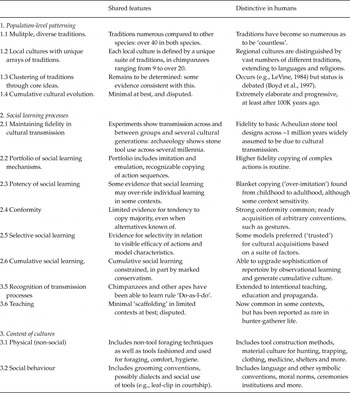
Over recent years I have developed an approach to the comparative analysis of human and animal cultural phenomena that begins with three major divisions, considered next in turn. Gratifyingly this has recent been adopted as an organizing scheme in cultural anthropology (Jordan, Reference Jordan2015) – a discipline that often resists an evolutionary perspective! This scheme was sketched in Whiten (Reference Whiten2005), elaborated in Whiten (Reference Whiten2011) and has been updated and embellished with some additional perspectives in Whiten (Reference Whiten2017). Accordingly here I offer only an abridged overview of the scheme (see table 1 for a corresponding chart) and some of the key relevant data, referring the reader to the above publications for fuller treatments. Because the chimpanzee is the living relative with whom we share our most recent non-human ancestor, but also, more significantly, because we have learned so much about social learning and culture in this species than in any other non-human, the primary analysis here remains focused on the chimpanzee/human comparison, supplemented with references to other primates as occasional appropriate asides. We still know all too little about comparable phenomena in chimpanzees’ sister taxon, the bonobo, who lives in a much more restricted range in Africa and remains much less studied.
Features of culture shared by chimpanzees, humans and (by inference) the common chimpanzee/human ancestor, and features of culture distinctive in humans. Features (rows) are nested under three main headings (see text for extended discussion). Based on Whiten (Reference Whiten2011 and Reference Whiten2017). Each row represents one way in which ‘culture’ extends beyond the mere existence of a tradition: see text for a fuller description. Each item is inspired by the scope of human culture together with the existence of relevant evidence for chimpanzees, permitting inferences about the origins of such characteristics in our common ancestor of approximately 6–7 million years ago

The existence of multiple, diverse traditions
Just a half century ago we knew almost nothing about the behavior of our closest relative in the wild, but in recent decades that has changed enormously, with a growing number of field sites across the central band of Africa accumulating long-term behavioral databases. As these built up it began to be recognized that like people, chimpanzees in different parts of Africa behaved in different ways, and these bore indicators of a cultural basis, such as youngsters intensively and extensively observing these behaviors, like skilled tool use, before slowly mastering them; accordingly researchers began to build up lists of suspected local traditions (Boesch & Tomasello, Reference Boesch and Tomasello1998; Goodall, Reference Goodall1986; McGrew, Reference McGrew1992). However these pioneering explorations were naturally plagued by various inconsistencies, superseded once all the leaders of the long-term studies developed an explicit collaboration and delivered a shared, systematic analysis (Whiten et al., Reference Whiten, Goodall, McGrew, Nishida, Reynolds, Sugiyama and Boesch1999; Reference Whiten, Goodall, McGrew, Nishida, Reynolds, Sugiyama and Boesch2001). This identified as many as 39 different traditions or ‘cultural variants’ defined as behavior patterns that were common in at least one community yet absent in another, with no apparent explanation due to either genetics or environmental constraints. This number of traditions was unprecedented, because most existing studies of animal traditions, such as birdsong dialects, had reported on just one.
A subsequent study following this approach but focused on long-term studies of our more distant ape relative, the orangutan, again revealed a substantial number of putative cultural variants (Krüzen, Willems, & van Schaik, Reference Kruzen, Willems and van Schaik2011; van Schaik et al., Reference van Schaik, Ancrenaz, Borgen, Galdikas, Knott, Singleton and Merrill2003), and as in the chimpanzee case, these were marked by a great diversity of kinds of behavior patterns spanning the repertoire of the species. This cultural richness appears not to be approached by other primate species, so there is a case for inferring it is owed to the ancestor of all the great apes (the Asian orangutan, and the chimpanzees, bonobos and gorillas of Africa) living in the region of 14 million years ago (Hara et al., Reference Hara, Imanishi and Satta2012) and a case has been made that this has generated a high degree of ‘cultural intelligence’ amongst the apes (van Schaik & Burkart, Reference van Schaik and Burkart2011; Whiten & van Schaik, Reference Whiten and van Schaik2007). However, evidence of multiple, if less numerous, cultural variants has been published for other species of primate, including the spider monkey (Santorelli et al., Reference Santorelli, Schaffner, Campbell, Notman, Pavelka, Weghorst and Aureli2011) and capuchin monkey (for reviews, see Whiten & van Schaik, Reference Whiten and van Schaik2007), New World monkeys both often highlighted as paralleling in some ways the niche of the chimpanzee in Africa. For discussion of other primate cases see Whiten (Reference Whiten, Mitani, Call, Kappeler, Palombit and Silk2012).
Local cultures with unique arrays of traditions
Taken together, the array of traditions of a community of chimpanzees is often unique to them, and again as in the human case, could thus be taken to constitute a recognizable local culture. This means that if for any one individual we know enough of the cultural variants she displays, we can tell where the individual comes from, much as we can for a person on the basis of the characteristics of the cultural community they hail from.
Accordingly, we have identified two cultural phenomena shared between humans and chimpanzees and thus attributed to their last common ancestor: the existence in the species of multiple, diverse cultural variants (traditions); and unique local cultures identified by distinctive arrays of the traditions (table 1). Of course, as is noted in table 1, what we see in chimpanzees pales in comparison to the richness of both these phenomena in the contemporary human case. But the broader implication holds and is the important one: the richness of human cultures did not spring out of nowhere, but instead represents the evolutionary flowering of characteristics shared with other primates and with our shared ancestors.
Complementary forms of evidence: observations and experiments
I here insert an aside on the crucial contributions and value of the complementary kinds of evidence this field has been able to call on, alluded to in my introductory comments. The conclusions of the above two sections are based in the first instance on observational data only, and this is inherently limited in its power to identify the critical cause-and-effect element of social learning. The approach of the broad regional comparisons has been essentially one of exclusion of alternative genetic and environmental explanations these differences, but this can be difficult to be sure of – for example, perhaps there is some ecological variable that plays a part that has not yet been recognized and measured. Application of sophisticated statistical analyses to evidence for the diffusion of innovation has been offered as a more compelling alternative (Hoppitt & Laland, Reference Hoppitt and Laland2013), but the opportunities to apply this are limited when the main differences are quite stable (they may have endured for millennia) and in any case this approach is itself inherently correlational, with the attendant weakness in identifying causal relationships.
By contrast, an experiment does this robustly. In the most fundamental experimental design to identify social learning, one simply compares the results of a condition in which subjects can witness a model’s behavior with an asocial one in which they cannot; if the former group acquire the innovation modeled and the other group do not – or even if the former group simply acquire it more often or more quickly – then a causal role for social learning cannot be in dispute. Even more telling are experiments applying a ‘two-action’ design in which in addition to a non-observing control group, each of two other experimental groups see some task being completed in each of two different ways; the experimenter can then record whether these differences are reflected in matching to the alternative models in later performances of the subjects. Such approaches have been used in large numbers of experiments in captivity where the two different scenarios and subjects’ access to them can be engineered with relative ease, many early ones reviewed in Tomasello and Call (Reference Tomasello and Call1997) and for later ape studies by Whiten, Horner, Litchfield, and Marshall-Pescini (Reference Whiten, Horner, Litchfield and Marshall-Pescini2004). However such experiments are inherently difficult in the wild, where one typically cannot control who watches whom. To be sure, such experiments have now started to be conducted in the wild, for example by offering ‘artificial fruits’ that can be opened in either of two ways, but with one method locked, to whole groups until one bold individual develops a successful technique for access. This is followed by testing for matching by other group members once the device is unlocked and both methods are possible (van de Waal, Renevey, Favre, & Bshary, Reference van de Waal, Renevey, Favre and Bshary2010). However, this has so far been managed for only a handful of lemurs and monkeys (reviewed in van de Waal, Claidière, & Whiten, Reference van de Waal, Claidière and Whiten2015) and to my knowledge not yet with apes in the wild.
In these circumstances it has been important to make experiments with captive primates more closely deal with the core issues arising from the discoveries in the wild. In my view, it has been crucial to first assemble the best picture we can in the wild, as in the case of the putative cultures of chimpanzees – whatever the caution we must recognize in ascribing regional differences to social learning. Providing our best inferences about the scope of culture in the wild is the only sensible starting point for research on this topic. It has then be important to design experiments that meet two important criteria; (i) not being limited to dyadic learning episodes but instead tracing the potential establishment and maintenance of traditions – i.e., the types of ‘diffusion’ experiments outlined above; and (ii) creating the circumstances for learning from conspecifics, rather than human models.
This is the approach we first took in training one chimpanzee to solve a naturalistic foraging task by applying a stick-tool in one way (‘Lift’) and then reuniting her with her group as an expert in this, in another group doing the same but teaching the model a quite different technique (‘Poke’), (Whiten, Horner, & de Waal, Reference Whiten, Horner and de Waal2005). This study showed that the two different methods spread in their respective groups to be become incipient traditions. A variety of other similar experiments were completed at the same site and a second one, which together showed that chimpanzees can indeed sustain the multiple tradition cultures inferred for the wild on the basis of the fieldwork observations summarized above (Whiten, Spiteri, Horner, Bonnie, & Lambeth, Reference Whiten, Spiteri, Horner, Bonnie, Lambeth, Schapiro and de Waal2007).
However, although this shows this fundamental ability is in place in the species and thus plausible in the wild, it does not show that each putative tradition inferred in the wild is indeed socially learned. Other experiments do come closer to closure on such concerns and perhaps the best example is of nut-cracking. This occurs only in a large swathe of far-West Africa, and not elsewhere. As noted earlier, evidence that this is not environmentally caused comes from studies that have checked that in areas of absence of the skill, all the necessary raw materials are present and can do the job (Boesch et al., Reference Boesch, Marchesi, Marchesi, Fruth and Jonlian1994; McGrew et al., Reference McGrew, Ham, White, Tutin and Fernandez1997). However this does not deal with the potential genetic explanation. The West African chimpanzees are indeed very different genetically, and indeed Langergraber et al. (Reference Langergraber, Boesch, Inoue, Inoue-Murayama, Mitani, Nishida and Vigilant2011) have shown there is a correlation between genetic variation and regional differences in behavior, leading these authors to suggest that genetic explanations for the variations cannot be excluded. However again, experiments clinch the matter, rejecting this hypothesis. Marshall-Pescini and Whiten (Reference Marshall-Pescini and Whiten2008a) studied juvenile East African chimpanzees in a sanctuary on an island in Lake Victoria in Uganda, introducing them to a six-year-old conspecific model who cracked nuts. By contrast with control conditions, the youngsters exposed to the model acquired the cracking skill. This clearly shows that we not dealing with a cracking ‘instinct’ in West African chimpanzees only, but instead with a skill that has never been seen in their East African cousins in the wild, but can be socially learned once they see an appropriate model (see Fuhrmann, Ravignani, Marshall-Pescini, & Whiten, Reference Fuhrmann, Ravignani, Marshall-Pescini and Whiten2014; for further analysis of mimetic processes in the acquisition process and Whiten (Reference Whiten2015) for an extended review of such experiments by our own and other research groups).
Core cultural ideas
Some cultural anthropologists such as Levine (Reference Levine, Schweder and Levine1984) have emphasized that human culture should not be thought of as a collection of separate unitary items; instead, certain core cultural ideas have diffuse influences on a range of practices. One well-aired example is an ethos celebrating independence of mind and analytic thought in the West, versus collectivist ideals and more holistic ways of thinking in the East. These biases pervade many particularities of cultural life in the West and the East respectively.
It is naturally difficult to test for analogous effects in the cultures of non-verbal creatures, but some recent field experiments may suggest one way this can be approached. In these studies, holes too small for chimpanzee fingers were drilled in logs and filled with honey, in two chimpanzee communities in Uganda. Chimpanzees in one of these communities habitually use sticks in extractive foraging, whereas stick tool use does not occur in the other. Here, other tools are used, that include masticated leaf-sponges to gain water from natural holes (Hobaiter et al., Reference Hobaiter, Poiso, Zuberbühler, Hoppit and Gruber2015; Whiten et al., Reference Whiten, Goodall, McGrew, Nishida, Reynolds, Sugiyama and Boesch1999). The two communities responded very differently to the artificial honey-filled holes (Gruber, Muller, Strimling, Wrangham, & Zuberbuhler, Reference Gruber, Muller, Strimling, Wrangham and Zuberbuhler2009). Those in the first community efficiently dipped sticks in the holes and licked off the honey, whereas the others made and applied their habitual leaf sponges, which were naturally much less effective. When leafy sticks were provided, the stick-culture chimpanzees stripped the leaves off to make a stick-tool, whereas the others chimpanzees did the opposite, stripping off the leaves and making these into sponges (Gruber, Muller, Reynolds, Wrangham, & Zuberbuhler, Reference Gruber, Muller, Reynolds, Wrangham and Zuberbuhler2011). The authors concluded that “wild chimpanzees rely on their cultural knowledge to solve an experimental honey acquisition task” (Gruber et al., Reference Gruber, Muller, Strimling, Wrangham and Zuberbuhler2009). This would seem close to the principle that core cultural cognitions may pervade and shape multiple contexts (Whiten, Reference Whiten2011).
Cumulative culture
Many authors see cumulative culture as a qualitative dividing line between humans and other animals (e.g., Henrich Reference Henrich2015; Tennie et al., Reference Tennie, Call and Tomasello2009). In my view this stark dichotomy is not correct. Other animals show some limited evidence of cumulative culture. The magnitude of the difference between ourselves and other animals in this respect is of course massive, but nevertheless in chimpanzees there are some significant signs of accumulation, and I hypothesize that it would have been from phenomena like these that our distinctive human capacities evolved.
Boesch (Reference Boesch2012) describes several candidate cases in chimpanzees. To me, a compelling example is chimpanzees in central Congo who extract termites from nests several feet beneath the ground (Sanz, Call, & Morgan, Reference Sanz, Call and Morgan2009). They first push a thick stick right down into the earth, creating a subterranean tunnel. They then prepare fresh, slim stems they carried to the site by stripping one end through their teeth to make a comb end, which is ideal for getting termites to bite on it. This is skillfully inserted down the long tunnel and withdrawn with termites on the brush end. It seems quite miraculous that the chimpanzees know what to do here, to gain these invisible and deeply embedded prey. Perhaps in the distant past these operations began close to the surface and then steadily went deeper, thus evolving across generations into the more elaborate form we see today. If so this would be an elementary case of cumulative culture.
This is indeed minimal compared to the pace and scope of accumulation that characterized recent phases of human history. However the beginnings of human cumulative culture were enormously slower. The evidence for the beginnings of the stone age date back to at least 2.6 million years (Semaw et al., Reference Semaw, Rogers, Quade, Renne, Butler, Dominguez-Rodrigo and Simpson2003), with new evidence suggesting an even older origin of 3.3 million years (Harmand et al., Reference Harmand, Lewis, Feibel, Lepre, Prat, Lanoble and Roche2015). The first cumulative step from these early flaking efforts to more advanced, symmetrically-shaped Acheulian hand axes did not emerge until approximately 1.8 million years ago. There was then little major progressive change for a million years or so before significant further cumulative steps were evident (Stout, Reference Stout2011). Thus although chimpanzee cumulative culture is minimal, it is relevantly comparable to much of the 6–7 million years or so of our unique hominin evolutionary pathway. We shall examine proposed explanations for the contrast between chimpanzee culture and modern human cumulative culture further below.
Social learning processes
Over the years comparative psychologists have distinguished numerous different forms of social learning, offering some variant definitions and taxonomies (Hoppit & Laland, 2003; Whiten & Ham, Reference Whiten and Ham1992; Whiten et al., Reference Whiten, Horner, Litchfield and Marshall-Pescini2004). Scholars new to the field must grapple with these to gain any deep understanding of the important distinctions at stake.
Primates, and chimpanzees in particular, have been prime foci for these studies, in many cases combined with corresponding child studies undertaken in an effort to understand if differences in social learning may explain the relatively enormous scale of the manifestations of culture in humans. Galef and Whiten (in press), charged with writing a review of the comparative psychology of social learning in animals, found only a handful of published studies that directly compare two or more related species, but there was one notable exception: as many as 24 studies compare children and chimpanzees. Galef and Whiten tabulate these and offer potted summaries of all of them. Here, we draw more selectively on this corpus of studies to indicate principal commonalities and differences between the species in several different aspects of social learning.
Fidelity in cultural diffusion within and across communities
An influential dichotomy due to Michael Tomasello (Reference Tomasello, Parker and Gibson1990) was initially drawn between two social learning processes. One was imitation, the copying of others’ actions, a process studied in comparative and developmental psychology for much of the prior century (Whiten & Ham, Reference Whiten and Ham1992). Tomasello distinguished the other process, emulation, following a study in which chimpanzees failed to imitatively copy a tool-use sequence displayed by a skilled individual, but showed by their efforts that they had learned something about the function of the stick-tool in gaining out-of-reach objectives (Tomasello, Davis-Dasilva, Camak, & Bard, Reference Tomasello, Davis-Dasilva, Camak and Bard1987). Tomasello described emulation as recreating desirable results of another’s actions rather than copying their form, which is the hallmark of imitation. Emulation could thus be considered to lie somewhere between such imitation and the simple forms of social learning called stimulus enhancement and local enhancement, in which all that is socially acquired is the focus of attention respectively on particular objects or locations displayed by others.
Tomasello, Kruger, and Ratner (Reference Tomasello, Kruger and Ratner1993) went on to suggest that the high fidelity, imitative action copying of which children are capable is what permits cumulative culture, because this is what is needed to maintain traditions between progressive steps up the cultural ‘ratchet’. By contrast, it was proposed that chimpanzees are constrained to emulation, where they have to generate an action sequence of their own to achieve the desirable results they learned about from others. A large corpus of studies has accumulated that is consistent with this hypothesis (e.g., Call, Carpenter, & Tomasello, Reference Call, Carpenter and Tomasello2005; Nagell, Olguin, & Tomasello, Reference Nagell, Olguin and Tomasello1993; for recent reviews and appraisals, see Tennie et al., Reference Tennie, Call and Tomasello2009; Whiten, McGuigan, Marshall-Pescini, & Hopper, Reference Whiten, McGuigan, Marshall-Pescini and Hopper2009). Herrmann, Call, Hernández-Loreda, Hare, and Tomaello (Reference Herrman, Call, Hernández-Loreda, Hare and Tomasello2007), for example, presented children and chimpanzees with modeled behaviors and reported that only the children showed significant evidence of imitating the model, although both children and chimpanzees performed similarly on physically-based tests.
However in these tests the apes were presented with a model of a different species (human), whereas children could copy a model of their own species. Several studies that employed ape models in studies of apes’ social learning have drawn different conclusions as regards fidelity of transmission. These include the cultural diffusion studies mentioned above (Mesoudi & Whiten, Reference Mesoudi and Whiten2008; Whiten & Mesoudi, Reference Whiten and Mesoudi2008; Whiten et al., Reference Whiten, Caldwell and Mesoudi2016). These studies are more appropriate experimental designs for assessing the spread of culture than those that ask only ‘what does B learn from model A?’, because whole groups are involved. In the first of these controlled experiments of this kind with chimpanzees, outlined earlier in this review, Whiten et al. (Reference Whiten, Horner and de Waal2005) showed that the alternative techniques spread differentially in their respective groups, becoming incipient alternative traditions. Some chimpanzees discovered the alternative technique, but by two months later these individuals tended to re-converge on the majority technique of their group. Such results do not necessarily distinguish imitation from emulation (see next section); their importance lies instead in reliably demonstrating whether the primates under study are able to transmit and sustain with some fidelity the kinds of alternative tradition inferred from observations in the wild, as in the case of chimpanzees outlined above.
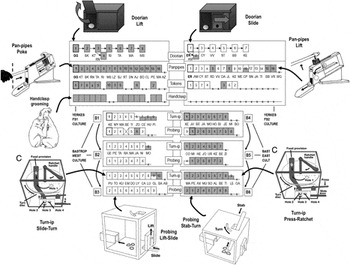
Because it is an open question who will watch the models in such experiments and who will (or will not) copy what they do, this design has been called ‘open diffusion’. By contrast in a ‘diffusion chain’, only one observer sees the model, then after mastering the task (whichever way they do it) they become the model for the next individual in a growing chain. Horner, Whiten, Flynn, and de Waal (Reference Horner, Whiten, Flynn and de Waal2006) reported fidelity along such chains amounting to 10 children, and to 6 chimpanzees (a number of ‘cultural generations’ limited by the need to match up compatible successive pairs in a colony of finite size). Additional diffusion experiments at two different sites showed that chimpanzees can show adequate fidelity of copying to sustain multiple-tradition cultures (Whiten et al., Reference Whiten, Spiteri, Horner, Bonnie, Lambeth, Schapiro and de Waal2007; figure 2).
Spread of experimentally seeded, multiple traditions generating four different chimpanzee ‘cultures’. At each pair of locations, alternative techniques were experimentally seeded in a single individual and all spread locally to others. Each block with a letter code represents a single chimpanzee, with shading corresponding to the alternative seeded techniques. At Yerkes, Row 1 = lift versus slide methods to open a ‘doorian fruit’, run as a diffusion chain (Horner et al., Reference Horner, Whiten, Flynn and de Waal2006); Row 2 = poke versus lift panpipes techniques spread in an open (unconstrained) diffusion (Whiten et al., Reference Whiten, Horner and de Waal2005); Row 3 = bucket versus pipe posting option for tokens in an open diffusion (Bonnie et al., Reference Bonnie, Horner, Whiten and de Waal2007); Row 4 = hand-clasp grooming, which emerged spontaneously and spread in only one Yerkes community. At Bastrop, Row 1 = turn-ip-slide versus turn-ip-ratchet techniques, Row 2 = fish-probe versus fish-slide techniques, to extract food from two different devices; each technique spread to a second group (middle, groups B2, B5) and then a third (bottom, B3, B6) (Whiten et al., Reference Whiten, Spiteri, Horner, Bonnie, Lambeth, Schapiro and de Waal2007). Numbers show order of acquisition. Based on Whiten et al. (Reference Whiten, Spiteri, Horner, Bonnie, Lambeth, Schapiro and de Waal2007) and references above.

Sequence of model actions in overimitation studies. Photos illustrate an adult model performing causally irrelevant actions of shifting a bolt to access the top hole and then insert a stick tool; and a child model performing subsequent causally necessary actions to reveal the lower hole and use a stick tool to retrieve a reward. In the studies discussed in the text, all four steps were undertaken by an adult in sequence, or similarly by a child model. Based on McGuigan et al. (Reference McGuigan, Makinson and Whiten2011), with permission.

We have repeated the ‘panpipes’ open diffusion experiment outlined above with young children in nursery groups (Flynn & Whiten, Reference Flynn and Whiten2012; Whiten & Flynn, Reference Whiten and Flynn2010), revealing both similarities to, and differences from, the chimpanzee findings. Initially, as for the chimpanzees, the study generated two different incipient traditions. These emerged on Day-1 of the study, as tool-use skills spread across the groups. However children were quicker than chimpanzees to discover the alternative technique and they also invented a third, intermediate method, involving aspects of both techniques we had seeded. These innovations then spread by social learning, with a majority of children being identified as ‘social learners’ and a minority as the ‘innovators’. This child/chimpanzee comparison thus offered results opposite to what several dyadic studies have reported, for here, the children showed less sustained traditions. However there are good reasons to think that this is not because children are inherently less able to faithfully copy; rather, it is likely they were more able to independently master the task and thus were more ready to innovate. Accordingly in making such comparisons, it is important to recognize that the level of challenge in the task for each species can be a critical factor in the resulting picture of fidelity of transmission they each display.
Fidelity of transmission in imitation versus emulation
The distinction between imitation and emulation emphasised by Tomasello (Reference Tomasello, Parker and Gibson1990) has pervaded the comparative study of human and ape social-learning literature. In the study outlined further above, Tomasello et al. (Reference Tomasello, Davis-Dasilva, Camak and Bard1987) observed that, although chimpanzees failed to copy the particular actions an expert conspecific used to acquire out-of-reach food, they did apply the tool more successfully than could be explained by mere stimulus enhancement. The authors concluded that the chimpanzees had observed “the relation between the tool and the goal” (p. 182) and learned “to use the tool in its function as a tool” (p. 182), and it was this that Tomasello (Reference Tomasello, Parker and Gibson1990) labelled ‘emulation”. Unlike imitation, in emulation the observer may act “in any way it may devise” (p. 284) to achieve the goal it had seen attained.
A series of experiments went on to compare children’s social learning with chimpanzees’ with a focus on the imitation versus emulation distinction. In one of the first, children were found to copy an adult’s trick of flipping over a pronged rake to recover a reward, illustrating imitation, unlike chimpanzees who used the tool without replicating the flip action and were therefore described as emulating (Nagell et al., Reference Nagell, Olguin and Tomasello1993). Call and Tomasello (Reference Call and Tomasello1994) reported a similar result for orangutans (Pongo pygmaeus).
In an ingenious and different approach, Call and Tomasello (1995) had orangutans watch human and conspecific models manipulating a lever to release food from an opaque box that hid the results of their actions, thus preventing emulation, so imitation of the actions of the model on the lever was the only way to succeed. Young children showed some copying of the various actions involved, such as pulling, pushing and turning the lever in specific sequences, but the orangutans did not.
However, Savage-Rumbaugh suggested that chimpanzees and bonobos (Pan paniscus) participating in her language learning studies appeared quite capable of imitation and a collaboration with Tomasello confirmed these observations experimentally (Tomasello, Savage-Rumbaugh, & Kruger, Reference Tomasello, Kruger and Ratner1993), although such results were found only for chimpanzees described as ‘enculturated’, who had had rich daily interactions with humans, and not for mother-reared chimpanzees. This led to the hypothesis that enculturation could shape apes’ social cognition to generate human-like capacities for imitation.
Other studies have taken further different approaches. An important one that provided evidence for imitation developed ‘Do-as-I-do’ experiments in which chimpanzees and orangutans were trained to match a series of actions and were then tested with a battery of more novel gestures and bodily actions, a significant number of which they were found to copy (Call, Reference Call2001; Custance, Whiten, & Bard, Reference Custance, Whiten and Bard1995). In a different approach, Horner and Whiten (Reference Horner and Whiten2005) hypothesised on the basis of such evidence that some degree of imitation and emulation might co-exist in the repertoires of both children and apes, but be expressed differentially according to context. Accordingly young children and chimpanzees witnessed a familiar model using a series of tool-based actions to extract food from either an opaque or a transparent ‘artificial fruit’. Some actions were not causally necessary and this was visibly apparent in the transparent apparatus. It was predicted that an intelligent imitator would imitate the sequence of actions observed with the opaque apparatus, but faced with the transparent version would omit the unnecessary actions and thus take a more emulative approach. To our surprise this is what the chimpanzees did, suggesting that chimpanzees possess a ‘portfolio’ of social learning capacities that includes both imitation and emulation, expressed differentially according to circumstances (Whiten, Horner, & Marshall-Pescini, Reference Whiten, Horner and de Waal2005). However unlike the chimpanzees, children tended to imitate the entire sequence, including any causally unnecessary elements, even when this was staring them in the face in the transparent artificial fruit condition.
Yet another approach has been the ‘ghost experiment’, in which the conditions for emulation are created, without a model being presented and so no opportunity for imitation. Hopper et al. (Reference Hopper, Spiteri, Lambeth, Schapiro, Horner and Whiten2007) did this with the panpipes apparatus in which successful cultural transmission had been demonstrated in the diffusion study of Whiten et al. (Reference Whiten, Horner and de Waal2005) summarised above, by arranging to have the necessary movements of the apparatus and tool occur with no intervention by a model. In this case, no chimpanzee was capable of a successful manipulation of the task, suggesting it is essential for chimpanzees to witness such complex actions and be able to copy them (Hopper, Lambeth, Schapiro, & Whiten, Reference Hopper, Lambeth, Schapiro and Whiten2015). With simpler object manipulations, such ghost experiments have produced evidence for fleeting emulative effects (Hopper, Lambeth, Schapiro, & Whiten, Reference Hopper, Lambeth, Schapiro and Whiten2008). However in a different context, clearer evidence for emulation had been found. In an experiment in which chimpanzees witnessed a human pour water from a bottle into a container to make a desirable peanut float up to become accessible in a tube, a few chimpanzees with no access to a bottle displayed impressive emulation in fetching water from their drinker in their mouths, and spitting it into the tube! (Tennie, Call, & Tomasello, Reference Tennie, Call and Tomasello2010).
Overimitation
Lyons, Young, and Keil (Reference Lyons, Young and Keil2007) amply replicated the surprisingly blanket-style copying in the study of Horner and Whiten (Reference Horner and Whiten2005) using a similar transparent puzzle box and other manipulable artefacts. Having failed in several efforts to encourage 3–5 years-old children to behave ‘more sensibly’, they dubbed the phenomenon ‘overimitation’. These authors had encouraged children to identify causally unnecessary action components like stroking a feather on a jar before unscrewing the top, offering them advice like “Remember, don’t do anything silly and extra, okay? Only do the things you have to do, okay?” However, these children still imitated. Whiten et al. (Reference Whiten, Horner and de Waal2005) suggested that children were essentially applying a ‘rule of thumb’ that simply copying all a competent adult does is generally productive. Lyons et al. went further, proposing an ‘automatic encoding mechanism’, in which young children automatically see adult actions on unfamiliar objects as causally effective. They suggested this may an adaptive disposition because children grow up surrounded by a huge array of objects that are often initially quite opaque regarding their causal workings.
Overimitation has been confirmed in numerous studies and identified across several very different cultures (Berl & Hewlett, Reference Berl and Hewlett2015; Nielsen, Mushin, Tomaselli, & Whiten, Reference Nielsen, Mushin, Tomaselli and Whiten2014). The early studies of Horner and Whiten (Reference Horner and Whiten2005) and Lyons et al. (Reference Lyons, Young and Keil2007) were with pre-school children and it was anticipated that the effect would wane in older children, with their more sophisticated cognition. To the contrary, imitation was found in the teenage years (Nielsen & Tomaselli, Reference Nielsen and Tomaselli2010) and even in adults (McGuigan, Makinson, & Whiten, Reference McGuigan, Makinson and Whiten2011). Lyons, Damrosch, Lin, Macris, and Keil (Reference Lyons, Damrosch, Lin, Macris and Keil2011) offered further evidence for their causal encoding hypothesis, but many other studies have offered evidence that a social function is being served, building bonds by being more like others, or mastering cultural norms and rituals (Hoehl, Zettersten, Schleihauf, Grätz, & Pauen, Reference Hoehl, Zettersten, Schleihauf, Grätz and Pauen2014; Kenward, Karlsson, & Persson, Reference Kenward, Karlsson and Persson2011; Keupp, Behne, & Rakoczy, Reference Keupp, Behne and Rakoczy2013; Nielsen, Simcock, & Jenkins, Reference Nielsen, Simcock and Jenkins2008).
It is nowadays common to read that overimitation is unique to humans, but this is based only on the original study of Horner and Whiten and another by Nielsen and Widjojo (Reference Nielsen, Widjojo and Håkansson2011), so replication and elaboration is badly needed. Effects in chimpanzee social learning perhaps more akin to overimitation were reported by Price, Lambeth, Schapiro, and Whiten (Reference Price, Lambeth, Schapiro and Whiten2009). Chimpanzees who saw a conspecific joining two sticks together to make a long tool to rake in food were more likely to learn this than non-observing individuals. However a few of these controls invented the stick-joining technique themselves. When the cognitive flexibility of successful chimpanzees was tested by providing food items close enough to make the long rake tool redundant, Price et al. found that the social learners were more likely to persist in the stick-joining technique they had acquired by observation than were the individual learners. This invokes some degree of ‘overcopying’ that perhaps bears some relationship to the overimitation we see so dramatically evidenced in children.
Conformity
Conformity is well illustrated by experiments made famous by the social psychologist Solomon Asch (Reference Asch1956), in which people in a small group were asked in turn to make a simple judgment about the relative length of lines. However, only one individual was the actual subject, and the others were stooges of the experimenter, primed to voice an incorrect choice. As many as 30% of the participants expressed the same preference as the others, despite clear visible evidence the choices were incorrect. Studies of this phenomeon by Walker and Andrade (Reference Walker and Andrade1996) reporting as many as 85% of 3–5-year-olds conforming in this way. A lesser figure of 20% of 3–4-year-olds conforming was reported in a more recent study by Corriveau and Harris (Reference Corriveau and Harris2010). One explanation may be that the other children were shown only on video, although it remains possible that the American children tested in these two studies have become less conformist in recent times.
Chimpanzees in the cultural transmission study of Whiten et al. (Reference Whiten, Horner and de Waal2005) who discovered the non-seeded solution tended later to converge on the method seeded in that group, that had become the group norm. This suggests an effect akin to that found by Asch, because these chimpanzees had experience of both options yet converged on the norm, apparently just because it was the method that was most common. However van Leeuwen and Haun (Reference van Leeuwen and Haun2014) argue this may instead reflect a tendency to converge on a first-learned technique, and this cannot be ruled out in that study. van Leeuwen and Haun express skepticism about the evidence for this brand of conformity for primates and non-human animals in general.
To directly tackle the question of whether naïve chimpanzees favor copying a majority, Haun, Rekers, and Tomasello (Reference Haun, Rekers and Tomasello2012) arranged that subjects could observe three conspecifics posting tokens in one of three receptacles, contrasting with only a single individual doing this three times in a different receptacle, and found that subjects’ subsequent choices did indeed tend to follow the majority. Young children made similar choices. However this did not require any switching of preferences. Haun, Rekers, and Tomasello (Reference Haun, Rekers and Tomasello2014) did incorporate this requirement, such that individuals first had to learn a reward location preference, then saw three conspecifics making a different choice. In this case only one of 12 chimpanzees were prepared to switch, whereas this was more characteristic of young children, approximately half of whom did so.
Luncz and Boesch (Reference Luncz and Boesch2014) and Luncz, Witting, and Boesch (Reference Luncz, Wittig and Boesch2015) have provided some evidence that wild chimpanzees are subject to this more demanding kind of conformity. These authors identified differences between neighboring communities in their seasonal preferences for stone and wooden tool materials for cracking nuts. That the differences are found between neighboring communities implies that genetic and ecological explanations can be discounted, implicating cultural transmission as the cause. Females show the same local biases as the males, yet the females have typically immigrated from other communities, implying they tend to conform to the local norms they experience there. One female who was tracked as she migrated, gradually converged on the new local patterns she experienced.
It is possible that these conformist dispositions become activated particularly in contexts of uncertainty, as in immigrating to a new area, and other recent reports of conformity in vervet monkeys (van de Waal, Borgeaud, & Whiten, Reference van de Waal, Borgeaud and Whiten2013) and great tits (Aplin et al., Reference Aplin, Farine, Morand-Ferron, Cockburn, Thornton and Sheldon2015a,Reference Aplin, Farine, Morand-Ferron, Cockburn, Thornton and Sheldonb) are consistent with this.
Other researchers focused on human cultural dynamics have emphasized a different criterion for conformity. Boyd and Richerson (Reference Boyd and Richerson1985) defined conformity as an exaggerated tendency to copy the majority. For example, if 80% of people in a community show a preference for option A over B, conformist transmission would be shown if incomers adopted option A with significantly greater probability than 0.8. Such an effect would be important in enhancing in-group cultural homogeneity and inter-group cultural diversity, as modelling by the authors confirmed. However, evidence that humans conform in this exaggerated way is limited (Claidiere & Whiten, Reference Claidière and Whiten2012). Morgan, Laland, and Harris (Reference Morgan, Laland and Harris2015) demonstrated the effect in young children, especially in the contexts of uncertainty highlighted above. Evidence of such an effect has recently been reported in birds (great tits) in a large population of marked individuals (Aplin et al., Reference Aplin, Farine, Morand-Ferron, Cockburn, Thornton and Sheldon2015a), an effect challenged by van Leeuwen, Kendal, Tennie, and Haun (Reference van Leeuwen, Kendal, Tennie and Haun2015), leading to more compelling evidence being offered by Aplin et al. (Reference Aplin, Farine, Morand-Ferron, Cockburn, Thornton and Sheldon2015b). As these exchanges emphasize, this topic is currently one of intriguing controversy.
Selective and ‘Rational’ social learning
Copying others often offers a productive and safe way to learn, by comparison with individual exploration and learning. However, it can also lead to copying actions that are instead maladaptive. Because of this we can predict the evolution and development of selective biases about when, from whom, and how to copy, according to the context (Boyd & Richerson, Reference Boyd and Richerson1985; Laland, Reference Laland2004). Young chimpanzees’ selectivity in the transparent box experiment of Horner and Whiten described above is one example, contrasting with a surprising lack of selectivity in children in ‘overimitation’ contexts.
However, other studies have demonstrated a plethora of kinds of selectivity in children’s social learning (Price, Wood, & Whiten, in press; Wood, Kendal, & Flynn, Reference Wood, Kendal and Flynn2012), including many studies of the bases of children’s trust in the verbal testimony of others (Harris, Reference Harris2012). These language-based studies offer little scope for direct comparisons with apes, but these can nevertheless be made in several other domains.
One concerns ‘rational’ imitation (Gergely, Bekkering, & Kiraly, Reference Gergely, Bekkering and Kiraly2002). Gergely and colleagues repeated Meltzoff’s (Reference Meltzoff1998) study in which infants readily copied an adult using their head rather than their hand to touch and so switch on a light, but they added a condition in which the model wrapped a blanket round their shoulders, such that they could not use their hands. Infants were much less ready to imitate the head touch in this circumstance. Gergely et al. concluded that infants have a sophisticated ‘theory of action’ that allows them to distinguish between actions that are intentional and worth copying, or instead are forced through context, as in the blanket condition. This idea has been adapted for apes by Buttelmann, Carpenter, Call, and Tomasello (Reference Buttelmann, Carpenter, Call and Tomasello2007; Reference Buttelmann, Carpenter, Call and Tomasello2008). These authors showed that enculturated chimpanzees, intimately reared by humans, showed similar selectivity biases to the infants.
Many biases concern who amongst alternative models is best to learn from. Horner, Proctor, Bonnie, Whiten, and de Waal (Reference Horner, Proctor, Bonnie, Whiten and de Waal2010) arranged that a high and a low ranked chimpanzees posted tokens in alternative containers at different locations to obtain rewards, and found that their groupmates preferentially copied the high rankers. This is likely to make adaptive sense because high rank is associated with access to the best resources such as food or mates, as well as well as being a general indicator of higher biological fitness, so a high ranker may be optimal to copy. In humans this is recognized in preferential copying of ‘prestigious’ individuals like celebrities (Henrich & Gil-White, Reference Henrich and Gil-White2001). Kendal et al. (Reference Kendal, Hopper, Whiten, Brosnan, Lambeth, Schapiro and Hoppitt2015) provided evidence from the dynamics of social learning in chimpanzees, of a bias to copy dominant and knowledgeable individuals.
Similar effects have been found in experiments with children, reviewed by Wood et al. (Reference Wood, Kendal and Flynn2012) and Reference Price, Wood and WhitenPrice et al. (in press). Thus Zmyj, Buttelmann, Carpenter, and Daum (Reference Zmyj, Buttelmann, Carpenter and Daum2010) showed that infants will tend to preferentially copy whichever of two models displays more competent behavior. At a crude level, age predicts such relative behavioral competence, and several experiments have found that adults are preferentially copied over child peers (McGuigan et al., Reference McGuigan, Makinson and Whiten2011; Rakoczy, Hamann, Warneken, & Tomasello, Reference Rakoczy, Hamann, Warneken and Tomasello2010). Interestingly, this bias may be reversed in play contexts when the optimal model may be a child rather than an adult (Zmyj, Daum, Prinz, Nielsen, & Aschersleben, Reference Zmyj, Daum, Prinz, Nielsen and Aschersleben2012).
The selectivity evidence in these studies poses something of a puzzling contrast with the lack of selectivity that defines overimitation, reviewed in the prior section, and with conformity, reviewed above (Whiten, Reference Whiten, Banaji and Gelman2013).
Cumulative cultural learning versus conservatism
Can the gulf between human cumulative culture and the minimal commonalities we see in the other apes be explained by the underlying social learning mechanisms available to each species? Surprisingly few experimental studies have directly addressed this by arranging situations that offer opportunities for cumulative cultural change. Marshall-Pescini and Whiten (Reference Marshall-Pescini and Whiten2008b) did this by first demonstrating to young chimpanzees how to open a hatch in an artificial foraging box and insert a small probe to extract some honey from inside, that could be the licked off the probe. These youngsters tended to acquire the technique whereas control individuals without benefit of a model did not, hence demonstrating a first phase of social learning. However when additionally shown a more complicated technique in which the probe was inserted into another hole to free the lid of the box and obtain all the nuts and honey inside, the chimpanzees failed to learn this, and stuck with the simpler probing method they knew. Given that other control individuals did discover the more complex technique, it appeared that these chimpanzees were inhibited from rachetting up their skills to the more complex technique by a conservative tendency to become stuck on the first-learned approach that they had mastered. By contrast, young children presented with the same scenarios also socially learned the first probing technique, but additionally tended to benefit from the further modelling and ratchetted their skill up the lid-opening technique (Whiten et al., Reference Whiten, McGuigan, Marshall-Pescini and Hopper2009). Chimpanzee conservatism has been described in other studies (Hopper, Lambeth, Schapiro, & Brosnan, Reference Hopper, Schapiro, Lambeth and Brosnan2011; Hrubesch, Preuschoft, & van Schaik, Reference Hrubesch, Preuschoft and van Schaik2009) and offers one possible explanation for the limited cumulative culture displayed by chimpanzees.
However this hypothesis was not supported by a study by Dean, Kendal, Schapiro, Thierry, and Laland (Reference Dean, Kendal, Schapiro, Thierry and Laland2012). Here, chimpanzees and children were faced with a puzzle box in which a series of three manipulations of increasing difficulty would provide progressively more valuable rewards. Children reached higher levels than the apes and monkeys, but did not appear to benefit from the success of a few of their number that did solve at the highest level, thus again showing a lack of cumulative culture. However, in a condition in which participants could no longer obtain low level rewards, they still did not achieve more at higher levels. This scenario prevented satisficing actions at the low level, so mere conservatism about such behavior could not explain chimpanzees’ failure to show cumulation in this experiment. Dean et al. reported other differences in behavior between the species, to which superior cumulative progress by the children might be attributed: notably spontaneous teaching, prosocial sharing and a greater tendency to match the successful actions displayed by other children. It is thus possible that one or more of these, acting in concert, may explain the results. However, other studies have experimentally manipulated such variables and not found supportive results (Zwinner & Thornton, Reference Zwinner and Thornton2016). For example, Caldwell and Millen (Reference Caldwell and Millen2009) had small groups of young adults make paper planes designed to fly as far as possible, and then repeatedly removed members and added new ones to investigate potential cumulative culture along the chains. Such progressive change was documented, but this occurred even in conditions that prevented either imitation of actions, or teaching.
Recognition of transmission processes
Hayes and Hayes (Reference Hayes and Hayes1952) studied imitation in a home reared chimpanzee by training her to try to imitate actions on being asked to “Do this”. The ape could then be tested on a variety of novel actions and was reported to copy these. This approach was more systematically applied to two young chimpanzees by Custance et al. (Reference Custance, Whiten and Bard1995) who presented a battery of 48 novel acts and blind-coded the results, identifying a significant ability to match the actions presented. Call (Reference Call2001) replicated this with an enculturated orangutan, identifying as many as 58% full imitations and 32% partial imitations. What is remarkable is that these apes can learn the ‘game’ - which appears to require that they can recognize what it is to imitate. Several efforts to train monkeys to do this have failed (Whiten et al., Reference Whiten, Horner, Litchfield and Marshall-Pescini2004, for details), suggesting that apes may be special in their reflexive recognition of the imitation process, a capacity shared with young children wo demonstrate this in a variety of imitation games.
Teaching
In cultures with schools and universities, teaching is easily assumed to be a major force for the transmission of many different aspects of cultural information and skill. However there are some interesting challenges and contrary evidence on this in the wider research literature. On the one hand, anthropologists have often commented on a lack of explicit or even informal teaching in hunter-gather societies (reviewed in Whiten, Horner, & Marshall-Pescini, Reference Whiten, Horner and Marshall-Pescini2003), an important observation because such societies are thought to represent a very long period of human evolution, stretching back a million or two years in some form and giving way to agriculture only around 10–12,000 years ago – the blink of an evolutionary eye (Whiten & Erdal, Reference Whiten and Erdal2012). This may be because of a lack of serious attention to documenting such behavior, anthropologists often having different priorities. Recent, more systematic, studies that have focused more specifically on the topic have reported more evidence of teaching than the earlier relatively anecdotal reports might suggest (Hewlett, Fouts, Boyette, & Hewlett, Reference Hewlett, Fouts, Boyette and Hewlett2011). Broader concepts of teaching that may encompass the ‘scaffolding’ of children’s cultural development are more consistent with these newer conceptions and data (Kline, Reference Kline2015; Kline, Boyd, & Henrich, Reference Kline, Boyd and Henrich2013; Whiten & Milner, Reference Whiten, Milner and Curran1984).
In any case, such demotion of the significance of teaching in humans contrasts with observations of early and spontaneous teaching by young children, albeit in western cultures where children experience schooling from early on, as well as much informal teaching by parents and familiar others. Thus both Whiten and Flynn (Reference Whiten and Flynn2010) and Dean et al. (Reference Dean, Kendal, Schapiro, Thierry and Laland2012), in the course of social learning experiments with small groups of children, recorded numerous instances of preschool children spontaneously and verbally instructing their peers in how to solve the experimental problems presented.
Little of such behavior has been described in chimpanzees, apart from an often patchy tolerance of youngsters learning activities like nut-cracking being allowed to borrow their mother’s hammer materials and mothers allowing them additional nuts (Boesch, Reference Boesch2012). Interestingly, this contrasts markedly with evidence of teaching, defined functionally as incurring a cost to support some aspects of development, occurring in some other, non-primate species, such as meerkats learning to deal with scorpions as prey (Thornton & Raihani, Reference Thornton and Raihani2008). In that case, adults will bring scorpions for pups to practice with, disabling and recovering them in ways adapted to different stages of pups’ developing competence (Thornton & McCauliffe, Reference Thornton and McCaulliffe2006). It may be that there is particular need of such support in predatory species like felines and meerkats, where young have to make the difficult transition from suckling milk to a mode of adult foraging that require considerable skill and practice in catching and killing prey. Hoppitt et al. (Reference Hoppitt, Brown, Kendal, Rendell, Thornton, Webster and Laland2008) suggest that by contrast to this, apes have relatively sophisticated observational learning mechanisms and a long period of development in which to learn more gradually, with respect to skills like opening difficult foods and using tools to harvest invertebrate prey.
Cultural contents
Hill (Reference Hill, Laland and Galef2009) has suggested two major differences between human culture and the closest forms it takes in other species. One concerns cumulative culture, already discussed above. The second concerns the specific contents of culture, where Hill highlights human “symbolic reinforcement of particular systems of rules and institutions that regulate behavior” (p. 285) as distinctive. But of course there is a vast range of other cultural contents that are distinctive even in those nomadic, human hunter-gatherer cultures whose total material items can be carried on their backs as they move from camp to camp. Examples from hunter-gather culture include hafted and other multi-component weapons and other tools, clothing, fire and medicines, and social components ranging from the local language acquired to ceremonial behavior, dance, music, marriage customs, moral norms and religion – and on and on! Murdock et al. (Reference Murdock, Ford, Hudson, Kennedy, Simmons and Whiting1987) distinguished 569 subcategories of such cultural contents in anthropologists Human Relations Area Files (HRAF) describing different human societies, which include such headings as ‘leather, textiles and fabrics’ constituted by work in skins, knots and lashings, mats and basketry, and woven fabrics. Most of the 569 categories do not apply to chimpanzees – a measure of the gulf between what culture achieves in humans versus other apes. Nevertheless, some chimpanzee cultural content is of course absent in humans, such as certain grooming customs and forms of sexual courtship like oral ‘leaf-clipping’ and other vegetation-manipulations, used to noisily attract a potential mating partner.
Nevertheless it is possible to identify features of cultural content that chimpanzees and humans share, so long as this is done as an appropriate and intermediate level of abstraction. We do not find a specific technique like chimpanzee ‘pestle pounding’ of the growing points of palm trees (Whiten et al., Reference Whiten, Goodall, McGrew, Nishida, Reynolds, Sugiyama and Boesch1999) in humans – but we do share a tool culture that includes a range of pounding tools as well as puncturing, probing and wiping tools, used for a diversity of functions that include aiding foraging (e.g. nut-cracking), comfort (e.g., leaf seats on wet ground) and hygiene (e.g., leaf wipes for blood, faeces or semen on the body). Shared contents of social behavior appear less easy to identify, but include vocal differences between communities (Crockford, Herbinger, Vigilant, & Boesch, Reference Crockford, Herbinger, Vigilant and Boesch2004).
Even so, do such questions about content really address the core of cultural phenomena? Content differences in culture are perhaps more to do with the range of behaviors that humans and chimpanzees can respectively generate, very much the result of human brains three times larger than similarly sized apes. Whether and how these become cultural phenomena in the different species are determined by the social learning processes reviewed above. Nevertheless, the content differences represent some of the most striking differences when we compare the scope of cultures in the two species. Arguably, they deserve more systematic studies and comparisons in future.
Concluding Discussion
The studies reviewed above have shown that chimpanzees and other apes have extensive, multiple-tradition cultures that shape significant parts of their lives and profoundly affect the nature of development, phenomena shared with our own species. The same is true for numerous aspects of the underlying social learning processes outlined above and summarized in Table 1. These commonalities suggest that our human cultural capacities did not appear completely out of the blue, but instead have ancient foundations that can be traced through these comparative and evolutionary analyses. At the same time, these comparisons point up all the ways in which human cultural capacities and manifestations have built up since the time our ancestors last split from the line leading to present day chimpanzees and bonobos. For much of this period there appears to have been little advance, with cultural complexity only accelerating in relatively recent times within the stone age (Henrich, Reference Henrich2015; Whiten et al., Reference Whiten, Hinde, Laland and Stringer2011).
I end by pointing out that these evolutionary events in the domain of culture are part of a much larger psychological picture that developmental and comparative research has been uncovering, delineating a cluster of socio-cognitive features that underwrite humanity’s remarkable evolutionary success. The other ‘pillars’ of this socio-cognitive complex include mindreading (‘theory of mind’), language, and egalitarian dispositions coupled with forms of cooperation unprecedented in primates, that are crucial adaptations in the hunter-gatherer way of life (Whiten & Erdal, Reference Whiten and Erdal2012). Human cumulative culture supports each of these, and is in turn facilitated by them. As for the social learning and culture reviewed in this paper, roots of each can be discerned through recent primate research. However, the positive feedbacks amongst the forms they have taken in humans create a uniquely deep social mind that has made our species what it is.
The author is grateful for the support of grant ID40128, ‘Exploring the evolutionary foundations of cultural complexity, creativity and trust’, from the John Templeton Foundation, during the writing of this paper.