Introduction
Since 2000, China's social protests have attracted considerable academic interest, particularly from political scientists and sociologists.Footnote 1 The concept of ‘rightful resistance’, proposed by O'Brien and Li, has become a mainstream theoretical framework for understanding social protests in contemporary China. According to O'Brien and Li, rightful resistance is a form of popular contention that operates near the boundary of authorized channels. Rightful resistance uses the rhetoric and commitments of the powerful to curb the exercise of power. It hinges on locating and exploiting divisions in the state and relies on mobilizing support from the wider public. In particular, rightful resistance involves the innovative use of laws, policies, and other officially promoted values to defy disloyal political and economic elites. Rightful resistance is a partially sanctioned protest that uses influential allies and recognized principles to apply pressure to people in power who have failed to live up to a professed ideal or who have not implemented some beneficial measure.Footnote 2 Rightful resistance can also be considered ‘policy-based resistance’.Footnote 3
Initially, O'Brien and Li used rightful resistance to explain collective actions among Chinese peasants in general and petitioners in particular. Eventually, the analytical framework received widespread application in other contexts. Researchers have used a similar approach in studies on property owners’ activism. For example, Shen and Chen noted that the law has become an indispensable component in homeowner activism.Footnote 4 The law not only delineates and ascertains government action and its scope of power but also re-establishes a contractual relationship between citizens and the government. Shi found that activists assiduously study the law and use it to define their rights. Accordingly, during their activism, activists become ‘citizens’ with an acute consciousness of their rights and roles. Local government officials often invoke their authority through their official status and ‘political discourse’ and questioned the legality of activism, whereas property owners use the law as a resource. Property owners often invoke the law to present an appearance of lawfulness for their activities, thereby reducing their political risk.Footnote 5
In this paper, the author has found that the middle class is more inclined to protect its rights through negotiation than through rightful resistance. The paper is based on fieldwork in Jie Township in Shanghai. Despite upholding its rights or demanding that the local government provide better public services, the middle class, comprised of residents in their 30s and 40s, often communicates and consults mildly and rationally. The middle class has gone out of its way to avoid direct confrontation with the government at the grassroots level and has attempted to strike a balance – the ‘maximum common ground’ – between its rights and the local government's demands, thus establishing a mutually beneficial relationship rather than a conflictual one. To the middle class, the law was not the weapon of first choice; it was the last resort. The middle class is more inclined to use political performance as the basis for cooperation with the government, which can improve the living quality of the middle class and the local government's reputation. Why does the middle class in Jie Township prefer negotiation, which is not legally binding for both parties? Was this preference an exception or does it represent a new mode of interaction between the state and society?
From rightful resistance to loyal appealing: a new theoretical lens
In social protest research, the role of ‘the social’ in protests has been downplayed in recent decades. Social class is regarded as a factor that has little explanatory value for understanding mobilization and protest in comparison with the role of political opportunity structures, for example.Footnote 6
A new Chinese middle class has emerged with China's economic reforms and economic growth. Significant economic growth since the beginning of the 1980s has created a new class of people who generally have a higher level of education, work predominantly in knowledge-intensive jobs, enjoy a certain amount of prosperity, and tend to have Western-style consumer habits. The middle class mentioned in this article mainly has the following criteria: (1) occupation – most are civil servants, SME owners, white-collar workers, and professional and technical personnel (teachers, lawyers, doctors, etc.); (2) income – most have a decent job, with a monthly income of approximately 10,000 Yuan or more; and (3) property – most own their own property in Shanghai, and most of them also have permanent registration in Shanghai.
The middle class has greater access to new sources of information and means of communication through the new media. As a result, the middle class is much more aware of unresolved social and political problems in the country. Furthermore, the middle class is somewhat familiar with Western political systems.Footnote 7
According to Lipset's modernization theory, there is a strong relationship between socioeconomic development and democratic transition. A growing educated middle class will demand democratization to obtain more participation in the political process.Footnote 8 In the past, many societies found that the emergence of a significant middle class was accompanied by demands for a greater voice in political decision-making. However, until recently, the Chinese middle class seemingly had no political ambition. The protests of the Chinese middle class are usually not for democratic rights but for economic interests. Grievances behind middle class protests concern the government's undue interference in property rights, a reduction in the quality of life, environmental degradation and NIMBY (Not in My Back Yard) facilities. Homeowners’ rights movements and NIMBY protests have become widespread phenomena in urban China since 2000.Footnote 9 These protests are mainly carried out by members of the middle class.
If we reconsider class analysis in social protest research, one question that we can ask is how different the middle class is from workers and peasants in relation to their protests in China.
Previous studies suggest that the Chinese middle class is moderate because of its intention to maintain the political order and its limited ability to stage disruptive action. Therefore, despite their higher economic status, when members of this class face state power, they demonstrate patterns of responses similar to those of workers and peasants.Footnote 10 These studies may have underestimated the difference in the pattern of protests between the middle class and the underclass, which includes peasants and workers. My research shows that there is a significant difference.
Workers and peasants tend to adopt strategies of ‘rightful resistance’ to protect their interests. When faced with illegal infringement of their rights or unfair treatment, they deploy the policies, laws, and commitments of the state to combat local officials who ignore these policies, laws, and commitments. As a result, there are frequent conflicts between protesters and local government. On the contrary, the upholding of rights by the middle class is characterized by rationality and friendliness to the local government.
Albert O. Hirschman noted that when confronting the declining quality of merchandise, consumers often choose between two actions: ‘exit’ or ‘voice’. ‘Exit’ means that members leave their organization or consumers buy competitors’ products. The result is declining sales revenue or declining membership, which forces management to change. ‘Voice’ involves ‘agitation’ by consumers or members of the organization to pressure manufacturers or organizations to change the status quo. ‘Agitation’ can occur through individual complaints or petitions by a group, and management must thoroughly understand the reasons for discontent to resolve it. If manufacturers or organizations are subject to competitive pressure, activists will be inclined to adopt an ‘exit’ strategy. In contrast, if manufacturers or organizations lack competition, especially if they are in monopolistic industries, activists will be inclined to adopt a ‘voice’ strategy. When the cost of an ‘exit’ strategy is excessive or even prohibitive, activists will be forced to adopt a ‘voice’ strategy.Footnote 11
To a large extent, the adoption of an ‘exit’ or ‘voice’ strategy depends on public loyalty to a company. If a company's product has quality issues, consumers who lack brand loyalty often change companies or products. Only when consumers have a certain ‘loyalty’ to the company or its products will they consider quality problems. Similarly, if an organization begins to deteriorate, the reason for its members selecting a ‘voice’ strategy over an ‘exit’ strategy is their loyalty to the organization as well as cost. However, if members’ ‘voices’ do not yield sufficient attention and accumulate – or even ‘fester’ – beyond a certain threshold, these members will also choose to ‘exit’. Because of the severe cost, this ‘exit’ may become extreme and violent in nature. In these cases, the ‘exit’ may possess, as Hirschman noted, a powerful destructive force because it is ‘the last resort once ‘voices’ proved to be ineffective’.
Where middle-class property owners are concerned, the costs of both ‘exit’ and ‘voice’ are too high. In a sense, ‘exit’ is what Tiebout described as ‘voting by foot’.Footnote 12 In a country where information is freely available, there is no restriction on the mobility of the population and there is a considerable number of local governments with similar tax regimes, residents can choose to live in places that fit their preferences, considering the public facilities and tax burden of these places. Conversely, the local government will spare no effort in improving its local public services to attract a high-income population (a source of taxation) and to compete with other regions. In China, there is a ‘local citizenship’ based on a household registration system.Footnote 13 The local citizenship perceives processes of entitlement and exclusion that are accomplished locally rather than through national frameworks.Footnote 14 The cost of migration is extremely high. This cost is particularly high in Shanghai, where high property prices – several million RMB per department – restrict the mobility of the ordinary middle class. Difficulty in buying property makes migration difficult. Thus, middle-class residents often lack the ability to ‘exit’.
There is a certain political risk to the ‘voice’ strategy in authoritarian countries. Petition is a means that is expressly permitted in the State Council's ‘Regulations on Petition’ and is the Chinese public's most preferred means of advocating rights. However, the personal price for petition – particularly by individuals – is extremely high.Footnote 15 China does not have a tradition of ‘loyal opposition’; thus, opposition to local government officials is often misunderstood as ‘political disloyalty’. Moreover, even if an activist petitions the Central Government, the specific problem must be resolved by the local government. Therefore, rightful resistance that uses laws and policies as activism against the local government may achieve some effect, but these results are unpredictable and involve significant uncertainty. Petition is not the best option for activists.
On the one hand, the middle class of Jie Township was unwilling to accept the present status; they had incurred significant expenses for their property but had not enjoyed a commensurate quality of life. On the other hand, middle-class activists of Jie Township had to reduce their political risk. Accordingly, the activists had two options for their strategy. One option was a ‘voice’ strategy; if it proved ineffective, activists could opt to ‘exit’. Several high-income families in Jie Township chose to sell their properties and move to locations with better public services and living environments. Second, activists were required to express their ‘loyalty’ even as they expressed their ‘voices’. In Hirschman's theory, loyalty constituted the foundation for ‘voice’, but consumers and members of organizations were not required to express their loyalty as they expressed their ‘voices’. In Jie Township, the middle-class activists had to express their loyalty and their ‘voices’ at the same time to minimize their political risk. Insofar as there is no ‘right of exit’, consultation can be a superior strategy because it combines loyalty with ‘voice’. I call this form of consultation ‘loyal appealing’.
Public services and living quality: homeowner activism of the middle class
Between 2012 and 2013, the author conducted ethnographic fieldwork and in-depth interviews among grassroots officials, protest leaders, and homeowners in Shanghai. The field work for this paper was mainly conducted in Jie Township in the Shanghai suburbs. (1) Participant observation: During July and September 2012, the author's research assistant assumed an internship position in the town government, and she collected data from the public services and management of Jie Township for the research team. (2) In-depth interviews: From March 2012 to May 2013, in-depth interviews were conducted with five protest leaders, six government officials, and ten homeowners. (3) Content analysis: To understand key issues of concern in Jie Township, the research team conducted a systematic review of Jie Township's property owner online forums, postings, and comments regarding public affairs.
Jie Township is at the junction of Shanghai's urban and rural districts. According to administrative divisions, Jie Township belongs to the Songjiang District. Jie Township is closer to the urban center than Songjiang New City, where the district government's office is located. Public service facilities, such as schools and hospitals, in Shanghai's urban areas are comprehensive. As a satellite township, Songjiang New City is a completely urban center, comparable to a medium-sized city, with a relatively comprehensive infrastructure. If viewed from the perspective of public service amenities, Jie Township would arguably be a ‘marsh land’ that sits between the urban and rural areas. In fact, Jie Township's public service facilities lag far behind those of the urban areas. Jie Township is also beyond the reach of the public service system of Songjiang New City. Furthermore, there has been a significant deterioration in the quality of public management and public services in recent years because of rapid growth in the population of Jie Township.
Regarding public management, Jie Township suffers from a lack of civil servants, police force, and other law enforcement personnel. At the end of 2011, there were eight policemen per ten thousand residents in the Songjiang District, whereas there were only 3.2 policemen per ten thousand in Jie Township (for the whole city, there were 22 policemen per ten thousand residents). Per capita units in the Songjiang District for food operation supervision were 44 units – 4–7 times those in the city center. The average number of urban administration staff per ten thousand residents in Shanghai was six, compared with less than two people in the Songjiang District. Long-term residents in Jie Township totaled approximately 350,000 over an area of 32.92 square kilometers. However, there were only 25 law enforcement personnel in urban administration (of whom 19 were administration team members). On average, a law-enforcement officer had to patrol an area of 1.7 square kilometers.
Public services in Jie Township, such as medical services, education, and transportation, are less than satisfactory. As of March 2012, there were only three public kindergartens and six schools in Jie Township, which were capable of taking 2,350 children. Eleven privately run kindergartens had 3,000 children, and there were as many as 41 uncertified pre-school educational facilities that accepted more than 4,000 children. With a population of more than 300,000 (close to that of a medium-sized city), Jie Township has only a Grade 2 B-class hospital and only one community health service center. For every 1,000 residents, the Songjiang District has an almost equal number of hospital beds as the city center. However, if we substitute the denominator with the permanent population, the result is only two beds per 1,000 residents. Furthermore, there are relatively few public transportation routes in Jie Township. The amenities for the ‘last mile’ between the bus stop and residential estates are inadequate to meet the public's needs. Accordingly, illegal vehicle operation is a serious problem, and the roads leading to the city center are often congested.
Judging by the public services infrastructure, Jie Township has become a ‘marsh land’ between the city center and the rural areas. In the northern section of Jie Township where the middle class is congregated (and where the majority of housing units built in the past decade are concentrated), public facilities are well behind actual demand. Because of these deficiencies, political participation by the middle class in Jie Township mainly involves living quality and lifestyle. The middle class seeks excellent public services and property management and rejects public facilities that pose potential health hazards, such as substations and signal towers. In this article, this type of political participation is called ‘homeowner activism’. The principal identity of the middle-class activist in Jie Township is a property owner. The property owner's activities mainly concern the ‘property owner's welfare’, such as property management and public facilities and services, and the property owner's goal is to improve living quality and to preserve and even enhance property values.
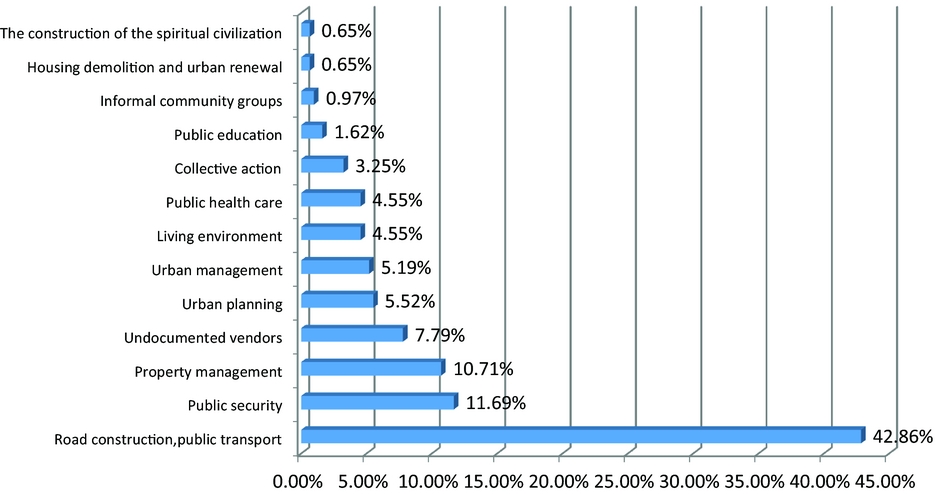
The author's research team conducted a systematic review of Jie Township's property owner online forums, postings, and comments concerning public affairs. In all, 694 postings were obtained. The team then classified the topics of interest to Jie Township's netizens. These topics were as follows (in order of importance): road construction, public transportation, urban administration, security, property management, and urban planning (see Figure 1).
The public issues of concern in Jie township

Rightful resistance: rejection of a power substation by ‘Chenhua Estate’
The middle class in Jie Township did not initially adopt loyal appealing. From 2008 to 2009, there were frequent incidents of rightful resistance. One classic case is the power substation involving Chenhua Estate.
Chenhua Estate is a high-end residential estate in Jie Township with property values ranging from RMB 17,000 to RMB 20,000 per square meter. In April 2008, less than a year after most of the residents moved in, it was discovered that a power substation was to be built within 30 meters of the estate. Chenhua Estate's property owners began to worry that the 110,000-volt power lines would affect their health and that of their children and expressed their concerns in the owners’ forum. The property owners immediately took action. First, the property owners gathered information from the Internet on substations built overseas in order to gain understanding of the hazards of high-voltage power lines. Next, the owners checked whether the proposed substation project had passed environmental assessments and whether land-use right permits and construction permits were procured.
Following the investigation and a consultation with relevant professional experts, the owners concluded that the substation project was in breach of a series of laws and regulations of the environmental protection authorities and the Shanghai People's Government. First, the project was in violation of the Ministry of Environmental Protection's ‘Regulations on Protection of Electromagnetic Radiation Environment’. This law expressly prohibited the construction of residential properties and kindergartens near places where large-scale electromagnetic radiation emission facilities or high-frequency equipment are used in concentration. Second, the project was in violation of the National Standard (‘Regulations on Urban Power Planning’). This law stated that ‘Underground power cables shall be used for new power lines of 35kV and above in the city's urban center, high-rise building clusters, urban trunk roads and busy thoroughfares’. Third, the project was in violation of Decree No. 14 of the State Environmental Protection Administration. The State required an ‘Environmental Impact Report’ for substation and power supply projects below 500kV in sensitive areas. A verification meeting or hearing had to be held to hear the views of the relevant unit, experts, and the public, followed by a public opinion survey. The property owners took turns petitioning and questioning the legality of the substation. At one time, work at the construction worksite was disrupted.
Song Xiaotian, a Shanghai native born in 1971 and the owner of a trading company, was a leader during Huachen Estate's collective actions. On 22 June, Song Xiaotian published a stirring ‘mobilization’ letter on the property owner's online forum:
We acknowledge that there is nothing wrong per se about the construction of high-voltage power lines because the aim is to resolve the power supply situation in Jie Township, but we must ask this question: What about our health? Although we support the State's power construction, we need more than anything a safer and more harmonious living environment. We found the most economical solution: the final 1.7 km of the power line from HQP Highway to LY road, i.e., its final section, should be buried underground. This solution would mean there was no need to alter the path of the power lines and would be most economical and practical. This would be our bottom line! In addition to posing a health hazard, the high-voltage power lines also caused – and this is extremely important – loss of our properties’ value. Our properties will see a significant drop in value. According to our rough estimate, the average price of Huachen Estate will decline by RMB 100,000 to 200,000.
Fortunately for us, among our neighbors, there are social elites who both care for the society and who have superb capabilities, not to mention our Central Government that cares for the people. We want a harmonious society and a secure life!Footnote 16
At that time, Song was already suffering from chronic renal failure. His wife had just had a child, and Song was adamant about not wanting his infant child to be exposed to radiation. Song's position received considerable support from fellow residents. After many of their petitions went unheard, more than 300 of the estate's residents gathered in front of the substation worksite at 8:00 a.m. on 13 July 2008. At 9:30 a.m., more than one hundred residents walked along JD Road in the direction of HS Highway, carrying with them a number of banners demanding removal of the substation. The move caused massive traffic congestion along HS Highway, a major road connecting Jie Township to the city center. The crowd was advised by the police to disperse. At noon, over 60 residents again congregated at the same road section and caused another round of traffic congestion, this time for approximately one hour. Significantly, there were even physical clashes with the police. As a result, the police forcibly removed Song, his wife and dozens of other residents from the site. Eventually, Song was granted bail pending trial, whereas the rest of the crowd was cautioned. Nevertheless, the rightful resistance achieved its desired effect: the high-voltage line was buried underground the next day, albeit at a relatively high cost for the owners, including Song himself. Subsequently, Song acknowledged the following:
I have learned an important lesson from this incident, and this is that even when we are upholding our rights, we should not sacrifice those of others. The highway is a public resource, and blocking it would damage another driver's interest. It would be impossible to imagine if an expecting mother was about to deliver and she was stuck in the traffic congestion! (Interviewed on 28 January 2013)
After the ‘substation incident’, Song became more tolerant and rational in his activism. A month later, he attempted to organize a volunteer team in the estate to provide some order to the homeowner rights campaigns:
There was great solidarity among the residents at Huacheng Estate. When the news about the high-voltage lines and high-voltage substation broke in April 2008, neighbors were of the same mind. It was unfortunate for the incident to occur on July 13, as there was no owner's organization. The incident was also a morale setback for many of us . . . For the sake of our personal health and property security, and for the sake of our beautiful lives and homes, we have decided to form a ‘Huancheng Estate Residents’ Volunteer Team’. Objectives of the volunteer organization: To ensure that residents uphold their rights in a lawful and orderly manner and to provide a platform through which residents can service the entire community insofar as it is within their means and capability. Footnote 17
Song's appeal met with little response. The middle-class owners and residents were busy with their own affairs and would act only when matters affected their personal interest. As soon as the problem was resolved, the owners returned to their lives. The owners had neither time nor interest to participate in group activities. However, Song quickly found one active organization – the ‘Volunteer Association’ – through the online owners’ forum.
Toward loyal appealing: The Volunteer Association and the Government-Netizen Conference
The Volunteer Association was ‘founded’ early in 2008 entirely on the initiative of property owners of several estates in Jie Township. The organizers used the online owners’ forum as a platform to address problems of transportation. Volunteers sent an outpouring of appeals and petitions to government officials at various levels. In April 2008, an open letter to Shanghai's Municipal Government was jointly signed by the moderator of the Volunteer Association forum and other property owners. In July 2008, the then-Vice Mayor of Shanghai, Shen Jun, met the Volunteer Association's forum moderators, Qiang Yu and Xue Bin, at the Complaints Office. In autumn 2008, Xue Bin also attended a face-to-face meeting of netizen representatives with then-Mayor Han Zheng during which the subject of transportation to Jie Township was once again raised.
Hua Lin, Deputy Magistrate of Jie Township in charge of community work, began to notice the importance of participation by owners in 2009. Hua began inviting netizens and forum moderators to offer their views on major issues involving municipal works and public administration. Hua promised to respond to these views within one week. Over time, a mechanism for meeting with netizens was established and perfected. Meetings were held once a month or once every two months. The meeting agenda was discussed and confirmed in advance, and heads of relevant government departments were invited to attend. Residents of Jie Township were notified by telephone, SMS, and online, and encouraged to attend, although there was a limit to the number of attendees – approximately 15–20 persons each session. The topics covered included health, education, security, traffic and road construction, municipal construction, and urban administration.
There were more than 60 members of the Volunteer Association from 15 estates in Jie Township. Ten of the members who formed the backbone of the Association regularly participated in internal discussions and meetings with netizens; each of these ten members was responsible for a specific issue. Wu Xu (age 30-plus, IT professional) was in charge of organization, Song Xiaotian (age 42, private entrepreneur) was the liaison and in charge of promotion, Rong Wen (age 30-plus, cadre in the Judicial System) was in charge of legal matters, Qiang Yu (age 40-plus, private entrepreneur) was in charge of action strategies, Zhong Jinfu (age 30-plus, interior designer) was in charge of urban planning, Wen Daohui (age 20-plus) was in charge of cultural activities, entertainment, and banquet meetings, and Xue Bin (age 40, senior manager in a multinational company) was involved with political consultation in his capacity as a township delegate to the People's Congress. It should be noted that although civil servants are typically members of the middle class, no civil servants have participated in the Volunteer Association because they are worried that participating in such organizations will affect their careers. However, these civil servants are happy to provide the Volunteer Association with government decision-making information, especially the grassroots government's bottom line, and advice.
For the past four years, the Volunteer Association has held regular roundtable meetings with the government and netizens. The record speaks for itself: 63 suggestions and views were either resolved or accepted out of the 87 submitted.
The Volunteer Association adopted a model of upholding rights that was different from rightful resistance. The new model possesses several features.
Rightful resistance considers the local government an object to confront, whereas loyal appealing considers it a potential ally. One example is the forum moderator's resolve in suppressing belligerent posts on the Internet. Some netizens in the Jie Township owners’ forum tried to organize a ‘collective walk’ over certain property management matters. The netizens even agreed on the time and route of the protest march. The moderator took the initiative to contact Hua Lin regarding the correct way to handle this protest. Hua requested that the moderator delete the posts, and the moderator agreed with certain conditions. The moderator determined it was necessary to provide an explanation for deleting the posts to avoid being misunderstood and scorned by netizens. Another example is the joint appeal to the national government for policy preferences or the allocation of resources. This strategy was demonstrated in the appeal for intervention by the municipal departments when public transportation routes to the city center went beyond the scope of the township government's power. Under these circumstances, the Volunteer Association was able to consolidate public opinion and speak on behalf of the public to exert the appropriate pressure on the national government. In May 2012, the Volunteer Association initiated a campaign that collected residents’ endorsements to install three public transport lines connecting Jie Township with Hongqiao Transportation Hub and Subway No. 9 Line. The volunteers had previously consulted the township government concerning their proposal, but the township government determined its hands were tied because the proposal involved planning beyond its jurisdiction. However, the township government did not object to the campaign for the residents’ endorsements. In fact, the campaign received full support from 15 resident committees and property managers, and in two weeks, the volunteers had collected endorsements from 5,698 residents. At the end of 2012, Shanghai transportation authorities acceded to the residents’ request.
Activists who engage in rightful resistance use central government policies as their weapon, whereas activists who engage in loyal appealing use the local government's political performance as a bargaining chip.
For grassroots governments, performance mainly consists of two aspects: first, economic development and its core indicator, i.e., the growth of the GDP, and, second, social stability and its core indicator, i.e., the number of petitions and mass disturbances. The political performance involved in this article is mainly concerned with social stability. Rightful resistance usually targets grassroots governments. Due to the fact that this form of protest is a symbol of the incompetence of the grassroots government and its leaders, the more recurrent it is, the lower the government's evaluation of a grassroots government is; however, loyal appealing sees grassroots governments as joint partners. Since it avoids an open conflict, it is easier to safeguard the positive image of a grassroots government.
Activists who use rightful resistance are inclined to deny the local government's political accomplishments. These activists assume that local governments have contravened the Central Government's policies and will. Therefore, these activists use central government policies to constrain and perhaps even rectify certain improper actions of the local government. In contrast, activists who use the loyal appealing strategy make efforts to find the best combination of personal interest and the local government's political accomplishments. Key individuals in the Volunteer Association, such as Rong Wen and Song Xiaotian, were relentless in emphasizing the need to help local government achieve ‘political accomplishments’. In a meeting with netizens in April 2013, Rong told You Aihua, director of the township's community office, that evaluations were underway for the award for Outstanding Cases of Lawful Governance for 2012 (4th edition). Rong suggested that the township government submit its ‘netizen meeting’ as an outstanding case: ‘Our former leader is responsible for the evaluation work, and when he heard about our netizens meeting, he felt that it was a compelling case. The honor is at the municipal level, and would be a great political accomplishment for you!’ Early in 2013, the Volunteer Association also presented banners and wrote letters of appreciation to the Municipal Complaints Office, Municipal Transportation and Port Administration as well as the township government to endorse the government's work accomplishments.
However, loyal appealing and rightful resistance are not polar opposites. First, because of the frequent incidents involving rightful resistance, the Jie Township government finally initiated dialogue with the middle-class property owners through meetings with netizens. The Shanghai World Expo also provided a fortuitous event for the middle class; it led the local government to relax its position. Netizen meetings first began in 2009, just before the World Expo. As the host city for the 2010 World Expo, Shanghai had high standards for the city's security. ‘Stability above all else’ was a common understanding of government at various levels. Faced with a middle class that was increasingly aware of its rights, Deputy Magistrate Hua, who was in charge of community work, courageously decided to establish a platform for an official dialogue with the people.
According to Song, the Volunteer Association's loyal appealing strategy worked because of the rightful resistance that preceded it. Rightful resistance forced the local government to recognize the property owners’ petition. Only after securing the right to speak with the local government on equal terms was the Volunteer Association able to leverage a ‘win-win’ situation and counsel the government to ‘achieve political accomplishments’ in the correct manner.
Second, the middle class did not completely relinquish its right to engage in rightful resistance, which was used as a backup to ensure the effectiveness of loyal appealing. To the middle class, rightful resistance was a ‘nuclear weapon’ of last resort and thus should not be used indiscriminately. Although it communicated ‘nuclear deterrence’ to the local government, the middle class made all efforts to align the interest of the local government with its own; the two combined would be a political accomplishment for the local government. The middle class merely wanted to improve public facilities and services to improve their living quality. This goal was a political accomplishment desired by the local government.
Comparing Rightful Resistance and Loyal Appealing
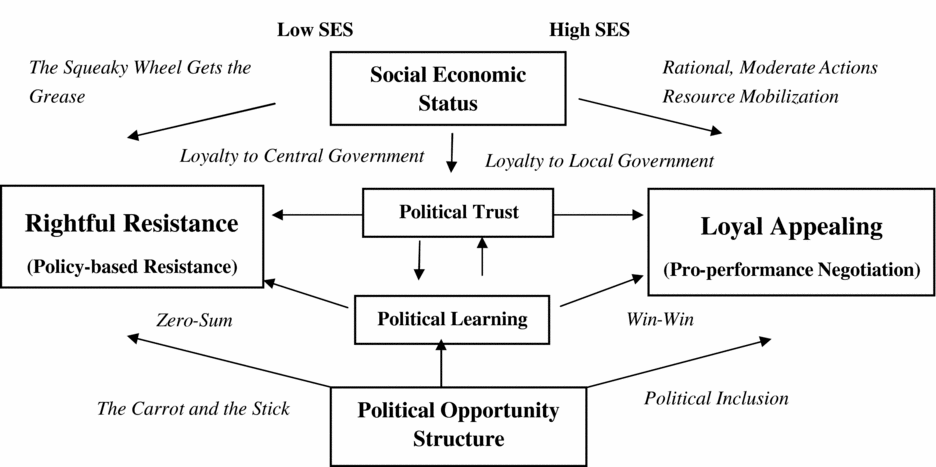
Why did the middle class in Jie Township prefer negotiation over rightful resistance? This study argues that the reasons are threefold (see Figure 2).
Effects of socioeconomic status on patterns of protest

The first reason is the result of political learning. The middle class in Jie Township attempted rightful resistance, but with no success in most cases. For example, the residents in Estate A of the township had protested against the election of the residents’ committee on the grounds of illegal procedures. Nothing came of the protest.Footnote 18 Although the ‘Huachen Estate’ substation protest was successful to a certain degree, the activists also paid a price. The homeowners gradually found that less confrontational and more cooperative and patient approaches may sometimes prove more effective.Footnote 19 For the township government, it was also a process of learning and refinement of strategy. The government was frustrated with the lack of effective responses and measures against frequent incidents involving rightful resistance and protest. Fortunately, the Shanghai World Expo in 2010 provided an opportunity for change. In 2009, the Municipal Government had demanded stability and harmony in preparation for the World Expo. This demand meant that local governments were eager for compromise and consultation. The township government allowed political participation by the middle class through meetings with netizens. These meetings enabled the township government to understand the public's complaints first-hand. Therefore, the meetings reduced the government's administrative costs and the risk of group incidents. According to He Baogang and Mark E. Wanen, complex governance comprises diverse parties and involves risks of resistance. Society's elites are motivated to respond to the public's needs through deliberation (or consultation).Footnote 20 In a way, rightful resistance is ‘policy-based resistance’, whereas loyal appealing is pro-performance negotiation. Loyal appealing is more compatible with the interest of the local government and the public. In a bargained authoritarian regime,Footnote 21 loyal appealing is an approach that encourages negotiation and cooperation.
The second reason for negotiation is that the middle class possesses a relatively higher socio-economic status and, accordingly, is more likely to have the opportunity to speak with officials on an equal basis. Some middle-class citizens are more highly educated or have higher income than local government officials. In the social hierarchy, members of both the local government and the Volunteer Association are in the middle class. Almost all of the members of the Volunteer Association are university-educated (Rong Wen even had a post-graduate degree from a law school at a renowned college) and have better careers and income (e.g., company owners, lawyers, management staff, and engineers). Compared with peasants and grassroots movements, members of the Volunteer Association have a better understanding of the way the government works. Therefore, these members know what to do and what to avoid and can change what they want to what the government wants. Because the middle class possesses a greater ability to mobilize resources, local government officials are more patient and careful in dealing with them, and the government is less willing to use force. Like the middle class, workers and peasants also strategically avoid direct conflicts with the government. However, due to their low social status and economic status, grassroots government officers often fail to value their demands, leading them to adopt a more drastic approach to trigger the government's response. As expected, compared with the underclass, the middle class has better political skills. They have a better understanding of the operational mechanism of a grassroots government and the performance needs of the grassroots officers; thereupon, they can more efficiently communicate with the grassroots government. In other words, the advantages of the middle class in dealing with the grassroots government are a higher social economic status, a wider network of social relations, and more sophisticated political skills.
The third reason for negotiation over rightful resistance is that the middle class’ political trust and awareness of its rights is different from peasants and workers. The middle class’ trust in the respective levels of government does not gradually decrease.Footnote 22 The middle class does not think that there is simply a ‘good’ national government and a ‘bad’ local government. On the surface, the problems in grassroots governance concern the quality of the government's cadres. In a deeper sense, the problem lies in the government's administration system.
Perry believes that the Chinese have a unique understanding of the idea of rights that differs from the West. In the Anglo-American tradition, a right is a natural right; a natural right is recognized as a right granted by God and not by the state.Footnote 23 In China, the current protests are based on moral economy, whereas the discourse of ‘rights’ is often unpopular. Chinese protestors usually demand the removal of low-level officials; they rarely question the authority of the party-state or its ideology. In China, rights are often understood as something that is approved by the state, either with a goal of enhancing the country's unity or as a means of bringing prosperity. Rights are not understood as a protective mechanism that is given naturally to the people to resist state interference. In this setting, the demands of the masses to exercise their rights may strengthen, rather than challenge, the state's power. As a result, Perry believes that what appears to be rights consciousness is instead a historically familiar ‘rules consciousness’. Rules consciousness targets rule-enforcement authorities, presumes skepticism toward them and a sense of equality with them under central policies and state laws, and implies a demand for direct or indirect participation in rule enforcement. Rights consciousness, in contrast, targets rule-making authorities, presumes skepticism toward them and a sense of equality with them under antecedent and/or constitutional principles, and implies a demand for direct or indirect participation in rule-making.Footnote 24 According to Perry, popular contention driven by rules consciousness implies no major challenge to the party-state and can ‘undergird rather than undermine’ the political system by providing ‘an effective check on the misbehavior of state authorities’.Footnote 25
Several follow-up questions must be asked: why is loyal appealing effective? What enables the middle class to establish an unofficial alliance with the local government?
A simple answer is the compatibility between the interests of the middle class and the government. As successful players in the market economy, the middle class possesses respectable income and social status. To some extent, the middle class is the beneficiary of reform and opening. In recent years, the government of Jie Township has been promoting real estate development to attract the wealthy middle class to settle there, thus raising the district's economic development. In general, middle-class communities have good social order and enjoy high economic spending. High economic spending drives economic growth, and the local government obtains additional benefit from an increase in land value.
The other commonality is that the middle class and the government share the ideology of developmentalism. As successful players in the market economy, the middle class has basically the same attitude as the government toward ‘nail households’,Footnote 26 unlicensed hawkers and slums. Sometimes, the middle class is even less tolerant. To the middle class, slums are where criminals congregate; therefore, these areas have an adverse impact on society's security and – more pertinently – affect property values. Thus, the middle class usually urges the government to forcibly demolish ‘nail households’, evict unlicensed hawkers, and destroy slums. Another consensus is the preference of the middle class and local government for social stability. Both the middle class and local government support progressive reform and worry that violent reforms will cause China to splinter similar to the USSR, thus harming their personal interests.
In fact, at Jie Township, the grassroots government used both repression and cooptation strategies. When the middle class blocked the street to stop the electrical substation construction, the grassroots government took a repressive approach. When the middle class organized the Volunteer Association and gained a larger social influence on the Internet, the grassroots government took a cooptation approach. Chinese people often use ‘flood control’ as a metaphor for social governance. They emphasize the combination of ‘blocking’ (building the dam), which is just like repression, and ‘dredging’ (dredging and guiding the river), which is just like cooptation. Long-term repression will increase people's dissatisfaction, thus ultimately leading to greater social conflicts. However, cooptation can be achieved by setting regular meetings for grassroots government and Internet users so that people have a channel to convey their grievances and interests to the political system, thus leading people from rightful resistance to loyal appealing. If the repression strategy triggered major social instability that stifles high-level governments or raises public discontent, the local government would opt for cooptation. In fact, cooptation by the grassroots government took place in 2009, the year before the Shanghai World Expo was held. This was because the Shanghai municipal government put social stability first and the grassroots government was afraid of an uncontrollable situation. Loyal appealing is the result of the interaction between the middle class and the grassroots government. If the appeal of the middle class cannot get the response of the grassroots government, then such a strategy would be abandoned. In general, the middle class has a stronger sense of law and risk control than the underclass groups and seldom takes violent collective action.
Conclusions
In authoritarian countries, citizenship is a potential status; personal rights are not necessarily bestowed at birth. Only during political action would a natural person be considered a citizen. Thus, in the middle class’ ‘loyal appealing’ strategy, activists publicly declare ‘loyalty’ in an attempt to position themselves as ‘good citizens’ who are acceptable to government officials. In this way, the middle class is better able to protect its self-interest. Through online and offline appeals, the middle class is undergoing a process of self-empowerment, transforming from owners’ activism to political participation. A classic example is the Volunteer Association's campaign of ‘electing a neighbor as the People's Representative’ in 2011. Through this campaign, volunteer Xue Bin became a township delegate to the People's Congress. Other scholars have found a similar trend in the demands of homeowners in Chinese cities that have gradually shifted away from economic rights and toward political ones.Footnote 27
Soft authoritarianism demonstrates a change in the state,Footnote 28 whereas loyal appealing signifies a change in civil society (the middle class). Both terms are helpful in allowing us to understand the transformation in the current relationship between the state and society in China. Previous researchers held the view that the motivation for authoritarian states to allow bargaining with their citizens was to establish a type of social contract, where the citizens relinquished their political rights in exchange for economic security.Footnote 29 However, the case of Jie Township has demonstrated that the public sought political rights for its economic interests (including living quality). As noted by Truex, limited participation channels may temporarily increase stability and buy some support among citizens with low expectations. In the long term, however, such reforms may raise expectations that must be satisfied through further reform.Footnote 30
There have always been disputes concerning the role of the middle class during political transitions. Some scholars have suggested that the middle class was the lynchpin for pushing democratic transformation in countries that uphold rights. Other scholars have argued that the middle class was often politically conservative because it had a vested interest.Footnote 31 Research for this essay has found that the political role of the middle class is vague. On the one hand, the middle class is the beneficiary of the existing system. Accordingly, the middle class yearns for social stability and economic growth, which constitute the source of its rule consciousness. On the other hand, the middle class possesses a certain degree of rights consciousness and harbors some discontent with the authoritarian system. Thus, the middle class hopes – insofar as society is stable – to advance reforms, albeit progressively. In this way, middle-class interests receive adequate protection from both the law and the political system.
About the author
Yihan Xiong is an Associate Professor at the School of International Relations and Public Affairs, Fudan University, Shanghai, China. His research interests include immigration, social inequality, ethnic conflict, and state capacity. He has published in China Quarterly, Security Studies, and Citizenship Studies. The author acknowledges the support from a grant awarded by the Carnegie Corporation of New York to the 21st Century China Center at the UC San Diego School of Global Policy and Strategy. The author also gratefully acknowledges helpful advice, comments and support from Susan Shirk, Lei Guang, Lianjiang Li, Eli Friedman, Ching Kwan Lee, Jane Mansbridge, Adam Tyner, Dorothy J. Solinger, Feng Chen, Min Tang, Shiping Tang, Yongshun Cai, Hui Li, Yue Xie, Ke Meng, Narisong Huhe, Pan Zi, and Qiang Zhou.