Introduction
Bryoria fremontii (Tuck.) Brodo & D. Hawksw. and B. tortuosa (G. Merr.) Brodo & D. Hawksw. constitute a chemically unique species group in the genus Bryoria Brodo & D. Hawksw. (Parmeliaceae, Lecanorales, Ascomycota) because of their production of a pulvinic acid derivative, vulpinic acid. Vulpinic acid is a bright yellow pigment that in B. fremontii appears only in soralia and apothecia but in B. tortuosa is present throughout the thallus, including the pseudocyphellae. In their monograph of the genus Bryoria in North America, Brodo & Hawksworth (Reference Brodo and Hawksworth1977) classified the two species in the section Tortuosae (Bystr.) Brodo & D. Hawksw. Both taxa occur mainly in western North America and Northern Europe. Bryoria fremontii was described from North America in 1858, but it was collected much earlier in Europe, for example, by G. Wahlenberg (Ahlner Reference Ahlner1948), and the lectotype of the rejected name Lichen jubatus L. (Hawksworth & Sherwood Reference Hawksworth and Sherwood1981) most probably represents B. fremontii. Bryoria tortuosa was for a long time known only from western North America. Motyka (Reference Motyka1958) was the first author to report B. tortuosa in Europe but the report has never been checked. Holien (Reference Holien1986) reported the species from northern Europe for the first time (see also Hermansson & Thor Reference Hermansson and Thor2004; Myllys et al. Reference Myllys, Halonen and Velmala2006).
In addition to having a unique chemistry, Bryoria fremontii and B. tortuosa are morphologically very distinct within the genus, and hence easily recognized in the field. Both are large species (often 20–50 cm in length) and both have twisted, foveolate and often partly flattened main branches and finer, rather terete secondary branches. The colour of the thallus is typically reddish or yellowish brown depending on the concentration of vulpinic acid. Typical specimens of B. fremontii and B. tortuosa are also rather easily distinguished from one another; the main distinguishing features being the surface of the cortex (mostly shiny in the first versus usually dull or matt in the other) and the frequency and colour of the pseudocyphellae (sparse and whitish versus usually abundant and yellow, respectively). Soralia production is more variable, ranging from rather common and widespread in European B. fremontii (Ahlner Reference Ahlner1948), to distinctly localized in North America. In B. tortuosa, by contrast, soralia are unknown from Northern Europe (Holien Reference Holien1986; Hermansson & Thor Reference Hermansson and Thor2004; Myllys et al. Reference Myllys, Halonen and Velmala2006), and very rare in North America (Brodo & Hawksworth Reference Brodo and Hawksworth1977). Apothecia have been found in North America in both taxa (Brodo & Hawksworth Reference Brodo and Hawksworth1977; this study), but in northern Europe only B. fremontii is known to produce sexual fruiting structures.
The habitat requirements of Bryoria fremontii and B. tortuosa seem to be fairly similar. In northern Europe both species prefer conifers growing in humid, shaded Picea abies forests as well as in dry, open Pinus sylvestris forests, the latter being especially favoured by B. fremontii (Ahlner Reference Ahlner1948; Holien Reference Holien1986; Gjerlaug Reference Gjerlaug1987; Hermansson & Thor Reference Hermansson and Thor2004; Myllys et al. Reference Myllys, Halonen and Velmala2006). In North America both taxa grow most copiously on conifer branches in open, usually late seral or oldgrowth forests in summer-dry intermontane regions at middle to upper elevations (Brodo & Hawksworth Reference Brodo and Hawksworth1977; Goward Reference Goward1999). Here it can also be noted that B. tortuosa in North America can be locally dominant in drier coastal and lowland forests.
Ever since its description roughly a century ago as “Alectoria tortuosa” (Merrill Reference Merrill1909), most authorities have accepted this taxon as a distinct species (e.g., Gyelnik Reference Gyelnik1934, Reference Gyelnik1935; Fink Reference Fink1935; Motyka Reference Motyka1958; Hale Reference Hale1979; McCune & Geiser Reference McCune and Geiser1997; Brodo et al. Reference Brodo, Sharnoff and Sharnoff2001; Spribille Reference Spribille2002; Derr et al. Reference Derr, Helliwell, Ruchty, Hoover, Geiser, Lebo and Davis2003). Goward & Ahti (Reference Goward and Ahti1992) and Goward (Reference Goward1999), however, challenged this view, pointing out that the key features distinguishing Bryoria tortuosa from B. fremontii combine in varying degrees in some British Columbian populations. They suggested that B. tortuosa might more appropriately be considered as a variety or chemical strain of B. fremontii. Holien (Reference Holien1986) considered the species to be distinct, but found some differences in the chemical and morphological characters as well as in the ecology between the Norwegian and North American specimens of B. tortuosa. However, he concluded that those differences are of minor importance considering the overall morphological similarity of the specimens.
During our phylogenetic studies on the genus Bryoria using both molecular data and intensive investigation of thallus morphology and chemistry, it became obvious that the relationship of B. fremontii and B. tortuosa required further clarification. These two taxa, especially in North America, often grow entangled with each other and at the same time exhibit a continuum of variation ranging from shiny and reddish or dark brown thalli deficient in vulpinic acid, to dull yellowish thalli rich in vulpinic acid. Moreover, the colour of the pseudocyphellae can vary from whitish to yellow within the same specimen, indicating a low concentration and uneven distribution of vulpinic acid.
In this paper we have reconstructed a molecular phylogeny using four DNA regions to examine whether Bryoria fremontii and B. tortuosa are distinct species or whether the differences in their chemical and morphological characters represent a range of variation across a single species. Furthermore, we have used both North American (Canadian) and European material to test the hypothesis that specimens from different continents form two monophyletic groups.
Materials and Methods
The material
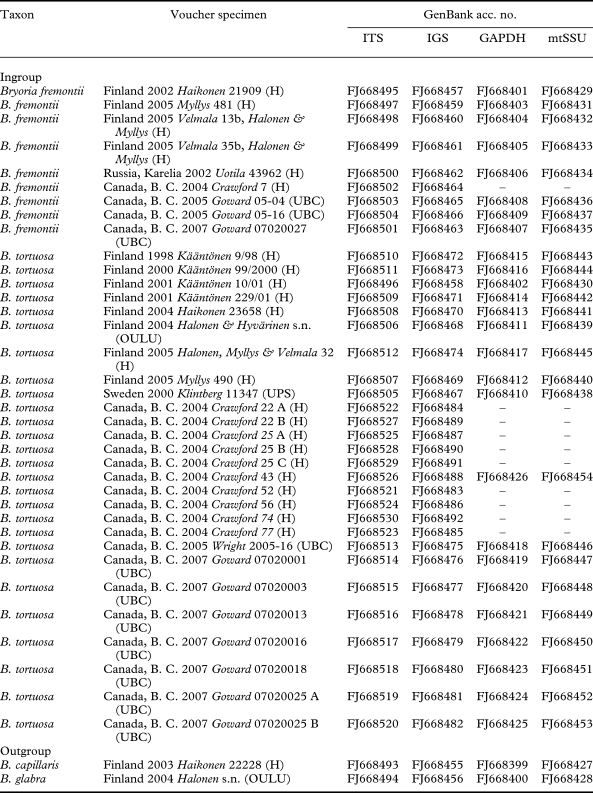
The material used in this study was selected to represent as broad a range of morphological and chemical variation as possible. Altogether nine specimens of Bryoria fremontii and 27 specimens of B. tortuosa from both Europe and North America were included in the analyses ( Table 1). Specimens were determined as B. tortuosa if there was any trace of vulpinic acid in the thallus. In a preliminary phylogenetic analysis using Platismatia glauca (L.) W. L. Culb. & C. F. Culb. as an outgroup, both the genus Bryoria and a clade including all B. fremontii and B. tortuosa specimens were monophyletic (tree not shown). In our final analysis we used Bryoria capillaris (Ach.) Brodo & D. Hawksw. and Bryoria glabra (Motyka) Brodo & D. Hawksw. as outgroup taxa in this study.
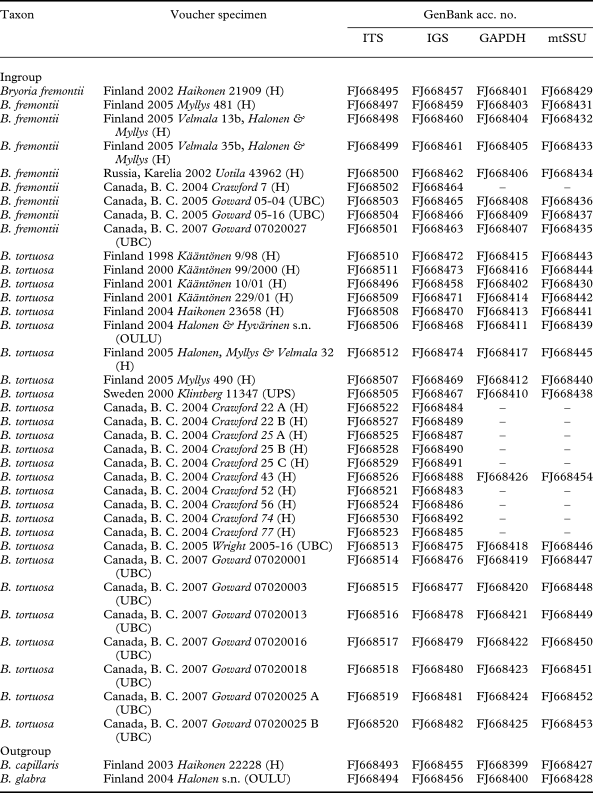
Specimens used in the phylogenetic analyses with collection data and GenBank accession numbers. Bryoria tortuosa specimens were submitted to GenBank as B. fremontii (see discussion).
Secondary chemistry
The secondary compounds were examined using thin-layer chromatography (TLC) according to Orange et al. (Reference Orange, James and White2001). The acetone extracts were spotted with 75 mm / 75 μl Haematocrit capillaries (Hirschmann Laborgeräten) on 10 × 20 cm Merck silica gel 60 F-254 pre-coated glass plates and run in solvent systems A and B (B formulae from both Culberson Reference Culberson1972 and Mietzsch et al. Reference Mietzsch, Lumbsch and Elix1994 according to Orange et al. Reference Orange, James and White2001 were used).
Molecular techniques
Four DNA regions were used in this study: 1) the internal transcribed spacers of the nuclear rDNA including the 5.8S region (ITS); 2) partial sequences from the intergenic spacer of the nuclear rDNA (IGS); 3) partial sequences of the small subunit of the mitochondrial rDNA (mtSSU); and 4) partial sequences from the protein-coding glyceraldehyde-3-phosphate dehydrogenase gene (GAPDH).
DNA was extracted using either Qiagen's DNeasy Plant Mini Kit or DNeasy Blood & Tissue Kit following the manufacturer's protocol except that the liquid nitrogen phase was omitted. Instead, thallus fragments of approximately 0·5–3 cm long were ground with mini-pestles in 40 μl of the lysis buffer after which 140 μl of the buffer was added. The extracted DNA was eluted in 120 μl of the elution buffer included in the kits.
Primers used for PCR amplification were: a) for the ITS region: ITS1-F (Gardes & Bruns Reference Gardes and Bruns1993) together with ITS4 (White et al. Reference White, Bruns, Lee, Taylor, Innis, Gelfand, Sninsky and White1990) or ITS1-LM (Myllys et al. Reference Myllys, Lohtander, Källersjö and Tehler1999) together with ITS2-KL (Lohtander et al. Reference Lohtander, Myllys, Sundin, Källersjö and Tehler1998); b) for the IGS region: IGS12B (Printzen & Ekman Reference Printzen and Ekman2002) together with nu-SSU-0072-5′ (Gargas & Taylor Reference Gargas and Taylor1992); c) for the mtSSU region: mtSSU1-KL together with mtSSU2-KL (Lohtander et al. Reference Lohtander, Oksanen and Rikkinen2002); and d) for the GAPDH region: Gpd1-LM together with Gpd2-LM (Myllys et al. Reference Myllys, Stenroos and Thell2002). PCR reactions were prepared using PuReTaq Ready-To-Go PCR beads (GE Healthcare). In addition, the 25 μl reaction volume contained 19 μl dH2O, 0·4 μM each primer and 4 μl extracted DNA. The parameters for the PCR schedule were: initial denaturation for 5 min at 95°C followed by five cycles of 30 s at 95°C (denaturation), 30 s at 60°C or 58°C for ITS, 55°C or 50°C for IGS, 52°C for mtSSU and 56 °C for GAPDH (annealing), and 1 min at 72°C (extension); in the remaining 30 cycles the annealing temperature was decreased to 58°C or 56°C (ITS), 50°C (mtSSU) and 54°C (GAPDH); the PCR schedule ended to final extension for 7 min at 72°C.
The PCR products were visualized under UV light on 1 % agarose gels stained with ethidium bromide to check the size and quality of the DNA. The PCR products were purified according to the manufacturers' protocols with either Qiagen's QIAquick PCR Purification Kit (PCR products eluted in 30 μl elution buffer) or GE Healthcare illustra's GFX tm PCR DNA and Gel Band Purification Kit (PCR products eluted in 50 μl dH2O).
The sequencing reactions were prepared using BigDye Terminator Cycle Sequencing Reaction Kit version 1.1 (Applied Biosystems). 10 μl reaction samples contained 3 μl dH2O, 2 μl BigDye, 2 μl sequencing buffer, 0·25 μM each primer and 2 μl purified PCR product. The above listed PCR primers were used also for sequencing except for the ITS region for which the primer ITS5 (White et al. Reference White, Bruns, Lee, Taylor, Innis, Gelfand, Sninsky and White1990) was used together with ITS2-KL. The sequencing reactions were run with the following parameters: initial denaturation for 1 min at 96°C or no initial denaturation, followed by 30 cycles of 30 s at 96°C, 15 s at 50°C and 4 min at 60°C.
The post-reaction purification of the samples for ABI PRISM™ DNA Sequencer (Applied Biosystems) was made following the protocol described in Högnabba (Reference Högnabba2006) and for MegaBACE 1000 DNA Analysis System (GE Healthcare) using Montage SEQ96 Cleanup Kit and MultiScreen SEQ384 Filter Plates (Millipore) according to the manufacturer's protocol. In some cases the cleaned PCR products were sequenced by Macrogen Inc., South Korea (www.macrogen.com). The DNA strands were assembled and manually corrected with SeqMan II 4.00 (DNASTAR).
Sequence alignment and phylogenetic analyses
Each DNA region was aligned separately using ClustalX 1.87 (Thompson et al. Reference Thompson, Gibson, Plewniak, Jeanmougin and Higgins1997) with default parameters. The four aligned sequence matrices were manually edited and combined with MacClade 4.08 (Maddison & Maddison Reference Maddison and Maddison2005) for simultaneous parsimony analysis. The cladograms were obtained using PAUP* 4.0b10 (Swofford Reference Swofford2002) with the following settings: heuristic search, random addition sequence with 500 replicates and TBR branch swapping. No more than 40 trees were saved for each replicate to save computation time. Gaps were treated as fifth character states and, for comparison, as missing data in a second set of analyses. Support for each node was estimated using bootstrapping (1000 repetitions) as implemented in PAUP*. We used equally weighted maximum parsimony as our optimality criterion, which according to Grant & Kluge (Reference Grant and Kluge2003) maximizes congruence over all data by minimizing the total number of transformations. To assess character congruence between the four DNA regions, a partition-homogeneity test was performed on each pair of partitions using PAUP*. The test included 1000 homogeneity replicates each employing a heuristic search with 500 addition-sequence replicates. Uninformative characters were excluded (Cunningham Reference Cunningham1997).
Unfortunately we could not obtain mtSSU and GAPDH sequences from all of the specimens. Consequently, in order to minimize the amount of missing data, we performed two analyses with different data sets. First, ITS + IGS data set, which included all 36 ingroup specimens. Second, ITS + IGS + mtSSU + GAPDH data set, which included 26 specimens from which all DNA regions were successfully sequenced.
Results
Secondary chemistry
In addition to vulpinic acid, some of the Bryoria tortuosa specimens analysed contained norstictic and barbatolic acids. The TLC procedure was repeated for those specimens. In some cases the results were not identical in the two runs (e.g., no barbatolic acid was detected in the second run) most probably because the material for the second run was obtained from different branches. Many of the specimens also contained some unidentified lichen compounds, with slightly different Rf -classes from those recorded by Holien (Reference Holien1986).
Phylogenetic analyses
One hundred and thirty-two new sequences were generated for this study, including 38 ITS, 38 IGS, 28 mtSSU and 28 GAPDH sequences (Table 1). The sequences showed very little variation in length except at the 5′ and 3′ ends of each region due to poor sequence quality. The ITS + IGS data set contained 998 characters of which 45 (4·5 %) were parsimony informative. The PAUP* analysis resulted in two equally most parsimonious trees of 94 steps, with consistency index (CI) of 0·989 and retention index (RI) of 0·989. The ITS + IGS + mtSSU + GAPDH data set contained 3056 characters of which 195 (6·4 %) were parsimony informative. The PAUP* analysis resulted in 468 equally most parsimonious trees of 342 steps, CI of 0·956 and RI of 0·944. According to the partition-homogeneity test, two out of seven pairs of partitions were significantly incongruent, the IGS-GAPDH pair (P = 0·042) and the ITS-GAPDH pair (P = 0·001).
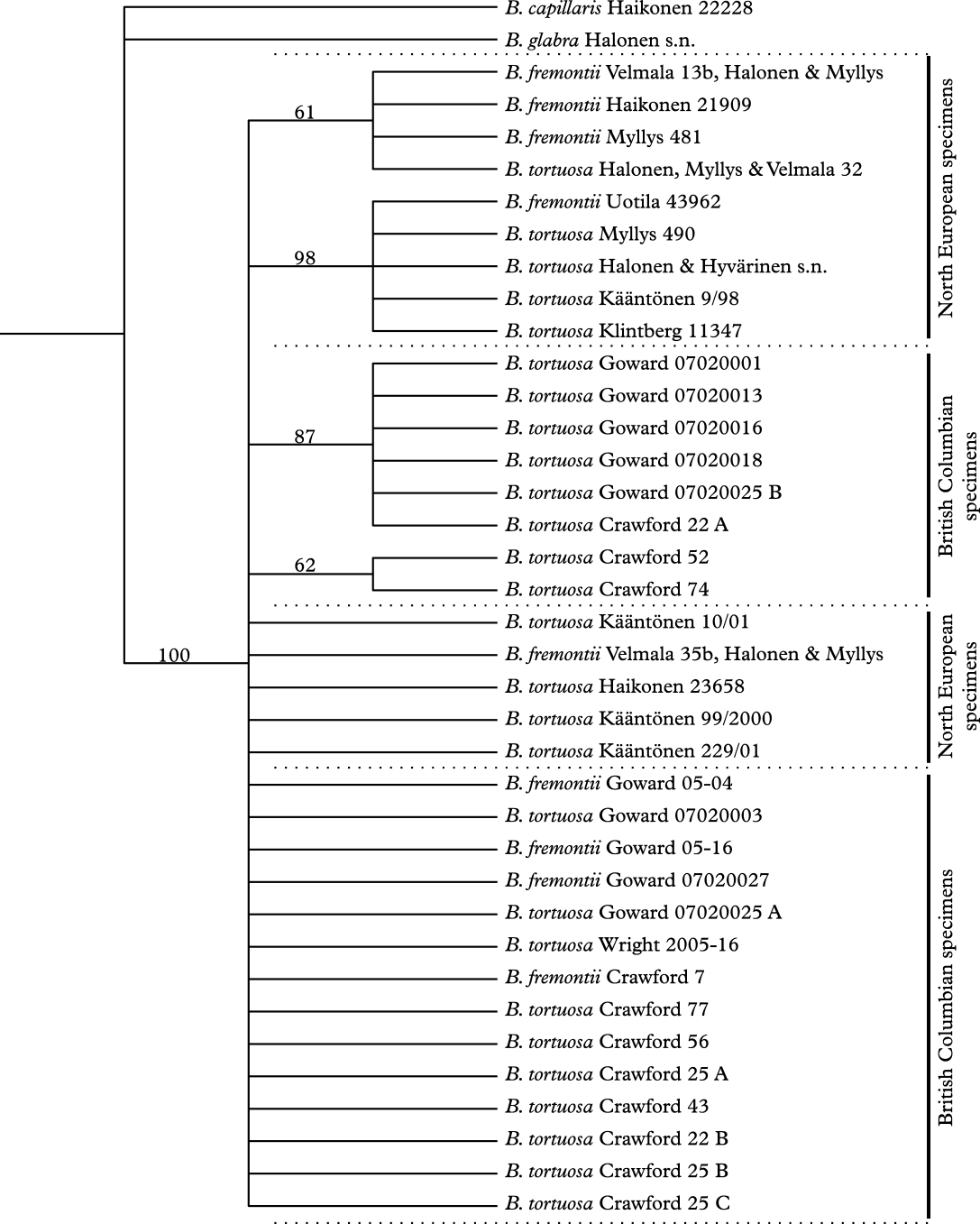
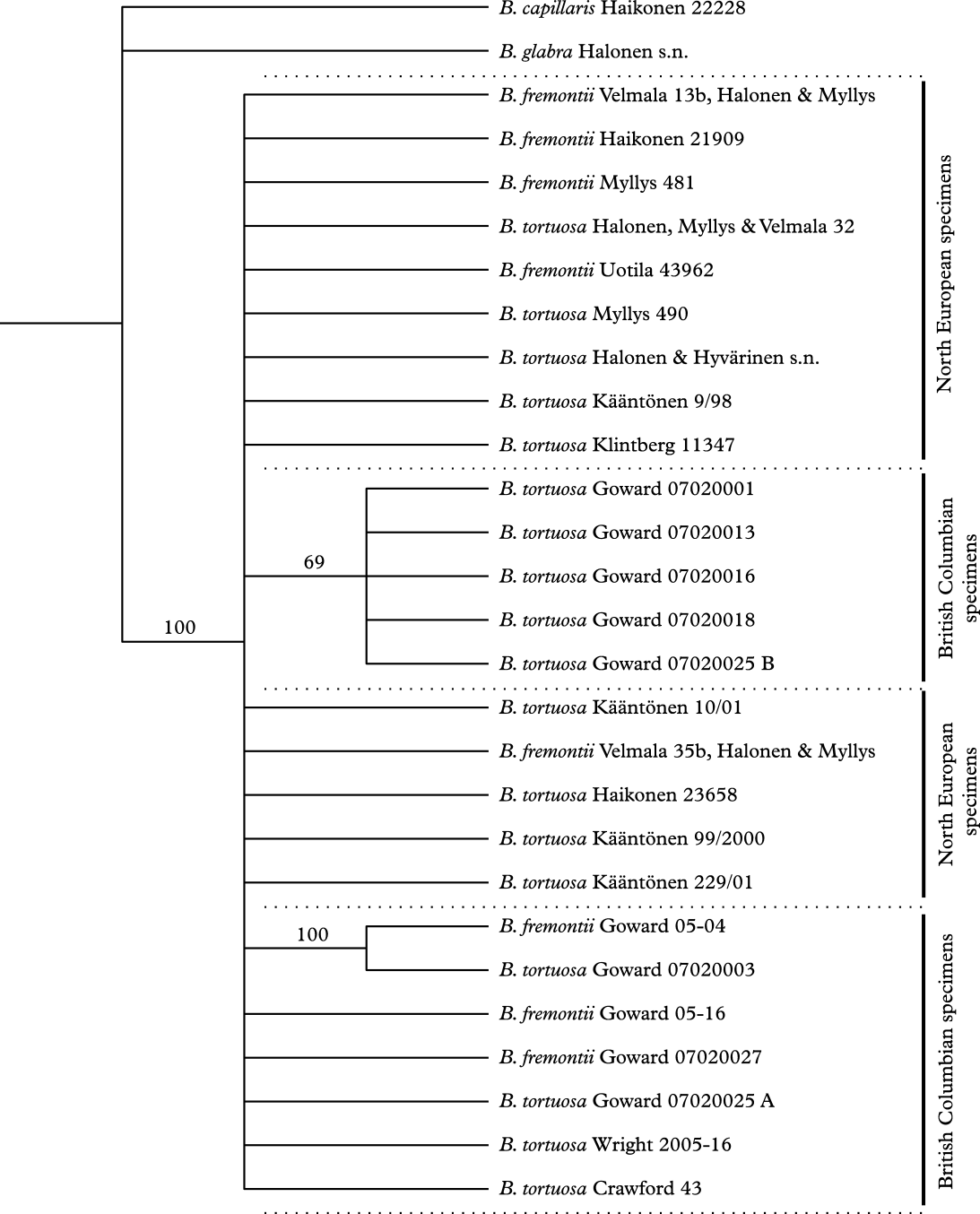
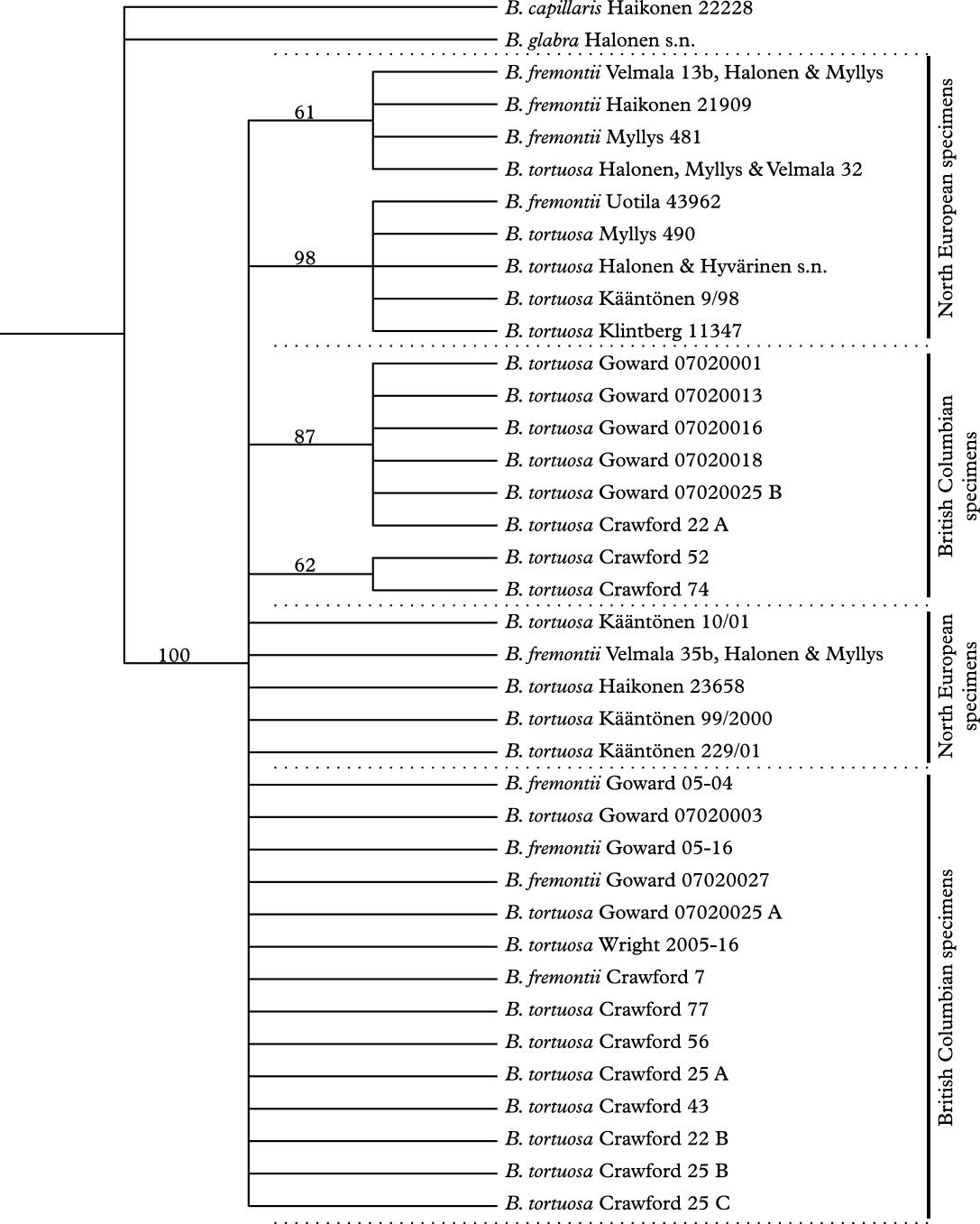
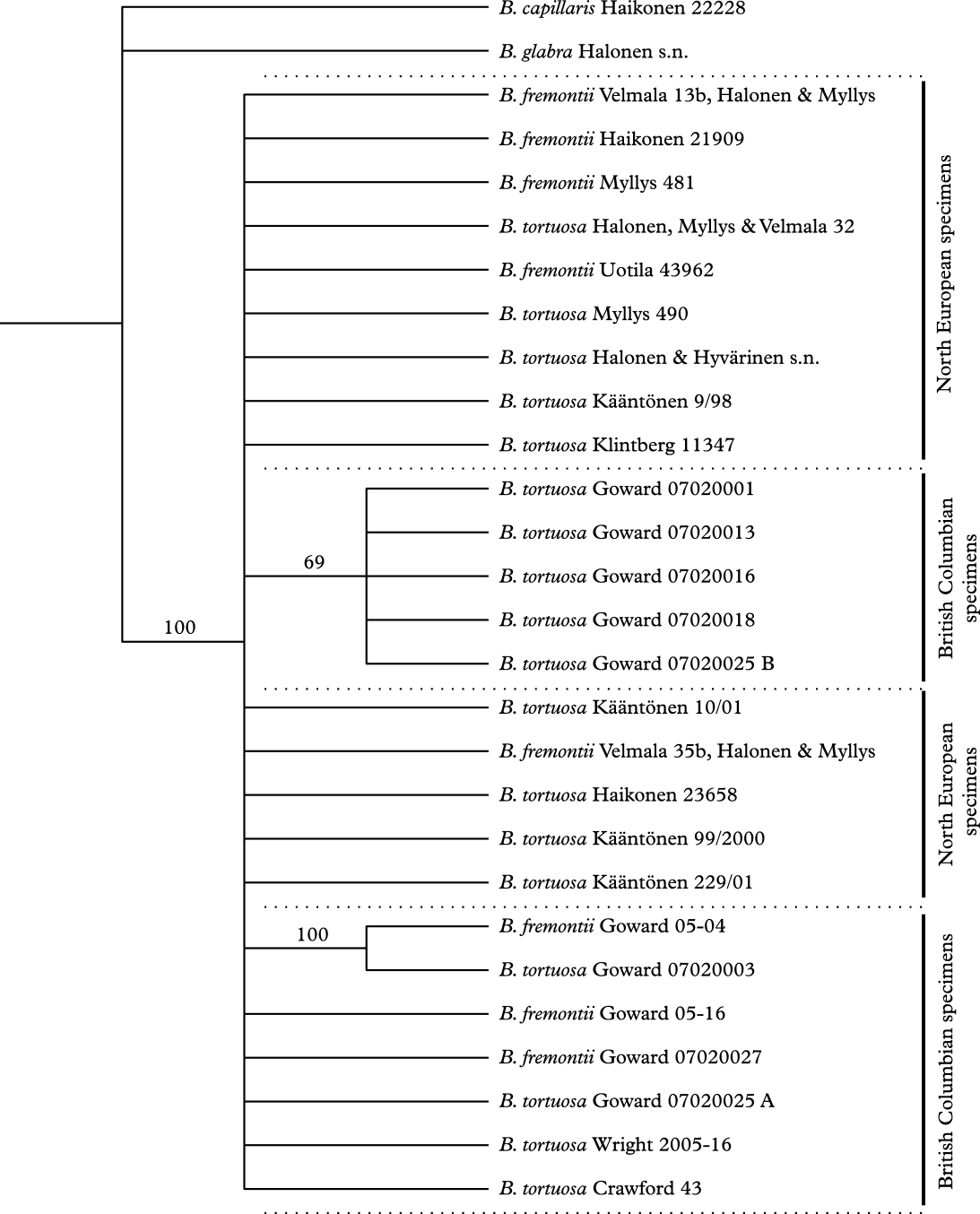
In the strict consensus trees of both analyses (Figs 1 & 2), the ingroup was monophyletic with a 100 % bootstrap support value. The relationships in the ingroup were mostly unresolved. In the ITS + IGS analysis, two clades with only European specimens appeared with bootstrap support values of 61 % and 98 % as well as two clades with only North American Bryoria tortuosa specimens with bootstrap support values of 87 % and 62 %. In the IGS + ITS + mtSSU + GAPDH analysis only two clades appeared both including merely North American specimens (support values 69 % and 100 %). The analyses with gaps treated as missing data revealed almost identical tree topologies (trees not shown).
Molecular phylogeny of Bryoria fremontii and B. tortuosa. A strict consensus tree of two trees based on ITS and IGS data. Bootstrap support values are shown above the nodes.
Molecular phylogeny of Bryoria fremontii and B. tortuosa. A strict consensus tree of 468 trees based on ITS, IGS, mtSSU and GAPDH data. Bootstrap support values are shown above the nodes.
In the ITS + IGS data set the IGS region was slightly more informative than the ITS (5·2 % vs. 4·0 %). In the ITS + IGS + mtSSU + GAPDH data set the mtSSU was the most informative region (9·3 %), followed by IGS (5·4 %), GAPDH (5·1 %) and ITS (4·0 %). Without the outgroup taxa, however, the information contents of the four DNA regions were considerably lower. In the ITS + IGS data set the regions were almost equally informative (ITS 1·1 % vs. IGS 0·9 %). In the ITS + IGS + mtSSU + GAPDH data set the mtSSU was the most informative region (7·3 %) followed by IGS and ITS (both 0·9 %) and GAPDH (0·6 %).
Discussion
Neither Bryoria fremontii or B. tortuosa was monophyletic in the combined analyses. Furthermore, the few monophyletic groups found in the strict consensus trees did not correlate with the current taxonomic delimitation. Although some of the clades included only B. tortuosa specimens, the remaining ones contained both B. fremontii and B. tortuosa specimens (Figs 1 & 2). Interestingly, in spite of low resolution all clades in the strict consensus trees included either North American or European specimens, hence suggesting some level of geographical population differentiation, although analysis of more collections is needed before reaching definite conclusions. We interpret these results as consistent with the hypothesis that the chemical and morphological variation of the sample material fall within the range of variation of a single species. Bryoria tortuosa can thus be considered as a synonym of B. fremontii; see below for a detailed synonymy. Specimens of B. fremontii in which vulpinic acid is present in abundance will henceforth be referred to as ‘B. tortuosa’.
The amount of homoplasy was extremely low in both analyses as indicated by high CI and RI values. This suggests that the low resolution in the strict consensus trees (Figs 1 & 2) reflects a lack of information (i.e., almost identical ingroup sequences) rather than conflicting characters between different gene regions. The partition-homogeneity test detected significant incongruence between GAPDH and IGS regions as well as between GAPDH and ITS regions. Because of the low amount of homoplasy, the incongruence between these regions might be explained by, for example, recombination. This implies that usually asexually reproducing Bryoria fremontii may have a capability for sexual reproduction.
Recent studies have successfully used the ITS, IGS, mtSSU and GAPDH regions in several intrageneric and population studies of lichenized fungi (e.g., Myllys et al. Reference Myllys, Stenroos and Thell2002; Printzen et al. Reference Printzen, Ekman and Tønsberg2003; Argüello et al. Reference Argüello, Del Prado, Cubas and Crespo2007; Lohtander et al. Reference Lohtander, Ahti, Stenroos and Urbanavichus2008). IGS is usually more variable than ITS and can be expected to contain sufficient information to separate genetically isolated populations (Printzen & Ekman Reference Printzen and Ekman2002; Lindblom & Ekman Reference Lindblom and Ekman2006, Reference Lindblom and Ekman2007). The mtSSU region usually contains highly variable portions, which are difficult to align and are thus sometimes removed from parsimony analyses (e.g., Mangold et al. Reference Mangold, Martín, Lücking and Lumbsch2008). In this study, the mtSSU was the most informative region. However, the relatively high information content resulted mostly from a long deletion at the end of the mtSSU present in two specimens. When the deletions were excluded, the ingroup sequences were almost identical.
As already discussed, we were unable to find any significant correlation between chemistry and phylogeny, as both vulpinic acid-rich specimens (‘Bryoria tortuosa’) and vulpinic acid-deficient specimens (B. fremontii) appeared in the same clade. The factors regulating the production or distribution of vulpinic acid are unknown. According to Stephenson & Rundel (Reference Stephenson and Rundel1979) and Golojuch & Lawrey (Reference Golojuch and Lawrey1988), light intensity and substratum have no effect on the concentration of vulpinic (and pinastric) acid in either Letharia vulpina (L.) Hue or Vulpicida pinastri (Scop.) J.-E. Mattsson. These results may be species-specific, but according to Hermansson & Thor (Reference Hermansson and Thor2004), Crawford (Reference Crawford2007) and our own observations, B. fremontii and ‘B. tortuosa’ can grow in mixed populations under the same environmental conditions. This fact could indicate that the variation in vulpinic acid concentration is not connected to the possible ecological differences (Holien Reference Holien1986) between B. fremontii and ‘B. tortuosa’. On the other hand, extensive field experience by one of us (TG) in western North America strongly suggests that ‘B. tortuosa’ is much more frequent here in summer-dry regions than in more humid regions. Crawford (Reference Crawford2007), in his western Canadian study of B. fremontii and B. tortuosa, showed that: 1) vulpinic acid-rich specimens usually grow intermixed with vulpinic acid-deficient specimens, while the vulpinic acid-deficient specimens, for their part, often form non-mixed populations; and 2) vulpinic acid-rich specimens tend to be localized within certain areas and even on certain trees within those areas. These observations are consistent with the hypothesis that ‘B. tortuosa’ may arise from time to time in populations of B. fremontii, the enhanced production of vulpinic acid being triggered by some environmental factor or factors as yet unknown. Here it can be noted that a somewhat similar mechanism may operate between Calicium glaucellum Ach., which lacks vulpinic acid, and C. trabinellum (Ach.) Ach. which contains it. Here again the presence of vulpinic acid correlates with summer-dry forests (T. Goward, pers. obs.). Interestingly, it appears that European ‘B. tortuosa’ is never as rich in vulpinic acid as its North American counterparts, i.e., the production of vulpinic acid seems to be more abundant in North America.
The Species
The citations below include some corrections to earlier data.
Bryoria fremontii (Tuck.) Brodo & D. Hawksw
Opera Bot. 42: 136 (1977).—Alectoria fremontii Tuck., Am. J. Arts Sci. ser. 2, 25: 422 (1858); type: USA, California, Sierra Nevada, ‘camp of Dec. 5–6’, 1845, J. C. Frémont (FH-Tuck. 498—holotype!).
New synonym: Bryoria tortuosa (G. Merr.) Brodo & D. Hawksw., Opera Bot. 42: 138 (1977).—Alectoria tortuosa G. Merr., Bryologist 12: 5 (1909); type: Canada, British Columbia, near New Westminster, July 1904, A. J. Hill (FH-hb. G. K. Merrill—holotype!).
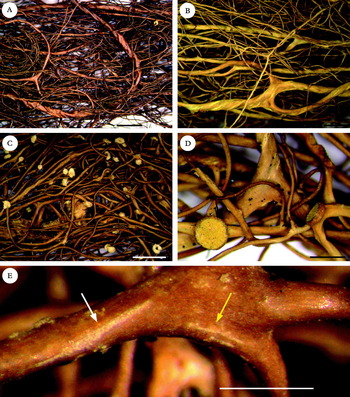
Bryoria fremontii. A, typical vulpinic acid-deficient chemotype showing reddish brown hue and foveolate branches (Velmala 13b et al.); B, typical vulpinic acid-containing chemotype showing yellow-brown hue and yellow pseudocyphellae (Goward 07020025); C, thallus with yellow soralia and pseudocyphellae (Crawford 52); D, thallus with yellow apothecia and pseudocyphellae (Crawford 32); E, branch with both yellow (yellow arrow) and white (white arrow) pseudocyphellae as seen in fresh material (Crawford 52). Scales: A – C = 2 mm; D = 1 mm; E = 0·5 mm.

Alectoria olivacea Räsänen, Meddeland. Soc. Fauna Fl. Fenn. 43: 4 (1917).—Alectoria fremontii subsp. olivacea (Räsänen) Räsänen, Luonnon Ystävä 23: 10 (1919); type: Finland, Ostrobottnia ultima, Simo, 6 Jun 1916, V. Räsänen (H—lectotype!, designated here; CANL, H, NY, OULU, TUR, UPS—isolectotypes!).
Alectoria corneliae Gyeln., Ann. Crypt. Exot. 4: 171 (1931); type: Oregon, Linn Co., near Brownsville, 25 May 1930, L. L. Haskin (US—holotype!).
For further synonyms see Brodo & Hawksworth (1977: 136 & 138).
The synonymous name Alectoria olivacea, given to a non-sorediate morph of Bryoria fremontii, was lectotypified in H by Brodo & Hawksworth (Reference Brodo and Hawksworth1977). However, there are several specimens with identical labels, and they did not annotate any of them. Therefore it was necessary to make a second-step lectotypification and restrict the type designation to one specimen. Isolectotypes exist in several other herbaria.
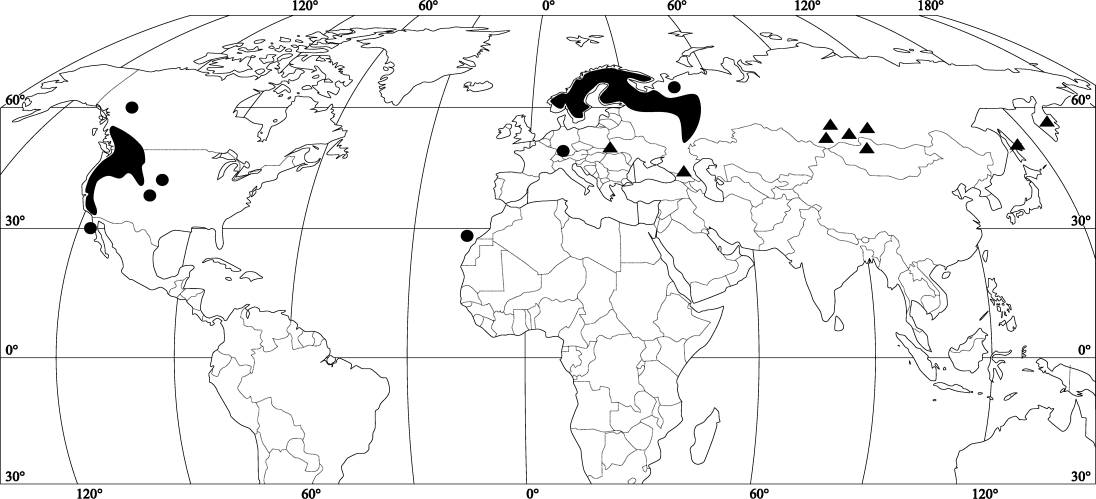
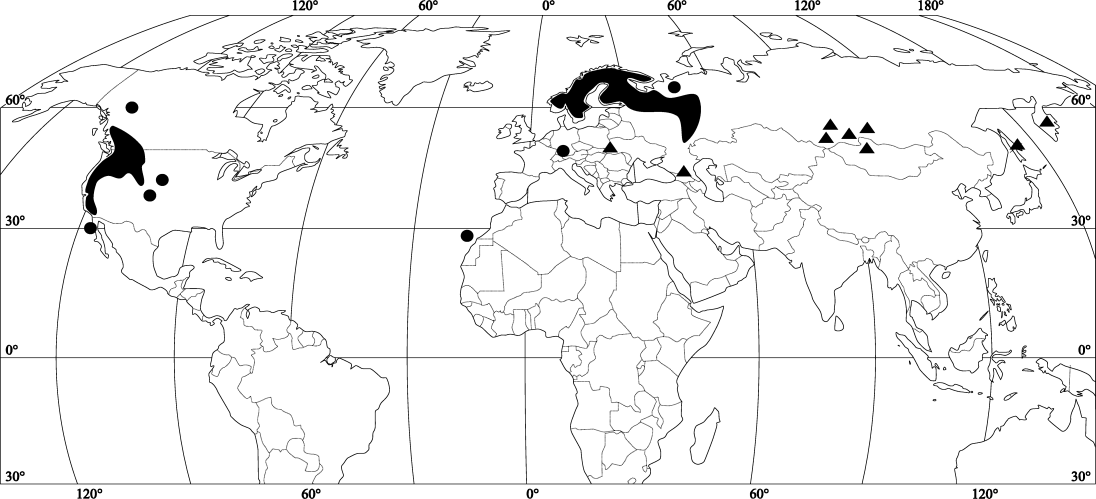
The global distribution of Bryoria fremontii based on Ahlner (Reference Ahlner1948) and Brodo & Hawksworth (Reference Brodo and Hawksworth1977), with later additions from the literature as well as herbarium material. The record from the Canary Islands is by Hawksworth (Reference Hawksworth1982). The records accepted from Russia include those in the following papers: Hermansson & Kudryavtseva Reference Hermansson, Kudryavtseva and Degteva1997: 218, Pystina & Hermansson Reference Pystina, Hermansson and Taskaev1998 (map), Petrova Reference Petrova2000 (map), Kravchenko Reference Kravchenko2003, Urbanavichus & Urbanavichene Reference Urbanavichus, Urbanavichene, Afonina and Golubkova2004 (in part), Chkobadze Reference Chkobadze, Konechnaya and Suslova2004 (map), Kuznetsova et al. Reference Kuznetsova, Ahti and Himelbrant2007, Fadeeva & Kravchenko Reference Fadeeva, Kravchenko, Ivanter and Kuznetsov2007 (map), Fadeeva et al. Reference Fadeeva, Golubkova, Vitikainen and Ahti2008 and Urbanavichus et al. Reference Urbanavichus, Ahti and Urbanavichene2008. Records from the Altay, Sayan and other mountains in the south of Siberia, Mongolia, the Carpathians, the Caucasus, the Kamchatka Peninsula and Sakhalin (e.g., Sedel'nikova Reference Sedel'nikova1985, Reference Sedel'nikova1990, Reference Sedel'nikova and Krasnoborov1998; Byazrov et al. Reference Byazrov, Ganbold, Gubanov and Ul'ziykhutag1989; Mikulin Reference Mikulin1990; Oxner Reference Oxner1993) could not be confirmed and are mapped as doubtful records (indicated with triangles).
Thallus pendent, up to 60 cm long, dull yellow to reddish, pale or dark brown, colour varying within the same specimen (i.e., depending on the concentration of brown pigment and vulpinic acid), cortex dull or shiny; branching mainly anisotomic dichotomous, angles between the dichotomies acute, sometimes with perpendicular side branches, branches uneven in diameter, the broadest ones often twisted and foveolate, sometimes flattened; soralia absent or sparse, sometimes abundant, tuberculate, bright to pale yellow; pseudocyphellae abundant or sparse to almost absent, when present usually conspicuous, elongate or fusiform, white to bright yellow, colour sometimes varying within the same specimen; true lateral spinules and isidia absent; apothecia rare.
For a detailed description of vegetative tissues, ascoma and spore characters, see Brodo and Hawksworth (Reference Brodo and Hawksworth1977).
Chemistry. Contains vulpinic acid in the thallus, soralia and apothecia, though often absent from the thallus per se. Barbatolic and norstictic acids rarely present.
Distribution and habitat. Bryoria fremontii occurs predominantly in western North America (Canada, USA, Mexico) and northern Europe (Norway, Sweden, Finland, Russia), with outliers in Germany and the Canary Islands, mostly on conifers, but also on deciduous trees in open or shady forests. The global distribution of Bryoria fremontii is presented in Fig. 4.
We wish to thank Stu Crawford for sending fresh material from Canada and G. P. Urbanavichus for giving valuable data on distribution of Bryoria fremontii in Russia; Leena Helynranta, Tuomo Niemelä and Tuuli Timonen for their help with the graphics; Jaana Kekkonen, Pia Tahvanainen and Maria Piisilä for their work at the MES-Laboratory, Department of Biological and Environmental Sciences, University of Helsinki. We also thank the curators of FH, UBC, UPS and US for providing us with material. The study was funded by the Finnish Ministry of Environment as a part of the research programme on insufficiently known and threatened forest species (“PUTTE”).