The circulation, re-use and revision of seventeenth- and eighteenth-century opera librettos and their musical settings are well-known aspects of the genre. This mutability has greatly influenced our idea of how opera functioned as a genre during this period.Footnote 1 Often, revised versions of a libretto were principally adaptations made to suit the requirements of local theatres and performers, but at other times changes were made to update a libretto in conformance with changing literary and dramaturgical tastes. Both grounds for revisions may have had the same effect on a libretto: the insertion, deletion, replacement or reshuffling of recitatives and arias, and even the removal or addition of entire characters and scenes. Studying such revisions can be useful, because the altered elements of a libretto presumably indicate problematic points as it made the transition from one context to another.
Whereas the circulation and revision of opera librettos and scores have been the subjects of sustained interest and study, these issues have not been explored much with regard to Italian oratorios of the same period.Footnote 2 Early eighteenth-century theorizing on (musical) drama also addressed the oratorio. Arcangelo Spagna's 1706 Discorso dogmatico on the Italian oratorio, published as the theoretical preface to an edition of his own oratorio librettos, posed the question of stylistic change explicitly, and the author credited himself with playing a decisive role in the genre's modernization.Footnote 3 Spagna revised a number of his own oratorio librettos for this edition, and numerous other oratorios also underwent rewriting during their life cycle.Footnote 4 Until the circulation and revision of oratorio librettos are studied more systematically and extensively, however, we will remain substantially in the dark about how common and extensive they were, and about how oratorio compares to opera in this respect.
REVISIONS, REFORM AND ZENO ON THE ORATORIO
Aside from Spagna's Discorso dogmatico, one of the few printed theoretical statements by a practising librettist on Italian oratorio reform is the dedicatory preface to the 1735 Poesie sacre drammatiche by Apostolo Zeno (1668–1750), imperial poet in Vienna from 1718 until 1729.Footnote 5 The book, dedicated to emperor Charles VI and his wife, is a republication of his oratorio librettos. Zeno was recognized in his time for playing an important role in the moral elevation and dramaturgical reform of the Italian opera libretto, notwithstanding the fact that he was not the first librettist to adopt such poetic and dramaturgical principles.Footnote 6 Zeno himself was well aware of the inevitable need for almost perpetual revision, and his approval of the changes made to his Griselda libretto by Girolamo Gigli for performances in Florence in 1703 shows that he did not claim immunity from this process.Footnote 7 Curiously, however, Zeno's theoretical statements on the oratorio and his oratorio librettos have so far been little studied, despite his undisputed significance as a librettist and the importance he attached to these works.Footnote 8
At the end of his life Zeno claimed that he ‘truly regretted’ having written his opera librettos, but that he ‘recognized the oratorios as something dear’ (‘pentirsi da vero d'averli fatti’, that is, the drammi, but ‘riconoscer per cosa cara gli oratorii’).Footnote 9 His preference for the oratorios is also reflected in his self-financing of the unprofitable Poesie sacre drammatiche, copies of which he donated to friends.Footnote 10 He appears to have been convinced that in his oratorios he had been able to come closer to the kind of dramatic poetry to which he aspired. In a letter to Giuseppe Gravisi from November 1730, prompted by the publication of Ludovico Muratori's Della perfetta poesia italiana, Zeno asserts that, compared with his opera librettos,
più di tenerezza nudrisco per li miei oratori, ove conservo l'unità del luogo, dell'azione, e del tempo, e la nobiltà de’ caratteri, e la proprietà degli affetti: talchè potrei ridurli a buone tragedie, se gli stendessi con più versi, e li rendessi liberi dalla necessità della musica, con cui debbono essere recitati nella Cappella Cesarea.Footnote 11
I have more affection towards my oratorios, in which I preserve the unity of place, action and time, as well as the nobility of the characters and the propriety of the affects, such that I could make them into good tragedies if I laid them out with more verses and liberated them from the necessity of the music with which they must be performed within the Imperial Chapel.
The key element of observing Aristotelian unities returns in greater detail in the Preface to the Poesie sacre drammatiche. Even there, Zeno focuses first on his opera reform, alleging that the imperial couple's grave customs and dignified character led him to ban the comical and the effeminate from his opera librettos. He instead sought out episodes illustrating princely virtues in the lives of ancient heroes and princes.Footnote 12 Similar noble sentiments permeate Zeno's views concerning the oratorio libretto, which he says is subject to rules even if oratorios are not intended to be acted (despite what other authors seem to think). According to him, this type of poetry should only treat of the marvellous actions worked by God, Scripture alone should serve as a guide, personifications of abstract concepts such as ‘Scripture’ itself (much less God himself) should not be used as singing characters and, more generally, ‘treating such sublime topics with more dignity and artfulness was necessary and praiseworthy’ (‘Parendomi perciò, che . . . maneggiare con più dignità ed artifizio così sublimi argomenti necessario fosse e lodevole’).Footnote 13 Zeno decries those who not only use God as a character, but also put into his mouth ‘certain profane expressions, certain tasteless similes and even musical arias’ (‘certe espressioni profane, certe comparazioncelle meschine, e insino le musiche ariette’). He instead sought ‘to have the characters, and especially the patriarchs, the prophets and the apostles, express themselves in the style of the Scripture and with the sentiments of the Fathers and Doctors of the Church’ (‘Studiai in oltre di far ragionare le persone, e in particolare i patriarchi, i profeti, e gli apostoli con lo stile delle Scritture, e co’ sentimenti de’ padri e dottori della chiesa’).Footnote 14 In both opera and oratorio, Zeno sought a dignity and uniform seriousness of tone and subject matter.
As for the ‘sublime arguments’ treated by the oratorios, Zeno declares that ‘little by little, according to the precepts, I adapted them to the unities of action, time and, for the most part, of place’ (‘li ridussi a poco a poco, giusta i precetti, a unità di azione e di tempo, e per lo più ancora di luogo’).Footnote 15 The observance of the unity of time had already been advocated by Spagna, who advised that one ought to constrain a story to the arc of one day and not distance oneself from Aristotelian precepts (‘Nè in questo dobbiamo punto allontanarci da i precetti Aristotelici, nel rappresentarlo dentro il termine di un giorno naturale’).Footnote 16 The French classical tragedies of Racine, Corneille and their contemporaries also influenced Zeno's opera and oratorio librettos.Footnote 17 This is particularly evident in the oratorio Joaz (1726), where Zeno notes in the printed libretto that, in addition to scriptural elements, ‘the tragedy entitled Athalia by the famous Racine has been an excellent guide for me’ (‘mi è stato eccellente guida il famoso Racine nella sua tragedia intitolata ATHALIA’).Footnote 18
Rather than explore how Zeno realized these principles in his own oratorio librettos, this article analyses the only known case in which Zeno revised another poet's oratorio libretto in preparation for a new musical setting. In 1726 he penned a series of changes, for the most part as simple as they were radical, directly into a copy of a 1712 Florentine libretto entitled Odio ed amore ovvero Assalonne nemico del padre amante.Footnote 19 This case allows us to observe how Zeno worked within the constraints of a pre-existing text, which means that the revisions themselves set his views on the oratorio as a literary genre in particular relief, while also revealing more practical concerns. Furthermore, by placing Zeno's revisions of Odio ed amore within the context of the libretto's previous history in Tuscany, we see that, as in the case of opera-libretto reform, his stylistic emendations are in line with a broader gradual process of change.
DOMENICO CANAVESE'S ODIO ED AMORE IN TUSCANY
The 1712 libretto of Odio ed amore ovvero Assalonne nemico del padre amante documents the oratorio's first known performance, which took place in Florence at an unspecified venue. It identifies Domenico Canavese as the author of the text. Little is known about Canavese, but he wrote a number of oratorio librettos that all received their first performances in Florence, a city with a flourishing oratorio scene at a number of lay confraternities and the Congregation of the Oratorio.Footnote 20 The libretto is based on the biblical account of David and Absalom in II Samuel, principally the elements narrated in chapters 14, 17 and 18. Absalom, son of King David, returns to his father's court after having previously ordered the assassination of his half-brother Amnon, who had raped Absalom's sister Tamar. Absalom subsequently musters support for a coup d’état against his father. David orders Joab and his military to spare the life of Absalom, but Joab kills him nonetheless and delivers the news to David. In Odio ed amore Canavese expands on the biblical sources of the story by supplementing the characters of Assalonne (Absalom), David and Gioab (Joab) with Assalonne's mother Macami (Maacah) and Amnon's mother Arsinoe (Ahinoam). The first part of the oratorio covers Assalonne's return to court and his return to favour with David, and the second part opens with David's realization that Assalonne has turned his army against him, then continues with the battle at the forest of Ephraim and Assalonne's death.
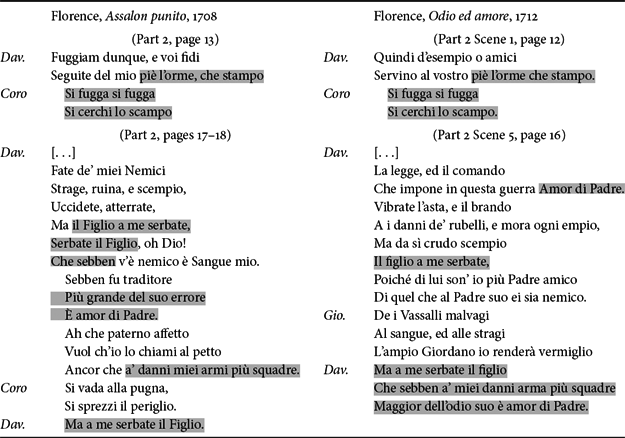
Canavese appears to have had a fondness for this particular biblical story, since Odio ed amore was his second oratorio based upon it. Almost exactly the same events form the outline of his Assalon punito, which was performed in 1708 at the oratory of the Congregation of the Oratorio in Florence, reportedly with music by Antonio Veracini (1659–1733).Footnote 21 Although Assalon punito and Odio ed amore are two distinct works, the presence in both librettos of similar turns of phrase indicates that Canavese had the former libretto at hand while writing the latter (Table 1). A direct borrowing is the brief turba chorus ‘Si fugga si fugga’ that appears in both librettos when David discovers that Assalonne is about to have his army move against him. Another, more diffuse, intertextual connection is Canavese's elaboration of David's command to his armies to spare his son Absalom, based on the biblical phrase ‘Servate mihi puerum Absalom’ (II Samuel 18:5).
Comparison of two passages in Assalon punito (Florence, 1708) with two passages in Odio ed amore (Florence, 1712), both by Domenico Canavese

It is possible, of course, that Canavese simply reused the two lines of text for ‘Si fugga si fugga’ in Odio ed amore, but why he would borrow text so directly only in this one case is unclear. Perhaps the borrowing indicates a reuse of the 1708 musical setting of the chorus as well. If the identification of Veracini as the composer of the lost music to Assalon punito is correct, then Odio ed amore may also have been set to music by him. It is also possible, however, that only his turba chorus was reused, especially if Odio ed amore was a pasticcio oratorio (something not uncommon in Tuscany).
Two years after its Florence performance Odio ed amore received a further one in Pistoia as Assalonne nemico del padre amante.Footnote 22 The oratorio was heard on 30 January 1714 at the instigation of the local Accademia degli Risvegliati.Footnote 23 Already by that time, an anonymous hand had made some revisions to the text, including renaming the oratorio with what had been its subtitle. The title Odio ed amore, although justified by the oratorio's principal moral message, may also have been an attempt by Canavese to mirror recent operas with similar titles, in particular Matteo Noris's L'odio e l'amore, on an episode from the life of the Persian king Cyrus. That work had been performed in the Tuscan town of Livorno as recently as 1708.Footnote 24 The exploration of contrasting sentiments and duties – love, revenge, duty, honour, justice and reason of state – was a core characteristic of eighteenth-century opera seria, and to some extent this was also true of oratorios, providing a link between the two genres.
However, oratorio titles often corresponded to the name of their protagonist or summed up their essential moral lesson. Typical Florentine titles from the period include La costanza trionfante nel martirio di S. Lucia (Constancy Triumphant in the Martyrdom of St Lucia; 1705), L'arroganza punita nella morte di Golia (Arrogance Punished in the Death of Goliath; 1706), L'umiltà trionfante in S. Odoardo re d'Inghilterra (Humility Triumphant in St Edward, King of England; 1707) and Il trionfo della divina provvidenza ne’ successi di Santa Geneviefa (The Triumph of Divine Providence in What Befell St Genevieve; 1708).Footnote 25 The double title of Canavese's Odio ed amore ovvero Assalonne nemico del padre amante, however, is simultaneously less explicit and more redundant. The choice by the unknown reviser in Pistoia to keep only the subtitle seems to have been dictated by the convention of brief, explicit and self-explanatory titles.
In Pistoia revisions were also made to the oratorio's text. Of the twenty-two original arias in the 1712 version of Odio ed amore, one was replaced: Macami's aria ‘Santo amor’ (Part 1), in which she pleads with David once more to accept Assalonne, is substituted with a different aria having the same affect:

Given the similarity in sentiment, this substitution was probably motivated by musical concerns, although no musical sources appear to survive for either aria.Footnote 26
The Pistoia libretto contains one further significant revision. Instead of the original concluding duet between Assalonne's mother Macami and Arsinoe, the 1714 version ends with an aria for Macami (see Table 4 below).Footnote 27 The likely reason for this change was that the original finale lacked a clear moral lesson; a duet between Macami deploring her son's death and Arsinoe rejoicing in the same fact could hardly be construed as an edifying conclusion. Spagna had written some years earlier that the tradition of a concluding four-part chorus emphasizing the oratorio's moral message was being abandoned largely owing to lack of skill on the parts of both composers and singers: ‘one considers it better to leave this out and conclude the cantata [that is, the oratorio] with a cheerful aria that allows the audience to disperse with universal satisfaction’ (‘si è stimato meglio tralasciarlo, e terminare la ca[n]tata co[n] una arietta allegra, che discioglie con universale gradime[n]to il congresso’).Footnote 28 Interestingly, it was the finale of the Pistoia libretto that was revised, precisely the element addressed by Spagna. Whereas he advocated a cheerful rather than a moralizing conclusion, the new finale moved exactly in the opposite direction: the original duet was not quite a ‘cheerful aria’, but the new finale is more serious in tone, stressing that God dispenses mercy rather than punishment (though if penitence is delayed, there is no escaping his wrath).
ZENO'S REVISIONS
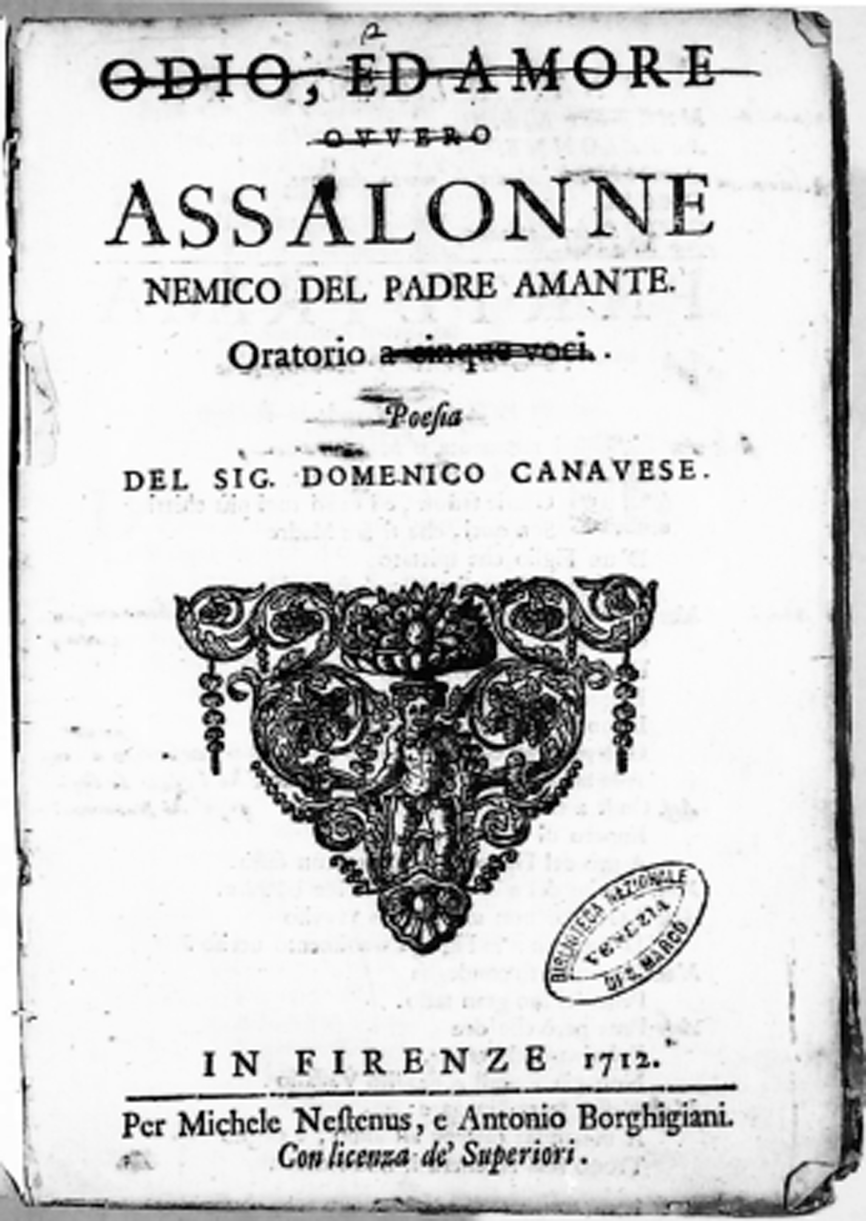
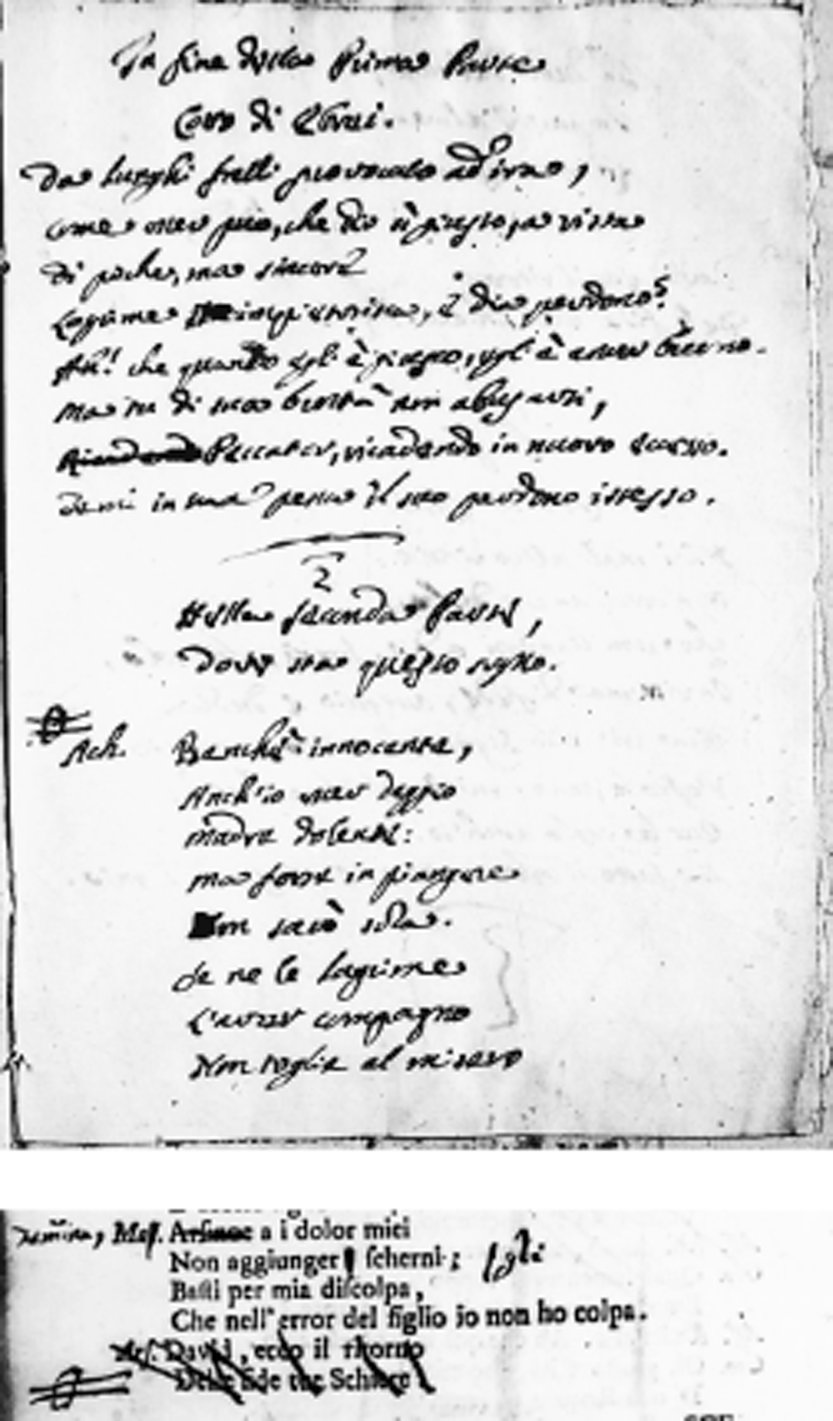
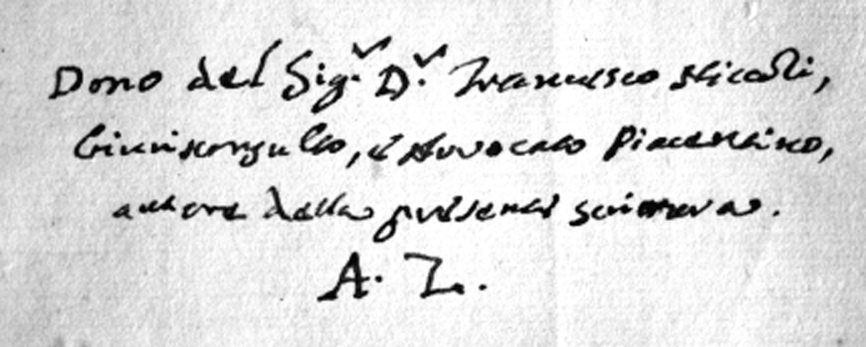
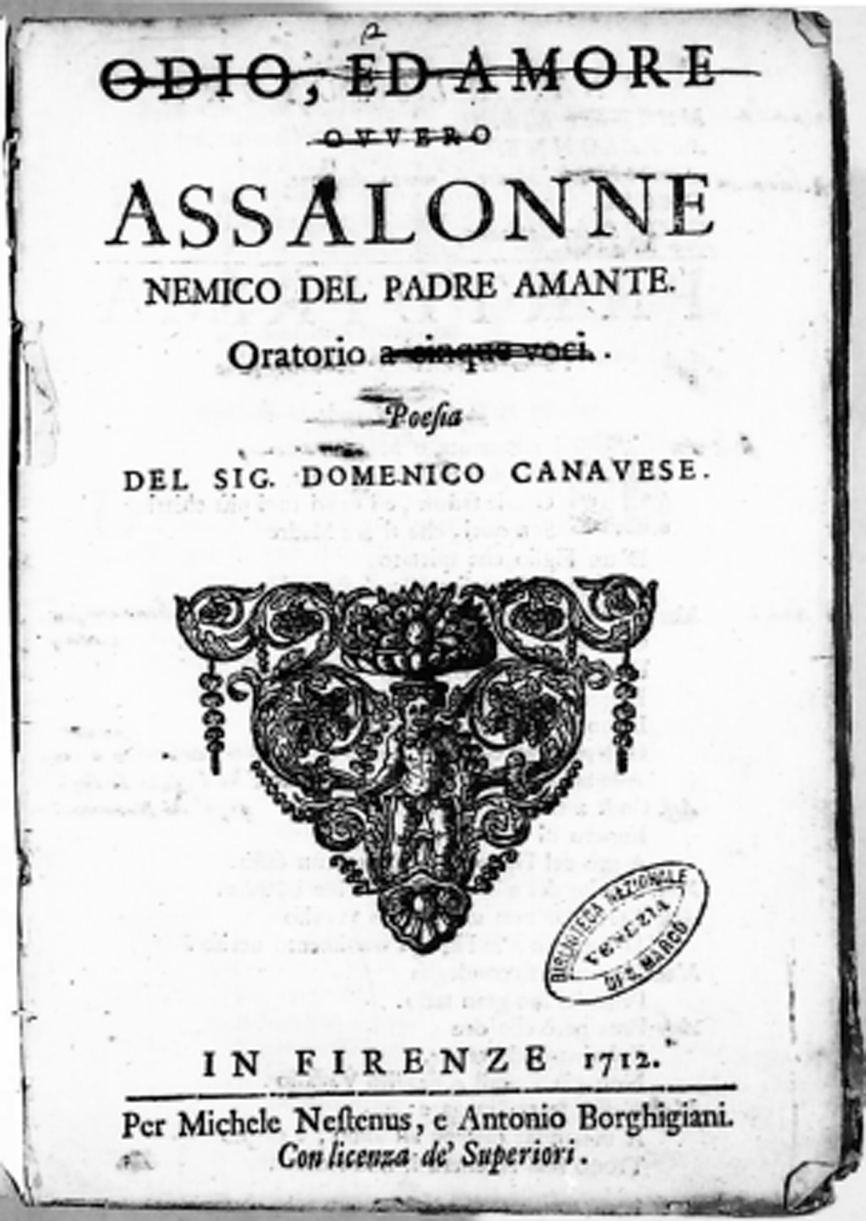
A copy of the 1712 libretto of Odio ed amore wound up in Zeno's library (Figure 1). There is no indication of why, when or how he obtained it, but he had a wide network of correspondents throughout Italy, including Florence, from whom he could have received it. Zeno's copy is included in one of the volumes of mostly early eighteenth-century Viennese oratorio librettos belonging to his large collection of Italian librettos, now at the Biblioteca Marciana in Venice.Footnote 29 In 1726 he revised the libretto in preparation for a new musical setting for the annual series of Italian Lenten oratorios, performed at the Imperial Chapel in Vienna in the presence of the imperial couple. During Zeno's years in the city, these performances featured either older works or new ones written by composers at the Viennese court, the latter on librettos by various poets. The oratorios were paired with sermons in Italian by preachers invited to Vienna. In short, these were the most important musical occasions at court during the Lenten season, both for librettists and composers, especially when new works were involved. A comparison of the revisions in Zeno's copy of Odio ed amore with confirmed samples of his handwriting leaves no doubt that the annotations written into the libretto and the text on a tucked-in piece of paper are all in his own hand (Figure 2). An autograph ownership note in another book from his library provides a corroborating example (Figure 3). That Zeno's revisions did not remain a preliminary or unused exercise is confirmed by further sources: a printed libretto from 1726 that incorporates his revisions, music by Giuseppe Porsile (1680–1750) that sets this revised libretto and a report of the work's performance all confirm that the oratorio was indeed performed in Vienna in 1726.
Title-page of Apostolo Zeno's copy of Domenico Canavese, Odio, ed amore ovvero Assalonne nemico del padre amante (Florence: Michele Nestenus and Antono Borghigiani, 1712). Venice, Biblioteca Marciana, Misc. 2461.2
Top: recto side of a sheet inserted between pages 10 and 11 of Zeno's copy of Canavese, Odio ed amore (1712) containing Zeno's chorus for the finale of Part 1 and the new aria ‘Benchè innocente’ for Achinoam in Part 2. Bottom: excerpt from page 18 of the libretto, with a symbol showing where the aria is to be inserted

Zeno's ownership note in a copy of Francesco Maria Nicoli, Ragioni della magnifica università di San Remo contro l'eccellentiss. camera rappresentate alla ser.ma repubblica di Genova (Piacenza: Filippo Giuseppe Giacopazzi, 1730). Venice, Biblioteca Marciana, 189.D.16.2

The fact that the oratorio was already fourteen years old in 1726, together with the different traditions and contexts represented by performances in Florence and Vienna, may have contributed to Zeno's revision of the text. But this was not the whole story. Other, even older, Italian oratorios continued to be performed in Vienna without such extensive revisions.Footnote 30 We do not know why and by whom Canavese's libretto was chosen for a new musical setting in Vienna, but Zeno's revision of it shows that he, at least, considered the original version unsuitable. It seems unlikely that he would have undertaken such work without a pressing need, for he usually had a busy schedule of writing opera and oratorio librettos for the imperial court, and his wariness of that obligation, which kept him from his scholarly activities, is well documented in his private correspondence.Footnote 31
There are no firm indications regarding the chronology of Zeno's revisions, but some basic deductions can be made. We know that Porsile's Assalonne nemico del padre amante was premiered on Thursday, 14 March 1726, during the first full week of Lent, which means that Zeno must have finished his revised libretto at least some weeks prior to that (although it is theoretically possible that Porsile had already started composing arias that he knew would be retained in the revised version).Footnote 32 Furthermore, at least a week before Porsile's setting was premiered, Zeno was already at the point of finishing a new oratorio libretto of his own invention that was to make its debut the following month. In a letter from 9 March 1726 to his brother Pier Caterino, just after the conclusion of Carnival, Zeno wrote:
Il carnevale si è qui terminato con gran chiasso, ma con più neve. . . . Io ne ho passati i tre ultimi giorni, non meno che i susseguenti di quaresima, in mia casa, talchè ebbi tempo di condur quasi a fine il mio nuovo Oratorio. In due o tre giorni gli darò compimento; e sarò per adesso libero di questo travaglio, a fine di dar poi l'applicazione ad un nuovo Dramma.Footnote 33
Carnival has concluded here with great uproar, and with even more snow. . . . I spent its last three days, just like the subsequent ones of Lent, at my house, so that I had time to bring my new oratorio almost to conclusion. In two or three days I will finish it; and for the time being I will be free of this burden, with the purpose of applying myself next to a new opera.
This new libretto was Joaz (subsequently spelled Gioaz in the Poesie sacre drammatiche), which premiered at the imperial chapel in Vienna with music by Antonio Caldara on Thursday, 4 April 1726.Footnote 34 Despite the pressure of producing his own libretto and the desire to start on a new opera (which would become I due dittatori), Zeno took the time to revise Odio ed amore, most likely upon request.Footnote 35
Zeno's revisions of Canavese's libretto consist of various interventions ranging from name changes to meticulous revisions of spelling and punctuation, and from substantial cuts and substitutions to smaller refinements of style and wording. In fact, the interventions appear to have had the double purpose of preparing a revised version of the oratorio and providing copy for a new Viennese edition of the libretto, as discussed below. Zeno's first revision concerns the title of the oratorio and the names of three of the five characters. In keeping with the Pistoia version of the libretto, which Zeno probably did not know, he deletes the main title Odio ed amore and retains the subtitle Assalonne nemico del padre amante. He may simply have preferred the more straightforward subtitle, which was in line with the names given to other oratorios performed in Vienna.
Zeno makes further changes right at the start, altering the name of Assalonne's mother from ‘Macami’ to ‘Maaca’, of Amnon (not a character in the oratorio, but referred to in the libretto) from ‘Ammone’ to ‘Amnone’, and of Amnon's mother from ‘Arsinoe’ to ‘Achinoam’. These choices reflect the more commonly accepted versions of these biblical names at the time. In fact, Canavese's spelling ‘Macami’ was rarely used and perhaps derived from an edition of Pietro Lauro's widely read Italian translation of Flavius Josephus’ Antiquitates Judaicae and De bello iudaico, which includes the story of David and Absalom.Footnote 36 Why Canavese called Amnon's mother ‘Arsinoe’ in the libretto is even more puzzling: the Vulgate calls her ‘Achinoam’, as does Zeno.Footnote 37
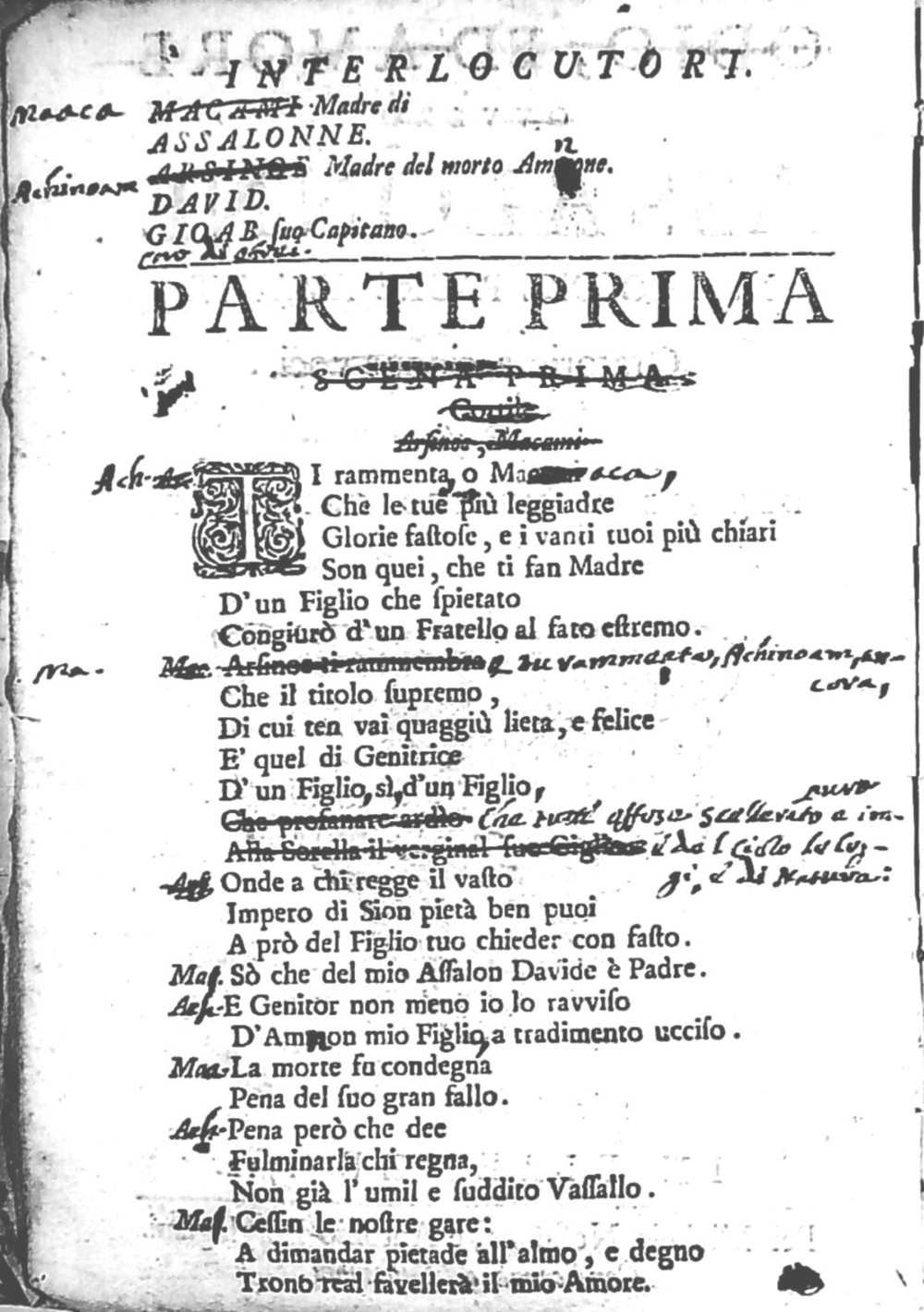
Only at the beginning and end of the libretto does Zeno rewrite some individual lines, as opposed to making wholesale cuts or substitutions. The smaller changes at the very end occur in connection with his more substantial revision of the finale, as we shall see below, but two small changes at the beginning are unconnected to such larger revisions. Rather, they seem to have been dictated by considerations of metre and personal taste. Both changes appear in Macami/Maaca's opening lines of recitative, in which she reminds Arsinoe/Achinoam that her son Amnon had raped his half-sister. The first line is changed for metrical reasons: because Zeno had replaced the three-syllable name of ‘Arsinoe’ with the four-syllable ‘Achinoam’, Canavese's original settenario would have had a syllable too many if Zeno simply changed the name (only settenari and endecasillabi were used for recitative). In order to resolve this problem, Zeno rewrote the line as an endecasillabo with the same meaning:
1712: ‘Ar·si·noe · ti · ram·mem·bro’ = 7
1726: ‘E · tu · ram·men·ta, A·chi·no·am, · an·co·ra’ = 11
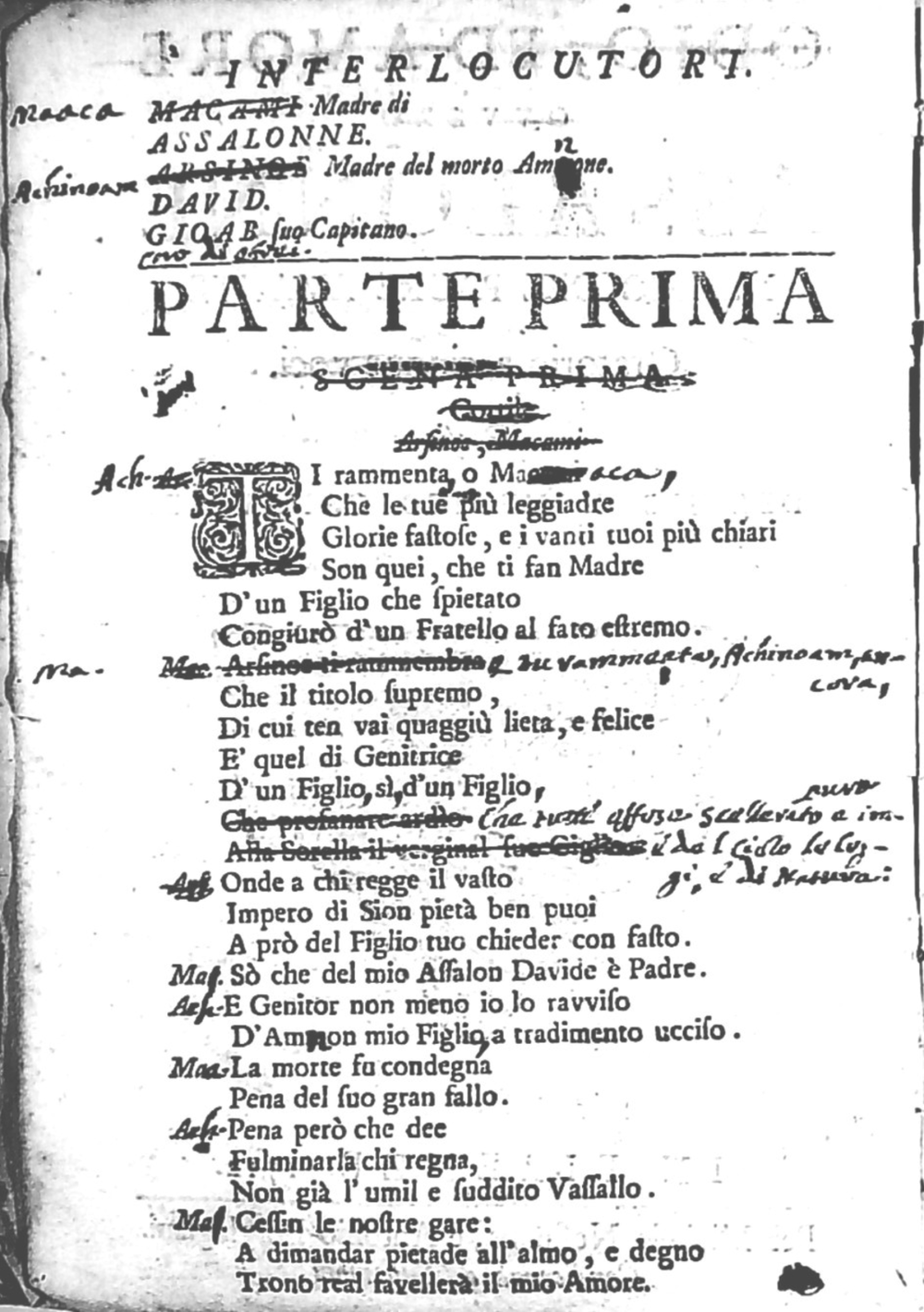
On the other hand, it appears that the last two lines of this recitative, in which Canavese describes the rape of Tamar, did not sit well with Zeno's poetical sensibilities (Figure 4). Whereas the original wording (expressed in a settenario + endecasillabo) speaks of Amnon who ‘dared to profane his sister's virginal lily’ (‘un figlio / Che profanare ardìo / Alla sorella il verginal suo giglio’), Zeno's revised text speaks (in a pair of endecasillabi) more coyly of Amnon ‘who wickedly and impurely offended all the laws of both the heavens and of nature’ (‘un figlio / Che tutte offese scellerato, e impuro, / E dal cielo le leggi, e di natura’). For Zeno, Canavese's wording was evidently a ‘profane expression’ or ‘tasteless simile’. His detailed changes here, at the beginning of the libretto, suggest that he initially intended to make a more heavily revised version of the text, but quickly abandoned this time-consuming prospect in favour of larger-scale, structural interventions.
First page of text of Zeno's copy of Canavese, Odio ed amore (1712), showing some of Zeno's revisions
Revisions to the rest of the text are more substantial and straightforward. The original libretto consisted of around 678 metrical lines, including eleven arias and two duets in the first part, and another eleven arias, one duet and a brief chorus (the one Canavese had taken over from the 1708 Assalon punito) in the second part. Zeno's most substantial interventions include cutting three arias in the first part and four in the second (where, however, he adds one new aria), and replacing the duets concluding each part with two new choruses. This brings the revised version of the libretto to a total of about 586 lines, including eight arias in each part, a single duet and the new choruses.Footnote 38 With a length of 635 lines, Zeno's own Joaz falls between these two line counts.Footnote 39 In his Discorso dogmatico, Spagna had stated that ‘ordinarily’ the ‘right length’ of an oratorio ought to be around 500 lines (‘La giusta longhezza di tali compositioni suol essere ordinariamente di 500 versi’), and Zeno's shortening of Canavese's text may reflect his agreement with this principle.Footnote 40 Yet Zeno allowed his own Joaz to be much longer, perhaps because it is easier to trim down someone else's text than one's own. In fact, in his preface to the Poesie sacre drammatiche Zeno mentions, with a tone of apparent resignation, that his own oratorios could have been called ‘sacred musical tragedies’ if he had made them longer, ‘which the short amount of time in which they had to be sung did not allow me to do’ (‘quando loro si fosse data una maggiore estensione . . . il che non mi era permesso dalla ristrettezza del tempo in cui cantar si dovevano’).Footnote 41
Nevertheless, Zeno also had sound dramaturgical and literary reasons for making some of his more radical cuts. In the first part of the oratorio he only cut arias and the final duet, but in the second part he deleted two entire scenes. This second part opens with David questioning his decision to forgive Assalonne, who is now about to attack him, followed by Gioab urging the king to flee (in the aria ‘Cerca scampo o re clemente’) and David's refusal to do so. Zeno cut the entire next scene (Canavese's Scene 2), in which Macami/Maaca pledges to stay with David. Although the scene itself does not appear to collide with Zeno's poetic principles, as a solo scene (containing Macami/Maaca's aria ‘Nel duro periglio con te venir voglio’ and thirteen lines of recitative) it could easily be cut without upsetting the narrative flow.
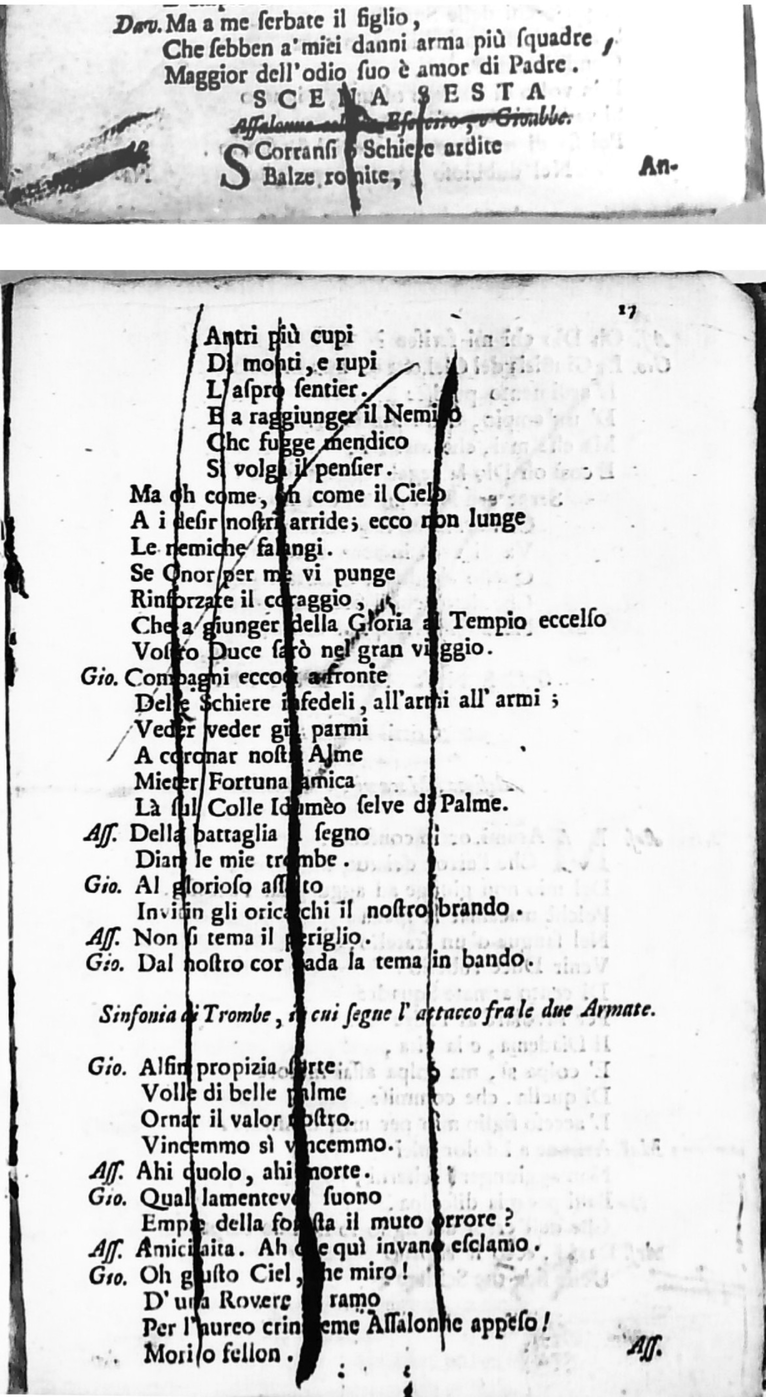
This cut scene is followed by Assalonne and his army's arrival at the gates of the city (Canavese's Scene 3: ‘Assalonne coll'esercito alle porte di Gerosolima’). Here Zeno deleted Assalonne's opening aria ‘La tromba che rimbomba’. Although Assalonne's bellicosity permeates this short scene as a whole, cutting the aria with its text about ‘the trumpet that resounds and calls us, o throngs of warriors, to battle’, was a way for Zeno to tone down the libretto's emphasis on war and battle while simultaneously shortening the text and rebalancing the distribution of arias among characters. After the longer Scenes 4 and 5 – where Macami/Maaca tries, without success, to convince her son Assalonne to abandon his ungrateful plan, and Gioab, with more success, convinces David not to take to the battlefield himself – Zeno deleted Scene 6, in which the armies of Assalonne and Gioab engage in battle following an instrumental interlude (‘Sinfonia di Trombe, in cui segue l'attacco fra le due Armate’) (Figure 5).
The bottom of page 16 and all of page 17 of Zeno's copy of Canavese, Odio ed amore (1712), with Zeno's crossings-out of all of Part 2 Scene 6
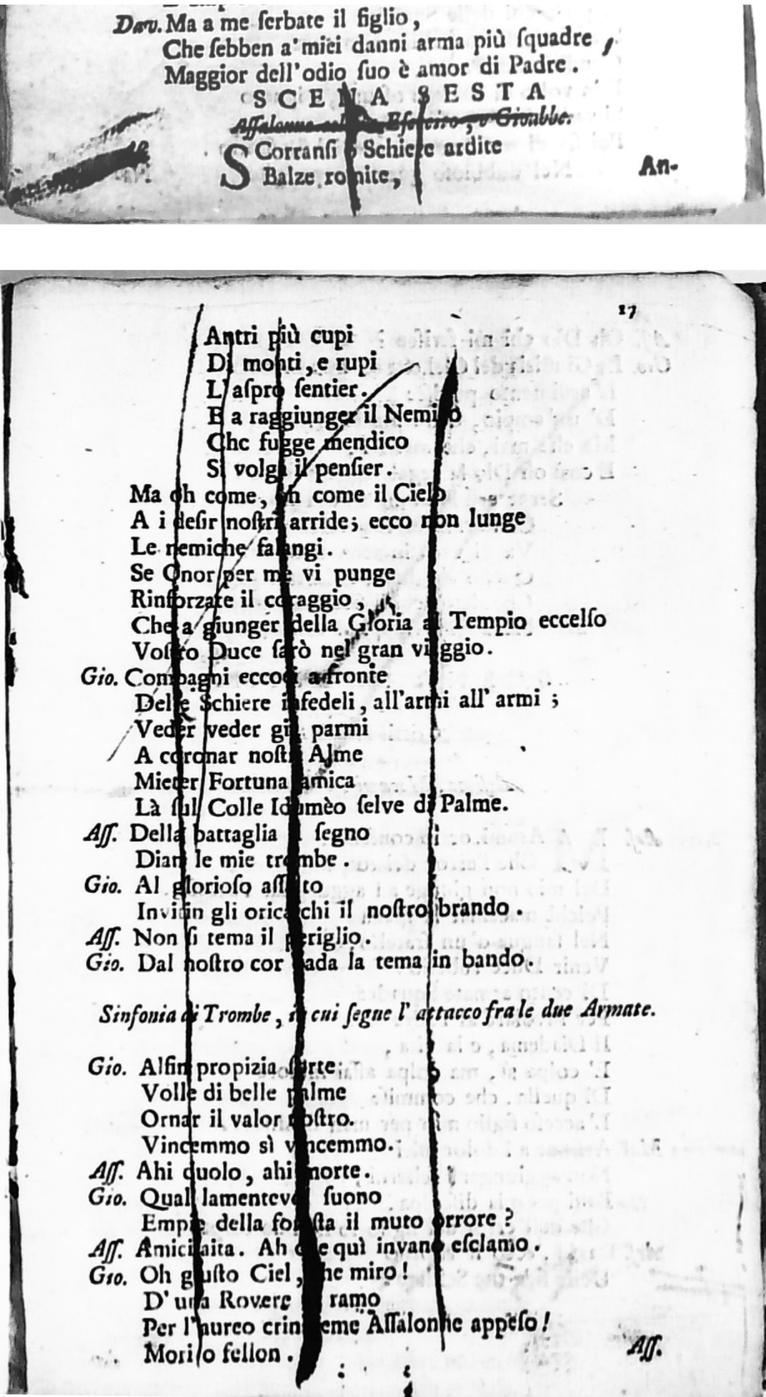
As Jean Grundy Fanelli notes, Tuscan oratorios include many scenes featuring military conflict and frequently mention the playing of trumpets.Footnote 42 In this respect the battle scene in Canavese's Odio ed amore was typically Tuscan. However, there were multiple reasons why Zeno would have found it a good candidate for omission. Despite its Old Testament character, the scene veered toward the profane and vulgar in its overt bellicosity and imaginary ‘live’ battle. In any case, it did not sit well with Zeno's high-minded ideals of dignified seriousness. Moreover, such an explicit transfer of the drama from a royal palace to a theatre of war plainly goes against the Aristotelian unity of place, which Zeno, as we have seen, tried to observe as much as possible.
As mentioned above, Zeno also cut individual arias. In total he eliminated three arias for Assalonne, two arias for Macami/Maaca, one aria apiece for David and Gioab, and duets for David–Assalonne and Arsinoe/Achinoam–Macami/Maaca. The latter duet was the only musical number for Arsinoe/Achinoam in the second part of the oratorio, and in order to compensate for its elimination Zeno provided her with a new aria – the only musical number he added besides the two choruses substituted for the duets.Footnote 43 The aria is placed, almost by necessity, in the short scene for Macami/Maaca and Arsinoe/Achinoam, now the only place where Arsinoe/Achinoam appears in the oratorio's second part (see Figure 2). Both the aria and the two new choruses are indistinguishable in style and content from comparable numbers in Zeno's own oratorio librettos.
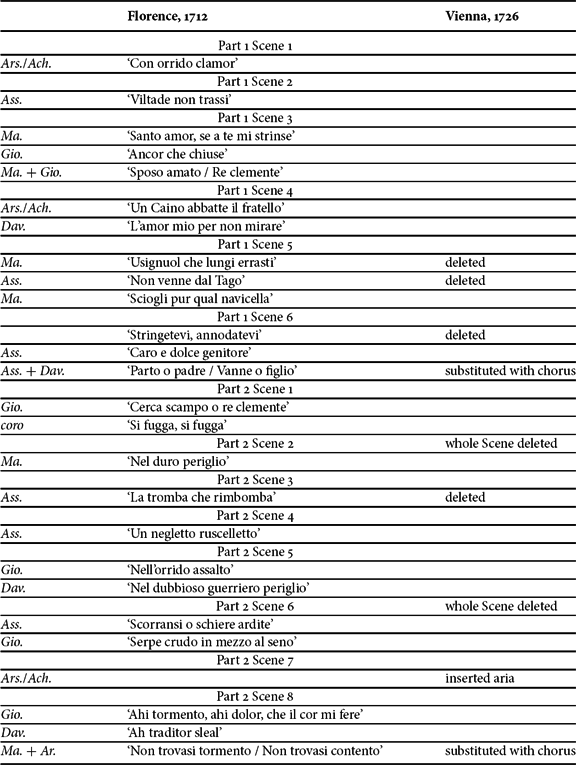
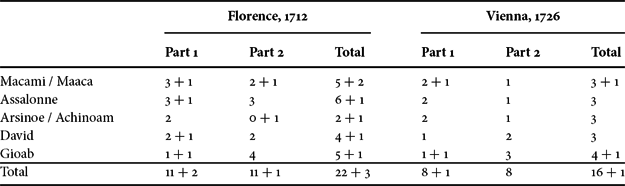
With these revisions Zeno reduced the count of musical numbers considerably: from twenty-two arias plus three duets to sixteen arias plus one duet (Table 2). This lower count is comparable to those in Zeno's own librettos. His Joaz from the same year, for instance, has seven arias in the first part and nine in the second; it also has choruses of Hebrews at the ends of the first and second parts that are similar to the ones Zeno wrote for Assalonne nemico del padre amante. Reducing the number of arias was among the reforms that Zeno took credit for with regard to opera librettos, recounting at the end of his life that ‘he had lowered the number of arias, which in an opera sometimes reached eighty in number’ (‘aver levato la quantità delle ariette, che in un drama arrivavano talvolta ad ottanta’).Footnote 44 In actual fact, Zeno was far less of an innovator in this respect than he claimed,Footnote 45 but his interventions in Odio ed amore show that in this case he did indeed reduce the number of arias in an older oratorio libretto, even if he never formulated a goal of doing so specifically in that genre.
Overview of the scene divisions, arias and duets in Odio ed amore (Florence, 1712), alongside revisions made for Assalonne nemico (Vienna, 1726)

Ars./Ach. = Arsinoe/Achinoam; Ass. = Assalonne; Dav. = David; Gio. = Gioab; Ma. = Macami (becomes Maaca in 1726)
Zeno's revisions also create a more even distribution of arias between the five characters (Table 3). This was neither a coincidence nor the result of purely dramaturgical considerations. The male and female singers employed at the Imperial Court, who sang in both opera and oratorio performances, were for the most part top-notch performers with international careers. As with opera arias, they would have wanted a distribution of oratorio arias that aligned with their relative professional statuses. Zeno's concern to avoid a great disparity between the characters in this respect is also reflected in his Joaz and David (1724). Of the six characters in the former oratorio, three have two arias, two have three arias and one, Athalia, has four. Similarly, two of the six characters in David have two arias, three have three arias and one, Saul, has four.
Overview of the number of arias and duets for each character in Odio ed amore (Florence, 1712) and Assalonne nemico (Vienna, 1726)

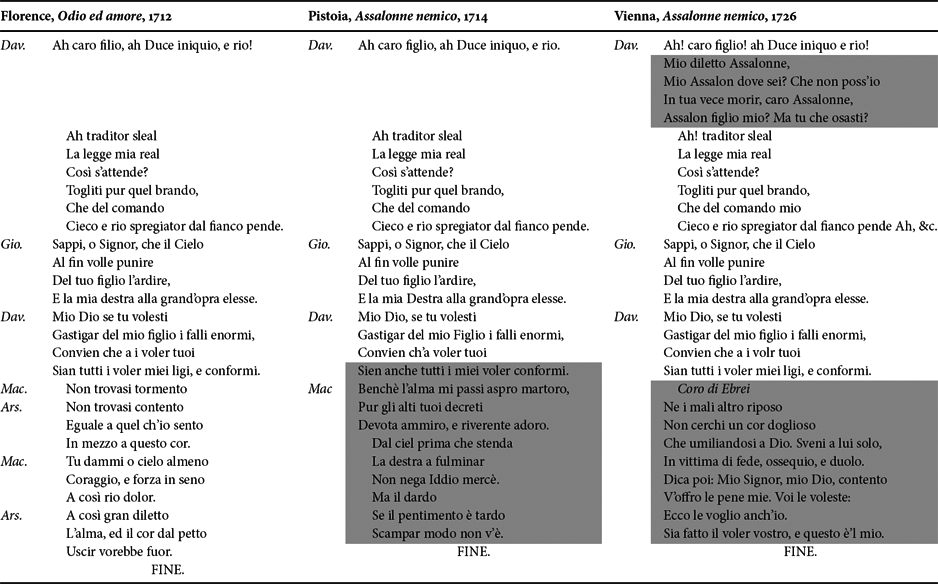
A number of revisions concern the work's finale, a dramatic point that was often of particular concern in oratorios because it tended to be where the moral message was summarized in a sententious way. As Spagna writes, it is the final choruses ‘from which the moral of the oratorio is derived at the end’ (‘ne quali si cavava nel fine la moralità dell'oratorio’).Footnote 46 In fact, one of the few revisions made to the libretto for the 1714 Pistoia performance concerned the oratorio's ending (Table 4). Zeno's own revision of the finale consists of a few separate but interrelated interventions: he added three lines of recitative, retouched Canavese's rhyme and metre in the last aria and replaced the concluding duet with a chorus of Hebrews. The recitative directly paraphrases David's well-known biblical lament in II Samuel 33: ‘fili mi Absalom fili mi Absalom quis mihi tribuat ut ego moriar pro te Absalom fili mi fili mi’.Footnote 47 In referencing one of the most expressive and well-known laments of the Old Testament, Zeno heightened the tragic character of the oratorio's finale, as opposed to the anger expressed in Canavese's aria ‘Ah traditor sleal’. The addition of the word ‘mio’ in the oratorio's last aria transforms one line from a quintenario to a settenario, sacrificing the end-rhyme brando-comando. The line now echoes the rio-io rhyme that Zeno created with his added lines of recitative, thereby tying them to Canavese's aria.
Three versions of the finale of the oratorio as they appear in Odio ed amore (Florence, 1712), Assalonne nemico (Pistoia, 1714) and Assalonne nemico (Vienna, 1726)

As is apparent from the 1714 revisions of the libretto for Pistoia, Arsinoe's rejoicing in the death of Assalonne in the oratorio's final duet was considered problematic. It is no surprise that Zeno also replaced the duet, given that it hardly corresponded with his ideal of preserving ‘the nobility of the characters and the propriety of the affects’. All of Zeno's oratorios, like most of those written for Vienna by others, end with a chorus. At the same time, he employed the new chorus to develop the point, made first in David's recitative, that one should accept God's will and make it one's own. As shown in Table 4, the chorus concludes with a prefiguration of phrases from the Lord's prayer and Christ's well known words at the Mount of Olives, both wishing that God's will be done rather than one's own (Matthew 6:10: ‘Fiat voluntas tua’, and Luke 22:42: ‘verumtamen non mea voluntas, sed tua fiat’).Footnote 48 Similarly, the final chorus of Canavese's Assalon punito (1708) implores King David to dry the tears of mourning Israel and leave the fate of his son Absalom to the will of God.Footnote 49 This reflected eschatological interpretations of the story's meaning in which Absalom's betrayal prefigures Judas's betrayal and David's unwavering love and forgiveness mirrors that of God the Father and Christ.
Zeno achieved two things with his revision of the finale: he linked the new final chorus organically to Canavese's pre-existing text and he introduced a more edifying conclusion. At the end of his life, Zeno declared having had a preference for ‘versifying with sententiousness’ (‘essergli piaciuto il verseggiar sentenzioso’), and this is borne out by his new conclusion to Canavese's libretto.Footnote 50 The Vocabolario of the Accademia della Crusca defines a sentenza in the sense that is meant here as ‘a brief and clever expression, generally held to be true’ (‘Sentenzia, si prende anche in significato di motto breve, e arguto, approvato comunemente per vero’).Footnote 51 The key word here is ‘arguto’ (clever or keen), a way of expressing a broadly accepted idea in a memorable way. In Zeno's own oratorio librettos this manner of writing is supported by numerous biblical or patristic paraphrases and references throughout the text, duly indicated in the margins of the printed libretto. Although references are not printed in the margins of the libretto to Assalonne nemico del padre amante, Giuseppe Porsile's musical setting of the oratorio's final chorus musically emphasizes the final textual line containing the paraphrase from Matthew and Luke. The chorus itself has a tempo marking of Adagio, but this last line is set apart from the rest with a new musical development in tempo giusto.
THE 1726 LIBRETTO
There are a few other differences between the 1712 and 1726 editions of Canavese's oratorio.Footnote 52 Although the work was probably not performed with action or staging in Florence, in the 1712 libretto the first part is divided into six numbered scenes and the second part into seven. Each scene is accompanied by imaginary stage indications (didascalie sceniche) and/or the names of the characters who appear therein (sometimes these two elements are combined into one line). The scenes in the first part place the action in and around the royal palace (‘cortile’; ‘gabinetto’; ‘camera regia’; ‘cortile’; ‘camera’), and scenes in the second part occur in yet further locations (‘sala reale’; ‘Assalonne coll'esercito alle porte di Girosolima’; ‘David, e Gioab coll'esercito accampato nella selva d'Effraim’; ‘cortil regio’). Zeno eliminated this division into numbered scenes and the imaginary stage indications. Although the latter were common in opera librettos and Zeno's own use of them in his operas was inventive, they were rarely used in oratorio librettos, even merely as a literary device to indicate the imagined location of the action.Footnote 53 No stage indications appear in other Viennese oratorio librettos of the time. In fact, the 1714 edition of the libretto had already deleted the numbering of the scenes and kept only three of the stage indications, although it retained precisely the ones that place the action outside the city of Jerusalem and on the battlefield; Zeno had the most reason to eliminate precisely these.Footnote 54 As with the finale, Zeno's revisions are in line with those made in Pistoia.
A comparison between the 1712 libretto with Zeno's mark-up, the printed libretto for the 1726 Viennese performance and the text as it appears in Porsile's score at the Österreichische Nationalbibliothek shows an almost exact correspondence between these sources.Footnote 55 In addition to the changes outlined above, Zeno edited the 1712 libretto for punctuation and capitalization. These minute changes were almost without exception followed scrupulously in the new edition, showing that Zeno's annotated copy was used, directly or indirectly, as the typesetter's copy for the 1726 libretto.Footnote 56 In addition to Zeno's revisions, the new edition adds further commas and greatly reduces the use of capital letters.Footnote 57 Other small differences between the two librettos reveal that at a later stage, Zeno made some further revisions to the text that are not documented in his annotated copy of Odio ed amore. The recitative lines ‘Onde a chi regge il vasto’ and ‘Chi di Belva Nemèa’ remain unchanged in Zeno's copy, but in the 1726 libretto they appear instead as ‘Vanne. A chi regge il vasto’ and ‘Chi di belve feroci’, as they do in Porsile's score.Footnote 58
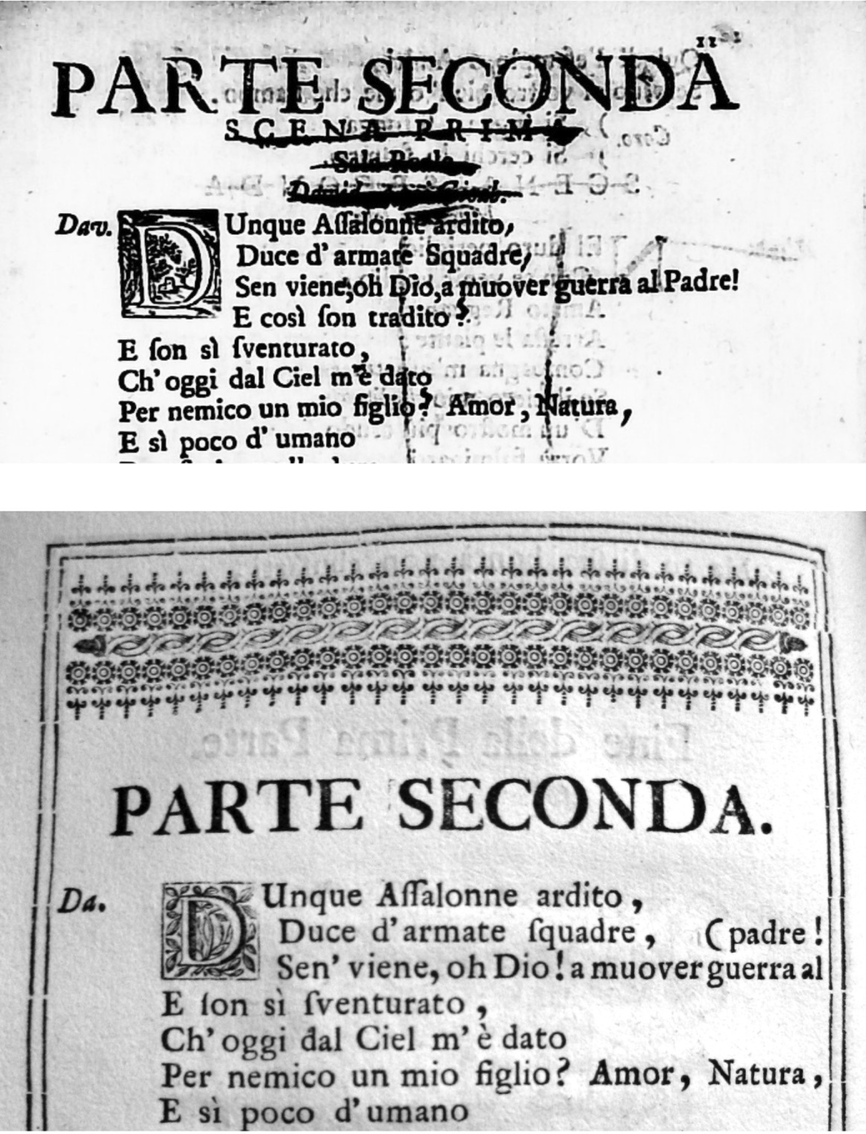
There is one further revealing difference between the 1712 and 1726 librettos. At the beginning of the second part of the oratorio, the fourth line of text (‘E così son tradito’) was mistakenly omitted from both the Viennese libretto and Porsile's score.Footnote 59 This was in all likelihood an error, since Zeno did not cancel the line, and appears to have been caused by the layout of the two printed librettos. Whereas the 1712 edition has a woodcut initial ‘D’ with the height of four lines of text, the 1726 edition has one that is three lines high (Figure 6). It seems likely that the deceptive correspondence of the line ‘E son sì sventurato’ immediately beneath the ‘D’ in both librettos explains why in 1726 the line above it was mistakenly left out by the typesetter. This in turn suggests that the typesetter worked directly from Zeno's own annotated copy of the 1712 libretto, rather than from a clean copy of the revised text.
Top: beginning of Part 2 of the oratorio in Canavese, Odio ed amore (1712), 11. Bottom: beginning of Part 2 of the oratorio in Assalonne nemico del padre amante oratorio (Vienna: Gio. Pietro Van Ghelen, 1726), fol. B4v. Milan, Biblioteca Livia Simone, Teatro alla Scala, TI R.909/20
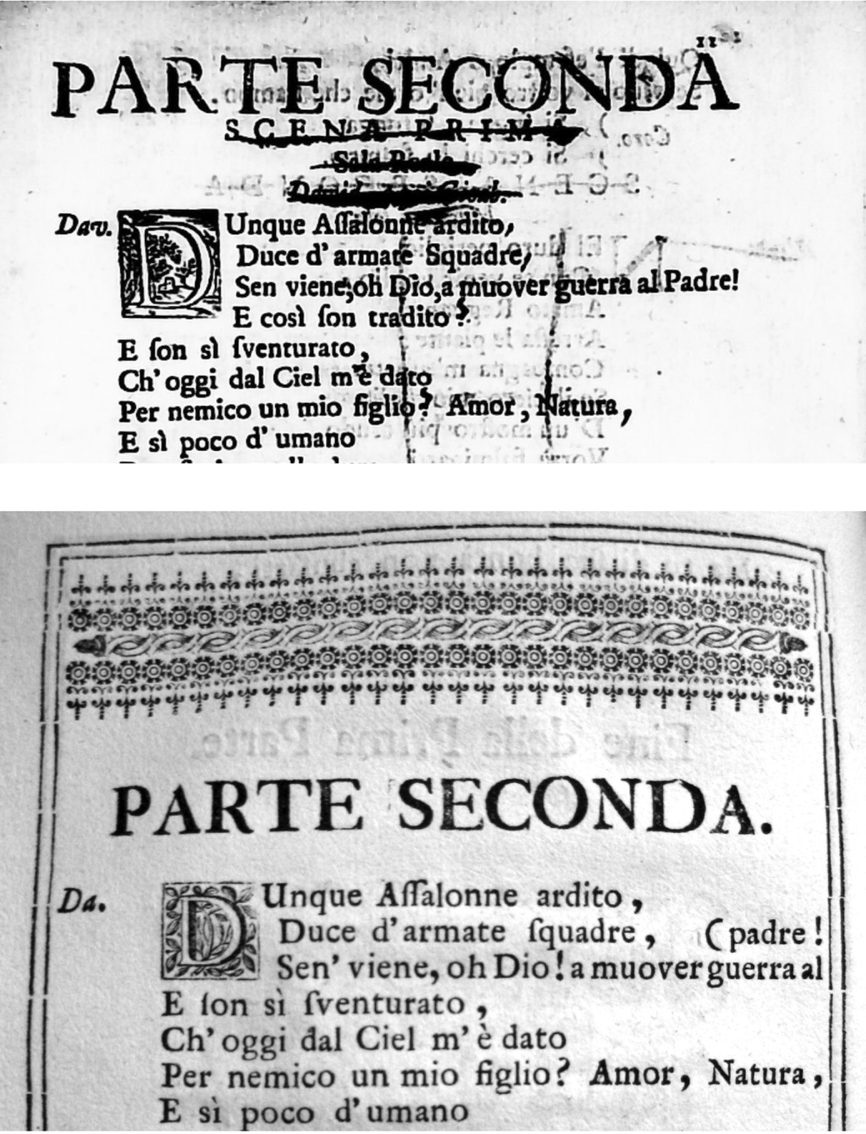
What emerges from a close reading of these relatively minor revisions is that Zeno was directly concerned with the minutiae of spelling, punctuation and capitalization, a fact not without significance for the philology of his own texts, especially the first editions of his Viennese librettos. If he took such care with editing the punctuation in someone else's libretto, he is likely to have been equally if not more concerned with punctuation in his own librettos.
A report in a Viennese newspaper states, as noted earlier, that Giuseppe Porsile's Assalonne nemico del padre amante was premiered in the presence of the emperor and his entire court on the afternoon of Thursday, 14 March 1726, during the first full week of Lent (Ash Wednesday fell on 6 March that year). As was customary, the performance was accompanied by a sermon in Italian.Footnote 60 The sermons for that year's Lenten oratorios were probably given by Sebastiano Paoli of the order of the Clerks Regular, the court's Italian preacher at the time.Footnote 61 Zeno wrote at the end of March to a correspondent in Venice that he had spoken to the emperor and directed their conversation towards ‘the sermons of father Paoli, with which he [the emperor] declared himself to be very satisfied’ (‘L'altr'ieri tenni lungo ragionamento di varie cose con l'Augustissimo Padrone, e destramente feci cadere il discorso intorno alle prediche del p. Pauli, delle quali egli si dichiarò di esser molto contento’).Footnote 62 In a later letter to Muratori in Modena, Zeno called Paoli their ‘mutual friend’ (‘comune amico’).Footnote 63
Although Zeno's correspondence includes no commentary on Porsile's setting of Assalonne nemico del padre amante, he seems to have liked other works by the composer. A week before the oratorio's first performance, in a letter of 9 March to his brother Pier Caterino, Zeno had written about the success of the opera Spartaco, which he claimed was ‘above all because of the beautiful music by Porsile’ (‘a riguardo sopra tutto della bella musica del Porsile’).Footnote 64 The oratorio appears to have circulated beyond Vienna, for a second score, from the collection of Duke Anton Ulrich of Sachsen-Coburg-Meiningen (1687–1763), has survived in Meiningen. Like other manuscripts of Viennese music in this collection, the score was copied by Viennese scribes. Its musical text shows no notable differences from the score in Vienna.Footnote 65 Both scores identify the singers who sang the first performance of the work: soprano Regina Schoonians (Maaca), tenor Francesco Borosini (Assalonne), contralto Anna Perroni (Achinoam), contralto castrato Gaetano Orsini (David) and bass Christian Praun (Gioab).Footnote 66
It is significant that the Meiningen collection includes a considerable number of Viennese operas, oratorios and other works, for the Imperial Court was reluctant to allow its music to circulate in manuscript copies. Thus it is noteworthy that a further score of Assalonne nemico del padre amante, now lost, appears in the 1759 auction catalogue of the musical collection belonging to bookseller Nicolas Selhof in The Hague. Among the ‘musique en Manuscrit’ omitted from the auction was ‘Assalone, Nemico del Padre Amante, Oratorio, dal Signor Porsile’.Footnote 67 The appearance of the oratorio in the Dutch Republic is puzzling, but may be connected to Duke Anton Ulrich in some way. He concluded a morganatic marriage in Amsterdam in 1711 and spent most of his time there until 1724, when his father died and he moved to Vienna for the next few years. He may therefore have attended the first performance of Porsile's Assalonne nemico del padre amante. The score in The Hague may have been a copy made from the one in Meinigen: an undated, loose-leaf summary list of scores brought back from Vienna to Meiningen by the duke in 1728 includes a note stating that ‘one oratorio and one opera’ were ‘kept in Holland’.Footnote 68
As with the circulation of operas, many oratorio librettos underwent revisions of different kinds. The vicissitudes of this particular libretto, in its migration from Tuscany to Vienna, would not be considered exceptional were it not for the involvement of Zeno. His relatively few but rigorous revisions of Canavese's libretto focused not so much on poetic and literary details, but instead aimed to provide an updated and shorter version of the oratorio. Besides leading to the desirable objective of a more concise text, the revision process also allowed Zeno to mitigate some of what he perceived as the libretto's dramaturgical transgressions, such as the battle scene. A number of his changes mirror or amplify those made in Pistoia in 1714: the deletion of Odio ed amore as the oratorio's principal title, the rewriting of the finale with a more morally elevated conclusion and the elimination of the numbered scenes and imaginary stage directions. As with Zeno's role in the reform of the opera libretto, the case of his revisions to Odio ed amore illustrates that he in fact carried out the changes he propounded in the realm of the oratorio, even if he was not the first to do so.