Evaluation of health-related quality of life becomes more and more important in those with congenital cardiac disease as an increasing number of patients survive,1, 2 and with recognition of the multitude of associated physical and psychosocial stresses.3–5 According to an international consensus,6 quality of life is defined as multi-dimensional construct integrating physical, emotional, and social well-being and functioning as perceived by the individual.7 With regard to the importance of family functioning for the outcome of health in chronic paediatric conditions,4 it is necessary to take account of the quality of life of not only the children, but also their parents. Multiple determinants of quality of life including disease-related and social stresses have been described so far. In accordance with the family stress and resilience model provided by McCubbin et al.8 quality of life can be seen as the endpoint of adaptation to a bundle of stresses associated with chronic illness. Coping is considered as mediator variable between stresses and quality of life. The coexistence of disease-related and additional psycho-social stresses may exceed the ability of the family to cope, and have detrimental effects on quality of life. Moreover, social stresses may reflect a lack of social support, which is a known protective factor in coping with disease-related stresses.9 It is necessary, therefore, to take account of both medical and social factors which contribute to the quality of life of families with a chronically ill child.
In spite of the high prevalence of congenital cardiac disease, relatively few studies thus far have investigated issues concerning the quality of life. As Moons et al.10 recently pointed out in their review, conceptual and methodological problems have hindered the research. Small study samples with different medical characteristics, and heterogeneous methods used to assess quality of life, with different inherent definitions, may be responsible for inconsistent empirical findings. Several studies describe impaired functioning of patients with congenital cardiac disease as emotional problems,5 restricted role functions and elevated symptom-related stress,11 elevated psychopathology at least in a subgroup of young adults with congenital cardiac disease,12 and poor quality of life in adulthood.13 Other studies report a normal cognitive, behavioural, and emotional functioning of children,14 and a favourable psychosocial functioning of young adults with congenital cardiac disease.15
Studies on the determinants of quality of life describe inconsistent findings regarding the impact of medical factors. In the study of Resch et al.,5 children with cardiologic symptoms had lower values for their quality of life than those without symptoms. Utens and Erdman16 found no difference in emotional problems depending on specific cardiologic groups. In another study, Utens et al.17 demonstrated that surgery involving open heart procedures was associated with significantly more distress than treatment by interventional catheterisation, and the children utilized a wider spectrum of strategies for coping after surgery compared to after intervention. In another study, the severity of disease did not predict the emotional state of children with congenital cardiac malformations.18 In a study on children and adolescents with implantable cardioverter-defibrillators, no association was found between the severity of disease and quality of life.19
The presence of cardiac disease in their child is known to be a source of persistent concerns for parents.20 Higher levels of depression, anxiety, somatization, and hopelessness, lower quality of life in comparison to parents of children with other diseases and/or parents of healthy children,3 fears after the diagnosis of congenital heart disease,21 more parental distress,22 and difficulties in coping with the disease23 have all been reported for parents. Although there is sufficient evidence to show that caregivers of children with congenital cardiac disease are at risk for a decrease in their personal quality of life, it is not clear which factors contribute to this finding. The correlation of the severity of disease and parental quality of life has repeatedly been reported to be absent or weak.24, 25 Neither was parental stress shown to be associated with the severity of disease in the study of Uzark and Jones.26 In a Swedish study, parents of children with less severe cardiac malformations were found to experience as much stress as parents of children with more complex disease.27 Wray and Sensky28 found increased parental distress prior to surgical procedures, but other parameters of parental functioning were not altered by surgical interventions. According to Lawoko and Soares3, 25 variables such as state of employment and financial situation explain more of the variation in distress, hopelessness, and quality of life among parents than the disease itself. Maternal education, and the amount of daily stress, was demonstrated to have an impact on maternal adjustment.24 In contrast, Uzark and Jones26 found no correlation between parental stress and socioeconomic status. They demonstrated that older age of child was associated with higher scores for parental stress.
Review of the literature, therefore, implies the need to consider the perspective of the family. Any comprehensive bio-psycho-social model must take account of the quality of life of not only the children, but also their caregivers. Multiple factors seem to be associated with quality of life, but the findings in the literature are inconsistent. Besides the severity of disease, social stresses seem to have a certain impact, at least on the parents. And there is a lack of studies considering parental quality of life. Our knowledge of the differential effects of risk factors on the quality of life of children and their caregivers in the setting of congenital cardiac disease is limited. In this exploratory study, we investigate the effect of disease-related and social factors on the quality of life of both the children and their caregivers. We expect a cumulative effect of the severity of the disease and social disadvantage on the quality of life of families with congenital cardiac disease.
Methods
Participants
The participants were approached consecutively for assessment after their medical appointment in an outpatient department of a centre for paediatric cardiac diseases. Of 161 families eligible for the study, 143 participated (88.8%), with 18 families (11.2%) refusing participation for organizational reasons. According to the data in the medical charts, there were no differences between responders and non-responders. We have no reason, therefore, to assume a bias in selection according to the somatic state. Of the patients, 11 adolescents or young adults appeared without a caregiver for their medical appointment. Thus, no data relating to the parents were available for these patients. We were able to analyse complete data sets from 132 patients, with parental reports of their own quality of life and that of their child, information on social variables, and the rating made by their paediatrician for severity of disease.
The study protocol was approved by the local ethical committee. The criterion for inclusion in the study was a primary cardiologic diagnosis. We excluded patients with co-morbid disorders such as malignancy of Down's syndrome, as well as those with an insufficient knowledge of the German language. Due to these criterions, only 15 patients were unable to participate in our study. Informed consent was obtained from the participating parents and appropriate adolescents.
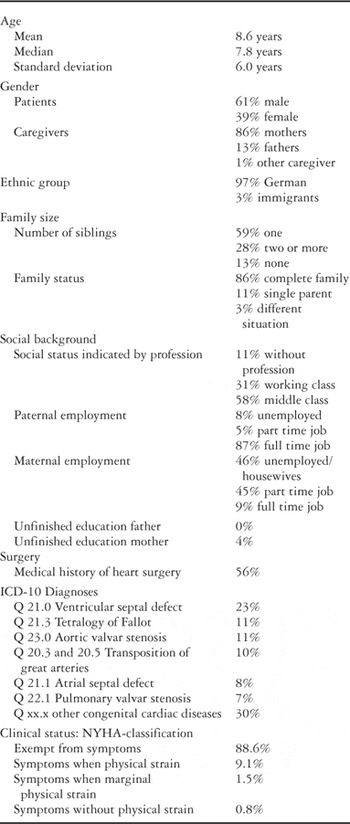
Most of the patients (86%) appeared with their mother as primary caregiver. A smaller sub-sample consisted of fathers or other caregivers and their children. Three-fifths of the participating children were male. Their ages ranged from 0 to 21 years, with two peaks at 0 to 1 year, and 8 to 10 years (Fig. 1). In 56%, there had been previous surgical procedures treatment for their heart disease. According to the classification of the New York Heart Association,29 89%were devoid of symptoms, indicating a predominance of mild disease in the cohort studied. Medical and demographic details are given in Table 1.

Figure 1. Distribution of age for the patients studied.
Table 1. Descriptive characteristics of the 132 patients studied.

Measures
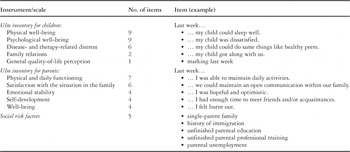
The Ulm Inventory for Children is a computer-assisted measure to assess health-related quality of life of children and adolescents with chronic conditions.30 It was originally developed as a self-reporting instrument for children with cancer, cardiac diseases, pulmonary diseases, diabetes mellitus, or other chronic conditions. Two parallel forms of the questionnaire are available for children prior to schooling, from 0 to 6 years, and those of school-age from 7 to 16 years. Even older adolescents who attend their medical appointments together with a caregiver, and who are still in education at school, can be assessed adequately by the school-age version. The decision to use this questionnaire was determined by the considerations that a short instrument was needed for the assessment of quality of life in an outpatient setting, and that no other German instrument was available that had been validated for congenital cardiac disease. The inventory prepared by Varni et al.31 an instrument similar to the questionnaire used in this study, was not available in German language at the time of planning our study. Self-reporting data could be collected only for patients older than 6 years. Those data in comparison to the parental reports have been reported elsewhere.32 In this study, we wanted to cover a broad age range, including preschool children, therefore we decided to use the reports from the caregivers. The Ulm Inventory for Children is a 27-item-instrument with sufficient psychometric properties. Reference for validity was shown by comparisons with different clinical groups.33 The instrument discriminates between patients with different diagnoses, treatment in various settings, and symptoms indicating intensity of disease. The caregivers of the sick child are asked to rate how much they agree with each statement on a series of five-point scales regarding the past seven days in the life of their child, from 1 indicating “never”, to 5 being equivalent of “always”. The raw scores of all single answers of one scale are added. The total score is derived by adding the raw scores of all five primary scales. In order to facilitate comparisons between different scales, raw scores are linearly transformed to scales ranging from 0 to 100. Higher scores indicate greater quality of life. The maximum score of 100 would represent optimal quality of life. Dimensions and examples of items of the different instruments are shown in Table 2.
Table 2. Description of instruments or scales used to assess quality of life, and social disadvantage.

We assessed the quality of life of the caregivers using the Ulm Inventory for Parents,34 a 29-item questionnaire specified for parents with a chronically ill child. The standardization sample consisted of parents with children suffering from cancer, haematological diseases, or insulin dependent diabetes mellitus. External validity can be reported for the total score by correlations of 0.65 with the Medical Outcome Study SF-3635 subscale psychological well-being, 0.40 with the SF-36 subscale emotional functioning, 0.53 with the subscale vitality and 0.50 with the subscale general health attitude. The response scales range from 1 to 5 as described above, but in this instance with regard to the past seven days in the life of the parents. The total score is derived by adding the raw scores of all five primary scales and four additional single items. These are absence of bodily complaints, pain, nervousness, and excitability. All raw scores for the subscores, and the total raw score, are linearly transformed in a scale from zero to 100 (Table 2).
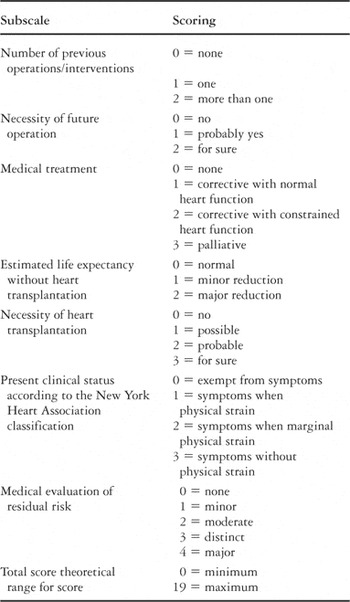
Information on the severity of disease was obtained from the physicians with primary responsibility for the child. Illness-related factors were assessed by the responsible paediatrician and rated along seven scales. An Index of Severity was calculated as a sum-score of these seven ratings. High scores correspond to severe disease. Details of the Index are shown in Table 3. Inter-rater reliability coefficients for the index as used by three independent raters, which were computed for parallel ratings on 20 patients, were 0.89, 0.92, and 0.94, respectively.
Table 3. Details of the index of severity of disease as estimated by paediatric cardiologists.

Information on social state, including single versus two-parent situations, ethnic status concerning German as opposed to immigrant families, parental education, parental professional training, and present parental employment was obtained from the parents as part of the computer-based assessment. Severity of disease was assessed on a form completed by the paediatric cardiologist on the basis of the medical charts and the present clinical state of the patient.
Statistical analyses
Means, medians, standard deviations, and internal consistency scores using Cronbach's α a factor, were computed for each of the subscales, for the sum-score of quality of life for both children and parents, and for the severity of disease. To test for association of medical and social factors with quality of life, we performed two separate analyses of variance across six subgroups, using severity of disease and social disadvantage as independent factors, and sub-scores for quality of life as dependent variables. Categorization of independent variables into groups was done because the index of severity and the number of social risk factors per family were not distributed normally. We discriminated three groups with different manifestations of severity, specifically those with mild disease, scoring zero to 3 points, those with moderate disease rating from 4 to 7 points, and those with severe disease who scored more than 7 points. According to the information about their social state, we distinguished a group of families with social risk factors, such as a single parent or other unusual family situation, ethnic minority status, unfinished parental education or professional training, and/or parental unemployment, from a group without any indicators for social risk. The quality of life for the children and their caregivers was analysed separately for each of the subgroups. As we did not discover any effect of age of the patient on the scores for quality of life, subsequent analyses were performed without controlling for this variable. We chose a significance level of α equal to 0.05. Analyses were performed with the statistical software package SYSTAT 10.0©.
Results
Descriptive statistics
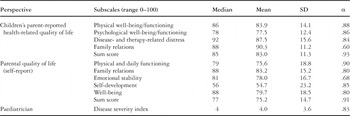
Scores for quality of life were distributed in the upper range of the scales, except the parental subscale self-development with a mean score of 54.7 and a standard deviation of 23.2 (see Table 4). Quality of life of the children as perceived by the parents was relatively best in the dimension of family relations, with a mean score of 90.3, and a standard deviation of 11.2, and in freedom from disease and therapy-related distress, with a mean score of 87.5 and a standard deviation of 15.6. The age of the patient was not significantly correlated with the quality of life as reported by the parents (r equal to −0.08). Self-reported parental quality of life was highest in the dimension of satisfaction with the family situation, with a mean score of 83.2 and a standard deviation of 15.2, and for well-being, with a mean of 79.7 and a standard deviation of 18.5. The judgements made by the paediatricians for the Index of Severity ranged from 0 to 16 points, with a mean of 4 and a standard deviation of 3.6 points. Almost half of the cohort (48.3%) scored between 0 and 3 on the Index, with one-third (32.9%) receiving between 4 and 7 points, and just under one-fifth (18.8%) attracting more than 7 points. Just over one-quarter (26.6%) of the families reported one or multiple social risk factors, either single-parent status, other unusual family situation, immigrant status, unfinished parental education, unfinished professional training and/or present paternal unemployment.
Table 4. Descriptive analyses of dimensions of quality of life and severity of disease for the 132 patients.

Impact of severity of disease and social disadvantage on quality of life
Quality of life of the children
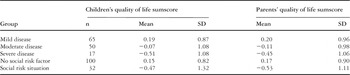
The first analysis of variance demonstrated significant effects of both severity (p equal to 0.004) and social disadvantage (p equal to 0.002) on the overall quality of life of the children as perceived by their parents. Post-hoc analyses revealed significant lower quality of life in children with severe disease, compared with those children having mild or moderate disease, and significantly lower quality of life in children from families with disadvantaged social background compared with children from socially integrated families (see Table 5). Moreover, we found an interactive effect between severity of disease and social risk (p equal to 0.033). Post-hoc analyses demonstrated some differential effects of this interaction on the quality of life of the children (Fig. 2). Children with mild disease scored on the same level regardless of whether or not their families were at social risk. Even moderate disease was not associated with lower quality of life in the absence of additional social risk factors, but was demonstrated when moderate disease was combined with additional social risk. The quality of life of the patients as perceived by their parents was worst in the sub-groups with additional social stress and moderate or severe disease.
Table 5. Means and standard deviations for quality of life after z-transformation of the sumscores, demonstrated by groups for severity of disease and social risk.


Figure 2. Scores for quality of life of the patients and their parents scores after z-transformation, demonstrated by sub-groups of different severity of disease and social situation.
Parental quality of life
The second analysis of variance showed a significant main effect of social risk on parental quality of life (p equal to 0.004), a statistical trend for a main effect of severity of disease (p equal to 0.075), but no interactive effect of severity and social disadvantage (p equal to 0.721). Post-hoc analyses indicated a consistent direction of the main effect of social state on quality of life of both the patients and their parents (Fig. 2).
Discussion
In our study, we assessed the quality of life of children and adolescents with congenital cardiac disease as perceived by their caregivers, and the quality of life of the primary caregivers themselves. With a response rate of almost nine-tenths, we were able to recruit a majority of the population of one specialized outpatient clinic. The subjective situation of the parents was sub-optimal in the dimension of self-development, indicating a considerable burden of caring for the sick child. This finding is consistent with the results of Lawoko and Soares,25 who demonstrated the load of caring as an independent predictor of decreased parental quality of life. Parents with chronically ill children might be at risk to become isolated, and in consequence their satisfaction with life might decrease. On the other hand, parents in our study were relatively satisfied with the support received within their families, and with the perceived family cohesion. These findings are consistent with the literature, describing a tendency to utilize intra-family resources in case of chronic childhood disease.36
On average, the parents described only minor restrictions in the quality of life of their children. This might because most of our cohort was deemed to have only mild cardiac disease. Only one-fifth of the patients studied was classified as being severely impaired in terms of cardiac function, and only one-tenth had clinical symptoms at the time of assessment. Psychological well-being and functioning of the children and adolescents is the dimension most restricted in the view of the parents, albeit that the average score is still in the upper range of the scale.
One of four families in our cohort was exposed to at least one social risk factor. Single-parent status, unemployment, and/or unfinished professional education were the most frequent manifestations of social disadvantage.
Multivariate analysis demonstrated a cumulative negative impact of severity of disease and social disadvantage on the quality of life of both the children and their caregivers. Quality of life of the patients was associated both with the severity of disease and social disadvantage. According to our statistical analyses, it can be shown that moderate disease can be compensated in socially integrated families. Even a severe disease can be buffered in its adverse effects on the quality of life of the patients if the family has sufficient resources. On the other hand, the combination of medical and social stresses has the strongest negative impact on the quality of life of the diseased child or adolescent.
Parental quality of life was significantly associated with the presence of social risk factors in the family. Severity of the disease of their child seems to have an additional minor effect on parental well-being and functioning. These results are in accordance with findings of Uzark et al.,37 who demonstrated that the pile-up of family stresses and decreased family resources were important negative correlates of psychosocial adaptation of recipients of transplanted hearts, and with the findings of Lawoko and Soares,325 who demonstrated that financial burden and unemployment predicted parental quality of life.
In summary, our data has proven our primary hypothesis of a cumulative negative effect of medical and social stresses on families with a child suffering from congenital cardiac disease. In accordance with the familial stress and resilience model, the family has a protective function in coping with congenital cardiac disease. In presence of additional social stresses, this protective function may be weakened.
Some limitations of our study have to be acknowledged. First, because of the predominantly mild disease in our cohort, our results cannot be generalized to all children and adolescents with congenital cardiac disease. Other studies with more severe and acute manifestations of cardiac disease have to be conducted to replicate our results. As most of the reporters in our study were mothers, future studies should also include fathers. Secondly, the cross-sectional design of our study leads to a cautious interpretation of the direction of effects. Although it is plausible that severity of disease and social stresses cause a decrease in quality of life, reciprocal effects between the subjective health of family members and the social situation of the parents are not excluded. As Lawoko and Soares25 pointed out in their study, psychological factors, such as hopelessness or depression, may be considered as mediators between medical and social stresses on the one hand, and parental quality of life on the other hand. The research on quality of life with mental disorders has repeatedly demonstrated negative correlations between affective disorders and quality of life.38 It can be supposed that a combination of chronic childhood illness and parental mental disorder would be a high-risk situation for the whole family. In future, designs of studies should integrate psychopathology and strategies for coping so as to obtain more insight into the process of familial adaptation to congenital cardiac disease. Moreover, longitudinal studies may generate more knowledge of causal relationships between different factors within the model.
Further methodical restrictions have to be mentioned. We decided to measure quality of life of the children as consistently reported by the parents because of the wide range in age of our patients. Our results, therefore, are based on the parental perceptions. Self-reports were not available from the young children. Correlations between parental proxy-reports and self-reported parental quality of life have to be considered, as demonstrated in another study.31 The integration of self-reports from children and adolescents might complement future studies. Multi-informant strategies are recommended to control a possible reporter bias in assessing the quality of life.7 The integration of parental proxy-reports, even of very young children, may be seen as strength of our study. On the other hand, this is only one method of describing the well-being and functioning of infants and toddlers. The combination with observational methods to cross-validate parental judgements would be necessary in further studies. Finally, it has to be mentioned that the constructs of severity of disease and social disadvantage have been represented by compound indexes in our study. A detailed analysis of specific medical or social factors should be performed in future research. Moreover, we were not able to explore all possible stressful circumstances not related to illness that may have influenced the quality of life of our patients and their parents. Multi-centric studies, with larger samples, are required to allow more differential analyses of the specific relevance of single risk factors.
In closing, we would suggest that the results of our study have some clinical implications. Together with the existing literature on psychosocial aspects of congenital cardiac disease, there is now sufficient evidence that severity of disease does not predict much variance in quality of life. Additional factors have to be considered to identify children and adolescents with special needs. Health professionals should therefore assess the social living circumstances of the families. Quality of life screening with psychometric measures can be recommended as a method to indicate psychosocial interventions. Families with difficult social backgrounds require the specific attention of professional caregivers. Providing assistance for these families requires integration of social and medical services. Professional support should enable caregivers to understand the disease of their children in its implications, to manage disease-related stress, and to maintain the best possible quality of life.
Acknowledgment
We thank all the staff at Children's University Hospital Ulm for their support and efforts in data collection.