Introduction
The ‘welfare modelling business’ (Abrahamson, Reference Abrahamson1999) has been at the heart of comparative social policy analysis since Esping-Andersen's (1990) path-breaking The Three Worlds of Welfare Capitalism, and attempts to classify welfare states continue to command much attention (Abrahamson, Reference Abrahamson and Hwang2011). Indeed, with the increased availability of reliable comparative data from bodies such as the OECD (Castles, Reference Castles2002) and a continual refinement of classificatory methods (Hudson and Kühner, Reference Hudson and Kühner2010), it is hardly surprising that this should be so. However, the welfare modelling business rests on the central assumption that we can meaningfully analyse national welfare regimes. Such an assumption has always been flawed in practice, with intended and unintended sub-national variations in policy commonplace in most countries (Greer, Reference Greer2010).
Yet, in the vast majority of comparative analyses of welfare, the sub-national dimension of policy is sidestepped, either ignored altogether or dealt with as a footnote. That this should be so is understandable. Even small-n based comparisons of welfare states can produce unwieldy data sets and, in anything less than book length projects, the space for discussing individual national cases is restricted even without a consideration of sub-national variation. Added to this, the most commonly available sources of comparative data on welfare state effort provide national figures only. Indeed, when confronted by regional variations in policy, the major cross-national data sets offer a range of methodological ‘fixes’ to the problem: typically aggregating or averaging national data or selecting national exemplars or omitting non-standard regions. None of these fixes is without its problems and all are premised on the assumption that sub-national variation matters less for analysis than cross-national variation.
It is not unreasonable to presume that cross-national variation will usually be greater than intra-national variation, but if a certain sub-national territory might reasonably be presumed to occupy a qualitatively different class or category to the rest of its nation, then we have a problem. Even then, if this is a one-off, then perhaps those interested in broad scale macro-level comparisons of welfare states can reasonably overlook it. However, if similar – or the same – types of sub-national territories occupy a privileged position in many or all of the nations under consideration, then a theoretically significant trend is at risk of being missed as key sub-national variations are masked. Crucially, recent thinking in both sociology and geography suggests that such a category of privileged sub-national territories may well exist in the form of global cities.
Here we highlight some implications of global cities for comparative cross-national welfare regime analyses. We stress at the outset that much of what follows is necessarily speculative in outlook, mapping future research agendas rather than providing firm answers to the questions we raise, for the issue is so under-researched that there is a scarcity of robust data of the sort required for cross-national analysis of the issues we raise. A primary goal is to draw links between the global cities and welfare regime literatures and this has influenced the sample of cases covered in this paper; though recent work has tried to expand the range of countries encompassed by the welfare regimes debate, how best to include a broader range of countries in the welfare regime frameworks without also undermining the central tenets of the Esping-Andersen model remains a moot point (see Hudson and Kühner, Reference Hudson and Kühner2011), so here we restrict our analysis to the high-income countries/territories that have been at the core of the welfare regimes debate. However, we should note that prominent global cities are (increasingly) present outside of these territories and many of the social policy tensions that we flag here are also present in global cities in middle- and lower-income countries too. In future work we hope to both broaden the scope of our analysis by including more countries and deepen it through the collection of detailed micro-level data.
Theorising global cities
Castells’ (2000, 2010) wide-ranging notion of a ‘network society’ has been extensively cited by those exploring the new global economy. He claims that, fuelled by new ICTs that annihilate barriers of time and place, the modern economy is centred around global informational networks in which the territorial boundaries of nation states have much less relevance than in the past. Yet, the apparent paradox that Castells teases out is that while it is often presumed that place matters less in the new informational economy – because ICTs annihilate geographic barriers to communication – the reality is that major global cities appear to have become more, rather than less, important in the new economy. The global informational economy is, he argues (2010: 429), ‘ushering in a new urban form, the informational city’ which ‘is not a form but a process, a process characterized by the structural domination of the space of flows’ (ibid.), whereby key global cities ‘articulate the global economy, link up the informational networks, and concentrate the world's power’ (2010: 434). Castells is far from alone in making such claims, his work echoing that of other key theorists, particularly Sassen (Reference Sassen1991, Reference Sassen2001, Reference Sassen2005), whose notion of the ‘global city’ offers a clearer articulation than Castells’ terminologically loose approach that uses phrases such as ‘mega city’ and ‘global city’ almost interchangeably. Specifically, Sassen knowingly uses the term ‘global city’ in order to conceptually connect these cities to the process of globalisation, for it is these cities’ role in directing the globalised economy that she sees as distinctive, extending beyond historic trade roles to become ‘highly concentrated command points in the organisation of the world economy’ (Sassen, Reference Sassen2001: 3).
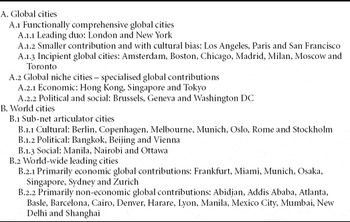
However, Sassen's analysis primarily focuses on three key examples of the global city – London, New York and Tokyo – with others, such as Frankfurt, Hong Kong, Paris and Singapore, being mentioned mainly in passing. As such, her work has been criticised by some for focusing attention on a small number of major cities and so risking missing important processes unfolding beneath the most high profile cases (see Taylor, Reference Taylor2005). Indeed, Sassen (Reference Sassen2001: 348) herself notes that beyond the global cities there are important instances of cities that fall short of this category but nonetheless have ‘global city functions’, something she admits is a ‘somewhat fuzzy distinction’. As a response to this, Taylor (Reference Taylor2005), whose work provides the most extensive attempt to capture the space of flows empirically, eschews the term ‘global city’ in favour of the earlier notion of the ‘world city’ (see Hall, Reference Hall1966), but talks of ‘cities in globalisation’ and the ‘world city network’ to capture the connections between modern cities and processes of globalisation and, more importantly, the interconnections between these cities in the global economy. Drawing on extensive data about economic, political, cultural and social activities in more than 300 cities, Taylor (Reference Taylor2005) uses an interlocking network model and, subsequently, principal component analysis, to develop a taxonomy of world cities that captures the intensity of flows within and between them. Crucially, his analysis identifies not only where the intensity of flows is greatest, but is able to identify different types of flow too, with some cities making a primarily economic contribution, others focusing on a cultural, social or political contribution (Table 1). Though Taylor's usage is more nuanced we will use the term ‘global cities’ as a short hand for world leading cities in the global network economy in the remainder of this paper, but will build on his taxonomy of cities.
Taylor's taxonomy of leading cities in globalisation

Source: Adapted from Taylor (Reference Taylor2005: 1606).
Theorising a welfare regimes and global cities link
We cannot here offer a comprehensive answer to the question of how global cities might influence welfare regimes. This is particularly so if we approach the issue – as Esping-Andersen (Reference Esping-Andersen1990) does – from an historical-institutionalist perspective that regards welfare regimes as long-run, path dependent differences between nations. Such a perspective stresses the complex and iterative interactions between meso-level institutional and political frameworks, macro-level socio-economic pressures and the micro-level actions of policy actors (Hudson and Lowe, Reference Hudson and Kühner2009). We are of the view that any relationship between global cities and welfare regimes is likely to be multi-directional and rooted in long-run historical trends that tap into the comparative advantage of different nations' political economies; it is important that we stress this perspective here so that the broad-brush analysis we present later in this paper is not misread as a crudely reductionist, quantitatively driven approach rather than – as we intend – an attempt to suggest there is a strong prima facie case for more detailed investigation of global city-welfare regime links. Moreover, we hope to suggest analysis of the ‘rise’ of global cities will help us better understand the impact of macro-level pressure on social policy makers (i.e. globalisation) as articulated through micro-level actors (i.e. individuals working in key global organisations located in global cities) operating in key meso-level institutions (e.g. multi-national corporations) and interacting with other meso-level institutions (e.g. policy networks, political institutions).
What we can do here is map out some of the factors that might result in global cities having an impact on welfare at the national level and provide some limited empirical illustrations to support these arguments before moving to consider whether these impacts might also help us understand cross-national variations in welfare regime types. We would like to suggest that the impacts of global cities on welfare regimes at the national level are likely to be visible in three key ways: the differing context for delivering welfare that exists in global cities; the impact on demands for differential levels of public spending in global cities compared to the national norm; and their influence on the composition of national policy making networks.
Impact on social policy context
Global cities are typically (amongst) the largest population centres in their nations and this means they are key drivers of demand for welfare state spending and key sources of welfare state revenues. As the major nodes in the global network economy, their labour force differs from the norm, featuring more international workers and a greater density of global linkages. It follows, then, that in most cases their demographic make-up differs from the national norm too. In particular, it means that these cities will have more diverse populations than is the norm for their nation, with more migrant workers and more high skilled workers in particular. This point has been well made by theorists of global cities such as Sassen (Reference Sassen2001), so will not be laboured here, save to note that such cities typically account for a disproportionate percentage of national GDP and that, in raw demographic terms, cities like New York and London are more like each other than they are like their respective nations.
Tied to this, although systematic comparable data are lacking, it seems relatively safe to conclude that global cities are typically sites of heightened economic and social inequality too. So, for example, from 2002 to 2005 some 28 per cent of children in the UK lived in households below 40 per cent of median income (after housing costs), but in Inner London it was a staggering 52 per cent (National Statistics, 2007: 51). In 2002–03, the 90:10 income percentile ratio (equivalised household income after housing costs) was 4.66 for the UK but was 6.36 for London (Hudson, Reference Hudson2006). New York displays levels of inequality well above those for the USA as whole, UN-Habitiat (2008: 64) reporting a Gini coefficient in excess of 0.5 compared to a figure of less than 0.4 for the nation as a whole. Hong Kong has a higher Gini co-efficient (0.475) than for any OECD country and, indeed, higher than for mainland China and neighbouring territories with supposedly weaker social policy frameworks, such as Thailand, the Philippines or Cambodia (Henrard, Reference Henrard2011: 7–8). This trend can even be found in countries with the strongest welfare states. In Amsterdam, some 25.3 per cent of children were living in a low-income household in 2006 compared to a national average of just 5.4 per cent (European Cities Against Child Poverty Network, 2008: 2). A recent survey of Greater Copenhagen reported 6.0 per cent of children were living in households with less than 50 per cent median income compared to a national average of 3.4 per cent (Save the Children Denmark, 2009: 22–3), while a related survey in Sweden in 2001 found that in Stockholm some 20 per cent of children were living in poverty compared to a national average of around 14 per cent (Save the Children Sweden, 2003: 28). Though there are variations in the scale of national–local difference across these cases, the pattern of heightened inequality within global cities is common.
Impact on demands for public spending
A second issue flows from the above. Policy makers are, of course, well aware of the differing scale and nature of social pressures in global cities, not least the increased levels of poverty and inequality they face. Consequently, not only do welfare contexts differ in these cities, but welfare inputs often do too. Castells (Reference Castells2000) suggests that, in economic terms, global cities act as magnets for resources, attracting more than their fair share of talent and capital investment. Might they be magnets for social resources too?
Significant resources are required to maintain global cities for they function on not just a different scale, but in a qualitatively different way from other localities. More specifically, additional resources are often required because of the increased diversity of their populations and the increased costs of living in a global economic hotspot, and there are often considerable additional infrastructure demands particularly in relation to security, law and order and transport systems. The complexity of social needs in global cities means provision beyond the national norm is often demanded even simply to meet the staffing requirements of essential public services: in New York City, for example, in 2002 the city authorities introduced a living wage significantly above the minimum wage for all those employed by service contractors engaged in public work and, more recently, implemented low-cost public housing scheme for teachers working in the city (Toynbee, Reference Toynbee2003; Gootman, Reference Gootman2007). Systematic data are scarce, but budgetary data for the UK illustrates well the situation with regard to London, where identifiable public expenditure per head is higher than any other part of the country by some margin: the 2007/8 spending plans allocated £9,099 per head to services in London compared to £7,790 for the UK as a whole, representing a 17 per cent gain for the capital (HM Treasury, Reference Treasury2008: 115). Much of this additional expenditure per head flowed from public order and safety costs (71% higher than the national average) and higher spending on transport (↑96%), but spending on core welfare sectors like housing (↑84%), health (↑14%) and education (↑18%) were also well above the national average (ibid.: 131).
The polarisation of incomes in global cities creates much of the pressure for increased state spending within them. This, in turn, arises in part from the heightened presence of highly skilled, highly paid international workers employed in global organisations. Yet, while creating pressure for increased spending, their presence also problematises some of the traditional ideas about the connections between welfare states and citizenship (cf. Clarke, Reference Clarke2005). It is a commonplace observation in the international human resource management literature that multinational enterprises (MNEs) face particular challenges in creating a package of benefits for expatriate/transnational workers, especially around areas such as pensions, health insurance, sickness insurance and disability insurance (see Briscoe et al., Reference Briscoe, Schuker and Claus2009: 247–9) that are traditionally seen as a central part of the (national) welfare state's role. Indeed, many MNEs respond to the complexities of managing this situation by, in essence, internalising the provision of these services, offering expatriate employees a generously funded package of private occupational welfare benefits: private health insurance seems an almost automatic element of such a package, but it is not uncommon for employees to be given additional payments to fund private schooling for children and ‘equalization adjustments’ that compensate the costs of making tax and insurance payments into the local welfare system (ibid.). Indeed, Bonache (Reference Bonache, Stahl and Björkman2006: 164) reports a 2002 survey of European MNEs which found that almost half automatically provide an education allowance and more than 75 per cent operate income tax reimbursement programmes. Not only do such employees have little attachment to local welfare services therefore, but their employers are most likely to regard the payment of social insurance and welfare related taxes as a particular burden, not least because the payment of equalisation adjustments on top of tax payments contributes considerably to their labour costs and are one reason why expatriate employees often cost employers more than twice as much as local employees (Bonache, Reference Bonache, Stahl and Björkman2006).
However, the above situation is relevant primarily to organisations that feature in the economic nodes of the global city, which are primarily made up of MNEs with international workforces located in multiple nation states. Most of the political, social and cultural organisations that play a co-ordinating role in the non-economic nodes of global cities have a different modus operandi. So, for example, key cultural and scientific organisations such as galleries, museums and universities are heavily plugged into international networks but are firmly rooted in localities rather than (with a few exceptions) being transnational entities. While attracting international staff remains a key goal for those with ambitions to be global leaders, HR strategies differ widely from those in MNEs because this is primarily a matter of recruiting staff from international competitors rather than one of sending an expatriate employee on an international assignment. Moreover, remuneration packages in these sectors tend to be smaller in scale than those offered by major MNEs, and expatriate staff are much more likely to employed on the same broad terms as local staff. The perceived injustices for employers in making tax and insurance contributions for such staff are likely to be much less pronounced in these sectors.Footnote 1 Meanwhile, with regard to the political nodes, many of the expatriate staff employed by organisations in this node, such as staff working in diplomatic roles or in many key international NGOs such as UN bodies, are exempt from taxation in their host country (see Muller, Reference Muller1995). Undoubtedly, this places such organisations in a rather different position vis-à-vis their motivations for challenging the fiscal basis for welfare policy in their host country.
In short, not only does the unusual context of global cities impact on demands for welfare, but also does so in complex and contradictory ways. Polarising incomes bring pressure for additional spending, but many of the workers (and employers) located within the economic node of global cities have weak connections with the national welfare state and the social contract underpinning it. This is likely to impact on political debates about tax and spending, and ties in with the third of our issues: how global cities influence the composition of national policy networks.
Impact on policy networks
Global cities are the places where processes of globalisation are deepest, flows of political and economic power are most concentrated and, in concrete terms, where global economic and political elites are most visible. As such, it is not unreasonable to hypothesise that they are likely to be home to a concentration of powerful pro-globalisation advocates. Indeed, Castells’ (2000) claim that the global city is a process not a place makes this an essential claim, for global cities are the creations of knowing agents of the global networked economy. At the very least, therefore, we would expect the existence of such cities in a nation state to have an impact on the composition of key national policy networks (Rhodes, Reference Rhodes1997, Reference Rhodes2007; Hudson and Lowe, Reference Hudson and Lowe2009). So, in the case of the UK, it has been argued that the City of LondonFootnote 2 has had a significant, long-term influence on the nation's welfare regime, acting as a brake on expansionary tendencies (Harris, Reference Harris2006). Its influence, however, is subtle, under-theorised and difficult to establish with clear empirical evidence. Taylor's (2005) work in mapping the nodes of the global economy underlines just how strong the presence of global finance and business service firms is in the city of London: it has a bigger presence of global accountancy firms, insurance firms and legal firms than any other city in the world and is second only to New York in terms of the presence of global management consultancies. It is difficult to imagine that this does not impact on the nature of policy discourse in the UK.
Compelling evidence of this impact is likely to be at best fuzzy, but the pressure from the global business lobby to maintain pro-competition policy is evident in regular threats from MNEs to move headquarters away from London when increased tax or regulation are mooted: e.g. in the recent cases of HSBC (Wilson, Reference Wilson2010), advertising giant WPP or media conglomerate UBM (Goodway, Reference Goodway2008a and Reference Goodway2008b). When Gordon Brown's Labour government increased the top rate of income tax from 40 per cent to 50 per cent in its 2009 Budget, the Conservative Mayor of London was the most prominent voice in his party arguing that it must be reversed, going against his party's national policy position to stress the particular impact that higher taxation would have on London's position in the world cities network, arguing it would affect ‘London and Londoners far more than anywhere else’ (Prynn, Reference Prynn2009). Indeed, he argued that ‘any sensible Mayor of London would oppose it’ (Prince, Reference Prince2009). Yet, despite his position on fiscal policy, Johnson still felt able to make the case against large-scale housing benefit cuts for London residents proposed by Cameron's government as part of a wide ranging set of spending cuts in 2010 (Roberts, Reference Roberts2010), illustrating well the Janus faced role of global cities towards their ‘hinterland’ that Castells (Reference Castells2000) surmised exists.
However, cities whose global standing is rooted in their political or cultural functions rather than their economic ones will differ in the constellation of actors looking to join national policy networks and, in turn, those actors will likely differ in terms of their agendas, interests and motivations. Taylor's (nd) data show that Germany's leading world city, Berlin, contrasts radically with London in the strength and make up its members of the global elite. So: in the global accountancy field it has around one third of the presence of London and ranks 54th globally; its banking/finance industry presence is around two-fifths the strength of London's and is ranked 38th in the world; in insurance its presence is only around a fifth of the strength of London's and is ranked 49th globally; in law its presence is around one third of London's and ranks 14th in the world; and, finally, in terms of global management consultancy its presence is around a fifth of London's, a global rank of 70th. In short, not only is Berlin a long way from competing with London as a global economic centre, the diminished presence of global economic elites in the city seems likely, at the very least, to move them a little further away from the core of key policy networks in Berlin than is the case in London, particularly if we accept the view of some policy network theorists that personal interactions remain a key feature of policy making networks even in the globalised era (Raab, Reference Raab2001). By contrast, Taylor's data also shows that Berlin is undoubtedly one of the biggest nodes in global political elites and acts as a rival to London for the title of Europe's political centre. As Korcelli-Olejniczak (Reference Korcelli-Olejniczak2007: 58) notes ‘Berlin is a global “cultural” metropolis . . . Berlin's importance as a cultural center determines its position in the European and global urban systems.’ Indeed, her view is that while Berlin has claims to be a global player in politics, the arts and in scientific research, it has ‘most probably no chance’ of becoming a transnational financial centre (ibid. 57) and, looking forward, ‘it is justified to expect it to grow into a political and cultural metropolis rather than a center of transnational business activity’ (ibid. 66). Is it unreasonable to expect that the diminished position of economic elites vis-à-vis non-economic elites in Berlin when compared to London might impact on the tenor of discourse in their local policy networks? We cannot be sure without detailed micro-level empirical analysis of policy networks, but can look at macro-level patterns in order to establish whether there is a strong prima facie case for more detailed investigation of global city-welfare regime links.
Global cities and welfare regime intersections
In sketching out some of the key ways in which global cities might impact on social policy at the national level, we have also noted that these impacts vary from city to city. We have noted too that one of the most sophisticated attempts to measure the global interconnections of major cities points to variations in type as well as of degree. And, as we noted at the outset, the debate about how far social policy variations between nations reflect different long-run welfare regime ideal types has been prominent within the comparative social policy literature for some two decades now. In the remainder of the paper, we want to explore whether these patterns might in some way be inter-related and, if so, to think through whether or not an analysis of global cities might help us understand welfare regimes.
The paucity of data limits the possibilities for a meaningful comprehensive quantitative analysis of this issue – even the very best data available are snapshot data capturing only a small number of the issues we highlight above – but, more importantly, a formal model would struggle to capture the complex multi-level interactions between global cities and welfare state structures we hypothesise above and would struggle to handle complex, non-linear feedback loops between (for instance) political factors such as institutional structures (e.g. federal v unitary), policy factors such as pre-existing welfare delivery structures (e.g. national scale v regionally varying), geographical factors such as the size of a country and the relative scale and size of its leading cities (e.g. multiple large cities such as Germany v. dominating leading city such as UK). Instead, we are restricted here to a relatively simple analysis of the intersection between Taylor's city types and commonly identified welfare regime types via a relatively simple set based approach (cf. Ragin, Reference Ragin2000) utilising pre-existing world city and welfare regime typologies.
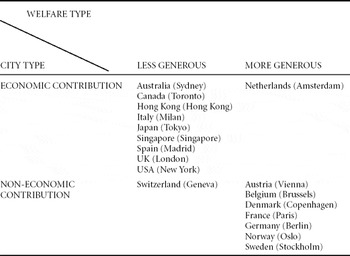
For reasons of parsimony, we have used the world city and welfare regime typologies to distinguish nations on just two dimensions: (i) welfare generosity – whether a nation has a more or less generous welfare system – and (ii) type of leading city – whether a nation's top ranked world leading city makes an economic or non-economic contribution. Using these two sets, we have a property space with four logically possible combinations: (i) less generous welfare and economic contribution of leading city; (ii) more generous welfare and economic contribution of leading city; (iii) less generous welfare and non-economic contribution of leading city; (iv) more generous welfare and non-economic contribution of leading city.
Membership of the leading world city set for each nation was determined using Taylor's classification as shown in Table 1. For each nation, the highest placed city within Taylor's hierarchy was selected. For some nations, this was a simple task as they have just one city in Taylor's taxonomy, but for others more complex choices were presented. In selecting cities, the ‘leading duo’ (labelled A.1.1 in Table 1) were presumed to trump all others in the hierarchy, with the global cities (labelled A.x.x in Table 1) presumed to be ranked above the world cities (labelled B.x.x in Table 1). These criteria provided straightforward selection of a leading city for all nations bar Australia and Germany where two or more cities were tied for top ranking. In these cases, we referred back to the underlying data Taylor used to construct his taxonomy, paying particular attention to the appearance and ranking of cities in his data tables on ‘site’ (nodal size) and ‘situation’ (network connectivity) in different sectors of activity (see tables 3–8 of Taylor, 2005). Following a process similar to that used by Taylor (Reference Taylor2005), the cities featuring more often in these data tables were deemed to rank more highly. In the case of Australia, Sydney was chosen ahead of Melbourne on this basis. For Germany, the task was more difficult as Berlin and Frankfurt tied on the overall number of appearances in these tables, but we chose Berlin on the basis that it has a broader base of activities, being a world leader in media and diplomatic missions, while Frankfurt excelled in law. Aside from the selection of the leading cities for each nation, we also had to determine which of Taylor's types fit into the ‘economic contribution’ set. Those falling into categories A.1.1 (leading duo), A.1.3 (incipient global cities), A.2.1 (economic global niche) and B2.1 (world-wide leading primarily economic global contribution) were classed as being in the ‘economic contribution’ set and all other cities as being outside of it (i.e., A.1.2 global city smaller contribution with cultural bias; A.2.2 political and social global niche city; B.1.x cultural/political/social sub-net articulator cities; B.2.2 world-wide leading cities primarily non-economic contributions).
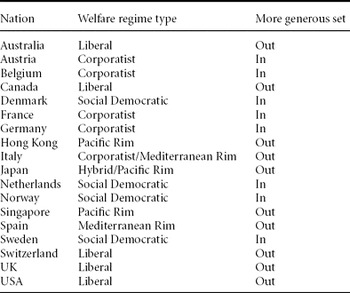
For the welfare types set, the proliferation of welfare state typologies creates not insignificant complexity. Our country memberships were derived from a mixture of Esping-Andersen's (1990) original social democratic, corporatist and liberal classification, supplemented by Mediterranean Rim and Pacific Rim typologies. In each case, we stuck with Esping-Andersen's initial classification where a clear one existed with two exceptions: Japan and Italy. Some have argued that Italy is more appropriately located within a Mediterranean Rim along with Greece, Spain and Portugal on the basis of their very weak social assistance schemes (Bonoli, Reference Bonoli1997; Ferrera, Reference Ferrera1996). With respect to Japan, some argue it is best placed in a ‘Pacific Rim’ category and others have pointed out that likely flaws in Esping-Andersen's calculations (Bambra, Reference Bambra2004) mean it was probably erroneously placed in the corporatist rather than the liberal regime; Esping-Andersen (Reference Esping-Andersen1997) concedes it is probably a hybrid case. In these cases, we have deviated from Esping-Andersen's original classification. The placing of several other nations is problematic because they were on the cusp of Esping-Andersen's social democratic and corporatist regimes and have been interpreted differently by different readers depending on which aspects of Esping-Andersen's thesis are given most prominence. So, for instance, in presenting the decommodification index, Esping-Andersen (Reference Esping-Andersen1990: 52) broke countries into three distinct groupings with Austria clearly in the group with the strongest social rights. This would imply it sits in the social democratic grouping, but earlier in the text he names Austria as an example of the corporatist regime-type cluster (Esping-Andersen, Reference Esping-Andersen1990:27), in large part because data presented elsewhere in the study (see Esping-Andersen, Reference Esping-Andersen1990: 70) show Austria to have a very strong degree of corporatism and modest average benefit equality. For some nations, the picture is still less clear because Esping-Andersen offered fewer clues as to their placing in his typology – e.g. Belgium and the Netherlands have even stronger decommodification scores than Austria but are regularly grouped together in the discussion with other corporatist nations, so are often presumed – but not explicitly confirmed – to be part of this cluster (e.g. Esping-Andersen, Reference Esping-Andersen1990: 53 & 73), though some theorists have interpreted the Netherlands as being an example of Esping-Andersen's social democratic regime (e.g. Goodin et al., Reference Goodin, Headey, Muffels and Dirven1999). We have placed these three countries in the corporatist type but accept they could fall into the social democratic one. On a similar note, Switzerland scores very highly on the decommodification index, but other indicators suggest it is more akin to the liberal regime. In his original work, Esping-Andersen (Reference Esping-Andersen1990: 75) hints it ought to be placed in the liberal regime, but other theorists have read his then argument to indicate that it is part of the corporatist/conservative regime (e.g. Bambra, Reference Bambra2004: table 1). In later work, Esping-Andersen (Reference Esping-Andersen1999:77) does little to help ease the confusion over this case, within a single page managing to state that ‘The liberal welfare regime cluster is, furthermore, almost invariably Anglo-Saxon: the United States, Canada, Australia, Ireland, New Zealand, and the UK’ yet then writing in a footnote to a table reporting results of a logistic regression that Switzerland is included in his analysis as part of the liberal regime. We take this footnote as the final word on where Switzerland ought to be placed. Incidentally, the footnote confirms Austria, Belgium and the Netherlands as members of the corporatist regime.
We have excluded some nations included in The Three Worlds of Welfare study on the basis that they do not have a city in Taylor's typology of world leading cities: Finland, Ireland and New Zealand. To capture a broader range of nations than Esping-Andersen, we also included Hong Kong, Singapore and Spain. All appear in Taylor's typology but not in Esping-Andersen's. Taking our cue from aforementioned revisions of the Worlds of Welfare thesis, Hong Kong and Singapore are deemed to be part of a ‘Pacific Rim’ model and Spain part of the ‘Mediterranean Rim’. We did not add cities to the analysis from medium or low-income nations that featured in Taylor's taxonomy – Abidjan, Addis Ababa, Bangkok, Beijing, Cairo, Harare, Manila, Mexico City, Mumbai, Nairobi, New Delhi and Shanghai – because these nations have not featured prominently in the welfare typologies debate (see Hudson and Kühner, Reference Hudson and Kühner2011.) In addition, the generally less extensive welfare arrangements in the countries that these cities are located within would add a degree of incommensurability to the analysis if the goal is to distinguish between members and non-members of the ‘more generous welfare’ set.
To create the ‘more generous welfare model’ set, those nations falling into the ‘social democratic’ and ‘corporatist’ regimes were deemed to be in the set on the basis that these regimes display relatively strong social rights compared to the liberal, Mediterranean and Pacific Rim regimes. This two way division also minimises some of the noise from nations with disputed classifications: Austria, Belgium and the Netherlands appear in the ‘more generous’ set whether classed as social democratic or corporatist for instance.Footnote 3 The membership of each country is shown in Table 2.
Welfare types

These classifications of world cities and welfare regimes are admittedly crude in many respects but they provide workable rule of thumb measures for a bird's eye analysis of the intersection between welfare types and world city types and they are derived from very commonly utilised classifications. Table 3 summarises the pattern of intersections and the overlap is striking. In all cases bar one (the Netherlands), where the nation's leading city is flagged by Taylor for their economic contribution, the welfare regime is a less generous one. Likewise, in all cases bar one (Switzerland), where the welfare regime is a more generous one, the leading world city in the nation makes a non-economic contribution. Of course, the existence of these overlaps could be coincidental and even if issues about the validity of the city and welfare classifications are ignored, they do not guarantee there is any causal relationship between cities and welfare regimes or vice-versa. But, the strength of the pattern would appear to provide a prima facie case for concluding that global cities merit further consideration by comparative social policy analysts interested in welfare regimes and that welfare regimes merit further analysis by global city specialists. Much more could – and needs – to be said about these overlaps and the specifics of the cases in question, but space does not permit a lengthy discussion here. Before concluding, we flag two issues that arise in particular: relationships between competing cities and the direction of global city-welfare regime influences.
Intersection of welfare types and city types

In most countries in our sample, a dominant city exists, but in some there are competing cities and the question of how these interact requires exploration. In the case of Switzerland, the presence of Zurich as a strongly economically focused global city seems likely to act as a counter-influence to the more socially and politically focused Geneva. Similarly, in the Netherlands the role of Amsterdam as an economic globaliser may be counterbalanced by The Hague that scores relatively high on political globalisation. One intriguing possibility is that this might partly explain why their classifications do not follow the typical pattern in Table 3. However, integrating additional cities into the analysis is far from a straightforward task, not least because the effects of multiple global cities on national politics are not likely to be uniform. Indeed, the composition of competing global cities in Switzerland and the Netherlands differs from that in other important cases where there are competing cities. So, for instance, in the case of Germany, Taylor's data suggest the depth of political globalisation is much deeper in Berlin than the economic globalisation, of its main economically focused city (Frankfurt), but Germany also features (amongst others) Munich, which leads the country as a centre of cultural globalisation so has a complex set of relationships between multiple cities playing different roles on the global stage.Footnote 4 In the USA meanwhile, New York might be counterbalanced by Washington, in which social and political globalisation is deeper than economic globalisation, but economic globalisation is strong by international terms in Washington too and, in addition, the USA is home to Chicago and Los Angeles which both have higher economic globalisation scores than all but six cities found in the countries this paper covers. Added to this, LA's role in the film and TV industry means it also scores very highly on cultural globalisation. The outcomes of these complex interlinkages are likely to be highly contingent, influenced by (for instance) the political institutional structures of each country (federalism has influenced the presence of competing cities in Germany and the USA for example) but also tied into the historic roles played be specific cities too (e.g. the location of well-established trading routes or the long-term presence of a significant international political body). As such, it is perhaps only through detailed and historically rooted comparative case studies that these links can be effectively drawn out.
Indeed, much the same might be argued of a bigger question still: the direction of global city-welfare regime linkages. We have stressed that these are likely to be multi-directional and iterative in nature, but others have raised the intriguing question of whether we should think more about how welfare states have driven globalisation processes rather than how globalisation processes have influenced welfare states (Schwartz, Reference Schwartz and Ellison2003). As the localised manifestation of globalisation processes, global cities offer us a clear focus for the exploration of such issues through the analysis of the interactions between global city institutions and policy actors, policy frameworks and policy outcomes. As the creation of knowing agents – a process, rather than a place, as Castells (Reference Castells2010) puts it – the growth and specialisation of global cities is necessarily influenced by actors’ judgements about the desirability of specific welfare regime frameworks. Key institutionalist theorists have observed long-term complementarities between welfare regimes and varieties of capitalism in the form ‘welfare production regimes’ (Estevez-Abe et al., Reference Estevez-Abe, Iversen, Soskice, Hall and Soskice2001). Perhaps much the same is true of global city and welfare regime linkages. If so, then as well as having ongoing impact on social policy frameworks through lobbying activities, it may well be the case that the specialisation of global cities also reflects longer-term complementarities between global city functions and welfare state types.
Conclusion: towards a global cities and welfare research agenda
We have argued that global cities are an under-researched issue for comparative social policy analysis. We should stress that it is for comparative analysis of welfare regimes that the problem remains particularly acute: while there are numerous studies of social policy within specific global cities, it is the absence of a systematic analysis and comparison of the impact of these cities on welfare that is the key issue.
Undertaking such an analysis is not without its challenges. Comparative analysis still proceeds on the basis that intranational differences matter less than international differences and the core cross-national data sets are rooted in national level analysis as a consequence. As Taylor (Reference Taylor2005: 1606) notes, official data tend to come in the form of ‘state-istics’. Despite the useful data generated by projects such as the Globalisation and World Cities Research Network (GaWC) or urban focused cross-national organisation such as UN-HABITAT (Reference Habitat2008), little of this relates to social policy frameworks and we are a long way off having extensive, robust and reliable quantitative data that would permit an analysis of global city and welfare linkages.
This means that qualitative case-study-based research offers the best way forward at present. Indeed, while the core research questions highlighted above would benefit from the collection of cross-national statistical data on welfare in global cities, they do not require it. What is needed is for the social policy research community to join their peers in sociology, geography and political economy in paying serious, systematic attention to global cities by thinking through their implications for comparisons of welfare states and for the political economy of welfare. Too often to date, globalisation has been treated as ‘out there’ process in social policy analysis: an exogenous force that impacts on national welfare states. But, as Clarke (Reference Clarke2005: 409) notes, ‘globalisation means, not the dissolution of the nation-state, but the unsettling presence of the ‘world’ within the nation-state’.
Though we have only been able to scratch the surface of the issue here, and too often have had draw on episodic or patchy data, we believe that a focus on the role of global cities in shaping welfare regimes – and vice-versa – offers a rich research agenda worthy of detailed investigation. Moreover, it is an agenda that places the examination of the impact of globalisation processes on social policy centre stage: not as an ‘out there’ force, but as ‘in here’ process, driven by knowing agents rooted in specific localities.
Acknowledgements
This work is the outcome of a series of discussions that have taken place within the Worldwide Universities Network's ‘Global/Mega Cities’ Research Network. The author is grateful to other members of the network for their contribution to the thinking that lead to this paper, particularly those who participated in meetings held at the University of Sydney (October 2008) and University of York (June 2008, July 2009). A draft version of this paper was presented at the 7th East Asian Social Policy network international conference, 20–21 August 2010, Sogang University, Seoul, Korea and at the Social Policy Committee of the Chinese Sociological Association 6th International Symposium and Lectures on Social Policy, Zhejiang University, Hangzhou, China, 27–29 August 2010 and an updated version at the Social Policy Association Annual Conference, University of Lincoln, 4–6 July 2011. An earlier paper on which this article builds was presented at the WUN Global/Mega Cities and Welfare Workshop at the University of York, July 2009. I am grateful to those who attended these events for the useful feedback they provided and to the anonymous referees and the editors of this journal for their constructive comments and helpful suggestions.