INTRODUCTION
Leucaena leucocephala (leucaena) is cheap (0·34 the price of green maize) and a good source of protein; therefore it is an economical feedstuff to use for milk production, also in addition, it is possible to produce 10–22 tonnes of edible dry matter (DM)/ha from leucaena (Hutton & Beattie Reference Hutton and Beattie1976). Inclusion of leucaena in the diet of dairy animals, either as a pasture grass (Rai et al. Reference Rai, Walli, Srivastava and Verma1994) or as seed (Talpada et al. Reference Talpada, Gupta, Murthy, Patel, Desai, Patel and Desai1994) in the concentrate mixture, improved (Flores et al. Reference Flores, Stobbs and Minson1979) or sustained (Garcia et al. Reference Garcia de, Sanchez, Colmenarez and Beltran1994, Reference Garcia de, Sanchez, Colmenarez, Monslave and Sierratta1995; Garg & Kumar Reference Garg and Kumar1994; Richards et al. Reference Richards, Brown, Ruegsegger and Bates1994) milk production with improved or similar composition (Flores et al. Reference Flores, Stobbs and Minson1979; Garcia et al. Reference Garcia de, Sanchez, Colmenarez and Beltran1994, Reference Garcia de, Sanchez, Colmenarez, Monslave and Sierratta1995; Garg & Kumar Reference Garg and Kumar1994; Rai et al. Reference Rai, Walli, Srivastava and Verma1994; Talpada et al. Reference Talpada, Gupta, Murthy, Patel, Desai, Patel and Desai1994).
The potential attributes of leucaena are severely limited because of the presence of toxic mimosine, β-(N-3-hydroxyl-4 (1H)-pyridone) α-amino propionic acid, a non-protein amino acid, and its immediate degradation product 3-hydroxy, 4 (1H)-pyridone 3,4-dihydroxy pyridine (3,4-DHP), which have depilatory effect and cause enlarged thyroid and several other toxic effects in ruminants as well as non-ruminants (Jones Reference Jones1979; D'Mello Reference D'Mello1992; Ram et al. Reference Ram, Atreja, Chhabra and Chopra1994). No detrimental effects of mimosine on animal health or performance are observed when leucaena constitutes only a small proportion of the diet (Hamilton Reference Hamilton, Donaldson and Lambourne1971). Gupta & Atreja (Reference Gupta and Atreja1998) did not observe any adverse effect on milk yield in goats fed gradually increasing levels of dietary leucaena DM (up to 750 g/kg). When leucaena was the sole component of the diet, a reduction in milk yield was reported that was attributed to either toxic effects or low nutrient intake; furthermore, these workers observed that neither mimosine nor DHP were secreted in goats' milk, thus rendering it safe for consumption. There is a paucity of information on secretion of mimosine or its metabolites, i.e. 3,4-DHP or 2,3-dihydroxy pyridone (2,3-DHP), through cows' milk; therefore the present study reports an attempt to elucidate the effect of feeding leucaena on the secretion of mimosine and dihydroxypyridone in milk, milk yield and composition, thyroid hormones and enzyme activities in lactating cattle.
MATERIALS AND METHODS
The experiment was conducted at the National Dairy Research Institute, Karnal, India. L. leucocephala, Hawaiian type K-8, was harvested from the institute farm, dried in the shade and the resultant leaf meal with twigs (LLM) used for feeding.
Experimental animals
Four Karan/Friesian crossbred (Holstein×Tharparkar) dairy cows in late lactation (>200 days), with mean LW of 400±15·4 kg, were fed a basic diet of green maize and concentrates with an increasing proportion of LLM which was gradually increased from 0·25 of the DM intake (DMI) in the first week to 0·50 in the second, 0·75 in the third and ad libitum in the fourth week. Concentrate mixture was offered at the time of milking. LLM was offered at 08.00 h and green maize was provided at 14.00 h. Fresh clean water was offered ad libitum twice daily. Daily records of DMI of LLM, concentrate mixture and green maize were maintained. LW were recorded weekly.
Collection of samples
Milk samples were collected for individual cows twice a week at the morning, noon and evening milkings. For each milking, the milk samples were collected separately and a suitable proportionate aliquot mixed. From each sample, 100 ml was kept for fat, solids not fat (SNF), total solids and ash estimation. From this, a small amount (15 ml) was centrifuged at 3000 rpm for 10 min to separate the fat and stored at −20°C. In the morning, before offering meals, blood samples were drawn by jugular vein puncture and collected in vacutainer tubes. The serum was separated and stored at −20°C for analysis. Twice a week, grab sampling of faeces was undertaken. The wet faeces were mixed with 0·1 N HCl and the volume was made so as to have a final concentration of 1 g faecal DM per 25 ml of 0·1 N HCl. Twice a week, urine samples were collected both in the morning and evening. To 75 ml of mixed urine sample, 5 ml 6 N HCl was added and stored until further analysis.
Chemical analysis
One gram DM of LLM or fresh faeces was extracted with 25 ml of 0·1 N HCl for 24 h and filtered through 0·22 μm filter paper (Lowry et al. Reference Lowry, Tangendjaja and Maryanto1983). Mimosine, 3,4-DHP and 2,3-DHP were estimated in Waters high performance liquid chromatography (HPLC) using 0·2% (w/v %) O-phosphoric acid as an eluent on a C18 microbondapack column (Tangendjaja & Wills Reference Tangendjaja and Wills1980). Urine samples were analysed following the method of Tangendjaja & Wills (Reference Tangendjaja and Wills1980). The mimosine and DHP in serum were estimated following the method of Tangendjaja & Wills (Reference Tangendjaja and Wills1983). Milk samples were analysed in two different ways. Firstly, the whey serum samples were analysed and secondly, milk was defatted by centrifuging at 3000 rpm for 10 min. A sample of 3 ml defatted milk with equal volume of 10 N HCl was hydrolysed at 110°C for 4 h under N2 gas environment and pH was adjusted at 3·0 by adding sodium hydroxide (NaOH) solution. This was filtered through ordinary filter paper and finally through 0·22 μm mdi filter paper (Micro Devises Pvt. Ltd, India); 20 μl of the resulting filtrate was injected into HPLC to determine the mimosine and DHP. Milk fat was determined with the help of a Milco Tester (Rajasthan Electronics and Instruments Ltd, Jaipur, India). Corrected lactometer readings were taken into consideration to calculate SNF content following the standard procedure (ISI 1962). Microkjeldahl (AOAC 1984) was employed for total nitrogen determination and was multiplied by 6·38 to obtain the milk protein value. For total solids, 10 g of milk sample was taken in pre-weighed porcelain crucibles and kept at 80°C in a hot air oven overnight. On the following day, the sample with crucible was weighed and total solids were estimated by difference. Dry samples, with crucible, were ashed at 550°C in the muffle furnace for 3 h and total ash was estimated by difference. Lactose was calculated by subtracting fat, protein and ash from total solids.
The T3 and T4 in serum samples were determined by radioimmunoassay using RIAK4 and RIAK5 kits, respectively, supplied by the Board of Radiation and Isotope Technology (BRIT), Mumbai, India. AST and ALT activities were determined with the help of SPAN Diagnostic Reagent Kits.
RESULTS
DM and mimosine intake
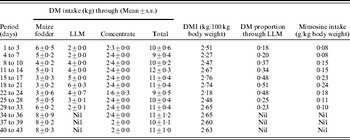
The LLM offered contained crude protein (CP) 196·0, ether extract (EE) 36·5, crude fibre (CF) 103·8, nitrogen free extract (NFE) 572·5, total ash 91·2 and mimosine 16·0 g/kg on a DM basis. The actual voluntary DMI through LLM feeding and mimosine intake is given in Table 1. During the last 10 days of LLM feeding both maize fodder and LLM were offered ad libitum. The initial consumption of mimosine (0·077 g/kg live body weight) increased to a maximum of 0·239 g/kg body weight during days 18–24. Subsequently, mimosine intake declined to 0·104 g/kg body weight when LLM was fed ad libitum. The concentrate mixture eaten was similar throughout except for days 22–24, when available concentrate was halved to induce an increase in voluntary LLM intake.
Average daily DM and mimosine intake in lactating cows fed leucaena leaf meal (LLM)

As error values are on occasion very small their values were given as 0·0.
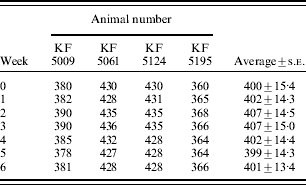
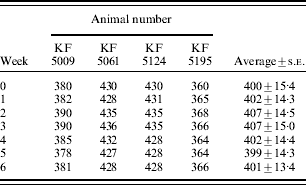
No external clinical symptoms were observed. Even average LW in the second (407±14·5 kg) and third (407±15·0 kg) week of the experiment were significantly higher than those in other weeks of the experiment (Table 2).
Weekly body weights of lactating cows (kg)
Fate of mimosine and DHP
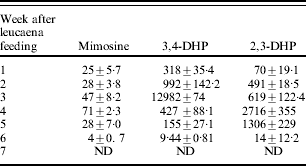
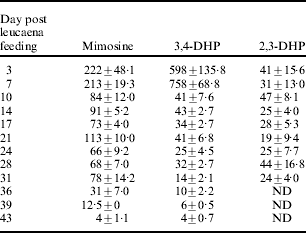
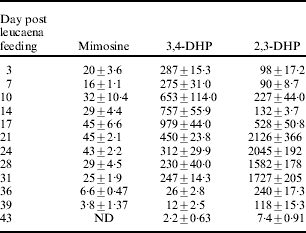
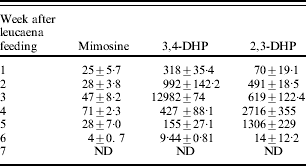
The mimosine, 3,4-DHP and 2,3-DHP concentrations differed significantly in the blood serum during different weeks of post-leucaena feeding (Table 3). Mimosine, 3,4-DHP and 2,3-DHP found during LLM feeding continued appearing in the serum up to the sixth week of experimental feeding, even after the withdrawal of leucaena from the 34th day onwards. Faecal concentrations of mimosine and 3,4-DHP fell sharply (Table 4) after 10 days on the diet while there was no discernable trend in the changes of 2,3-DHP over time. After the withdrawal of LLM on the 34th day, both mimosine and 3,4-DHP continued to be excreted through faeces up to the 43rd day at appreciably lower concentrations than earlier. However, 2,3-DHP could not be detected in faeces when mimosine was not present in the feed.
Serum profile of mimosine and DHP in lactating cows (μg/ml)
ND=not detectable.
Faecal excretion of mimosine and DHP in lactating cows (μg/g DM)
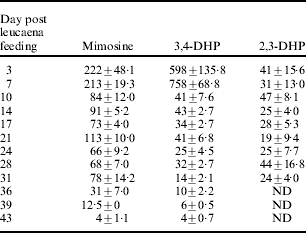
ND=not detectable.
The mimosine, 3,4-DHP and 2,3-DHP amounts excreted through urine when animals were on the leucaena-based diet are presented in Table 5. Even after withdrawal of leucaena from the diet on the 34th day of experimental feeding, mimosine was detected in the urine on the 39th day, but not on the 43rd day. Both 3,4-DHP and 2,3-DHP were detectable even up to the 43rd day, 8 days after withdrawal of mimosine.
Urinary excretion of mimosine and DHP in lactating cows (μg/ml)
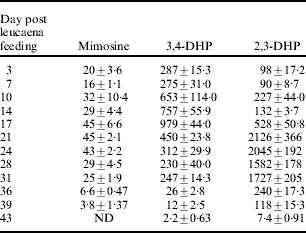
ND=not detectable.
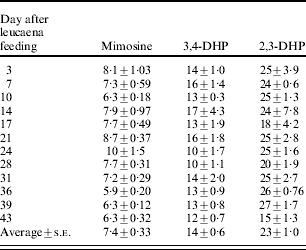
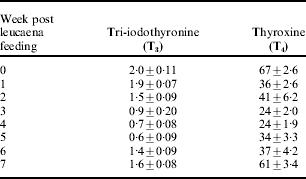
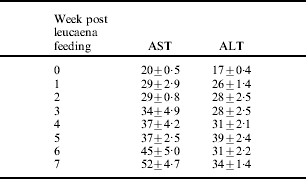
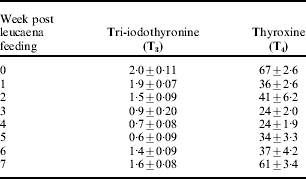
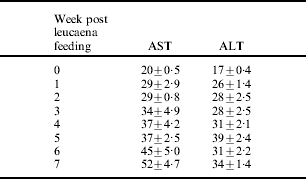
The defatted milk samples revealed no detectable amounts of mimosine, 3,4-DHP or 2,3-DHP. In the second procedure defatted milk samples were hydrolysed. The results showed that mimosine, 3,4-DHP and 2,3-DHP were secreted in the milk of dairy cows fed a leucaena-based diet even after 10 days of withdrawal of leucaena from their diet (Table 6). Serum enzyme and endocrinal analysis showed a drastic decline of T3 and T4 (Table 7) and a sharp rise of AST and ALT (Table 8) with leucaena feeding.
Mimosine and DHP secretion through milk (μg/ml) in LLM-fed lactating cows
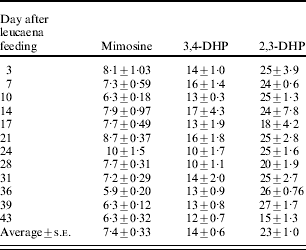
Serum thyroid hormone profile (ng/ml) in leucaena-fed lactating cows
Serum enzymatic activities (units/ml) in leucaena-fed lactating cows
Influence of leucaena on milk yield and composition
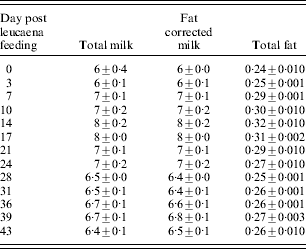
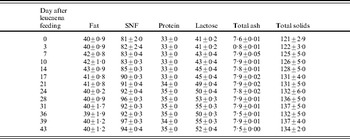
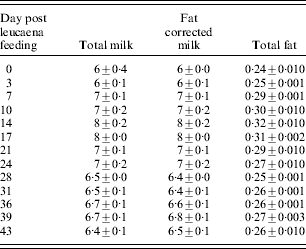
Increase in milk yield was evident from the 5th day of leucaena feeding. The gradual increase was maintained until the 22nd day of feeding. The total milk yield as well as fat corrected milk (FCM) markedly differed on different days of milking after leucaena feeding (Table 9). After 24 days, the total milk yield tended to decline, hence immediately thereafter restriction of LLM feeding was lifted and ad libitum maize fodder was offered. The milk composition data are presented in Table 10. Higher total fat production was recorded on the 7th, 10th, 14th, 17th and 21st days of milking. The SNF and total solids percentage showed a rising trend from the 17th day onwards and increased protein content was noticeable from the 21st day onwards. The total ash content on all days was similar.
Average milk and fat yield of leucaena-fed cows (kg)
Average chemical milk composition (g/kg) of leucaena-fed lactating cows

DISCUSSION
DMT on leucaena feeding
The voluntary DMI during 22–24th day of feeding the leucaena-based diet was less than the required level (Kearl Reference Kearl1982). Therefore, it was evident that as the animals were forced to increase their voluntary intake of leucaena they tended to decrease their total DMI, which might be a response towards toxic materials present in leucaena. However, in the present study none of the experimental animals showed any visible toxicity symptoms due to leucaena feeding. The retardation in voluntary DMI has been related to an increased proportion of leucaena in the diets of cattle (Blunt & Jones Reference Blunt and Jones1977; Ram et al. Reference Ram, Atreja, Chhabra and Chopra1994), depending on the extent of biodegradation of mimosine and/or its metabolites (Hegarty et al. Reference Hegarty, Schinckel and Court1964; Ram et al. Reference Ram, Atreja, Chhabra and Chopra1994; Feng & Atreja Reference Feng and Atreja1998; Gupta & Atreja Reference Gupta and Atreja1998). Improvements in DMI (Table 1) were evident following withdrawal of leucaena from the animals' diets, thereby revealing that short-term negative effects observed due to leucaena feeding could be reversed by changing to a non leucaena-based diet without any adverse effect. During the last 10 days of LLM feeding (24th–33rd day of the experiment), animals were provided both LLM and maize fodder ad libitum. The voluntary intake of leucaena was found to be 0·23–0·25 of total DMI (Table 1). It seems that there is a mechanism within animals that allows them to adjust their intake. This hypothesis is supported by the findings of Jordan et al. (Reference Jordan, Cino and Roque1995) who observed that, after 2 h of grazing on leucaena pastures, animals moved to non-leucaena pastures.
Mimosine and DHP in blood serum, faeces and urine
In ruminants, mimosine is degraded in the rumen (Hegarty et al. Reference Hegarty, Schinckel and Court1964; Ram et al. Reference Ram, Atreja, Chhabra and Chopra1994; Samanta et al. Reference Samanta, Chopra, Atreja and Chhabra1994; Feng & Atreja Reference Feng and Atreja1998; Gupta & Atreja Reference Gupta and Atreja1998), 3,4-DHP (Hegarty et al. Reference Hegarty, Lee, Christie, Court and Haydock1979; Jones & Hegarty Reference Jones and Hegarty1984; Gupta & Atreja Reference Gupta and Atreja1998) and 2,3-DHP (Jones & Hegarty Reference Jones and Hegarty1984; D'Mello, Reference D'Mello1992) to various metabolites. Mimosine and its metabolites may be absorbed through the rumen wall, pass to the lower gut to be absorbed there, or excreted in the faeces. Unabsorbed mimosine may be metabolized in the caecum while some absorbed is also metabolized in the liver and it and metabolites may subsequently be excreted in urine or milk. As the experimental feeding of leucaena progressed, very high concentrations of 2,3-DHP were observed in serum of all cows (Table 3). Unabsorbed mimosine, 3,4-DHP and 2,3-DHP were excreted through faeces but, after day 7, the excretion of 2,3-DHP began to decline, suggesting improved absorption of these metabolites as LLM feeding continued. However, from a rough estimation of faecal output, total loss of mimosine and metabolites by the faecal route would be 0·01 or less of the total loss. Most of the toxin and its metabolites were eliminated in urine (Table 5).
Mimosine and DHP in milk
Critically observing the data (Table 6) for mimosine and DHP secretion, it was found that, on average, 7±0·3 μg mimosine/ml, 14±0·6 μg 3,4-DHP/ml and 23±1·0 μg 2,3-DHP/ml were secreted through milk. Although the dietary intake of mimosine was variable, there was little difference in secretion of mimosine and its metabolic products in milk. This observation suggested that the mammary gland served as a regulatory organ for these toxins. All or most of the major milk constituents are known to be synthesized in the mammary glands from various precursors which are absorbed selectively from the blood. The mammary gland also exerts a selective filtering action on certain nutritional components. However, it seems to be freely permeable to the mimosine and its metabolites which are transferred directly from blood to the milk (McDonald et al. Reference McDonald, Edwards, Greenhalgh and Morgan1995). The selective absorption of mimosine and DHP also occurred in dairy cows in the present study, whereas this was not true in case of lactating goats. Although 0·01 or less of metabolites appeared in milk, the presence of such metabolites at all is of concern since it is not known to what extent these toxins might influence the health of consumers. The various toxins are known to influence different species of animals differently (Cheeke & Shull Reference Cheeke and Shull1985; Cheeke Reference Cheeke1997). Such milk should only be used for human consumption with caution.
Influence of mimosine and DHP on thyroid hormones
The marked reduction in T3 and T4 (Table 7) levels occurred from the first week onwards, which, on withdrawal of leucaena feeding, became normal on the seventh week of experimental feeding. The above effects of hypothyroidism, i.e. reduction in serum T3 and/or T4 levels, were because of leucaena feeding wherein mimosine is converted to 3,4-DHP and to 2,3-DHP. The latter two are known to have goitrogenic effects (Hegarty et al. Reference Hegarty, Lee, Christie, Court and Haydock1979; Jones & Jones Reference Jones and Jones1982; Jones & Hegarty Reference Jones and Hegarty1984; Gupta et al. Reference Gupta, Gupta and Malik1988; Senani et al. Reference Senani, Joshi, Singh and Chattopadhyay1996; Haque et al. Reference Haque, Varshney, Khan and Lal1996).
Influence of mimosine and DHP on AST and ALT activities
AST and ALT concentrations give an indication of liver function in animals. In the present study, AST and ALT (Table 8) activity was within a normal physiological range, indicating no damage to the liver as increases of their activities have been reported to be associated with hepatic necrosis and other disease conditions related to histopathological changes (Benjamin Reference Benjamin1985). Similar observations have also been recorded by other workers (Girdhar et al. Reference Girdhar, Lall and Pathak1991; Gupta & Atreja Reference Gupta and Atreja1998).
Influence of leucaena on milk yield and its composition
The results for average milk and fat yield of leucaena-fed cows (Table 9) showed that beneficial effects in increasing milk yield and FCM were evident from the 7th–21st days of leucaena feeding (Flores et al. Reference Flores, Stobbs and Minson1979; Rai et al. Reference Rai, Walli, Srivastava and Verma1994). An increase was also observed in terms of SNF, protein, total solids (Rai et al. Reference Rai, Walli, Srivastava and Verma1994) and fats which may be due to higher digestible protein and TDN values of leucaena (Singh & Mudgal Reference Singh and Mudgal1967; Upadhayaya et al. Reference Upadhyaya, Rekib and Pathak1974; Sobale et al. Reference Sobale, Kharat, Prasad, Joshi, Rangnekar and Deshmukh1978; Deshmukh et al. Reference Deshmukh, Gaffar and Shah1983; Rodriguez & Borges Reference Rodriguez and Borges1989). The increase in fat might be due to increased acetate proportion in the leucaena-based diet (Gupta et al. Reference Gupta, Akbar and Vidyasagar1986; Pathak et al. Reference Pathak, Bansal, Johri and Rai1988; Samanta et al. Reference Samanta, Chopra, Atreja and Chhabra1994; Senani & Joshi Reference Senani and Joshi1995; Gupta & Atreja Reference Gupta and Atreja1998) by enhancing supply of fat precursors in the mammary gland (McDonald et al. Reference McDonald, Edwards, Greenhalgh and Morgan1995). However, all these beneficial effects may be nullified if the recorded levels of mimosine, 3,4-DHP and 2,3-DHP have an untoward influence on the offspring of the animals or human health.