Body mass index (BMI) is usually recommended for the identification of overweight or obese children and youth (Cole et al., Reference Cole, Bellizzi, Flegal and Dietz2000). Anthropometric indices, such as waist circumference, hip circumference and waist-to-hip ratio are commonly used to assess central obesity in epidemiological and clinical settings. Waist circumference is an accurate surrogate for central adiposity (Brambilla et al., Reference Brambilla, Bedagni, Moreno, Goran, Gutin and Fox2006). Body mass index is commonly utilized as an index of obesity in adults, whereas its use in defining childhood obesity is still debated (Morimoto et al., Reference Morimoto, Nishimura, Kanada, Sano, Matsidian and Miyashita2007; Reilly et al., Reference Reilly2010; Almendro-Delia et al., Reference Almendro-Delia, Gracia-Arnanda and Hidalgo-Urbano2011). Body mass index is a measure of excess weight relative to height rather than excess body fat and may be a less sensitive indictor of fatness among children (Reilly, Reference Reilly2010). Abdominal obesity predicts cardiovascular disease risk better than overall obesity (Maffeis et al., Reference Maffeis, Pietrobellie, Grezzani, Proveras and Tato2001; Brambilla et al., Reference Brambilla, Bedagni, Moreno, Goran, Gutin and Fox2006). There is also increasing interest in the use of waist circumference as an index of obesity and obesity-related health risk among children and adolescents, as waist circumference has been shown to have a strong association with risk of coronary heart disease (Savva et al., Reference Savva, Tornaritis, Savva, Kourides, Panagi and Silikiotou2000). Since urban paediatric obesity levels in India are increasing (Kapil et al., Reference Kapil, Singh, Pathak, Dwivedi and Bhasin2002; Raj et al., Reference Raj, Sundaram, Paul, Deepa and Kumar2007), the aim of the present study was to evaluate whether there was a significant relationship between BMI and waist and hip circumference in Sunni Muslim school girls in Delhi, thus allowing the use of BMI as an alternative to determine waist and hip circumference and to predict waist-to-hip ratio from BMI.
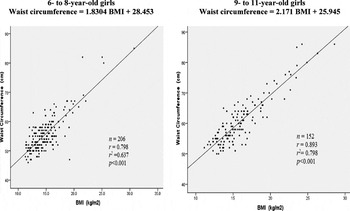
Relationship between BMI and waist circumference (p<0.01).

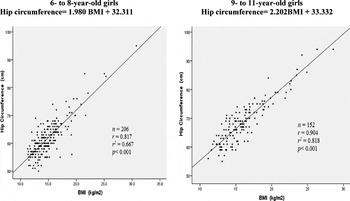
Relationship between BMI and hip circumference (p<0.01).

The data comprised 358 Sunni Muslim females ranging in age from 6 to 11 years. The data were collected during August–November 2011. Two Muslim girls' schools were randomly selected out of a total of fifteen located in the Muslim majority of the old Delhi area. From these schools one section from each class (i.e. class I to VII) was selected by lottery method and all students aged between 6 and 11 years from these selected sections were chosen as the study population. The school authorities gave their informed consent and the children provided their verbal assent. The study was approved by the Ethical Committee of Department of Anthropology, University of Delhi.
General personal information was recorded from each subject before taking measurements, i.e. name, date of birth, date of measurement, father's surname and maternal uncle's surname. The date of birth of all subjects was derived from the birth records provided by school officials. The girls were divided into two groups according to age: 206 girls aged 6–8 years and 152 girls aged 9–11 years. Anthropometric measurements (height, weight and waist and hip circumferences) were taken from all subjects according to standard procedures (Lohman et al., Reference Lohman, Roche and Martorell1988). Body mass index (weight (kg)/height (m)2) was calculated for each girl. Pearson's correlation coefficient (r) was determined using SPSS version 16 to calculate the relationship of BMI with waist and hip circumference.
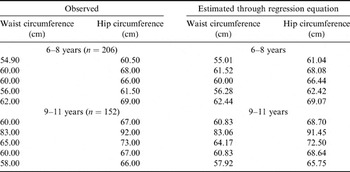
A significant linear correlation was found between waist circumference and BMI in each age group of girls, suggesting the possibility of estimating waist circumference from BMI (height and weight), at least among these 6- to 11-year-old Sunni Muslim girls. Similarly, there was a significant linear correlation between hip circumference and BMI in each age group of girls, suggesting the possibility of estimating hip circumference from BMI (height and weight). The estimation of waist and hip circumferences through linear equation was very near to the actual measurements (Table 1). Thus the results support the assumption that waist and hip circumferences can be estimated with prediction model reliably using BMI (height and weight).
Observed and estimated waist and hip circumferences, 6- to 11-year-old Delhi school girls, 2011

Estimation of waist and hip circumference and the derivation of the waist-to-hip ratio is required in settings where direct measurement of this parameter is not possible, since waist circumference and waist-to-hip ratio are reliable predictive factors for metabolic syndrome and risk of cardiovascular disease in children (Freedman et al., Reference Freedman, Dietz, Srinivasan and Berenson1999; Kahn & Valdez, Reference Kahn and Valdez2003; Jassen et al., Reference Janssen, Katzmarzyk and Ross2004; Browning et al., Reference Browning, Hsieh and Ashwell2010; Aeberli et al., Reference Aeberli, Gut-Knabenhans, Kusche-Ammann, Molinari and Zimmermann2011). The urban paediatric obesity level in India is increasing (Al-Adsani et al., Reference Al-Adsani, Moussa and Al-Jasem2009; Al Rasdan et al., Reference Al Rasdan and Nesef2010), but waist and hip circumference measurements are not performed on children in schools (Abate et al., Reference Abate, Garg, Peshok, Stray-Gundersen and Grundy1995). By contrast, BMI is a simple anthropometric measure, routinely recorded during children's physical examination in schools. The significant linear correlation between waist and hip circumferences and BMI values found in this study is in agreement with some other studies (Ochiai et al., Reference Ochiai, Shirasawa, Nishimura, Morimoto, Shimada and Ohtsu2010; Hajjian & Heidari, Reference Hajjian-Tilaki and Heidari2010; Pratesi et al., Reference Pratesi, Paternosto, Tani, Sassoli and Cappellini2012). This approach is proposed to be an alternative and useful way of detecting childhood metabolic syndrome, which would otherwise require waist circumference or waist-to-hip ratio measurement.