


Introduction
Paediatric clinicians have a long perspective on extracorporeal membrane oxygenation outcome with wisdom gained and changing attitudes towards extracorporeal membrane oxygenation eligibility. Neonates continue to have higher survival rate in children with refractory septic shock supported by extracorporeal membrane oxygenation. Reference Rehder, Turner and Cheifetz1 Extracorporeal membrane oxygenation survival rate after respiratory failure is lower in patients aged between 10 and 18 years than in young paediatric patients. Reference Ramanathan, Yeo and Alexander2 Bleeding complications are more common in children with univentricular CHD, and a second extracorporeal membrane oxygenation run is more common with poorer survival. Reference Amodeo, Stojanovic and Erdil3 Pre-existing neurologic disorders or neurofunctional disabilities in children are not independently associated with in-hospital mortality or decline in neurological outcomes. Reference Dante, Carroll and Ng4
Adult clinicians are increasingly using extracorporeal membrane oxygenation in a variety of anticipatory situations integrating with state-of-the-art interventional procedures and rapidly developing new clinical paradigms of care. Centres with extracorporeal membrane oxygenation-based management protocol can significantly improve survival without severe disability and with potential cost-effectiveness. Reference Peek, Mugford and Tiruvoipati5 As a high-volume extracorporeal membrane oxygenation centre, in particularly during the 2009 and 2019 pandemics, our adult extracorporeal membrane oxygenation team has provided input to paediatric patients with severe acute respiratory failure, as an extension of our vertical model of care for patients with heart and/or lung disease. With a sound and reasonable physiological basis for extracorporeal membrane oxygenation support in children in adolescent years, paediatric and adult programmes can interdependently achieve patient survival with minimal morbidities on the principal goal of maximising quality of life.
We evaluated the collaboration of extracorporeal membrane oxygenation specialist teams across our adult and paediatric clinical groups on integrated care delivery for children over 8 years and over 30 kg. Our objective is to present our experience with consultative adult and children extracorporeal membrane oxygenation services on management and survival outcomes upon referral for extracorporeal membrane oxygenation.
Methods
The Royal Brompton Hospital Institutional Review Board approved this retrospective study. We identified from our extracorporeal membrane oxygenation registry children under 17 years of age from 2015 to 2023. Patients over 30 kg and over 8 years with a diagnosis of cardiogenic shock and having input from both adult and paediatric extracorporeal membrane oxygenation teams were included. The electronic database was retrospectively analysed for primary outcome of time from index joint multidisciplinary conference on extracorporeal membrane oxygenation eligibility to deployment or arrival at cardiogenic shock centre. Technical and transport information was collected from the clinical perfusionist database, paediatric and adult extracorporeal membrane oxygenation coordinators. Secondary outcomes were 90-day survival and neurological outcome defined by paediatric cerebral performance category. Reference Fiser6
Results
Over the 8-year study period, joint multidisciplinary conferences with membership from adult and paediatric specialists were conducted for 6 patients aged 13–16 years, with median weight of 44.5 kg (range 38–75). Table 1 describes the details of patient characteristics, cardiac diagnoses, extracorporeal membrane oxygenation support, and interventions. Cardiac diagnoses included CHD (n = 2), malignant tachyarrhythmia (n = 2), and acquired or metabolic cardiomyopathy (n = 2).
Patient characteristics, modality of extracorporeal membrane oxygenation support, and outcome

*Multi-stage cannula. LFA = left femoral artery; LFV = left femoral vein; RFA = right femoral artery; RFV = right femoral vein; RIJV = right internal jugular vein; SCAI = modified Society for Cardiovascular Angiography and Interventions; SFA = superficial femoral artery; V-AV = venous-arteriovenous; VV-A = venovenous-arterial; ECMO = extracorporeal membrane oxygenation; PCPC = paediatric cerebral performance category.
Joint multidisciplinary conference
Case conference was coordinated by on-call paediatric extracorporeal membrane oxygenation intensivist (n = 3) or adult cardiogenic shock coordinator (n = 3). Three referrals were made directly to our paediatric cardiac ICU by the critical care transport network, and three cases were inpatient in our hospital. Two patients had established multisystem failure or co-morbid systemic syndromes and were deemed unsuitable to benefit from mechanical circulatory support. One patient with cardiogenic shock was transferred to our centre and improved on protocol-based conventional cardiogenic shock care, then repatriated to the referring hospital ICU. Interval from index joint multidisciplinary conference to extracorporeal membrane oxygenation implantation was 0.2–4 hours (n = 3) and to arrival at cardiogenic shock centre was 3–4 hours (n = 2).
Cardiac extracorporeal membrane oxygenation care
Cannulation operators included paediatric and adult cardiac surgeons at operating suite or paediatric cardiac ICU or emergency department. Extracorporeal membrane oxygenation care delivery was continued in the paediatric cardiac ICU. Participants at bespoke extracorporeal membrane oxygenation care review meetings were specialists from paediatrics (extracorporeal membrane oxygenation programme, congenital heart and cardiac surgery, interventional radiology) and adult branch (mobile extracorporeal membrane oxygenation service, shock hotline, vascular and cardiothoracic surgery, interventional cardiology, transplant programme).
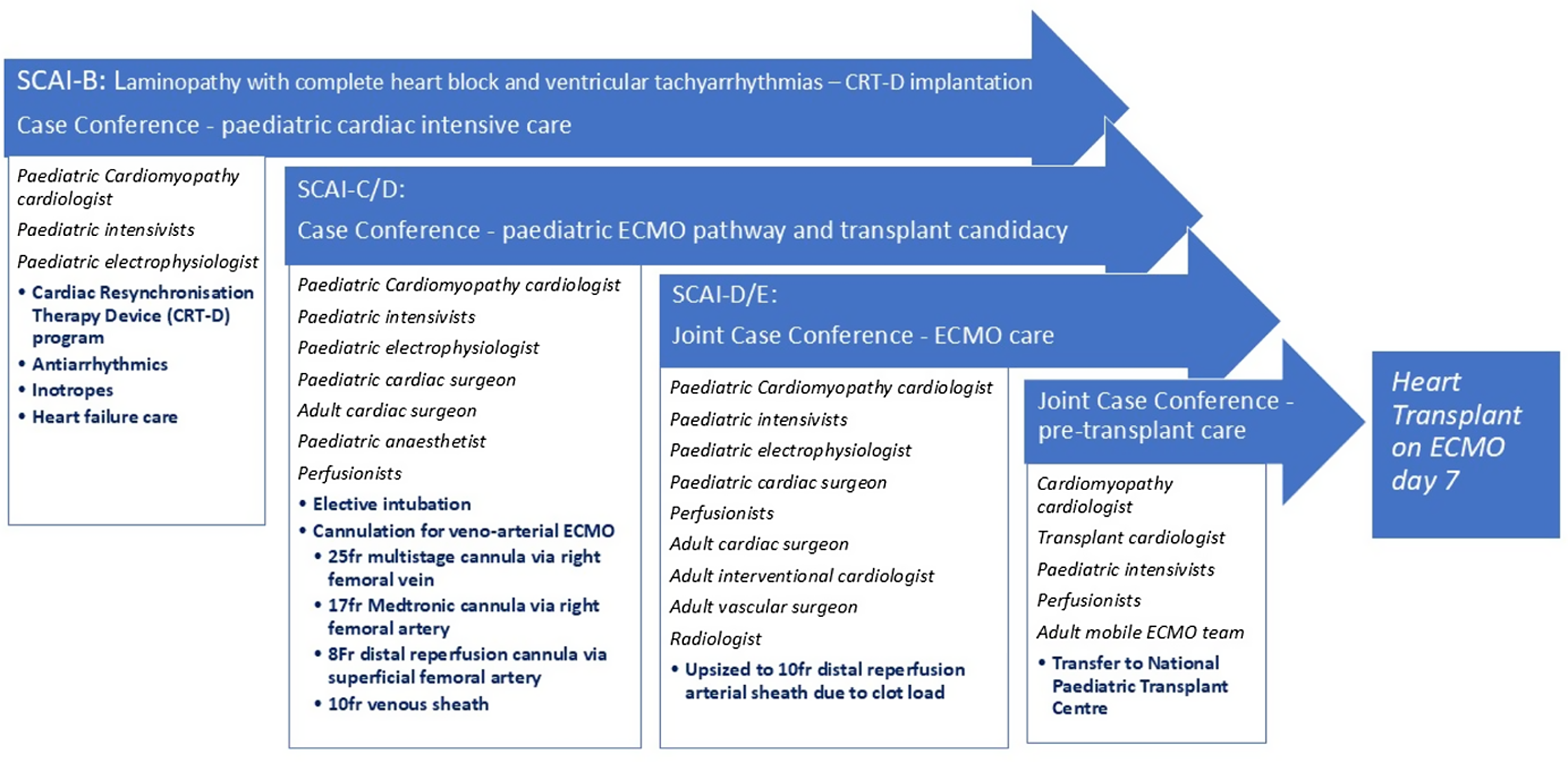
The adult mobile extracorporeal membrane oxygenation team was dispatched for 3 interhospital transfers. One patient was retrieved for assessment, one patient was cannulated at the emergency department to facilitate safe transfer, and one patient on awake extracorporeal membrane oxygenation was transferred to the national transplant centre (Figure 1).
Cardiogenic shock roadmap (15-year-old female with laminopathy cardiomyopathy and malignant ventricular tachyarrhythmia). CRT-D = cardiac resynchronisation therapy-device; SCAI = Society of Cardiovascular Angiography and Interventions; ECMO = extracorporeal membrane oxygenation.
Outcome
The 90-day survival after extracorporeal membrane oxygenation and rate of favourable neurological outcome at 12 months (paediatric cerebral performance category 1–2) were 67% and 67%, respectively. One patient was discharged home with implantable defibrillator, and one patient received a heart transplant after 6 days on awake extracorporeal membrane oxygenation. Extracorporeal life support was withdrawn in one patient who sustained major intracerebral haemorrhage a week after surgical repair of newly diagnosed cor triatriatum sinistrum.
Discussion
Demographics of critically ill children admitted with severe cardiogenic shock requiring mechanical circulatory support are characterised by acquired diseases or CHD reaching adulthood. The bimodal age distribution in paediatric acute myocarditis includes a peak in mid-teenage years. Reference Ghelani, Spaeder, Pastor, Spurney and Klugman7 During the COVID-19 pandemic, adolescents in age group 13–21 years represented 60–65% of patient cohort who received extracorporeal membrane oxygenation for either multisystem inflammatory syndrome in children or acute severe pneumonitis. Reference Bembea, Loftis and Tiagarajan8
With an established paediatric critical care retrieval network available, local district general hospitals are able to seek advice; however, emergency transport capacity may not be feasible. Post-puberty adolescence represents a transition phase in both anthropometry and physiology. Well-developed adult-size children over 50 kg may benefit from some of the interventions offered for adult patients, though our audit showed that children with chronic diseases, CHD, or associated syndrome have smaller vessel calibre (unpublished data). During the study period, our adult extracorporeal membrane oxygenation team also provided input to paediatric patients (age 8–16 years, weight range 34–55 kg) with severe respiratory failure, including cannulation by mobile extracorporeal membrane oxygenation team at referring hospital, or rescue extracorporeal cardiopulmonary resuscitation as bridge to veno-venous extracorporeal membrane oxygenation. Majority of them had favourable neurological outcome (paediatric cerebral performance category 1–2) or resumed baseline neurofunctional status (paediatric cerebral performance category 3–4) at 12-month follow-up.
Our hospital conceived the first cardiogenic shock service in the UK providing consultative 24/7 Shock hotline. A nurse coordinator facilitates multidisciplinary meetings attended by referring clinical team, our cardiogenic shock team of cardiologists (including interventional cardiologist, heart failure) and cardiac surgeons, specialist personnel from the commissioned service with extracorporeal membrane oxygenation intensivists, perfusionist, and extracorporeal membrane oxygenation nurses. Recommendations for extracorporeal membrane oxygenation eligibility of adolescent children were fast-tracked with joint membership of paediatric professionals from critical care transport services, cardiac intensive care, and cardiology.
A modified Society of Cardiovascular Angiography and Interventions shock stage classification created for children in cardiogenic shock can serve as a visualised framework to track clinical course. Reference Puri, Jentzer and Spinner9 Children with Society of Cardiovascular Angiography and Interventions-C may benefit from bedside clinicians triggering consultative discussions with Shock “hub” that offers mechanical circulatory support or be linked to satellite Shock “spoke”.
Timely extracorporeal membrane oxygenation deployment is critical to improve morbidity. Reference Bhaskar, Davila, Hoskote and Thiagarajan10 In-hospital referrals that were eligible proceeded with extracorporeal membrane oxygenation cannulation within the paediatric ICU or theatre, whilst external referrals resulted in adult mobile extracorporeal membrane oxygenation service activated to cannulate and transfer to extracorporeal membrane oxygenation centre or retrieve then further joint multidisciplinary conference to watch and intervene accordingly. The regularity of multidisciplinary team meetings or joint case conference depended on the patient’s clinical complexity and complications that may occur during extracorporeal membrane oxygenation, to strategize and mitigate systemic or regional malperfusion injury. The vertical model with joint approach offered at our centre has enabled a tailored approach, incorporating adult and paediatric best practice, experiential resources to manage the dynamic indications for extracorporeal membrane oxygenation and adapt accordingly to meet the goals of therapy. Adult teams can be a vital source for transport capacity as well as consultative input with their large-volume caseload of critically ill patients, high acquisition of technical skills, and wider access to devices and advancing technology.
The hub and spoke model for quality improvement in cardiogenic shock care facilitating multidisciplinary expert consultation can also allow early identification of patients with low rate of favourable neurological functional outcome. Duration of cardiogenic shock and burden of severe early comorbidities such as renal and liver injury may prompt conversations and discussions of non-extracorporeal membrane oxygenation candidacy. Integrated care delivery draws upon clarity of principles and purpose, interdependence on practicalities and personnel, shared decision-making on place, and context for psychological safety of all stakeholders to enhance team performance. Working alongside each other means that situation awareness to anticipate possible complications to mitigate morbidities and signpost the trajectory to procreate options for survival enables all children to have access to highly specialised clinicians and interventional expertise. Timely focused and open cross-division consultations can support both groups to expand the band of safety in practice with learning from systems of care for patients, different clinical care protocols, equipment, and cannulation techniques.
Conclusion
At our institution, Shock hotline service initiative that fast-tracks access to highly specialised inter-professional team consultative conference inviting input from adult and paediatric disciplines can promote cardiogenic shock care delivery for adolescent children. Integrated extracorporeal membrane oxygenation care defined by awareness of cross-specialty resource, tailored access to adult expertise and paediatric critical care, and retrieval network with real-time advocacy approach for individualised care can improve survival and neurofunctional outcomes.
Acknowledgements
We would like to thank and acknowledge Mr. Richard Trimlett, Professor Susanna Price, extracorporeal membrane oxygenation coordinators, and all of the nurses, doctors, and perfusionists who contributed to the adult cardiogenic shock hotline service.
Financial support
No funding was secured for this report.
Competing interests
All authors have no competing interests to disclose.



