Ductus arteriosus is a blood vessel connecting the pulmonary artery to the aorta. During the foetal period, oxygenated blood is supplied to the aorta from the right ventricle via the ductus arteriosus. After birth, the dramatic decline in prostaglandin levels and elevation of oxygen partial pressure result in the narrowing or closure of ductus arteriosus. Patent ductus arteriosus is one of the common CHDs that cause congestive heart failure. Symptomatic patent ductus arteriosus is treated by administration of cyclooxygenase inhibitors, such as indomethacin, surgical ligation, and catheter intervention. Ductal patency is essential to postnatal life in cases of right ventricular outflow tract obstruction with ductal-dependent pulmonary blood flow. These patients require intravenous administration of prostaglandin E-1 to maintain the patency of ductus arteriosus during the neonatal period. Palliative pulmonary systemic shunt operation is then performed.Reference Dirks, Pretre and Knirsch 1 Premature narrowing of ductus could occur in the fetuses whose mother received indomethacin and excessive amounts of polyphenol-rich beverages.Reference Enzensberger, Wienhard and Weichert 2 , Reference Sridharan, Archer and Manning 3 This sporadic phenomenon leads to congestive heart failure in newborns by tricuspid or pulmonary valve regurgitation and persistent pulmonary hypertension.
Reverse orientation of the ductus arteriosus is usually observed in neonates with critical or severe right ventricular outflow tract obstruction. Pulmonary circulation of these neonates depends on ductus arteriosus. On the contrary, normal orientation of the ductus arteriosus usually occurs in patients with relatively mild right ventricular outflow tract obstruction. We observed patients with right ventricular outflow tract obstruction, who suffered from the closure of normally shaped ductus arteriosus at birth, and failed to respond to prostaglandin E-1 agents. To the best of authors’ knowledge, there is no report on the haemodynamic and clinical difference between the reverse orientation and normal orientation groups in the cases of right ventricular outflow tract obstruction.
In this study, we investigated the haemodynamic and clinical features of CHD with right ventricular outflow tract obstruction during the perinatal period and discussed the perinatal management with special reference to the ductal morphology of these diseases.
Materials and methods
Patients with prenatal diagnosis of right ventricular outflow tract obstruction at Kyushu University Hospital between 2010 and 2015 were included. All prenatal and initial postnatal evaluations of echocardiography and CT were reviewed. Patients associated with multiple anomalies such as chromosome abnormality were excluded. All medical data including clinical manifestation and morphological and haemodynamic characteristics of ductus arteriosus were retrospectively obtained from the charts and electronic database. This study was approved by the Ethics Committee of Kyushu University.
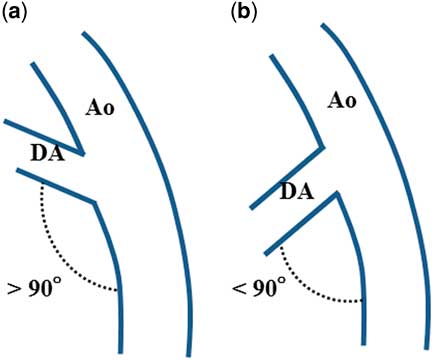
Pre and postnatal echocardiography were performed using Voluson E8 (GE Health Care, Japan) with 4 MHz convex probe by gynaecologists and Vivid I (GE Health Care) with 10 MHz probe by paediatric cardiologists, respectively. Echocardiography of neonates was performed within 2 hours after birth. Enhanced CT scan was used to confirm the diagnosis. The diameter of ductus arteriosus was measured at the narrowest portion, typically at the pulmonary end. Doppler and colour flow imaging were used to evaluate the direction and velocity of ductal flow. Reverse orientation of the ductus arteriosus was defined as an inferior angle of <90° at the aortic junction,Reference Hinton and Michelfelder 4 and normal orientation of the ductus arteriosus as an angle of >90° at the same junction (Fig 1). The shape and diameter of ductus arteriosus were confirmed at birth by transthoracic echocardiography and/or CT. In addition, the degree of pulmonary stenosis was diagnosed after birth.
Schematic illustration of the type of DA (sagittal view). The dotted line showed the inferior angle between the aorta and DA. NDA and RDA were defined as an inferior angle of <90° ( a ) and >90° ( b ), respectively. Ao=aorta; DA=ductus arteriosus; NDA=normal orientation of the ductus arteriosus; RDA=reverse orientation of the ductus arteriosus.

In this study three patients without information on the shape of the ductus arteriosus were excluded. To assess the perinatal characteristics, we collected gestational age at prenatal diagnosis, and birth characteristics including gestational age and body weight. In the neonatal and infantile period, variables collected included lowest oxygen saturation, age at surgery, and survival outcome.
The values are presented as the median (range). The collected and analysed data included echocardiographic measurements and clinical manifestation. The variables were compared between the two groups, normal orientation group versus reverse orientation group, using the Wilcoxon rank-sum test and statistical analysis software JMP Pro12. Statistical significance was defined when a p-value was <0.05.
Results
Patient characteristics
From April 2010 to December 2015, 178 neonates with CHD were admitted to neonatal ICU at our institution. The prenatal diagnosis was obtained in 115 of 178 patients. Of these 115, 42 patients were diagnosed having right ventricular outflow tract obstruction prenatally. Congenital heart anomalies in these 42 fetuses were detected by routine foetal ultrasonography. Because the information of ductus shape were not obtained in three of 42 patients, they were excluded from analysis. The median gestational age at the time of prenatal diagnosis was 29.8 (24.0–36.2) weeks. All were singleton pregnancies showing normal foetal growth. There was no maternal complication during the pregnancy. There was no evident history of excessive consumption of polyphenol-rich beverage. The heart anomalies accompanied with right ventricular outflow tract obstruction included tetralogy of Fallot with pulmonary atresia (n=8), pulmonary atresia with intact ventricular septum (n=7), tetralogy of Fallot (n=5), double-outlet right ventricle with critical pulmonary stenosis (n=10), double-outlet right ventricle with pulmonary atresia (n=2), tricuspid atresia with concordant ventriculoarterial connection (n=1), single ventricle with pulmonary atresia (n=3), single ventricle with pulmonary stenosis (n=1), complete atrioventricular septal defect with pulmonary atresia (n=1), and complete atrioventricular septal defect with severe pulmonary stenosis (n=1). Moreover, five patients were associated with polysplenia (n=2) and asplenia (n=3). Prenatal diagnosis did not change after birth in all patients. Patients were classified into two groups based on the shape of ductus arteriosus: normal orientation of the ductus arteriosus (n=15) and reverse orientation of the ductus arteriosus (n=24). The median gestational age of these infants was 38 (34–42) weeks, and their birth weights were 2610 (1910–3520) g. In 25 (81%) patients, flow direction of ductus arteriosus during prenatal period was retrograde, from aorta to pulmonary artery. At birth, all patients presented with retrograde flow of ductus arteriosus. The levels of peripheral oxygen saturation at birth were 86 (70–95)% (room air), and 37 (95%) patients underwent successful operation of systemic pulmonary shunt during the neonatal or infantile period (45 [3–156] days of age). In two patients, ductus arteriosus was not detected at birth. One of them died after birth (Table 1).
Clinical characteristics.

BT=Blalock-Taussig; BW=body weight; DA=ductus arteriosus; GA=gestational age; NDA=normal orientation of the ductus arteriosus; PA=pulmonary atresia; PS=pulmonary stenosis; RDA=reverse orientation of the ductus arteriosus; RVOTO=right ventricular outflow tract obstruction; SpO2=peripheral oxygen saturation
* Comparison between NDA and RDA
** Retrograde means from aorta to pulmonary artery
*** Patients with closed DA were excluded from this analysis
Comparison between normal and reverse orientation of the ductus arteriosus
There was no significant difference between the normal and reverse orientation groups in the median gestational age at the time of prenatal diagnosis (30 [25–33] versus 29 [24–36] weeks) and body weight at birth (2640 [1910–3175] versus 2542 [2185–3520] g). Foetal echocardiography showed retrograde flow at ductus arteriosus in eight (57%) fetuses with normal orientation of the ductus arteriosus. Remaining six fetuses presented with antegrade flow at ductus arteriosus. In comparison, the direction was retrograde in all 17 patients in reverse orientation group during the foetal period. After birth, the flow directions of ductus arteriosus in all neonates were retrograde. The narrowest diameter of ductus arteriosus after birth in the normal orientation group was significantly smaller than that in the reverse orientation group (2.0 [1.0–5.4] versus 3.0 [1.3–4.4] mm, p<0.05). Normal orientation group did not show lower levels of peripheral oxygen saturation at birth (normal orientation versus reverse orientation: 88 [70–94] versus 86 [76–95]%). There was no significant difference in age at shunt operation. Ductus arteriosus was patent at birth in all patients with reverse orientation, while it is closed in two patients in the normal orientation group at birth (p=0.046). One patient in the normal orientation group died after birth because of severe desaturation following alveolar capillary dysplasia and premature closure of ductus arteriosus (Table 1).
Clinical features in normal orientation group
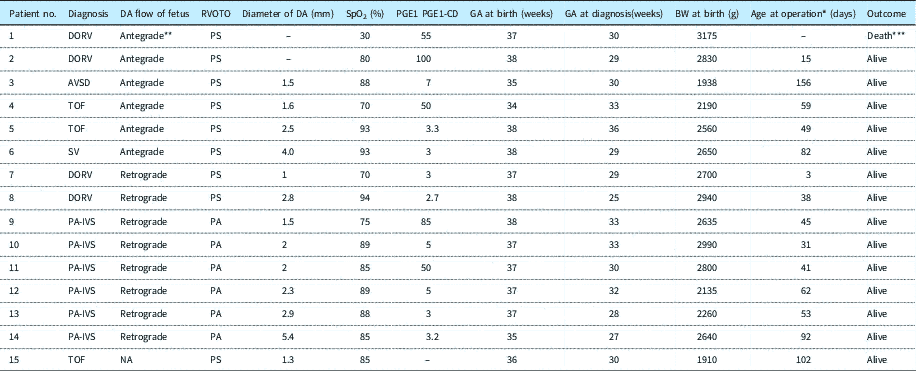
Clinical course and characteristics of 15 patients in the normal orientation group were summarized in Table 2. In six of 15 patients, patients 1–6, antegrade flow in ductus arteriosus was observed at foetal diagnosis. Among these six patients, ductus arteriosus has already closed in two patients – patient 1 and 2. In patient 1 and 7, right ventricular outflow tract obstruction developed during the perinatal period. High-dose administration of prostaglandin-E1 failed to re-open ductus arteriosus in patient 1 and 2. Unfortunately, patient 1 died of severe desaturation 6 hours after birth. Autopsy revealed closure of ductus arteriosus and alveolar capillary dysplasia. In patient 2, although the antegrade pulmonary flow was enough to maintain peripheral oxygen saturation level at birth, rapid progression of right ventricular outflow tract obstruction led to desaturation after birth. Then, the Blalock-Taussig shunt operation was performed 15 days after birth. In patient 3, although right ventricular outflow obstruction was severe, the size of ductus arteriosus was sufficient to maintain the pulmonary blood flow. Blalock-Taussig shunt operation was carried out at 30 days of age. In patient 7, peripheral oxygen saturation level at birth was very low at 60–70% because of the extremely narrow diameter of ductus arteriosus. The high-dose administration of prostaglandin-E1, oxygen supply, and nitrogen oxide inhalation therapy were not effective. Central shunt operation was performed at 3 days of age. Six patients, patient 9–14, were diagnosed as having pulmonary atresia with intact ventricular septum with retrograde flow of ductus arteriosus at prenatal diagnosis. Interestingly, the main pulmonary artery dilation was observed in three of six patients. Blalock-Taussig shunt operation was performed in these patients within 92 days after birth.
Clinical courses and DA diameters in NDA group patients.

AVSD=atrioventricular septal defect; BW=body weight; DA=ductus arteriosus; DORV=double outlet right ventricle; GA=gestational age; PA-IVS=pulmonary atresia with intact ventricular septum; PS=pulmonary stenosis; RVOTO=right ventricular outflow tract; SpO2=peripheral oxygen saturation; SV=single ventricle; TOF=tetralogy of Fallot
* Operation includes Blalock-Taussig shunt and central shunt
** Antegrade flow means from pulmonary artery to aorta
*** Cause of death is severe cyanosis because of early closure of DA and alveolar capillary dysplasia
Discussion
The present study demonstrated that the narrowest diameter of ductus arteriosus after birth in the normal orientation group was significantly smaller than those in the reverse orientation group. Two patients with early closure of ductus arteriosus at birth showed the normal orientation morphology. In these cases, high-dose administration of prostaglandin-E1 was ineffective to re-open ductus arteriosus. These observations suggested that patients having CHD with right ventricular outflow tract obstruction and normal orientation are at high risk of the progressive narrowing and closure of ductus arteriosus.
In normal heart development, ductus arteriosus with various degrees of the inferior angle is completely formed by 8 weeks of gestational age.Reference Hinton and Michelfelder 4 – Reference Abrams and Walsh 7 It has been described that right ventricular outflow tract obstruction with reverse orientation might be associated with ductal-dependent pulmonary circulation and needs early intervention after birth.Reference Hinton and Michelfelder 4 , Reference Santos, Moll, Drumond, Araujo, Romao and Reis 6 , Reference Quartermain, Glatz and Goldberg 8 When right ventricular outflow obstruction has been complete or critical from early gestation age, acute inferior angle would be formed.Reference Santos, Moll, Drumond, Araujo, Romao and Reis 6 On the contrary, the patients who had normal orientation and antegrade flow of ductus arteriosus almost certainly maintained blood flow from the right ventricle to the pulmonary artery during the early foetal life.Reference Santos, Moll, Drumond, Araujo, Romao and Reis 6 Thus, even if the antegrade flow of pulmonary artery decreases in late foetal life, the degree of the inferior angle of ductus arteriosus will remain unchanged.
Formation of the right ventricular outflow tract is also completed by the early gestational age.Reference Anderson, Webb, Brown, Lamers and Moorman 9 It has been described that right ventricular outflow tract obstruction was CHD with significant potential for progression during the prenatal period, and results in a more severe condition in term, although the precise mechanism of the progression is still unclear.Reference Yamamoto and Hornberger 10 For instance, right ventricular outflow tract obstruction in tetralogy of Fallot progressed in utero, resulting in pulmonary hypoplasia.Reference Hornberger, Sanders and Sahn 11 Severe stenosis with intact ventricular septum could develop to pulmonary atresia, and reversed flow in ductus arteriosus appeared during the prenatal period.Reference Todros, Paladini and Chiappa 12 Our cases of pulmonary atresia with intact ventricular septum had normal oriented duct, post-stenotic dilatation, and retrograde flow in ductus arteriosus. These anatomical findings implicated the presence of antegrade flow of the pulmonary artery during the entire prenatal course.
Tuo et al demonstrated that the diameter of ductus arteriosus in the moderate right ventricular outflow tract obstruction with antegrade ductus flow was small.Reference Tuo, Volpe, Buffi, De Robertis and Marasini 13 They discussed that decrease of ductal blood flow might relate to ductal narrowing. Combined with these reports, the present study suggested that the volume of antegrade pulmonary artery flow could define the diameter of ductus arteriosus in neonates with normal orientation and right ventricular outflow tract obstruction. Early narrowing or closure of ductus arteriosus might occasionally occur along with the decrease in antegrade ductus arteriosus flow in this population. Moreover, because normal orientation is not optimal shape for retrograde ductus flow, the flow volume in normal orientation may decrease more than in reverse orientation patients. Thus, repeated careful examination by foetal echocardiography should be needed.
Some studies reported dilation of foetal ductus arteriosus following maternal administration of phosphodiesterase 3 or 5 inhibitor, and magnesium sulphate in rats.Reference Toyoshima, Momma, Imamura and Nakanishi 14 – Reference Toyoshima, Momma and Nakanishi 16 These agents dilated constrictive ductus arteriosus by indomethacin in foetal rats, suggesting the potential usefulness of maternal administration of these agents for the treatment of idiopathic or secondary foetal ductal narrowing. Patients having right ventricular outflow tract obstruction with foetal ductal narrowing may need maternal administration of these agents for the treatment and prophylaxis of constrictive ductus arteriosus.
This study is associated with some limitations such as small sample size from single institution and not enough data on foetal echocardiography.
In conclusion, right ventricular outflow tract obstruction with the normal orientation morphology might impact on early narrowing or closure of ductus arteriosus. Precise foetal diagnosis, repeated careful evaluation, and maternal treatment may improve the perinatal management of CHDs with right ventricular outflow tract obstruction.
Acknowledgements
None.
Financial Support
The authors have indicated they have no financial relationships relevant to this article to disclose.
Conflicts of Interest
The authors have indicated they have no potential conflicts of interest to disclose.