Introduction
Springtails (Collembola) are one of the primary constituents of Antarctic terrestrial faunal assemblages. Their physiological adaptations to the challenges of the Antarctic environment - in particular, low temperature and desiccation - have stimulated extensive enquiry (e.g. Cannon & Block Reference Cannon and Block1988, Hayward et al. Reference Hayward, Worland, Convey and Bale2004, Worland Reference Worland2005, Hawes et al. Reference Hawes, Marshall and Wharton2008a, Reference Hawes, Marshall and Wharton2011). However, to date, we know nothing about their adaptations and responses to the unique photo-environment of the period when they are active, the Antarctic summer. Two factors define this photo-environment: 24 h sunlight and high doses of ultraviolet radiation (UV). The latter, in particular, is of growing interest and concern to biologists as a result of projected increases in UV linked to the depletion of the ozone layer (e.g. Weiler & Penhale Reference Weiler and Penhale1994, Weatherhead & Andersen Reference Weatherhead and Andersen2006), although there is some evidence to suggest a recovery of the Antarctic ozone layer in recent years (Salby et al. Reference Salby, Titova and Deschamps2011). This paper represents the first study to examine the UV tolerance and sensitivity of Antarctic springtails, the most southerly living hexapods.
Although extensive work has examined, and continues to examine, UV effects on Antarctic aquatic organisms and terrestrial flora (e.g. Lamare et al. Reference Lamare, Barker, Lesser and Marshall2006, Turnbull et al. Reference Turnbull, Leslie and Robinson2009), terrestrial arthropods have been largely ignored (but see Lopez-Martinez et al. Reference Lopez-Martinez, Elnitsky, Benoit, Lee and Denlinger2008). Part of the reason for this is that, certainly in the case of springtails, they have an edaphic lifestyle, which should reasonably be expected to mean that they have little general exposure to sunlight. In addition, with the exception of the white isotomid, Antarcticinella monoculata Salmon - described by Janetschek (Reference Janetschek1967) as colourless or transparent (which represents a curious anomaly and presumably a throwback to an ancient Antarctic landscape with a more significant soil profile) - all mainland Antarctic springtails are heavily pigmented and therefore in possession of natural cutaneous screening. It is also worth noting that Meyer-Rochow et al. (Reference Meyer-Rochow, Reid and Gal2005) found evidence of retinal resistance to photic damage associated with screening pigment granules.
Although Antarctic springtails are readily observed to be edaphic (whether through collections under stones or from soil profiles), the fact remains that they also occur on the surface, so must experience some exposure to UV in their lives. It is difficult, although not impossible, to observe epigeal activity. For example, pitfall trapping by McGaughran et al. (in press) has provided indirect evidence of surface dispersal activity. However, their most obvious presence on the surface is connected to passive dispersal. Water and aerially captured springtails are a random but not unusual occurrence (Hawes et al. Reference Hawes, Worland, Bale and Convey2007, Reference Hawes, Worland, Bale and Convey2008b, Hawes Reference Hawes2011). Indeed, springtails captured in rafting aggregations on meltwater or tidal pools probably represent the primary scenario for sustained UV exposure for this group (Hawes Reference Hawes2011).
This study examined the effects of ambient UV exposure on the springtail Gomphiocephalus hodgsoni Carpenter, floating on water. In addition to comparing the relative survival of animals exposed or not exposed to UV, the experiments sought to examine whether there was any evidence for: a) a photo-inhibitive effect on moulting (moulting occurs readily in the presence of water; but moulting under sunlight would expose animals to increased levels of UV during ecdysis and the formation of the new cuticle), and b) DNA damage and repair.
Methods
Field site and collection
Fieldwork and field collection were carried out from a camp established near Granite Harbour, south Victoria Land. UV-B levels were measured throughout the experimental period using a digital ultraviolet radiometer (Zoo Med Laboratories, USA). Measurements were taken daily, every hour, for the hours 09h00–22h00. Gomphiocephalus hodgsoni were collected by gently brushing aggregations of springtails found on the under-surface of rocks into pots with moistened plaster of Paris and moss.
Exposure protocol
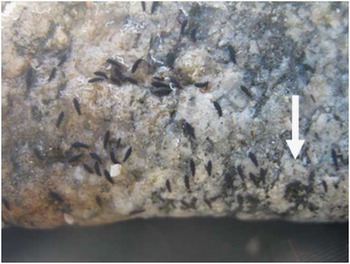
Samples were then transferred to Eppendorf tubes (1.5 ml) filled to 1 ml with water for experiments. Flotation was employed for three reasons: a) to ensure the hydration state of animals was not compromised (springtails are extremely susceptible to dehydration and it was important not to have to continually interfere with the experimental containers to manage this), b) to prevent the escape of animals from both containers and solar exposure (water is the most effective capture mechanism for springtails which can survive extended durations on its surface, and the provision of any form of alternative substrate would automatically provide a surface to hide from sunlight - G. hodgsoni demonstrates readily observable negative phototaxis (Fig. 1), presumably an adaptation to the Antarctic photo-environment in its own right), and c) to simulate the primary natural/ecologically realistic scenario in which springtails are most likely to be susceptible to UV loading, when they are rafting on water bodies and have no recourse to behavioural avoidance (Hawes et al. Reference Hawes, Worland, Bale and Convey2008b, Hawes Reference Hawes2011). For exposure (‘LIGHT’) treatments, Exp. 1 and 2 used attenuated exposure - exposure to sunlight was mediated through the plastic lids of the Eppendorf tubes. Given the length of the treatments, it was deemed necessary to used closed-top tubes to prevent anything like dust or snow getting in that could provide a covering medium, as well as to completely prevent the escape of animals (the tubes although ideal for management of replicates, provide a water surface whose radius is too small to guarantee complete capture). The attenuation of UV-B absorbance by the plastic of the Eppendorf tubes was measured with the digital ultraviolet radiometer. Absorbance values were compared between the sensor exposed to direct sunlight and covered by a tube cap. The average attenuation factor was 61.15 ± 1.86 μW cm-2 (n = 20). This represents an average reduction of 42.04 ± 1.14% of total UV-B. Results for these experiments therefore represent minimized UV-B exposure equivalent (although experiments were carried out during a spell of largely clear, sunny days) to natural exposures of overcast weather. For the short-term treatment destined for DNA analysis, this was not necessary and animals were exposed with tops of the Eppendorf tubes open to direct sunlight.
Negative phototaxis in G. hodgsoni: rock with springtail aggregation turned over and springtails (body size c. 1 mm) dispersing away from light toward underside of rock (white arrow indicates direction of negative phototaxis).

Experiment 1. Individual long-term survival of indirect exposure
The first experiment examined time to mortality of individual springtails exposed continuously to attenuated sunlight. Five replicates of ten individual animals were placed in individual Eppendorf tubes - this was the ‘LIGHT’ treatment. Five control replicates were prepared in the same way but the Eppendorfs were completely covered with duct tape (the silver-grey colour promotes light reflection, while the covering prevents the entry of light) - this was the ‘DARK’ treatment. Eppendorfs were then examined daily for evidence of survival and moulting (appearance of shed cuticle).
Experiment 2. Survival of ten-day indirect exposure by aggregations
The second experiment compared the survival of springtail aggregations (rather than individuals) exposed to attenuated sunlight over a 10 day period. Five replicates of Eppendorf tubes were used for each day (10 d = 50 replicates). Each replicate contained 10 springtails. To allow for statistically independent samples, all replicates were half-buried into the substrate at ground level and, at the end of each 24 h period of exposure, five replicates from each treatment were removed for assessment of survival and moulting.
Experiment 3. DNA damage after 5 h direct exposure on sunny day
On 20 January, 15 replicate Eppendorf tubes with 10 floating springtails each were exposed (see Exp. 1) to ambient UV for a 5 h period of clear sunny weather from 10h00–15h00 (representing the time when the sun was directly overhead). In conjunction with the exposure five additional replicates of 10 animals were floated for the same amount of time in darkness. These animals were used as the control treatment (C). After the completion of the 5 h period, animals from the control treatment and animals from five replicates of the exposure treatment, the immediate group (I), were euthanized and preserved by 95% ethanol. To determine whether there was any evidence for DNA repair in springtails, the remaining replicates were transferred to complete darkness for a further 12 and 24 h - the ‘12 h’ and ‘24 h’ groups. After the completion of this recovery period these samples were also euthanized and preserved by ethanol. Samples were stored and returned to New Zealand for laboratory analysis.
Total genomic DNA was extracted from five individuals (each a sub-sample from one of the five replicate Eppendorfs) from each treatment using the Mammalian Genomic DNA Miniprep Kit (Sigma) as per manufacturer's instructions with the exceptions that 175 ml Lysis solution T and 200 ml of Lysis solution C were used in the preparatory steps and 60 ml was used to elute DNA (see Hawes et al. Reference Hawes, Toricelli and Stevens2010). Damage to genomic DNA was quantified using a DNA Damage Quantification Kit (Biovision, CA, USA) as per manufacturer's instructions. The kit assays apurinic/apyrimidinic (AP) sites. The quantification of AP levels provides an indicator of the extent of cellular DNA lesion and repair. Manufacturer's standards provided a reference point to determine the number of AP sites in samples. Differences between control (C) and other treatments represent the effect of the exposure.
Data analysis
For Exp. 1, probit analysis was used to estimate the LT90, LT50 and LT10 for each treatment. Both survival and moult data were compared between treatments using a Kruskal-Wallis test as zero counts from the LIGHT treatment led to distributions that were not normally distributed and, in the case of the survival data, unequal variances. For Exp. 2, probit analysis was tried but discarded after it became apparent that although a difference between treatments was apparent as well as a decline over time, the method of sampling (survival was determined each day by the removal of a sub-sample for counting) introduced too much inter-diel variability to allow a useful estimation of lethal times. Survival data was normally distributed so a two-sample t-test was used to compare means. As with Exp. 1, moult data was not normally distributed as a result of zero counts from the LIGHT treatment, so a Kruskal-Wallis test was used to compare medians. For Exp. 3, differences in DNA damage were normally distributed so compared by ANOVA.
Results
UV-B levels
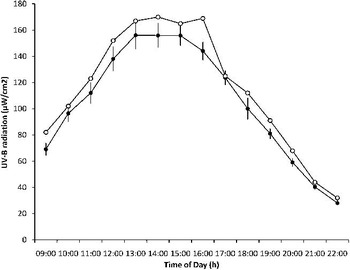
UV-B levels over the study period are shown in Fig. 2, with mean values for the sampling period (13–27 January) and individual values for 20 January, the day of the experimental exposures for DNA damage (see below, Exp. 3). For the latter, mean UV-B was 146.5 (12.5), with a minimum of 104 nm, and a maximum of 175 nm. These values represent the gradual increase in UV-B during the day from the morning through to the afternoon, with 175 nm, taken at the point of removal, coinciding with both the peak UV-B level for that day and the termination of exposure for the experiment.
UV-B radiation at field site for the hours 09h00–22h00 over the experimental period of 13–27 January 2010 (black circles) and exposure period for DNA damage, 5 h direct exposure on 20 January 2010 (open circles) (Exp. 3). (Standard error = s.e. ± 1).

Experiment 1
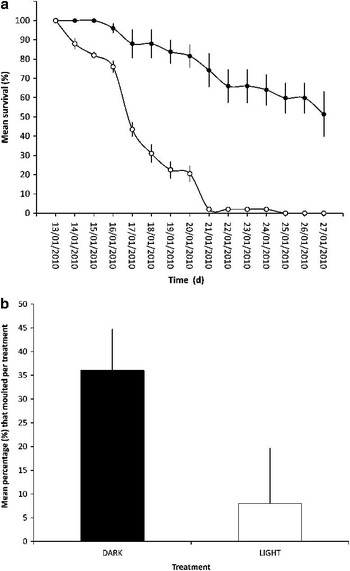
Given that the results for both Exp. 1 and 2 represent minimized UV exposure – equivalent to an overcast day (see discussion of attenuation factor above) - they are particularly revealing, showing the extent to which even such mediated exposure, largely limits survival to a relatively short survival timeframe. The comparative differences between LIGHT and DARK treatments clearly demonstrate the effect of UV on individual survival. Figure 3a compares the survival of individuals in LIGHT and DARK treatments. By the end of the experiment none were left alive in the LIGHT treatment, but 60% were still alive in the DARK treatment. Comparison of medians (Kruskal-Wallis test) found a highly significant difference between the survival times of springtails in each treatment (df = 1, H = 9.48, P = 0.002 (adjusted for ties)). Probit-estimated lethal times were calculated for each treatment as: a) for the DARK treatment: LT90 = 22.66 ± 0.93; LT50 = 14.31 ± 0.40; LT10 = 5.96 ± 0.37 days; and b) for the LIGHT treatment: LT90 = 8.40 ± 0.18; LT50 = 5.24 ± 0.12; LT10 = 2.07 ± 0.20 days. Samples in the DARK treatment also moulted more than LIGHT treatment springtails (Fig. 3b). Comparison of medians (Kruskal-Wallis test) found these differences to be significant (df = 1, H = 4.62, P = 0.032 (adjusted for ties)).
Responses of G. hodgsoni to individual exposure to attenuated UV: a. mean percentage (%) survival, and b. mean percentage moulting. DARK treatment = black circles/bars, LIGHT treatment = open circles/bars. (Standard error = s.e. ± 1).

Experiment 2
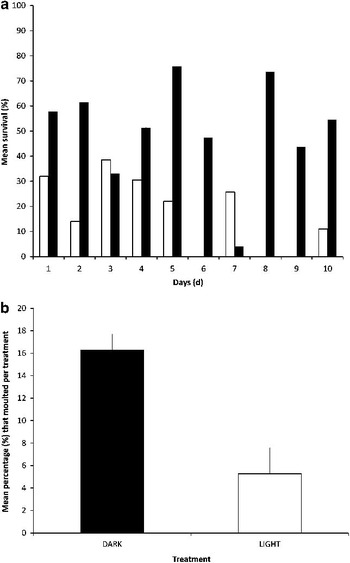
Survival of LIGHT and DARK treatments by aggregations is shown in Fig. 4a. As with the individual treatments, survival was highly significantly greater in the DARK treatment (df = 16, T-value = -4.10, P = 0.001). As with Exp. 1, DARK treated springtails moulted more than LIGHT treated springtails (Fig. 4b). Comparison of medians (Kruskal-Wallis test) found a significant difference between moult rate in each treatment (df = 1, H = 8.28, P = 0.004 (adjusted for ties)). Given the different protocols for Exp. 1 and 2, it is not possible to quantitatively compare the differences between exposure for individuals and aggregations. However, a qualitative comparison shows that the overall difference between LIGHT and DARK treatments is confirmed by its replication in each experiment. Differences in survival and moulting between the experiments are not sufficiently discriminated to suggest any clear advantage to exposure as either individuals or aggregations.
Responses of G. hodgsoni to aggregated exposure to attenuated UV: a. mean percentage (%) survival, and b. mean percentage moulting. DARK treatment = black bars, LIGHT treatment = white bars. (Standard error = s.e. ± 1; note some values for s.e. low so not visible on this scale).

Experiment 3 DNA damage and repair
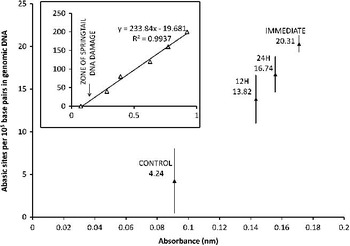
There was a highly significant difference (df = 3, F = 6.94, P = 0.03) in DNA damage (quantified as number of AP sites) between UV exposed springtails and control springtails kept in darkness (Fig. 5). Post hoc analysis of the comparisons found that this result was produced by a significant difference between the immediate (I) treatment and controls (C) (diff of means = -0.068, T-value = -4.34, adjusted P -value = 0.003); and a significant difference between the 24h treatment and controls (C) (diff of means = 0.05, T-value = 3.38; adjusted P-value = 0.02). There was no significant difference between controls and the 12 h treatment, indicating that DNA repair had occurred in that treatment. Damage reduction (in comparison to controls) was also observed in the 24 h treatment but this was not significant.
DNA damage to G. hodgsoni after 5 h UV exposure and (inset) standard curve calculated from manufacturer's standards with zone of springtail DNA damage indicated. (Standard error = s.e. ± 1).

Discussion
It has been frequently noted that terrestrial fauna may have some respite from the effects of increased UV exposure caused by the ozone hole over Antarctica because of the temporal asynchrony of their summer active stages with the main effects of increases in late winter. Nonetheless, regardless of the lack of major ozone depletion effects, terrestrial surfaces in the Antarctic summer - and by extension the fauna inhabiting them - are characterized by high exposure to UV. Indeed, it can truly be characterized as an ‘intense’ photic-environment (Lopez-Martinez et al. 2008).
UV can be discriminated by wavelength into three classes (UV-A, UV-B, UV-C). UV-C (100–280 nm), also known as shortwave or ‘germicidal’ UV, is absorbed in the upper atmosphere (Cockell Reference Cockell2001). UV-A (320–400 nm) leads to the production of reactive oxygen species which, in turn, may institute oxidative damage in a variety of ways from lipid peroxidation, to protein and DNA damage (Lopez et al. 2008). Unlike UV-A, UV-B (290–320 nm) damages DNA directly, most commonly by the formation of pyrimidine dimers, which distort the strand and block transcription and replication (Turnbull & Robinson Reference Turnbull and Robinson2009). Although we only measured UV-B levels (Fig. 3), it should be acknowledged that the effects on physiology and DNA that were observed in this study should be conservatively attributed to both UV-A and UV-B. Thus our results reflect the natural effects of combinatorial exposure to UV at both wavelength regions. However, it is noted that UV-B damage is the most widely observed class of UV stress reported in Antarctic biota (e.g. Hughes Reference Hughes2006, Lamare et al. Reference Lamare, Barker, Lesser and Marshall2006, Reference Lamare, Barker and Lesser2007, Newsham & Robinson Reference Newsham and Robinson2009, Turnbull & Robinson Reference Turnbull and Robinson2009, Turnbull et al. Reference Turnbull, Leslie and Robinson2009)
It is of great interest to note the occurrence of DNA damage, despite the short exposure period, and despite screening pigmentation. After exposure animals were alive and actively motile and there was evidence of DNA repair in the 12 h treatment, which showed no significant difference with controls (C). Springtails from the longer recovery treatment (24 h), although showing a reduction in damage, were however significantly different from controls (C). It is not clear whether this is just a reflection of some unknown variability or whether initial recovery processes are followed at a later period by more persistent damage. Thus, although DNA repair is evident, its time scale requires further investigation and it is clear that even such a short 5 h exposure to UV may represent a significant physiological perturbation. Longer exposures, more typical of trapping by water surfaces for example, could be expected to represent a major challenge.
Previous examinations of the physiological challenges to springtails caught on water surfaces did not account for a photo-dimension to the stresses encountered. In particular, we note that the demonstration of long-term survival by Hawes et al. (Reference Hawes, Worland, Bale and Convey2008b) which was carried out under laboratory conditions with a combination of artificial light (for examination) and darkness (for controlled temperature incubation), may in the context of these findings be considered to represent survival under near optimal conditions although true optimal conditions may be considered to be absolute darkness at or near to 0°C. Observations of in situ raft aggregations of springtails - C. antarcticus in the Maritime Antarctic (TCH, unpublished data) and G. hodgsoni in continental Antarctica (Hawes Reference Hawes2011) - show that they can survive for some period while floating on water bodies. In such a field context, exposed to natural doses of UV, this period will be not as optimized as the survival times measured by Hawes et al. (Reference Hawes, Worland, Bale and Convey2008b). At least some of the rafting G. hodgsoni observed by Hawes (Reference Hawes2011) survived 12 days or more. McGaughran et al. (in press) also independently demonstrated survival of G. hodgsoni after ten days of floating on water, although it is noted that the photo-environments for these experiments were also not sufficiently ecologically realistic. Of course, at the other end of the continuum, true ‘ecological realism’ is ultimately the experience of each individual animal in its individual context (Hawes Reference Hawes2011). Natural exposure to UV by floating springtails may be mediated by a range of individual environmental characters such as the aspect of the water body, local cloud cover, and presence of snow as a UV reflector. Thus the degree of the stress of the exposure is ultimately determined by both local micro-factors (e.g. pool location) and macro-factors (e.g. weather).
Given that survival of even attenuated exposure (Exp. 1 and 2) was greatly decreased by 10 day exposures, and that there was such a clear difference between the light and dark treatments, it is clear that G. hodgsoni are less adapted to UV than their heavy pigmentation would suggest. These longer exposures were constant but in terms of intensity, the UV experienced by the springtails was c. 40% less than natural conditions. That even under such mediated conditions, they should show such clear differences, is evidence of their sensitivity to UV.
Another aspect of the physiological challenges of rafting in Antarctic springtails that was not anticipated by Hawes et al. (Reference Hawes, Bale, Worland and Convey2008a) was the effect of the interaction between the light environment and moulting. Previous work has demonstrated the significance of moulting to the cold tolerance of Antarctic springtails (Worland Reference Worland2005, Worland & Convey Reference Worland and Convey2008). Further benefits of moulting to the polar ecology of these arthropods are evident in a rafting context: moulting greatly facilitates survival by providing a flotation device (raft) and food store (Hawes et al. 2008b). For springtails to achieve sufficient haemolymph pressure to achieve ecdysis, it is vital for them to be in a fully hydrated state before they can moult (Hopkin Reference Hopkin1997). Thus moulting springtails habitually moult in sites that are either or both saturated and buffered against water loss. Although perhaps not their preferred habitat, water bodies represent an ideal moult site for many terrestrial springtails, as they offer the security of complete hydration. Many springtails - including Antarctic species - once placed on a water surface, will therefore not take long to moult. Moulting is also encouraged by aggregation, with many springtails synchronizing their stages of growth and development via pheromones (Leinaas Reference Leinaas1983). Both lone individuals and aggregations of individuals caught on the water surface are therefore in a state highly conducive to moulting. However, in an Antarctic context, the benefits of moulting must also be weighed against the costs of moulting in a photically exposed situation. In particular, the process of shedding the cuticle is followed by a brief period in which the newly exposed, emergent cuticle may not be completely matured - in terms of sclerotization or the deposition of pigment. Such a situation probably makes them vulnerable to UV. Ultimately, the springtails are faced with a physiological dilemma, choosing between their natural tendency to moult and its photo-inhibition by the presence of Antarctic light. Although the internal drivers that cause moulting seem to prevail in the end, with moulting occurring in both light and dark treatments - and moulting clearly evident in natural raft aggregations (Hawes Reference Hawes2011) - the results of the experiments indicate the presence of a strong photo-inhibitive element to moulting. This is clearly of adaptive value - given the damage UV can do - but it remains to be seen whether this is just a convergent enhancement of fitness resulting from collembolan edaphic lifestyles, or whether it is something unique to polar springtails.
In conclusion, despite its adaptations/pre-adaptations (e.g. pigmentation, negative phototaxis) to the extreme photo-environment of Antarctica, the springtail G. hodgsoni demonstrated significant sensitivity to UV. Short-term direct exposures elicited significant evidence of DNA damage, while longer exposures to milder doses showed significant differences with dark-acclimated springtails for both survival and moulting. These results represent the first examination of UV tolerance in an Antarctic springtail. In addition to highlighting the susceptibility of these arthropods to UV, they reveal how exposure may be mediated by factors like DNA repair and photo-inhibition of moulting. It is also noted that these results emphasize the importance of careful protocols for the collection of experimental treatments of specimens for other biological studies on Antarctic Collembola - particularly genetic analysis. The integrity of samples or treatments may be mediated by any exposure to UV. There is considerable scope for further research into the photobiology of G. hodgsoni.
Acknowledgements
Research was funded by an Antarctic Science Ltd bursary to TCH. Thanks to Stephen Clarke and Michelle Liddy for field assistance. The constructive comments of the reviewers are also gratefully acknowledged. Finally, thanks also the weather gods of Antarctica for some experimentally-friendly skies.