INTRODUCTION
Warming global temperatures have resulted in numerous shifts in the distributions of marine species (Southward et al., Reference Southward, Hawkins and Burrows1995; Hawkins et al., Reference Hawkins, Moore, Burrows, Poloczanska, Mieszkowska, Herbert, Jenkins, Thompson, Genner and Southward2008, Reference Hawkins, Sugden, Mieszkowska, Moore, Poloczanska, Leaper, Herbert, Genner, Moschella, Thompson, Jenkins, Southward and Burrows2009; Poloczanska et al., Reference Poloczanska, Brown, Sydeman, Kiessling, Schoeman, Moore, Brander, Bruno, Buckley, Burrows, Duarte, Halpern, Holding, Kappel, O'Connor, Pandolfi, Parmesan, Schwing, Thompson and Richardson2013). However, predicting these changes can be challenging. Correlative species distribution models are an increasingly common approach to predicting current and future distributions (Elith & Leathwick, Reference Elith and Leathwick2009; Reiss et al., Reference Reiss, Cunze, König, Neumann and Kröncke2011; Robinson et al., Reference Robinson, Elith, Hobday, Pearson, Kendall, Possingham and Richardson2011; Singer et al., Reference Singer, Schückel, Beck, Bleich, Brumsack, Freund, Geimecke, Lettmann, Millat, Staneva, Vanselow, Westphal, Wolff, Wurpts and Kröncke2016), but can fail when range limiting mechanisms vary spatially (Alexander & Edwards, Reference Alexander and Edwards2010), when systems are undergoing rapid change (Brun et al., Reference Brun, Kiørboe, Licandro and Payne2016), or when physical barriers inhibit dispersal (Alexander & Edwards, Reference Alexander and Edwards2010; Keith et al., Reference Keith, Herbert, Norton, Hawkins and Newton2011). In these cases mechanistic based models may provide more accurate predictions (Kearney & Porter, Reference Kearney and Porter2009; Woodin et al., Reference Woodin, Hilbish, Helmuth, Jones and Wethey2013).
In many marine invertebrates early life-history stages are the most physiologically sensitive (Andronikov, Reference Andronikov1975). Therefore, warming ocean temperatures may pose a greater risk to early-life history stages than adults, and the effects of temperature on early-life history stages may be important in driving changes in the distribution of many marine species (Hutchins, Reference Hutchins1947; Andronikov, Reference Andronikov1963; Ushakov, Reference Ushakov1964; Wethey et al., Reference Wethey, Woodin, Hilbish, Jones, Lima and Brannock2011). Both the larval pool and successful recruitment are necessary for population persistence, making the fate of early-life history stages very important in determining the potential success or failure of marine populations (Cowen & Sponaugle, Reference Cowen and Sponaugle2009; Pineda et al., Reference Pineda, Reyns and Starczak2009).
While an increasing number of studies are examining the consequences of warming ocean temperatures on early life-history stages (Walther et al., Reference Walther, Crickenberger, Marchant, Marko and Moran2013; Przeslawski et al., Reference Przeslawski, Byrne and Mellin2015), few examples exist in the marine literature that allow contemporary studies to examine long-term changes in population fluctuations as a result of temperature effects on early life-history stages. The barnacle Semibalanus balanoides can serve as a good model species for understanding the effects of warming ocean temperatures on early life-history stages and the consequences for population persistence because of numerous studies on historical distributions (Fischer, Reference Fischer1872; Crisp & Fischer-Piette, Reference Crisp and Fischer-Piette1959; Barnes et al., Reference Barnes, Barnes and Klepal1972; Wethey & Woodin, Reference Wethey and Woodin2008; Wethey et al., Reference Wethey, Woodin, Hilbish, Jones, Lima and Brannock2011; Jones et al., Reference Jones, Southward and Wethey2012) and the effects of temperature on reproductive success (Barnes, Reference Barnes1963; Tighe-Ford, Reference Tighe-Ford1967; Crisp & Patel, Reference Crisp and Patel1969; Drévès, Reference Drévès2001; Rognstad & Hilbish, Reference Rognstad and Hilbish2014).
The distribution of S. balanoides includes temperate and boreo-arctic shorelines of the Atlantic and Pacific Oceans (Hutchins, Reference Hutchins1947; Stubbings, Reference Stubbings1975). Along the coast of the eastern Pacific S. balanoides is found as far south as Yellow Point, Vancouver Island, British Columbia, Canada (49.2°N) (Carroll & Wethey, Reference Carroll and Wethey1990, Wethey, unpublished data), and the southern limits in the western Pacific extend in Russia to at least the mouth of the Amur River (53°N) (Tarasov, Reference Tarasov1937). It is not present on Sakhalin Island, Russia, from Alexandrov Sakhalinski (51°N) to Korsakov (46.6°N) or in Hokkaido, Japan (Wethey, unpublished data). Records from the Atlantic provide better temporal resolution of the distribution of S. balanoides, and the southern limits along both sides of the Atlantic have migrated hundreds of kilometres over the past century. In the western Atlantic the southern range limit of Semibalanus occurred near Cape Hatteras, North Carolina, USA (35.5°N) in the 1950s and 1960s (Wells et al., Reference Wells, Wells and Gray1960; Jones et al., Reference Jones, Southward and Wethey2012) with occasional episodes of recruitment further south (Mohammed, Reference Mohammed1961). Since the 1960s the southern range limit of S. balanoides has retracted 350 km poleward to Lewes, Delaware, USA (39.5°N) (Jones et al., Reference Jones, Southward and Wethey2012).
On the European coast multiple breaks exist in the distribution of S. balanoides. On the English Channel coast there have been long-term fluctuations with increases during cold decades and near extinction in warm decades (Fischer-Piette, Reference Fischer-Piette1936; Southward & Crisp, Reference Southward and Crisp1956; Southward, Reference Southward1967, Reference Southward1991; Herbert et al., Reference Herbert, Southward, Sheader and Hawkins2007; Wethey et al., Reference Wethey, Woodin, Hilbish, Jones, Lima and Brannock2011; Mieszkowska et al., Reference Mieszkowska, Burrows, Pannacciulli and Hawkins2014; Rognstad et al., Reference Rognstad, Wethey and Hilbish2014). Historically, the southern limit on the Bay of Biscay extended at least as far as St. Jean de Luz, France (43.4°N) near the border of France and Spain (Fischer, Reference Fischer1872). The French southern limit of the species has fluctuated over a distance of ~400 km since that time, coincident with periods of regional warming and cooling. It retracted to the mouth of the Gironde River by the mid 1950s (Crisp & Fischer-Piette, Reference Crisp and Fischer-Piette1959), expanded again to Arcachon, France (44.6°N) during the extreme cold period of the early 1960s (Barnes & Powell, Reference Barnes, Powell and Barnes1966), retreated to Les Sables d'Olonne, France (46.5°N) by 2006 (Wethey & Woodin, Reference Wethey and Woodin2008), and was found again in Arcahon (44.6°N) after the extremely cold winter of 2010 (Wethey et al., Reference Wethey, Woodin, Hilbish, Jones, Lima and Brannock2011). The barnacle is absent from the majority of the northern coast of Spain except for Galicia (Fischer-Piette & Prenant, Reference Fischer-Piette and Prenant1956, Reference Fischer-Piette and Prenant1957; Barnes & Barnes, Reference Barnes, Barnes and Barnes1966; Wethey & Woodin, Reference Wethey and Woodin2008; Macho et al., Reference Macho, Vázquez, Giráldez and Molares2010; Wethey et al., Reference Wethey, Woodin, Hilbish, Jones, Lima and Brannock2011). Within Galicia both the southern (41.70–42.76°N) and north-eastern (43.37–43.68°N) range limits fluctuate, probably due to intermittent periods of reproductive failure associated with warmer years (Wethey & Woodin, Reference Wethey and Woodin2008; Wethey et al., Reference Wethey, Woodin, Hilbish, Jones, Lima and Brannock2011).
Both the number of recruits and the timing of recruitment vary annually in S. balanoides, and this variation is correlated with temperatures during the time of reproduction (Connell, Reference Connell1961; Hawkins & Hartnoll, Reference Hawkins and Hartnoll1982; Kendall et al., Reference Kendall, Bowman, Williamson and Lewis1985; Southward, Reference Southward1991; Drévès, Reference Drévès2001; Mieszkowska et al., Reference Mieszkowska, Burrows, Pannacciulli and Hawkins2014; Rognstad et al., Reference Rognstad, Wethey and Hilbish2014; Abernot-Le Gac et al., Reference Abernot-Le Gac, Antajan, Courtay, Drévès, Lamort, Martin, Pierre- Duplessix and Schlaich2016; but see Burrows et al., Reference Burrows, Jenkins, Robb and Harvey2010 for cases with low correlation to temperature). A number of different hypotheses about the effects of temperature on reproductive success in S. balanoides exist to explain the close association between the timing and intensity of settlement with temperature.
(1) Warmer autumn temperatures prevent or reduce fertilization success through either inhibition of the development of ovigerous tissue during the conditioning period or prevention of fertilization through failed insemination of eggs or failed copulation (Barnes, Reference Barnes1963; Tighe-Ford, Reference Tighe-Ford1967; Crisp & Patel, Reference Crisp and Patel1969). Gonads of S. balanoides mature during the autumn (September and November) (Crisp & Clegg, Reference Crisp and Clegg1960), and following gonad maturation copulation results in fertilized lamellae that lie in the base of the barnacle by the end of the autumn (November to December) (Barnes, Reference Barnes1963). As a consequence, warm autumn temperatures may delay the onset of fertilization until cooler temperatures prevail and reduce the frequency of fertilized adults.
(2) Following successful fertilization warmer temperatures may negatively affect brooded embryos within the cavities of adult barnacles (Rognstad & Hilbish, Reference Rognstad and Hilbish2014). Embryos develop throughout the winter within lamellae until they are ready to be released into the water column with the spring phytoplankton bloom (Crisp, Reference Crisp1959a, Reference Crisp1964). High temperatures may kill embryos or high metabolic rates associated with warmer temperatures could lead to rapid depletion of embryonic energetic reserves (Lucas & Crisp, Reference Lucas and Crisp1987; Rognstad & Hilbish, Reference Rognstad and Hilbish2014).
(3) Delayed onset of fertilization or faster embryonic development during warm winters may result in a mismatch between the phytoplankton bloom and larvae release. This mismatch could result in high planktonic larval mortality (Barnes, Reference Barnes1956, Reference Barnes1957, Reference Barnes1962; Connell, Reference Connell1961; Hawkins & Hartnoll, Reference Hawkins and Hartnoll1982) or high post-settlement mortality due to settlement of poorly fed, low quality cyprids (Jarrett, Reference Jarrett2003; Emlet & Sadro, Reference Emlet and Sadro2006; Pechenik, Reference Pechenik2006; Torres et al., Reference Torres, Giménes, Pettersen, Bue, Burrows and Jenkins2016). High post-settlement mortality could also occur in warmer years because warmer spring temperatures that could kill new recruits (Foster, Reference Foster1969) are likely to follow warm winters (Kendall et al., Reference Kendall, Bowman, Williamson and Lewis1985; Poloczanska et al., Reference Poloczanska, Hawkins, Southward and Burrows2008).
Here we tested if temperature affects fertilization of S. balanoides eggs. Fertilization may affect reproductive success in a number of ways. First, warm temperatures may inhibit fertilization through either biochemical or mechanical means. Second, warmer temperatures may delay fertilization by either slowing the process of fertilization, or inhibiting the process of fertilization until temperatures cool during the winter months making fertilization possible. We specifically tested the hypotheses that (1) fertilization is inhibited at warm temperatures, (2) fertilization might occur, but be delayed at high temperatures, and (3) fertilization might occur at warmer locations once barnacles are exposed to cooler water temperatures. Additionally, we used predictive models to test the consequences of the effects of temperature on fertilization, brooding, the interaction between fertilization and brooding, and the potential for phytoplankton mismatches for biogeography.
MATERIALS AND METHODS
Experimental design
Cobbles with attached adult Semibalanus balanoides were collected from White Horse Beach in Manomet, Massachusetts, USA (41.92°N 70.54°W) on 19 October 2014 and immediately transported to the University of South Carolina at Columbia, USA. Six cobbles were randomly assigned to each of four treatment temperatures including 10, 13, 16 and 19°C, which are representative of the range of sea-surface temperatures found throughout the distribution of S. balanoides during the time period of fertilization. Light cycles were set to match those of White Horse Beach in each environmental chamber. To simulate a daily tidal cycle matching that of White Horse Beach seawater was pumped from each experimental tank to a head tank at low tide and refilled for high tide at 6 h intervals. Lighting and tidal cycle was readjusted to that of White Horse Beach every 2 weeks. Every 2 days barnacles were fed using Spat Formula (Innovative Aquaculture Products Ltd, Lasqueti Island, BC, Canada) at a concentration of 108 cells l−1. Experimental tanks were cleaned weekly and every 2 weeks water was changed during low tide, which allowed the water to come to the appropriate treatment temperature prior to immersion. All seawater used in the experiments was maintained at 35 ppt.
Three barnacles were randomly sampled from each of the six cobbles at each treatment temperature to determine the per cent fertilized (N = 18 per treatment) on 21 October 2014, 5 November 2014, 18 November 2014 and 30 November 2014. Only barnacles whose shells were touching a neighbouring barnacle were sampled to ensure that they had access to a partner for mating. At each sampling date barnacles were scored as fertilized or unfertilized, and basal diameter, opercular length and shell height were measured using calipers. To determine if fertilization was possible at temperatures that completely inhibited fertilization over a longer period of time or after being transferred to cooler temperatures, three cobbles from the 19°C treatment remained at 19°C and three cobbles were placed and maintained at 10°C on 1 December 2014. Both treatments were sampled as described above on 26 January 2015.
Biogeographic models of fertilization, brooding and total reproductive success
Fertilization success was modelled to determine if coastal sea surface temperatures (SSTs) near the southern range limits of S. balanoides in the eastern and western Atlantic could inhibit fertilization. Historical records for S. balanoides are much richer along the coasts of the eastern and western Atlantic so we focused on comparing our models to historical records from these regions (Figure 1). The influence of temperature on reproductive success of S. balanoides from the eastern and western Atlantic is known to differ (Crisp, Reference Crisp1964); however, previous biogeographic modelling efforts based on the same temperature thresholds for reproductive success have resulted in accurate predictions on both sides of the Atlantic (Wethey & Woodin, Reference Wethey and Woodin2008; Wethey et al., Reference Wethey, Woodin, Hilbish, Jones, Lima and Brannock2011; Jones et al., Reference Jones, Southward and Wethey2012). A logistic regression was used to determine the relationship between the experimental temperatures and fertilization proportion on the last sampling date. This relationship was then projected onto average November SSTs between 1870 and 2015 in each region using Hadley Centre SST data (HADISST, Rayner et al., Reference Rayner, Parker, Horton, Folland, Alexander, Rowell, Kent and Kaplan2003, Reference Rayner, Brohan, Parker, Folland, Kennedy, Vanicek, Ansell and Tett2005; HADISST, 2016) because fertilization occurs in November (Crisp, Reference Crisp1959a; Crisp & Clegg, Reference Crisp and Clegg1960; Barnes, Reference Barnes1963). Fertilization success was affected by size, so we excluded barnacles with a shell height of less than 1.9 mm from our model because this was the size where half of the barnacles were predicted to be unfertilized across all temperatures where fertilization occurred.
Distribution and abundance of Semibalanus balanoides near the equatorward range limits in the eastern Atlantic (A) between 1854 and 1916 (Darwin, Reference Darwin1854; Fischer, Reference Fischer1872; Pilsbry, Reference Pilsbry1916); (B) between 1948 and 1963 (Southward & Crisp, Reference Southward and Crisp1954, Reference Southward and Crisp1956; Fischer-Piette & Prenant, Reference Fischer-Piette and Prenant1956; Fischer-Piette & Prenant, Reference Fischer-Piette and Prenant1957; Ardré, Reference Ardré, Cabañas Ruesgas, Fischer-Piette and Seoane1958; Crisp & Southward, Reference Crisp and Southward1958; Crisp & Fischer-Piette, Reference Crisp and Fischer-Piette1959; Fischer-Piette, Reference Fischer-Piette1963; Southward, Reference Southward1967; Simkanin et al., Reference Simkanin, Power, Myers, McGrath, Southward, Mieszkowska, Leaper and O'Riordan2005); (C) between 1997 and 2010 (Jenkins et al., Reference Jenkins, Åberg, Cervin, Coleman, Delany, Hawkins, Hyder, Myers, Paula, Power, Range and Hartnoll2001; Simkanin et al., Reference Simkanin, Power, Myers, McGrath, Southward, Mieszkowska, Leaper and O'Riordan2005; Wethey & Woodin, Reference Wethey and Woodin2008; Herbert et al., Reference Herbert, Southward, Clarke, Sheader and Hawkins2009; Mieszkowska, Reference Mieszkowska2011; Wethey et al., Reference Wethey, Woodin, Hilbish, Jones, Lima and Brannock2011; Rognstad et al., Reference Rognstad, Wethey and Hilbish2014; NBN, 2016); and (D) between 2011 and 2014 (T.J. Hilbish and D.S. Wethey, unpublished data; Herbert et al., Reference Herbert, Southward, Clarke, Sheader and Hawkins2009 locations unchanged in the eastern English Channel S.J. Hawkins, pers. comm.; NBN, 2016). Distribution and abundance of S. balanoides in the western Atlantic (E) between 1854 and 1916 (Darwin, Reference Darwin1854; Pilsbry, Reference Pilsbry1916); (F) between 1942 and 1963 (McDougall, Reference McDougall1943; Wells et al., Reference Wells, Wells and Gray1960; Jones et al., Reference Jones, Southward and Wethey2012); (G) in 2007 (Jones et al., Reference Jones, Southward and Wethey2012); and (H) in 2015 (S. Crickenberger, unpublished data). Locations without circles were not surveyed and may or may not contain S. balanoides. For example, we were unable to obtain density data for S. balanoides in Ireland between 2011 and 2014. ACFORN density scales after Crisp & Southward, Reference Crisp and Southward1958: A, abundant; C, common; F, frequent; O, occasional; R, rare; N, none.

Temperatures during brooding can also influence reproductive success (Drévès, Reference Drévès2001; Rognstad & Hilbish, Reference Rognstad and Hilbish2014). Records of recruitment over the past 33 years (1983 to 2015) demonstrate a strong linear relationship between the temperature of the coldest month of the year and logarithm of intensity of recruitment in the English Channel near Flamanville, France (Abernot-Le Gac et al., Reference Abernot-Le Gac, Antajan, Courtay, Drévès, Lamort, Martin, Pierre- Duplessix and Schlaich2016) where our model predicted fertilization between 1870 and 2015 to be consistently high (84 to 100%). We modelled brooding success using the relationship between the intensity of recruitment and Hadley SSTs during the coldest month between 1983 and 2014, and then projected onto the coldest monthly SSTs between 1870 and 2015 in each region using Hadley SST data (HADISST, Rayner et al., Reference Rayner, Parker, Horton, Folland, Alexander, Rowell, Kent and Kaplan2003, Reference Rayner, Brohan, Parker, Folland, Kennedy, Vanicek, Ansell and Tett2005). We regressed the 33-year S. balanoides recruitment data in Abernot-Le Gac et al. (Reference Abernot-Le Gac, Antajan, Courtay, Drévès, Lamort, Martin, Pierre- Duplessix and Schlaich2016) against SST from three different interpolated SST products (HADISST monthly, Rayner et al., Reference Rayner, Parker, Horton, Folland, Alexander, Rowell, Kent and Kaplan2003, Reference Rayner, Brohan, Parker, Folland, Kennedy, Vanicek, Ansell and Tett2005; OISST v2 daily, Reynolds et al., Reference Reynolds, Smith, Liu, Chelton, Casey and Schlax2007, OISST, 2016; OSTIA daily analysis and reanalysis, Donlon et al., Reference Donlon, Martin, Stark, Roberts-Jones, Fiedler and Wimmer2011, Roberts-Jones et al., Reference Roberts-Jones, Fiedler and Martin2012; OSTIA, 2016a, b). HADISST provided the best fit to the Abernot-Le Gac et al. (Reference Abernot-Le Gac, Antajan, Courtay, Drévès, Lamort, Martin, Pierre- Duplessix and Schlaich2016) data of all SST products evaluated (HADISST R 2 = 0.68, P < 0.0001; OISST R 2 = 0.56, P < 0.0001; OSTIA SST R 2 = 0.62, P < 0.0001). Model predictions were restricted to recruitment values less than 2000 per 100 cm2 because this density is equivalent to 100% cover. Total reproductive success was modelled by multiplying predicted fertilization success by predicted brooding success. All models were run in R (R 3.1.0, R Core Team, 2014).
Predictive accuracy of the brooding and total reproductive success models was assessed by comparing predicted recruitment success or failure at several thresholds to measurements of recruitment near the southern range limits in the western Atlantic in 2015 and the eastern Atlantic in 2010, 2011 and 2012. Fertilization in S. balanoides is dependent on the distance to its nearest neighbour (Barnes & Crisp, Reference Barnes and Crisp1956; Yuen & Hoch, Reference Yuen and Hoch2010), and post-settlement survival is probably reduced near southern range limits where temperatures are higher (Jones et al., Reference Jones, Southward and Wethey2012). The combination of these two effects can interact within years and among consecutive years to reduce larval pool, and therefore larval dispersal, leading to lower values of recruitment than when recruitment is predicted solely by temperatures in a single year. For these reasons we tested the predictive accuracy of our models at three different thresholds greater than zero. At nearest neighbour distances less than 1 cm fertilization is near 100%, at 2.5 cm fertilization is ~50%, and fertilization is zero at 5 cm (Barnes & Crisp, Reference Barnes and Crisp1956; Yuen & Hoch, Reference Yuen and Hoch2010). Assuming random settlement nearest neighbour distance can be used to calculate recruitment density (Clark & Evans, Reference Clark and Evans1954), so we calculated recruitment densities for nearest neighbour distances of 1 (25 recruits per 100 cm2), 2.5 (4 recruits per 100 cm2) and 5 cm (1 recruit per 100 cm2). For each threshold (25, 4 and 1 recruit per 100 cm2) predicted values of recruitment greater than or equal to the threshold were scored as reproductive success and values less than the threshold were scored as reproductive failure. Measured recruitment was scored as reproductive success if densities were greater than zero and reproductive failure if no recruits were found.
Models of the timing of larval release and the potential for phytoplankton mismatch
A mismatch between larval release and the phytoplankton bloom is dependent on timing of fertilization, rate of embryonic development, timing of larval release, rate of larval development, and timing of the phytoplankton bloom. We estimated the timing of each of these events between 1997 and 2015 in the western and eastern Atlantic to determine if phytoplankton mismatches were possible. Fertilization typically occurs between the beginning of November and the beginning of December (Crisp, Reference Crisp1959a; Crisp & Clegg, Reference Crisp and Clegg1960; Barnes, Reference Barnes1963). In our experiments temperature was able to delay the onset of fertilization by some time less than 2 months. We set our start dates for the onset for fertilization at 1 November, 1 December and 1 January. The relationships between the rate of embryonic development and temperature (eastern Atlantic: Crisp Reference Crisp1959b; western Atlantic: Crisp Reference Crisp1964) and the rate of larval development and temperature (larval development: Harms, Reference Harms1984) were modelled as power functions. Rates of embryonic development are faster for S. balanoides embryos from the USA, so we scaled rates of embryonic development using Q 10 values calculated from Crisp (Reference Crisp1964) for embryonic development in the western Atlantic. Power functions were natural log transformed to create linear models of the relationship between development and temperature:
 $${\rm ln(}t){\rm} = {\rm ln(}a){\rm} + {\rm} b{\rm ln(SST})$$
where t is the length of development, a and b are coefficients for each relationship, and SST is sea surface temperature. We used these power functions (Table 1) and daily SST data at 10 km intervals along the coastline in each region (OISST: Reynolds et al., Reference Reynolds, Smith, Liu, Chelton, Casey and Schlax2007) to calculate the proportion of development completed in each day.
 $$\eqalign{& {\rm Proportion \ of \ development \ completed \ in \ one \ day} \cr & \quad = {\rm} \displaystyle{1 \over {{\rm exp}({\rm ln}(a){\rm} + {\rm} b\ {\rm ln}({\rm SST}))}}}$$
when the sum of these proportions equalled one development was complete. Length of larval development based on daily SST was also used to determine the number of days when food was available to support larval development and test for a phytoplankton mismatch using daily cloud-free optimally interpolated 4 km chlorophyll a data (Saulquin et al., Reference Saulquin, Gohin and Garrello2011). Copernicus chlorophyll a data (Copernicus, 2016) represent the longest running cloud-free dataset available for both the eastern and western Atlantic (Saulquin et al., Reference Saulquin, Gohin and Garrello2011). Half-saturation points for clearance rates of larval feeding are unknown in S. balanoides. Therefore, we used clearance rate values for B. crenatus, another temperate/subarctic, intertidal barnacle, to calculate a half-saturation point of chlorophyll a below which food may be limiting (Turner et al., Reference Turner, Levinsen, Nielsen and Hansen2001). We assumed larvae required food levels above the half-saturation point for at least 25% of their development because other crustacean larvae have similar requirements to complete development (Anger & Dawirs, Reference Anger and Dawirs1981; Qiu et al., Reference Qiu, Gosselin and Qian1997). Remotely sensed chlorophyll a data can be representative of food availability for filter feeding marine invertebrates because models of growth based on remotely sensed chlorophyll a data closely mirror field measurements of growth in the mussel Mytilus edulis (Thomas et al., Reference Thomas, Mazurié, Alunno-Bruscia, Bacher, Bouget, Gohin, Pouvreau and Struski2011).
Power function regressions (ln(t) = ln(a) + b ln(SST)) examining the relationship between temperature and embryonic development and temperature and larval development for Semibalanus balanoides (t = length of development in days; a = intercept; b = slope; SST = sea surface temperature; r = correlation coefficient; P = P-value).

Field estimates of the timing of larval release and the timing of peak larval abundance in the water column suggest larval release occurs over no more than a one month period (Kendall et al., Reference Kendall, Bowman, Williamson and Lewis1985; Pineda et al., Reference Pineda, Riebensahm and Medeiros-Bergen2002). To quantify the potential for a phytoplankton mismatch for each of our estimates of larval release we calculated the percentage of days where a phytoplankton mismatch was predicted to occur during a 30 day window beyond our estimates of the completion of embryonic development in each year. Regional differences in the interaction between phytoplankton mismatch and total reproductive success were estimated by multiplying predicted probability of phytoplankton match and predicted total reproductive success, and then calculating the percentage of years where recruitment was greater than or equal to recruitment thresholds of 25, 4 and 1 recruit per 100 cm2. Predictive accuracy of the interaction between phytoplankton match and total reproductive success was assessed by comparing predicted recruitment success or failure at 25, 4 and 1 recruit per 100 cm2 to measurements of recruitment near the southern range limits in the western Atlantic in 2015 and the eastern Atlantic in 2010, 2011 and 2012.
Statistical analysis
A multinomial logistic regression with Rock nested within temperature treatment was run to determine if rock significantly affected fertilization within each temperature treatment using data from the final sampling date. After finding no effect of rock, a Kruskal–Wallis test was run to determine if temperature treatment significantly affected the fraction of fertilized barnacles on the final sampling date because the data could not be transformed to fit a normal distribution. Steel–Dwass post-hoc tests were used to compare temperature treatments. A Student's t-test was used to examine the effect of temperature treatment on fertilization for embryos maintained at 19°C and then left at 19°C or transferred to 10°C. Logistic regressions were run to determine the relationship between fertilization and basal diameter, opercular diameter, and shell height using data from the last sampling date for barnacles maintained at 10, 13 and 16°C. Inverse prediction was used to determine the shell height at which half of the barnacles were predicted to be fertilized. All analyses were run in JMP (JMP, Version 11. SAS Institute, 2013).
Predictive accuracy of the brooding, total reproduction and the interaction between phytoplankton match and total reproduction biogeographic models was tested using 2 × 2 contingency tables comparing predicted reproductive success and failure to observed reproductive success and failure for each of the three thresholds in the eastern (2010, 2011, 2012) and western Atlantic (2015). Additionally, we calculated overall accuracy (Finley, Reference Finley1884; Liu et al., Reference Liu, White and Newell2011) of each model as the total number of accurately predicted presences and absences divided by the total number of sites. All analyses were run in R (R 3.1.0, R Core Team, 2014).
RESULTS
Effects of temperature on fertilization
Rock nested within treatment temperature did not affect fertilization (multinomial logistic regression, P > 0.9). Treatment temperature significantly affected the percentage of fertilized barnacles (Kruskal–Wallis test, χ2 = 20.2789, P ≤ 0.0001, df = 3, Figure 2). No difference was found between barnacles at 10° and 13°C (P = 1), but a larger percentage of barnacles were fertilized at 10°C (78%) and 13°C (78%) than at 16 (28%) or 19°C (0%) (Steel–Dwass tests, P < 0.02 in all comparisons). More barnacles were fertilized at 16°C than at 19°C (P < 0.05). The percentage of fertilized barnacles did not increase 8 weeks after barnacles from 19°C were moved to 10°C (Student's t-test, P > 0.2, Figure 3). Among the lamellae that were fertilized, those that remained at 19°C did not contain viable embryos. At this temperature small balls that did not resemble embryos were present within the chitinous casing of each egg within the lamellae. In lamellae of barnacles transferred from 19 to 10°C embryos were eyed and normal in appearance. Among barnacle size metrics shell height was, by a slight margin, the best predictor of fertilization (logistic regression: basal diameter R 2 = 0.52, P < 0.0001; opercular length R 2 = 0.49, P < 0.0001; shell height R 2 = 0.57, P < 0.0001). Half of barnacles less than 1.9 mm in shell height were predicted to be unfertilized across all temperatures where fertilization occurred.
Back-transformed mean (±SE) fraction of fertilized Semibalanus balanoides on each sampling date. Letters represent significant differences (P < 0.05) in the fraction of fertilized barnacles on the last sampling date.

Back-transformed mean (±SE) fraction of fertilized Semibalanus balanoides on 26 January 2015 from barnacles maintained at 19°C and then either kept at 19°C or transferred to 10°C on 1 December 2014. The fraction of fertilized barnacles was not significantly different between the two treatments (P > 0.05). In the lamellae that were fertilized, those that remained at 19°C did not contain viable embryos. Lamellae from barnacles that were transferred from 19 to 10°C contained embryos that were eyed and regular in appearance.

Biogeographic models of fertilization, brooding and total reproductive success
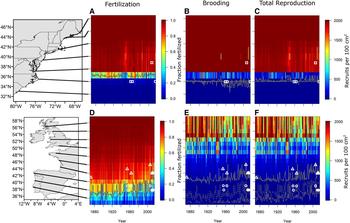
Temperature was a good predictor of fertilization on the last sample date in our laboratory experiments (logistic regression, R 2 = 0.66, P < 0.01), and monthly minimum SST was a good predictor of brooding success in the data of Drévès (Reference Drévès2001) and Abernot-Le Gac et al. (Reference Abernot-Le Gac, Antajan, Courtay, Drévès, Lamort, Martin, Pierre- Duplessix and Schlaich2016) (linear regression, R 2 = 0.68, P < 0.0001). We used these two relationships in our biogeographic models. Historically S. balanoides was found south to Cape Hatteras, North Carolina, USA (35.5°N) along the western Atlantic shoreline (Figure 1). Predicted fertilization (0–14%; Figure 4A), brooding (0.1–14 recruits per 100 cm2; Figure 4B), and total reproductive success (0.0–2 recruits per 100 cm2; Figure 4C) were all low at Cape Hatteras (35.5°N) across all years. Just north of Cape Hatteras in Virginia Beach, Virginia (36.5°N) predicted fertilization (8–89%), brooding (14–1919 recruits per 100 cm2), and total reproduction (1.4–1573 recruits per 100 cm2) were higher and more variable. Predicted fertilization, brooding and total reproduction in Virginia Beach, Virginia (36.5°N) decreased marginally or not at all between 1870 and 2015 (linear regression, fertilization: R 2 = 0.05, P < 0.01; brooding: R 2 = 0.00, P > 0.2; total reproduction: R 2 = 0.02, P = 0.05). Since the 1960s the southern range limit of S. balanoides has retracted to Lewes, Delaware, USA (39.5°N) where all predictions of reproductive success were consistently high in all years (fertilization: 81 and 99%; brooding: 2000 recruits per 100 cm2; total reproduction: 1617 to 1988 recruits per 100 cm2). At the 25 recruits per 100 cm2 threshold predictions of brooding success and failure closely matched observed values, while predictions of total reproductive success and failure were less accurate (Table 2; Figure 4B, C). Similar patterns were found at thresholds of 4 recruits per 100 cm2 and 1 recruit per 100 cm2 (Table 2; Figure 4B, C) due the presence of recruits at all measured sites. Measured range limits closely matched all thresholds for predicted total reproduction in all years except 2006 (Figure 4C).
Predicted fraction of fertilized Semibalanus balanoides in the (A) western Atlantic and (D) eastern Atlantic, predicted brooding success in the (B) western Atlantic and (E) eastern Atlantic, and predicted total reproductive success in the (C) western Atlantic and (F) eastern Atlantic between 1870 and 2015. Fertilization contours at 50% predicted fertilization. Brooding and total reproductive success contours at recruitment levels of 25 (solid line), 4 (short dashes), and 1 (long dashes) recruits per 100 cm2 corresponding to nearest neighbour distances of 1, 2.5 and 5 cm respectively. Historical southern range limits in the western Atlantic (white squares), and in the eastern Atlantic in Galicia (white circles) and France (white triangles). Black lines match predictions to corresponding locations on the coastline at 1 degree latitude intervals.

Overall accuracy as a measure of predictive accuracy for each biogeographic model in each region and year for each recruitment threshold (25, 4 and 1 recruit per 100 cm2). Cases where predictions were not significantly different from measured recruitment are in bold (2 × 2 contingency table, P > 0.05).

Along the coastline of Europe fertilization was predicted to be possible at all coastal sites examined, but highly variable between years (Figure 4D). Near the limit of S. balanoides in the 1870s at St Jean de Luz, France (43.4°N) the model predicted fertilization ranged between 42 to 97% (brooding: 6–118 recruits per 100 cm2, Figure 4E; total reproduction: 4–112 recruits per 100 cm2, Figure 4F). At the range edge in the 1960s near Arcachon, France (44.6°N) the model predicted fertilization ranged from 54–98% (brooding: 16–236 recruits per 100 cm2; total reproductive: 10–226 recruits per 100 cm2), and from 59–98% (brooding: 21–302 recruits per 100 cm2; total reproductive: 14–292 recruits per 100 cm2) at Les Sables d'Olonne, France (46.5°N), the documented range limit in 2006. Fertilization, brooding and total reproductive success were predicted to have decreased at all of these locations since 1870 (linear regressions, St Jean de Luz, France, fertilization: R 2 = 0.29, P < 0.0001, brooding: R 2 = 0.26, P < 0.0001, total reproduction: R 2 = 0.35, P < 0.0001; Arcachon, France, fertilization: R 2 = 0.29, P < 0.0001, brooding: R 2 = 0.26, P < 0.0001, total reproduction: R 2 = 0.30, P < 0.0001; Les Sables d'Olonne, France, fertilization: R 2 = 0.32, P < 0.0001, brooding: R 2 = 0.21, P < 0.0001, total reproduction: R 2 = 0.25, P < 0.0001). At the 25 recruits per 100 cm2 threshold predictions of brooding success and failure were similar to observed values in some years, while predictions of total reproduction more closely matched observed values across all years (Table 2; Figure 4E, F). Lower thresholds provided less accurate predictions (Table 2; Figure 4E, F). The presence of recruits at all sites where recruitment was measured in 2012 led to high predictive accuracy at all thresholds (Table 2). Measured range limits were all within one degree latitude of the 25 recruits per 100 cm2 threshold for predicted brooding and total reproduction in all years (Figure 4F).
Near the southern range limit of S. balanoides in Galicia (41.5°N) the model predicted fertilization was between 14 to 89%, 14 to 97% within Galicia, and 52 to 97% near the north-eastern range edge. Brooding (1.5 to 57 recruits per 100 cm2, Figure 4E) and total reproduction (0.3 to 53 recruits per 100 cm2, Figure 4F) were also predicted to be low within Galicia. Near the southern and north-eastern range edges in Galicia the model predicted fertilization, brooding and total reproductive success have decreased since 1870 (linear regressions, southern limit, fertilization: R 2 = 0.22, P < 0.0001, brooding: R 2 = 0.22, P < 0.0001, total reproduction: R 2 = 0.29, P < 0.0001; north-eastern limit, fertilization: R 2 = 0.27, P < 0.0001, brooding: R 2 = 0.26, P < 0.0001, total reproduction: R 2 = 0.30, P < 0.0001). Predictions from our brooding and total reproduction models underpredicted reproductive success at the 25 recruits per 100 cm2 threshold (Table 2; Figure 4E, F). At the 1 recruit per 100 cm2 threshold our brooding and total reproduction models tended to overpredict the limit of successful reproduction (Table 2; Figure 4E, F). At the 4 recruits per 100 cm2 threshold our brooding and total reproduction model predictions were similar to measured recruitment in 2010 and 2012 (Table 2). Measured range limits were all within two degrees latitude of the 4 recruits per 100 cm2 threshold for predicted brooding and total reproduction in all years (Figure 4E, F).
Models of the timing of larval release and the potential for phytoplankton mismatch
Temperature was a good predictor of the length of embryonic development and length of larval development (Table 1). We used these relationships and remotely sensed chlorophyll a data to predict whether a phytoplankton mismatch was likely between 1997 and 2015 in the western and eastern Atlantic (Figure 5; Supplementary Figures 1 & 2). The half-saturation point for B. crenatus was 3 mg chlorophyll a m−3 (Turner et al., Reference Turner, Levinsen, Nielsen and Hansen2001). In most cases this threshold predicted a phytoplankton mismatch, suggesting this threshold was unrealistically high for S. balanoides. The exact half-saturation point for S. balanoides is unknown, and may vary with larval size, larval stage and algal type, so we simply used half of 3 mg chlorophyll a m−3 (1.5 mg chlorophyll a m−3) as the threshold for our predictions of phytoplankton mismatch. In the western Atlantic phytoplankton mismatch was predicted to be unlikely for most sites. Between the historical southern range limit at Cape Hatteras, North Carolina (35.5°N) and the current southern range limit of S. balanoides near Lewes, Delaware (39.5°N) phytoplankton mismatch was predicted to be unlikely in all years (Figure 5; Supplementary Figures 1 & 2). The probability of phytoplankton mismatch led to similar or slightly poorer predictions of total reproductive success in the western Atlantic than the predictions from brooding and total reproduction alone (Table 2). In the eastern Atlantic the potential for phytoplankton mismatch was predicted to be more likely, particularly in the western English Channel (Figure 5; Supplementary Figures 1 & 2). On the Bay of Biscay in France, including the probability for phytoplankton mismatch decreased predictive accuracy at all recruitment thresholds (Table 2). At the southern range limit in Galicia phytoplankton mismatch was predicted to be likely in a number of years (Figure 5; Supplementary Figures 1 & 2). At the 25 recruits per 100 cm2 threshold phytoplankton mismatch tended to further underpredict measured recruitment (Table 2). At the 1 recruit per 100 cm2 phytoplankton mismatch overpredicted measured recruitment similar to brooding and total reproduction predictions (Table 2). At the 4 recruits per 100 cm2 threshold phytoplankton mismatch improved predictions of measured recruitment in 2010 and 2011 (Table 2).
Predicted per cent success of early life-history stages of Semibalanus balanoides between 1998 and 2015 in the western and eastern Atlantic at recruitment levels of 1, 4 and 25 recruits per 100 cm2 corresponding to nearest neighbour distances of 5, 2.5 and 1 cm respectively. Predicted per cent success was calculated by multiplying total reproductive success by the probability of phytoplankton mismatch in each year, and then finding the fraction of years between 1998 and 2015 greater than or equal to each recruitment threshold. Predicted per cent success at (A) 1, (B) 4 and (C) 25 recruits per 100 cm2 in the western Atlantic, and predicted per cent success at (D) 1, (E) 4 and (F) 25 recruits per 100 cm2 in the eastern Atlantic.

DISCUSSION
Multiple hypotheses exist to explain the relationship between temperature and both the timing and intensity of settlement in S. balanoides. Warm temperatures during the reproductive period of S. balanoides may prevent or reduce fertilization, kill embryos while they are brooded, delay the onset of fertilization, or increase the rate of embryonic development causing a mismatch between the phytoplankton bloom and larval release. Here we used laboratory manipulations to determine the effects of temperature on fertilization in S. balanoides. We specifically tested if fertilization is inhibited at warm temperatures, if fertilization might occur, but be delayed at warm temperatures, and if fertilization can occur at warmer temperatures once barnacles are exposed to cooler temperatures.
Fertilization was inhibited and delayed at warmer temperatures (Figures 2 & 3). Temperature inhibition of fertilization has been documented in a number of studies; however, the exact threshold varies, and interpretation is difficult due to unbalanced experimental designs. For example, Barnes (Reference Barnes1963) found barnacles collected in Scotland, and reared at 5°C reproduced successfully, and the majority of treatments at 15°C failed to be fertilized. Similarly, Clegg (Reference Clegg1957) observed copulation at temperatures ranging from 5 to 17°C. In contrast, barnacles collected from Woods Hole, Massachusetts, USA and Menai Bridge, Isle of Anglesey, Wales fed in dim ambient light at 15–16°C and 19–20°C remained unfertilized, while those in ambient daylight at 10–11°C from Woods Hole were 100% fertilized and those from Menai Bridge were 40% fertilized. At 3–4°C in complete darkness barnacles from both locations were 100% fertilized (Crisp & Patel, Reference Crisp and Patel1969). Earlier experiments by Crisp (Reference Crisp1957) also found temperatures between 14–18°C completely inhibited fertilization. We found the percentage of fertilized barnacles was reduced at 16°C when compared with fertilization success at 10° and 13°C, and at 19°C fertilization in a small fraction of barnacles was possible only after a long delay (Figures 2 & 3). Furthermore, embryos remaining at 19°C were non-viable.
Fertilization was possible at warmer temperatures once barnacles were exposed to cooler temperatures. When barnacles were transferred from 19° to 10°C a smaller fraction of barnacles were fertilized than when they remained at 10°C for the duration of the experiment (Figures 2 & 3). There is some support for a delay in fertilization when barnacles are kept at a warmer temperature and then transferred to a cooler temperature. Crisp & Patel (Reference Crisp and Patel1969) found barnacles kept at 17–22°C from October to March were completely unfertilized. After being transferred to 2–3°C in complete darkness 75% were fertilized and at 6–7°C in ambient daylight 36% were fertilized (Crisp & Patel, Reference Crisp and Patel1969). While food availability and light exposure can influence the timing of fertilization, temperature can drive reduced and delayed fertilization (Crisp, Reference Crisp1957, Reference Crisp1959a; Barnes, Reference Barnes1958; Crisp & Clegg, Reference Crisp and Clegg1960; Crisp & Patel, Reference Crisp and Patel1969; Davenport et al., Reference Davenport, Berggren, Brattegard, Brattenborg, Burrows, Jenkins, McGrath, MacNamara, Sneli, Walker and Wilson2005).
Delayed onset of fertilization due to warm autumn temperatures may have three different consequences. First, a smaller proportion of adults were fertilized when transferred from 19 to 10°C (22% fertilized) compared with adults maintained at 10°C (78% fertilized). Therefore, delayed fertilization would lower the number of propagules and reduce subsequent levels of recruitment. Second, a late start to development could result in a phytoplankton mismatch (Barnes, Reference Barnes1956, Reference Barnes1957, Reference Barnes1962). Embryos are fully developed and remain in the mantle cavity of adult S. balanoides until the spring phytoplankton bloom (Crisp, Reference Crisp1956, Reference Crisp1959a, Reference Crisp1964); however, there is some evidence American barnacles release their nauplii as early as December (Barnes & Barnes, Reference Barnes and Barnes1959, Reference Barnes and Barnes1976; J. Pineda, personal communication). In the western Atlantic our predictions of phytoplankton mismatch found no release dates when a temperature-induced delay in fertilization could result in phytoplankton mismatch near the southern range limit. In the eastern Atlantic phytoplankton mismatches were predicted to occur near southern range limits in France and Galicia (Figure 5). In both cases limited availability of food during the larval period may interact with temperature limits to successful reproduction to further reinforce these range limits, and explain the presence of ephemeral populations on either side of the western English Channel (Figure 5). Third, increased energetic demand of adults at higher temperatures could result in resorption of gametic tissue prior to fertilization (Barnes & Achituv, Reference Barnes and Achituv1976), and reduce the number of embryos or the energetic content of each embryo. Embryos with low energy reserves would be particularly vulnerable to starvation in the water column if larval release and the phytoplankton bloom were mismatched, and larvae with limited energetic reserves could result in low quality settlers that have reduced survival (Jarrett, Reference Jarrett2003; Emlet & Sadro, Reference Emlet and Sadro2006; Pechenik, Reference Pechenik2006; Torres et al., Reference Torres, Giménes, Pettersen, Bue, Burrows and Jenkins2016).
To better understand the role of fertilization success in influencing the distribution of S. balanoides, we used the relationship between fertilization and temperature (Figure 2) to create a predictive model, and projected it onto historical SSTs in the eastern and western Atlantic. As mentioned above, fertilization is not the only reproductive process influenced by temperature, so we also modelled the relationship between brooding success and temperature using over 30 years of recruitment records (Abernot-Le Gac et al., Reference Abernot-Le Gac, Antajan, Courtay, Drévès, Lamort, Martin, Pierre- Duplessix and Schlaich2016) from a site in the English Channel where fertilization was predicted to be at or near 100%, and projected it onto SSTs in the same regions. Total reproductive success, the product of fertilization and brooding, was also predicted for both regions and multiplied by the probability of phytoplankton match. At the southern limits of Semibalanus in both the eastern and western Atlantic low levels of fertilization were predicted in some cases. In the 1950s and 1960s the southern range limit of Semibalanus occurred near Cape Hatteras, North Carolina, USA (35.5°N) (Wells et al., Reference Wells, Wells and Gray1960; Jones et al., Reference Jones, Southward and Wethey2012). Fertilization success was predicted to be high just north of Cape Hatteras (35.5°N) at Virginia Beach (36.5°N) in the majority of years between 1870 and 2015. Since the 1960s the southern range limit of S. balanoides has retracted 350 km to Lewes, Delaware (39.5°N) (Jones et al., Reference Jones, Southward and Wethey2012). Interestingly, fertilization, brooding, and total reproductive success were predicted to be high as far south as Virginia Beach (36.5°N) in most years with very low predicted probability for phytoplankton mismatch (Figure 4A–C; Figure 5), which is consistent with occasional sightings and transplant experiments of S. balanoides south of Lewes, Delaware (39.5°N). A single S. balanoides was found underneath a completely shaded rock at Oregon Inlet, North Carolina (35.7°N) in 2002 (Wethey, unpublished data), S. balanoides was present in the shade at several locations between Cape Hatteras (35.5°N) and Lewes, Delaware (39.5°N) in 2015 (Figure 1), and transplant experiments found adults were unable to survive summer temperatures south of Lewes, Delaware (39.5°N) (Jones et al., Reference Jones, Southward and Wethey2012), suggesting that post-settlement mortality may ultimately determine the southern range limit along this coast, and explain the historical range shift from Cape Hatteras, North Carolina (35.5°N) to Lewes, Delaware (39.5°N).
On the European coast multiple breaks exist in the distribution of S. balanoides with range limits along the Atlantic coast of France, with occasional localized extinctions along the western English Channel (e.g. Southward, Reference Southward1967; Wethey et al., Reference Wethey, Woodin, Hilbish, Jones, Lima and Brannock2011; Rognstad et al., Reference Rognstad, Wethey and Hilbish2014) and Galicia, Spain (Fischer-Piette & Prenant, Reference Fischer-Piette and Prenant1957; Wethey & Woodin, Reference Wethey and Woodin2008; Macho et al., Reference Macho, Vázquez, Giráldez and Molares2010; Wethey et al., Reference Wethey, Woodin, Hilbish, Jones, Lima and Brannock2011). Since the late 1800s the southern range limit of S. balanoides along the coast of France has retracted from the border of France and Spain (43.4°N) (Fischer, Reference Fischer1872) to Les Sables d'Olonne, France (46.5°N) with scattered individuals present further south at Châtelaillon Plage (46°N) and the mouth of the Gironde River (45.5°N) (Wethey & Woodin, Reference Wethey and Woodin2008; Wethey et al., Reference Wethey, Woodin, Hilbish, Jones, Lima and Brannock2011; Wethey, unpublished data). Fertilization was predicted to be high (59–98%) throughout this region in all years between 1870 and 2014 (Figure 4D). However, brooding was predicted to be lower (3.7–7.2 recruits per 100 cm2), and decreased in a pattern matching historical range shifts, suggesting brooding success plays a more important role in determining the distribution of S. balanoides in this region than fertilization (Figure 4E). In the western English Channel both fertilization and brooding were predicted to be high in all years. However, phytoplankton mismatch was predicted to be likely. Mismatch between the timing of larval release and phytoplankton availability may limit S. balanoides from colonizing this region in some years (Figure 5). Phytoplankton mismatch within this region was driven by both intrinsic factors influencing the timing of larval release and extrinsic factors influencing the onset of the phytoplankton bloom (Figure 5; Supplementary Figures 1 & 2). Similarly, delayed onset of the phytoplankton bloom or low availability of suitable phytoplankton species may have driven patterns of low settlement in some years in the Firth of Clyde and Isle of Man (Barnes, Reference Barnes1956, Reference Barnes1957, Reference Barnes1962; Crisp & Spencer, Reference Crisp and Spencer1958; Connell, Reference Connell1961; Hawkins & Hartnoll, Reference Hawkins and Hartnoll1982).
Along the northern coast of the Iberian Peninsula S. balanoides is absent, but an isolated metapopulation exists within Galicia in NW Spain (Fischer-Piette & Prenant, Reference Fischer-Piette and Prenant1956; Fischer-Piette, Reference Fischer-Piette1963; Barnes & Barnes, Reference Barnes, Barnes and Barnes1966; Wethey & Woodin, Reference Wethey and Woodin2008; Macho et al., Reference Macho, Vázquez, Giráldez and Molares2010; Wethey et al., Reference Wethey, Woodin, Hilbish, Jones, Lima and Brannock2011). Near the north-eastern range limit in Galicia (43.37–43.68°N) fertilization was predicted to be high (52 and 97%) in most years. However, fertilization was predicted to be lower, and more variable (14 and 89%) near the southern range limit (41.70–42.76°N) (Figure 4D). The southern range limit in Galicia was at or below 50% predicted fertilization in seven out of the eight years of historical records (Figure 4D), and at the 4 recruits per 100 cm2 threshold total reproduction closely matched historical range limits in all but the most recent records (Figure 4F) suggesting fertilization is an important driver of this border. Both brooding and total reproductive success were predicted to be lower than at any of the documented range limits in France, which suggests a different temperature threshold for brooding may exist for barnacles in this region (M. Herrera, personal communication). Phytoplankton mismatch was likely within Galicia and improved the predictive accuracy of our models in some cases. However, it is difficult to determine the relative importance of phytoplankton mismatch without better estimates of the relationship between temperature and brooding in barnacles from Galicia.
Near the southern limits of S. balanoides along the US east coast and in the European populations found in Galicia, Spain low levels of fertilization were predicted in a large number of years. Interactions between low levels of fertilization and low adult densities may influence population dynamics near these range edges. Allee effects are known to be particularly strong in cross-fertilizing barnacles, such as S. balanoides, because they are unable to move to find mates (Crisp, Reference Crisp1958; Kent et al., Reference Kent, Hawkins and Doncaster2003; Yuen & Hoch, Reference Yuen and Hoch2010). Lower levels of fertilization at low population density would result in fewer propagules, which would continue to maintain low adult densities in combination with the effects of reduced brooding success and low adult survival delaying or potentially inhibiting increases in adult density (Svensson et al., Reference Svensson, Jenkins, Hawkins and Åberg2005). Additionally, fewer propagules would reduce dispersal potential, and interact with other local recruitment processes responsible for larval delivery (Pineda et al., Reference Pineda, Reyns and Starczak2009) further contracting the range (Bennell, Reference Bennell1981; Kendall et al., Reference Kendall, Bowman, Williamson and Lewis1985; Hyder et al., Reference Hyder, Johnson, Hawkins and Gurney1998; Jenkins et al., Reference Jenkins, Åberg, Cervin, Coleman, Delany, Della Santina, Hawkins, LaCroix, Myers, Lindegarth, Power, Roberts and Hartnoll2000, Reference Jenkins, Åberg, Cervin, Coleman, Delany, Hawkins, Hyder, Myers, Paula, Power, Range and Hartnoll2001, Reference Jenkins, Murua and Burrows2008; Svensson et al., Reference Svensson, Jenkins, Hawkins, Myers, Range, Paula, O'Riordan and Åberg2004, Reference Svensson, Jenkins, Hawkins and Åberg2005). Thus biogeographic range edges are likely to be strongly influenced by the effects of temperature on multiple steps in the reproductive process, namely fertilization, embryonic and larval development. These results highlight the important role of physiology in biogeography and the need for mechanistic species distribution models that model physiological performance.
SUPPLEMENTARY MATERIAL
The supplementary material for this article can be found at https://doi.org/10.1017/S0025315417000364
ACKNOWLEDGEMENTS
Supported by grants from NSF (OCE 1129401) and NASA (NNX11AP77G) to DSW. We thank Cristián Monaco for help with feeding and Rhiannon Rognstad for advice on the husbandry of Semibalanus balanoides. Sarah Woodin and Jerry Hilbish provided helpful suggestions, and access to facilities. Contribution number 90 in Ecological Forecasting from the University of South Carolina.