INTRODUCTION
The evolutionary events determining the structure of a parasite assemblage are relatively well understood. A parasite species may have been inherited by the host species from its ancestor, may be the result of an intra-host speciation event, and/or may have colonized the host species from another sympatric host species (host switching) (Paterson and Gray, Reference Paterson, Gray, Clayton and Moore1997). Therefore, it is possible to search for the key factors that have caused certain parasite assemblages to diversify more than others over evolutionary time (Poulin, Reference Poulin1998a; Page, Reference Page2003). The studies attempting to determine which host features may promote the diversification of parasite assemblages are based on 2 theoretical frameworks. First, following island biogeography theory (MacArthur and Wilson, Reference MacArthur and Wilson1967; Kuris et al. Reference Kuris, Blaustein and Alió1980), host features that promote high rates of parasite speciation or colonization, and low probabilities of extinction, by parasite species should be associated with high parasite diversity (e.g. large body size, broad geographical range, breadth of habitats). Epidemiological modelling represents the second theoretical source of predictions regarding parasite diversity (Dobson and Roberts, Reference Dobson and Roberts1994; Roberts et al. Reference Roberts, Dobson, Arneberg, De Leo, Krecek, Manfredi, Lanfranchi, Zaffaroni, Hudson, Rizzoli, Grenfell, Heesterbeek and Dobson2002). These models suggest that host population density, which regulates the contact rate between parasite infective stages and hosts, is the key factor determining whether a parasite species can invade and persist in a host population. Comparing different host species, those occurring at higher population density (e.g. schooling fish species) should harbour more species of parasites, because they exceed the persistence threshold of more parasite species than hosts with low population density.
Several studies have investigated the factors potentially controlling the number of parasite species in freshwater and marine fishes (Bell and Burt, Reference Bell and Burt1991; Guégan and Kennedy, Reference Guégan and Kennedy1993; Poulin, Reference Poulin1995; Poulin and Rohde, Reference Poulin and Rohde1997; Sasal et al. Reference Sasal, Morand and Guégan1997; Morand et al. Reference Morand, Cribb, Kulbicki, Rigby, Chauvet, Dufour, Faliex, Galzin, Lo, Lo-Zat, Pichelin and Sasal2000; Luque and Poulin, Reference Luque and Poulin2004, Reference Luque and Poulin2008). However, the results available to date show very little consistency, since some studies claim that a certain variable is a predictor of parasite species richness, either host body size, host geographical range, host diet, etc., but no consensus on a particular variable as the main determinant has been reached.
Freshwater fish helminths are undoubtedly the most well known group of vertebrate parasites in Mexico, because fishes have been studied more than any other group (Pérez-Ponce de León and Choudhury, Reference Pérez-Ponce de León and Choudhury2010; Pérez-Ponce de León et al. Reference Pérez-Ponce de León, García-Prieto, Mendoza-Garfias, Grill and Gianfranco2011). The helminth fauna of these hosts includes approximately 260 species (Oceguera-Figueroa et al. Reference Oceguera-Figueroa, Sidall and García-Prieto2010; Pérez-Ponce de León and Choudhury, Reference Pérez-Ponce de León and Choudhury2010). The first descriptions of distributional patterns of fish-parasite and drainage associations indicated that the parasite fauna is largely circumscribed by higher levels of monophyletic host taxa, especially at the level of fish family. Likewise, areas within a certain biogeographical region and consequently with similar fish composition possess more similar parasite faunas compared to areas with less similar fish faunal composition (Pérez-Ponce de León and Choudhury, Reference Pérez-Ponce de León and Choudhury2005). Recently, Pérez-Ponce de León and Choudhury (Reference Pérez-Ponce de León and Choudhury2010) evaluated the progress made on the inventory of freshwater fish helminths of Mexico and suggested that following a traditional approach, the inventory is nearing completion for most helminth groups (except monogeneans). These authors suggested that host species and geographical areas that would be targeted in the future could be expected, with very few exceptions, to have helminth faunas that are consistent with the fish composition in those areas. However, they argued that in the future DNA-based taxonomic methods have the potential to alter drastically the estimates of helminth diversity in freshwater fishes, because of the existence of cryptic species (morphologically indistinguishable but genetically distinct, see Poulin, Reference Poulin2011; Nadler and Pérez-Ponce de León, Reference Nadler and Pérez-Ponce de León2011) in several lineages of helminths in Mexico. Despite this fact, they described species richness patterns and pointed out that the diversity is distributed heterogeneously. These patterns were described by considering all freshwater helminth parasites irrespective of their developmental stage i.e. larval and adult forms, under a strict definition of what constitutes a freshwater species and by including both native and introduced fish species. However, Pérez-Ponce de León and Choudhury (Reference Pérez-Ponce de León and Choudhury2010) did not use the proper methods to analyse data with unequal sampling effort that might act as a confounding factor. In addition, potential factors that cause the heterogeneous distribution of helminth species richness were not explored. For these reasons, our aims in this paper are to describe the distribution patterns of adult helminth diversity throughout parasite and host groups as well as across hydrological regions, and to investigate the host traits and/or environmental and geographical factors that determine the uneven diversification of assemblages of freshwater fish helminths.
MATERIALS AND METHODS
A database updated to November, 2011, with distribution records for Mexican freshwater fish helminths (trematodes, monogeneans, cestodes, acanthocephalans, nematodes, and hirudineans) was constructed. Our study was restricted to adult helminths of the native freshwater fishes, which are unable to disperse across brackish and marine waters (i.e., presumably non-diadromous). Larval helminths were excluded because of the confounding effects of dispersal caused by their definitive hosts in any distribution pattern. Also, if we consider larval stages, the parasite species count could be underestimated because they often cannot be identified to the species level and one putative taxon might actually consist of more than one species.
The data set was mostly obtained from monographs (e.g. Pérez-Ponce de León et al. Reference Pérez-Ponce de León, García-Prieto, Osorio-Sarabia and León-Règagnon1996, Reference Pérez-Ponce de León, García-Prieto and Mendoza-Garfias2007; Garrido-Olvera et al. Reference Garrido-Olvera, García-Prieto and Pérez-Ponce de León2006; Kohn et al. Reference Kohn, Cohen and Salgado-Maldonado2006; Salgado-Maldonado, Reference Salgado-Maldonado2006; García-Prieto et al. Reference García-Prieto, Garcia-Varela, Mendoza-Garfias and Pérez-Ponce de León2010; Oceguera-Figueroa et al. Reference Oceguera-Figueroa, Sidall and García-Prieto2010) and specimens deposited in the Colección Nacional de Helmintos (CNHE), Instituto de Biología, Universidad Nacional Autónoma de México, Mexico City. Nomenclature was updated using specialized literature (e.g. Scholz et al. Reference Scholz, Vargas-Vázquez, Aguirre-Macedo and Vidal-Martínez1997; Moravec, Reference Moravec1998; Scholz et al. Reference Scholz, Aguirre-Macedo and Salgado-Maldonado2001; Vidal-Martínez et al. Reference Vidal-Martínez, Aguirre-Macedo, Scholz, González-Solís and Mendoza-Franco2001; Aguirre-Macedo and Scholz, Reference Aguirre-Macedo and Scholz2005; Caspeta-Mandujano, Reference Caspeta-Mandujano2005; Pérez-Ponce de León et al. Reference Pérez-Ponce de León, García-Prieto and Mendoza-Garfias2007). To avoid cases of synonymies among fish species, valid species names were adopted according to FishBase (Froese and Pauly, Reference Froese and Pauly2011).
The geographical distribution patterns were recognized through distribution maps for each taxon, which were prepared using ArcView GIS 3.2 (ESRI, 1999). Sample-based rarefaction curves considering the number of localities studied as a measure of sampling effort were used to compare the helminth species richness (the number of parasite species in an assemblage) between host families and hydrological regions at comparable sampling effort (Colwell et al. Reference Colwell, Mao and Chang2004). Non-parametric species richness estimators are also used to analyse data with unequal sampling effort. Therefore, total helminth species richness for each data set was calculated using 5 estimation methods: ICE, Chao2, Jackknife1, Jacknife2, and Bootstrap (Poulin, Reference Poulin1998b; Walther and Morand, Reference Walther and Morand1998). In addition, an evaluation of the performance of these estimators with the unscaled measures of bias, precision, and accuracy was conducted (Walther and Moore, Reference Walther and Moore2005). EstimateS version 8.2 was used to obtain rarefaction curves and total species richness (Colwell, Reference Colwell2006).
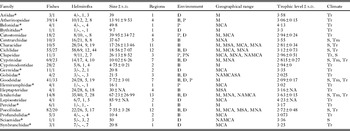
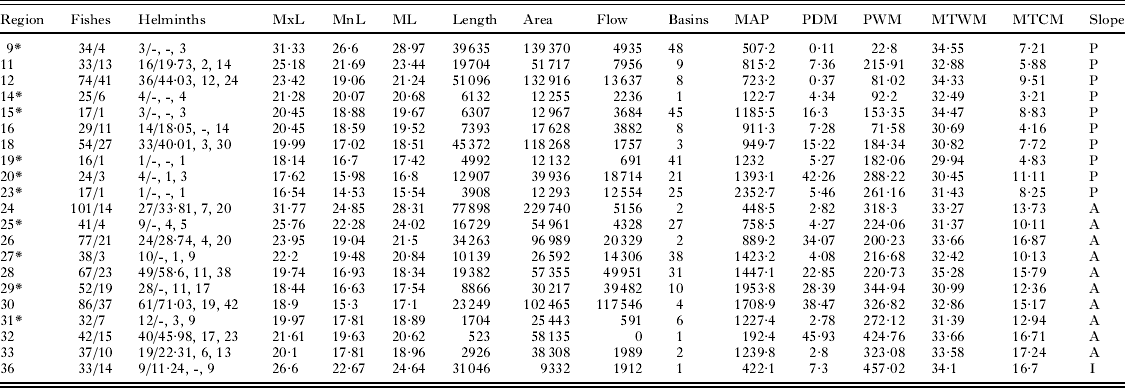
In order to examine the possible factors determining the helminth species richness in an assemblage, we gathered detailed information on the fish species and geographical areas. The host traits were obtained from Miller et al. (Reference Miller, Minckley and Norris2005) and Froese and Pauly (Reference Froese and Pauly2011) (Table 1). The environmental and geographical data for each hydrological region were obtained from the Comisión Nacional del Agua (2008) and Fernandez-Eguiarte et al. (Reference Fernandez-Eguiarte, Zavala-Hidalgo and Romero-Centeno2010) (Table 2).
Summary information to family level of freshwater fish species recorded as hosts of adult helminths in Mexico

* Data were insufficient for estimating total parasite species richness. Fishes, total/known host fish species; Helminths, observed/estimated total species richness, ectoparasites, endoparasites; Size±s.d., mean body size (standard length in cm) ± standard deviation; Regions, number of regions where fish family is distributed; Environment: B, Benthopelagic, D, Demersal, P, Pelagic, PN, Pelagic-neritic; Trophic level±s.d. = mean trophic level ± standard deviation; Climate: S, subtropical, Tr, tropical, Tm, temperate; Geographical range: M, Mexico, MCA, Mexico and Central America, MNA, Mexico and North America, MSA, Mexico and South America, NAMCA, North America, Mexico and Central America, NAMCASA, North America, Mexico, Central America, and South America.
Summary information on Mexican hydrological regions, where adult helminth species have been recorded as parasites of freshwater fishes
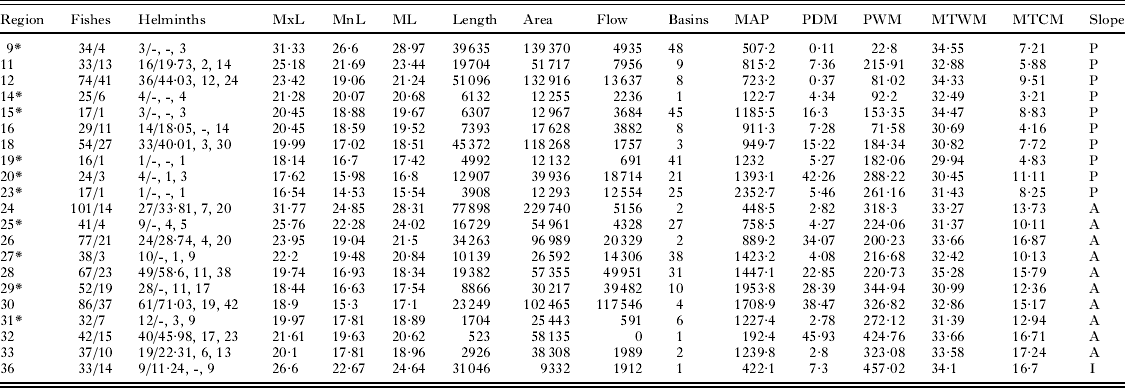
* Data were insufficient for estimating total species richness. Region, 9, Sonora Sur; 11, Presidio-San Pedro; 12, Lerma-Santiago; 14, Río Ameca; 15, Costa de Jalisco; 16, Armería-Coahuayana; 18, Balsas; 19, Costa Grande de Guerrero; 20, Costa Chica de Guerrero; 23, Costa de Chiapas; 24, Bravo-Conchos; 25, San Fernando-Soto La Marina; 26, Pánuco; 27, Norte de Veracruz; 28, Papaloapan; 29, Coatzacoalcos; 30, Grijalva-Usumacinta; 31, Yucatán Oeste; 32, Yucatán Norte; 33, Yucatán Este; 36, Nazas-Aguanaval; Fishes, total/ known host fish species; Helminths, observed/estimated total species richness, ectoparasites, endoparasites; MxL, maximum latitude; MnL, minimum latitude; ML, mean latitude; Length, total length of rivers (in km); Area, area (in km2); Flow, mean current flow (in hm3/year); Basins, basin number in the region; MAP, mean annual precipitation (mm); PDM, precipitation of driest month (mm); PWM, precipitation of wettest month (mm); MTWM, maximum temperature of warmest month (°C); MTCM, minimum temperature of coldest month (°C); Slope, A, Atlantic, I, Interior, P, Pacific.
The helminths include various taxonomic groups, with different biological characteristics related with life-cycle dynamics and transmission modes. Therefore, these parasite taxa may be subjected to different factors potentially influencing their species richness. For this reason, helminth species richness for each assemblage was estimated in 3 ways: for all parasites, for endoparasites only (trematodes, cestodes, acanthocephalans, and nematodes), and for ectoparasites only (monogeneans and hirudineans).
To analyse factors influencing differences in species richness among assemblages, the information on the fish species and their distribution regions was combined. In the initial analyses, fish species were treated as independent observations. The relationships between helminth species richness and continuous variables were tested through correlations, while the influence of categorical variables was assessed by inspecting mean values. Next, we determined which factors played a role in the diversification of parasite assemblages, i.e., we tested whether any of those associations were significant and whether there were interactions between the explanatory variables by performing generalized linear models, where species richness (total parasites, ectoparasites, and endoparasites, independently) was the response variable and host traits were explanatory variables. The models were fitted with a log link (to ensure that the fitted values are bounded below) and Poisson errors (to account for the non-normality) (Crawley, Reference Crawley2007).
Parasite assemblages of closely related host species are not truly independent statistical observations. Therefore, we used Felsenstein's (Reference Felsenstein1985) comparative method to control for the effects of phylogenetic association between host species. The PDAP:PDTREE software (Midford et al. Reference Midford, Garland and Maddison2011), implemented in Mesquite Modular System for Evolutionary Analysis, Mesquite version 1.12 (Maddison and Maddison, Reference Maddison and Maddison2011) was used to compute independent contrasts. Host phylogeny was constructed from mainly molecular studies and the phylogenetic relationships of the orders were based on Nelson (Reference Nelson2006), as follows: (((((Ophisternon aenigmaticum, (Eugerres mexicanus, Etheostoma sp., ((Lepomis megalotis, L. macrochirus), Micropterus salmoides), Aplodinotus grunniens, (Awaous banana, Sicydium multipunctatum), (Cichlasoma geddesi, C. mayorum, (((C. beani, C. istlanum), ((Parachromis friedrichsthalii, C. trimaculatum), (Petenia splendida, C. urophthalmus))), ((Rocio octofasciata, Amphilophus robertsoni), ((C. salvini, ((Thorichthys helleri, T. pasionis), (T. meeki, (T. ellioti, T. callolepis)))), ((Herichthys labridens, (H. minckleyi, H. cyanoguttatus)), ((C. pearsei, (Theraps lentiginosus, Vieja intermedia)), ((V. fenestrata, (V. bifasciata, V. hartwegi)), (V. synspila, V. argentea)))))))))), (((((Cyprinodon meeki, C. nazas), ((((Poecilia butleri, P. mexicana), (P. sphenops, P. catemaconis)), (P. velifera, (P. petenensis, P. latipunctata))), (((Poeciliopsis catemaco, P. gracilis), (P. infans, P. baenschi), P. balsas), ((Xiphophorus hellerii, X. variatus), (Heterandria bimaculata, (Belonesox belizanus, ((Gambusia vittata, G. marshi), G. senilis, G. yucatana))))))), ((Profundulus hildebrandi, P. punctatus, P. labialis), ((Characodon audax, C. lateralis), (((Ilyodon cortesae, I. whitei, I. furcidens), (Xenotaenia resolanae, ((Allodontichthys tamazulae, A. hubbsi), A. zonistius))), (((((((Chapalichthys encaustus, C. pardalis), Ameca splendens), Xenotoca variata), Alloophorus robustus), Zoogoneticus quitzeoensis), (X. eiseni, X. melanosoma)), ((Ataeniobius toweri, (Goodea atripinnis , G. gracilis)), (((Girardinichthys multiradiatus, G. viviparus), (Hubbsina turneri, (Skiffia bilineata, S. multipunctata, S. lermae))), (((((Allotoca catarinae, (A. diazi, A. meeki)), A. zacapuensis), A. dugesii), A. maculata), A. regalis)))))))), (Strongylura sp., Hyporhamphus mexicanus)), ((Atherinella crystallina, A. balsana), (((((Poblana letholepis, P. squamata), P. alchichica), Chirostoma riojai), Ch. arge), (Ch. attenuatum, ((Ch. jordani, Ch. labarcae), (Ch. lucius, (Ch. humboldtianum, (Ch. grandocule, Ch. estor))))))))), Typhliasina pearsei), (((Rhamdia guatemalensis, (Potamarius nelsoni, (Ameiurus melas, (Pylodictis olivaris, ((Ictalurus furcatus, I. punctatus), I. balsanus, I. mexicanus, I. pricei, I. dugesii))))), ((Ictiobus meridionalis, Catostomus nebuliferus), ((((Algansea lacustris, A. tincella), A. monticola), Gila conspersa), (Campostoma ornatum, (Dionda ipni, (Pimephales promelas, (((((Notropis calientis, Aztecula sallaei), Yuriria alta), Hybopsis boucardi), N. nazas, N. chihuahua), (Codoma ornata, ((Cyprinella garmani, C. lutrensis), C. xanthicara)))))))), ((((Astyanax aeneus, A. mexicanus), A. fasciatus), Bramocharax caballeroi), Brycon guatemalensis)), ((Dorosoma cepedianum, D. petenense), D. anale))), Atractosteus tropicus); (Ptacek and Breden, Reference Ptacek and Breden1998; Breden et al. Reference Breden, Ptacek, Rashed, Taphorn and Figueiredo1999; Harris and Mayden, Reference Harris and Mayden2001; Reznick et al. Reference Reznick, Mateos and Springer2002 ; Miya et al. Reference Miya, Takeshima, Endo, Ishiguro, Inoue, Mukai, Satoh, Yamaguchi, Kawaguchi, Mabuchi, Shirai and Nishida2003; Schönhuth and Doadrio Reference Schönhuth and Doadrio2003; Simons et al. Reference Simons, Berendzen and Mayden2003; Cunha et al. Reference Cunha, Mesquita, Dowling, Gilles and Coelho2002; Doadrio and Dominguez, Reference Doadrio and Domínguez2004; Wilcox et al. Reference Wilcox, García de León, Hendrickson and Hillis2004; Near et al. Reference Near, Bolnick and Wainwright2005; Hulsey et al. Reference Hulsey, García de León and Rodiles-Hernández2006; Chakrabarty, Reference Chakrabarty2007; Concheiro Pérez et al. Reference Concheiro Pérez, Rícan, Ortí, Bermingham, Doadrio and Zardoya2007; Hrbek et al. Reference Hrbek, Seckinger and Meyer2007; Hardman and Hardman, Reference Hardman and Hardman2008; Hertwig, Reference Hertwig2008; Lavoué et al. Reference Lavoué, Miya, Kawaguchi, Yoshino and Nishida2008; Rícan et al. Reference Rícan, Zardoya and Doadrio2008; Bloom et al. Reference Bloom, Piller, Lyons, Mercado-Silva and Medina-Nava2009, Reference Bloom, Unmack, Gosztonyi, Piller and Lovejoy2012; Mirande Reference Mirande2009; Pérez-Rodríguez et al. Reference Pérez-Rodríguez, Domínguez-Domínguez, Pérez-Ponce de León and Doadrio2009; McMahan et al. Reference McMahan, Geheber and Piller2010; Schönhuth and Mayden, Reference Schönhuth and Mayden2010).
True branch lengths are not available in this tree, so all branch lengths were set to unity, which adequately standardized contrasts of all variables. The program can only compute independent contrasts in continuous variables. In order to obtain independent contrasts of categorical variables, we treated these variables as continuous with states of 1, 2, 3 or more as recommended by Midford et al. (Reference Midford, Garland and Maddison2011) in the PDAP:PDTREE manual.
The relationships among independent contrasts were assessed using least-squares regressions forced through the origin (Garland et al. Reference Garland, Harvey and Ives1992). The possibility that multiple host traits influence parasite diversity was also addressed and then contrasts in independent variables (host traits) were entered into multiple regression methods (computed through the origin) to predict contrasts in species richness (total parasites, ectoparasites, and endoparasites, independently) (Crawley, Reference Crawley2007).
In both generalized linear models and multiple regression analyses, the minimal adequate models were obtained with categorical and continuous explanatory variables, separately (i.e., models without redundant parameters or factor levels). We achieved this by fitting a maximal model and then simplifying it by stepwise deletion: non-significant terms were left out, and significant terms were added back (Crawley, Reference Crawley2007). All statistical analyses were conducted in the software R version 2.11.0 for Windows (http://www.r-project.org/).
RESULTS
The adult helminth fauna parasitizing freshwater fishes in Mexico is composed by 160 species belonging to 6 groups. The most numerous group was Nematoda with more than 50 species, followed by Trematoda and Monogenea, with 39 species each. The remaining groups were composed by no more than 10 species each (4 Hirudinea, 6 Acanthocephala, and 9 Cestoda). No parasite species occurred in all hydrological regions, but the cestode Bothriocephalus acheilognathi and the acanthocephalan Neoechinorhynchus golvani were distributed in 14 and 11 regions, respectively. In contrast, more than 100 species (approximately 60% of total parasite species) were recorded from only 1 region. The most generalist helminth species were the cestode B. acheilognathi and the nematode Rhabdochona kidderi parasitizing 11 and 10 host families, respectively. However, approximately 120 species (75% of total parasite species) infected only 1 fish family each.
In total, 149 fish species belonging to 23 families have been recorded as hosts of adult helminths. This means that approximately 40% of Mexican freshwater fishes have been recorded as hosts of these parasites. Helminths were found infecting 8% to 100% of the species included in each host family, though the highest percentages correspond to monotypical families. With the exception of the Cyprinodontidae and Catostomidae, the more species-rich host groups (i.e., Poeciliidae, Cyprinidae, Cichlidae, Goodeidae, Atherinopsidae, and Ictaluridae, which account for more than 80% of the Mexican ichthyofauna) have been sampled with relatively high intensity, since at least 24%, 33%, 49%, 81%, 36%, and 57%, of their species, respectively, have been recorded as hosts of helminths (Table 1).
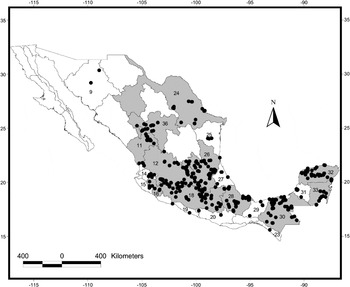
In terms of geographical distribution, freshwater fish adult helminths were found in 198 localities pertaining to 21 of the 37 Mexican hydrological regions. The number of records was reduced in most of the regions located in the Nearctic biogeographical region and in coastal areas. In contrast, Lerma-Santiago, Balsas, Grijalva-Usumacinta, Nazas-Aguanaval, and Presidio-San Pedro were the best known hydrological regions, considering the number of fish species recorded as hosts and the actual number of fish species occurring in each region as well as the number of localities studied (Fig. 1, Table 2).
Distribution of adult helminth parasites of freshwater fishes in Mexico. The country is divided in 37 hydrological regions and numbers indicate the regions where data are available: 9, Sonora Sur; 11, Presidio-San Pedro; 12, Lerma-Santiago; 14, Río Ameca; 15, Costa de Jalisco; 16, Armería-Coahuayana; 18, Balsas; 19, Costa Grande de Guerrero; 20, Costa Chica de Guerrero; 23, Costa de Chiapas; 24, Bravo-Conchos; 25, San Fernando-Soto La Marina; 26, Pánuco; 27, Norte de Veracruz; 28, Papaloapan; 29, Coatzacoalcos; 30, Grijalva-Usumacinta; 31, Yucatán Oeste; 32, Yucatán Norte; 33, Yucatán Este; 36, Nazas-Aguanaval. Shaded regions are those for which the data were sufficient for comparative analysis.

Although the sample-based rarefaction curves did not reach the asymptote, the majority showed a certain stability indicating that the sample size in each data set was large enough to consider that their adult helminth fauna was properly known. The comparisons of rarefaction curves at comparable sampling effort indicated that the difference in helminth species richness was significant among both host families and hydrological regions. The cichlids and ictalurids harboured the highest helminth species richness, whereas an intermediate number of species parasitized characids, goodeids, heptapterids, and poeciliids. The remaining host families did not harbour helminth faunas with more than 10 species (rarefaction curves not shown). At the species level, most fish species (60%) harboured poor helminth faunas (i.e., fewer than 5 species per host species). In contrast, only 6% of the fish species were parasitized by helminth faunas comprising more than 10 parasite species. The parasite species richness among hydrological regions also varied significantly. In southeastern Mexico, particularly in the Grijalva-Usumacinta and Papaloapan river basins, the highest helminth species richness was found. In contrast, with the exception of the regions situated in the Yucatán Peninsula, the hydrological regions with intermediate or low helminth species richness were always located in northern and central areas of the country (e.g. the Balsas, Lerma-Santiago, Nazas-Aguanaval and Pánuco systems) (rarefaction curves not shown).
We only considered the estimations of species richness produced by the bootstrap method, which achieved the best performance measures in all data sets. Based on these values, the minimum number of missing species remaining to be found varies from 1 to 11 and from 2 to 10 in the 13 host families and 11 hydrological regions analysed, respectively. Interestingly, the estimated species richness was distributed in the same way as the observed species richness in both host families and hydrological regions (Tables 1 and 2).
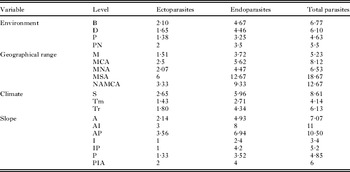
The analyses across fish species values, not corrected for possible phylogenetic effects, revealed that the extent of their geographical distribution correlated positively with species richness of ectoparasites, endoparasites, and total parasites. The r values obtained by considering the number of sites as well as the regions in which a host species occurs (within its regional distribution range) were 0·73 and 0·77, 0·78 and 0·70, and 0·83 and 0·78, N = 149, P = < 2·2e-16, respectively. In addition, the total area of hydrological regions where fishes are distributed correlated positively with ectoparasite species richness (r = 0·70, N = 149, P = < 2·2e-16). Based on main effect means of categorical variables, we also found that the distribution range of the host is an important variable and it seems that neotropical fishes have higher parasite species richness than those occurring in nearctic ones (Table 3).

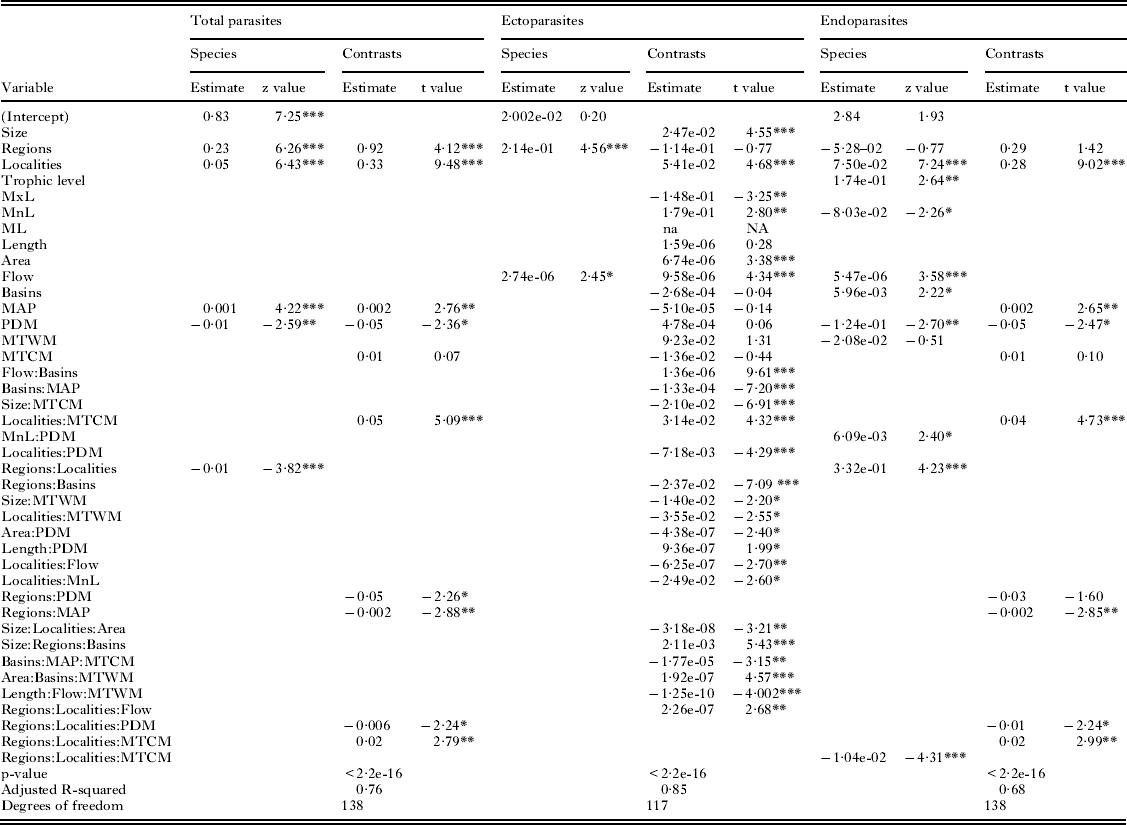
In the generalized linear models performed on fish species values, only the following variables, geographical distribution, trophic level, temperature, precipitation and latitude were retained, with the distribution range being the most important explanatory variable. The aforementioned trend is significant and there is compelling evidence that fish species with a broad distribution range tend to harbour more parasite species. In addition, these models showed significant interactions between distribution range and temperature and between latitude and precipitation in determining the number of endoparasites (Table 4).
Coefficients obtained from generalized linear models performed on fish species values and results of multiple regressions of standardized independent contrasts (estimated through the origin) predicting species richness
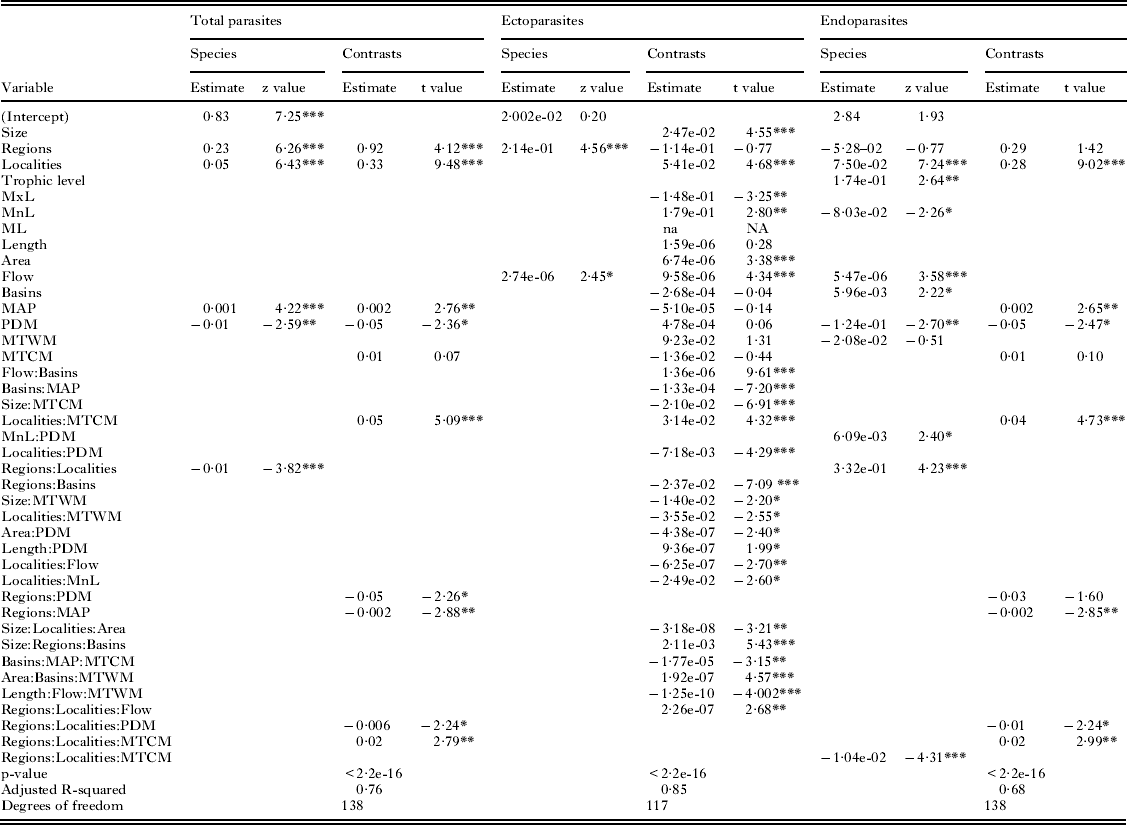
SPECIES, results of non-phylogenetic analyses; CONTRASTS, results of phylogenetic analyses; the sign indicates the direction of the effect; significance codes = 0 ‘***’ 0·001 ‘**’ 0·01 ‘*’ 0·05 ‘.’ 0·1 ‘ ’ 1.
After controlling for phylogenetic influences by using the independent contrasts method (Felsenstein, Reference Felsenstein1985), the same factors (the number of sites and regions in which a host species occurs) were correlated with the helminth species richness (ectoparasites r = 0·66 and 0·74, endoparasites r = 0·74 and 0·65, and total parasites 0·79 and 0·74, respectively, N = 148, P = < 2·2e-16).
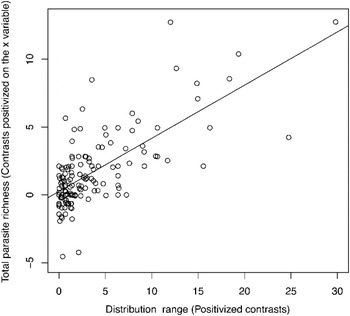
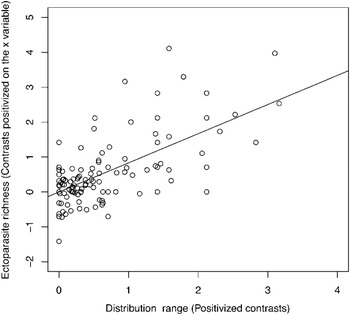
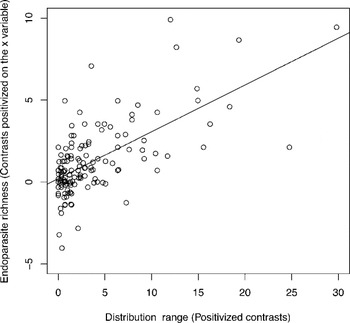
The results of the regression analyses corroborated that the geographical range was a key determinant of the variability in parasite species richness among host species (Figs 2–4). These findings suggest that, on average, widespread fish species harbour more species of helminth parasites and that this pattern is explained mainly by recent processes. Although, some results were similar when phylogenetic relationships were considered, there were some changes in the relationships between helminth species richness and their explanatory variables. For example, trophic level and latitude were not important in determining the number of endoparasites. In addition, a difference in parasite species richness between fish species with larger vs smaller body size was detected when data were corrected for host phylogeny (Table 4).
Relationship between the total parasite species richness and the geographical range of the Mexican freshwater fish species (r = 0·62·85, p < 2·2e-16). Points are phylogenetically independent contrasts positivized as suggested by Garland et al. (Reference Garland, Harvey and Ives1992).

Relationship between the ectoparasite species richness and the geographical range of the Mexican freshwater fish species (r = 0·5507, p < 2·2e-16). Points are phylogenetically independent contrasts positivized as suggested by Garland et al. (Reference Garland, Harvey and Ives1992).

Relationship between the endoparasite species richness and the geographical range of the Mexican freshwater fish species (r = 0·5497, p < 2·2e-16). Points are phylogenetically independent contrasts positivized as suggested by Garland et al. (Reference Garland, Harvey and Ives1992).

DISCUSSION
In this paper, we only considered adult helminth species found in native Mexican freshwater fishes unable to disperse across the sea (i.e., presumably non-diadromous), because of the fact that the parasite fauna of exotic fishes is not necessarily one they have acquired over evolutionary time in their area of origin. The species count provided in this study for adult helminths parasitizing freshwater fishes in Mexico (160) is not in agreement with species counts presented in previous studies. Part of the problem is the challenge in defining what is a freshwater fish (Miller et al. Reference Miller, Minckley and Norris2005). Salgado-Maldonado (Reference Salgado-Maldonado2006) quantified approximately 180 adult parasite species of freshwater fishes, but this author listed some helminth species found in marine or brackish water fishes that regularly enter freshwater at some life-history stage. In a recent publication, after a detailed consideration of the status of the freshwater fish fauna where objective criteria were followed, Pérez-Ponce de León and Choudhury (Reference Pérez-Ponce de León and Choudhury2010) considered that the adult helminth fauna of freshwater fish in Mexico consists of 177 species (37 trematodes, 62 monogeneans, 15 cestodes, 6 acanthocephalans, and 54 nematodes); however, they considered both native and exotic species of fishes. In this context, the inclusion of either marine and brackish water fish species or exotic species could obscure not only any biodiversity pattern, but also biogeographical patterns, since the processes that determine the distribution of parasites are different in the sea than in freshwater.
An obvious pattern uncovered in this study after the analysis of the information is the asymmetrical distribution of the species richness per parasite group. The group with the highest species richness is the nematodes, and even though we cannot establish at this point the reason for this, we argue that it is due to some of the nematode genera occurring in Mexican freshwater fishes (e.g. Rhabdochona, with 12 species, see Aguilar-Aguilar et al. Reference Aguilar-Aguilar, Rosas-Valdez and Pérez-Ponce de León2010) not conforming to monophyletic assemblages (Mejía-Madrid et al. Reference Mejía-Madrid, Vázquez-Domínguez and Pérez-Ponce de León2007). This means that their diversification is not associated strictly with vicariance/ dispersal events from the same ancestor. Instead, they seem to derive from different lineages from fishes whose affinities are found in both the Nearctic and Neotropical biogeographical regions.
Recent papers have discussed the appropriateness of taxonomic distinctness of parasite assemblages as an alternative measure of parasite diversity in comparative analyses (Luque et al. Reference Luque, Mouillot and Poulin2004; Luque and Poulin, Reference Luque and Poulin2008; Ponlet et al. Reference Ponlet, Chaisiri, Claude and Morand2011). However, we decided to use species richness since we were only looking for factors that influence species number in an assemblage and not the causes of a narrow or broad taxonomic range of parasite species in a host species, or we were not attempting to distinguish between the different origins of parasite species, an approach that necessarily requires detailed and robust phylogenetic hypotheses. Likewise, measurements of diversity that incorporate information on the relationships among parasite species would be necessary (i.e., taxonomic distinctness).
Patterns of species richness among hydrological regions show that southeastern areas of Mexico possess higher adult helminth species richness, whereas northern and central areas have lower richness. Previous studies have also pointed out that the geographical regions in which goodeids occur, i.e. central regions, are characterized by depauperate helminth communities in freshwater fishes (Espinosa-Huerta et al. Reference Espinosa-Huerta, García-Prieto and Pérez-Ponce de León1996; Rojas et al. Reference Rojas, Pérez-Ponce de León and García-Prieto1997, Pérez-Ponce de León et al. Reference Pérez-Ponce de León, García-Prieto, León-Régagnon and Choudhury2000; Sánchez-Nava et al. Reference Sánchez-Nava, Salgado-Maldonado, Soto-Galera and Jaimes-Cruz2004), while the parasite communities of fishes occurring in southern regions are more diverse, i.e., Cichlidae (see Vidal-Martínez, Reference Vidal-Martínez1995; Salgado-Maldonado and Kennedy, Reference Salgado-Maldonado and Kennedy1997). It has been argued that the basin's geological age, magnitude, and ichthyofaunal composition could explain those differences in helminth species richness among hydrological regions (Pérez-Ponce de León and Choudhury, 2005; Salgado-Maldonado et al. Reference Salgado-Maldonado, Aguilar-Aguilar, Cabañas-Carranza, Soto-Galera and Mendoza-Palmero2005). In addition, the biogeographical position of Mexico could be another explanation, since fish species occurring in the Nearctic or Neotropical region are not exposed to the same pool of parasite species. The size of the pool of available parasite species must differ from one geographical region to the next, and thus it can limit how many parasite species a host can acquire over time, regardless of the characteristics of this host species.
Several studies have searched for correlations between parasite diversity (in terms of species richness) and various fish host features such as body size, feeding habits, schooling behaviour and population density (for freshwater fishes: Poulin, Reference Poulin2001; Simková et al. Reference Simková, Morand, Matejusová, Jurajda and Gelnar2001; Takemoto et al. Reference Takemoto, Pavanelli, Lizama, Luque and Poulin2005; Luque and Poulin, Reference Luque and Poulin2008; for marine fishes: Sasal et al. Reference Sasal, Morand and Guégan1997; Morand et al. Reference Morand, Cribb, Kulbicki, Rigby, Chauvet, Dufour, Faliex, Galzin, Lo, Lo-Zat, Pichelin and Sasal2000; Luque et al. Reference Luque, Mouillot and Poulin2004; Luque and Poulin, Reference Luque and Poulin2004, 2008). However, there is no consensus regarding the role, if any, of these host traits in the evolutionary diversification of parasite faunas. Here, we found that adult helminth richness was not distributed randomly among freshwater fish species with respect to host traits and environmental and geographical factors. In addition to that, in the search for the factors that determine the parasite species richness, our study supports the need to take into account the transmission mode of the parasites, either direct or indirect (i.e., ectoparasites versus endoparasites), as has been shown in earlier studies (e.g., Luque and Poulin, Reference Luque and Poulin2004).
The results correspond in general with the patterns recognized previously by other authors at a comparable study scale. For instance, the distribution range, host size, precipitation, temperature and latitude, appear to influence the number of parasite species exploiting a freshwater fish species. The host geographical range (the number of sites in which a host species occurs) was the main predictor of the species richness in our study. This characteristic correlated positively with parasite richness, i.e., fishes with broad geographical distributions have richer assemblages than those with limited distribution. This relationship suggests that new parasite species can be acquired in various geographical regions because fishes living across many localities feed on a wider array of prey species and therefore are exposed to colonization by more parasite species than fishes restricted to a narrow distribution. Under this scenario, fishes are also exposed to colonization by more ectoparasite species with the consequent increase in species richness.
A positive correlation between host body size and ectoparasite species richness was also found. This finding can be explained in the light of island biogeography theory (Kuris et al. Reference Kuris, Blaustein and Alió1980), where larger hosts offer a larger number of habitats for parasite colonization than smaller ones.
Another pattern detected in the present study was the correlation between the parasite species richness and latitude as well as precipitation and temperature of the distribution area of the fish species. This relation has been addressed in several earlier papers dealing with species richness and latitudinal gradients. Rohde (Reference Rohde1992) and Rohde et al. (Reference Rohde, Hayward and Heap1995) observed that marine fish from tropical latitudes typically harbour richer ectoparasite communities than fish from temperate latitudes. Later, Poulin and Rohde (Reference Poulin and Rohde1997) suggested that the relationship between temperature and the marine-fish ectoparasite community richness was an indicator of the importance of temperature in the diversification of fish parasites in the tropics. Rohde and Heap (Reference Rohde and Heap1998) confirmed that pattern, but they did not find a correlation between temperature and endoparasite species richness in marine fishes, suggesting that biological differences between ecto- and endoparasites may explain this difference. In accordance with Rohde (Reference Rohde1992) the increase in parasite species diversity towards tropical areas is the result of higher diversification rates or effective evolutionary time, which are correlated with temperature. In the case of freshwater fishes a negative relationship between parasite species richness and temperature has been observed (Choudhury and Dick, Reference Choudhury and Dick2000; Poulin, Reference Poulin2001). However, in a more recent study Luque and Poulin (Reference Luque and Poulin2008) found a positive correlation between the parasite taxonomic distinctness of freshwater fishes from the Neotropical Region and temperature for all parasites and for ectoparasites and endoparasites treated separately. Apparently, in marine and freshwater environments, temperature is a major force driving not only the increase in the number of parasite species but also the increase of their taxonomic complexity over evolutionary time, mediated by greater rates of speciation and host colonization (Poulin and Morand, Reference Poulin and Morand2004).
Trophic level (host feeding habits, host diet or trophic category) influenced endoparasite species richness, but only when the analyses were conducted with fish species values, i.e., fish species at higher trophic levels may not only acquire more parasites through their diet, but also they may be exposed to a broader range of different parasite taxa. This pattern was only evident when endoparasite assemblages were analysed separately, because helminth endoparasites are usually acquired by ingestion due to their indirect life cycle. For instance, predatory fish (fishes with higher trophic levels) should be exposed to more infective helminth larvae in their diet than planktivores. Over evolutionary time, this should translate in higher parasite colonization rates in predatory fish than in planktivorous fish, pushing up the equilibrium of parasite species richness.
Another host trait that was evaluated in this paper was the position of the host in the water column and its relation with parasite species richness. In particular, no correlation was found between these two variables even though previous studies have shown that benthic fish may harbour more directly transmitted parasite species than pelagic fish. The reason for that pattern has not been identified for freshwater fish parasites, although it has been argued that the benthic boundary layer is a focal point for parasite exchange among faunas inhabiting different vertical zones in marine habitats (Marcogliese, Reference Marcogliese2002).
Finally, on a larger scale, several other important factors can influence the parasite species distribution and the diversification of parasite assemblages in Mexican fish (e.g. high levels of endemism in certain river basins (Domínguez-Domínguez et al. Reference Domínguez-Domínguez, Doadrio and Pérez-Ponce de León2006; Huidobro et al. Reference Huidobro, Morrone and Alvarez2006) and a significant number of exotic species introduced in the region). Therefore, the patterns uncovered in this study support the contention that parasite diversity, in this case parasite species richness, is largely affected by both host ecology and biogeography.
Although our approach uses the best available data for the helminth parasites of freshwater fishes, our attempts to identify the factors that determine parasite species richness are preliminary and provide but a glimpse of the patterns and processes that determine the species distribution of the helminth fauna of freshwater fish. Further sampling needs to be conducted in certain host families and particular river basins along the country, even though, as stated by Pérez-Ponce de León and Choudhury (Reference Pérez-Ponce de León and Choudhury2010), the inventory of the helminth parasite fauna in freshwater fishes in Mexico may be nearing completion (with the exception of the monogeneans).
ACKNOWLEDGEMENTS
We thank L. García-Prieto and E. V. Vega-Peña for efficient technical support and statistical advice, respectively. Special thanks to Robert Poulin for helpful observations and comments on an earlier draft of this manuscript and to José Luis Luque and Saúl López Alcaide for suggesting the use of PDAP to perform the phylogenetic contrast method.
FINANCIAL SUPPORT
L.G.O. was supported by a scholarship from the Cosejo Nacional de Ciencia y Tecnología (CONACyT). This paper fulfills the requirement of L.G.O. to obtain her Ph.D. degree within the Posgrado en Ciencias Biológicas, Universidad Nacional Autónoma de México. The study was partly funded by the Consejo Nacional de Ciencia y Tecnología (G. P. P. L., grant number CONACyT 83043 and 178830); and the Programa de Apoyo a Proyectos de Investigación e Innovación Tecnológica (G. P. P. L., grant number PAPIIT-UNAM IN202111).