Introduction
Digital transformation is a multifaceted (Crittenden, Crittenden, & Crittenden, Reference Crittenden, Crittenden and Crittenden2019; Tekic & Koroteev, Reference Tekic and Koroteev2019), complex (Hess, Matt, Benlian, & Wiesböck, Reference Hess, Matt, Benlian and Wiesböck2016; Matt, Hess, & Benlian, Reference Matt, Hess and Benlian2015), and dynamic (Lam & Law, Reference Lam and Law2019) process that can improve the performance of companies with the use of new digital technologies (Westerman, Bonnet, & McAfee, Reference Westerman, Bonnet and McAfee2014). Digital transformation became an imperative process for companies (Fitzgerald, Kruschwitz, Bonnet, & Welch, Reference Fitzgerald, Kruschwitz, Bonnet and Welch2014), especially those involved in a competitive and globalized trade context (Feliciano-Cestero, Ameen, Kotabe, Paul, & Signoret, Reference Feliciano-Cestero, Ameen, Kotabe, Paul and Signoret2023), and highly focused on digitalization (von Leipzig et al., Reference von Leipzig, Gamp, Manz, Schöttle, Ohlhausen, Oosthuizen and von Leipzig2017). However, digital transformation means a particular challenge for small and medium enterprises (SMEs) (Marino-Romero, Palos-Sánchez, & Velicia-Martín, Reference Marino-Romero, Palos-Sánchez and Velicia-Martín2024). Besides the financial investments required in digital technology (Ghobakloo and Iranmanesh, Reference Ghobakhloo and Iranmanesh2021), there is also a need for readiness in information security, organizational changes to meet digital capabilities, and adaptation to different business models (Chen & Lai, Reference Chen and Lai2022). However, SMEs are, at the same time, the more agile and able to respond to digital transformation challenges and to the sudden changing requirements of the markets (Marino-Romero et al., Reference Marino-Romero, Palos-Sánchez and Velicia-Martín2024), disrupting established companies in the sector (Crittenden et al., Reference Crittenden, Crittenden and Crittenden2019; Tekic & Koroteev, Reference Tekic and Koroteev2019) with better market positioning (Skare, de Obesso, & Ribeiro-Navarrete, Reference Skare, de Obesso and Ribeiro-Navarrete2023), organizational (Chen, Jaw, & Wu, Reference Chen, Jaw and Wu2016; Mukherjee, Baral, Chittipaka, Nagariya, & Patel, Reference Mukherjee, Baral, Chittipaka, Nagariya and Patel2024) and international (Feliciano-Cestero et al., Reference Feliciano-Cestero, Ameen, Kotabe, Paul and Signoret2023; Tolstoy, Nordman, & Vu, Reference Tolstoy, Nordman and Vu2022) performance.
Although companies have realized the need to digitize as a driver of innovation (Ayoko, Reference Ayoko2021), many are unsure how to start the digital transformation process (Hess et al., Reference Hess, Matt, Benlian and Wiesböck2016; von Leipzig et al., Reference von Leipzig, Gamp, Manz, Schöttle, Ohlhausen, Oosthuizen and von Leipzig2017). The process of transitioning from traditional industries to industry 4.0 is challenging. It requires moving forward to a stage of digitization, then a stage of digitalization, and only with a profound organizational involvement the stage of digital transformation can be achieved (Verhoef et al., Reference Verhoef, Broekhuizen, Bart, Bhattacharya, Dong, Fabian and Haenlein2021). In emerging countries, for example, this process is characterized by an intermediate stage of smart manufacturing called industry 3.5, as it is the case of the textile industry in Taiwan (Ku, Chien, & Ma, Reference Ku, Chien and Ma2020).
Digital transformation involves an entire ecosystem of interconnection and dependencies between and within companies and functions (Rahmati, Tafti, Westland, & Hidalgo, Reference Rahmati, Tafti, Westland and Hidalgo2020), requiring the preparation of entire organizations to implement different action plans according to technological possibilities (Westerman, Reference Westerman2017). Digital transformation requires change from a holistic business perspective (Hausberg, Liere-Netheler, Packmohr, Pakura, & Vogelsang, Reference Hausberg, Liere-Netheler, Packmohr, Pakura and Vogelsang2019), involving technical, organizational, and environmental dimensions (Chen & Lai, Reference Chen and Lai2022). In fact, the reinvention of the business comprises adjustments of operations, adaptation to new customer needs and expectations and the definition of a different business model (Ciacci, Balzano, & Marzi, Reference Ciacci, Balzano and Marzi2024; Westerman et al., Reference Westerman, Bonnet and McAfee2014; Verhoef et al., Reference Verhoef, Broekhuizen, Bart, Bhattacharya, Dong, Fabian and Haenlein2021). It is a process of incrementing digital tools, but also individual and organizational capabilities (Marino-Romero et al., Reference Marino-Romero, Palos-Sánchez and Velicia-Martín2024) to foster a digital transformation strategy (Zhang, Xu, & Ma, Reference Zhang, Xu and Ma2023). In this sense, the digital transformation framework is based on strategic management, technology, human capital, and organizational culture (Gurbaxani & Dunkle, Reference Gurbaxani and Dunkle2019). While the workforce must be flexing, deepening, and revitalizing (Eden, Burton-Jones, Casey, & Draheim, Reference Eden, Burton-Jones, Casey and Draheim2019), leadership capabilities are crucial (McCarthy, Sammon, & Alhassan, Reference McCarthy, Sammon and Alhassan2024), since entrepreneurs or decision-makers have an important role in the development of the transformation strategy (Jafari-Sadeghi, Mahdiraji, Alam, & Mazzoleni, Reference Jafari-Sadeghi, Mahdiraji, Alam and Mazzoleni2023; Zhang et al., Reference Zhang, Xu and Ma2023).
While previous research has focused on the technological, strategic, and organizational drivers of digital transformation (Björkdahl, Reference Björkdahl2020; Kraus et al., Reference Kraus, Jones, Kailer, Weinmann, Chaparro-Banegas and Roig-Tierno2021), this study fills in a gap of knowledge about the process of digital transformation in companies of an industry cluster, considering the importance of the organizational ecosystem in the digital transformation process (Appio, Frattini, Petruzzelli, & Neirotti, Reference Appio, Frattini, Petruzzelli and Neirotti2021). This research question is particularly important in the case of industrial clustering because of the importance of the interconnection of companies (Rahmati et al., Reference Rahmati, Tafti, Westland and Hidalgo2020) and the importance of a marketing positioning of the cluster as a branding element (Bhamra & Kishore, Reference Bhamra and Kishore2022). In this sense, it requires a homogeneous process of digital transformation among the companies of the industrial cluster (Teng, Zheng, Li, & Wu, Reference Teng, Zheng, Li and Wu2024).
This paper focuses on the footwear industry in Portugal, which created a brand for the national cluster of footwear, called ‘Portuguese Shoes’. This brand has the purpose of positioning the shoe industry in the global market with attributes of quality, innovation, performance, and fashion trends. The paper discusses the process of digital transformation based on the company’s digital maturity in relation to the level of leadership capacity and the level of digital capacity – the most relevant drivers for digital strategy in SMEs (Marino-Romero et al., Reference Marino-Romero, Palos-Sánchez and Velicia-Martín2024; Jafari-Sadeghi et al., Reference Jafari-Sadeghi, Mahdiraji, Alam and Mazzoleni2023; Zhang et al., Reference Zhang, Xu and Ma2023). The research provides valuable insights for SMEs’ top managers, allowing a measure of digital transformation maturity of companies and an understanding of the required organizational improvements that can be implemented.
Literature review
Digital transformation strategy
The technological volatility of the digital age leads to a complex process of organizational change with the integration of digital technologies in business, meeting new requirements, and expectations of contemporary society (Verhoef et al., Reference Verhoef, Broekhuizen, Bart, Bhattacharya, Dong, Fabian and Haenlein2021). Digital business strategy is an ‘organizational strategy formulated and executed through the use of digital resources to create differential value’ (Bharadwaj, Sawy, Pavlou, & Venkatraman, Reference Bharadwaj, Sawy, Pavlou and Venkatraman2013: 472), based on four key elements – reach, scale, speed, and sources of creation and capture of business value. In fact, digital transformation involves much more than the implementation of a technological infrastructure (Hess et al., Reference Hess, Matt, Benlian and Wiesböck2016). Digital technologies can solve problems, such as reducing costs and/or achieving operational efficiency, but require a digital business strategy (Ghobakhloo & Iranmanesh, Reference Ghobakhloo and Iranmanesh2021; Gurbaxani & Dunkle, Reference Gurbaxani and Dunkle2019; Marino-Romero et al., Reference Marino-Romero, Palos-Sánchez and Velicia-Martín2024; Zhang et al., Reference Zhang, Xu and Ma2023) to achieve both revenue growth and cost reduction (Mithas & Rust, Reference Mithas and Rust2021). Such digital strategy requires organizational readiness, such as digital capabilities and digital culture (Proksch, Rosin, Stubner, & Pinkwart, Reference Proksch, Rosin, Stubner and Pinkwart2024). In the past decade, companies have dedicated considerable efforts to building and implementing a powerful digital transformation strategy to enhance online visibility, improve reputation, or increase sales (Kane, Reference Kane2015). However, it required a holistic approach – an alignment with the business, operational, or functional strategies (Chen & Lai, Reference Chen, Jaw and Wu2016; Hausberg et al., Reference Hausberg, Liere-Netheler, Packmohr, Pakura and Vogelsang2019; Hess et al., Reference Hess, Matt, Benlian and Wiesböck2016; Matt et al., Reference Matt, Hess and Benlian2015), dynamic capabilities for business innovation through the digital transformation process (Witschel, Baumann, & Voigt, Reference Witschel, Baumann and Voigt2022) and the whole ecosystem of interconnected firms (Rahmati et al., Reference Rahmati, Tafti, Westland and Hidalgo2020).
Digital transformation strategies involve the use of technologies, changes in value creation, structural organizational changes, and financial aspects (Matt et al., Reference Matt, Hess and Benlian2015). In this context of theorizing the process of digital transformation, Gurbaxani and Dunkle (Reference Gurbaxani and Dunkle2019) considered the reinvention of business in a framework of strategic, technological, human capital and organizational culture change. Chen and Lai (Reference Chen and Lai2022) follow a TOE – technology, organization, and environment framework, in line with the assumptions of Björkdahl (Reference Björkdahl2020), who state that digitalization needs to incorporate dynamic capabilities, adaptation of resources, and organizational structures. Human and organization aspects are determinant as countermeasures against barriers to digital transformation, as it is the case of the education of employees to accept, implement, and optimize digital transformation in the company (Packmohr, Paul, & Brink, Reference Packmohr, Paul and Brink2024). In this sense, the access and implementation of technology have an important role, but the organizational strategy of the company is what ensures that such implementation is effective and efficient (Björkdahl, Reference Björkdahl2020). While companies should consider the technological evolution that surrounds them, the digital infrastructure needs to be skilled by the labor force (Skare et al., Reference Skare, de Obesso and Ribeiro-Navarrete2023). This means that digital technologies are the tools, while individuals and organizational capabilities are the enablers of the digital strategy in SMEs (Marino-Romero et al., Reference Marino-Romero, Palos-Sánchez and Velicia-Martín2024).
From a business-centric perspective, the digital strategy focuses on the transformation of products, processes, and organizational aspects due to new technologies. Its scope is broader and explicitly includes digital activities at the customer interface, with digital technologies as part of the end-user products. This constitutes a clear difference from process optimization, since digital transformation strategies go beyond the process paradigm and include changes and implications for products, services, and business models as a whole (Matt et al., Reference Matt, Hess and Benlian2015).
The strategy has been recognized in the literature as a driving force of digital transformation and digital success (Gobble, Reference Gobble2018; Hess et al., Reference Hess, Matt, Benlian and Wiesböck2016; Kane, Reference Kane2015; Matt et al., Reference Matt, Hess and Benlian2015; Westerman, Reference Westerman2017). Tekic and Koroteev (Reference Tekic and Koroteev2019) proposed a typology of digital transformation strategies based on two distinct dimensions – use of digital technologies and business model readiness – to provide a conceptual abstraction to the complexity of the digital transformation process and, in turn, better understanding and strategic decision-making. The framework considers four types of generic digital transformation strategies taking into account an high or low level of digital technologies relevant to the sector in which the company competes; and a high or low level of readiness of the business model for digital operation: The disruptive digital transformation strategy is characterized by a high level of business model readiness for digital operation and a high level of mastery of digital technologies relevant to the sector in which the company competes; the business model-led digital transformation strategy is characterized by a high level of business model readiness for digital operation and a low level of mastery of digital technologies relevant to the sector in which the company competes; the technology-led digital transformation strategy has a low level of business model readiness for digital operation and a high level of mastery of digital technologies; and the pride of having an analogue strategy is characterized by a low level of readiness of the business model for digital operation and a low level of mastery of digital technologies. Table 1 summarizes the characteristics of the four types of digital transformation strategies.
Characteristics of digital transformation strategies

Source: Adapted from Tekic and Koroteev (Reference Tekic and Koroteev2019).
Digital maturity
Digital maturity is the level of efficacy the organization has to compete in a digital context and goes far beyond the simple implementation of new technologies, aligning strategy, workforce, culture, the technology, and company structure to satisfy the digital expectations of customers, employees, and partners (Gurbaxani & Dunkle, Reference Gurbaxani and Dunkle2019). Although it is a slow, continuous, and constantly adapting process, digital maturity can increase the likelihood of an organization surviving and thriving in the digital era, given the context of rapid and unpredictable changes (Ostmeier & Strobel, Reference Ostmeier and Strobel2022).
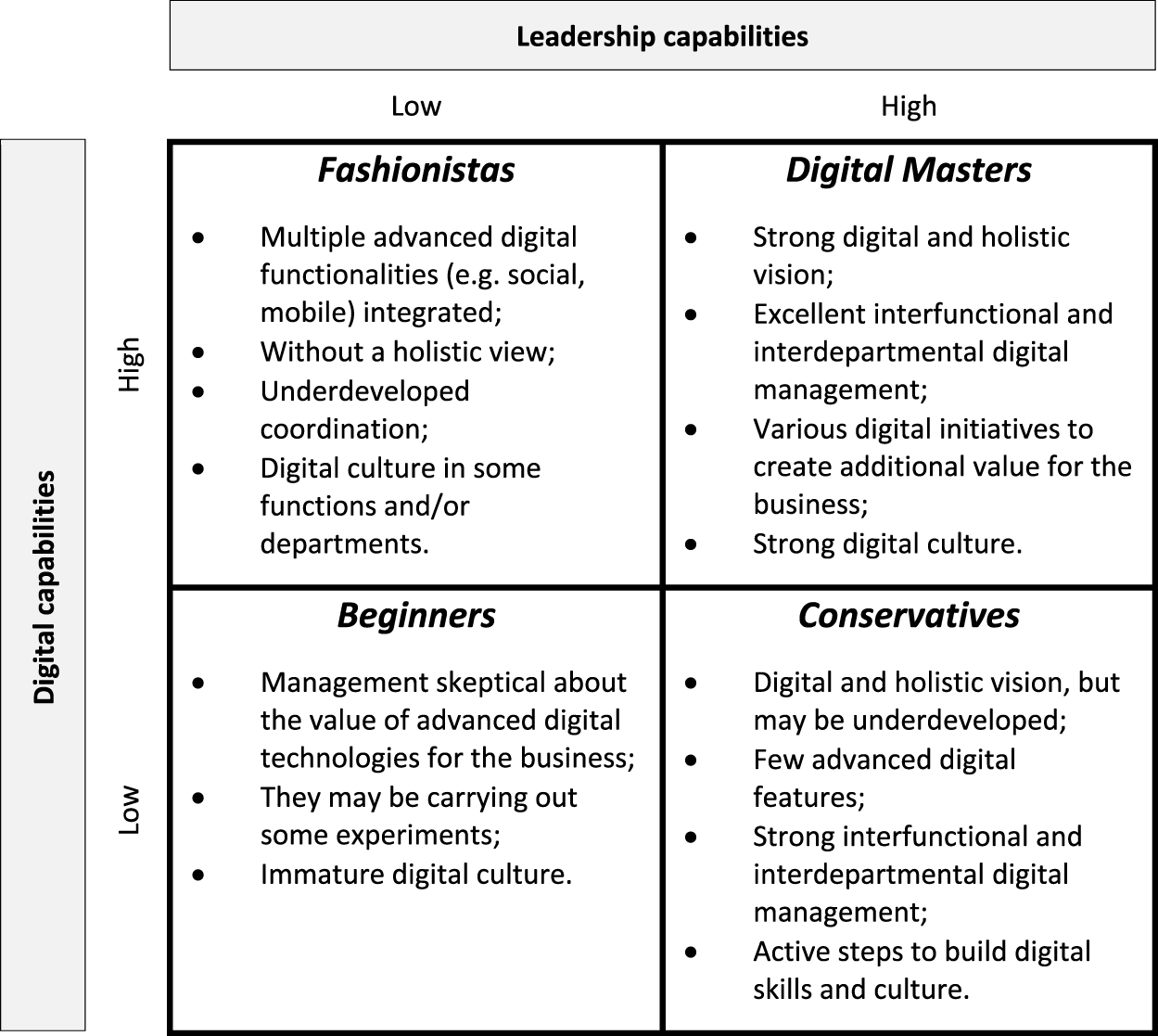
Organizations are not at the same level of digital maturity. Westerman et al. (Reference Westerman, Bonnet and McAfee2014) argue that the most digitally successful companies – Digital Masters – simultaneously exceed digital capabilities (the ‘what’ of technology) and leadership capabilities (the ‘how’ of change). The leaders of these companies articulate the vision for change, identify critical initiatives and ensure the alignment of employee activities and behaviors for this change. The Conservatives are characterized by a high level of leadership capabilities and a low level of digital capabilities. These companies have an effective vision and organizational structure compared to adapting to technology. The fear of taking risks makes companies focus more on rules than on making progress, which is why the approach is extremely cautious when it comes to adopting digital technologies.
The Fashionists are characterized by a low level of leadership capabilities and a high level of digital capabilities. These companies seek to quickly adopt digital technologies, but without a clear vision and strategy that encompasses the entire organization, in a coordinated way. In fact, enthusiasm for new digital technologies can mislead organizations into focusing more on technologies than on business transformation (Westerman, Reference Westerman2017). Even though digital technologies are facilitators of transformation and allow the business to elevate, they cannot be seen as an objective of digital transformation but rather as a tool and a means to achieve the strategic objectives of digital transformation (Tekic & Koroteev, Reference Tekic and Koroteev2019). Beginners – companies with less digital success – are characterized by a low level of leadership capabilities and a low level of digital capabilities. Typically, these are companies that are at the beginning of their digital journey or companies new to the market that are not yet prepared to take the leap into the technological world, or are not willing to take risks. As a result, these companies have only basic digital capabilities and follow a ‘wait and see’ strategy (Westerman et al., Reference Westerman, Bonnet and McAfee2014). Figure 1 systematizes this classification and expresses the main characteristics of these companies in the process of digital transformation.
Classification of companies according to the level of leadership capabilities and the level of digital capabilities.

It is undeniable that Digital Masters are the companies that manage to grow and obtain a comparative advantage (Skare et al., Reference Skare, de Obesso and Ribeiro-Navarrete2023). The approach must be holistic, involving financial and accounting, marketing, innovation and management departments, manufacturing and human resources management (Eden et al., Reference Eden, Burton-Jones, Casey and Draheim2019; Hausberg et al., Reference Hausberg, Liere-Netheler, Packmohr, Pakura and Vogelsang2019). However, the transformation should try to have with little operational impact, making use of the online channels to achieve higher performance (Chen et al., Reference Chen, Jaw and Wu2016; Ghobakhloo & Iranmanesh, Reference Ghobakhloo and Iranmanesh2021; Tolstoy et al., Reference Tolstoy, Nordman and Vu2022).
The fourth industrial revolution reinvented existing business models and developed new digital business models, allowing companies to reach their customers more easily. As a result, companies need to evaluate and balance the various existing digital communication channels (online stores, websites smartphones, social networks, and online markets) in order to be able to take advantage of their functionalities to boost market-driven and market-driving orientations and achieve better international performance (Tolstoy et al., Reference Tolstoy, Nordman and Vu2022). With mobile growing and new digital technologies emerging (Lam & Law, Reference Lam and Law2019), it is important to adapt to digital business models: e-commerce, mobile commerce, ubiquitous commerce, social commerce, and electronic market (Hajli, Reference Hajli2013; Kumar, Joshi, & Saquib, Reference Kumar, Joshi and Saquib2015; Lin, Li, & Wang, Reference Lin, Li and Wang2017; López-López & Giusti, Reference López-López and Giusti2020; Schaupp & Bélanger, Reference Schaupp and Bélanger2014). Building a successful digital business involves the application of digital technologies throughout the organization, with a view to optimizing internal processes in the value chain, as well as external processes in the value system, allowing the strengthening of internal relationships between the organization’s employees and external relationships between the organization and its suppliers, partners, and customers (Lipiäinen, Karjaluoto, & Nevalainen, Reference Lipiäinen, Karjaluoto and Nevalainen2014; Subramaniam, Iyer, & Venkatraman, Reference Subramaniam, Iyer and Venkatraman2019).
In short, transformations are needed in many, if not all, dimensions of the business and a clear and well-defined digital transformation strategy is required to achieve digital success. Table 2 summarizes the dimensions of digital transformation, considering the level of leadership capacity and the level of digital capacity by organizational dimension, identified in the literature.
Dimensions of digital transformation by organizational dimension

Source: Authors.
The case of Portuguese shoes
The footwear cluster has a significative importance to the country’s economic growth, and is representative of the majority Portuguese industry, in line with Portuguese textile. This latter is mainly operating in service business models to international private labels, while Portuguese shoes have been establishing increasingly as important players among premium brands of footwear fashion, targeting high value markets (Monteiro, Rosa, Martins, & Jayantilal, Reference Monteiro, Rosa, Martins and Jayantilal2023). Globalization of markets and the competitive dynamics impressed by the technological and digitalization of distribution channels led companies in the Portuguese footwear cluster to restructure their production and business from competitiveness based on price to a strategic shock based on sophistication and creativity, with production efficiency fostered by technological and sustainable processes (Miranda & Roldán, Reference Miranda and Roldán2022). Portuguese shoes have historically been made up of SMEs acting mainly in the context of the national economy. This cluster is responding to the current challenges, investing in the qualification of people, in sustainable production and agility to respond to the volatility of fashion markets at an international level (Monteiro et al., Reference Monteiro, Rosa, Martins and Jayantilal2023). Portuguese footwear industry currently exports to 175 countries in 5 continents and is investing 80 million euros in a project called BioShoes4All, aiming at developing sustainable solutions for the footwear industry though biomaterials, ecological production, circular economy, advanced production technologies, and training and promotion (APICCAPS, 2023).
The footwear industry in Portugal is increasingly adopting a strategy of greater added value, targeting more demanding consumers, usually associated with social classes with high purchasing power. The quality and consistency of the products, the technical and functional characteristics of the materials and components used, the continually renewed innovative design, the flexibility and technical and technological capacity to respond quickly to small series, the brand and the distinctive character of the products are seen as decisive elements of differentiation in Portuguese shoes, nowadays (Sena-Dias, Pina e Cunha, & Rego, Reference Sena-Dias, Pina e Cunha and Rego2014). In this context, innovation has played an important role in increasing added value, but also in implementing new production processes, making it easier for different companies to respond and adapt to new market demands (Monteiro et al., Reference Monteiro, Rosa, Martins and Jayantilal2023). From a traditional industry orientated toward the domestic market, it has reinvented itself into a dynamic, entrepreneurial and competitive industry orientated toward the international market, rising from cheap products to a level where ‘Made in Portugal’ is synonymous of excellence on an international level (APICCAPS, 2023). It should be noted that this change in business model by companies in the Portuguese footwear industry is a lengthy process that requires highly complex human and financial resources (Miranda & Roldán, Reference Miranda and Roldán2022). Some companies focus on undervalued product ranges, while others lack the financial resources to invest in creating and developing their own brands and in the internationalization process.
In order to take advantage of the opportunities arising from the digital age, the practices of the new technological and digital paradigm need to be accepted and integrated, not only by the companies’ employees (internal digital transformation), but also by their suppliers, distributors, partners, and customers (external digital transformation). Basically, the acceptance and integration of these practices by all the economic agents involved (digital transformation at a holistic level) (Rahmati et al., Reference Rahmati, Tafti, Westland and Hidalgo2020) is essential for building a digital business. This is no less true in the case of the Portuguese footwear industry, where the collaboration of different stakeholders is considered particularly important for sharing resources (Rocha, Galvão, Marques, Mascarenhas, & Braga, Reference Rocha, Galvão, Marques, Mascarenhas and Braga2020; Vaz, Reference Vaz2020). Incorporating the new possibilities resulting from the digital transformation process will create smarter factories capable of responding more quickly in a more customized and efficient way. In this way, companies can seize the opportunities offered by digital technologies, face the challenges arising from digitalization and develop digital businesses. This is the cornerstone for companies in the footwear sector in Portugal to remain relevant in the market and be able to extract the highest levels of performance, competitiveness, and digital success (Miranda & Roldán, Reference Miranda and Roldán2022). Previous research in the footwear industry in Portugal assumes there is a long way to go to obtain an effective implementation of digital transformation due to the need for digital literacy (Rocha, Reference Rocha2023) and the limitations in economic and technical resources (Vaz, Reference Vaz2020). Although the leaders of these companies are generally aware of new technologies and consider it is important to implement digitalization in their industry, they also assume the limitations in dynamic capabilities to proceed with such transformation and recognize a need for training the employees (Silva, Reference Silva2019). This low level of maturity in digital transformation in the footwear industry in Portugal compromises the goals of sustainability related to the circular economy (Monteiro, Reference Monteiro2023).
This context makes Portuguese shoes a good example to discuss the process of digital transformation of SMEs and, at the same time, representing an industry ecosystem in a form of an industrial cluster, which is of major relevance according to the literature (Kraus et al., Reference Kraus, Jones, Kailer, Weinmann, Chaparro-Banegas and Roig-Tierno2021). Exploring the digital transformation process in footwear industry in Portugal enhances and diversifies the academic knowledge about the process of digital transformation of SMEs, in a relevant industry with economic added value and with a well-established cluster of companies, highly supported by the government to incentivize export and qualification, but also rejuvenated with new entrepreneurs focused on innovation, sustainability, and fashion oriented (APICCAPS, 2023). This context represents a research opportunity to strengthen the knowledge about digital transformation in SMEs, expanding the discussion to the context of an industrial cluster fostering innovation and internationalization after a strategic turnaround. Specifically, the creation of a common brand for the cluster ‘Portuguese Shoes’ opens a relevant research question regarding the common stage in terms of digital transformation within the companies that constitute the brand. In fact, different paces in terms of digital transformation may compromise the interdependency of the cluster network.
Methodology
This paper follows a qualitative methodological approach, using the multiple case study method to analyze the phenomenon of digital transformation in footwear companies in Portugal, considering that they form an important cluster-based brand – ‘Portuguese Shoes’. Although the qualitative methodology has been the most used approach to study the Portuguese footwear industry, including regarding the topic of digital transformation and collaborative networks (Monteiro, Reference Monteiro2023; Silva, Reference Silva2019; Rocha et al., Reference Rocha, Galvão, Marques, Mascarenhas and Braga2020; Vaz, Reference Vaz2020), the comparison of case studies remains the most suitable method to compare the different maturity stage of companies, because reported data from databases are not able to answer our research question.
In order to understand how SMEs in the footwear industrial cluster in Portugal are implementing transformation, the researchers analyzed five important Portuguese footwear companies as case studies. The companies selected had to be Portuguese, with international expansion and act in the digital environment. To this end, five companies in the Portuguese footwear sector – Augustha, Egídio Alves, Entrudo, Friendly Fire, and Josefinas – were analyzed following the theoretical assumptions about the digital transformation process. The authors conducted in-depth interviews in each of the five companies analyzed as case studies (see the interview guide in annex). In parallel, the authors also proceeded with document analysis of internal reports about the digital strategy and the significance of digital business, as it is the case of e-commerce. The authors also observed the business practices in digital tools, as social media presence, digital contents, and digital interaction with stakeholders, including social media followers. Table 3 shows the characterization of the selected cases, as well as the characterization of the interviewees in each company under study, representing mostly the decision makers of the company and the relevant mentors of digital transformation (Jafari-Sadeghi et al., Reference Jafari-Sadeghi, Mahdiraji, Alam and Mazzoleni2023; Zhang et al., Reference Zhang, Xu and Ma2023).
Characterization of the selected cases

Source: Compilation by the authors.
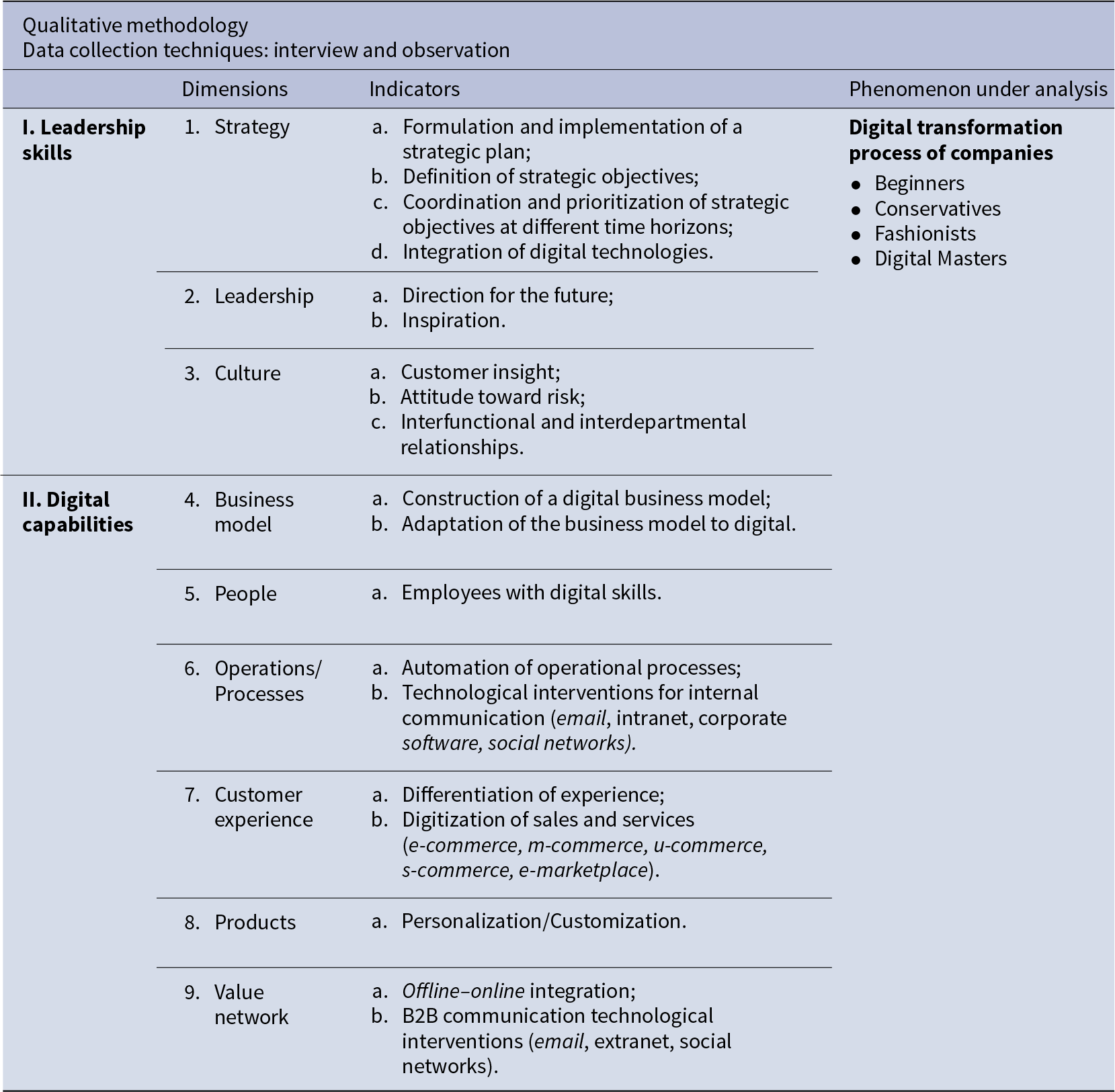
The purpose of this research was to develop a study from the company point of view to understand how the dimensions of digital transformation have been implemented in companies in the footwear sector in Portugal. Based on the conclusions drawn from the literature review, the research focused on the understanding of the nine dimensions defined as relevant to the digital transformation process in terms of (I) leadership capacity – (1) strategy; (2) leadership, and (3) culture – and (II) digital capacity – (4) business model; (5) people; (6) operations/processes; (7) customer experience; (8) products, and (9) value network. The authors conducted multiple case studies, gathering interview data from top managers in five footwear companies in Portugal, along with field document analysis and observations. A set of 15 questions were defined based on these same dimensions and their respective indicators, seeking to extract the information needed to analyze and discuss the companies’ digital transformation process with rigor. However, the researchers followed a semi-structured interview model, allowing an interactive conversation to identify emerging ideas about the digital transformation process. The researchers analyzed the data collected in the interviews and the data found in the observation of the digital channels used in the business model (e-commerce, m-commerce, u-commerce, s-commerce, e-marketplace). A checklist was used to understand which components of the digital business the companies integrate: e.g. social media elements on the website recommendations, feedback, blogs (Chae, McHaney, & Sheu, Reference Chae, McHaney and Sheu2020), the subscription of newsletters and contact forms on the website, the personalization/customization on the website, the existence of mobile applications, and interaction via various digital channels – website, smartphone, social networks, – implementation of systems following the assumptions of the internet of things (Caro & Sadr, Reference Caro and Sadr2019), the offline–online integration, as well as the existence of social commerce and the use of B2C e-marketplaces (Gregory, Ngo, & Karavdic, Reference Gregory, Ngo and Karavdic2019; Kumar et al., Reference Kumar, Joshi and Saquib2015; Lin et al., Reference Lin, Li and Wang2017; López-López & Giusti, Reference López-López and Giusti2020). The data was analyzed using NVivo software, following the mentioned dimensions of analysis defined based on existing literature. Table 4 systematizes the categories of analysis.
Conceptual model for analyzing the digital transformation process of companies

Source: Authors.
Results
Leardership capacity
Augustha, Egídio Alves, and Josefinas have a well-defined strategic plan, which includes the strategic steps to be taken in the short, medium, and long term, as well as the goals to be achieved through the use of digital technologies These companies are visionary in terms of their direction for the future, inspiring all organizational activity, motivating employee action and helping to create beliefs that are shared throughout the company: ‘Every business should have a plan. We defined major objectives, strategies and actions that allow us to achieve the objectives and also measure whether we are or not on a good path’ (Josefinas). The companies were unanimous in their understanding of the main advantages of a digital business model, referring to it as a way of achieving brand recognition, promotion, and expansion, as referred by Kane (Reference Kane2015).
On the other hand, Entrudo and Friendly Fire have not defined a strategic plan, although both companies are currently working in the digital environment: ‘We felt that there was a need to establish ourselves in the digital area and we are step by step readapting and readjusting as needs arise. We have never made a digital plan, honestly. We react to the current reality in each moment’ (Friendly Fire).
An inspiring vision was found in two of the five companies interviewed – Egídio Alves and Josefinas. These companies provide clear and well-defined directions and influence all organizational activity, motivating employees to act and helping to create beliefs that are shared throughout the organization, as stated in the literature to characterize an inspiring leadership (Fitzgerald et al., Reference Fitzgerald, Kruschwitz, Bonnet and Welch2014; Kane, Reference Kane2015). In the case of Egídio Alves, this is reflected in the training activities that its founder promotes, stating that all the employees are ‘completely integrated’. Likewise, at Josefinas, employees are reflected in the activities and areas of ‘women’s empowerment, artisanal creation and customer word-of-mouth’ that the company promotes. Furthermore, it is emphasized throughout the interview that ‘everyone who works at Josefinas truly believes that the brand pillars are important and are what truly define the brand’. All the activities that are carried out at Josefinas, in all functions and departments, serve solely to continue to nurture and seek to fulfill the vision, mission and values (which are the reason for its existence). However, it is undeniable that the vision only has the capacity to inspire employees if it is communicated, proven by the expressions ‘I try to internalize this entire journey in them too’ (Egídio Alves) and ‘We communicate this in everything we do’ (Josefinas). Otherwise, it is just a vision without practical applicability.
On the other hand, in the remaining three companies interviewed, one does not have any internal employees yet (Augustha), one was born from a family project (Entrudo), and the vision of one is generic and not very precise (Friendly Fire). In the three mentioned companies, there is no inspiring vision that helps to create beliefs to be shared throughout the organization.
The five companies refer to knowledge sharing and cooperation relationships between employees from different functions and departments. According to Westerman et al. (Reference Westerman, Bonnet and McAfee2014), a culture of knowledge sharing, inter-functional and interdepartmental collaboration is extremely important among organization’s employees for the functioning of companies, as it allows for faster, more conscious, and intelligent strategic decision-making (Kane, Reference Kane2015). The interviews allowed the authors to identify in the five companies the existence of knowledge and cooperation between employees from different functions or departments: ‘It is very easy to manage this because there are few of us and the entire team is multidisciplinary. Therefore, the entire team communicates to resolve any issue whatsoever. It is all very interconnected’ (Friendly Fire); ‘I subcontract more than twenty services in outsourcing, but they are as my employees, because they all collaborate a lot with the brand and there is a commitment with the success of the brand because of the interdependence of services’ (Egídio Alves).
Digital capacity
Three of the five companies (Augustha, Egídio Alves, and Josefinas) highlight the entry into new markets as the main motivator for building a digital business model, giving little emphasis to the remaining advantages of the e-commerce business model. This highlights the strategic option of these three companies for the internationalization process, a result compatible with the sector’s strong export vocation, given that Portuguese footwear is becoming an international success story, each year managing to reach further, both in numbers as well as its geographic presence in new markets (APICCAPS, 2023). The interviewee assumed that the market itself dictated the start of the digital transformation process for one company: ‘The focus is on markets with greater purchasing power. In order to reach these markets, the intervention would necessarily have to be digital’ (Augustha). Friendly Fire began an extensive process of organizational change in 2018 through the substantial integration of digital technologies into the business, but the interviewee from this company mentioning that the digital channels represented a way of surviving toward the new demands of digital society. The company was forced to begin the digital transformation process as a way of surviving the new demands of society, a contemporary phenomenon supported by Tekic and Koroteev (Reference Tekic and Koroteev2019).
Two companies, Entrudo and Josefinas, admit that the digital channel is essential for the vitality of the business, but all the interviewees recognized the importance of having a presence on digital channels, which led to a subsequent search for people with the skills to apply digital technologies, using subcontractors in photography, digital marketing, technological development, and e-commerce platforms. Entrudo did not refer to people, employees, or subcontractors to provide digital solutions. Surprisingly, this was the only company (Entrudo) that mentioned cost reduction as the main driver for starting activity with a digital business model. Such interest in electronic commerce on the part of this company is proven in the literature by the fact that it is a commercialization model that responds to the current needs of organizations to reduce costs (Kumar et al., Reference Kumar, Joshi and Saquib2015)
Regarding the automation of operational processes, the companies were unanimous in their opinion that this did not exist, given that they prioritize the handmade process of shoe manufacture to meet their customers’ needs in terms of exclusivity, differentiation, and the creation of additional value. On the other hand, with regard to the use of digital technologies in internal processes, it is understood that email appears to be the main digital channel for corporate communication. Entrudo, Friendly Fire, and Josefinas also mentioned the use of WhatsApp, corporate software, and Instagram, respectively. In this sense, technological platforms are very important in companies’ internal dynamics in terms of sharing and accessing information.
The customer is the main concern of all five companies, with extreme importance being attached to differentiating the shopping experience, whether through easy and intuitive access to the online shop, support during and after the sale, the creation of additional value, the personalization of interaction, the exchange and returns policy, proximity to the customer and/or delivery time. Likewise, interaction with the customer through various digital communication channels is essential for companies. In practice, the companies have opted to be present on various digital channels in an integrated way, essentially by integrating social media elements into the website, a blog, and a newsletter, and on mobile apps such as the Josefinas App.
The incorporation of services with high added value for the customer, such as ‘tailor-made’ product development or product personalization/customization, is a determining factor for the differentiation strategy and, consequently, the competitiveness of companies in the digital age. Although it is currently the only company that does not offer this service, Augustha plans to do so in the medium term. In addition, Josefinas is the only company that offers a ‘personalization’ option on its e-commerce platform, from which it can offer products tailored to customers’ needs and preferences.
Despite their integrated presence on various digital communication channels, no company is committed to online–offline integration. Only Egídio Alves has a physical store, in showroom format, but this is not integrated with its online store.
To complement the interviews, the digital channels of the five companies under study were observed, using a checklist, in order to understand which components of the digital business they comprise and how digital media are used (see Table 5).
Observation of digital business components in the digital channels of the case studies

Source: Authors.
The companies do not have the same level of leadership and digital capabilities. Based on the classification of companies for the level of leadership capabilities and the level of digital capabilities proposed by Westerman et al. (Reference Westerman, Bonnet and McAfee2014;. 25), it was possible to classify the five companies in the footwear industry in Portugal analyzed in this research – Augustha, Egídio Alves, Entrudo, Friendly Fire, and Josefinas – as follows:
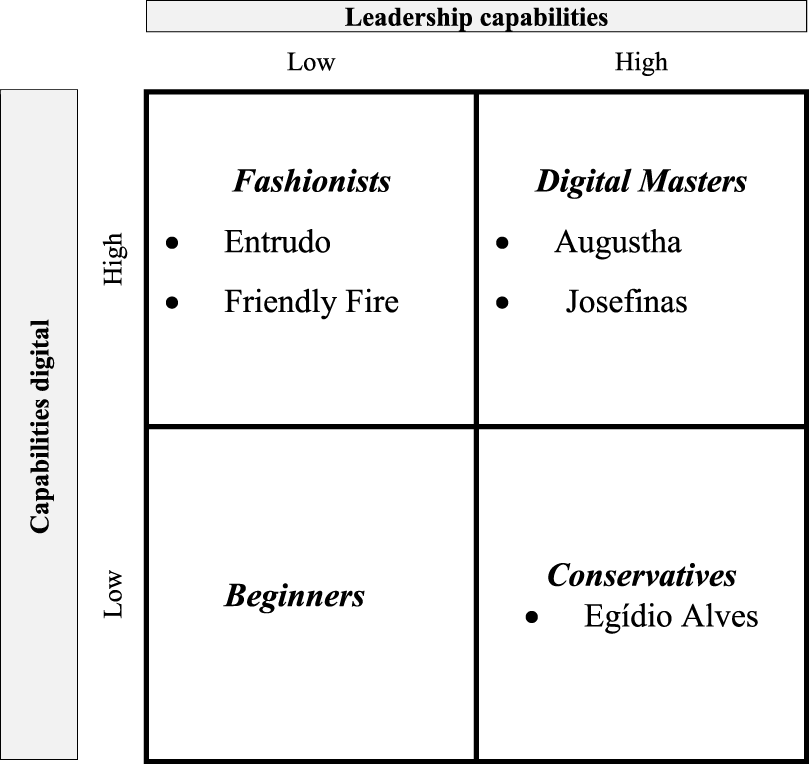
Entrudo and Friendly Fire can be considered fashionists, given their low level of leadership skills and high level of digital skills. These companies have quickly adopted various technologies and digital channels to get closer to the customer, but without a holistic vision and a clear, well-defined strategy that encompasses the entire company in a coordinated way. This is particularly true of Entrudo, since the company has been in the digital environment since its inception. Until when it opened its online shop, Friendly Fire could be considered a Beginner, given its presence exclusively in the physical environment and its extremely cautious attitude. On the other hand, Egídio Alves was considered Conservative, given its high level of leadership skills and low level of digital skills. This company has an effective holistic vision and organizational structure compared to adapting to technology, as few advanced digital features were observed in the company. Augustha and Josefinas, on the other hand, are the most digitally successful companies, characterized by a high level of leadership skills and a high level of digital capabilities, especially Josefinas. These two companies are classified as Digital Masters, considering their strong digital and holistic vision of how digital technologies and channels will effectively achieve and commit to this vision.
Figure 2 posits the five analyzed case studies in the Westerman et al.’s (Reference Westerman, Bonnet and McAfee2014) classification.
Classification of case studies according to the level of leadership capabilities and the level of digital capabilities.

Discussion, contributions and implications
While the five analyzed companies assume that their digital transformation process has led to increased market penetration, higher sales, and improved customer satisfaction, in line with the theoretical assumptions (Ghobakhloo & Iranmanesh, Reference Ghobakhloo and Iranmanesh2021), those with a higher level of digital maturity, as the digital masters, recognize the success of implementing a well-defined strategy inspired by a strong leadership that was able to build a supportive organizational culture with trained employees and dynamic capabilities. By integrating digital technologies into their operations and fostering a culture of innovation, these companies admit they have achieved a competitive advantage with better market orientation and collaborative networks, which are strengthened by the easy digital communication and efficiency of resources shared.
The results of this paper contribute to a framework for actionable recommendations based on the nine dimensions described in Table 3, used to analyze the case studies – strategy, leadership, culture, business model, people, operations/processes, customer experience, products, and value network. As recommendations, companies should formulate and implement a strategic plan that includes well-defined strategic objectives, activities for coordinating and prioritizing strategic objectives over different time horizons, and activities for integrating digital technologies into the overall business strategy that guides them in their digital future. Regarding leadership, the top management level should reflect what the company intends to be in the future and inspire the actions of its employees. The existence of a common purpose throughout the company allows all objectives and decisions to arise around this vision and for employees to feel that they are contributing to something greater. It is also critical to the success of companies in the digital age an organizational culture built with the customer vision, a risk-taking attitude, and knowledge-sharing relationships and cross-functional and interdepartmental collaboration. Then, the companies should create a digital business model, looking for people with skills to apply digital technologies and knowledge about operational processes, such as the creation of automation. The business model should be oriented to the market preferences and focused on the shopping experience, with the incorporation of high-added value services for the customer, such as the development of ‘tailor-made’ products or personalization/customization. Finally, it is crucial the activation of the value network through digital communication.
Previous research on the topic has shown the initial stage of companies in digital transformation and the limitations of resources to pursue such purpose (Rocha, Reference Rocha2023; Vaz, Reference Vaz2020), despite the awareness about its importance (Silva, Reference Silva2019). This paper gives a step forward, showing the process to overcome such difficulties, the successful outcomes and the different stages of digital transformation within different companies, contributing to actionable recommendations to pursue the desired homogeneity within the companies of the cluster-based brand ‘Portuguese Shoes’.
Conclusions
This paper examines the adaptation of footwear companies in Portugal to an increasingly global and competitive market through the adoption of digital transformation strategies. In an age where digitalization is extremely important and consumption patterns are constantly changing, this research was therefore designed with the main objective of discussing the process of digital transformation in companies in the footwear sector in Portugal, because of the rapid changes in customer preferences and fashion trends and the fact of ‘Portuguese shoes’ being a cluster-based brand, requiring a common strategy among the companies that contribute to such a clustering brand.
The study identifies leadership capacity, through dimensions of strategy, leadership, and organizational culture; and digital capacity, through dimensions of the design of business models, personnel, operations/processes, customer experience, products, and value network, as crucial aspects in the digitalization process. The authors concluded that three companies show an evident leadership capacity – Augustha, Egídio Alves, and Josefinas. The leadership of these companies combines strategy and a holistic vision for change, identifies critical initiatives for creating additional value for the business, and ensures an organizational culture in tune with this change, in which the activities and behavior of all employees are aligned. At Entrudo and Friendly Fire, where leadership capacity is clearly lacking, it is urgent that the leaders of these companies prepare themselves to transform their approach, having the capacity to set in motion continuous learning, creating a digital culture and coordinating the entire organization according to this change.
Four companies – Augustha, Entrudo, Friendly Fire, and Josefinas – show a notable digital capacity. The companies benefit from an integrated presence in various digital communication channels, both internally and externally. Internally, companies exploit digital corporate communication channels, mainly email and management software, such as information and access systems. Externally, companies interact with their stakeholders via email and social media, mainly through more socially orientated social media platforms such as Instagram and Facebook, which can be accessed via smartphone as well as desktop and automatically redirect the customer to their websites and online shops. Egídio Alves, on the other hand, despite having a high level of leadership skills, does not interact through various digital channels, i.e. there were few advanced digital functionalities (mobile and social) integrated.
This work found the complex process of digital transformation, as it reveals the reasons why companies transform digitally, illustrating internal motivations, as well as external stimuli. This research gives understanding, in practice, of how companies were constantly adapting their business model to the technological volatility experienced almost daily in the digital era. Given the scarcity of information on how companies change their management in order to respond to the ongoing digital challenges, this research expands research in the field of digital transformation, giving knowledge to companies that wish to combine their efforts in this extensive process of organizational change, providing a better understanding of how to manage the dimensions previously defined as relevant to the digital transformation process. Companies intending to start a digital transformation process or even reinforcing digital strategy can incorporate guidance from this paper about other companies that have already done so.
The main theoretical contribution of this paper is the evidence that in a cluster-based brand, as is the case of Portuguese shoes, different companies face different stages of digital transformation, which can hinder the cluster-based brand positioning and the interdependencies between the companies of the ecosystem in the digital environment. In this sense, global leadership and digital capacity is needed, provided by the entities that are involved in the acceleration of the cluster brand – industry association, public policies, etc., to disseminate the imparities among companies of the cluster. This is particularly relevant, considering the interdependencies among companies from the cluster.
Limitations and future research
Results are limited to the cases studies analyzed. Due to the limitation of the cases, future research may extend the research to more companies in the footwear sector, operating in different market segments and with different organizational dimensions. Future research may present a quantitative component of customer perceptions of companies’ digital transformation efforts.
Supplementary material
The supplementary material for this article can be found at https://doi.org/10.1017/jmo.2024.78.
Acknowledgements
This work is financed by national funds through FCT - Foundation for Science and Technology I.P. within the scope of the project «UIDB/04647/2020» of CICS.NOVA– Interdisciplinary Centre of Social Sciences of Universidade Nova de Lisboa.