


When Kenneth Pomeranz claimed that the Great Divergence began only during the nineteenth century, his fundamentally quantitative claim was backed up with surprisingly little data, as Jack Goldstone notes.Footnote 1 After more than 15 years of debate, incorporating systematic quantitative evidence on both Europe and Asia, Pomeranz himself has accepted that his original claim was somewhat exaggerated and that the divergence dates from the eighteenth century.Footnote 2 Of course, this is still a lot later than suggested by the classic view of the rise of the West, which would see Europe forging ahead of Asia as early as 1500. Pomeranz and the California school can thus be seen as having had a substantial effect on the dating of the divergence. The California School also had a lasting effect on the characterisation of development on both continents, by highlighting the significance of regional variation. Goldstone seeks to upset this emerging consensus on the timing of the Great Divergence by restoring the spirit of Pomeranz’s original claim that the divergence occurred only after 1800.
At the heart of the disagreement lies Goldstone’s belief that the episodes of growth in Britain and Holland before 1800 are just further examples of his concept of ‘efflorescences’.Footnote 3 However, his definition of an efflorescence lacks clarity, covering two very different cases. First, there is the standard Malthusian case, where an episode of growing is followed by an episode of shrinking, so that there is no long-term trend in per capita income. Second, however, there is the case where an episode of growing is followed by the economy remaining on a plateau with a permanently higher level of per capita income until the next growing episode starts, so that per capita income trends upwards over the long run. Goldstone writes as if he believes that the latter case were the norm, arguing that ‘To be sure, societies often retained the techniques and capital accumulated during the efflorescence, and preserved a new equilibrium, so that an efflorescence usually had a ratchet effect’.Footnote 4 But if such a ratchet effect had been the norm, then most of world history would have been characterised by trend growth rather than long-run stagnation of per capita incomes.
What the new work on historical national accounting demonstrates is that the standard case was long-run stagnation, with alternating episodes of growing and shrinking.Footnote 5 From the mid-fourteenth century, however, Britain and Holland broke away from this pattern, beginning a dynamic process of reduction in episodes of shrinking rather than an acceleration in the rate of growing.Footnote 6 Although other west European economies shared in the growth of per capita incomes after the mortality crisis of the Black Death, only Britain and Holland retained the gains and avoided shrinking as population growth returned, before building on these gains during the early modern period, culminating in the first transition to sustained modern economic growth in eighteenth-century Britain. The permanent gains in per capita income in the North Sea area were underpinned by permanent structural changes. Whilst most European economies remained dominated by agriculture, the North Sea area economies were characterised by a remarkably precocious shift of labour out of agriculture into industry and services, a high rate of urbanisation and a process of fixed capital accumulation. No doubt the temporary booms in other European economies led to structural change and urbanisation in the short run, as Goldstone asserts, but they were reversed and did not lead to permanent shifts comparable to those which occurred in Britain and Holland.
Despite its title, the bulk of Goldstone’s paper concentrates on the dating of modern economic growth in the Netherlands and Britain. The normal definition of modern economic growth requires merely positive growth of population and GDP per capita at the same time, in contrast to pre-modern economic growth, where positive growth of per capita income is permitted only by negative growth of population in a world of diminishing returns. Eighteenth-century Britain meets these criteria, so that is where modern economic growth began. Goldstone attempts to support his argument that Britain did not achieve modern economic growth during the eighteenth century by claiming that Broadberry et al. have exaggerated the growth of British agricultural output during the eighteenth century and hence also overstated the growth of GDP per capita.Footnote 7 Here, Goldstone offers no new evidence but relies on the work of Clark, to which Broadberry et al. have already responded elsewhere.Footnote 8 Here, therefore, I will focus on the implications of Goldstone’s assumption of a 25% decline in agricultural output per capita between 1750 and 1800. The effect of this is merely to reduce the growth rate of GDP per capita from 0.39% per annum to 0.20%, since agriculture accounted for a relatively small share of output by the eighteenth century. Since population was growing rapidly at 0.77% per annum at this time, this was still modern economic growth on the normal definition.
Patterns of pre-industrial growth and Goldstone’s efflorescences
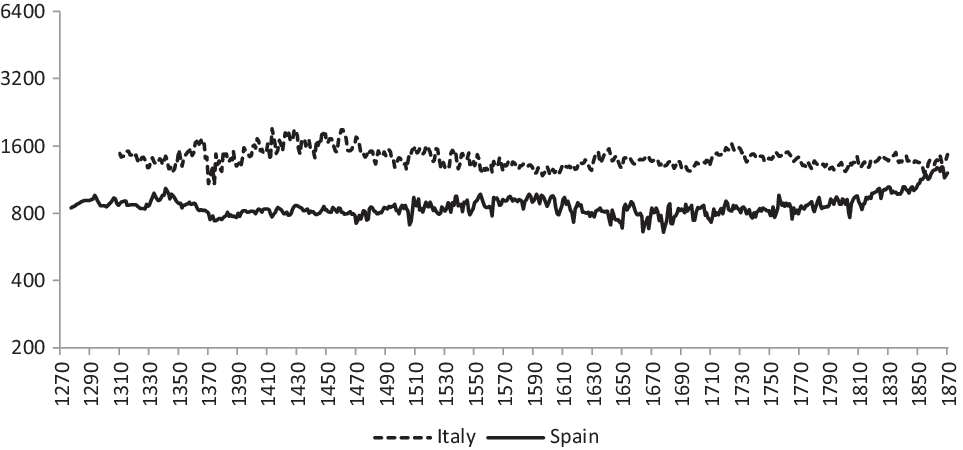
By failing to draw a distinction between long-run stagnation and long-run trend growth, Goldstone misses an important aspect of the Little Divergence debate and its emphasis on the reduction in episodes of negative per capita income growth or shrinking.Footnote 9 Broadberry and Wallis provide a detailed analysis of this process, distinguishing between long-run trends over 50-year periods, episodes of at least three consecutive years of growing or shrinking, and medium-run trends of around a decade or so.Footnote 10 Here, I show the data for all years rather than a few selected dates and focus on medium-run trends. The first pattern of long-run stagnation is illustrated in Figure 1 by the cases of Italy and Spain between 1300 and 1800. In both cases, medium-run periods of positive trend growth alternated with medium-run periods of negative trend growth or shrinking, leaving little or no progress in the level of per capita incomes over the long run.
Real GDP per capita in Italy and Spain 1270–1870 (1990 international dollars, log scale).
Sources: P. Malanima, “The Long Decline of a Leading Economy: GDP in Central and Northern Italy, 1300–1913,” European Review of Economic History 15 (2011): 169–219; C. Álvarez-Nogal and L. Prados de la Escosura, “The Rise and Fall of Spain (1270–1850),” Economic History Review 66 (2013): 1–37.

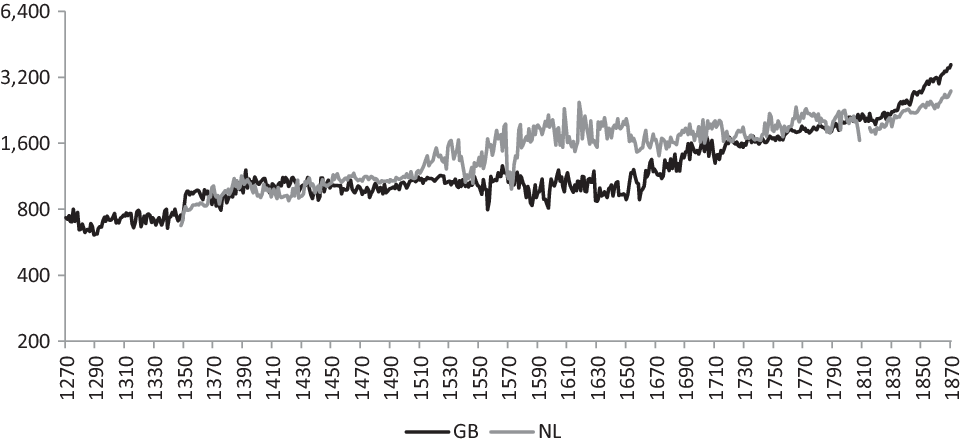
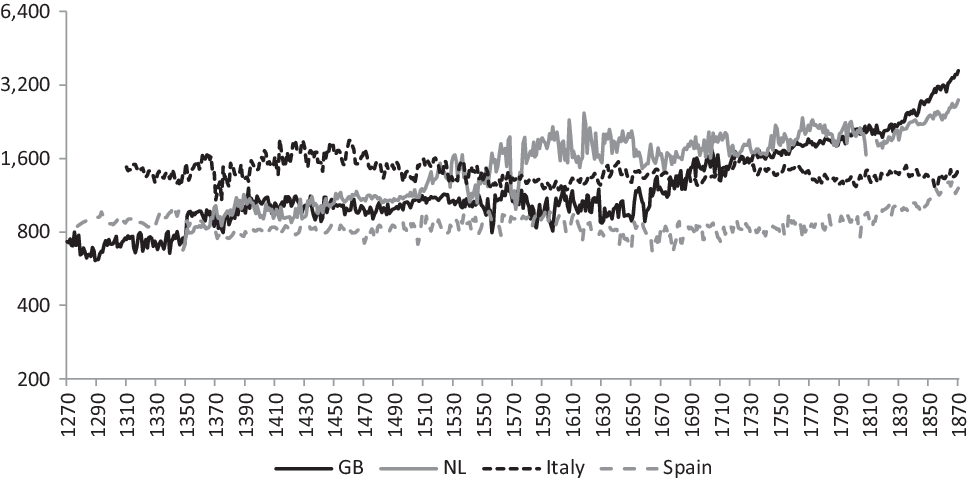
For the cases of Britain and the Netherlands in Figure 2, however, although there were periods of strong positive trend growth over the medium run, periods of negative medium-run trend growth were either non-existent in the case of Britain or highly dampened in the case of the Netherlands.Footnote 11 One way to think about Europe’s Little Divergence, and also the Great Divergence, is therefore not so much the beginnings of growth, but rather a reduction in periods of shrinking. As this process occurred in northwestern Europe, Britain and Holland overtook Italy and Spain, as shown in Figure 3. Of particular significance in this Little Divergence within Europe was the different effects of the arrival of the Black Death in the mid-fourteenth century, which wiped out around a third of Europe’s population within three years, and around half within a century. Both Britain and the Netherlands received a permanent boost to per capita GDP from this mortality shock, remaining on a plateau with substantially higher per capita incomes, even after the return of population growth from the mid-fifteenth century. Although Italy also experienced a rise in GDP per capita in the aftermath of the mortality shock, per capita incomes returned to their pre-Black Death level with the return of population growth, following the conventional Malthusian pattern. Those lucky enough to survive the mortality shock had a transitory increase in their incomes as a result of an increase in land and capital per head, but the return of the population to pre-Black Death levels eliminated the gains. In Spain, however, where population density was much lower during the Reconquest period, a further decline of population destroyed commercial networks and further isolated an already scarce population, reducing specialisation and the division of labour. Thus, Spain did not share in the general west European increase in per capita incomes after the Black Death.Footnote 12
Real GDP per capita in Britain and the Netherlands, 1270–1870 (1990 international dollars, log scale).
Sources: S. Broadberry, B. Campbell, A. Klein, M. Overton, and B. van Leeuwen, British Economic Growth, 1270–1870 (Cambridge: Cambridge University Press, 2015a); J. L. van Zanden and B. van Leeuwen, “Persistent but not Consistent: The Growth of National Income in Holland, 1347–1807,” Explorations in Economic History 49 (2012): 119–30.


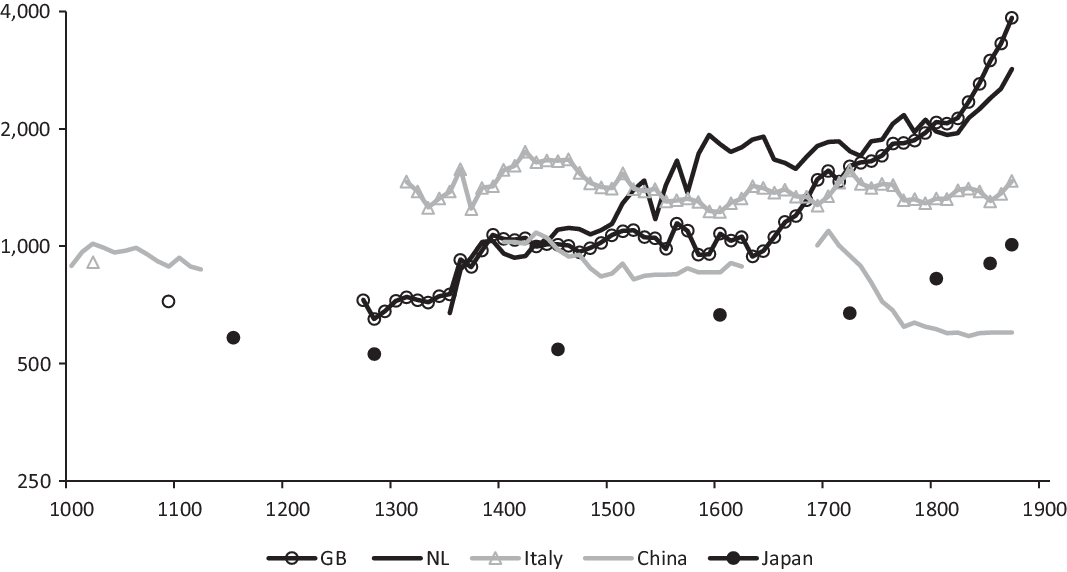
Recent reconstructions of historical national accounts for China and Japan mean that it is possible to report in Figure 4 trends in GDP per capita in these major Asian economies alongside the three European economies of Britain, the Netherlands and Italy.Footnote 13 In China, there were ‘efflorescences’ during the Northern Song and Ming dynasties, but without trend growth over the long run, and this was followed during the Qing dynasty by a strong downward trend of per capita GDP.Footnote 14 Japan is an interesting case, exhibiting a growth episode between 1450 and 1600, followed by a plateau and then a second growth episode during the eighteenth century.Footnote 15 Japan, which was the first Asian country to achieve modern economic growth after the Meiji Restoration of 1868, thus appears to have followed a pattern similar to that of the North Sea area economies of Britain and the Netherlands, avoiding major episodes of shrinking. However, Japan started at a lower level and grew more slowly, so that it continued to fall behind the leading European economies until the late nineteenth century.
GDP per capita in Europe and Asia, 1000–1870 (1990 international dollars).
Sources: S. Broadberry, B. Campbell, A. Klein, M. Overton, and B. van Leeuwen, British Economic Growth, 1270–1870 (Cambridge: Cambridge University Press, 2015a); J. L. van Zanden and B. van Leeuwen, “Persistent but not Consistent: The Growth of National Income in Holland, 1347–1807,” Explorations in Economic History 49 (2012): 119–30; P. Malanima, “The Long Decline of a Leading Economy: GDP in Central and Northern Italy, 1300–1913,” European Review of Economic History 15 (2011): 169–219; S. Broadberry, H. Guan, and D. Li, “China, Europe and the Great Divergence: A Study in Historical National Accounting,” Journal of Economic History 78 (2018b): 955–1000; J.-P. Bassino, S. Broadberry, K. Fukao, B. Gupta, and M. Takashima, “Japan and the Great Divergence, 730–1870,” Explorations in Economic History 72 (2019): 1–22.

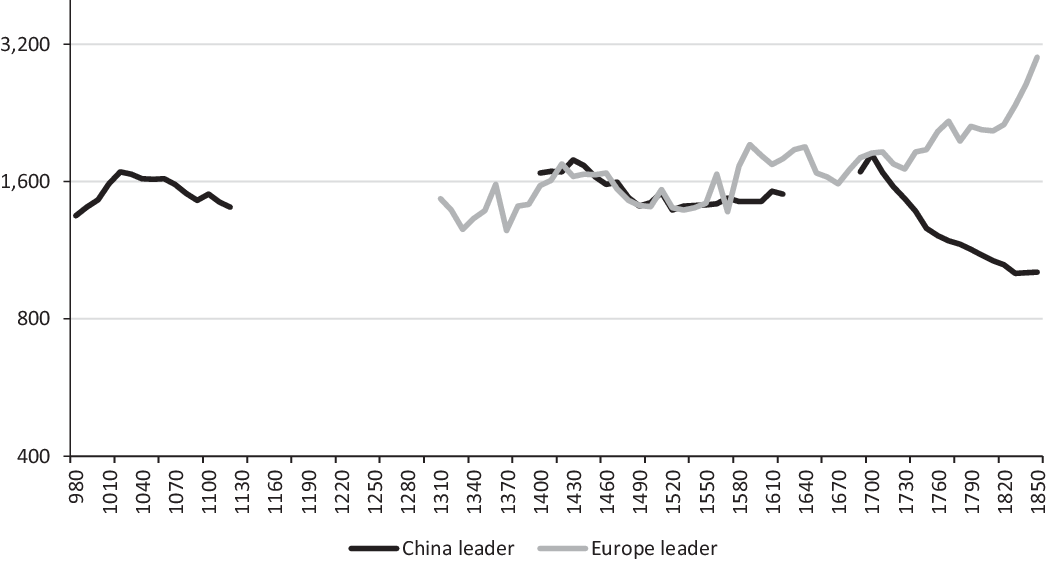
Figure 4 indicates the range of possible dates for the start of the Great Divergence. At first sight, Figure 4 may appear to support the classic view of the rise of the West from the late medieval period, as Italy was clearly ahead of China already by 1300. Broadberry et al. reject this position, however, because it fails to consider regional variation within China, which was a much larger economy than any European nation.Footnote 16 To make a fair comparison, it is necessary to compare European nations with similar sized regions of China. We know from the work of Li and van Zanden that the Yangzi delta, the richest region of China, was substantially poorer than the richest European nations by the 1820s.Footnote 17 Applying the ratio between the Yangzi delta and China as a whole in the 1820s to Chinese GDP per capita for earlier years produces a quantification of the leading Chinese region for comparison with the European leader in Figure 5.Footnote 18 The European frontier is constructed from Italy for the period from 1300 to 1540, then the Netherlands to 1800 and finally Britain after 1800. Figure 5 shows that on this basis, taking account of regional variation, the Great Divergence began in the early eighteenth century and was already quite substantial by 1800. It occurred partly as a result of increasing GDP per capita in Europe but also because of a decline in GDP per capita in China. The inclusion of the other Asian nations does not change the picture since India was also declining from 1600, and while Japan exhibited a trend increase in GDP per capita, it was starting from a much lower level and also growing more slowly than Britain. To close the gap between the Yangzi delta and the European frontier in 1800 would require changes that are simply not credible. Furthermore, it would go much further than Pomeranz now considers plausible.Footnote 19
Real GDP per capita in the leading regions of China and Europe, 980–1850 (1990 international dollars, log scale).
Source: S. Broadberry, H. Guan, and D. Li, “China, Europe and the Great Divergence: A Study in Historical National Accounting,” Journal of Economic History 78 (2018b): 955–1000.

It is worth noting that Goldstone’s preferred method of closing the Anglo-Chinese gap until 1800 simply does not work. Goldstone suggests that Broadberry et al. have exaggerated the growth of the British economy during the eighteenth century. However, this does not have the effect on the gap between the European and Chinese frontiers that Goldstone thinks it does, for two reasons. First, the European frontier in Figure 5 is derived from the Netherlands during the eighteenth century rather than from Britain. But secondly, even if we are concerned about the comparison between China and Britain, it should be noted that lowering the British growth rate during the eighteenth century raises rather than lowers the level of per capita GDP in Britain before 1800. The reason for this is that comparative levels of GDP per capita are established at 1840 and working back from this date with slower growth in Britain would raise the level of British per capita income relative to China in earlier years. This would mean an earlier rather than a later start date for the Great Divergence.
The transition to modern economic growth in Britain
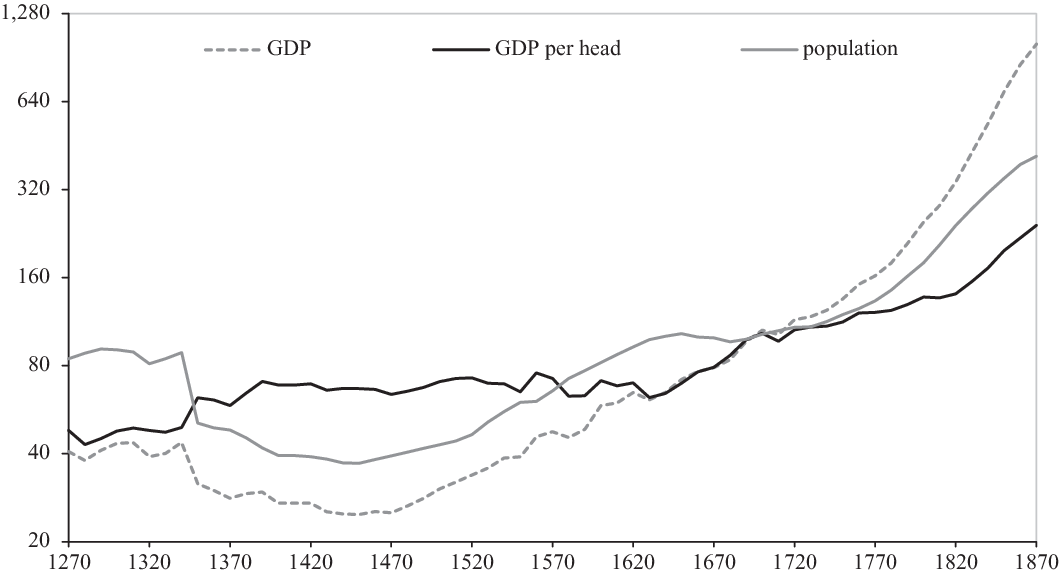
Goldstone misses the transition to modern economic growth in eighteenth-century Britain as well as the beginning of the Great Divergence at this time, by failing to see the significance of (1) the plateau between episodes of per capita income growth rather than alternating periods of growing and shrinking and (2) the continued upward trend of per capita income after the return of population growth in the eighteenth century. Figure 6 tells the story of Britain’s long-run trajectory to modern economic growth, highlighting the significance of the reduction of shrinking episodes and the interaction between population growth and per capita income growth.Footnote 20
Real GDP, population, and real GDP per head, England 1270–1700 and Great Britain 1700–1870 (averages per decade, log scale, 1700 = 100).
Source: S. Broadberry, B. Campbell, A. Klein, M. Overton, and B. van Leeuwen, British Economic Growth, 1270–1870 (Cambridge: Cambridge University Press, 2015a).

Goldstone is correct to point out that per capita income growth before 1700 was confined largely to two episodes, between the 1340s and 1400s following the Black Death and between the 1650s and 1700s following the Civil War. However, there is a substantial difference between the two episodes. Whereas population declined catastrophically at −1.32% per annum during the post-Black Death growth phase, the population decline between the 1650s and 1700s was just −0.06% and barely shows up as a downward trend. By the seventeenth century, the economy was capable of achieving per capita income growth without the catastrophic population collapse that underpinned the earlier growth phase. Furthermore, already by the 1450s, the return of population growth after the Black Death mortality crises did not lead to a downward trend in per capita incomes, as in the normal Malthusian pattern of alternating phases of growing and shrinking.
Finally, as population growth returned in the eighteenth century after the episode of rapid economic growth following the Civil War, per capita income continued to grow rather than follow the Malthusian pattern of shrinking. So yes, the growth rate of per capita income slowed down after 1700 compared with the period 1650–1700, as Goldstone points out, but compared with other economies at the time, this was a remarkable achievement. It was the first case of modern economic growth as normally understood: sustained positive per capita income growth together with substantial population growth. Real GDP per head grew at 0.19% per annum between 1700 and the 1750s, rising to 0.44% between the 1750s and 1800s, as population growth increased from 0.30% to 0.77%. Notice the progression here from the maintenance of the higher level of per capita income with the return of population growth from the 1450s to the maintenance of per capita income growth with the return of population growth after 1700.
Conclusions
The main disagreement here is one of the interpretation. Goldstone does not see any distinction between two patterns of pre-industrial growth, which leads him to miss the significance of both the Little Divergence within Europe and the Great Divergence between Europe and Asia. The most common pattern of pre-industrial growth was fluctuations with long-run stagnation, where an episode of positive per capita income growth was followed by an episode of negative per capita income growth or shrinking, so that per capita income showed no permanent gain. However, a second pattern of pre-industrial growth occurred in the North Sea area, with each episode of growth being followed by a plateau where per capita incomes remained at a higher level. Since the next growth episode started from this plateau, per capita incomes trended upwards over the long run. This second pattern was therefore a crucial stepping stone to modern economic growth, since it dampened and eventually eliminated the episodes of shrinking that had condemned economies to long-run stagnation for millennia. Modern economic growth began in eighteenth-century Britain as per capita income growth remained positive despite the return of substantial population growth.
Stephen Broadberry is a Professor of Economic History, Oxford University. His books include British Economic Growth, 1270–1870, co-authored with Bruce Campbell, Alexander Klein, Mark Overton and Bas van Leeuwen and The Cambridge Economic History of the Modern World, co-edited with Kyoji Fukao, which will appear in 2021.