Introduction
Most of the Chrysopilus Macquart material collected and examined for this publication was collected during five trips to New Caledonia (December 1991, October–December 1992, January 1996, November 1998, and October–December 2000) as part of an examination of the faunal biodiversity of New Caledonia coordinated through Dr. Jean Chazeau, Office de la Recherche Scientifique et Technique d'Outre-Mer (ORSTOM), Centre de Nouméa, New Caledonia.
Thirty-two species of Chrysopilus have been described from the Australasian/Oceanian Region (Nagatomi and Evenhuis Reference Nagatomi, Evenhuis and Evenhuis1989; Reference KerrKerr 2010). Twenty-two species occur in Australia (Paramonov Reference Paramonov1962; Nagatomi and Evenhuis 1989; Kerr 2010). Several species show similarities to the new species from New Caledonia, but none of the Australian species were found in New Caledonia. Chrysopilus androgynus Paramonov and C. tasmanensis White have been reported from New Caledonia (Nagatomi and Evenhuis 1989), but neither of these species was collected during five collecting trips to New Caledonia by the author. Specimens of these two species from New Caledonia could not be located in the insect collections of the Muséum National d'Histoire Naturelle, Paris; The Natural History Museum, London; the Bishop Museum, Honolulu; the Australian National Insect Collection, Canberra; the Australian Museum, Sydney; Queensland University, Brisbane; and the Queensland Museum, Brisbane. Also, the specific locality sites of their occurrence in New Caledonia could not be found in the literature or provided by N. Evenhuis or A. Nagatomi (personal communications). Chrysopilus fijiensis Webb and C. schlingeri Webb from Fiji (Webb Reference Webb2006) show similarities to C. melinus sp. nov. and C. woodi sp. nov. from New Caledonia, but differ in the patterns on the wing membrane and in the characters of the male genitalia. No species of Chrysopilus have been described from the New Hebrides, the Samoa Islands, or the Solomon Islands. Nine species of Chrysopilus have been described from the Maluku Islands, Papua, and Papua New Guinea. From the original descriptions of these species, none displayed a close similarity to any of the new species from New Caledonia described here. Most of these species are known only from single locations and only Chrysopilus ferruginosus (Wiedemann) is widely distributed in the Oriental and Australasian regions. This is a large (9–11mm long) reddish yellow species with clear wings and a dark-brown pterostigma, but it does not match any species in New Caledonia. From New Zealand, only C. nitidiventris Tonnoir has been reported, based on a single female that bears no resemblance to any of the new species from New Caledonia.
Materials and methods
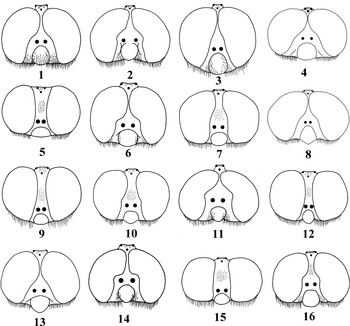
Morphological terminology follows McAlpine (Reference McAlpine, McAlpine, Peterson, Shewell, Teskey, Vockeroth and Wood1981). When more than one specimen was measured, lengths are given as a range, followed by the mean. Setae described in this paper are filiform unless otherwise defined; elongate setae have a length equal to or greater than the width of the scape, short setae have a length less than the width of the scape. All material examined is listed after the description, and the depository collection is given in parentheses. Georeferences are cited as [-latitude/longitude]. “Holoptic” refers to the male eyes being separated by a distance less than the width of the median ocellus (Fig. 4) and “dichoptic” refers to them being separated by a distance equal to or greater than the width of the median ocellus (Fig. 5). In New Caledonia there are two common spellings of Mount Khogis, the alternative being Mount Koghis.
The following institutions were kind enough to loan material relevant to this study or are depository collections for specimens:
- ANIC
Australian National Insect Collection, Canberra, Australian Capital Territory, Australia
- BMNH
The Natural History Museum, London, United Kingdom
- BPBM
Bernice P. Bishop Museum, Honolulu, Hawai′i, United States of America
- CAS
California Academy of Sciences, San Francisco, California, United States of America
- INHS
Illinois Natural History Survey, Champaign, Illinois, United States of America
- MNHN
Muséum National d'Histoire Naturelle, Paris, France
- QM
Queensland Museum, South Brisbane,Queensland, Australia
- USNM
National Museum of Natural History, Washington, D.C., United States of America
In New Caledonia, adults were hand-netted or collected in Malaise or pan traps. When hand-netted, adults were generally found sitting on rocks in small streams where the males appeared to be station-taking or waiting for females or were collected on fern fronds along small streams.
Taxonomy
In New Caledonia, species of Chrysopilus separate into two discrete species groups. The chazeaui species group, consisting of C. bicoloratus sp. nov., C. brunneabdominalis sp. nov., C. caliginosus sp. nov., C. chazeaui sp. nov., C. mandjelia, sp. nov., C. frankmcalpinei sp. nov., C. petersoni sp. nov., C. shewelli sp. nov., and C. teskeyi sp. nov., have the male eyes holoptic (Fig. 4.); the male ommatidia smaller on the ventral half of the eyes; and the male frons glabrous. The sarramea species group, consisting of C. irwini sp. nov., C. melinus sp. nov., C. noumea sp. nov., C. sarramea sp. nov., C. everti sp. nov., C. vockerothi sp. nov., and C. woodi sp. nov., have the male eyes dichoptic (Fig. 5); the male ommatidia equal in size; and the frons with short setae. Chrysopilus plautifrons sp. nov. is not included in these species groups because the male is unknown.
Key to species of Chrysopilus of New Caledonia
Males
(the male of C. plautifrons sp. nov. is unknown)
1. Eyes holoptic (Fig. 4); ommatidia smaller on ventral half; frons glabrous………chazeaui species group………2
— Eyes dichoptic (Fig. 5); ommatidia of equal size; frons with short setae………serramea species group………10
2. Coxae yellow, setae yellow………3
— Coxae dark brown to black; setae dark yellowish brown to black………4
3. Wings hyaline (as in Fig. 21); scutum pruinescence dull yellowish brown; parafacial setae brown ventrally; maxillary palpus pale yellow………brunneabdominalis sp. nov.
— Wings pale brown with apex of sc dark brown, apical band broad, dark brown, (Fig. 19); scutum dull brownish black, pruinescence brownish turquoise; parafacial setae absent; maxillary palpus pale brown, becoming dark apically………chazeaui sp. nov.
4. Femora yellow………5
— Femora dark brown………7
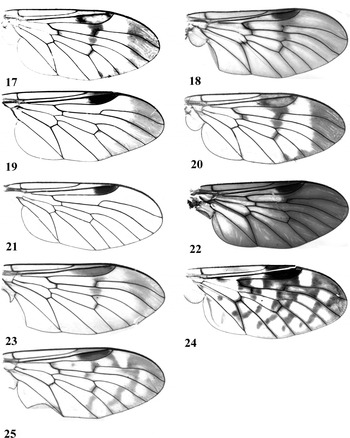
5. Wing (Fig. 18) pale smoky brown with veins and crossveins margined with darker brown………caliginosus sp. nov.
— Wing (Figs. 20, 24) hyaline with scattered brown pattern………6
6. Wing (Fig. 20) hyaline with brown apical band extending across apex of r2+3, r4, r5, m1, and m2, pterostigmal band extending from apex of sc to apical margin of dc, and a band across crossvein r-m; abdomen dark brown, dorsal setae on abdomen dark brown, appressed mixed with whitish gold setae on tergites 2–5………frankmcalpinei sp. nov.
— Wing (Fig. 24) pale opaque brown with scattered brown pattern; abdominal tergites 1–6 pale brown, dark brown on posterior half; setae whitish brown on tergite 1, whitish yellow anterolaterally on tergite 2 with dark-brown appressed setae; setae on tergites 3–6 whitish yellow, appressed anteriorly with dark-brown appressed setae posteriorly………shewelli sp. nov.
7. Setae on parafacial and clypeus absent; wing (Fig. 22) smoky dark brown with opaque areas in r1, br, bm and basal half of r2+3, dc, m3, and cup………mandjelia sp. nov.
— Setae present ventrally on parafacial, laterally on clypeus; wing (Figs. 17, 23, 25) hyaline with variable brown patterns………8
8. Wing (Fig. 17) hyaline with narrow brown margin at r-m, m-m, fork of R4+5, and apical margin of d; pterostigma brown; R4 slightly sinuous, nearly right-angled basally, ending apically posterior to apex of wing; r4 enclosing area posterior to apex of wing………bicoloratus sp. nov.
— Wing (Figs. 23, 25) more strongly patterned………9
9. Gena with setae whitish brown; wing (Fig. 23) with brown apical band extending across apex of r2+3, r4, and r5, a narrow pterostigmal band extending from pterostigma across middle of r2+3, fork of R4+5, middle of r5, and crossvein m2–m3, and a band across crossvein r-m………petersoni sp. nov.
— Gena with anterodorsal patch of dark-brown setae, becoming pale whitish yellow ventrally; wing (Fig. 25) apex of sc brown; pterostigma brown; r2+3 brown apically with three small brown areas basally; r4 brown apically, separate from medial brown area with fork of R4+5 possessing brown margin; r5 with apical, subapical, and basal brown area; m1 with apical and subapical brown area; m2 with apical brown area and m-m at base brown; m3 slightly brown apically with narrow medial brown band; d with subapical brown area and m-m with brown margin; br, bm, cup, cua1, a1, and a2 without brown markings………teskeyi sp. nov.
10. Male eyes separated by a distance equal to or greater than width of ocellar tubercle, medial margin rounded (Figs. 5, 9, 15)………11
— Male eyes separated by distance less than width of ocellar tubercle; inner margin angulate or rounded (Figs. 7, 10, 12, 16)………13
11. Scutum dull brown, pubescence gray………everti sp. nov.
— Scutum dull yellowish brown, glossy………12
12. Abdomen with tergites 1–3 yellow to yellowish brown, tergites 4–8 dark brown; short dark-brown appressed setae with whitish turquoise appressed setae anteriorly on tergites 1–7.………vockerothi sp. nov.
— Abdomen dark yellow, glossy; dorsal and lateral abdominal setae dark brown, appressed………melinus sp. nov.
13. Scutum dull brown, pubescence gray………14
— Scutum dark yellowish, glossy………15
14. Abdomen with tergites 1–4 dark yellow, glossy with dark reddish brown area posterolaterally, separated medially; tergite 5 dark yellow, glossy, dark reddish brown on posterior half; tergites 6–8 dark reddish brown………noumea sp. nov.
— Abdomen with tergite 1 dark yellow and posterior margin dark reddish brown; tergites 2–3 dark yellow with lateral posteromedial area, and posterior margins dark brown; tergite 4 dark yellow anteriorly with posterior two-thirds dark brown; tergites 5–8 dark brown. Dorsal setae predominantly black, appressed, with scattered yellow appressed setae on dark-yellow areas of tergites 1–4………sarramea sp. nov.
15. Parafacial setae black, short, sparse on ventral third; maxillary palpus dark yellowish brown with apex dark brown; pleura dark yellow, setae dark brown across dorsal margin of anepisternum………woodi sp. nov.
— Parafacial glabrous; maxillary palpus pale yellow; pleura reddish brown, setae dark yellow on dorsal margin of anepisternum………irwini sp. nov.
Females
(the females of C. caliginosus sp. nov., C. mandjelia sp. nov., C. melinus sp. nov., C. noumea sp. nov., C. sarramea sp. nov., C. everti sp. nov., and C. shewelli sp. nov. are unknown)
1. Wing (as in Fig. 21) completely hyaline………2
— Wing (as in Figs. 17–20, 23, 25) patterned………4
2. Eyes separated by a distance 3.5–4.2 times width of ocellar tubercle; maxillary palpus black, pruinescence gray, setae black; abdomen dark brown to black; dorsal setae short, whitish yellow, appressed, mixed with dark brown to black appressed setae on posterior third of tergite………plautifrons sp. nov.
— Eyes separated by a distance less than 2 times width of ocellar tubercle; maxillary palpus pale yellow; abdomen yellowish to pale brown………3
3. Setae on maxillary palpus black; coxae dark brown to black; femora brown to dark brown; abdomen with tergite 1 yellowish brown anteriorly, dark brown posteriorly, tergites 2–8 dark brown………brunneabdominalis sp. nov.
— Setae on maxillary palpus pale yellow; coxae dark yellow; femora dark yellow; abdomen dark brown, pruinescence, gray, dorsal setae on tergite 1 white, on tergites 2–6 whitish turquoise medially, appressed, with black appressed setae along posterior and lateral margins, tergites 7–8 with short black appressed setae………irwini sp. nov.
4. Wing (as in Fig. 19) hyaline with broad apical band………5
— Wing (as in Figs. 17, 18, 20, 23, 25) patterned………7
5. Parafacial setae black, short, sparse on ventral third; coxae dark brown………woodi sp. nov.
— Parafacial setae absent; coxae yellow………6
6. Abdomen dark brown, dorsal setae white gold on tergite 1, white gold, appressed across anterior margin of tergites 2–6 (occasionally separated medially), with short black appressed setae on remainder of tergites; lateral setae black, short………chazeaui sp. nov.
— Abdomen with tergites 1–3 yellow to yellowish brown, tergites 4–8 dark brown; short dark-brown appressed setae, with whitish turquoise appressed setae anteriorly on tergites 1–7………vockerothi sp. nov.
7. Wing (Figs. 17, 20, 23) hyaline, with narrow brown apical band and narrow brown margin at r-m, m-m, fork of R4+5, and apical margin of d………8
— Wing opaque with broad apical band (Fig. 18) or with mottled pattern (Fig. 25)………10
8. Parafacial and clypeal setae yellow to whitish brown………bicoloratus sp. nov.
— Parafacial and clypeal setae dark brown………9
9. Gena with anterodorsal patch of dark-brown setae, becoming pale whitish yellow ventrally; abdomen dark brown, dorsal setae dark brown, appressed, mixed with whitish gold setae on tergites 2–5………frankmcalpinei sp. nov.
— Gena setae pale whitish brown; abdomen black, pruinescence grayish turquoise, setae on tergite 1 white, elongate, appressed, with dark-brown appressed setae on posteromedial margin, setae on tergites 2–4 white, elongate, appressed along anterior and lateral margins, dark brown, appressed medially, setae dark brown, appressed on tergites 5–8………petersoni sp. nov.
10. Wing (Fig. 18) presumably opaque with pale apical band extending across apex of r2+3, r4, r5, smoky brown with veins and crossveins margined with dark brown………caliginosus sp. nov.
— Wing (Fig. 25) hyaline, apex of sc brown; pterostigma brown; r2+3 brown apically with three small brown areas basally; r4 brown apically, separated from medial brown area with fork of R4+5 possessing brown margin; r5 with apical, subapical, and basal brown area; m1 with apical and subapical brown area; m2 with apical brown area and m-m at base brown; m3 slightly brown apically with narrow medial brown band; d with subapical brown area and m-m with brown margin; br, bm, cup, cua1, a1, a2 without brown markings………teskeyi sp. nov.
Chrysopilus bicoloratus sp. nov.
Chrysopilus, male head, frontal view: 1, bicoloratus sp. nov.; 2, brunneabdominalis sp. nov.; 3, caliginosus sp. nov.; 4, chazeaui sp. nov.; 5, everti sp. nov.; 6, frankmcalpinei sp. nov.; 7, irwini sp. nov.; 8, mandjelia sp. nov.; 9, melinus sp. nov.; 10, noumea sp. nov.; 11, petersoni sp. nov.; 12, sarramea sp. nov.; 13, shewelli sp. nov.; 14, teskeyi sp. nov.; 15, vockerothi sp. nov.; 16, woodi sp. nov.

Etymology
bi (Latin) =two; color (Latin)=hue, tint; atus (Latin)=pertaining to. This species name refers to the bicoloured setal pattern on the abdomen.
Diagnosis
Chrysopilus bicoloratus sp. nov. is part of the chazeaui species group and shares with C. calignosus sp. nov., C. frankmcalpinei sp. nov., C. petersoni sp. nov., C. shewelli sp. nov., and C. teskeyi sp. nov. the coxae being brown to black with dark yellowish brown to black setae. It shares with C. mandjelia sp. nov., C. petersoni sp. nov., and C. teskeyi sp. nov. the femora being brown. It shares with C. petersoni sp. nov. and C.teskeyi sp. nov. the presence of setae ventrally on the parafacial and laterally on the clypeus, and the wing membrane hyaline with a variable brown pattern (Fig. 17). It differs from C. petersoni sp. nov. and C. teskeyi sp. nov. in having the wing membrane (Fig. 17) hyaline with a narrow brown margin at r-m, m-m, fork of R4+5, and apical margin of d.
Description
Male. Body length 5.0–5.3, 5.2mm (n=3).
Head. Ocellar tubercle dark brown to black, pruinescence gray; distinctly raised above level of vertex; setae black, moderately long. Eyes holoptic; ommatidia slightly smaller ventrally with discrete line of demarcation; medial margin (Fig. 1) angulated, diverging ventrally, without distinct hemispherical emargination dorsolateral to antennal base. Frons dark brown, pruinescence brownish gray; glabrous. Antenna dark brown to black, pruinescence gray. Parafacial pruinescence gray; setae whitish brown, elongate ventrally. Clypeus dark brown, pruinescence gray; setae whitish brown to yellow, elongate, abundant. Genal setae whitish yellow. Maxillary palpus dark brown to black, pruinescence gray; setae black, whitish brown apically. Occipital setae whitish yellow, elongate ventrally, becoming dark brown, short dorsally.
Thorax. Scutum dark brown, pruinescence gray, vittae absent; setae short dark-brown suberect, mixed with whitish yellow to yellow appressed setae. Notopleural setae whitish yellow to yellow, with dark-brown elongate setae posterolaterally. Postpronotal lobe concolorous with scutum; setae whitish yellow to yellow, with dark-brown setae posteriorly. Pleura dark brown, pruinescence gray; setae pale yellow on propleuron and anterior margin of anepimeron, katepisternum, and meron, dark brown across dorsal margin of anepisternum, white to whitish yellow on laterotergite. Scutellum dull brown; setae whitish yellow to yellow, appressed, with dark-brown elongate setae across posterior margin. Wing (Fig. 17). Length 5.0–5.3, 5.2mm. Membrane hyaline, with faint apical band and narrow brown margin at r-m, m-m, fork of R4+5, and apical margin of d; pterostigma brown. R4 with basal angle almost 90°, vein slightly sinuous, ending posterior to wing apex. Cell r4 enclosing area posterior to apex of wing. Halter stalk brown, knob dark brown. Legs. Coxae dark brown to black, pruinescence gray; setae white. Femora brown to dark brown; setae white, appressed. Tibiae and tarsi brown.
Abdomen. Dark brown, pruinescence gray; dorsal setae white to whitish yellow, appressed on tergites 1–7 with dark-brown appressed setae across posterior margin of tergites 2–5. Terminalia. All tergites dark brown. Gonostylus (Fig. 26) broadly expanded posterolaterally; setae brown, elongate; apex broadly pointed. Ejaculatory apodeme in dorsal view (Fig. 26) dark brown, thick, sinuate; in lateral view (Fig. 42) thick, constricted subapically. Lateral ejaculatory sclerite (Fig. 26) heavily sclerotized.
Female. Similar to male except for the following: body length 6.2–7.3, 6.7mm (n=5).
Head. Vertex not emarginated lateral to ocellar tubercle. Frons dark brown, pruinescence brownish gray. pruinescence gray dorsal to antennal base; setae short, dark brown to black, scattered over medial half of frons and lateral to ocellar tubercle, glabrous dorsal to antennal base.
Thorax.Wing. Length 5.2–6.3, 5.8mm.
Abdomen. All tergites dark brown, pruinescence gray; dorsal setae yellow, appressed on tergites 1–4, with dark-brown appressed setae across posterior margin of tergites 2–4.
Specimens examined
Holotype male: labeled “NEW CALEDONIA, Riviere Bleue Prov. Pk., 28km NW Yaté, 23–27 December 1991, M. E. Irwin, D. W. Webb” (MNHN). Paratypes: New Caledonia. Province Sud: Mt. Khogis, 17km NNE Nouméa [−22.1761, 166.5047], 500m, 23.xii.1991, M.E. Irwin, D.W. Webb, 1♂, (INHS); 24–26.xii.1991, M.E. Irwin, D.W. Webb, 1♂, 2♀ (INHS), Malaise trap across forest stream; 15–20.xii.1992, D.W. Webb, 1♀ (INHS), Malaise trap in tropical rain forest; 425m, 24–28.i.1996, M.E. Irwin, D.W. Webb, E.I. Schlinger, 2♀ (INHS), Malaise trap across path in rain forest; Rivière Bleue, 30km NW Yaté, 11–27.xi.1988, L.B. deLarbogne, J. Chazeau, A. and S. Tillier, 1♀ (MNHN).
Chrysopilus brunneabdominalis sp. nov.
Chrysopilus, wing: 17, bicoloratus sp. nov.; 18, caliginosus sp. nov.; 19, chazeaui sp. nov.; 20, frankmcalpinei sp. nov.; 21, irwini sp. nov.; 22, mandjelia sp. nov.; 23, petersoni sp. nov.; 24, shewelli sp. nov.; 25, teskeyi sp. nov.

Etymology
brunneus (Medieval Latin)=brown; abdomen (Latin)=abdomen; alis (Latin)=pertaining to. This species name refers to the brown coloration of the male and female abdomens.
Diagnosis
Chrysopilus brunneabdominalis sp. nov. is similar in appearance to C. imitator Paramonov from New South Wales in Australia, but differs in the coloration of the parafacial setae and abdominal setae. In New Caledonia, it falls within the chazeaui species group and shares with C. chazeaui sp. nov. the coxae being yellow with yellow setae. It differs from C. chazeaui sp. nov. in having the wings hyaline (as in Fig. 21); the mesonotal pruinescence dull yellowish brown; the parafacial setae brown ventrally; and the maxillary palpus pale yellow.
Description
Male. Body length 4.3–7.3, 5.4mm (n=5).
Head. Ocellar tubercle dark yellow; distinctly raised above level of vertex; setae short, black. Eyes holoptic; ommatidia smaller ventrally with faint line of demarcation; medial margin (Fig. 2) angulated with distinct hemispherical emargination dorsolateral to antennal base. Frons dark brown, pruinescence brownish gray; glabrous. Antenna brown, pruinescence dark yellowish brown. Parafacial pruinescence gray; setae brown ventrally. Clypeus pruinescence yellowish brown; glabrous. Genal setae pale yellowish brown. Maxillary palpus pale yellow; setae black. Occipital setae yellowish brown, elongate ventrally, becoming short and lateral dorsally.
Thorax. Scutum pruinescence dull yellowish brown; setae short, black, erect, mixed with pale-gold appressed setae. Notopleural setae yellowish gold, becoming elongate laterally. Postpronotal lobe concolorous with scutum; setae dark yellow. Pleura yellow, pruinescence white; setae yellow on propleuron, dorsal margin of anepisternum, katepisternum, meron, and laterotergite. Scutellum dull brown; setae yellow, appressed with brown elongate setae across dorsal margin. Wing (as in Fig. 21). Length 4.5–5.3, 5.0mm. Membrane hyaline; pterostigma brown. Veins brown. R4 with basal angle almost right-angled, apical half of vein sinuate, ending posterior to apex of wing. Cell r4 enclosing area posterior to apex of wing. Halter pale brown. Legs. Coxae yellow; setae yellow. Femora yellow; setae yellow with dark-brown appressed setae on dorsal surface. Tibiae yellowish brown. Tarsi yellowish brown.
Abdomen. Tergite 1 brown anteriorly, posterior half dark brown; tergites 2–8 brown, dark brown laterally and dorsally; dorsal setae short, yellow, appressed, mixed with dark-brown suberect, moderately long setae (overall setal pattern not evident because most setae rubbed off). Terminalia. Brown. Gonostylus (Fig. 27) moderately expanded posterolaterally; setae brown, moderately long; apex almost truncate. Ejaculatory apodeme in dorsal view (Fig. 27) pale yellow, apical half expanded; in lateral view (Fig. 43) narrow, slightly sinuate. Lateral ejaculatory sclerite (Fig. 27) heavily sclerotized, becoming membranous apically.
Female. Similar to male except for the following: Variation (n=2). Body length 6.2–6.3mm.
Head. Vertex slightly emarginated lateral to ocellar tubercle. Frons pruinescence dull brown, brownish gray dorsal to antennal bases; setae dark brown, short dorsolateral to antennal base.
Thorax.Wing. Length 5.3–5.7mm.
Abdomen. Tergite 1 yellowish brown anteriorly, dark brown posteriorly; tergites 2–3 dark yellowish brown, dark brown laterally and posteriorly; tergites 3–8 dark brown.
Specimens examined
Holotype male: labeled “NEW CALEDONIA 11760, 22 147′′S,x16653′′E, 250m, Pic de Grand Kaori, site 1, 22–23Nov2004, rainforest, Burwell, Wright, yellow pan” (MNHN). Paratypes: New Caledonia. Province Nord: Mt. Mandjélia, 5km WSW Puébo [−20.397, 164.528], 780m, 2–3.xi.2000, D.W. Webb, E.I. Schlinger, 4♂, 1♀ (INHS), Malaise trap; 13–17.xi.2000, E.I. Schlinger, M.E. Irwin, 2♂, 1♀ (INHS); Mt. Mandjélia, 6 km WSW Puébo [−20.4025, 164.515], 545m, 2–3.xi.2000, Malaise trap, M.E. Irwin, D.W. Webb, 1♀ (INHS).
Chrysopilus caliginosus sp. nov.
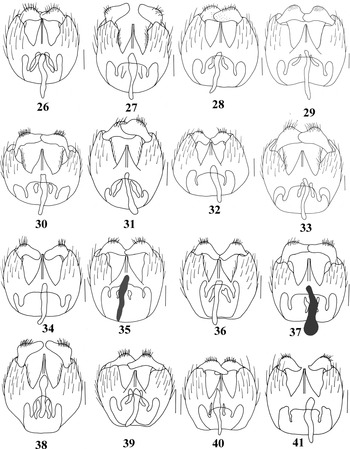
Chrysopilus, male genitalia, dorsal view: 26, bicoloratus sp. nov.; 27, brunneabdominalis sp. nov.; 28, caliginosus sp. nov.; 29, chazeaui sp. nov.; 30, everti sp. nov.; 31, frankmcalpinei sp. nov.; 32, irwini sp. nov.; 33, mandjelia sp. nov.; 34, melinus sp. nov.; 35, noumea sp. nov.; 36, petersoni sp. nov.; 37, sarramea sp. nov.; 38, shewelli sp. nov.; 39, teskeyi sp. nov.; 40, vockerothi sp. nov.; 41, woodi sp. nov. Scale bars=0.1mm.

Etymology
caligo (Latin)=fog, mist, vapour; osus (Latin) nature or quality of. This species name refers to the smoky brown colour of the wings.
Diagnosis
Chrysopilus caliginosus sp. nov. is part of the chazeaui species group and shares with C. bicoloratus sp. nov., C. frankmcalpinei sp. nov., C. petersoni sp. nov., C. shewelli sp. nov., and C. teskeyi sp. nov. the coxae being brown to black with dark yellowish brown to black setae. It shares with C. frankmcalpinei sp. nov. and C. shewelli sp. nov. the femora being yellow. It differs from C. frankmcalpinei sp. nov. and C. shewelli sp. nov. in having the wing pale smoky brown with veins and crossveins margined with darker brown (Fig. 18).
Description
Male. Body length 6.7mm (n=1).
Head. Ocellar tubercle dark brown, pruinescence brownish gray; not raised above level of vertex; setae black, short. Eyes holoptic; ommatidia smaller ventrally, with distinct line of demarcation; medial margin (Fig. 3) sinuate, diverging ventrally, without distinct hemispherical emargination dorsolateral to antennal base. Frons dark brown, pruinescence brown, gray ventrally; glabrous. Antenna brown. Parafacial pruinescence gray; setae brown ventrally. Clypeus pale brown; setae dark brown, scattered. Genal setae dark brown. Maxillary palpus dark yellowish brown; setae black. Occipital setae dark brown, becoming short dorsally.
Thorax. Scutum pruinescence dull yellowish brown, dark brown posteromedially; setae short, black, erect, mixed with white appressed setae. Notopleural setae yellowish brown, becoming elongate laterally. Postpronotal lobe concolorous with scutum; setae dark brown, elongate. Pleura dark brown, pruinescence dull brown; setae dark brown on anterior and dorsal margins of anepisternum, and ventral fourth of katepisternum; dark yellow on propleuron and meron; yellow on laterotergite. Scutellum dull brown; setae yellowish gold, appressed, with brown elongate setae across posterior margin. Wing (Fig. 18). Length 6.0mm. Membrane with pale apical band extending across apex of r2+3, r4, r5, smoky brown with veins and crossveins margined with dark brown; pterostigma brown. Veins dark brown. Cell r4 enclosing apex of wing. R4 with basal angle almost right-angled, vein broadly curved, ending slightly anterior to apex of wing. Halter yellow, some brown on knob. Legs. Coxae brown; setae dark yellowish brown. Femora yellow; setae pale yellow, erect, appressed on dorsal surface. Tibiae dark yellowish brown. Tarsi brown.
Abdomen. Brown, pruinescence dull brown; setae rubbed off abdomen. Terminalia. Brown. Gonostylus (Fig. 28) moderately expanded posterolaterally; setae brown, moderately long with scattered short setae; apex broadly pointed. Ejaculatory apodeme in dorsal view (Fig. 28) pale yellow, sinuate; in lateral view (Fig. 44) expanded basally, sinuate. Lateral ejaculatory sclerite (Fig. 28) heavily sclerotized.
Female. Unknown. When the female is collected it will presumably have a distinctive wing pattern similar to that of the male.
Specimens examined
Holotype male: labeled “New Caledonia, Prov. Nord, 20767S, 164.452E., 13.5km S. Kaala-Gormén, 150m, 26-XI-7-XII-2000, M. E. Irwin” (MNHN).
Chrysopilus chazeaui sp. nov.
Etymology
This species is named for Jean Chazeau, ORSTOM, Centre de Nouméa, New Caledonia, for all his assistance and advice in our collecting endeavours in New Caledonia.
Diagnosis
Chrysopilus chazeaui sp. nov. is similar in appearance to C. bifasciatus Paramonov from Queensland, Australia, but differs in the wing pattern and setal pattern on the abdomen. In New Caledonia it falls within the chazeaui species group and shares with C. brunneabdomalis sp. nov. the coxae being yellow with yellow setae. It differs from C. brunneabdominalis sp. nov. in having the wings pale brown with a broad dark-brown apical band (Fig. 19); the scutum is dull brownish black with brownish turquoise pruinescence; the parafacial setae are absent; and the maxillary palpus is pale brown, becoming dark apically.
Description
Male. Body length 8.0–9.4, 8.8mm (n=5).
Head. Ocellar tubercle dark brown, pruinescence brownish gray; not raised above level of vertex; setae short, black, sparse. Eyes holoptic; medial margin angular (Fig. 4), broadly diverging ventrally, without distinct hemispherical emargination dorsolateral to antennal base. Frons dark brown, pruinescence brown, darker laterally, with medial dorsoventral groove; glabrous. Antenna brown with yellowish brown pruinescence, flagellum often paler. Parafacial pruinescence gray; glabrous. Clypeus gray; glabrous. Genal setae pale whitish yellow. Maxillary palpus pale brown, becoming darker apically; setae dark brown. Occipital setae pale yellow ventrally, becoming dark brown dorsally.
Thorax. Scutum black, pruinescence brownish gray, becoming gray laterally; setae short, dark brown, erect, mixed with dark yellowish gold appressed setae. Notopleural setae short, brown, mixed with short gold appressed setae and dark-brown elongate setae along lateral margin. Postpronotal lobe pale brown; glabrous (occasionally a few short black setae). Pleura pale brown, pruinescence gray; setae yellow on propleuron, pale yellow along anterior margin of anepisternum and dark brown across dorsal margin, pale yellowish brown on katepisternum, yellow on meron, and dark yellow to gold on laterotergite (often with black posteromedial setae). Scutellum dark brown, subshiny; dorsal setae short, black, mixed with short gold appressed setae, posterior margin with dark-brown elongate setae. Wing (Fig. 19). Length 7.2–8.8, 7.9mm. Membrane pale brown with apex of sc dark brown, apical band broad, dark brown, veins dark brown; r4 enclosing area posterior to apex of wing. R4 with apical half slightly sinuate, reaching costa at apex of wing. Halter stalk dark yellow, knob dark brown. Legs. Coxae dark yellow, pruinescence gray; setae yellow, elongate, mixed with dark-brown setae. Femora dark yellow to yellowish brown; setae short, dark yellow mixed with dark-brown setae, dorsal half of femora with dark-yellow to dark-brown appressed, lanceolate setae; apical half of mid and hind femora dark brown. Tibiae pale brown. Tarsi pale brown.
Abdomen. All tergites dark brown, dull, pruinescence brownish gray laterally on tergites 2–6; dorsal setae gold to golden turquoise on tergite 1, gold to golden turquoise, appressed across anterior margin of tergites 2–6, with short black appressed setae on remainder of tergites; lateral setae dark. Terminalia. Dark brown. Gonostylus (Fig. 29) expanded posterolaterally, apex rounded; setae short, dark brown. Ejaculatory apodeme in dorsal view (Fig. 29) elongate, sinuate; in lateral view (Fig. 45) sinuate, apical fourth narrowed. Lateral ejaculatory sclerite (Fig. 29) heavily sclerotized.
Female. Similar to male except for the following: body length 8.6–10.4, 9.8mm (n=5).
Head. Vertex emarginated lateral to ocellar tubercle. Frons brown, pruinescence brownish gray; setae short, dark brown to black, sparse.
Thorax.Wing. Length 7.5–9.8, 8.5mm.
Abdomen. Dark brown; dorsal setae white gold on tergite 1, white gold, appressed across anterior margin of tergites 2–6 (occasionally separated medially), with short black appressed setae on remainder of tergites; lateral setae short, black.
Specimens examined
Holotype male: labeled “NEW CALEDONIA, Mt. Khogis, 500m, 17km NNE Nouméa, 1 Nov 1992, DWWebb” (MNHN). Paratypes: New Caledonia. Province Sud: Forêt INF, Mt. Mou, Bord Ruiss, 250m, 6.xii.1983. L. Matile, 1♂, (MNHN); Mt. Khogis, 17km NNE Nouméa, 500m, 24–26.xii.1992, M.E. Irwin, D.W. Webb, 1♀ (INHS); 350m, 26.xii.1991, M.E. Irwin, D.W. Webb, 1♀ (INHS); 500m, 1.xi.1992, D.W. Webb, 34♂, (INHS); 500m, 3–4.xi.1992, M.E. Irwin, D.W. Webb, 1♂, (INHS); 500m, 3–5.xi.1992, D.W. Webb, 4♂, 1♀ (INHS); 500m, 5–15.xi.1992, D.W. Webb, 3♂, 2♀ (INHS); 500m, 15.xi.1992, D.W. Webb, 40♂, 1♀ (INHS); 500m, 15–20.xi.1992, D.W. Webb, 3♂, 2♀ (INHS); 500m, 20.xi.1992, D.W. Webb, 13♂, (INHS); 500m, 21–29.xi.1992, D.W. Webb, 2♂, 1♀ (INHS); 500m, 29.xi.1992, D.W. Webb, 12♂, 1♀ (INHS); 500m, 3–5.xii.1992, D.W. Webb, 14♂, 4♀ (INHS); [−22.1761, 166.5047], 425m, 25.i.1996, M.E. Irwin, D.W. Webb, E.I. Schlinger, 2♂, (INHS), Malaise trap across path in rain forest; 27–28.i.1996, M.E. Irwin, D.W. Webb, E.I. Schlinger, 1♀ (INHS), Malaise trap across path in rain forest; 29.i.1996, M.E. Irwin, D.W. Webb, E.I. Schlinger, 3♂, 2♀ (INHS), Malaise trap across path in rain forest; Sarraméa, 125m, 14.xi.1992, D.W. Webb, 2♂, (INHS); Sarraméa, 125m, 15.xi.1992, D.W. Webb, 5♂, 3♀ (INHS); 6km NW Sarraméa, 360m, 13–14.xi.1992, D.W. Webb, 1♀ (INHS) Malaise trap across stream in Reserve Ornithologique Territoriale; 8.3km NW Sarraméa, 244m, 13.xi.1992, D.W. Webb, 2♂, (INHS); 7.5km NW Sarraméa, 355m, 17.xi.1998, E.I. Schlinger, M. Schlinger, 2♂, (INHS); 7.5km NW Sarraméa, 311m, 20.xi.1998, E.I. Schlinger, M. Schlinger, 8♂, 2♀ (INHS); 7.5km NW Sarraméa, 303m, 4.xi.2000, D.W. Webb, 4♂, 1♀ (INHS); 6 km NW Sarraméa, Reserve Ornithologique Territoriale, 360m, 14–23.xi.1992, D.W. Webb, 3♀ (INHS); 6km NW Sarraméa, Reserve Ornithologique Territoriale, 360m, 13.xi.1992, D.W. Webb, 3♂, (INHS); 14.xi.1992, D.W. Webb, 5♂, (INHS); Col d'Amieu, Reserve Ornithologique Territoriale, 23.xi.1992, E.I. Schlinger, M. Schlinger, 4♂, (INHS); Reserve Ornithologique Territoriale, N Col d'Amieu, 305m, 13.xi.1992, E.I. Schlinger, M. Schlinger, 19♂, (INHS); Mt. Do, 13.5km NNW Bouloupari [−21.6794, 166.0078], 955m, 25–29.i.1996, M.E. Irwin, D.W. Webb, 2♂, (INHS), Malaise trap across hillside road; Rivière Bleue Provincial Park, trail to upper Rivière Bleue, 290m, 19–28.xi.1992, D.W. Webb, 1♀ (INHS); Rivière Bleue Provincial Park, trail to Vallée de Pourina, 400m, 19.xi.1992, D.W. Webb, 1♂, (INHS). Province Nord: 5km SSW Kouaoua, 14.x.1992, D.W. Webb, 1♂, (INHS); 18km WSW Canala, 14.xi.1992, D.W. Webb, 1♀ (INHS); 4km SW Canala, 14.xi.1992, D.W. Webb, 1♀ (INHS); 14km SW Canala, 14.xi.1992, D.W. Webb, 3♂, 2♀ (INHS).
Chrysopilus everti sp. nov.
Etymology
This species is named for Dr. Evert I. Schlinger for his extensive support and efforts in collecting New Caledonian Diptera.
Diagnosis
Chrysopilus everti sp. nov. is similar in appearance to C. androgynus Paramonov from New South Wales, Australia, but differs in the coloration of the frons; the coloration of the maxillary palpus and palpal setae; the length of the fore femora in relation to the fore tarsi; and the setal pattern on the abdomen. In New Caledonia it is part of the sarramea species group and shares with C. vockerothi sp. nov. and C. melinus sp. nov. the male eyes being separated by a distance equal to or greater than the width of the ocellar tubercle and the medial margin being rounded (Fig. 5). It is separated from C. vockerothi sp. nov. and C. melinus sp. nov. by having the scutum dull brown with gray pubescence.
Description
Male. Body length 5.0–6.3, 5.6mm (n=5).
Head. Ocellar tubercle pruinescence pale brown; not raised above level of occiput; setae black, short. Eyes dichoptic, separated by distance 1.3–1.4, 1.4 times width of ocellar tubercle; medial margin rounded (Fig. 5), slightly diverging ventrally, without distinct hemispherical emargination dorsolateral to antennal base; ommatidia equal in size. Frons pruinescence brownish gray; setae short, black, scattered on medial third. Antenna brown, pruinescence gray. Parafacial pruinescence gray; glabrous. Clypeus pale brown; glabrous. Maxillary palpus pale yellow; setae pale yellow. Genal setae pale yellow. Occipital setae pale yellow ventrally, grading dorsally into short dark-brown setae.
Thorax. Scutum pubescence gray, vittae dull brown; setae short, black, appressed, mixed with short whitish turquoise appressed setae. Notopleural setae short, whitish turquoise, appressed, with black elongate setae laterally. Postpronotal lobe yellowish brown; setae dark yellow, short. Pleura reddish brown, pubescence gray; setae yellow on propleuron, along dorsal margin of anepisternum, on meron, and in anterior and posterodorsal patch on laterotergite, with dark-yellow setae on posteroventral patch on laterotergite. Scutellum dark brown, pubescence gray; dorsal setae whitish turquoise, appressed. Wing (as in Fig. 21). Length 5.0–5.7, 5.3mm. Membrane hyaline; pterostigma dark brown; r4 encloses area of wing posterior to apex; basal angle of R4 obtuse, vein ends at wing apex. Halter stalk pale yellow, knob dark brown. Legs. Coxae dark yellow; setae yellow. Femora dark yellow; setae yellow with short dark-brown appressed setae on dorsal surface. Tibiae dark brown. Tarsi dark brown.
Abdomen. Dark brown, pruinescence, gray; dorsal setae on tergite 1 white, on tergites 2–7 whitish turquoise medially, appressed with black appressed setae along posterior and lateral margins. Terminalia. Gonostylus (Fig. 30) posterolateral margin moderately expanded; setae brown, moderately long; apex broadly pointed. Ejaculatory apodeme in dorsal view (Fig. 30) dark brown, sinuate, narrowed basally, apex truncate; in lateral view (Fig. 46) narrow, sinuate. Lateral ejaculatory sclerite (Fig. 30) heavily sclerotized.
Female. Unknown.
Specimens examined
Holotype male: labeled “NEW CALEDONIA, Mt. Khoghis [Khogis], 500m, 17km NNE Nouméa, 23–26 Dec. 1991, M.E. Irwin, D.W. Webb, Malaise trap across forest stream” (MNHN). Paratypes: same locality as holotype, 4♂, (ANIC, BPBM, INHS).
Chrysopilus frankmcalpinei sp. nov.
Etymology
This species is named in honour of Dr. J. Frank McAlpine, Agriculture and Agri-Food Canada, for his extensive work and contribution to the Manual of Nearctic Diptera.
Diagnosis
Chrysopilus frankmcalpinei sp. nov. is part of the chazeaui species group and shares with C. bicoloratus sp. nov., C. caliginosus sp. nov., C. mandjelia sp. nov., C. petersoni sp. nov., C. shewelli sp. nov., and C. teskeyi sp. nov. the coxae being brown to black with dark yellowish brown to black setae. It shares with C. calignosus sp. nov. and C. shewelli sp. nov. the femora being yellow. It differs from C. caliginosus sp. nov. and C. shewelli sp. nov. in having the wing membranes hyaline (Fig. 20) with a brown apical band extending across the apex of r2+3, r4, r5, m1, and m2; the pterostigmal band extending from the apex of cell sc to the apical margin of dc, and a band across crossvein r-m; and the dorsal abdominal setae dark brown, appressed, mixed with whitish gold setae on tergites 2–5.
Description
Male. Body length 5.2mm (n=1).
Head. Ocellar tubercle dark brown, pruinescence brownish gray; distinctly raised above level of vertex; setae black, short. Eyes holoptic; ommatidia smaller ventrally with distinct line of demarcation; medial margin (Fig. 6) diverging ventrally, with distinctive emargination dorsolateral to antennal base. Frons dark brown, pruinescence brown; glabrous. Antenna with scape and pedicel pale brown, flagellum and arista dark brown. Parafacial pruinescence grayish turquoise; setae dark brown to black on ventral half along medial margin. Clypeus dark brown, paler medially; setae dark brown laterally. Gena with anterodorsal patch of dark-brown setae, becoming pale whitish yellow ventrally. Maxillary palpus pale brown, cylindrical, thick; setae dark brown. Occipital setae pale yellow ventrally, becoming dark brown, short dorsally.
Thorax. Scutum dull brown, pruinescence brownish turquoise; setae rubbed off (see description of female). Notopleural setae rubbed off (see description of female). Postpronotal lobe pale brown; setae rubbed off (see description of female). Pleura dark brown, pruinescence gray; setae yellow, elongate on meron, rubbed off on remainder of pleuron (see description of female). Scutellum dark brown, subshiny; setae short, black, appressed, mixed with short gold appressed setae; posterior setae brown, elongate. Wing (Fig. 20). Length 5.1mm. Membrane hyaline with a brown apical band extending across apex of r2+3, r4, r5, m1, m2, a pterostigmal band extending from apex of sc to apical margin of dc, and a band across r-m; pterostigma brown. Veins dark brown. Cell r4 enclosing area posterior to apex of wing. R4 with basal angle almost right-angled, apical half of vein slightly sinuate, ending at wing apex. Halter stalk dark yellow, knob dark brown. Legs. Coxae dark brown; setae dark brown. Femora yellow; setae yellow, appressed on dorsal surface and mixed with dark-brown appressed setae. Tibiae pale. Tarsi pale yellowish brown.
Abdomen. All tergites dark brown, setae rubbed off. Terminalia. Dark brown. Gonostylus (Fig. 31) short, broadly expanded posterolaterally; setae brown, moderately long; apex pointed, recurved. Ejaculatory apodeme in dorsal view (Fig. 31) dark brown, narrow, slightly expanded basally; in lateral view (Fig. 47) narrow, sinuate, expanded basally. Lateral ejaculatory sclerite (Fig. 31) heavily sclerotized.
Female. Similar to male except for the following: body length 5.5–6.3, 5.9mm (n=5).
Head. Vertex slightly emarginated lateral to ocellar tubercle. Frons dark brown, pruinescence brownish gray ventrally; setae short, dark brown to black, sparse. Clypeus with yellowish brown setae laterally.
Thorax. Scutum with a mixture of short dark-brown and pale yellowish gold setae with dark-brown elongate setae posterolaterally. Notopleural setae dark brown and whitish gold, becoming more elongate, dark brown laterally. Setae yellow on propleuron, anterior margin of anepisternum, and meron, dark brown across dorsal margin of anepisternum, yellowish brown on laterotergite. Scutellar setae short, pale yellowish gold, appressed; posterior setae brown, elongate. Wing. Length 5.2–6.8, 5.9mm. Legs. Tibiae and tarsi pale yellowish brown.
Abdomen. All tergites dark brown; dorsal setae dark brown, appressed, mixed with whitish gold setae on tergites 2–5.
Specimens examined
Holotype male: labeled “New Caledonia, Province Nord, 20.397 S, 164.528 E, Mt. Mandjélia, 5km WSW Puébo, 780m, 2-13-XI-2000, D. W. Webb, E. I. Schlinger, Malaise trap” (MNHN). Paratypes: New Caledonia. Province Nord: Mt. Mandjélia, 5km WSW Puébo [−20.397, 164.528], 780m, 2–13.xi.2000. D.W. Webb, E.I. Schlinger, 1♀. (INHS), Malaise trap; Réserve spéciale de faune de l'Aoupinié [−21.178S, 165.303], 13–30.xi.2000, M.E. Irwin, 4♀ (INHS), Malaise trap; Réserve spéciale de faune de l'Aoupinié [−21.174, 165.312], 30.xi–9.xii.2000, M.E. Irwin, 1♀ (INHS), Malaise trap. Province Sud: West side of Mt. Mou, 7.5km NW Paita, 22.xii.1991, M.E. Irwin, 1♀ (INHS).
Chrysopilus irwini sp. nov.
Etymology
This species is a patronym for Dr. M.E. Irwin in recognition of his years of devotion to the collecting of Diptera.
Diagnosis
Chrysopilus irwini sp. nov. is part of the sarramea species group and shares with C. noumea sp. nov. and C. sarramea sp. nov. the male eyes being separated by a distance less than the width of the ocellar tubercle and the inner margin being angulate (Fig. 7). It is separated from C. noumea sp. nov. and C. sarramea sp. nov. in having the scutum dull brown with gray pubescence.
Description
Male. Body length 5.8–6.8, 6.4mm (n=5).
Head. Ocellar tubercle pruinescence pale brown; not raised above level of occiput; setae short, black. Eyes dichoptic, separated by a distance 0.53–0.78, 0.63 times width of ocellar tubercle; medial margin sinuate (Fig. 7), not diverging ventrally, without distinct hemispherical emargination dorsolateral to antennal base. Frons pruinescence brownish gray; setae black, short on medial third. Antenna brown, pruinescence gray. Parafacial pruinescence gray; glabrous. Clypeus pale brown; glabrous. Maxillary palpus pale yellow; setae pale yellow. Genal setae pale yellow. Occipital setae yellow ventrally, grading dorsally into short dark-brown setae.
Thorax. Scutum pubescence gray, vittae dull brown; setae short, black, appressed, mixed with short whitish turquoise appressed setae. Notopleural setae whitish gold, appressed, with black elongate setae laterally. Postpronotal lobe dull brown, concolorous with scutum; setae short, dark yellow. Pleura reddish brown, pubescence gray; setae dark yellow on propleuron, dorsal margin of anepisternum, meron, and laterotergite. Scutellum dark brown, pubescence gray; dorsal setae whitish turquoise, appressed, posterior setae brown, elongate. Wing (Fig. 21). Length 5.2–6.2, 5.8mm. Membrane hyaline; pterostigma dark brown; r4 encloses area of wing posterior to apex; basal angle of R4 rounded; R4 slightly sinuate, ending at apex of wing. Halter stalk pale yellow, knob dark brown. Legs. Coxae dark yellow; setae yellow. Femora dark yellow; setae yellow with short dark-brown appressed setae on dorsal surface. Tibiae dark brown. Tarsi dark brown.
Abdomen. All tergites dark brown, pruinescence gray; dorsal setae on tergite 1 white, on tergites 2–6 whitish turquoise medially, appressed with black appressed setae along posterior and lateral margins, tergites 7–8 with short appressed black setae. Terminalia. Dark brown. Gonostylus (Fig. 32) moderately expanded posterolaterally, apex with small blunt point; setae dark brown, moderately long. Ejaculatory apodeme in dorsal view (Fig. 32) thick, sinuate; in lateral view (Fig. 48) pale, sinuate, constricted medially. Lateral ejaculatory sclerite absent.
Female. Similar to male except for the following: body length 6.2–7.8, 7.3mm (n=5).
Head. Vertex slightly emarginated lateral to ocellar tubercle. Frons pruinescence dull dark brown; setae short, dark brown, sparse ventrolateral to ocellar tubercle.
Thorax.Wing. Length 6.5–7.8, 7.1mm.
Specimens examined
Holotype male: labeled “New Caledonia, Prov. Sud, Mt. Khogis, 17km NW Nouméa, Malaise trap across path in rainforest, el. 425m, 27/28 January 1996, MEIrwin, DWWebb, EISchlinger, 22° 10′ 34′′ S. 166° 00′ 28′′ E” (MNHN). Paratypes: Province Sud: Mt. Khogis, 17km NW Nouméa [−22.1761, 166.00], 500m, 23–26.xii.1991, M.E. Irwin, D.W. Webb, 1♂, (INHS); Mt. Khogis, 17km NW Nouméa [−22.1761, 166.00], 425m, 25–26.i.1996, M.E. Irwin, D.W. Webb, E.I. Schlinger, 1♂, (INHS); Mt. Khogis, 17km NW Nouméa [−22.1761, 166.00], 425m, 24–28.i.1996, M.E. Irwin, D.W. Webb, E.I. Schlinger, 1♂, (INHS); Mt. Khogis, 17km NW Nouméa [−22.1761, 166.00], 425m, 10.i.1996, M.E. Irwin, D.W. Webb, E.I. Schlinger, 1♂, (INHS); Mt. Khogis, 17km NW Nouméa [−22.1761, 166.00], 425m, 27–28.i.1996, M.E. Irwin, D.W. Webb, E.I. Schlinger, 2 5♂, (ANIC, BPBM, INHS); 9km NW Sarraméa [−21.583,165.817], 305m, 14.I.1996, M.E. Irwin, D.W. Webb, E.I. Schlinger, 1♂, (INHS); 9km NW Sarraméa [−21.583,165.817], 305m, 21.i.1996, M.E. Irwin, D.W. Webb, E.I. Schlinger, 1♀ (INHS); 9km NW Sarraméa [−21.583,165.817], 305m, 25–27.i.1996, M.E. Irwin, D.W. Webb, E.I. Schlinger, 1♀ (INHS); Sarraméa, along path to plateau Dogny,25.xii.1991, D.W. Webb, 1♂, (INHS); Sarraméa [−21.641, 165.846],24.xiiI.1991, M.E. Irwin, 1♂, (INHS); Rivière Bleue, 30 km NW Yate [−22.977, 166.736], 29.ix.–13.X.1986, L.B. deLabogne, J. Chazeau, A. and S. Tillier, 3♀ (MNHN), Malaise trap; Col d'Amieu, 380–470m, 29.xi.1983, L. Matile, 2♀ (MNHN); Col d'Amieu, 300–350m, 12.xii.1983, L. Matile, 1♀ (MNHN); Mt. Mou, 160–250m, 6.XII.1983, Matile, L., 2♂, (MNHN); Parc de Rivière Bleue, 13–28.x.1986, L.B. deLabogne, J. Chazeau, A. and S. Tillier, 3♀ (MNHN); Parc de Rivière Bleue, 750m, 5–21.i.1987, L.B. deLabogne, J. Chazeau, A. and S. Tillier, 3♀ (MNHN), Malaise trap. Province Nord: Poya [−21.349, 165.151], 8–15.iii.1984, J. Chazeau, Malaise trap, 1♀ (MNHN).
Chrysopilus mandjelia sp. nov.
Etymology
This species is named for Mount Mandjélia from where it was collected.
Diagnosis
Chrysopilus mandjelia sp. nov. is part of the chazeaui species group and shares with C. bicoloratus sp. nov., C. calignosus sp. nov., C. frankmcalpinei sp. nov., C. petersoni sp. nov., C. shewelli sp. nov., and C. teskeyi sp. nov. the coxae being brown to black with dark yellowish brown to black setae. It shares with C. bicoloratus sp. nov., C. petersoni sp. nov., and C. teskeyi sp. nov. the femora being brown. It differs from C. bicoloratus sp. nov., C. petersoni sp. nov., and C. teskeyi sp. nov. in lacking parafacial and clypeal setae, and the wing membrane (Fig. 22) being smoky dark brown with opaque areas in r1, br, bm and the basal half of r2+3, dc, m3, cup.
Description
Male. Body length 8.8–9.6, 8.8mm (n=5).
Head. Ocellar tubercle dark brown, pruinescence brownish gray; not raised above level of occiput; setae black, short. Eyes holoptic; medial margin sinuate (Fig. 8), broadly diverging ventrally, without distinct hemispherical emargination dorsolateral to antennal base. Frons dark brown, pruinescence brownish gray medially; glabrous. Antenna dark brown, pruinescence brownish gray. Parafacial pruinescence gray; glabrous. Clypeus pruinescence gray; glabrous. Maxillary palpus dark brown; setae dark brown. Genal setae pale yellow. Occipital setae yellow ventrally, becoming short, dark brown dorsally.
Thorax. Scutum dull, dark brown, vittae indistinct; setae short, black, appressed, mixed with short gold appressed setae. Notopleural setae black. Postpronotal lobe dark yellowish brown; setae dark brown. Pleura dark reddish brown with anepimeron and anterodorsal area of meron dark yellow, pubescence gray; setae yellow on propleuron, anterior margin of anepisternum, meron, and on anterior area of laterotergite, dark brown along dorsal margin of anepisternum and posterior area of laterotergite. Scutellum dark brown; dorsal setae short, black, appressed, mixed with short gold appressed setae; posterior setae dark brown, elongate. Wing (Fig. 22). Length 7.0–8.0, 7.4mm. Membrane smoky dark brown with paler areas in r1, br, bm, and basal half of r2+3, dc, m3, cup; pterostigma dark brown; r4 encloses apex of wing; basal angle of R4 right-angled; R4 ends slightly anterior to apex of wing. Halter stalk yellow, knob dark brown. Legs. Coxae dark brown; setae brown. Femora dark brown; setae dark brown with short dark-brown appressed setae on dorsal surface. Tibiae dark brown. Tarsi dark brown.
Abdomen. All tergites dark brown; dorsal setae dark brown, appressed, with white appressed setae laterally on tergites 1–7. Terminalia. Gonostylus (Fig. 33) broadly expanded posteriorly, with short dark-brown setae; apex broadly pointed. Ejaculatory apodeme in dorsal view (Fig. 33) dark brown, narrow, sinuate; in lateral view (Fig. 49) dark brown, narrowed medially. Lateral ejaculatory sclerite (Fig. 33) heavily sclerotized.
Female. Unknown. When the female is collected it will presumably have a distinctive wing pattern similar to the male's.
Specimens examined
Holotype male: labeled “New Caledonia, Province Nord, 20.397 S, 164.528 E, Mt. Mandjélia, 5km WSW Puébo, 780m, 2-13-XI-2000, D. W. Webb, E. I. Schlinger, Malaise trap in alpine forest” (MNHN). Paratypes: same locality and date as holotype, 2♂, (INHS); 5.3km WSW Puébo, 550m, 26.xi.1992, D.W. Webb, 2♂, (INHS).
Chrysopilus melinus sp. nov.
Etymology
Melinus (Latin)=yellow, honey-coloured. This species name refers to the glossy yellow coloration of the abdomen.
Diagnosis
Chrysopilus melinus sp. nov. is similar to C. fijiensis Webb from Fiji in having the male eyes separated by a distance greater than the width of the ocellar tubercle and in having the abdomen yellow and glossy. It differs from C. fijiensis in having the wing membrane (as in Fig. 20) opaque gray with a faint hint of brown apically; in having the male ejaculatory apodeme in lateral view (Fig. 50) narrow and sinuate; and in the male lateral ejaculatory sclerite being absent. In New Caledonia C. melinus is part of the sarramea species group and shares with C. everti sp. nov. and C. vockerothi sp. nov. the male eyes being separated by distance equal to or greater than width of the ocellar tubercle and the medial margin being rounded (Fig. 9). It differs from C. everti sp. nov. in having the scutum dull yellowish brown and glossy. It differs from C. vockerothi sp. nov. in having the abdomen dark yellow and glossy, with the dorsal and lateral abdominal setae dark brown, appressed.
Description
Male. Body length 5.5mm (n=1).
Head. Ocellar tubercle dark brown, pruinescence brownish gray; slightly raised above level of vertex; setae black, short. Eyes dichoptic; ommatidia equal; medial margin (Fig. 9) rounded, without distinct hemispherical emargination dorsolateral to antennal base. Frons dark brown, pruinescence grayish brown over dorsal three-fourths; setae short, black, scattered. Antenna brown. Parafacial pruinescence gray; glabrous. Clypeus pale brown, darker laterally; glabrous. Genal setae yellow. Maxillary palpus yellow; setae yellow. Occipital setae yellow, becoming short, black dorsally.
Thorax. Scutum yellowish brown, glossy; setae short, black, appressed, mixed with whitish gold appressed setae with a turquoise tint. Notopleural setae short, black, appressed, mixed with whitish gold appressed setae with erect, elongate brown setae posterolaterally. Postpronotal lobe concolorous with scutum; setae dark brown, short. Pleura dark yellow, glossy; setae yellow on propleuron, anterior and dorsal margins of anepisternum, katepisternum; dark brown on meron; yellow on anterior two-thirds of laterotergite, dark brown on posterior third. Scutellum dark yellowish brown; setae polychromatic white and turquoise, appressed. Wing (as in Fig. 19). Length 5.2mm. Membrane opaque gray with faint hint of brown apically; pterostigma brown. Veins dark brown. Cell r4 enclosing apex of wing. R4 with basal angle almost right-angled, vein slightly sinuate, ending at apex of wing. Halter stalk yellow, knob brown. Legs. Coxae dark yellow, glossy; setae yellow. Femora yellow; setae pale yellow with brown appressed setae on dorsal surface. Tibiae dark yellowish brown. Tarsi brown.
Abdomen. All tergites dark yellow, glossy; dorsal and lateral setae dark brown, appressed. Terminalia. Dark yellow. Gonostylus (Fig. 34) slightly expanded posterolaterally; setae brown, elongate; apex rounded. Ejaculatory apodeme in dorsal view (Fig. 34) pale yellow, narrow, slightly sinuate; in lateral view (Fig. 50) narrow, sinuate. Lateral ejaculatory sclerite absent.
Female. Unknown.
Specimens examined
Holotype male: labeled “New Caledonia, Prov. Nord,, Mt. Mandjélia, 6km WSW Puébo, Malaise in rain forest, el. 545m, 17/19 January 1996, MEIrwin, DWWebb, 20 29′ 09′′ S, 164 30′ 54′′E” (MNHN).
Chrysopilus noumea sp. nov.
(Figs. 10, 35, 51)
Etymology
This species is named for Nouméa, the capital of New Caledonia.
Diagnosis
Chrysopilus noumea sp. nov. is similar in appearance to C. bifasciatus Paramonov from Queensland, Australia, but differs in the wing pattern and setal pattern on the abdomen. In New Caledonia, it falls within the sarramea species group and shares with C. irwini sp. nov. and C. sarramea sp. nov. the male eyes being separated by a distance less than the width of the ocellar tubercle and the inner margin being angulate (Fig. 10). It shares with C. sarramea sp. nov. the scutum being dull brown with gray pubescence. It is separated from C. sarramea sp. nov. in having abdominal tergites 1–4 dark yellow and glossy, with a dark reddish brown area posterolaterally, separated medially; tergite 5 dark yellow, glossy, dark reddish brown on posterior half; and tergites 6–8 dark reddish brown.
Description
Male. Body length 5.0–6.2, 6.0mm (n=5).
Head. Ocellar tubercle dark reddish brown, pruinescence gray; not raised above level of vertex; setae short, black. Eyes dichoptic, separated by a distance 0.7–0.8, 0.8 times width of ocellar tubercle; medial margin (Fig. 10) slightly sinuate, with shallow emargination dorsolateral to antennal base; ommatidia equal in size. Frons broad, dark brown, pruinescence brownish gray; setae short, black, scattered on medial third. Antenna dark brown, pruinescence brownish gray. Parafacial pruinescence dark brown; glabrous. Clypeus dark brown, pruinescence brownish gray; glabrous. Maxillary palpus dark yellow; setae yellow, elongate. Occipital setae yellow, becoming short, dark brown dorsally.
Thorax. Scutum dark yellowish, glossy; setae short, black, suberect, mixed with dark yellow to yellowish gold appressed setae. Notopleuron with short black suberect setae mixed with dark-yellow to yellowish gold appressed setae with lateral border of dark-brown elongate setae. Postpronotum concolorous with scutum; setae dark brown, elongate. Pleura yellow, subshiny; setae yellow on propleuron, along anterior and dorsal margins of anepisternum, on meron, and on laterotergite. Scutellum dark yellow; dorsal setae dark reddish brown mixed with dark-yellow appressed setae; posterior setae brown, elongate. Wing (as in Fig. 19). Length 5.3–5.7, 5.4mm. Membrane opaque with faint brown apical band; pterostigma dark brown; veins dark brown; r4 encloses apex of wing or area posterior to apex of wing; R4 with basal angle almost right-angled, apical half of vein slightly sinuate, reaching costa anterior or posterior to apex of wing. Halter stalk dark yellow, knob dark brown. Legs. Coxae yellow, glossy; setae yellow, elongate. Femora yellow, glossy; setae pale yellow with dark reddish brown appressed setae on dorsal surface of mid and hind femora. Tibiae pale grayish brown. Tarsi brown.
Abdomen. Tergites 1–4 dark yellow, glossy, with dark reddish brown area posterolaterally, separated medially; tergite 5 dark yellow, glossy, dark reddish brown on posterior half; tergite 6–8 dark reddish brown. Dorsal setae predominantly black, appressed, with scattered yellow appressed setae on dark-yellow areas of tergites 2–5; lateral setae black. Terminalia. Gonostylus (Fig. 35) expanded posterolaterally; setae dark brown, moderately long; apex broadly pointed. Ejaculatory apodeme in dorsal view (Fig. 35) dark brown, slightly sinuate; in lateral view (Fig. 51) broad basally, apical two-thirds narrow, sinuate. Lateral ejaculatory sclerite (Fig. 35) heavily sclerotized.
Female. Unknown.
Specimens examined
Holotype male: labeled “New Caledonia, Prov. Sud, Mt. Khogis, 17km NNE Nouméa, el. 425m, 25–26 January 1996, MEIrwin, DWWebb, EISchlinger, 22 10′ 34′′ S. 166 30 17′ E” (MNHN). Paratypes:NEW CALEDONIA. Province Sud: Mt. Khogis, 17km NNE Nouméa, 500m, 23–26.xii.1991, M.E. Irwin, D.W. Webb, 3♂, (INHS); Mt. Koghis, 500–600m,15.xi. 1983, L. Matile, J. Chazeau, 1♂, (MNHN).
Chrysopilus petersoni sp. nov.
(Figs. 11, 23, 36, 52)
Etymology
This species in named for Dr. B.V. Peterson in recognition of his active participation in the production of the Manual of Nearctic Diptera.
Diagnosis
Chrysopilus petersoni sp. nov. is part of the chazeaui species group and shares with C. bicoloratus sp. nov., C. calignosus sp. nov., C. mandjelia sp. nov., C. frankmcalpinei sp. nov., C. petersoni sp. nov., C. shewelli sp. nov., and C. teskeyi sp. nov. the coxae being brown to black with dark yellowish brown to black setae. It shares with C. bicoloratus sp. nov., C. mandjelia sp. nov., and C. teskeyi sp. nov. the femora being brown. It differs from C. mandjelia sp. nov. in having setae ventrally on the parafacial and laterally on the clypeus, and the wing membrane being hyaline with a variable brown pattern (Fig. 23).
Description
Male. Body length 5.2mm (n=1).
Head. Ocellar tubercle dark brown, pruinescence brownish gray; distinctly raised above level of vertex; setae short, black. Eyes holoptic; ommatidia smaller ventrally, with distinct line of demarcation; medial margin broadly diverging ventrally, with distinctive emargination dorsolateral to antennal base. Frons dark brown, pruinescence brown; glabrous; medial margin angulated (Fig. 11). Antenna dark brown. Parafacial pruinescence grayish turquoise; setae dark brown to black ventrally along margin with clypeus. Clypeus dark brown, pruinescence grayish turquoise; setae dark brown, elongate laterally. Gena setae pale whitish brown. Maxillary palpus black, pruinescence gray; setae black. Occipital setae pale yellow ventrally, becoming short, dark brown dorsally.
Thorax. Scutum dull brownish black, pruinescence brownish turquoise; setae rubbed off (one dark-brown elongate, erect seta on specimen). Notopleural setae rubbed off. Postpronotal lobe concolorous with scutum; setae rubbed off. Pleura dark brown, pruinescence grayish turquoise; setae yellowish brown on propleuron (for anepisternum see female), katepisternum, meron, and laterotergite, rubbed off remainder of pleuron. Scutellum dull brownish black, pruinescence brownish turquoise; setae rubbed off. Wing (Fig. 23). Length 5.0mm. Membrane hyaline with brown apical band extending across apex of r2+3, r4, r5, narrow pterostigmal band extending from pterostigma across median of r2+3, fork of R4+5, median of r5, and m2–m3, and a band across r-m; pterostigma brown. Veins dark brown. Cell r4 enclosing area posterior to apex of wing. R4 with basal angle almost right-angled, apical half of vein slightly sinuate, ending at apex of wing. Halter stalk yellowish brown, knob dark brown to black. Legs. Coxae dark brown, pruinescence grayish turquoise; setae black. Femora dark brown, apices dark yellow; setae rubbed off. Tibiae yellow. Tarsi yellowish brown.
Abdomen. All tergites black, pruinescence grayish turquoise, setae rubbed off (see female). Terminalia. Gonostylus (Fig. 36) broadly expanded posterolaterally; setae brown, moderately long; apex narrowed, pointed. Ejaculatory apodeme in dorsal view (Fig. 36) pale yellow, narrow, slightly expanded apically; in lateral view (Fig. 52) narrow, sinuate, basal fourth moderately expanded. Lateral ejaculatory sclerite (Fig. 36) heavily sclerotized.
Female. Similar to male except for the following: body length 5.8–6.7, 6.3mm (n=5).
Head. Vertex slightly emarginated lateral to ocellar tubercle. Frons dark brown, pruinescence brownish gray ventrally; setae dark brown to short, black, sparse.
Thorax. Setae dark brown in band across dorsal margin of anepisternum. Wing. Length 5.7–7.3, 6.3mm.
Abdomen. Black, pruinescence grayish turquoise; setae on tergite 1 white, elongate, appressed with dark-brown appressed setae on posteromedial margin; on tergites 2–4 white, elongate, appressed along anterior and lateral margins, dark brown, appressed medially; dark brown, appressed on tergites 5–8.
Specimens examined
Holotype male: labeled “New Caledonia, Province Nord, 20.397 S, 164.528 E, Mt. Mandjélia, 5km WSW Puébo, 780m, 2-13-XI-2000, D. W. Webb, E. I. Schlinger, Malaise trap” (MNHN). Paratypes: NEW CALEDONIA. Province Nord: Mt. Mandjélia, 5km WSW Puébo [−20.397, 164.528], 780m, 2–13.xi.2000. D.W. Webb, E.I. Schlinger, 2♀. (INHS), Malaise trap; Réserve spéciale de faune de l'Aoupinié [−21.157, 165.323], 6–12.xi.2000, D.W. Webb, E.I. Schlinger, 1♀ (INHS), Malaise trap; Réserve spéciale de faune de l'Aoupinié [−21.178, 165.303], 13–30.xi.2000, M.E. Irwin, 4♀ (INHS), Malaise trap; Réserve spéciale de faune de l'Aoupinié [−21.178, 165.303], 30.xi–9.xii.2000, M.E. Irwin, 1♀ (INHS), Malaise trap.
Chrysopilus plautifrons sp. nov.
Etymology
Plautus (Latin)=broad, flat; frons (Latin)=brow, forehead. This species name refers to the distinctively broad frons of the female.
Diagnosis
Chrysopilus plautifrons sp. nov. is a unique species within the Chrysopilus fauna of New Caledonia, as it is black with the eyes separated by a distance 3.5–4.2 times the width of the ocellar tubercle.
Description
Male. Unknown.
Female. Body length 3.1–5.8mm (n=2).
Head. Vertex slightly emarginated lateral to ocellar tubercle. Ocellar tubercle dark brown, pruinescence brownish gray; setae dark brown, short. Eyes dichoptic (separated by distance 3.5–4.2 times width of ocellar tubercle). Frons pruinescence brownish gray with band of gray pruinescence dorsal to antennal base; setae short, dark yellowish brown, scattered. Antenna dark brown, pruinescence whitish gray. Parafacial pruinescence gray; glabrous. Clypeus dark brown, pruinescence brownish gray; glabrous. Genal setae dark brown, elongate mixed with whitish brown, elongate setae. Maxillary palpus black, pruinescence gray; setae black. Occipital setae black mixed with whitish brown setae ventrally, becoming black dorsally.
Thorax. Scutum pruinescence dull blackish brown; setae black, erect, mixed with white appressed setae. Notopleural setae short, yellowish gold, appressed, with dark-brown elongate setae laterally. Postpronotal lobe concolorous with scutum; setae dark brown. Pleura dark brown, pruinescence gray; setae dark brown on propleuron, along dorsal margin of anepisternum, and ventrally on katepisternum, whitish yellow on anterior margin of anepisternum, posterodorsal corner of meron, and laterotergite. Scutellum dull brown, pruinescence brownish gray; setae whitish yellow, appressed, with dark-brown elongate setae across posterior margin. Wing (as in Fig. 21). Length 5.5–6.7mm. Membrane hyaline; pterostigma brown. Veins brown. R4 with basal angle almost right-angled, vein smoothly curved, ending at apex of wing. Cell r4 enclosing area posterior to apex of wing. Halter dark brown. Legs. Coxae dark brown; setae dark brown to black. Femora dark brown, erect, with dark-brown appressed setae on dorsal surface. Tibiae and tarsi brown.
Abdomen. All tergites dark brown to black. Dorsal setae short, whitish yellow, appressed, mixed with dark brown to black appressed setae on posterior third of tergite. Terminalia. Dark brown.
Specimens examined
Holotype female: labeled “NEW CALEDONIA: MT. Khoghis, 500m, 17 KM NW Noumea, 30-X-1992, ME Irwin & DW Webb, malaise trap across forest path” (MNHN). Paratype: NEW CALEDONIA. Province Sud: Mt. Do, 14km NE Bouloupari [−21.778, 166.139], 1000–1026m, 28.xi.1992, Malaise trap, M.E. Irwin, D.W. Webb, 1♀ (INHS).
Chrysopilus sarramea sp. nov.
(Figs. 12, 37, 53)
Etymology
This species is named for the region around the town of Sarraméa, New Caledonia, where a considerable amount of time was spent collecting.
Diagnosis
Chrysopilus sarramea sp. nov. is similar in appearance to C. mackerrasi Paramonov from Queensland, Australia, but differs in the wing pattern and setal pattern on the abdomen. In New Caledonia it falls within the sarramea species group and shares with C. irwini sp. nov. and C. noumea sp. nov. the male eyes being separated by a distance less than the width of the ocellar tubercle, and the inner margin being angulate (Fig. 12). It shares with C. noumea sp. nov. the scutum being dull brown with gray pubescence. It is separated from C. noumea sp. nov. in having the abdomen with tergite 1 dark yellow and the posterior margin dark reddish brown; tergites 2–3 dark yellow with the lateral posteromedial area and posterior margins dark brown; tergite 4 dark yellow anteriorly, with the posterior two-thirds dark brown; tergites 5–8 dark brown and the dorsal setae predominantly black, appressed, with scattered yellow appressed setae on dark-yellow areas of tergites 1–4.
Description
Male. Body length 5.5–6.1, 5.8mm (n=4).
Head. Ocellar tubercle dark reddish brown, pruinescence gray; not raised above level of vertex; setae short, black. Eyes dichoptic, separated by distance 0.8–0.9, 0.9 times width of ocellar tubercle; medial margin rounded (Fig. 12), slightly diverging ventrally, without distinct hemispherical emargination dorsolateral to antennal base; ommatidia equal in size. Frons broad, dark brown, pruinescence brownish gray; setae short, black, scattered on medial third. Antenna dark brown, pruinescence brownish gray. Parafacial pruinescence dark brown; glabrous. Clypeus dark brown, pruinescence brownish gray; glabrous. Maxillary palpus dark yellow; setae yellow. Occipital setae yellow, becoming short, dark brown dorsally.
Thorax. Scutum dark yellowish, glossy; setae short, black, appressed, mixed with yellow appressed setae. Notopleural setae yellow. Postpronotum concolorous with dorsum; setae dark yellow. Pleura yellow, subshiny; setae yellow on propleuron, along anterior and dorsal margins of anepisternum, on meron, and on anterior half of laterotergite, dark yellow on posterior half of laterotergite. Scutellum pale brown; dorsal setae dark reddish brown mixed with dark-yellow appressed setae. Wing (as in Fig. 19). Length 4.7–5.5, 5.1 mm. Membrane opaque with faint brown apical band; pterostigma dark brown; veins dark brown; r4 encloses area of wing posterior to apex; R4 with basal angle almost right-angled, apical half of vein slightly sinuate, reaching costa at apex of wing. Halter stalk dark yellow, knob dark brown. Legs. Coxae yellow, glossy; setae yellow, elongate. Femora yellow, glossy; setae pale yellow with yellow appressed setae on dorsal surface becoming dark brown apically on mid and hind femora. Tibiae pale grayish brown. Tarsi brown.
Abdomen. Tergite 1 dark yellow with posterior margin dark reddish brown; tergites 2 and 3 dark yellow with lateral and posteromedial area and posterior margins dark brown; tergite 4 dark yellow anteriorly, with posterior two-thirds dark brown; tergites 5–8 dark brown. Dorsal setae predominantly black, appressed, with scattered yellow appressed setae on dark-yellow areas of tergites 1–4; lateral setae black. Terminalia. Gonostylus (Fig. 37) curved mediolaterally at 90°; posterolateral margin slightly expanded; setae dark brown, moderately long. Ejaculatory apodeme in dorsal view (Fig. 37) dark brown, expanded anteriorly, sinuate; in lateral view (Fig. 53) moderately expanded basally, apical two-thirds narrower, sinuate. Lateral ejaculatory sclerite (Fig. 37) heavily sclerotized.
Female. Unknown.
Specimens examined
Holotype male: labeled “NEW CALEDONIA, 360m, 6km NW Sarraméa, 24 December 1991, D. W.Webb” (MNHN). Paratypes: NEW CALEDONIA. Province Sud: Sarraméa, 24.xii.1991, D.W. Webb, 2♂, (INHS); Col d'Amieu, 420m, 30.xi.1983, L. Matile, 1♂, (MNHN).
Chrysopilus shewelli sp. nov.
(Figs. 13, 24, 38, 54)
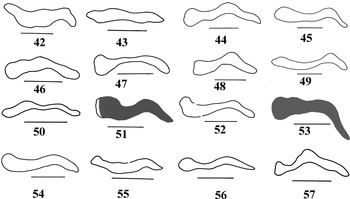
Chrysopilus, male ejaculatory apodeme, lateral view: 42, bicoloratus sp. nov.; 43, brunneabdominalis sp. nov.; 44, caliginosus sp. nov.; 45, chazeaui sp. nov.; 46, everti sp. nov.; 47, frankmcalpinei sp. nov.; 48, irwini sp. nov.; 49, mandjelia sp. nov.; 50, melinus sp. nov.; 51, noumea sp. nov.; 52, petersoni sp. nov.; 53, sarramea sp. nov.; 54, shewelli sp. nov.; 55, teskeyi sp. nov.; 56, vockerothi sp. nov.; 57, woodi sp. nov. Scale bars=0.1mm.

Etymology
This species is named for Dr. G.E. Shewell in recognition of his dedication to the production of the Manual of Nearctic Diptera.
Diagnosis
Chrysopilus shewelli sp. nov. is part of the chazeaui species group and shares with C. bicoloratus sp. nov., C. calignosus sp. nov., C. frankmcalpinei sp. nov., C. mandjelia sp. nov., C. petersoni sp. nov., and C. teskeyi sp. nov. the coxae being brown to black with dark yellowish brown to black setae. It shares with C. calignosus sp. nov. and C. frankmcalpinei sp. nov. the femora being yellow. It differs from C. calignosus sp. nov. and C. frankmcalpinei sp. nov. in having the wing membrane pale opaque brown (Fig. 24) with a scattered brown pattern; abdominal tergites 1–6 pale brown and dark brown on the posterior half; the abdominal setae whitish brown on tergite 1 and whitish yellow anterolaterally on tergite 2, with dark-brown appressed and whitish yellow appressed setae anteriorly and dark-brown appressed setae posteriorly on tergites 3–6.
Description
Male. Body length 6.0mm (n=1).
Head. Ocellar tubercle dark brown, pruinescence brownish gray; slightly raised above level of vertex; setae short, black. Eyes holoptic; ommatidia smaller ventrally, with distinct line of demarcation; medial margin (Fig. 13) sinuate, broadly diverging ventrally, without distinct hemispherical emargination dorsolateral to antennal base. Frons dark brown, pruinescence brown, gray ventrally; glabrous. Antenna pale brown. Parafacial pruinescence gray; setae brown, sparse ventrally along medial margin with clypeus. Clypeus pale brown; glabrous. Genal setae dark brown. Maxillary palpus dark yellow; setae dark brown. Occipital setae dark brown.
Thorax. Scutum pruinescence dull brown; setae short, black, erect, mixed with pale-gold appressed setae. Notopleural setae yellowish gold with dark-brown erect, elongate setae laterally. Postpronotal lobe concolorous with scutum; setae dark brown, elongate. Pleura dark brown, pruinescence dull brown; setae dark brown on propleuron, anterior and dorsal margin of anepisternum, and katepisternum, dark yellow on meron, pale brown on laterotergite, with yellow patch of setae posterodorsally. Scutellum dull brown; setae yellowish gold, appressed; posterior setae dark brown, elongate. Wing. Length 5.1mm. Membrane (Fig. 24) opaque with variable brown markings; sc brown apically; r1 brown at origin of Rs, and pterostigma brown; r2+3 brown with apical and basal opaque area; r4 brown with subapical opaque area; r5 brown with basal and subapical opaque area; m1, m2, m3, cua1, cup, and a1 opaque with small, scattered brown areas; apical margin of br and bm brown. Veins dark brown. Cell r4 enclosing area posterior to apex of wing (left wing encloses area slightly anterior to apex of wing). R4 with basal angle almost right-angled, apical half of vein slightly sinuate, ending at wing apex (left wing ends slightly anterior to apex). Halter stalk yellow, knob dark brown. Legs. Coxae dark brown, pruinescence grayish brown; setae dark brown. Femora yellow; setae pale yellow, appressed on dorsal surface. Tibiae yellow. Tarsi yellowish brown.
Abdomen. Tergite 1 pale brown, dark brown across anterior margin; tergite 2 dark brown with pair of pale-brown areas medially; tergites 3–6 pale brown, dark brown laterally and across posterior margin; tergites 6–8 brown; setae whitish brown, elongate, appressed on tergite 1, whitish yellow, elongate, appressed on pale-brown areas of tergites 2–6, dark brown, elongate, appressed on dark-brown areas of tergites 2–8. Terminalia. Dark brown. Gonostylus (Fig. 38) slightly expanded posterolaterally; setae dark brown, moderately long; apical margin rounded. Ejaculatory apodeme in dorsal view (Fig. 38) pale yellow, sinuate, expanded apically; in lateral view (Fig. 54) narrow, sinuate. Lateral ejaculatory sclerite (Fig. 38) sinuate, heavily sclerotized.
Female. Unknown. When collected, the female is expected to exhibit a similar wing and abdominal pattern as the male.
Specimens examined
Holotype male: labeled “New Caledonia, Province Nord, Mt. Mandjélia, 6km WSW Puébo, Malaise in rainforest, el. 545m, 19 January 1996, MEIrwin, DWWebb, 20 24′ 09′′ S, 164 30′ 54′′ E” (MNHN).
Chrysopilus teskeyi sp. nov.
(Figs. 14, 25, 39, 55)
Etymology
This species is named in honour of Dr. H.J. Teskey for his contribution to the systematics of the Tabanidae and his collaboration in the production of the Manual of Nearctic Diptera.
Diagnosis
Chrysopilus teskeyi sp. nov. is part of the chazeaui species group and shares with C. bicoloratus sp. nov., C. caliginosus sp. nov., C. frankmcalpinei sp. nov., C. petersoni sp. nov., and C. shewelli sp. nov. the coxae being brown to black with dark yellowish brown to black setae. It shares with C. bicoloratus sp. nov., C. mandjelia sp. nov., and C. petersoni sp. nov. the femora being brown. It shares with C. petersoni sp. nov. and C. bicoloratus sp. nov. the presence of setae ventrally on the parafacial and laterally on the clypeus, and the wing membrane being hyaline with a variable brown pattern (Fig. 25). It shares with C. petersoni sp. nov. the wing membranes (Fig. 25) being more strongly patterned than in C. bicoloratus sp. nov. It differs from C. petersoni sp. nov. in having the genal setae pale whitish yellow with an anterodorsal patch of dark-brown setae; the wing membranes (Fig. 25) with the apex of sc brown, the pterostigma brown, r2+3 brown apically with three small brown areas basally, r4 brown apically, separated from the medial brown area, with the fork of R4+5 possessing a brown margin, r5 with an apical, subapical, and basal brown area, m1 with an apical and subapical brown area; m2 with an apical brown area and m-m brown basally, m3 faintly brown apically with a narrow medial brown band, d with a subapical brown area and m-m with a brown margin, and br, bm, cup, cua1, a1, a2 without brown markings.
Description
Male. Body length 4.4–5.3mm (n=2).
Head. Ocellar tubercle dark brown, pruinescence brownish gray; distinctly raised above level of vertex; setae short, black. Eyes holoptic; ommatidia smaller ventrally, with distinct line of demarcation; medial margin (Fig. 14) angulated, with distinct emargination dorsolateral to antennal base, slightly diverging ventrally. Frons dark brown, pruinescence pale brown, gray ventrally; glabrous. Antenna dark brown, pruinescence gray. Parafacial pruinescence grayish turquoise; setae dark brown to black ventrally along medial margin with clypeus. Clypeus dark brown, paler medially; setae dark brown, sparse laterally. Gena with anterodorsal patch of dark-brown setae, becoming pale whitish yellow ventrally. Maxillary palpus pale brown; setae dark brown. Occipital setae whitish yellow, elongate ventrally, becoming short, dark brown dorsally.
Thorax. Scutum dull brown, pruinescence brownish turquoise, lacking vittae; setae rubbed off (see description of female). Notopleural setae rubbed off (see description of female). Postpronotal lobe pale brown; setae rubbed off (see description of female). Pleura dark brown, pruinescence gray; setae yellow on meron, rubbed off remainder of pleuron (see description of female); yellowish brown, elongate on laterotergite. Scutellum dull, dark brown, pruinescence pale bluish brown; setae rubbed off (see description of female). Wing (Fig. 25). Length 4.2–4.5mm; membrane hyaline, apex of sc brown; pterostigma brown; r2+3 brown apically with three small brown areas basally; r4 brown apically, separated from medial brown area, with fork of R4+5 possessing brown margin; r5 with apical, subapical, and basal brown area; m1 with apical and subapical brown area; m2 with apical brown area and m-m brown at base; m3 slightly brown apically with narrow medial brown band; d with subapical brown area and m-m with brown margin; br, bm, cup, cua1, a1, a2 without brown markings. Veins dark brown. R4 with basal angle almost right-angled, vein slightly sinuous, ending slightly beyond apex. Cell r4 enclosing area posterior to apex of wing. Halter stalk dark yellow, knob dark brown. Legs. Coxae dark brown, pruinescence gray; setae dark brown. Femora dark brown; setae dark brown, appressed dorsally. Tibiae dull yellow. Tarsi yellowish brown.
Abdomen. All tergites dark brown, setae rubbed off (see description of female). Terminalia. Dark brown. Gonostylus (Fig. 39) broadly expanded posterolaterally; setae brown, moderately long; apex truncate with small blunt point. Ejaculatory apodeme in dorsal view (Fig. 39) pale yellow, expanded apically; in lateral view (Fig. 55) narrow, sinuate. Lateral ejaculatory sclerite (Fig. 39) heavily sclerotized.
Female. Similar to male except for the following: body length 4.8–6.2, 5.6mm (n=5).
Head. Vertex not emarginated lateral to ocellar tubercle. Frons dark brown, pruinescence yellowish brown, brownish gray ventrally; setae short, dark brown to black, scattered lateral to ocellar tubercle, glabrous dorsal to antennal bases.
Thorax. Scutum lacking vittae; setae short, pale yellowish gold, appressed, with slight turquoise tinge, mixed with short black erect setae. Postpronotal lobe concolorous with scutum; setae dark brown to black, moderately long posteriorly. Setae on notopleuron short, pale yellowish gold, appressed, with slight turquoise tinge, mixed with dark-brown elongate, erect setae posterolaterally, dark brown on propleuron, along anterior and dorsal margins of anepisternum, yellow on meron and laterotergite. Scutellum short, whitish gold, appressed, with slight turquoise tinge, posterior setae brown, elongate. Wing. Length 4.5–5.3, 5.0 mm. Legs. Tibiae and tarsi pale yellowish brown.
Abdomen. All tergites dark brown, pruinescence brownish gray. Dorsal setae on tergite 1 white, elongate; tergites 2–6 with white elongate, subappressed setae on anterior three-fourths and dark-brown appressed setae posteriorly.
Specimens examined
Holotype male: labeled “New Caledonia, Province Nord, Réserve spéciale de fauna de l'Aoupinié, 21.157S, 165.323E, 6-12-XI-2000, D. W. Webb, E. I. Schlinger, Malaise trap in alpine forest” (MNHN). Paratypes: New Caledonia. Province Nord: Réserve spéciale de fauna de l'Aoupinié [−21.178,165.303], 13–13.x.2000, M.E. Irwin, 1♀ (INHS); Mt. Mandjélia, 5 km WSW Puébo [−20.397, 164.528], 780m, D.W. Webb, E.I. Schlinger, 1♀ (INHS), Malaise trap; trail to Mt. Panié, 22km NW Hienghéne, 600m, 25.xi.1992, D.W. Webb, 2♀ (INHS). Province Sud: Rivière Bleue Provincial Park, 28km NW Yaté, 23–27.xii.1991, M.E. Irwin, D.W. Webb, 1♀ (INHS), Malaise trap across running stream; trail to Upper Rivière Bleue, 290m, 5–16.xi, 1992, D.W. Webb, 1♀ (INHS); Rivière Bleue, 30km NW Yaté, 13–26.iii.1984, L.B. deLarbogne, J. Chazeau, A. and S. Tillier, 2♀ (MNHN), Malaise trap; 28.xi–12.x.1986, 1♀ (MNHN), Malaise trap; 20–31.i.1987, 1♀ (MNHN), Malaise trap; 28.x–12.xi.1986, 1♀ (MNHN), Malaise trap; 8–22.ii.1989, 1♀ (MNHN), Malaise trap; Pic du Grand Kaori [−22.2833, 166.8833], 22.xi.2004, Burwell, Wright, 1♀ (MNHN), yellow pan trap in rain forest; 22.xi–21.xii.2004, Burwell, Wright, 1♂, (MNHN), yellow pan trap in rain forest; 21.xii–12.i.2005, Burwell, Wright, 1♀ (MNHN).
Chrysopilus vockerothi sp. nov.
(Figs. 15, 40, 56)
Etymology
This species is named in honour of Dr. J.R. Vockeroth for his contribution to the systematics of Diptera and his diligence and collaboration in the production of the Manual of Nearctic Diptera.
Diagnosis
Chrysopilus vockerothi sp. nov. is similar in appearance to C. bifasciatus Paramonov from Queensland, Australia, but differs in the wing pattern and setal pattern on the abdomen. In New Caledonia it falls within the sarramea species group and shares with C. melinus sp. nov. and C. everti sp. nov. the male eyes being separated by a distance equal to or greater than the width of the ocellar tubercle and the medial margin being rounded (Fig. 15). Chrysopilus vockerothi sp. nov. shares with C. melinus sp. nov. the scutum being yellowish brown and glossy. It is separated from C. melinus sp. nov. by having abdominal tergites 1–3 yellow to yellowish brown and tergites 4–8 dark brown and the dorsal setae short, dark brown, appressed, with whitish turquoise appressed setae anteriorly on tergites 1–7.
Description
Male. Body length 4.2–6.3, 5.2mm (n=5).
Head. Ocellar tubercle pruinescence dull brown; moderately raised above level of vertex; setae short, black. Eyes dichoptic (separated by distance 1.4–2.0, 1.7 times width of ocellar tubercle); ommatidia equal in size; medial margin (Fig. 15) parallel dorsoventrally, without distinct hemispherical emargination dorsolateral to antennal base. Frons pruinescence dull brownish gray; setae black, short on medial half of frons, glabrous dorsal to antennal bases and lateral to ocellar tubercle. Antenna dark brown. Parafacial dark brown dorsally, pruinescence gray ventrally; glabrous. Clypeus yellowish brown; glabrous. Genal setae pale yellow. Maxillary palpus pale yellow; setae dark brown. Occipital setae yellow, elongate ventrally, becoming short, dark brown dorsally.
Thorax. Scutum yellowish brown, glossy, vittae absent; setae short, dark brown, suberect, mixed with whitish turquoise appressed setae. Notopleural setae whitish turquoise to dark yellow, with dark-brown elongate setae posterolaterally. Postpronotal lobe concolorous with scutum; setae dark brown posteriorly. Pleura dark yellow, pruinescence white; setae yellow on anterior margin of anepimeron, katepisternum, and meron, dark brown across dorsal margin of anepisternum, and yellow and dark brown on laterotergite. Scutellum dull brown; setae short, dark-brown, appressed, mixed with whitish turquoise appressed setae, with dark-brown elongate setae across posterior margin. Wing (as in Fig. 19). Length 5.0–5.7, 5.3mm; membrane hyaline, apical band pale brown; pterostigma brown; R4 with basal angle almost right-angled, vein smoothly curved to slightly sinuous, ending at apex. Cell r4 enclosing area posterior to apex of wing. Halter stalk dark yellow, knob dark brown. Legs. Coxae yellow, pruinescence whitish yellow; setae yellow. Femora yellow; setae dark brown, appressed, denser on hind femur. Tibiae and tarsi brown.
Abdomen. Tergites 1–3 yellow to yellowish brown, tergites 4–8 dark brown; setae short, dark brown, appressed, with whitish turquoise appressed setae anteriorly on tergites 1–7. Terminalia. Dark brown. Gonostylus (Fig. 40) moderately expanded posterolaterally; setae brown, moderately long; apex rounded. Ejaculatory apodeme in dorsal view (Fig. 40) pale yellow, expanded apically, apex pointed; in lateral view (Fig. 56) narrow, sinuate. Lateral ejaculatory sclerite (Fig. 40) heavily sclerotized.
Female. Similar to male except for the following: body length 4.7–8.8, 6.4mm (n=5).
Head. Vertex not emarginated lateral to ocellar tubercle. Frons dark brown, pruinescence brownish gray; setae short, dark brown to black, scattered over medial half of frons and lateral to ocellar tubercle, glabrous dorsal to antennal bases.
Thorax.Wing. Length 4.5–6.2, 5.4mm.
Abdomen. Tergites 1–3 yellow to yellowish brown, tergites 4–8 dark brown; setae short, dark brown, appressed, with whitish turquoise appressed setae rubbed off female specimens.
Specimens examined
Holotype male: labeled “NEW CALEDNONIA 11774, 2217'Sx 16653′E, 250m, Pic du Grand Kaori, site 2, 22Nov2004, QM party, mv lamp, rainforest” (MNHN). Paratypes: NEW CALEDONIA. Province Nord: Réserve spéciale de fauna de l'Aoupinié [−21.178, 165.303], 13–30.x.2000, M.E. Irwin, 1♂, (INHS), Malaise trap; Aoupinié [−21.1833, 165.3167], 850m, 20.xi.2000, G. Monteith, 1♀ (QM); Mont Panie, 360m, 11–16.xii.1983, Malaise trap, L. Matile, 1♀ (MNHN). Province Sud: Pic du Grand Kaori [−22.2833, 166.8833], 22–23.xi.2004, Burwell, Wright, 2♂, 2♀ (QM), yellow pan trap in rain forest; 22–24.xi.2004, QM party, 1♀ (QM); 22.xi–21.xii.2004, Wright, Burwell, 1♂, 1♀ (QM), Malaise trap in rain forest; 21.xii–12.i.2005, Wright, Burwell, 4♂, 1♀ (QM), Malaise trap in rain forest; Parc territorial de la Rivière Bleue, 23.5km NNW Plum [−22.049, 166.654], 11.xi.2000, L.J. Boutin, 1♂, (INHS); Rivière Bleue, 30km NW Yaté, 29.ix–13.xi.1986, L.B. deLarbogne, J. Chazeau, A. and S. Tillier, 1♀ (MNHN); Mt. Do [−21.758 165.002], 1100m, 1–25.xi.2000, M.E. Irwin, 37♂, 2♀ (INHS); 25.xi–3.xii.2000, E.I. Schlinger, M.E. Irwin, 36♂, 1♀ (INHS).
Chrysopilus woodi sp. nov.
(Figs. 16, 41, 57)
Etymology
This species is named in honour of Dr. D.M. Wood for his contribution to the systematics of Diptera and his diligence and collaboration in the production of the Manual of Nearctic Diptera.
Diagnosis
Chrysopilus woodi sp. nov. is similar to C. schlingeri Webb from Fiji in having the male eyes separated by a distance greater than the width of the median ocellus but less than the width of the ocellar tubercle; the scutum dark yellow and glossy; and the setae dark brown across the dorsal margin of the anepisternum. It differs from C. schlingeri in having the wing membrane hyaline (as in Fig. 19) and the apex with a faint pale-brown tint; in having the male ejaculatory apodeme in lateral view (Fig. 57) narrow with a dorsomedial expansion; and in the male lateral ejaculatory sclerite being absent. In New Caledonia, C. woodi sp. nov. is part of the sarramea species group and shares with C. irwini sp. nov, C. noumea sp. nov., and C. sarramea sp. nov. the male eyes being separated by a distance less than the width of the ocellar tubercle and the inner margin being angulate (Fig. 16). It shares with C. irwini sp. nov. the scutum being dull brown with gray pubescence. It differs from C. irwini sp. nov. in having the parafacial setae short, black, sparse on the ventral third; the maxillary palpus dark yellowish brown with the apex dark brown; and the pleura dark yellow with dark-brown setae across the dorsal margin of the anepisternum.
Description
Male. Body length 4.5–5.3, 4.9mm (n=3).
Head. Ocellar tubercle pruinescence dull brownish gray; moderately raised above level of vertex; setae short, black. Eyes dichoptic (separated by distance less than width of ocellar tubercle); ommatidia equal in size; medial margin (Fig. 16) angulated, with hemispherical emargination dorsolateral to antennal base, diverging ventrally. Frons pruinescence gray with turquoise hue; setae short, black, sparse on medial half of frons, glabrous dorsal to antennal bases and lateral to ocellar tubercle. Antenna dark brown, apical half of pedicel paler; scape glabrous. Parafacial pruinescence gray with turquoise hue; setae short, black, sparse on ventral third. Clypeal pruinescence gray with turquoise hue; glabrous. Genal setae pale yellow, elongate. Maxillary palpus dark yellowish brown with apex dark brown; setae yellow. Occipital setae pale yellow, elongate ventrally, becoming short, dark brown dorsally.
Thorax. Scutum brown, pruinescence gray with turquoise hue, vittae absent; setae short, dark-brown, suberect, mixed with whitish turquoise appressed setae. Notopleural setae whitish turquoise with dark-brown elongate setae posterolaterally. Postpronotal lobe concolorous with scutum; setae yellow with dark-brown setae posteriorly. Pleura dark yellow, pruinescence white; setae yellow, elongate on propleuron, on anterior margin of anepimeron, on ventral fourth of katepisternum, in small posterodorsal patch on meron, and on laterotergite, dark brown across dorsal margin of anepisternum. Scutellum dull brown; setae whitish turquoise, appressed,with dark-brown elongate setae across posterior margin. Wing (as in Fig. 19). Length 5.2–5.7, 5.4mm; membrane hyaline, apex with faint brown tint; pterostigma brown; R4 sinuate, ending at apex of wing, basal angle nearly right-angled; r4 enclosing area posterior to wing apex. Halter stalk dark yellow, knob dark brown. Legs. Coxae dark brown, pruinescence gray with turquoise hue; setae yellow. Femora yellow with dorsal apical area of hind femur dark brown; setae pale yellow, mixed with dark-brown appressed setae, denser and darker brown on hind femur. Tibiae and tarsi dark yellowish brown.
Abdomen. All tergites dark brown, pruinescence gray; dorsal setae on tergite 1 white, on tergites 2–6 whitish turquoise medially, appressed, with black appressed setae along posterior and lateral margins, on tergites 7–8 short, black, appressed. Terminalia. Dark brown. Gonostylus (Fig. 41) expanded posterolaterally; setae brown, moderately long; apex pointed, recurved. Ejaculatory apodeme in dorsal view (Fig. 41) pale yellow, thick, sinuate; in lateral view (Fig. 57) narrow with dorsomedial expansion. Lateral ejaculatory sclerite absent.
Female. Similar to male except for the following: body length 4.3–7.2, 5.4mm (n=5).
Head. Vertex not emarginated lateral to ocellar tubercle. Frons dark brown, pruinescence brownish gray; setae short, dark brown to black, scattered over medial half of frons and lateral to ocellar tubercle, glabrous dorsal to antennal bases.
Thorax.Wing. Length 4.5–6.2, 5.5 mm.
Abdomen. All tergites dark brown, pruinescence brownish gray; setae short, dark brown, appressed, with whitish turquoise appressed setae anteriorly on tergites 1–4.
Specimens examined
Holotype male: labeled “New Caledonia, Province Nord, 21.157° S,165.323°E Réserve spéciale de fauna de l'Aoupinié, Malaise trap, 9–14.XII.2000, M. E. Irwin” (MNHN). Paratypes: NEW CALEDONIA. Province Nord: Réserve spéciale de fauna de l'Aoupinié [−21.178,165.303], 13–30.xi.2000, M.E. Irwin, 1♀ (INHS), Malaise trap; 30.xi.2000, M.E. Irwin, 1♀ (INHS), Malaise trap; [−21.157,165.323], 5–12.xi.2000, D.W. Webb, E.I. Schlinger, L.J. Boutin, 1♂, 1♀ (INHS), Malaise trap; 9–14.xii.2000, M.E. Irwin, 1♂, 4♀ (INHS). Province Sud: Mt. Koghis, 17km NNE Nouméa [−22.176,166.505], 500m, 13–24.xi.2000, E.I. Schlinger, L.J. Boutin, 1♂, (INHS).
Acknowledgements
I thank Dr. Jean Chazeau, ORSTOM, for facilitating collecting logistics and obtaining collecting permits for New Caledonia. Support for this study was provided by the Illinois Natural History Survey. I also thank Dr. M.E. Irwin for his development of a research program to produce a worldwide monograph of the Therevidae (Diptera), which provided financial support for several collecting trips to New Caledonia. Dr. Irwin received funding from the National Science Foundation's (NSF) Partnerships for Enhancing Expertise in Taxonomy program under award numbers NSF DEB 95-21925 and NSF DEB 99-77958. Funding for the collecting trips to New Caledonia was also provided by the Schlinger Foundation. Any opinions, findings, and conclusions or recommendations expressed in this publication are those of the author and do not necessarily reflect the views of the NSF or the Schlinger Foundation.