It is well known that children with congenital heart disease are often small and undernourished.Reference Mehrizi and Drash1–Reference Vaidyanathan, Radhakrishnan, Sarala, Sundaram and Kumar6 Malnutrition results in reduced muscle function,Reference Hill7 poor wound healing,Reference Haydock and Hill8 and impaired immunity,Reference Gross and Newberne9 which may increase post-operative morbidity and mortality. Some possible explanations for undernourishment include hypoxia,Reference Varan, Tokel and Yilmaz10 intestinal venous congestion resulting in malabsorption,Reference Sondheimer and Hamilton11 genetic factors, and frequent infections of upper and lower respiratory tracts.Reference Mehrizi and Drash1 In addition, feeding problems,Reference Thommessen, Heiberg and Kase12 inadequate energy intake,Reference Thommessen, Heiberg and Kase12 and increased energy expenditureReference Leitch, Karn and Peppard13 have been suggested as contributing factors. Delay in surgical repair can lead to deterioration of nutritional status and growth of children with congenital heart disease, whereas early surgical correction has been associated with better growth outcome.Reference Vaidyanathan, Nair and Sundaram5, Reference Vaidyanathan, Radhakrishnan, Sarala, Sundaram and Kumar6 In some situations, however, surgical repair may have little influence on growth, because of significant residual lesions or surgery sequelae. Moreover, low socio-economic status probably has an impact on the genesis of growth restriction in patients with congenital heart disease, because it may limit nutrient intake before and after surgical repair. Children with congenital heart disease are reported to present catch-up growth within 3–12 months after surgery in both developed and developing countries.Reference Mehrizi and Drash1–Reference Vaidyanathan, Radhakrishnan, Sarala, Sundaram and Kumar6, Reference Manso, Carmona, Jacomo, Bettiol, Barbieri and Carlotti14
Cyanosis is the most prominent clinical manifestation of Tetralogy of Fallot. Chronic hypoxaemia has been shown to contribute to anorexia, feeding problems, and may affect the digestive tract by decreasing enzyme activities.Reference Thommessen, Heiberg and Kase12, Reference Bernstein, Bell, Kwong and Castillo15 In addition, there is evidence that serum insulin-like growth factor I concentrations are reduced in patients with cyanotic congenital heart disease,Reference Dundar, Akcoral and Saylam16 which may intensify growth restriction in these patients. There are a few studies evaluating long-term growth of patients with Tetralogy of Fallot after surgical intervention;Reference Vaidyanathan, Radhakrishnan, Sarala, Sundaram and Kumar6, Reference Cheung, Davis, Wilkinson and Weintraub17, Reference Schuurmans, Pulles-Heintzberger, Gerver, Kester and Forget18 only two studies, performed in developed countries, included a specific population of children with Tetralogy of Fallot.Reference Cheung, Davis, Wilkinson and Weintraub17, Reference Schuurmans, Pulles-Heintzberger, Gerver, Kester and Forget18 Thus, the objective of this study was to determine whether children submitted to total surgical repair of Tetralogy of Fallot in a Brazilian tertiary care university hospital presented catch-up growth after the intervention, and whether the presence of residual lesions and patients’ socio-economic status influenced this process.
Materials and methods
Subjects
This is a longitudinal study of a cohort of children with Tetralogy of Fallot submitted to surgical correction between January, 1998 and January, 2006 in our institution. All operated children were eligible. This study was approved by the institutional review board for human research, and informed consent was obtained. We declare no conflicts of interest. Patients were selected by the database of the hospital electronic system for surgery booking. Health records were reviewed, and both clinical and anthropometric data were collected. Patients over 5 years of age at repair, as well as those with genetic, chromosomal or extracardiac abnormalities, or peri-operative death, were excluded.
Data collection
Anthropometric measurements chosen for analysis included those recorded at birth, on the day of the surgery, and 3, 6, and 12 months after intervention. Anthropometric measurements were routinely carried out in the outpatient clinics and wards by trained staff. Children up to 2 years of age were weighed on a digital scale (BP Baby® model, Filizola, Sao Paulo, Brazil) and measured with an anthropometric ruler in the supine position. Children older than 2 years of age were weighed on a digital scale (Personal Line® model, Filizola, Sao Paulo, Brazil) and measured with an anthropometric ruler in the orthostatic position. All patients were examined at the outpatient clinics by the researchers during the data collection period; they also had their current weight and height measured – named “long-term” – and their bone age determined by fist radiography analysis using the Greulich–Pyle method. Bone age was considered delayed when below 2 standard deviations from the mean for age and gender.Reference Reiter and Rosenfeld19 On the same occasion, parents’ heights were measured and they were subsequently used to obtain mid-parental predicted height as previously described.Reference Tanner20 Nutritional status was assessed by z-scores of weight for age, height for age, and weight for height, adopting the Centres for Disease Control and Prevention 2000 curves as reference, using statistical software Epi-Info (Centres for Disease Control and Prevention, Atlanta, United States of America). In pre-term babies, birth z-scores were calculated using appropriate growth charts,Reference Niklasson and Albertsson-Wikland21 whereas pre- and post-operative z-scores were calculated using Centres for Disease Control and Prevention 2000 curves, with corrected age for gestational age until 2 years of life. Chronic growth impairment was defined as a height-for-age z-score below −2 at surgery, and acute growth impairment as a weight-for-height z-score below −2 at the same time point. Catch-up growth was defined as a post-operative rise in z-score above 0.67 standard deviations, which corresponds to the distance between adjacent centile lines of standard growth charts.Reference Ong, Preece, Emmett, Ahmed and Dunger22
Information on the current – long-term – socio-economic status, that is, monthly income, parental educational level, employment status, and housing conditions, was obtained by the social worker during an interview with the patients’ parents; families were assigned into 1 out of 5 levels: (1) high, (2) medium–superior, (3) medium–inferior, (4) low–superior, or (5) low–inferior. Current – long-term – energy and protein intake were calculated during interviews by a qualified nutritional therapist using a commercial software package DietSys® (Applied Research, National Cancer Institute, Bethesda, United States of America). Energy intake was expressed in kilocalories per kilogram per day and as the percentage of the resting energy expenditure predicted by the Schofield equation.Reference Schofield23 This formula is known to better correlate with resting energy expenditure measured by indirect calorimetry in children undergoing surgery for both cyanotic and acyanotic congenital heart disease.Reference Avitzur, Singer and Dagan24 Protein intake was expressed in grams per kilogram per day.
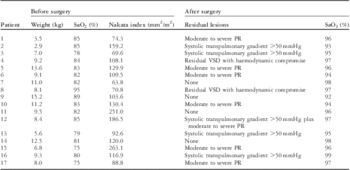
Pre-operative echocardiographic data were used to determine the Nakata index, which was calculated by dividing the total cross-sectional area of the main pulmonary arteries by the body surface area. The surgical technique for Tetralogy of Fallot repair consisted of transventricular closure of ventricular septal defect and transannular patch reconstruction of right ventricular outflow tract. Echocardiography was performed post-operatively during follow-up with a Hewlett Packard 5500® (Hewlett Packard, Andover, United States of America), and significant residual lesions were defined by the presence of moderate to severe pulmonary regurgitation; systolic pressure gradient between right ventricle and pulmonary artery greater than 50 millimetres of mercury; or residual ventricular septal defect with haemodynamic compromise.
Statistical analysis
Results are expressed as median and total range or percentages. All data were analysed using commercially available software package SAS® version 9 (SAS Institute Inc., Cary, United States of America). A mixed-effects linear model was used to investigate the effects of surgical intervention, the presence of residual lesions, and daily energy intake on weight-for-age, height-for-age, and weight-for-height z-scores. Long-term height was compared with mid-parental predicted height, both converted to z-scores, and bone age was compared with chronological age in a within-subject paired analysis using Wilcoxon signed-rank test, because of a non-Gaussian distribution. Patients were then grouped according to pre-term birth, age at repair (above or below the median), socio-economic status, post-operative arterial oxygen saturation (above or below the median) and Nakata index (above or below the median). Between-group comparisons of anthropometric data were made using analysis of variance, Student's t-test, or Fisher's exact test, when appropriate. Results were considered significant when the p-value was less than 0.05.
Results
A total of 17 of 25 patients with Tetralogy of Fallot were included. Their median age was 16 months (range: 0–36 months) at the time of the surgical procedure; this included ten male patients. In all, eight patients were excluded, because of peri-operative death in four children, age at repair above 5 years in two children, and genetic abnormalities in two children. Approximately 23%, that is, four, of the patients were pre-term (range: 33–35 weeks of gestational age). They were followed in the outpatient clinics, and only two patients had a modified Blalock-Taussig shunt previously done. The median duration of follow-up after surgery was 65 months (range: 25–92 months). Demographic data are presented in Table 1, and oxygen saturation and main echocardiographic findings are shown in Table 2. The median intensive care unit length of stay was 9 (range: 1–18) days, while the median duration of mechanical ventilation was 2 (range: 0–10) days.
Demographic data.

CHF = congestive heart failure
Numbers are median and range or percentages
Oxygen saturation and main echocardiographic findings before and after surgical repair.

PR = pulmonary regurgitation; SaO2 = arterial oxygen saturation; VSD = ventricular septal defect
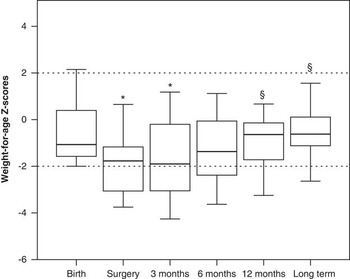
Weight-for-age z-scores decreased from birth to the time of surgery and at 3 months post-operatively, and subsequently increased over time at 6 and 12 months post-operatively, and in the long term. We found that values measured at surgery (p = 0.0012) and 3 months post-operatively (p = 0.0016) were significantly lower than those at birth. Values measured 12 months after surgery (p = 0.0082) and in the long term (p = 0.0003) were significantly higher than those at surgery (Fig 1). The presence of residual lesions had a significant influence on weight-for-age z-scores (p = 0.03), but not daily energy intake (p = 0.06).
Median, interquartile, and total range of weight-for-age z-scores at different times before and after surgical repair (* = significant difference from birth; § = significant difference from surgery).

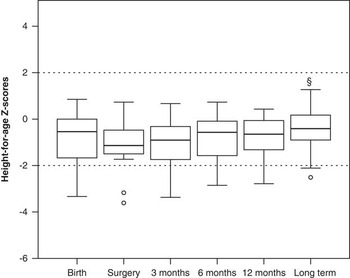
Height-for-age z-scores showed a slight decrease before repair and improved over time. Values measured in the long term were significantly higher than those measured at birth (p = 0.032), at surgery (p = 0.005), and 3 months after repair (p = 0.007; Fig 2). Neither the presence of residual lesions (p = 0.17) nor daily energy intake (p = 0.39) influenced height-for-age z-scores.
Median, interquartile, and total range of height-for-age z-scores at different times before and after surgical repair (§ = significant difference from birth, surgery, and 3 months; ○ = outliers).

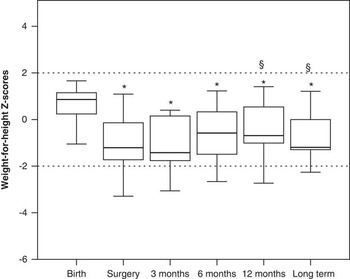
Weight-for-height z-scores decreased from birth to the time of surgery and 3 months following repair, and subsequently increased at 6 and 12 months post-operatively. Values measured at surgery (p < 0.0001) and after 3 months (p < 0.0001), 6 months (p < 0.0001), and 12 months post-operatively (p = 0.0004), as well as in the long term (p = 0.0015), were all significantly lower than those at birth (Fig 3). However, values measured at 12 months post-operatively (p = 0.026) and in the long term (p = 0.042) were significantly higher than those at 3 months following repair. There was no influence of residual lesions (p = 0.08) or daily energy intake (p = 0.16) on weight-for-height z-scores.
Median, interquartile, and total range of weight-for-height z-scores at different times before and after surgical repair (* = significant difference from birth; § = significant difference from 3 months).

On individual analysis, at the time of surgery, three patients (17.6%) had acute growth impairment, one patient (6%) had chronic growth impairment, and two patients (11.7%) had both acute and chronic growth impairment. A total of 12 patients (70.5%) presented catch-up growth for height for age, mainly after 12 months post-operatively; 14 patients (82.3%) exhibited catch-up growth for weight for age, mostly 6 months after surgery; and 12 patients (70.5%) showed catch-up growth for weight for height, four after 3 months, and four in the long term.
In all, 13 patients (76%) had significant residual lesions identified by echocardiography; it was characterised as severe pulmonary regurgitation in six children, systolic pressure gradient between right ventricle and pulmonary artery above 50 millimetres of mercury in four children, both conditions in one child, and residual ventricular septal defect with haemodynamic compromise in two children. Patients with residual lesions had lower birth weight (p = 0.02) and length (p = 0.02) when compared with those without residual lesions. In our study, only weight-for-age z-scores were influenced by the presence of residual lesions on multivariate analysis.
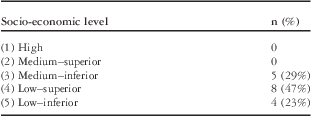
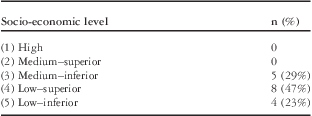
Despite the fact that 12 patients (70%) were from families of low socio-economic levels (Table 3), all but one patient had energy intake above the estimated resting energy expenditure for age and gender (median 148%, range: 95–369% of resting energy expenditure; median 79, range: 40–185 kilocalories per kilogram per day). Median daily protein intake was 3.5 (range: 1.7–6.3) grams per kilogram per day. Only two patients had protein intake below 2 grams per kilogram per day. Energy intake did not influence any anthropometric measurements. There were no differences on pre- and post-operative weight-for-age, height-for-age, and weight-for-height z-scores and daily energy and protein intake among patients from different socio-economic levels.
Socio-economic distribution.
There was no influence of pre-term birth on long-term height-for-age (−1.1 plus or minus 1.0 versus −0.2 plus or minus 1.0, p = 0.15), weight-for-age (−0.8 plus or minus 0.8 versus −0.4 plus or minus 1.1, p = 0.55), or weight-for-height (0.3 plus or minus 1.3 versus −1.1 plus or minus 0.8, p = 0.07) z-scores. Age at surgery (above or below 16 months) did not influence long-term height-for-age (−0.6 plus or minus 1.2 versus −0.3 plus or minus 1.0, p = 0.65), weight-for-age (−0.3 plus or minus 1.2 versus −0.7 plus or minus 0.9, p = 0.39), or weight-for-height (−0.2 plus or minus 1.5 versus −1.0 plus or minus 0.8, p = 0.29) z-scores. Arterial oxygen saturation (above or below 96%) also did not influence long-term height-for-age (−0.2 plus or minus 1.5 versus −0.6 plus or minus 0.7, p = 0.54), weight-for-age (−0.2 plus or minus 1.4 versus −0.8 plus or minus 0.7, p = 0.23), or weight-for-height (−0.2 plus or minus 1.3 versus −0.9 plus or minus 1.1, p = 0.44) z-scores. Lastly, the Nakata index (above or below 109 square millimetres per square metres) did not influence long-term height-for-age (0.0 plus or minus 0.9 versus −0.8 plus or minus 1.1, p = 0.12), weight-for-age (−0.4 plus or minus 1.0 versus −0.7 plus or minus 1.2, p = 0.52), or weight-for-height (−1.7 plus or minus 0.8 versus −0.4 plus or minus 1.1, p = 0.17) z-scores.
Median bone age was significantly lower than median chronological age in the long term (median 72, range: 24–108 months versus median 81, range: 26–120 months, respectively, p = 0.002). Only five patients had bone age higher than chronological age.
There was no significant difference between median mid-parental predicted height z-scores and observed long-term height-for-age z-scores (median −0.36, range: −1.51–1.03 versus median −0.39, range: −2.51–1.27, respectively, p = 0.92). Approximately 93% of patients had their long-term height-for-age z-scores within mid-parental predicted height z-score limits.
Discussion
The present study showed that Brazilian children undergoing surgical correction of Tetralogy of Fallot exhibited growth restriction before surgery, with recovery mainly 12 months after repair. Previous reports in a large cohort of children with several types of congenital heart disease in a developing country showed catch-up growth within 3 months after surgical repair.Reference Vaidyanathan, Nair and Sundaram5, Reference Vaidyanathan, Radhakrishnan, Sarala, Sundaram and Kumar6 In children undergoing surgery for Tetralogy of Fallot, previous studies in developed countries showed that catch-up growth occurred within 6–12 months after surgery.Reference Cheung, Davis, Wilkinson and Weintraub17, Reference Schuurmans, Pulles-Heintzberger, Gerver, Kester and Forget18 In our study, weight-for-age z-scores were significantly impaired pre-operatively and 3 months after surgery. Cheung et alReference Cheung, Davis, Wilkinson and Weintraub17 also reported pre-operative weight-for-age impairment with post-operative catch-up growth in a specific population of children with Tetralogy of Fallot, but they did not evaluate the presence of post-operative residual lesions. We showed that they influenced weight-for-age z-scores in our study. In contrast to the latter, in the present study we did not observe pre-operative decreases on height-for-age z-scores, although three children (17%) had values below −2 at surgery, indicating chronic growth impairment. Interestingly, long-term height-for-age z-scores were significantly higher than those measured at birth, at surgery, and 3 months post-operatively. Indeed, 70% of children showed catch-up growth for height for age. Moreover, in our study, weight-for-height z-scores were severely impaired pre-operatively, when compared with birth values, recovering only later after surgery, indicating pre-operative acute growth impairment. However, only five patients (29%) had acute growth impairment at surgery when considering a lower limit of −2 for the z-score. It is noteworthy that all post-operative values, including the long-term measures, were significantly lower compared with birth. In addition, despite the fact that 70% of our children showed catch-up growth for weight for height they did not reach the birth values, suggesting that acute growth impairment could still be present. In a heterogeneous cohort of children with congenital heart disease in a developing country, weight-for-age, height-for-age, and weight-for-height z-scores were below −2 in 59%, 26%, and 56% of children, respectively.Reference Vaidyanathan, Nair and Sundaram5 Schuurmans et alReference Schuurmans, Pulles-Heintzberger, Gerver, Kester and Forget18 observed low pre-operative mean weight-for-age and height-for-age z-scores in 18 Dutch children with Tetralogy of Fallot, which improved after the introduction of adequate nutritional therapy. The mean pre-operative weight-for-height z-score was normal, suggesting the presence of chronic rather than acute growth compromise. Australian children with Tetralogy of Fallot were reported to have both acute and chronic growth impairment pre-operatively.Reference Cheung, Davis, Wilkinson and Weintraub17
Several studies have suggested that surgical intervention should be carried out early in order to attenuate growth restriction and improve outcome. Encouraging results of early repair of congenital heart disease have been reported in neonates and infants.Reference Vaidyanathan, Radhakrishnan, Sarala, Sundaram and Kumar6 Although the median age at surgery of our patients was higher than those reported in the literature,Reference Cheung, Davis, Wilkinson and Weintraub17, Reference Schuurmans, Pulles-Heintzberger, Gerver, Kester and Forget18 catch-up growth was not influenced by it, because they presented catch-up within 6–12 months after surgery, and long-term z-scores were within normal range. In fact, we observed a trend for patients operated on later in life to present a more prolonged catch-up period. Therefore, we believe that a higher age at surgery can lead to a delayed catch-up, instead of low stature in adulthood. Nevertheless, we did not study patients operated on after 5 years of age, in whom this effect on long-term growth could be better studied. Interestingly, the presence of residual lesions influenced weight-for-age z-scores, but catch-up growth was not affected. However, because patients with post-operative residual lesions were already lighter – lower birth weight – and shorter – lower birth length – before surgery, we cannot rule out that impaired anthropometric measurements at birth may have prevented the demonstration of the influence of post-operative residual lesions in height recovery. Nevertheless, almost all long-term height-for-age z-scores were within mid-parental predicted height limits. This finding agrees with a previously published study.Reference Cheung, Davis, Wilkinson and Weintraub17 Furthermore, in our study, socio-economic status did not influence peri-operative or long-term growth, as shown in children from India with several types of cardiac malformations.Reference Vaidyanathan, Radhakrishnan, Sarala, Sundaram and Kumar6 Interestingly, despite the fact that most patients were from low socio-economic status families, all but one child had their energy intake fairly above the estimated resting energy expenditure for age and gender. All energy exceeding the resting energy expenditure should be used for daily activity and spared for growth.Reference Menon and Poskitt25 We did not evaluate our patients’ physical activity level, but as our children grew we assumed that energy intake was enough for basal metabolism, daily activity, and growth. In addition, we have found that our patients had total daily energy intake above previously reported values of measured total energy expenditure after heart surgery in several countries.Reference Avitzur, Singer and Dagan24, Reference Nydegger and Bines26–Reference Nydegger, Walsh, Penny, Henning and Bines29 Daily protein intake was also above that recommended for age and gender.Reference Trumbo, Schlicker, Yates and Poos30 Although socio-economic status was evaluated only in the long-term, we assumed it to be the same throughout the study.
The limitations of this study include the relatively small sample size, and lack of physical activity evaluation and direct measurement of total energy expenditure. In addition, as we do not routinely do cardiac catheterisation in patients with Tetralogy of Fallot – only five did – it is possible that patients with low Nakata index and high oxygen saturation had undiagnosed single or multiple aortopulmonary collateral arteries. Lastly, although patients with genetic and chromosomal abnormalities were excluded, those included in the study were not routinely screened for 22q11 deletion.
This is the first study to address the influence of residual lesions and socio-economic status on catch-up growth in a specific population of children submitted to surgical repair of Tetralogy of Fallot in a developing country. Our children had more acute and less chronic growth impairment, and catch-up growth occurred in almost all of them, regardless of socio-economic status. Only weight-for-age z-scores were influenced by the presence of residual lesions.
Acknowledgements
We thank Mrs. Renata Bernardino Buccioli, social worker, for interviewing the families, and Mr. Davi Casale Aragon for statistical advisory. Financial support: Fundação de Amparo à Pesquisa do Estado de São Paulo, Grant no. 2007/05180-6.