Background
Aircraft first distinguished themselves as tools for patient transport in theaters of combat. A hot air balloon was used to transport injured soldiers in the Franco-Prussian War (1870), and fixed-wing airplanes were used for similar purposes starting in the First World War (WWI). Reference Barr and Montgomery1 Reports suggest the first dedicated civilian air ambulances began in Australia: airplanes transported patients from remote regions in the Australian Outback as early as 1928. Reference LC2 This system would later become the Royal Flying Doctor Service. Reference Hutchinson3 Other civilian air ambulance programs started in subsequent years, such as the Scottish Air Ambulance Service in 1933. Reference Hutchinson3 Helicopters emerged as valuable tools for patient transport towards the end of the Second World War (WWII). In 1944, United States military helicopters were used to evacuate injured patients in Burma. Reference Essebag, Halabi, Churchill-Smith and Lutchmedial4 However, it was later campaigns in Korea, Southeast Asia, and British Colonies in the Pacific that solidified helicopters’ utility in medical evacuation missions. Reference Meier and Samper5,Reference Trunkey6 In the mid-1960s, there was a growing need for civilian out-of-hospital care, especially as deaths due to acute injury were rising dramatically. Reference Trunkey6,Reference Edgerly7 In response, a number of individuals and organizations began cross-applying the utility of air ambulances in military settings to civilian settings, leading to the growth of an entire air medical industry. Reference Barr and Montgomery1,Reference Essebag, Halabi, Churchill-Smith and Lutchmedial4,Reference Trunkey6 Currently, thousands of airplanes (fixed-wing) and helicopters (rotor-wing) are used as air ambulances to transport high-acuity patients. Reference Ruskin8,Reference Shekhar and Blumen9
Unfortunately, the air medical industry has been plagued with serious and fatal accidents over the last several decades, especially when looking at helicopter air ambulances. Reference Ruskin8,Reference Dodd10–Reference Mains14 For instance, one study from 1991 reported the accident rate of medical helicopters was twice that of non-medical helicopters, and working on a helicopter air ambulance was described in 2009 as “the most dangerous job in America.” Reference Mains14–Reference Paztor16 Fixed-wing air ambulances have not been immune to fatal accidents, as well. Reference Handel and Yackel17 Research specifically examining the causes and circumstances surrounding fatal air medical crashes has the potential to dramatically improve safety in the air medical industry and to save lives.
Methods
This is a retrospective and descriptive analysis of data from the National Transportation Safety Board (NTSB; Washington, DC USA), an agency of the United States Federal Government tasked with civil transportation safety. When a civil aviation accident occurs in the United States, the NTSB performs an investigation and issues a report detailing the facts surrounding the accident. Importantly, this report identifies probable causes that may have contributed to the accident. Accidents and accident reports can be queried online through the NTSB Case Analysis and Reporting Online (CAROL) database.
For this study, the CAROL database was queried for fatal air medical accidents – classified by the NTSB as air medical aviation accidents that involved at least one fatality – in the United States from January 2000 through December 2020. The NTSB reports of accidents meeting these inclusion criteria were analyzed. A number of different factors from these accident reports were extracted, including the date of the accident, how many individuals were injured or killed, and a brief narrative synopsis of the accident containing probable causes as determined by the NTSB. The date of the accident was used to determine which months and years contained the most and least number of fatalities during the time period surveyed. The model of aircraft involved was used to help ascertain what percentage of fatalities could be attributed to specific aircraft categories (eg, single-engine helicopter or twin-turbine airplane). The narrative synopses of each accident were reviewed. Accident reports that mentioned probable causes that could be interpreted as human factors, nighttime, weather, or mechanical failure were categorized accordingly. Since all data are publicly available, institutional review board (IRB) approval was not sought.
Results
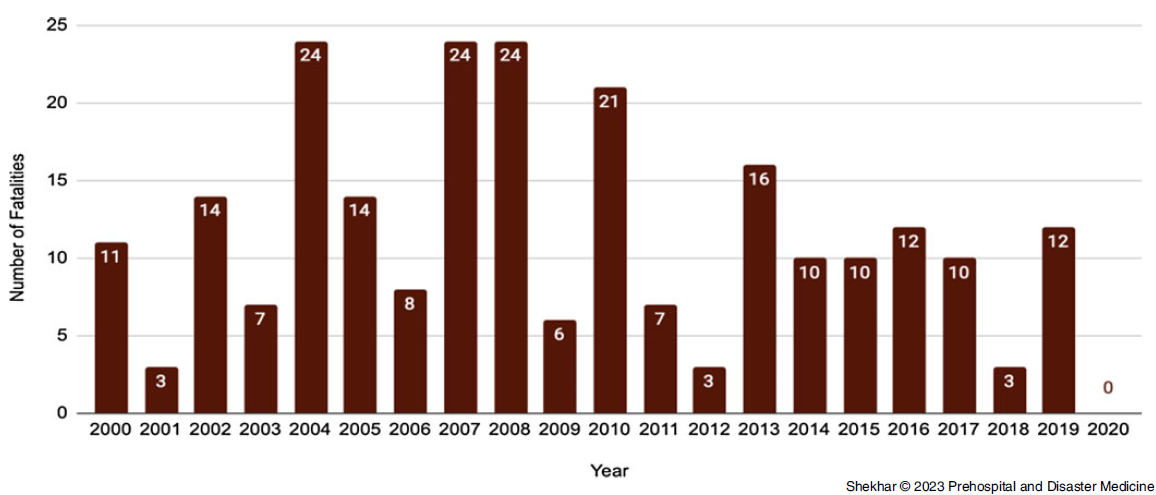
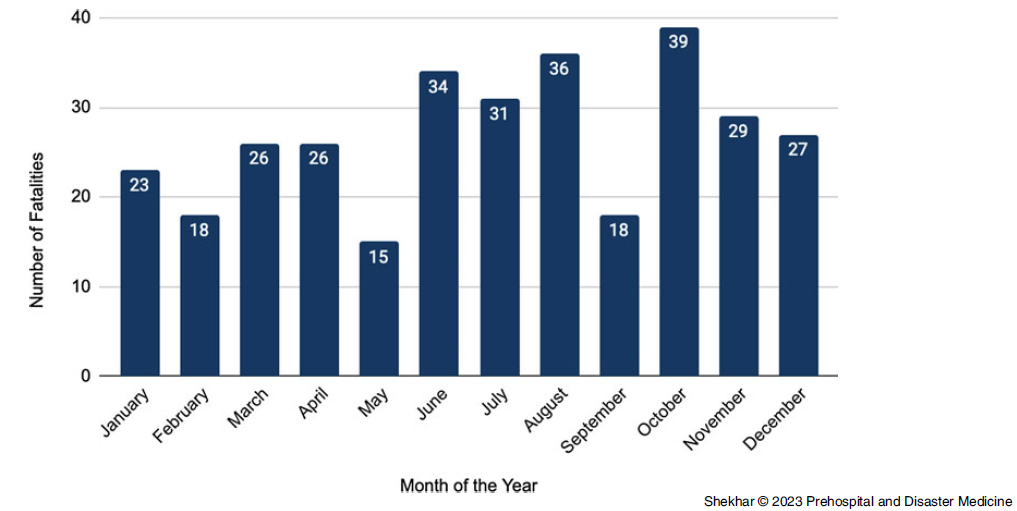
The NTSB data indicated a total of 87 accidents and 239 fatalities were associated with air medical flights from 2000 through 2020. The first fatal accident during this timeframe took place on March 10, 2000 and the last fatal accident took place on December 25, 2019. There was an average of 12 fatalities per year. The deadliest years were 2004, 2007, and 2008, which each had 24 fatalities (Figure 1). The least deadly year was 2020, which had no fatalities. Across all years, the deadliest months were October (39 fatalities), August (36 fatalities), and June (34 fatalities). The least deadly months were May (15 fatalities), February (18 fatalities), and September (18 fatalities); Figure 2.
Air Medical Fatalities by Year (2000-2020).
Note: Figure 1 shows the number of air medical fatalities per year from 2000 through 2020. Years 2004, 2007, and 2008 were the deadliest, and the year 2020 was the least deadly.

Air Medical Fatalities by Month (2000-2020).
Note: Figure 2 shows the number of fatalities based on the month the accident took place: October, August, and June were the deadliest months, and May, February, and September were the least deadly.

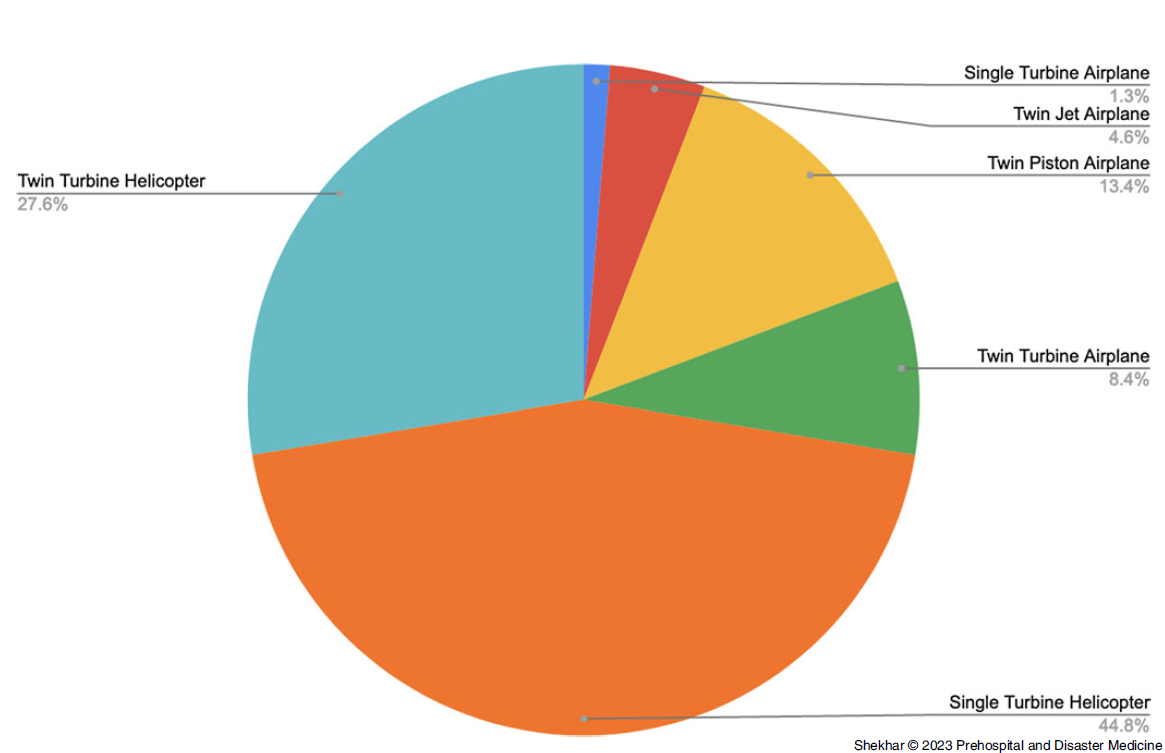
When considering the category of aircraft involved, the vast majority of air medical accident fatalities occurred on rotor-wing helicopters (72.4%); only 27.6% of fatalities occurred on fixed-wing airplanes. It is possible to subdivide aircraft categories by engine type (eg, turbine or piston) and configuration (eg, single-engine or twin-engine). Approximately 44.8% of all fatalities took place on single-engine helicopters, and 27.6% of fatalities took place on twin-engine helicopters. On the other hand, there were four different types of fixed-wing airplanes involved in fatal air medical accidents: single-turbine airplanes (1.3% of fatalities), twin-turbine airplanes (8.4% of fatalities), twin-jet airplanes (4.6% of fatalities), and twin-piston airplanes (13.4% of fatalities); Figure 3.
Air Medical Fatalities by Aircraft Category (2000-2020).
Note: Figure 3 shows the percentage of air medical fatalities that occurred on various platforms. The vast majority of fatalities took place on helicopters, and almost one-half of all fatalities took place on single-engine turbine helicopters.

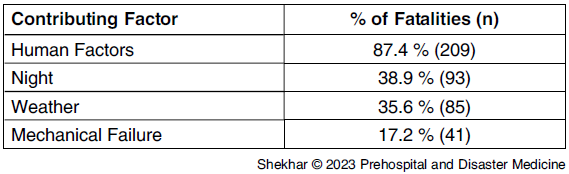
When examining the causes of fatalities and taking into account the NTSB-determined probable causes for these accidents, findings show various human factors probably contributed to 87.4% of fatalities (Figure 3). Various human factors include, but are not limited to, pilot disorientation, pilot errors, maintenance errors, impairment, fatigue, or weather misestimation. Nighttime-related factors contributed to 38.9% of fatalities, followed by weather-related factors (35.6%), and various mechanical failures (17.2%). It should be noted there is overlap between human factors and other factors. For instance, a fatal accident attributable to a pilot who decided to fly during adverse weather conditions was considered involving both human factors and weather (Table 1).
Probable Causes of Fatal Air Medical Accidents (2000-2020)

Note: Table 1 shows a list of the factors cited in NTSB accident reports. An overwhelming majority of accidents were caused by human factors. Night-related factors, weather-related factors, and mechanical failure were other commonly-cited contributors to fatal accidents.
Discussion
The main finding from this study is that an overwhelming majority of air medical accidents are caused by human factors. Therefore, one might conclude that many of these accidents are likely preventable. Furthermore, there were several human factors that were potentially responsible for multiple accidents.
Disorientation during flight into weather, instrument meteorological conditions (IMCs), and nighttime accounted for a considerable number of fatal accidents and fatalities, especially for rotor-wing helicopters. The risk of disorientation during flight into weather may be mitigated through increased instrument flight rules (IFRs) training, IFR-capable aircraft, and full-motion IFR simulation scenarios. This may better provide pilots in IFR-capable programs to have the skills to more-effectively navigate IMCs. Of course, IFR capability will not guarantee that a pilot will never get disoriented, but it likely reduces the risk of flight into IMCs resulting in an accident. These IFR capabilities can also be supplemented with simulator and practical pilot training aimed at improving situational awareness, better preparing pilots for IMCs. Additionally, some weather-related accidents could have been mitigated with better weather reporting, improved communications, and a more comprehensive decision-making process to accept, turn down, or abort a flight. In some accidents, a weather misestimation likely took place – improved meteorological training for pilots and communications specialists could help reduce the likelihood of such weather misestimations occurring in the future. Lastly, disorientation during nighttime operations could be reduced with improved nighttime training, as well as the increased use of night vision goggles (NVGs) or other technologies during nighttime flight.
In addition to disorientation, a number of other human factors were mentioned in NTSB reports, including fatigue, impairment, and maintenance errors. For instance, fatigue was cited in several accident reports. Previous research has specifically identified pilot and medical crew fatigue as being a recurring challenge in the air medical industry. Reference Nix, Gossett and Shepherd18 Maintenance errors were cited in several accident reports. The problem of maintenance errors is not unique to air medical aviation. A significant body of research has examined aircraft maintenance errors and how to reduce them. Reference Endsley and Robertson19–Reference Marx and Graeber21 Applying the lessons learned in other areas of aviation may help reduce the likelihood of maintenance errors leading to a fatal air medical accident.
Many of the identified human factors concerns can be mitigated through changes implemented at the operator level or within individual programs. Training for all members of an air medical team is a huge component of effective safety management systems. Already discussed was specific training aimed at IMCs, night flight, and situational awareness. Another essential element of safety management is Air Medical Resource Management (AMRM) training, which specifically instructs flight and medical crewmembers on how to collaboratively work together to maximize safety. Reference Mains14 Furthermore, the increased use of advanced simulation technology allows for high-fidelity scenario-based training that involves both pilots and medical crewmembers. Reference Wright, Lindsell and Hinckley22–Reference Dotson, Gustafson, Tager and Peterson24 Finally, the fact crews may feel pressure to accept or complete a mission was discussed in several accident reports. This mission pressure may be combated with air medical operators and programs developing or enhancing a more-robust safety culture for their entire team. A culture focused on safety and an organizational obsession with safety has the potential to lead to a reduction in human factors errors as safety becomes ingrained into all aspects of operations.
Limitations
One of the major limitations of this study is the lack of available data on the number of hours flown annually by air ambulances or by individual models of aircraft. This prevents a calculation of the overall incidence rate of accidents or the specific incidence rate of any given aircraft category (eg, single-engine turbine helicopter or twin-engine turboprop airplane) or model. For instance, a large percentage of fatalities took place in specific categories of airplane and helicopter. Is it possible that these aircraft simply fly more hours/missions than other categories, or is it possible that there are unidentified common factors that may contribute to these accidents?
Over the period from 2000 through 2020, specific years and months were more deadly than others. For instance, across all years, the months of October, August, and June were the deadliest, and May, February, and September were the least deadly. It is tough to estimate whether something about these months in particular lend themselves to being safer or less safe, especially since data on the total number of hours flown during that month were not available. For example, more accidents could have taken place in August and June because the summertime weather allowed for more air ambulance missions to be flown industry-wide. One positive result is that the deadliest years (2004, 2007, and 2008) have been early in the period, and there were no fatal air medical accidents in 2020. This could be due to better pilot and crew training, increased adoption of IFR, NVGs, AMRM training, and safety-first cultures making a positive impact on the air medical landscape. In addition, the 2014 Federal Aviation Administration (FAA; Washington, DC USA) regulations that addressed new rules for Helicopter Air Ambulance (and other helicopter operations) likely had a significant impact on industry safety. Unfortunately, continued fatal and nonfatal accidents indicate more work still remains. Reference Sklar25–Reference Dowd28
Further research – especially analyses capable of calculating precise accident rates industry-wide and within specific sectors – is certainly needed to better elucidate the comparative frequencies of accidents. This effort will likely need to start with better reporting on the total number of hours flown by air ambulances and by specific categories or models. However, the finding that a majority of fatal accidents can be related to human factors is still notable.
Conclusions
This analysis of fatal air medical accidents from 2000 through 2020 revealed an overwhelming majority of accidents were, in part, attributable to human factors. Logic might suggest that these human factors accidents might be prevented or reduced. Developing or enhancing a safety-first culture and training may be ways to prevent such accidents. Compelling areas for training include: (1) situational awareness; (2) weather and meteorology; (3) night-flight; (4) AMRM; and (5) scenario-based simulation. Better reporting of total hours flown would help strengthen air medical safety analyses, and further studies should continue to interrogate causes and circumstances surrounding air medical accidents with the goal of improving safety.
Conflicts of interest/funding
none