Political skill (i.e., an individual’s ability to understand and influence others in social situations, as well as cultivating one’s social network) can act as a cognitive resource that is connected to both positive extrinsic (e.g., pay and promotion) and intrinsic (e.g., career and life satisfaction) outcomes (Douglas & Ammeter, Reference Douglas and Ammeter2004; Todd, Harris, Harris, & Wheeler, Reference Todd, Harris, Harris and Wheeler2009). Political skill, for example, has been found to reduce stress and enhance life satisfaction by offering individuals heightened awareness and a sense of control (Ferris, Treadway, Perrewe, Brouer, Douglas, & Lux, 2007; Todd et al., Reference Todd, Harris, Harris and Wheeler2009). Although research has consistently shown these positive intrapsychic and interpersonal influences of political skill, possible negative intrapsychic outcomes that could be associated with political skill have been ignored in the literature. For example, while individuals motivated to excel in their organization use political skill to advance their careers, individuals with this heightened awareness might realize that they are stuck in their job due to a lack of alternatives. Therefore, the heightened awareness and sense of control that accompany political skill could actually backfire in certain circumstances (cf. Kolodinsky, Hochwarter, & Ferris, Reference Kolodinsky, Hochwarter and Ferris2004).
In order to demonstrate how political skill may have both positive and negative intrapsychic outcomes, we focused on the multifaceted construct of organizational commitment, namely affective and continuance commitment. Allen and Meyer (Reference Allen and Meyer1990) theorized that organizational commitment is the result of affective (emotional), normative (social pressure), and continuance (high sacrifice to change and lack of alternatives) psychological bonds. While these commitment bonds may result in similar outcomes such as reduced turnover (Mathieu & Zajac, Reference Mathieu and Zajac1990; Meyer, Stanley, Herscovitch, & Topolnytsky, Reference Meyer, Stanley, Herscovitch and Topolnytsky2002; Gelade, Dobson, & Gilbert, 2006), such bonds also have contrasting intrapsychic results (e.g., well-being, role conflict, and life satisfaction; Mathieu & Zajac, Reference Mathieu and Zajac1990; Meyer et al., Reference Meyer, Stanley, Herscovitch and Topolnytsky2002). Affective and continuance commitment have typically yielded the strongest contrasting findings (Meyer & Herscovitch, Reference Meyer and Herscovitch2001; Meyer & Maltin, Reference Meyer and Maltin2010). In particular, although empirical studies suggest that affective commitment has a positive relationship with life satisfaction, continuance commitment has typically yielded a negative relationship (Zickar, Gibby, & Jenny, Reference Zickar, Gibby and Jenny2004; Lu, Siu, Spector, & Shi, Reference Lu, Siu, Spector and Shi2009). Therefore, affective and continuance commitment were selected due to their relationship with both positive and negative intrapsychic outcomes on individuals within organizations. Specifically, we posited that consistent with past political skill research based on conservation of resources (COR) theory (Hobfoll, Reference Hobfoll1989), political skill would strengthen the relationship between affective commitment and life satisfaction (see Ferris et al., Reference Ferris, Treadway, Perrewé, Brouer, Douglas and Lux2007; Meurs, Gallagher, & Perrewé, Reference Meurs, Gallagher and Perrewé2010). Nevertheless, counter to previous political skill research based on COR theory, but in line with Cognitive Activation Theory (CAT; Ursin & Eriksen, Reference Ursin and Eriksen2004), we posited that political skill would weaken the relationship between continuance commitment and life satisfaction such that the heightened awareness associated with political skill, coupled with the realization that alternative employment options are not available, will reduce one’s life satisfaction (see Meurs & Perrewé, Reference Meurs and Perrewé2011).
This paper advances the research of multiple domains. First, while most political skill research has focused on positive outcomes, this line of research sheds light on the potential negative outcomes of the construct. Second, the organizational commitment literature has primarily focused on the organizational outcomes associated with commitment and has only recently begun to explore personal considerations (Meyer, Stanley, & Parfyonova, Reference Meyer, Stanley and Parfyonova2012). This is important, because the divergent forms of commitment have different cognitive implications (Harris & Cameron, Reference Harris, Kacmar, Zivnuska and Shaw2005). Third, management research has typically focused on context-specific forms of satisfaction such as job and career satisfaction, while neglecting the broader concept of satisfaction with life (Erdogan, Bauer, Truxillo, & Mansfield, Reference Erdogan, Bauer, Truxillo and Mansfield2012). Finally, this study contributes to the literature through the use of data from a large Ecuadorian firm, in the highly regulated financial services industry, to test our hypotheses. Research on political skill and life satisfaction in a Latin American context is limited. Latin American countries differ from other countries in that they share a ‘common Roman law heritage, a common Iberian colonial past, and present day patterns of social organization’ (Rosenn, Reference Rosenn1988). Furthermore, this cluster is characterized by a strong sense of dignity, in-group versus out-group identity, and paternalistic behaviors (House, Hanges, Javidan, Dorfman, & Gupta, Reference House, Hanges, Javidan, Dorfman and Gupta2004). Since cultural values have been suggested to affect sources of life satisfaction (Meyer & Maltin, Reference Meyer and Maltin2010), research in this unique culture is warranted.
Toward that end, in the following section we discuss the organizational commitment and satisfaction with life literature in order to develop our first two hypotheses. Next, we explain the moderating effects of political skill on the affective and continuance commitment on life satisfaction relationship and offer hypotheses. We then explain the methodology used as well as a brief description of the context of the study followed by the results of the analysis. Finally, we discuss the findings in terms of the theoretical and practical implications, highlight limitations and offer avenues for future research.
The Relationship Between Organizational Commitment and Satisfaction with Life
Life (dis)satisfaction is a generalizable state that ‘refers to a cognitive and global evaluation of the quality of one’s life as a whole’ (Pavot & Diener, Reference Pavot and Diener1993; Heller, Watson, & Ilies, Reference Heller, Watson and Ilies2004; McDowell, Reference McDowell2010; Hakanen & Schaufeli, Reference Hakanen and Schaufeli2012: 416). As a context-free state, life satisfaction has been associated with a number of positive outcomes such as greater physical and mental health and decreased mortality (Donovan & Halpern, Reference Donovan and Halpern2002; Chida & Steptoe, Reference Chida and Steptoe2008). Additionally, life satisfaction is linked to higher levels of organizational citizenship behavior and organizational commitment and reduced turnover intent (Rode, Rehg, Near, & Underhill, Reference Rode, Rehg, Near and Underhill2007; Lambert, Kim, Kelly, & Hogan, 2013).
The relationship between organizational commitment and life satisfaction stems from the influence of domain-specific relationships (i.e., work and family) on overall satisfaction (Diener, Suh, Lucas, & Smith, Reference Diener, Suh, Lucas and Smith1999; Heller, Watson, & Ilies, Reference Heller, Watson and Ilies2004; Harris & Cameron, Reference Harris, Kacmar, Zivnuska and Shaw2005). Organizational commitment is a widely researched construct that reflects a bond with an organizational target. Researchers have identified multiple types of bonds such as affective, normative, and continuance (Meyer & Allen, Reference Meyer and Allen1991), as well as multiple targets such as leader, supervisor, workplace, or organization (Klein, Molloy, & Brinsfield, Reference Klein, Molloy and Brinsfield2012). Organizational commitment is defined as ‘an internal force that binds an individual to a target (social or nonsocial) and/or to a course of action of relevance to that target’ (Meyer, Reference Meyer2009: 39). As an internal force, organizational commitment has been conceptualized as a type of motivation (Cooper-Hakim & Viswesvaran, Reference Cooper-Hakim and Viswesvaran2005) or a proximal antecedent to motivation (Klein, Molloy, & Brinsfield, Reference Klein, Molloy and Brinsfield2012).
Life satisfaction research is typically performed using either a top-down or bottom-up perspective (Diener, Reference Diener1984; Headey, Veehoven, & Wearing, 1991; Erdogan et al., Reference Erdogan, Bauer, Truxillo and Mansfield2012). The top-down perspective suggests that life satisfaction is the result of a number of stable traits (DeNeve & Cooper, Reference DeNeve and Cooper1998). The bottom-up perspective considers life satisfaction as the result of an assessment of multiple aspects of one’s life (Steel, Schmidt, & Shultz, Reference Steel, Schmidt and Shultz2008). Essentially, these two perspectives represent ‘one of the oldest debates in psychology: the person versus the situation’ (Heller, Watson, & Ilies, Reference Heller, Watson and Ilies2004: 574). In this present study, we adopt a bottom-up (i.e., situational) perspective to explain the spillover effects of organization-targeted motivation (i.e., affective and continuance commitment), and political skill, on satisfaction with life. Such a stance is consistent with theoretical and empirical research supporting the organizational commitment-life satisfaction relationship (Thompson, Kopelman, & Schriesheim, Reference Thompson, Kopelman and Schriesheim1992; Lambert et al., Reference Lambert, Kim, Kelley and Hogan2013).
Affective commitment and satisfaction with life
Affective commitment is defined as ‘an emotional attachment to, identification with, and involvement in the organization’ (Meyer, Stanley, Jackson, & McInnis, 2012: 226), and reflects an embracement of the bond with the organization. Meyer et al. (Reference Meyer, Stanley and Parfyonova2012) suggested that affective commitment is the ‘desire’ component of organizational commitment and described an employee who experiences affective commitment as one who heavily identifies with the goals of the organization and commits to the organization because they ‘want to.’ This bond or identification with the organization has been found to result in a number of positive organizational as well as personal outcomes. For example, researchers have found affective commitment to have a positive influence on job performance, organizational citizenship behaviors, job satisfaction, job involvement, occupational commitment (Meyer et al., Reference Meyer, Stanley, Herscovitch and Topolnytsky2002), and employee well-being (Meyer & Maltin, Reference Meyer and Maltin2010). Furthermore, affective commitment has a negative relationship with stress and work–family conflict (Meyer et al., Reference Meyer, Stanley, Herscovitch and Topolnytsky2002).
Researchers have also focused on understanding the implications of cultural dimensions and values on affective commitment. Cross-cultural research findings suggest that affective commitment is typically unrelated to collectivism/individualism or power distance measures (Fischer & Mansell, Reference Fischer and Mansell2009; Meyer et al., Reference Meyer, Stanley and Parfyonova2012). Furthermore, while mean levels of life satisfaction may vary between countries (Zhang, Yang, & Wang, Reference Zhang, Yang and Wang2009) due to income, education, politics, trust and employment rates, researchers have not been able to explain a significant portion of the variance in life satisfaction due to country-level effects (Blanchflower & Oswald, Reference Blanchflower and Oswald2011). However, the relationship between affective commitment and life satisfaction has been supported in studies in disparate countries (Yilmaz, Reference Yilmaz2008; Vanaki & Vagharseyyedin, Reference Vanaki and Vagharseyyedin2009; Lambert et al., Reference Lambert, Kim, Kelley and Hogan2013). Therefore, although commitment research in Latin American countries has been limited, these research results suggest that findings in other contexts might be generalizable to the Latin American context in general and to the Ecuadorian context in particular.
In summary, there is substantial theoretical and empirical evidence that demonstrates the relationship between affective commitment and life satisfaction regardless of cultural context (Vanaki & Vagharseyyedin, Reference Vanaki and Vagharseyyedin2009; Lambert et al., Reference Lambert, Kim, Kelley and Hogan2013). Hence, we hypothesize the following:
Hypothesis 1a: Affective commitment has a positive relationship with life satisfaction.
Continuance commitment and satisfaction with life
Continuance commitment represents the lack of employment alternatives as well as the perceived cost(s) associated with leaving the organization (Meyer & Allen, Reference Meyer and Allen1984; Allen & Meyer, Reference Allen and Meyer1990; Meyer et al., Reference Meyer, Stanley, Herscovitch and Topolnytsky2002). As such, it reflects ‘compliance or resignation to the bond’ with the organization (Klein, Molloy, & Brinsfield, Reference Klein, Molloy and Brinsfield2012: 135). Becker (Reference Becker1960) posited that continuance commitment results from individuals making ‘side bets’ (e.g., the time invested in the development of skills specific to the organization), which makes it very costly to exit the organization. Studies of continuance commitment have indicated that employees may feel ‘trapped’ in their current situation, and hence are reluctant to engage in organizational citizenship behaviors (Shore & Wayne, Reference Shore and Wayne1993; Allen & Meyer, Reference Allen and Meyer1996; Gellatly, Meyer, & Luchak, Reference Gellatly, Meyer and Luchak2006). Furthermore, although individuals may remain in an organization in order to remain employed, research suggests that this may lead to a reduced job performance (Meyer, Paunonen, Gellatly, Goffin, & Jackson, Reference Meyer, Paunonen, Gellatly, Goffin and Jackson1989), sense of worth, and control (Harris & Cameron, Reference Harris, Kacmar, Zivnuska and Shaw2005), which could possibly hinder satisfaction with life. In other words, continuance commitment may serve as a double-edge sword (Harris & Cameron, Reference Harris, Kacmar, Zivnuska and Shaw2005); it serves to reduce turnover, but it might come at the expense of employee well-being.
Additionally, empirical studies have found a positive relationship between continuance commitment, stress and work–family conflict (Meyer et al., Reference Meyer, Stanley, Herscovitch and Topolnytsky2002) suggesting that the feeling of being trapped in the organization is stressful for employees and may spillover to the family domain. Life satisfaction is considered to result, in part, from satisfaction with varied life domains including family, work, health, and leisure (Andrews & Whithey, 1976; Campbell, Converse, & Rodgers, Reference Campbell, Converse and Rodgers1976).
Research has also been conducted to understand the cultural implications on commitment. Two meta-analyses that focused on the cross-cultural effects of commitment show nonsignificant results between continuance commitment and Hofstede’s individualism/collectivism and power distance dimensions (Fischer & Mansell, Reference Fischer and Mansell2009; Meyer et al., Reference Meyer, Stanley, Jackson, McInnis, Maltin and Sheppard2012). Therefore, we have no reason to suspect divergent influences than past commitment research in the context of the present study.
In summary, theoretical and empirical evidence suggest that the feeling of being trapped or the awareness of the costs associated with attempting to switch jobs, as reflected by continuance commitment may result in lower life satisfaction (Harris & Cameron, Reference Harris, Kacmar, Zivnuska and Shaw2005; Lambert et al., Reference Lambert, Kim, Kelley and Hogan2013). Furthermore, most empirical studies show weak (Fischer & Mansell, Reference Fischer and Mansell2009) or no evidence (Hattrup, Mueller, & Aguirre, Reference Hattrup, Mueller and Aguirre2008) that continuance commitment is culture-dependent. Hence, the following is hypothesized:
Hypothesis 1b: Continuance commitment has a negative relationship with life satisfaction.
The Moderating Role of Political Skill
Political skill
Political skill is defined as ‘the ability to effectively understand others at work, and to use this knowledge to influence others to act in ways that enhance one’s personal and/or organizational objectives’ (Ferris et al., Reference Ferris, Treadway, Kolodinsky, Hochwarter, Kacmar, Douglas and Frink2005: 127). Political skill has been conceptualized as a second-order factor formed by four underlying dimensions: network ability, interpersonal influence, social astuteness, and apparent sincerity. Networking ability refers to an individuals’ ability to create strong social ties. Interpersonal ability refers to the ability to influence others’ behaviors to obtain desired outcomes. Social astuteness is the ability to observe and interpret social interactions of both ones self as well as those of others. Finally, apparent sincerity is the ability to portray oneself to others as sincere (Ferris et al., Reference Ferris, Treadway, Kolodinsky, Hochwarter, Kacmar, Douglas and Frink2005).
Individuals possessing political skill ‘are able to easily comprehend social cues and accurately attribute the behavioral motivations of others’ (Treadway, Ferris, Duke, Adams, & Thatcher, Reference Treadway, Ferris, Duke, Adams and Thatcher2007: 850). These abilities enable individuals to acquire personal resources and achieve goals through what Ferris et al. (Reference Ferris, Treadway, Perrewé, Brouer, Douglas and Lux2007) labeled as intrapsychic processes. Additionally, political skill has been related to many psychological and organizational outcomes, including promotions, career satisfaction, external mobility, and life satisfaction (Todd et al., Reference Todd, Harris, Harris and Wheeler2009).
Politically skilled individuals develop an intuitive savvy and understanding of organizational events because they are able to read situational cues well in advance and perceive control over events through tacit knowledge (Ahearn, Ferris, Hochwarter, Douglas, & Ammeter, Reference Ahearn, Ferris, Hochwarter, Douglas and Ammeter2004). As politically skilled individuals are able to read situations in advance and act accordingly, they tend to experience less strain and reduced stress at work. In this regard, most research on political skill has suggested that it acts as a coping mechanism that attenuates the relationship between work-related stressors and outcomes (Perrewé, Ferris, Frink, & Anthony, Reference Perrewé, Ferris, Frink and Anthony2000).
As an intrapsychic process, political skill is conceived as, ‘the mechanism through which goal-directed behavior is activated in pursuit of interpersonal objectives’ (Ferris et al., Reference Ferris, Treadway, Perrewé, Brouer, Douglas and Lux2007: 300). Theoretically, intrapsychic processes involved with political skill have been explained in terms of the COR theory (Hobfoll, Reference Hobfoll1989). The COR theory is an integrated resource theory in which resources are viewed as part of the broader processes associated with well-being (Hobfoll, Reference Hobfoll2002). According to the theory, resources are conceived broadly and include material goods (e.g., shelter and food), directed energy (e.g., time and effort), individual characteristics (e.g., confidence and political skill), and conditional circumstances (e.g., employment and social economic status; Hobfoll, Reference Hobfoll1989). The COR theory has also been described as a balance model in which well-being is endanger in so far as perceived situational demands exceed perceived resources (Meurs & Perrewé, Reference Meurs and Perrewé2011). According to the theory, therefore, resource acquisition and facilitation is essential to well-being (Hobfoll, Reference Hobfoll2002).
For example, using COR theory as the theoretical underpinning, Perrewé, Zellars, Ferris, Rossi, Kacmar, and Ralston (Reference Perrewé, Zellars, Ferris, Rossi, Kacmar and Ralston2004) found support for the moderating effect of political skill on the relationship between role conflict and several job stress indicators, including psychological anxiety, somatic complaints, and blood pressure. The impact of role conflict was reduced for those high in political skill, suggesting that political skill acts as a buffer between the stressor–strain relationship, allowing individuals to cope with psychological, somatic, and physiological forms of strain (Perrewé et al., Reference Perrewé, Zellars, Ferris, Rossi, Kacmar and Ralston2004). Similarly, Harvey, Harris, Harris, and Wheeler (Reference Harvey, Harris, Harris and Wheeler2007) found that political skill moderates the relationship between social stressors and both job and career satisfaction. In their study, political skill served as a buffer that reduced the impact of social stressors on satisfaction. These findings are consistent with a number of empirical research that have used political skill as a moderator to increase positive or reduce negative outcomes (Perrewé et al., Reference Perrewé, Zellars, Ferris, Rossi, Kacmar and Ralston2004; Harris, Kacmar, Zivnuska, & Shaw, Reference Harris and Cameron2007). Furthermore, in an empirical study, Todd et al. (Reference Todd, Harris, Harris and Wheeler2009) found a positive relationship between political skill and life satisfaction. They argued that ‘employees high in political skill will report higher levels of career satisfaction and life satisfaction because if they suspect unacceptable levels in either of those outcomes, they will actively incorporate political skills to achieve the desired balance’ (Todd et al., Reference Todd, Harris, Harris and Wheeler2009: 185).
Recently, the CAT (Ursin & Eriksen, Reference Ursin and Eriksen2004) was introduced into the organizational science literature (Meurs & Perrewé, Reference Meurs and Perrewé2011) in response to potential drawbacks to balance models like the COR theory. Meurs and Perrewé (Reference Meurs and Perrewé2011) suggested that balance models do not clearly explain how negative circumstances like stress can be functional, or how well-being may be influenced when resources exceed situational demands. Further, the role of future expectations in current experiences of well-being is ignored in most balance models. The CAT, on the other hand, predicts that the cognitive appraisal of negative experiences is critical to their influence on well-being. Therefore, ‘…coping involves beliefs both that actions taken in response to a stressor can affect an outcome and that these actions will affect the outcome in a positive (i.e., desirable) fashion’ (Meurs & Perrewé, Reference Meurs and Perrewé2011: 1050). Recent research has supported the utility of applying the CAT to organizational settings (Sonnentag & Fritz, Reference Sonnentag and Fritz2015). In particular, such diverse areas as organizational citizenship behavior (Decoster, Stouten, Camps, & Tripp, Reference Decoster, Stouten, Camps and Tripp2014), conflict at work (Meier, Semmer, & Gross, Reference Meier, Semmer and Gross2014), job control (Daniels, Beesley, Wimalasiri, & Cheyne, 2012), and employee health have been elaborated using various aspects of the CAT. According to the theory therefore, resources not only mitigate negative experiences, but also exacerbate those experiences depending on responses to and expectancies of those experiences. As a result, appraisals are a key component of CAT since an individual’s appraisals create expectancies, which in turn determine whether a stimulus is interpreted negatively and whether the individual believes coping is possible (Meurs & Perrewé, Reference Meurs and Perrewé2011).
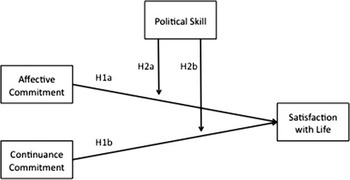
In regards to the relationship between organizational commitment and satisfaction with life, we predicted that an employee’s level of political skill might influence them to appraise situations differently. In other words, political skill may act as a resource that determines whether the employee views their work situation as either positive (thus attenuating the relationship between commitment and life satisfaction) or negatively (exacerbating the relationship between commitment and life satisfaction). In particular, we posited that when an individual’s commitment is based on their desire to be part of the organization (i.e., affective), then those high in political skill will experience more satisfaction with life due to their ability to engage with and influence individuals in an environment where they are content. However, when an individual’s organizational commitment is based on a lack of viable alternatives (i.e., continuance), then those high in political skill will experience less life satisfaction than those lower in political skill. In situations where control is extremely low or unattainable, feelings of frustration may arise in those individuals high (rather than low) in political skill due to the heightened awareness associated with social astuteness, networking ability, and interpersonal influence. Such a prediction is consistent with recent speculation by researchers who suggest that having too much of a resource, such as control-related concepts (Hobfoll, Reference Hobfoll2002) or even political skill itself (Ferris et al., Reference Ferris, Treadway, Perrewé, Brouer, Douglas and Lux2007), can be related to negative outcomes. In fact, political skill has, for example, been shown to have an inverted U-shaped relationship with job satisfaction (Kolodinsky, Hochwarter, & Ferris, Reference Kolodinsky, Hochwarter and Ferris2004). Therefore, we predicted the following (see Figure 1):
Hypothesis 2a: Political skill will moderate the relationship between affective commitment and life satisfaction, such that life satisfaction is higher when both affective commitment and political skill are higher.
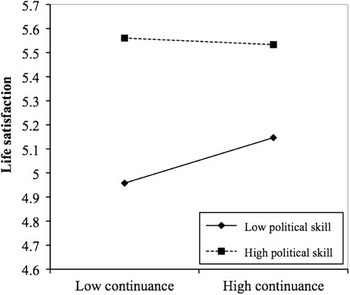
Hypothesis 2b: Political skill will moderate the relationship between continuance commitment and life satisfaction, such that life satisfaction is lower when both continuance commitment and political skill are higher.
Conceptual model

Method
Research context
While prior research suggests that organizational commitment varies across cultures (Cohen & Gattiker, Reference Cohen and Gattiker1992; Ibrahim & Rue, Reference Ibrahim and Rue1994), more recent meta-analyses reveal that affective and continuance commitment have resulted in weak or nonsignificant results (Fischer & Mansell, Reference Fischer and Mansell2009; Meyer et al., Reference Meyer, Stanley and Parfyonova2012). However, because cultural and economic factors might influence perceptual evaluations by shaping meaning and perception (Meyer et al., Reference Meyer, Stanley and Parfyonova2012), we contextualize our research by offering a brief overview of the Ecuadorian and organizational environments.
Ecuador is a small (population 13 million) South American developing country with a combined unemployment and underemployment rate at the time of this study of ~60% (Instituto Nacional de Estadisticas y Censos del Ecuador, 2013). According to the GLOBE (Global Organizational and Behavioral Effectiveness) project, Ecuador has a human development index (HDI) of 0.767 placing it in 73rd place out of 146 countries (House et al., Reference House, Hanges, Javidan, Dorfman and Gupta2004). Ecuador is characterized by low assertiveness, high uncertainty avoidance, high power distance, and high in-group collectivism. These dimensions might have important implications for the relationships researched in this paper since ‘high uncertainty-avoidance cultures may have a greater need for control (Hofstede, Reference Hofstede1980), suggesting a higher threshold of perceived control necessary for a commitment bond to form’ (Klein, Molloy, & Brinsfield, Reference Klein, Molloy and Brinsfield2012: 142). Also, in countries with high power distance, such as Ecuador, the bonds between employees are greater than those between the employee and the organization (Cheng, Jiang, & Riley, Reference Cheng, Jiang and Riley2003). Finally, countries with high unemployment and underemployment rates, such as Ecuador, may have important implications for individual perceptions of feeling ‘trapped,’ as reflected by continuance commitment, in their current organization.
The particular firm under investigation in this study is a relatively large (over 1,000 employees), well-established, Ecuadorian financial services firm with a positive social perception. While the firm operates in multiple cities around Ecuador, the largest offices are located in Quito, the capital, and Guayaquil, the primary port and financial hub of Ecuador. Compensation in this firm are not tied to sales metrics, but rather to the achievement of goals established by the employees in conjunction with their supervisors.
Procedure and participants
Employees from a large Ecuadorian financial services (non-sales) firm were asked by the HR Director to participate in this study. Employees were given time to complete the survey during working hours. Of the 1,042 employee population asked to complete the questionnaire, 841 responses were received, resulting in an 81% response rate. Of the 841 responses received, 620 had no missing data on any of the variables and thus was the sample used for the analysis described below. Approximately 52% of the responses were male and 48% female, with ages ranging from 21 to 64 years of age. The survey was first translated into Spanish and then back translated to English by another native Spanish speaker. The translation was then analyzed and discussed with a third party correcting for any inconsistencies.
Main variables
Commitment
Affective and continuance commitment were measured using Meyer and Allen’s (Reference Meyer and Allen1997) survey items that range from 1=‘strongly disagree,’ to 7=‘strongly agree’. Affective commitment included eight items, of which two were reverse coded. A sample item from the affective commitment scale included ‘I would be very happy to spend the rest of my career with this organization.’ This scale yielded a Cronbach’s α of 0.75. Due to the low reliability, which may have been an artifact of changes of meaning due to the translation, the data were further analyzed to check for loadings of the items on the construct. The two reverse coded items had unsatisfactory loadings suggesting that they were not capturing the underlying construct and hence were deleted from the summated scale. The resulting reliability of the scale was 0.87, indicating good reliability (George & Mallery, Reference George and Mallery2003; Hair, Black, Babin, & Anderson, Reference Hair, Black, Babin and Anderson2010). Consistent with these findings, a principle components analysis supported a one-factor solution, accounting for 62% of the variance (after dropping the reverse coded items); therefore, during subsequent steps, the two reverse coded items were dropped since they were not adding to the simple factor structure and did not conform to a minimal criteria of having a primary factor loading of 0.4 or above, and no cross-loading of 0.3 or above (see Costello & Osborne, Reference Costello and Osborne2005).
Continuance commitment also included eight items of which two were reverse coded. This scale yielded a Cronbach α of 0.54. Upon examination of the item loadings, two reverse coded items had unsatisfactory loadings, similar to affective commitment, suggesting that they were not capturing the underlying construct and hence were deleted from the summated scale. The resulting reliability of the scale was 0.67 and therefore acceptable (Moss et al., Reference Moss, Prosser, Costello, Simpson, Patel, Rowe, Turner and Hatton1998; George & Mallery, Reference George and Mallery2003; Hair, et al., Reference Hair, Black, Babin and Anderson2010). Cronbach’s α values are on the diagonal of Table 1. Similar to affective commitment, a principle components analysis supported a one-factor solution, accounting for 57% of the variance (after dropping the reverse coded items); therefore, during subsequent steps, the two reverse coded items were dropped since they were not adding to the simple factor structure and did not conform to a minimal criteria of having a primary factor loading of 0.4 or above, and no cross-loading of 0.3 or above (see Costello & Osborne, Reference Costello and Osborne2005).
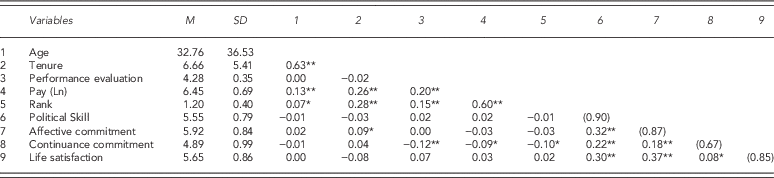
Descriptive statistics, intercorrelations and reliabilities

Note. N=620
Values in parentheses represent internal consistency (α) estimates.
*p<.05 (two-tailed); **p<.01 (two-tailed).
Political skill
Political skill was measured using the full 18-item Political Skill Inventory (PSI; Ferris et al., Reference Ferris, Treadway, Kolodinsky, Hochwarter, Kacmar, Douglas and Frink2005). The Political Skill Inventory includes the four dimensions of network ability, apparent sincerity, social astuteness and interpersonal influence, and uses a scale ranging from 1=‘strongly disagree,’ to 7=‘strongly agree.’ A sample item measuring network ability is ‘I spend a lot of time and effort at work networking with others’; a sample item for apparent sincerity is ‘I try to show a genuine interest in other people’; a sample item for social astuteness is ‘I am particularly good at sensing the motivations and hidden agendas of others’; and a sample item for interpersonal influence is ‘I am able to communicate easily and effectively with others.’ A principle components analysis was used to verify whether a four-factor solution was relevant in the current sample. Consistent with past research (e.g., Ferris et al., Reference Ferris, Treadway, Kolodinsky, Hochwarter, Kacmar, Douglas and Frink2005), the four-factor solution, which accounted for 65% of the variance, provided the best fit given the flattening out of eigenvalues after four factors, the inadequate number of primary loadings, and the difficulty of interpreting additional factors (see Costello & Osborne, Reference Costello and Osborne2005). Nevertheless, despite the existence of four subdimensions of the political skill measure, consistent with our theoretical focus, the way the measure was validated (i.e., Ferris et al., Reference Ferris, Treadway, Kolodinsky, Hochwarter, Kacmar, Douglas and Frink2005), and other researchers use of the measure (e.g., Jawahar, Stone, & Kisamore, Reference Jawahar, Stone and Kisamore2007; Blickle et al., Reference Blickle, Meurs, Zettler, Solga, Noethen, Kramer and Ferris2008), we were only interested in the higher order measure of political skill that combines each of the four dimension together. This full Political Skill Inventory scale yielded a Cronbach’s α of 0.90.
Satisfaction with life
Satisfaction with life was measured using Diener, Emmons, Larsen, and Griffin (Reference Diener, Emmons, Larsen and Griffin1985) satisfaction with life scale. A sample item from the scale is ‘I am satisfied with my life.’ The scale included five items and ranged from 1=‘strongly disagree,’ to 7=‘strongly agree.’ This scale yielded a Cronbach’s α of 0.85.
Control variables
Influences from both the family and work domains have been theorized and empirically tested to impact life satisfaction (Tyssen, Hem, Gude, Gronvold, Ekeberg, & Vaglum, 2009; Erdogan et al., Reference Erdogan, Bauer, Truxillo and Mansfield2012). In line with prior research, we controlled for the family variables age and number of dependents, as well as the work-related variables salary, performance evaluations, and tenure (e.g., Hakanen & Schaufeli, Reference Hakanen and Schaufeli2012). It is worthy to note that prior research has typically found weak support for the influence of demographic data on life satisfaction (Campbell, Converse, & Rogers, 1976; Diener, et al., Reference Diener, Suh, Lucas and Smith1999). Performance evaluations were included as a control variable grounded on the Job Characteristics Model (Hackman & Oldham, Reference Hackman and Oldham1976), and empirical support for the model (Heller, Watson, & Ilies, Reference Heller, Watson and Ilies2004), that suggests that feedback influences job satisfaction which, in turn, has been found to have a strong relationship with life satisfaction (Tait, Padget, & Baldwin, 1989). Therefore, based on the theoretical and empirical evidence linking performance evaluations and life satisfaction, we controlled for variance that could have distorted our results.
Age
Age was determined by the number of months from birth until the time when this study was conducted. Ages ranged from 21 to 64 with a mean age of 34 (SD=7.98).
Number of dependents
The number of dependents was self-reported and operationalized as the number of immediate family members who were financially dependent on the employee and were under the age of 18. In all, 42% of the sample had no children, while 58% had between one and six children.
Salary
Salary reflects the monthly net pay excluding commissions or bonuses. A natural logarithmic transformation was performed to normalize the data. Salaries ranged from $240 to ~$9,000/month with a mean of $818.62/month.
Performance evaluations
The yearly performance evaluations scores were measured by the individuals supervisor using a 5-point likert type scale with 1 (one) indicating poor performance and 5 (five) indicating excellent performance. Performance evaluations ranged from 3 to 5 with a mean of 4.28.
Tenure
Tenure was operationalized as the number of years from the time of employment until the time of this study. Tenure ranged from 1.1 to 36.18 years with a mean of 6.66 years.
Results
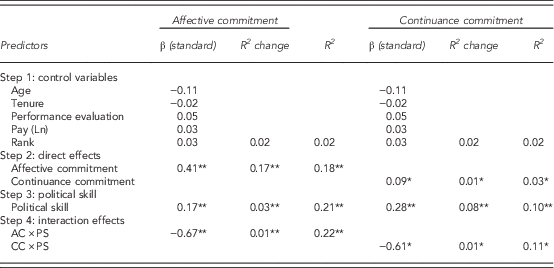
For descriptive statistics, correlations, and reliabilities see Table 1. Two separate hierarchical moderated multiple regressions (i.e., affective commitment as predictors and political skill as moderator in one and continuance commitment as predictors and political skill as moderator in the other) were conducted on the dependent variable of life satisfaction (see Table 2). For both models, age, number of dependents, salary, performance evaluations, and tenure served as control variables (step 1)Footnote 1 . Subsequent variables were entered as follows: main effects of affective commitment (Model 1, step 2), and continuance commitment (Model 2, step 2), main effect of political skill (Models 1 and 2, step 3) then two-way interactions between affective commitment and political skill (Model 1, step 4), and continuance commitment and political skill (Model 2, step 4).
Multiple regression results

Note.AC, affective commitment; PS, political skill; CC, continuance commitment.
**p<.01; *p<.05.
For Model 1 in which affective commitment was used as the predictor, the control variables accounted for 2%, F(5, 614)=2.22, p=.05, of the variance in life satisfaction. Adding the main effect of affective commitment created a significant improvement in the model, accounting for an additional 17.5% of variance, F(6, 613)=22.9, p<.001, in life satisfaction. The addition of the main effect of political skill accounting for an additional 3% of variance in life satisfaction, significantly improving the model, F(7, 612)=23.19, p<.001. Finally, adding the two-way interaction between affective commitment and political skill accounted for an additional 1% of variance, F(8, 611)=21.35, p<.001, in life satisfaction.
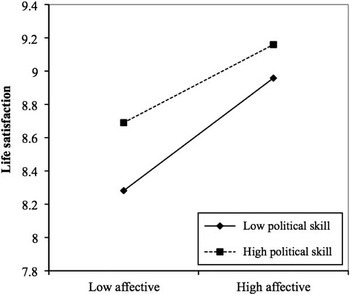
Specifically, at step 1, no significant effects were found. At step 2, a significant effect for affective commitment was found (β=0.41, p<.001), such that as scores on affective commitment increase so do scores on life satisfaction, supporting Hypothesis 1a. At step 3, a significant effect for political skill was found (β=0.17, p<.001), such that as scores on political skill increase so do scores on life satisfaction. This was qualified by a significant two-way interaction at step 4 between affective commitment and political skill (β=0.67, p=.01), such that life satisfaction is higher when both affective commitment and political skill are higher, supporting Hypothesis 2a (see Figure 2). An examination of the simple slopes reveled that among those low in affective commitment, those high in political skill had significantly higher life satisfaction than those low in political skill, B=0.28, t=5.43, p<.001, with those high in affective commitment significantly showing the same pattern, B=0.40, t=7.86, p<.001.
Interaction of political skill on affective commitment and life satisfaction

For Model 2, in which continuance commitment was used as the predictor, the control variables accounted for 2% of the variance, F(5, 614)=2.22, p=.05, in life satisfaction. Adding the main effect of continuance commitment created a significant improvement in the model, accounting for an additional 1% of variance, F(6, 613)=2.66, p<.001, in life satisfaction. The addition of the main effect of political skill, accounting for an additional 9% of variance in life satisfaction, significantly improving the model, F(7, 612)=9.85, p<.001. Finally, adding the two-way interaction between continuance commitment and political skill accounted for an additional 1% of variance in life satisfaction, F(8, 611)=9.26, p<.001.
Specifically, at step 1, no significant effects were found. At step 2, a significant effect for continuance commitment was found (β=0.09, p=.03), such that as scores on continuance commitment increase, so do scores on life satisfaction, directly counter to Hypothesis 1b. At step 3, a significant effect for political skill was found (β=0.28, p<.001), such that as scores on political skills increase so do scores on life satisfaction. This was qualified by a significant two-way interaction at step 4 between continuance commitment and political skill (β=0.61, p=.03), such that life satisfaction is lower when both continuance commitment and political skill are higher (see Figure 3); however examination of simple slopes failed to support Hypothesis 2b. Specifically, an examination of the simple slopes reveled that among those high in continuance commitment, those high in political skill did not have a significantly higher life satisfaction than those low in political skill, B=−0.04, t=−1.09, p=.28, while those low in continuance commitment who were high in political skill only had a marginally significantly lower life satisfaction than those low in political skill, B=0.07, t=1.79, p=.08.
Interaction of political skill on continuance commitment and life satisfaction

Discussion
Political skill has typically been couched as having a positive intrapsychic influence that minimizes stress and strain through a heightened sense of awareness and control. However, in an effort to gain further insights concerning the construct, we sought to research the negative intrapsychic consequences that may accompany such a skill. Toward that end, this study explored how political skill, accompanied by divergent forms of motivation (i.e., affective and continuance commitment), influences life satisfaction. Our results suggested that higher levels of political skill are related to higher life satisfaction for those with higher levels of affective commitment to their organization. These results are consistent with prior theoretical and empirical work that proffer the construct as a skill that has the capability of helping individuals achieve both objective and subjective career success (Ng, Eby, Sorensen, & Feldman, Reference Ng, Eby, Sorensen and Feldman2005). However, although our findings were consistent with prior theoretical (grounded in COR theory) and empirical work suggesting that political skill may operate as an intrapsychic buffer against stress and strain, and hence result in higher levels of life satisfaction (e.g., Harvey et al., Reference Harvey, Harris, Harris and Wheeler2007), we theoretically argued (grounded in CAT), but failed to empirically find, that individuals with high political skill may at times experience decreased life satisfaction. We speculate that it is possible that while political skill enhances an individual’s awareness and sense of control over their environment, its primary function is as an adaptive mechanism that allows an individual to thrive in their context. Particularly in developing countries, such as those is Latin America, where income is low and unemployment is high, individuals might experience life satisfaction by being able to cleverly maneuver within their organizations and hence secure their employment.
Another interesting finding is that both affective and continuance commitment had a positive relationship with life satisfaction while prior research has typically shown a positive relationship between affective commitment and life satisfaction and a negative relationship between continuance commitment and life satisfaction (Vanaki & Vagharseyyedin, Reference Vanaki and Vagharseyyedin2009; Lambert et al., Reference Lambert, Kim, Kelley and Hogan2013). One possible explanation, that is consistent with past research, is that ‘the continuance commitment component is more highly correlated with affective and normative components in lower income contexts, and therefore these commitment components might be less distinguishable in more adverse economic contexts’ (Fischer & Mansell, Reference Fischer and Mansell2009: 1353). In other words, it is plausible that in contexts with low income and high unemployment, such as those found in many Latin American countries, the boundary between affection for ones organization and feelings of attachment due to a lack of opportunities becomes blurred.
These findings have important theoretical and practical implications. Theoretically, our study advances knowledge in the cognition domain by testing the assumption of CAT regarding how resources may influence expectations and hence may have either positive or negative effect on well-being. Specifically, our results did not support the use of CAT over COR because we found no evidence that the intrapsychic resource of political skill, coupled with a sense of being ‘trapped’ (i.e., continuance commitment), resulted in lower life satisfaction. However, we acknowledge that these results may be unique to the political skill construct and not reflective of a flaw in the CAT theory. Therefore, further research is warranted in this domain; specifically, empirically distinguishing the tenets of CAT that differ from (or build upon) those of COR.
Another theoretical insight obtained from this research is the positive relationship between continuance commitment and life satisfaction. The results suggest, as mentioned previously, that organizational commitment dimensions might be influenced more by broad economic indicators more so than by cultural nuances. We recommend that future cross-cultural research take this into consideration and explore (theoretically and empirically) the impact of economic indicators on individual perceptions of and relations with their organizations.
Further, prior research suggests that the sense of control gained by political skill and perceived organizational support, along with high-quality leader-member exchanges (LMX), is related to positive employee outcomes such as lower job stress and higher engagement and commitment (Demerouti, Bakker, Nachreiner, & Schaufeli, Reference Demerouti, Bakker, Nachreiner and Schaufeli2001; Schaufeli & Bakker, Reference Schaufeli and Bakker2004; Mauno, Kinnunen, & Ruokolainen, Reference Mauno, Kinnunen and Ruokolainen2007; Schaufeli, Taris, & van Rhenen (Reference Schaufeli, Taris and van Rhenen2008). For future cross-culture research, it would be interesting to consider the association between perceived organizational support and leader-member exchanges as it relates to political skill, levels of organizational commitment, and life satisfaction.
We recognize that this study also has limitations. The two primary limitations are the generalizability of the findings and the causal inferences based on a cross-sectional data set. For example, the results from our study may only generalize to other large firms in developing Latin American countries that share Ecuador’s colonial heritage and cultural dimensions (e.g., individualism/collectivism, power distance, assertiveness, and so forth). Research suggests that commitment and life satisfaction levels may, in part, be culturally dependent (Diener, Reference Diener2009). This may help explain why our findings of a positive relationship between continuance commitment and life satisfaction were directly opposite of what was predicted based on past research. In particular, it may be that in cultures where the bonds between employees are greater than those between the employee and the organization, high continuance commitment by itself positively relates to life satisfaction (Cheng, Jiang, & Riley, Reference Cheng, Jiang and Riley2003). Generalizability issues could also exist given that our data were collected in one financial services industry organization. However, we found no research to support industry-level differences of the main constructs of this study (political skill, commitment, and life satisfaction).
Similarly, we predicted lower levels of life satisfaction for participants who have higher levels of continuance commitment and political skill. Perhaps the cultural and economic conditions of participants in our survey may offer an explanation of our nonsignificant results. Our study was conducted in an area of high unemployment and underemployment; therefore, alternative job opportunities may be scarce for the participants of this survey. Perhaps under these conditions where employees are simply grateful to have any job, feelings of being ‘trapped’ in a current position are not as salient, even if an employee is aware that they possess the ability to achieve more. Therefore, we suggest that future researchers explore similar models under other cultural and economic conditions.
Furthermore, the cross-sectional nature of the data does not allow us to infer causality among the variables. This is particularly significant because the causal direction between organizational commitment and life satisfaction has yet to be established in the literature (Erdogan et al., Reference Erdogan, Bauer, Truxillo and Mansfield2012). In fact, the theoretical debate of whether more stable dispositional traits (i.e., top-down approach) or contextual factors (i.e., bottom-up approach) are the sources of satisfaction is still unresolved (Heller, Watson, & Ilies, Reference Heller, Watson and Ilies2004). Therefore, we agree with other researchers (e.g., Diener et al., Reference Diener, Suh, Lucas and Smith1999; Heller, Watson, & Ilies, Reference Heller, Watson and Ilies2004) that life satisfaction research needs to move toward more longitudinal studies in order to gain a greater understanding of temporal effects of the antecedents and outcomes of life satisfaction as well as to be able to perform causal modeling.
From a practical perspective, this study contributes to our understanding of the influence of political skill on the commitment-life satisfaction relationship. It is likely that individuals benefit from a balance between the assessment of their resources and their environmental constraints. In other words, well-being in general, and life satisfaction in particular, may result from a balanced cognitive appraisal between intrapsychic resources and situational constraints. If individuals have under or overdeveloped resources (e.g., political skill), this imbalance might lead to a mismatch between resources and situational demands, resulting in a state of dissonance, which requires coping or causes helplessness (Meurs & Perrewé, Reference Meurs and Perrewé2011). As the results of the current study indicate, individuals who develop their resources (i.e., political skill) may find job opportunities better aligned with their knowledge, skills, abilities, and aspirations and have higher well-being in their life.
Acknowledgments
We would like to acknowledge the editor and reviewers for their help in developing this article.