INTRODUCTION
The low milk production of both exotic and cross-bred cattle is still the main problem in dairy farming in the tropics. The combination of high temperature and humidity (as indicated by the temperature humidity index (THI)) is a main factor that can produce heat stress and have a negative effect on lactation performance and physiological status of dairy cows (Armstrong Reference Armstrong1994; Kadzere et al. Reference Kadzere, Murphy, Silanikove and Maltz2002). The mechanisms for an alteration of digestive function in cross-bred dairy cattle during exposure to high temperatures are not yet clear, although a reduction in dry matter intake (DMI) is known as one of the responses to heat stress leading to a reduction of milk yield. However, there are inconsistent results as regards the relationship between high environmental temperature and digestive function. Some reports showed a reduction in diet digestibility by excess THI, which relates to a decline in ruminal activity through the depression of rumen cellulolytic activity (Bernabucci et al. Reference Bernabucci, Bani, Ronchi, Lacetera and Nardone1999). Slower passage rate and longer mean retention time of digesta have been shown in response to high ambient temperature (AT) (Christopherson & Kennedy Reference Christopherson and Kennedy1983; Silanikove Reference Silanikove1992). Other results have shown an increase in diet digestibility in dairy cows exposed to a hot environment (Collier et al. Reference Collier, Beede, Thatcher, Israel and Wilcox1982; Mathers et al. Reference Mathers, Baber and Archibald1989). The increase in diet digestibility would result in increase in total volatile fatty acids produced at high temperatures which might lead to increased heat production and result in increased body temperature (Shibata & Mukai Reference Shibata and Mukai1979).
Many technologies are required to improve milk production of dairy cattle in the tropics. Environmental modification is the most common approach with alleviation of severe heat stress in dairy cattle by, for example, fans and sprinklers (Fike et al. Reference Fike, Staples, Sollenberger, Moore and Head2002) or evaporative cooling systems (Chan et al. Reference Chan, Huber, Chen, Simas and Wu1997). Armstrong (Reference Armstrong1994) found that cows cooled with spray and fans had greater milk yields than those cooled with evaporative cooling systems. In addition to environmental modification, other technologies can increase milk production in dairy cattle, for example the application of exogenous bovine somatotropin (bST) has been reported to minimize the effects of heat stress and potentially increase milk yields (West Reference West1994). However, few data are available on the relationship between the action of exogenous somatotropin and the effect of high temperatures on milk production in cross-bred Holstein cows in the tropics. Somatotropin is known to play a role in galactopoiesis and contributes to both homoeostasis and homeorhesis in ruminants (Bauman & Currie Reference Bauman and Currie1980). Administration of bST to lactating cows in a hot environment can increase milk yield (West et al. Reference West, Mullinix and Sandifer1991), but such cows also increase heat production by approximately 25% over the value in control cows (West Reference West1994). Johnson et al. (Reference Johnson, Li, Manula, Spencer-Johnson, Becker, Collier and Baile1991) reported that somatotropin increased the efficiency of feed conversion into milk without any significant changes in body weight (BW) and temperatures. These results show that there is no consistent conclusion about the interaction effects between thermal stress and bST on lactation performance. Little is known about how somatotropin modifies digestive function in cross-bred cattle.
In other ruminants, an increase in the rate of liquid flow from the rumen during heat exposure has been reported in buffaloes and goats (Chaiyabutr et al. Reference Chaiyabutr, Buranakarl, Muangcharoen, Loypetjra and Pichaicharnarong1987; Silanikove & Tadmor Reference Silanikove and Tadmor1989). It is believed that increased water absorption occurs in the lower gastrointestinal (GI) tract to increase heat dissipation during heat exposure. In view of an increase in total body water in recombinant bST (rbST)-treated cows (Chaiyabutr et al. Reference Chaiyabutr, Thammacharoen, Komolvanich and Chanpongsang2007), it is necessary to establish whether rbST supplementation in cows maintained at high temperatures will minimize the effects of heat stress and whether the flow rate of digesta from the rumen will maintain sufficient nutrients to sustain the potentially increased milk yields. It is therefore important to study the digestive function and milk yields during bST supplementation under high AT in cross-bred dairy cattle. Therefore, the objectives of the current study were to evaluate (1) the effect of providing cross-bred cattle with housing under shade with or without mister-fans and (2) supplementation of cows with rbST or not during periods of lactation (early, mid and late lactation). Measures to evaluate the effectiveness of these treatments were feed intake, digestion kinetic, diet digestibility, efficiency of feed utilization and milk production.
MATERIALS AND METHODS
Animals, housing and managements
Ten primiparous, non-pregnant cross-bred cattle (0·875 Holstein), age 36±2 months, average BW 358±32·5 kg and body condition score (BCS) 2·5±0·50 were used for the experiment. Cows, on average, had been 60±1 days in milk (DIM) at the start of the trial. They were assigned randomly into two groups of five animals each. During the study period, cows in both groups were housed in an open-sided barn with a tiled roof and tie-stall. The barn (16 m long×7 m wide×3·5 m high) was separated into two parts by a metal sheet wall (3·5 m high) to ensure no drift of water from the mist treatment could reach to the other half of the barn. The first part was arranged for non-cooled cows in normal shade (NS) and the second part of the barn for cooled cows was equipped with two pedestal mist-fan cooling systems (MF), which were placed 2 m from the ground to cool the cows. Each system consisted of a 650 mm diameter blade fan circulating 81 m3/min of air, with oscillation coverage of 180°. The amount of water discharged from four mister spray heads (placed close to the fan) was 7·5 litres/h; the size of the mist droplets was 0·01 mm. Cooled cows were exposed to MF for 45 min at 15 min intervals from 06.00 to 18.00 h. At night, animals were exposed to MF for 15 min at 45 min intervals from 18.00 to 06.00 h.
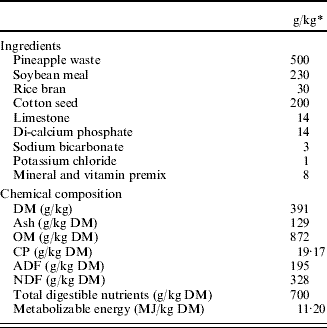
Cows in both groups were fed a total mixed ration (TMR) formulated according to NRC requirements (National Research Council 2001) for cows producing 10–15 kg milk/day. The TMR diet and ingredients are shown in Table 1. The TMR was offered twice daily at 1·1 of assumed ad libitum consumption at 06.00 and 17.00 h throughout the experimental period. Water was given to cows ad libitum. DMI of each cow was measured daily by weighing the TMR offered and subtracting the amount refused. Cows were normally milked at around 06.00 and 17.00 h and milk production was recorded daily.
Feed ingredients and chemical compositions of the diet

* As fed basis.
The AT in NS and MF barns were recorded using a wet and dry bulb thermometer. The relative humidity (RH) at NS and MF barns were read by a psychrometric chart depending on wet and dry bulb temperature. ATs and humidity were measured during the daytime (13.00 h), 3 days before beginning of the first injection of rbST (pre-supplemented period) and 3 days after the third injection of rbST (supplemented period) in each stage of lactation. Average values were considered to be the mean values of all measurements taken throughout periods of study.
On each specified day during measurements of AT around 13.00 h, rectal temperature (RT) of each cow was measured by electronic thermometer and respiration rates (RRs) were measured by counting flank movements. BWs of all animals were recorded by weighing monthly throughout experimental periods. The procedures used in the present study were carried in accordance with the principles and guidelines of the Faculty of Veterinary Science, Chulalongkorn University. These guidelines were formulated to comply with international standards and are in accordance with the principles and guidelines of the National Research Council of Thailand.
Experimental design
The experiment in each group was divided into three periods, namely early- (60–90 DIM), mid- (120–150 DIM) and late-lactating periods (180–210 DIM). The pre-treatment study was conducted on the starting day of each period. At the end of the pre-treatment, within the same day, the cow was injected with the first subcutaneous injection of 500 mg of rbST (POSILAC, Monsanto, USA). Subsequently, the animal was injected with two consecutive doses injections of rbST every 2 weeks. Thereafter, within 3 days of the third injection, the effect of rbST supplementation was assessed. During the last 30 days of each period, no procedures were performed. This allowed effects of handling, sampling and rbST to return to normal before the start of the next period. It has been demonstrated in dairy cattle by Kirchgessner et al. (Reference Kirchgessner, Windisch, Schwab and Muller1991) that, during the first week after injection of bST, milk yield increased sharply and almost returned to control level within the next 3 weeks.
Sample collection and chemical analysis
Chromic oxide (Cr2O3) was used as an external marker to estimate digestibility and passage rate of digesta in the total GI tract of each cow. Cows were given 10 g Cr2O3/day contained in gelatin capsules. Cr2O3 was divided into two portions and was given orally to animals twice a day at 06·00 and 18·00 h for 10 days. To determine diet digestibility, faecal grab samples were collected three times a day from day 8 to day 10 after dosing so that nine samples were taken for each cow. Nine faecal samples were pooled and dried for analysis of chemical composition. After the last dose of chromic oxide, individual faecal grab samples were collected at 0, 4, 8, 12, 16, 20, 24, 30, 36, 44, 50, 62, 68, 74 and 96 h. The samples were dried in a forced oven dryer at 70°C for 24 h, followed by grinding. The chromic oxide content of the sample was determined by a colorimetric method according to Kimura & Miller (Reference Kimura and Miller1957) using a nitric–perchloric acid oxidation with molybdate catalyst. The concentrations of Cr2O3 in the faeces were used for estimation of the passage rate of digesta.
Samples of TMR were collected weekly and pooled for determinations of dry matter (DM), organic matter (OM), crude protein (CP), neutral detergent fibre (NDF) and acid detergent fibre (ADF). Feed and faeces were dried at 55°C in a forced-air oven for 72 h and were analysed for DM concentration. All dried samples were ground with a Wiley mill (1 mm screen). All feed and faeces samples were dried at 105°C for 8 h in a forced-air oven before determination of components (OM, CP, NDF and ADF). The ash concentration of samples was determined by heating at 550°C for 5 h in a muffle furnace. Concentrations of NDF and ADF were determined according to Van Soest et al. (Reference Van Soest, Robertson and Lewis1991). CP was determined using the Kjeldahl procedure (AOAC 1990).
Calculation
The semi-logarithmic plot of Cr2O3 concentrations in faeces were plotted against time of sampling taken over the period of 4 days after the last dose of Cr2O3 administration. The descending portion of the curve was used for regression analysis and the regression line represents the passage rate and half life of Cr2O3. The digesta passage rate constant (per hour), mean retention time (h), faecal output (kg DM/day), digesta flow rate (kg/day), concentration of DM and digestibility, and efficiency of feed utilization for milk production were calculated as follows:


where M=marker, N=nutrients, M conc.=marker concentration, t 1/2=half-time of Cr2O3 in the whole digestive tract.

where FCM=fat-corrected milk at 40 g/kg (kg/cow/day), DMI=dry matter intake (kg/day).
A THI was calculated from the average AT of dry and wet bulb temperatures according to McDowell (Reference McDowell1972), as follows:

where ‘wb’ is the wet bulb temperature and ‘db’ is the dry bulb temperature expressed in °C.
Statistical analysis
Data for BW, DMI and milk yield in each lactating period were adjusted for covariate effects using the mean value in the 14 days before onset of the experimental period (46–59 DIM). The statistical analyses were performed using general linear model procedures of statistical software package SPSS (SPSS for windows, V14.0; SPSS Inc., Chicago, IL, USA). The model used for each analysis was

where Yijk =observation, μ=overall mean, Al =animal effect, Hi =house effect as main plot (i=NS, MF), A(H) il =main plot error (animal l in house i), Bj =treatment effect (rbST) as a split plot (j=with and without rbST supplementation), (HB) ij =interaction effect between treatment and house, A(HB) ijl =split plot error (animal l in house i and treatment j), Cov k =covariate effect and eijk =residual error.
The environmental and physiological parameters, digesta passage rate and digestibility were also analysed by a similar model, but the covariate effect was not included. The mean values were used to evaluate the effect for all variables. Statistical significance was assessed as P<0·05 and trends were declared at 0·05<P⩽0·10.
RESULTS
ATs, RH, THI, RR and RT
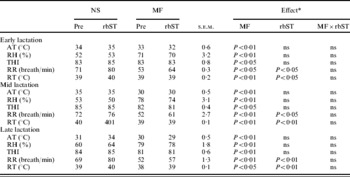
Data for ATs, RH, THI, RT and RR are shown in Table 2. The mean values of measurements at experimental site for AT, RH and THI were highly significantly different (P<0·01) between NS and MF barns. The AT and THI in the NS barn were significantly higher than the MF barn but the RH of MF barn was significantly higher than the NS barn (P<0·01) at all stages of lactation. The RR and RT of cooled cows were lower than non-cooled cows irrespective of rbST supplementation at all stages of lactation. The rbST-supplemented cooled and non-cooled cows were significantly higher in RR and RT than those of cows without rbST throughout the experimental periods.
The mean values of AT, RH, THI measured at 13.00 h under MF cooling and NS barns and effects of cooling and supplemental rbST on respiratory rate and RT of cross-bred cows

Pre, pre-rbST supplementation; rbST, rbST supplementation.
* Effect: MF, mist-fan cooling effect; rbST, rbST effect; MF×rbST, interaction effect of MF and rbST.
The statistical significance of main and interaction effects are shown as P-value, ns=not significant (P>0·05).
BW, DMI, milk yield and efficiency of feed utilization
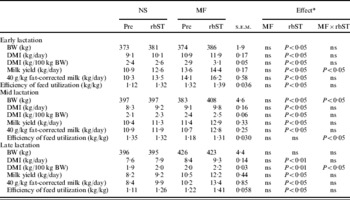
Data of BW, feed intake and milk yields are shown in Table 3. The mean values of BW for cooled and non-cooled cows were not significantly different at all stages of lactation. Supplementation of rbST increased BW of cooled cows during early and mid lactation but not for late lactation. DMI (kg/day) and DMI (kg/100 kg BW) of cooled cows without rbST supplementation were on average 13% higher than those for non-cooled cows at all stages of lactation. The rbST-supplemented cooled and non-cooled cows showed a significantly higher DMI than non-rbST-supplemented cows.
Effects of cooling and supplemental rbST on BW, DMI, milk yield and efficiency of feed utilization of cross-bred Holstein cows housed under MF cooling and NS barns

Pre, pre-rbST supplementation; rbST, rbST supplementation.
* Effect: MF, mist-fan cooling effect; rbST, rbST effect; MF×rbST, interaction effect of MF and rbST.
The statistical significance of main and interaction effects are shown as P-value, ns=not significant (P>0·05).
The milk yields of non-cooled and cooled cows were not statistically different at any stage of lactation. Milk yield and 40 g/kg FCM of rbST-supplemented cooled cows were significantly higher than those of other groups at all stages of lactation. Efficiency of feed utilization for milk synthesis showed no significant differences between cooled and non-cooled cows. Supplemented rbST cows significantly increased the efficiency of feed utilization in early and late lactation but not for mid lactation. However, the interaction effect between cooling and rbST supplementation was significantly different (P<0·05) for an increment in efficiency of feed utilization during mid lactation.
Digestion kinetics and digestibility
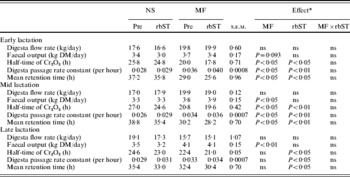
Mean values of flow rate, faecal output, half-time of Cr2O3, passage rate and mean retention time of digesta are shown in Table 4. The digesta flow rates of cooled cows were not significantly different (P>0·05) from those of non-cooled cows at any stage of lactation. Faecal output of cooled cows tended to increase (P=0·09) during early lactation and marked increases were apparent in mid and late lactation as compared with non-cooled cows. The digesta flow rate and faecal output of rbST-supplemented cows were not significantly different when compared with those of non-rbST-supplemented cows throughout the experimental period. The half-time of Cr2O3 in the whole digestive tract for the cooled cows was lower than for those of non-cooled cows without rbST supplementation (P<0·05) during early and mid lactation but not for late lactation. The half-time of Cr2O3 significantly decreased during rbST supplementation in both non-cooled and cooled cows at all stages of lactation. The digesta passage rate constant (the fraction of total digesta moving per unit of time) in cooled cows was significantly higher than in non-cooled cows during early and mid lactation. The magnitude of responses to the effects of rbST supplementation from pre-treatment values for digesta passage rate constant was larger in animals with rbST than those of animals without rbST. The rapid digesta passage rate constant and short mean retention time of digesta were significantly different in rbST-supplemented cooled and non-cooled cows in all stages of lactation.
Effects of cooling and supplemental rbST on digestion kinetics of cross-bred Holstein cows housed under MF and NS barns

Pre, pre-rbST supplementation; rbST, rbST supplementation.
* Effect: MF, mist-fan cooling effect; rbST, rbST effect; MF×rbST=interaction effect of MF and rbST.
The statistical significance of main and interaction effects are shown as P-value, ns=not significant (P>0·05).
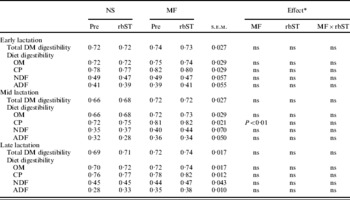
Digestibility data are shown in Table 5. Digestibility of DM, OM, NDF and ADF of cooled cows were not significantly different from those of non-cooled cows, with or without supplementation of rbST in all stages of lactation. CP digestibility during early and late lactation of cooled cows was not significantly different from those of non-cooled cows, except in mid lactation. There was no effect of rbST supplementation on CP digestibility at all stages of lactation.
Effects of cooling and supplemental rbST on digestibility coefficient in cross-bred Holstein cows housed under MF cooling and NS barns

Pre, pre-rbST supplementation; rbST, rbST supplementation.
* Effect: MF, mist-fan cooling effect; rbST, rbST effect; MF×rbST, interaction effect of MF and rbST.
The statistical significance of main and interaction effects are shown as P-value, ns=not significance (P>0·05).
DISCUSSION
In the present study, THI (based upon AT and humidity) was always higher than 72 in the barn for animals of both groups. This value is considered the upper critical THI for lactating dairy cows (Kadzere et al. Reference Kadzere, Murphy, Silanikove and Maltz2002; Smith et al. Reference Smith, Chapa, Willard, Herndon, Williams, Crouch, Riley and Pogue2006). Animals were therefore always subjected to moderate heat stress throughout experimental periods (i.e. THI=80·7–85·5). Thus, the effect of misters and fans for cooling animals in the present study was not sufficient to completely eliminate heat stress. The values of THI might not accurately reflect heat stress when using a mister and fan system for evaporative cooling that result in higher humidity but also cause cooling. Although the MF cooling was not sufficient to adequately reduce THI in the barn, there is a beneficial effect as indicated by a lower RR and RT in cooled cows and also higher milk yield throughout lactation. These results are consistent with the study of Fike et al. (Reference Fike, Staples, Sollenberger, Moore and Head2002) that housing cows during the day with fans and sprinklers effectively reduced heat stress as indicated by lower body temperature and RR. In the present study, an increase in milk yield of rbST-supplemented cows was accompanied by an increase in both RT and RR in comparison with cows without rbST supplementation in both cooled and non-cooled cows throughout the experimental periods. It indicates that cows increase heat production during rbST supplementation. This observation agrees with the report of West et al. (Reference West, Mullinix and Sandifer1991) and comments by West (Reference West1994) that rbST-treated cows in a hot environment may increase heat production in higher and lower milk producing cows.
Thus the use of misters and fans for cooling cows in the present study does partly alleviate the effect of heat stress. Both DMI and milk yield of cooled cows without rbST supplementation were higher than those of non-cooled cows. These results are in agreement with the report of Chen et al. (Reference Chen, Huber, Theurer, Armstrong, Wanderley, Simas, Chan and Sullivan1993) that an increase in milk production was about 9% with evaporative cooling over shade alone. Several studies have reported that lactating cows exposed to high environmental temperatures either with (Settivari et al. Reference Settivari, Spain, Ellersieck, Byatt, Collier and Spiers2007) or without rbST treatment (Bernabucci et al. Reference Bernabucci, Bani, Ronchi, Lacetera and Nardone1999; Hirayama et al. Reference Hirayama, Katoh and Obara2004), showed a reduction in feed intake and milk yields. However, the present results indicate that rbST is effective during hot weather at all stages of lactation, since non-cooled cows with rbST supplementation consumed additional feed for the higher milk production compared with non-cooled cows without rbST. These results agree with earlier findings (Santos et al. Reference Santos, Huber, Theurer, Nussio, Nussio, Tarazon and Lima-Filho1999; Tarazon-Herrera et al. Reference Tarazon-Herrera, Huber, Santos, Mena, Nusso and Nussio1999; Gulay & Hatipoglu Reference Gulay and Hatipoglu2005) that the bST-treated cows improved efficiency of utilization of food for milk production. Another reason for enhancement in DMI during rbST supplementation in non-cooled cows may be that cows were able to regulate their body temperatures within the normal range. Although rbST increases heat production it also increases heat dissipation (Johnson et al. Reference Johnson, Li, Manula, Spencer-Johnson, Becker, Collier and Baile1991). Moreover cows supplemented with rbST increase total body water as shown previously (Chaiyabutr et al. Reference Chaiyabutr, Thammacharoen, Komolvanich and Chanpongsang2007). Increased total body water would be useful in slowing down the elevation in body temperature in hot conditions through evaporative cooling during heat dissipation. These changes would partly affect the DMI.
Increased digestibility with reduced GI motility and rate of passage of digesta in cattle exposed to hot conditions has often been reported (e.g. Christopherson & Kennedy Reference Christopherson and Kennedy1983; Mathers et al. Reference Mathers, Baber and Archibald1989). In the present study, non-cooled cows without rbST supplementation and exposure to moderate heat stress (86>THI>80) had lower values for both rate of passage of digesta and DMI, but digestibility did not significantly change compared with cooled cows throughout the entire lactation period. Thus the apparent digestibility of DM (including NDF and ADF) for the whole tract did not change as might have been expected as a result of changes in load and rate of passage of digesta.
The significant differences in the passage rate of digesta, but non-significant differences in diet digestibility between non-cooled and cooled cows without rbST, cannot depend upon the different types or nature of feeds offered (Deinum et al. Reference Deinum, Van Es and Van Soest1968; Michalet-Doreau & Doreau (Reference Michalet-Doreau and Doreau2001), since cross-bred cows in both groups were fed with a similar TMR diet throughout lactation.
However, it might be because the cows had been subjected to a prolonged period of exposure to high temperature since there is evidence that the response changes with time. Bernabucci et al. (Reference Bernabucci, Bani, Ronchi, Lacetera and Nardone1999) observed an increase in digestibility coinciding with decrease in passage rate of digesta during short-term exposure to excess THI, but not in a long-term adaptation.
In addition, during prolonged heat exposure, depressed rumen cellulolytic activity (Ole Miaron & Christopherson Reference Ole Miaron and Christopherson1992) and reduction of blood flow to the rumen epithelium (Hales et al. Reference Hales, Bell, Fawcett and King1984) may occur in non-cooled cows. These factors would tend to reduce total digestibility. The study of Grimaud & Doreau (Reference Grimaud and Doreau2003) indicated that a shorter retention time of digesta would reduce the attraction between digesta particles and ruminal micro-organisms, resulting in decreased diet digestibility.
Thus, the absence of differences in diet digestibility between non-cooled and cooled cows may be due to differences in rumen cellulolytic activity in cows under different environmental conditions. Depressed rumen cellulolytic activity may not occur in cooled cows resulting in no change in total diet digestibility.
Effect of supplementing with recombinant growth hormone (rbST)
The rate of passage of digesta for both cooled and non-cooled cows supplemented with rbST was higher than for cows without rbST supplementation. This suggests that exogenous rbST could overcome some effects of high temperatures.
However, total DM digestibility of cows in the current study was not affected by rbST supplementation, in agreement with other studies in cows using exogenous bST (Peel et al. Reference Peel, Bauman, Gorewit and Sniffen1981; Sechen et al. Reference Sechen, Bauman, Tyrell and Reynolds1989). A faster rate of passage of digesta is usually given as the reason for the decrease in digestibility (Bernabucci et al. Reference Bernabucci, Bani, Ronchi, Lacetera and Nardone1999). The lack of such an effect in the present study may be partly explained by changes of GI-tract volume and the level of DMI. Increasing the relative mass of many organs and tissues including the GI-tract has been reported during exogenous bST (Moallem et al. Reference Moallem, Dahl, Duffey, Capuco, Wood, McLeod, Baldwin and Erdman2004). Such an increased capacity of the GI-tract mass may compensate for the effect of the higher DMI level on the higher passage rate of digesta in rbST supplemented cows.
The unchanged total digestibility of DM perhaps suggests that more complex processes of regulation exist in the digestive system during rbST supplementation.
In the present study, rbST-supplemented cows showed high efficiency of feed utilization. It has been reported by Bauman (Reference Bauman1992) that an increase in the efficiency of feed utilization for milk production in rbST-supplemented cows is associated with increased partition of nutrients to the mammary gland. From the present results, it would seem that the increased milk production due to the effect of rbST on efficiency of feed utilization depends on both an increase in the partition and post-absorptive use of nutrients for milk synthesis (Sechen et al. Reference Sechen, Bauman, Tyrell and Reynolds1989).
The application of MF cooling to cows slightly increased feed intake and milk yields, whereas rbST supplementation with or without cooling showed more marked increases in both feed intake and efficiency of feed utilization.
The differences in the magnitude of responses of digestive functions between the effects of cooling and rbST supplementation indicate that the main effects of cooling reduce a negative effect of hot environment on digestive function via increase in digesta passage rate, resulting in an increase in feed intake.
The response of milk production in cross-bred cows to rbST supplementation is enhanced when accompanied by the effect of cooling.
The effect of rbST supplementation was not directly on digestive function. It exerted a galactopoietic effect through increased post-absorptive use and partition of nutrients resulting in their increased efficiency of utilization in the mammary gland for milk synthesis.
This study was supported by Thailand Research Fund (BRG498004) and The 90th Anniversary of Chulalongkorn University Fund. W. Chanchai is the recipient of a grant from Rajamongala University of Technology, Lanna, Nan, Thailand.