γνώσɛται δὲ τὸν Διὸς
Διόνυσον, őς πέφυκɛν ὲν τέλɛι θɛός,
δɛινότατος, ὰνθρώποισι δ’
ὴπιώτατος.Footnote 1
—Euripides, BacchaePrologue: Tomb Raider BƒNΛ6,<
As what follows is largely about the ghosting of antiquity, I begin at a broken grave.
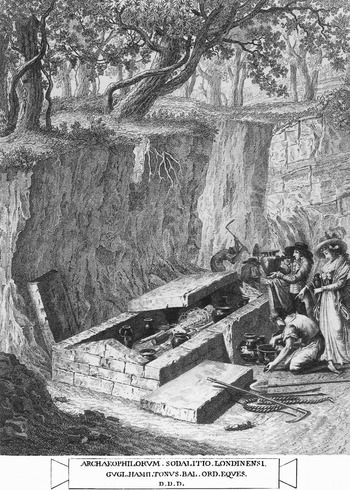
Trebbia, Italy, 1766. The English special envoy to Naples, Sir William Hamilton, accompanied by the best antiquarian field guide in Italy, the German classicist Johann Winklemann (who had just published his pathbreaking study History of Ancient Art in 1764), mounted an excursion to a recently exposed burial ground above Capua. Winklemann described the scene: “Mr. Hamilton … caused these tombs to be opened in his presence, partly for the purpose of seeing the mode of their construction, and partly for the purpose of ascertaining whether vases … would be found in tombs located in places so difficult of access.”Footnote 2 Although Sir William's interest in tomb construction may have been genuine, he never published anything on the subject. However, he was very interested in the contents of these sepulchers, particularly their vases, and was not above despoiling graves to acquire them. A sketch of a similar raid of the Blacas tomb at Nola captures Hamilton in the moment of discovery/desecration. He stands to the side of the opened grave, admiring a fine krater, while a servant tends to the newest additions to Sir William's collection of antique vases (see Fig. 1). Hamilton wrote, “I have been present at the opening of many of those ancient sepulchres, in which, and no where else, such vases are found,” and one gathers that his presence was not serendipitous.Footnote 3
A Tomb at Nola. Engraving by Angelo de Clener after a 1790 watercolor by Christoph Heinrich Kniep. This engraving was the frontispiece to volume 1 of William Hamilton and Johann Wilhelm Tischbein, Collection of Engravings from Ancient Vases, Discovered in Sepulchres in the Kingdom of the Two Sicilies but Chiefly in the Neighborhood of Naples During the Course of the Years MDCCLXXXIX and MDCCLXXXX Now in the Possession of Sir Wm. Hamilton … with Remarks on Each Vase by the Collector, 4 vols. (Naples: W. Tischbein, 1791–5). © The Trustees of the British Museum. Used by permission.

Hamilton's appetite for antiquities was legendary (Horace Walpole thought him “antique mad”), and his appointment as British ambassador to the court of Naples only exacerbated his condition. By the end of his career in 1803, he had acquired hundreds of Greek vases—so many, in fact, that Hamilton's “cabinet” later formed the core of the British Museum's collection of them.Footnote 4 He purchased some from Neapolitan dealers, many of whom were of dubious integrity, but most of them he robbed directly from ancient graves. One hears the longing in Hamilton's voice in a letter he wrote to a colleague in Athens to say that he could not get to the tombs there. However, he helpfully suggested that “if a diligent search were to be made without the walls of Athens, sepulchers with entire vases in them would be found.”Footnote 5 That there were also bodies inside these tombs at Nola, Capua, and Trebbia (Hamilton's usual Neapolitan haunts)—Greek settlers of Magna Graeca (southern Italy) who had remained undisturbed for 2,200 years—was a matter of some inconvenience to the greater business of vase hunting.
Such tomb raids may have returned to haunt Hamilton later in life, particularly because dozens of the vases in his collection, scores perhaps, take for their subject the cult of Dionysus. Ecstatic maenads, randy satyrs, and followers of the god of the grape dance, rage, or frolic across the pages of his published collection, over which presides the god of wine and theatre. The vases Hamilton recovered were among the first images of Dionysus to be popularly circulated since antiquity, and it is not incidental to the argument that it was from despoiled tombs that the god of discord returned to visibility and that in the end the return of Dionysus may have despoiled Sir William.
The arrival and subsequent erasure of Dionysus as a cultural force in the Georgian imagination is the subject of the study that follows. To be clear, I am not speaking of a figural Dionysus in the Nietzschean sense of literary studies (like that of R. D. Stock's Flutes of Dionysus) that trace a vaguely disruptive presence through literature.Footnote 6 Rather, I am interested in the return of the god himself as a reclaimed, recirculated antirational rupture in the English imagination. In the last third of the eighteenth century, as images of Dionysus reemerged from the broken tombs, the god found an immediate and popular circulation through the hands of antiquarians such as Hamilton and members of his club (the Dilettanti), through display in the newly founded British Museum, and through Josiah Wedgwood's mass production of Etruscan ceramicware directly modeled on Hamilton's images of his collection. Theatre practitioners also eagerly embraced the Greek Revival for reasons of their own. However, proponents of the British theatre were not so comfortable with Dionysus, and they quickly and firmly deleted his presence. This article explores how and why that happened.
Dionysus' unruly appearance would be more explicable as another arcane interest of Georgian antiquarians had it not occurred during the most visible period of the Greek Revival, when classicism and Palladian architecture were being aggressively promoted as part of a constellation of shared national values and the English theatre was allying itself with those values by adopting solidly classical antecedents. The role of antiquity in the promotion of theatre was not a small one. The English theatre circa 1769 was in the thick of a self-rehabilitation project to gentrify and distance itself from its essentially medieval reputation as a vagrant profession. Those who sought to legitimate the theatre promoted actors and theatrical managers (such as David Garrick and Samuel Foote), worked to nationalize theatrical spaces (royal patents were issued to theatres in Bath, Bristol, Edinburgh), and vigorously appropriated the Greek Revival and the newly discovered charisma of antiquity—architecturally, genealogically, and ontologically—precisely when antiquity was coming to mean high culture. Yet throughout this intensely cosmetic project in which theatres were made over into Palladian temples to Apollo and to the muses Thalia and Melpomene, theatre proponents edited Dionysus—the god at the core of classical theatre, the god whose cult images were being recovered and recirculated in popular culture—out of the process. When the god of ecstasy returned, he met the full rational force of the Enlightenment and was quickly returned to the tomb. But this did not happen without a certain resistance, and it is the resistance that I pursue here. What follows traces the intersection of English theatre and the Greek Revival, the unwelcomed and slightly embarrassing arrival of Dionysus as part of the new classical vocabulary, the subsequent exclusion of Dionysus from the theatre's newfound classical heritage, and, finally, inexorably, the return of the suppressed god in spite of his exclusion.
In Which the English Theatre Rediscovers Its Classical Origins
No nation under Heaven so nearly resembles the ancient Greeks and Romans as we. There is a Haughty Courage, an Elevation of Thought, a Greatness of Taste, a Love of Liberty, a Simplicity, and Honesty among us, which we inherit from our Ancestors and which belongs to us as Englishmen, and 'tis in These the Resemblance consists.Footnote 7
Visual information easily makes the point that the English aspired to imitate the ancients. Any number of midcentury great houses visibly claimed classical antecedents. Some good examples are Lord Burlington's Chiswick House, thought to be the finest example of early Greek Revival, or Wentworth Woodhouse or Broadlands. Indeed, these houses competed in their displays of pediments, porticos, Doric columns, and Attic friezes lifted straight out of the many Palladian chapbooks that were in circulation by midcentury.Footnote 8 Palladio's Quattro libri had been translated into English as early as 1715, but more accessible were the many manuals such as The Builder's Pocket-Treasure; or, Palladio Delineated that were popularly printed.Footnote 9 Their availability guaranteed that all across the English cityscape young architects could cash in on the desire of elites to be like the Greeks.Footnote 10 From the middle of the century on, the Greek Revival was itself in transition, widening first from the private to the public sphere and later becoming even more broadly deployed, commercialized, and even mimicked. But more important, Palladian classicism—the massive columns, pilasters, high pediments, and exacting symmetry that characterize such Georgian monuments as the British Museum, King's College, and the General Post Office—had also been consolidated into a small but potent constellation of values that came to mean “royal,” “national,” and “governmental.”Footnote 11 By the final third of the century, classical style (what Richardson called “Greatness of Taste”) had acquired “command,” and it was at this point that the theatre began to insert itself into the aesthetic, to borrow both the charisma of antiquity and the command of Georgian imperialism to become part of the shared national high culture.
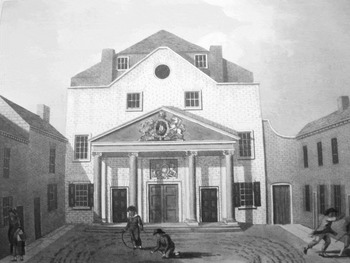
The trajectory from classical to national is a history that is well rehearsed, though the theatre has yet to be incorporated into it.Footnote 12 While gifted architects such as Henry Holland and Robert Smirke were consolidating classicism and nationalism in such significant sites as the British Museum and the Covent Garden Theatre, amateur builders such as actor-managers James Winston and Henry Thornton were working with fewer resources and far less talent and training to spread their bits of Palladio scattershot across the English countryside. Consider the awkwardly executed Greek Revival in the small town of Newbury, Berkshire, where Thornton built a temporary theatre (see Fig. 2) in 1792.
Newbury Theatre, from James Winston, The Theatric Tourist; Being a Genuine Collection of … Views, with Brief … Accounts of All the Principal Provincial Theatres in the United Kingdom. By a Theatric Amateur, ca. 1805, add. Ms. 78.l.15, British Library. © The British Library Board. Used by permission.

A portico of colossal Ionic columns and an oversized pediment jut out from a brick malthouse like a Greek tumor. Even in a decade when cottage architecture might quote some Palladian feature, the oversized portico strikes us almost as a caricature of classicism. Indeed, it is not even a freestanding structure whose design was its own fault; it is still attached to a square of adjoining tenements. Nor were the improvements original to the size and scale of the building: the columns and pilasters of the facade were purchased secondhand from John's College, Oxford, and carted over.Footnote 13 The classical ambitions of the building seem amusingly out of place with both the structure and its setting. This is, after all, not a civic building but an occasional provincial theatre in the outskirts of a small town on a third-rate circuit.
If the Newbury Theatre looks like a social interloper, an affected country squire in a Goldsmith comedy, it is because its ambitions reveal its unease, topographically and socially. The buildings on either end of the triplex were tenements (entrances were located underneath the portico) that framed the haute culture ambitions of the classical playhouse with affordable housing for the poor. There was a reason for this theatre's unusual site. When Thornton, the manager of the strolling company that was playing in Newbury, first applied for permission to erect a theatre in town, he was flatly denied. The city refused him a license, and Thornton was obliged to choose a building site a mile from town, across the river, described by James Winston as “on waste ground” and thus outside civic jurisdiction. Here among the projects Thornton converted a malthouse and draped the portico with all the architectural icons of the authority he could not wrest from the town itself, including duplicate coats of arms on the pediment and over the main doors.Footnote 14
Understanding why the architectural overkill sought to impose a cultural authority where it was denied a civic one is central to understanding how the English theatre sought to appropriate antiquity to create for itself a classical genealogy. The theatre sidled up to the new classicism to borrow its charisma. The mapping of Greek Revival architecture onto the English theatrical circuit during the period 1780–1810 was the trump card in the theatre's ontological journey from the periphery of its culture (vagrants and strollers) toward a centrality of authority (royal theatres). Architecture was one legible response to ongoing local moral and economic opposition to the theatre as an institution. Antitheatricalism lingered through the last third of the century, particularly on the provincial circuit, where the annual influx of strollers pulling capital from small markets roused the indignation of the merchant classes and moralists alike. Even setting aside the explosion of Methodist itinerant preachers such as George Whitefield (1714–70) and John Wesley (1703–91) who waged an intense moral campaign against the theatre, the homegrown distrust in the smaller hamlets was loud, persistent, and not unearned. Here is Winston's account of Thornton's company and the companies that preceded it:
Their visits have been continued from the year 1788[.] before the company was one manag'd by Smith whose performances were made in a Barn in the outskirts of the Town as the magistrates would not suffer them to come within the Borough[.] Before Smith was Johnson's company whose conduct was so very bad— the women being ale whores & the men ale rogues. They left the Town in so disgraceful a manner that the Mayor & Corpn. determined never to let any other vagrants enter it[.]Footnote 15
The word “vagrants” is the medieval infamia that tarred the whole profession of itinerant troupes, but the real objection was to the actors' conduct that was too closely aligned with that of their Dionysian progenitors. While the managers were aggressively marketing the theatre as a rational, national institution, the strolling “ale whores” and “ale rogues” were still worshipping at the altar of the god of the grape. The intersection of the two made for some deeply troubled buildings, like the Newbury Theatre, that professed an authority they could neither earn nor uphold while betraying a heritage they would rather disown.
Even for the more reputable provincial theatres, such as the Theatre Royal in Bristol, which opened with a royal patent in 1768, acceptance was far from automatic. Letters to Farley's Gazette, Bristol's newspaper, vigorously debated the utility of the stage throughout the first summer the theatre was active. One critic extemporized at great length against the economic drain on the town in a poem that concluded with the note that “the Example of Pagan Antiquity should have no weight with pious Christians.”Footnote 16 But the example of antiquity is exactly what the managers of such provincial theatres were evoking; they were trying to insert their marginal profession into a nationalized aesthetic that included the authority of antiquity without the paganism of it.
It was the kind of memory refashioned that Paul Ricoeur invoked when he wrote that “imagination, freed from its service to the past, has taken the place of memory.”Footnote 17 English theatres became part of an imagined antiquity, an ancient, respectable genealogy into which strolling companies (once vagrants) now archived themselves. Consider Garrick's Shakespeare Temple at his Hampton house, which inserted the playwright into the ancient pantheon and shouldered the profession into the sacred history of temple architecture.Footnote 18
In the stage literature of the period as well, advocates of the theatre, from Joseph Addison in the beginning of the eighteenth century to William Dunlap a century later, routinely cited the Greek precedent as a cultural model for the efficacy and social utility of theatre. One of the first historians of the English theatre, William Chetwood, a prompter at Drury Lane and Smock Alley in Dublin and the author of A General History of the Stage (1749), was quick to note the antiquity of theatre and equally eager to distance it from the dangerous associations with Dionysus. “Tho Bacchus is allowed to be Father,” wrote Chetwood, “yet all nations, Ancient and Modern, esteemed it to be a Sober and Instructive entertainment.”Footnote 19 His was the first comprehensive attempt to inscribe the English theatre in a historical tradition that began with the Greeks. In 1775, William Cooke opened his Elements of Dramatic Criticism with the assumption that “all authors, however, agree that tragedy in Greece was derived from the hymns of Bacchus,” followed by the almost immediate displacement of the god with the statement that “the original subject of [the hymns], the praise of Bacchus, was by degrees … forgotten.” And so the actor emerged and the god retired. By the close of the century, it had become axiomatic that the theatre was claiming a classical pedigree.Footnote 20
The theatre managers and builders who were so quick to parse out Bacchus from the new genealogy compensated for the absent progenitor with hyperbolic attention to the more benign muses. The accompanying architectural strategy was a prestidigitation in which the classical world at large was displayed in abundance and Dionysus was dexterously withheld. Here is the description of the opening of the provincial theatre in Winchester in May 1785:
The front of the stage is a grand arch, supported by two noble pillars of the Ionic order, near 14 feet high, most beautifully gilt and ornamented; in the centre is the bust of Shakespeare, over which is the following motto “Omne tulit Punctum qui miscuit Utile Dulci” and on either side are the arms of the city and country. The pillars that support the green boxes and gallery are superbly painted after the manner of those at the Parthenon; the ceiling is painted in imitation of a blue sky, with some well-fancied clouds, in the centre of the ceiling is a ventilator, and at the four corners Thalia and Melpomene, as the Comic and Tragic Muses, Apollo, as an emblem of the Opera, or Music, and Pierot [sic], as the representative of Pantomime; the pannell next the ceiling is decorated with festoons of flowers, and the whole house is finished in a stile of elegance which does great credit to the taste and judgment of Mr. Cave, by whom the whole of the ornaments are designed and executed.Footnote 21
In one sweep of the ceiling, the building evokes Palladio; the Parthenon; the muses of the theatre (Thalia, Melpomene); Apollo, the apotheosis of Shakespeare, the English god of drama; the arms of the city; the arms of the country; and a Latin inscription from Horace testifying to the utility of the theatre. The excessive display of temporal and classical authority should alert us that this too is a building with issues, a shamelessly self-credentialing edifice that betrays a deep insecurity about its standing in the social order.
Yet by adopting temple architecture, English theatre successfully inserted itself into the “governmentality” of the age, trumping objections by joining the rational (looking) institutions and regulators of society. The theatre architecture of the late eighteenth century, deployed in the mimicry of “command,” did indeed reform, redefine, and promote the theatre as a social subject. The profession at the close of the century was more reputable than it had been fifty years earlier and largely because it had been able to inscribe itself in the classical tradition. A crowning moment: when Covent Garden burned down in 1808, it was rebuilt by Robert Smirke, who would become the designer and architect of the General Post Office, King's College, and the British Museum, some of the most classical icons of British culture.
Perhaps the theatre's finest intersection with the Greek Revival was Henry Holland's plan for the remodel of Drury Lane (1791–4), whose approach was to be a colonnade “of the Grecian Ionic order.” The Doric columns in its salon, the Palladian symmetry of its paired pilasters, the niches that displayed antique verde statues of the muses Melpomene and Thalia, and the turrets on its roof that were cribbed directly from the Tower of the Winds in Athens were all crowned with a “figure of Apollo, ten feet high.”Footnote 22 With the popularity of the Greek Revival in the closing decades of the eighteenth century, the English theatre had “discovered” its classical origins, had claimed an ancestry firmly lodged in antiquity, and was displaying its bloodlines inside and out, effusively, in a bid for cultural authority.
The theatre sought to rewrite its own history in that singular eighteenth-century way of burying the fugitive past, like a transported convict or bondsman in Australia or America, swallowing its old identity to refashion itself as esquired gentry. And except for a few high-profile, late-century ruptures that exposed the self-fashioning and the concomitant erasures, it would all have worked.
In Which the God Dionysus Does Not Make an Appearance
But Dionysus, the Greek god of theatre, was absent among the Greek and English deities that were carved out and set up to adorn the new temples of the art of theatre—the ten-foot Apollos, the antique verde muses, the Shakespeares. The central and governing agent in the memory of classical Greek theatre was edited out of architectural and rhetorical circulation early and entirely. The god in whose honor the Athenians gathered to celebrate during the festival of Dionysus, at the Theatre of Dionysus, before the priests of Dionysus, next to the Temple of Dionysus—the god of wine, fertility, and sexual abandon, the very disreputable things against which the theatre was struggling—was excised from the memory of antiquity. Why certain images survive, circulate, and are replicated and others do not has as much to do with ideology as it does materiality, and that is particularly so in this case. The Dionysiac revels evoked in the Trebbia and Nola vases Hamilton reproduced in his catalogs—with their images of wine, masks, flute girls, ithyphallic satyrs, and the fertile god of wine himself—ran contrary to the sanitation of the theatre's social trajectory and were thus cautiously set aside in favor of the more sedate virtues of Apollo: order, measure, beauty. The followers of Dionysus, the satyrs and maenads with their frank and open displays of ecstatic abandon, gave way to the more rational, draped, and serious ornamental muses of comedy and tragedy, Thalia and Melpomene. The promoters of theatre never articulated their erasure of Dionysus, but he was rather quietly understood to be persona non grata. Like one born too low to be introduced at court, his erasure was one of consigned omission; he was imagined out of the new antiquity. The theatre thus became a site where classical imagination replaced classical memory.
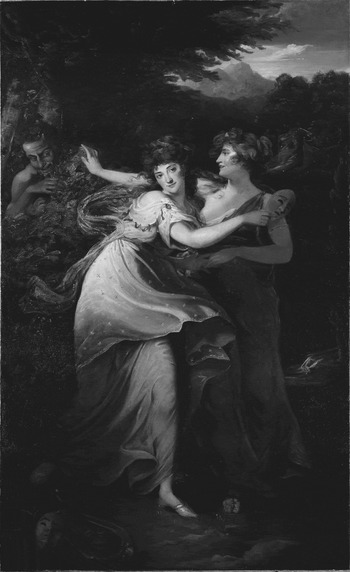
And it could not have been otherwise. A god of wine, ecstatic maenads, satyrs with predatory phalluses at the performative core of a “classical” theatre were more than a little embarrassing to the generation struggling to gentrify theatre. Satyrs in particular were exactly the goat-footed devils that opponents of the theatre had deployed for centuries. Now, the chthonic-erotic images Hamilton resuscitated from the tombs of the Greeks crashed in iconographic intersection with the medieval devils already being hushed. Occasionally one finds traces in the culture's imagination of the erasure itself. The painter John Hoppner arrested this process in the act in his portrait of Mrs. Jordan in the Character of the Comic Muse (1786), in which the great actress is being physically distanced by Euphrosyne from the lascivious desires of a lurking satyr in the bushes (see Fig. 3). It's a stunning rubric of eighteenth-century theatre, complete with its incomplete burial of an ecstatic past that had receded only as far as the dark recesses of the canvas and was never so far out of mind that the secret could not be uncloseted for ready circulation.Footnote 23
John Hoppner, Mrs. Jordan in the Character of the Comic Muse, Supported by Euphrosyne, Who Represses the Advance of a Satyr (1786). The Royal Collection 2009, Her Majesty Queen Elizabeth II.

The Cabinet of Sir William Hamilton
Fortunately for the emerging profession of the theatre, Dionysus and his satyrs had kept a remarkably low profile during the Renaissance and into the seventeenth century, when the pantheon resurfaced. The most famous images associated with the cult of Dionysus—the so-called Barberini Faun sculpture, with its graceful, drunken display of sexuality, or Michelangelo's Bacchus—are not identified with the theatre at all. With few classical sculptural models, Renaissance imitators looked elsewhere in the pantheon for subjects. The god of wine and theatre was not the recipient of any serious scholarly interest from antiquarians either, with the exception of Johann Eggeling's 1682 tract that described Ceres and Bacchus on an onyx vase.Footnote 24 One fine relief of Roman make that had been restored heavily in the mid-eighteenth century for the English tourist market did find its way back to England. Henry Temple, second viscount Palmerston, purchased a bas-relief of maenads for his house at Broadlands.Footnote 25 But in the public sphere as well as in print culture, Dionysus had all but disappeared from visibility until the lesser-known artifacts of antiquity began to emerge in the later third of the eighteenth century. The exquisitely painted red-letter and black-letter vases originally used in the service of wine (amphorae for storing, kraters for mixing, kylikes for drinking) arrived in the English marketplace in the 1760s through the hands of Sir William Hamilton. These included depictions of the cult of Dionysus.
As special envoy to Naples, Sir William Hamilton (1730–1803) was the single most active (and addicted) collector of antiquities of his generation.Footnote 26 The newly formed British Museum welcomed his interests and his collections and honored him by appointing him as a trustee.Footnote 27 However, serious antiquarians gathered not at the museum but at the Dilettanti Society—of which, of course, Hamilton was a presiding member. The Dilettanti was originally a convivial beefsteak club of English gentlemen back from the tour, though, as Walpole wryly wrote, “The nominal qualification is having been in Italy, and the real one, being drunk.”Footnote 28 Their formal mandate betrays their intentions: “Some gentlemen who had traveled in Italy, desirous of encouraging at home, a taste for those Objects which had contributed so much to their Entertainment abroad, formed themselves into a Society.”Footnote 29 Drinking aside (and even Sir Joshua Reynolds's portraits of the society do not spare the bottles),Footnote 30 the members did undertake to study seriously the art of antiquity and, more important, to sponsor expeditions to Greece to survey, record, illustrate, and publish their findings.Footnote 31
Almost immediately after arriving in Naples as British ambassador in 1764, Hamilton began collecting medals, gems, artifacts from Mount Vesuvius, and (especially) vases, a genre that had previously garnered little interest. Hamilton purchased some of these antiquities, like the famous Barberini vase (later known as the Portland Vase), but his passion for collectables as often as not led him to hire dubious profiteers to lead him to small mausoleums such as those at Trebbia and Nolas, from which Hamilton carted off treasures for his cabinet. So successful was this pursuit that within a few years he had acquired a collection large enough to sell to the British Museum. In preparation for the sale, in collaboration with Pierre-François Hugues (aka Baron d'Hancarville), Hamilton financed and produced a luxurious multivolume edition of illustrations and texts that documented his collection of vases. Collection of Etruscan, Greek, and Roman Antiquities is still one of the most beautiful and influential English publications of the eighteenth century.Footnote 32 The project was beset with debt and difficulties, but the first volume finally appeared in 1766. On the strength of the publication, the British Parliament voted to appropriate £8,400 to the British Museum so it could purchase Hamilton's collection—sight unseen.
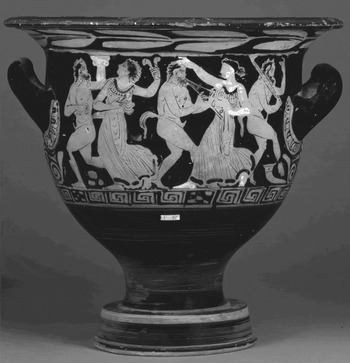
Hamilton, in the meantime, went back for more. The second volume of Collection of Etruscan, Greek, and Roman Antiquities appeared in 1769, and two more volumes followed. Hamilton's mania for collecting antiquities continued unabated for the next two decades, with or without finances. Hamilton raided more tombs and gathered more vases, and his cabinet at Naples became one of the must-see wonders on any Grand Tour. Dignitaries and dilettantes alike visited. He shipped a second collection of more than seventy vases to London via the English fleet. One vessel sank en route, but enough was salvaged for the British Museum to make a second purchase.Footnote 33 A second multivolume illustrated catalog followed in 1791, Collection of Engravings from Ancient Vases, Mostly of Pure Greek Workmanship, which included more images of Dionysus, satyrs, wine, and processions (see Fig. 4).Footnote 34
Bell krater showing Dionysiac thiasos, satyrs, and maenads, from the collection of Sir William Hamilton, Greek and Roman Antiquities, 1772,0320.105. © The Trustees of the British Museum. Used by permission.

Indeed, the most striking thing about the 450 illustrations of Hamilton's collection is the remarkable number of vases dedicated to the cult of Dionysus. Literally scores of them, randy maenad-stalking satyrs, ephebes playing at being satyrs, the god of the grape in repose, the masked players of the aulos or kithara (wind and string instruments), the whole ribald cult at its most erect. Many of the older vases in Hamilton's second collection retain the old ecstasy. For example, a black figure amphora (Corinth, ca. 550) shows a comic dance of costumed and padded men and naked women; a costumed actor with mask and aulos plays for satyrs and maenads while a drunken Dionysus looks on.Footnote 35 The second collection also included an assortment of phallic amulets excavated from Herculaneum. Each amulet was displayed, illustrated, and circulated. For Hamilton, Dionysus represented more than a cult of antiquity; it was a natural religion of fertility and procreation that more closely approximated his own theology than that of the Church of England. As more than one guest observed of their host, antiquity had made a pagan of Hamilton. For example, when he first learned of the loss of the ship Colossus and its cargo of vases, he lamented: “God Almighty has never made himself known to the miserable Atoms that inhabit this globe otherwise than bidding them to increase and multiply and to leave the rest to Him—so thought the wise Ancients when the mysteries of Bacchus and Eleusis were established.”Footnote 36 His antiquity was not mediated by Augustan morality; its actors arrived undraped and authentically erect.
And so through the hands of Hamilton, the god of the golden phallus crept back into visibility. Indeed, largely because of the Hamilton collection, images of Dionysus, satyrs, and maenads were enjoying a wider circulation in the late eighteenth century than at any time since Rome converted to Christianity. The ultimate purveyor of the collection was, of course, the British Museum, but the handsomely illustrated volumes inspired other collectors, tourists, painters, and profiteers.Footnote 37 Of the latter category, the greatest was the English ceramicist Josiah Wedgwood.
In Which Dionysus Hits the English Marketplace
“The Birth of Bacchus will be quite cheap at 36/-.”Footnote 38
Even before the first book that documented his collection was published, Hamilton circulated the proofs of the plates among his aristocratic associates, including his brother-in-law, Lord Cathcart, ambassador to Russia. Cathcart, in turn, shared them with Josiah Wedgwood, who was producing a set of creamware for Queen Catherine of Russia at the time. Wedgwood immediately recognized the enormous marketing potential of a line of Greek ceramicware whose beauty would rival that of the original antiquities.Footnote 39 He did two things: he immediately acquired Hamilton's publication and he built a new factory.
On 13 June 1769, Josiah Wedgwood opened his new pottery works in Staffordshire expressly to manufacture a line of Greek ceramicware modeled after items in William Hamilton's collection. He called the factory “Etruria” after the French title of Hamilton's first published catalog (Antiquités Étrusques, Grecques et Romaines). When the first two volumes of the luxuriously illustrated publication had appeared in 1766 and 1769, they had created a minor stir among the public, the aristocracy and the merchant class alike. Wedgwood's sister had written to her brother a month earlier about the “vase mania” and the brisk business his first samples were reaping at his London showroom. Wedgwood reported what she had said to his partner, Thomas Bentley: “No getting to the door for Coaches, nor into the rooms for Ladies & Gent. & Vases, she says, Vases, was all the cry—We must endeavour to gratify this universal passion.”Footnote 40 It was to gratify this passion that Wedgwood opened Etruria. The vases produced there were drawn in size and subject from Hamilton's publication and adorned with many of the same images (the apotheosis of Homer, Heracles in the garden of the Hesperides, the birth of Achilles). Wedgwood also produced a series of plaques chronicling the birth, education, and triumph of Dionysus. The project's indebtedness to Hamilton can be seen in the “First Day Vase,” the first piece that Wedgwood designed and threw to celebrate his new manufactory. The vase was a commemorative piece patterned on a Greek marriage bowl (λɛβɛς γαμικoς). On one side of the broad belly was the Wedgwood inscription, on the other side was a painted scene from one of Hamilton's vases as it had been described and engraved in the catalog of his collection.
If “Vases … Vases” was all the cry and original Greek vases were out of reach for most (Hamilton had purchased the Portland Vase alone for £1,000), the mass production of the new line of Wedgwood black-figure Grecian ceramicware marked the arrival of antiquity in the broad English marketplace. Some, like the 36-shilling Bacchus vase, were quite affordable. Indeed, Hamilton had loaned Wedgwood the Portland Vase so he could make affordable reproductions from it. The issuing of the Wedgwood Etruria line was a small moment in the Greek Revival that swept across England at the close of the eighteenth century and was out of fashion fifty years later, but it was perhaps the most accessible and certainly one very visible index of the English desire for antiquity. By the end of Etruria's first quarter of business in September 1769, Wedgwood was overwhelmed with work. He wrote to Bentley in London: “We are very busy getting up the orders you have sent us … but what with Mr. Baumgartner's orders, those we had on hand, & such as are now wanted in London & Liverpool—Pebble—Candlesticks, plain Etruscans—Medallions—new Bass [sic] reliefs & an hundred others—Oh my poor head! The Etruscan Vases are arrived.”Footnote 41
Wedgwood's treatment of Dionysus, however, was restricted to the more innocent moments. He produced a birth of Bacchus panel (a blue jasper plaque) that the 1782 Wedgwood catalog described as a “lively vintage scene” and an education of Dionysus panel that was livelier but still clothed.Footnote 42 The most risqué is a plaque entitled “Apollo Instructing the Youthful Dionysus” or sometimes “Alcibiades among the Courtesans.” Here Dionysus, holding a lyre, courts a bacchante while two nude female figures recline. Still, for all the play he received in the English market, when Dionysus emerged from Etruria, he was clothed, a sedate and classicized figure, a chubby, grape-leafed cherub who had left the wine, the satyrs, the masks, and the madness behind.
In Which Dionysus becomes English Pornography
If the cult of Dionysus was the dominant theme of Hamilton's collection, the images that were too erotic for the Etruria sales catalog found other popular applications in the marketplace and in the Georgian imagination. One was a politely erotic novel, The Grecian Courtezan, or the Adventures of Lycoris, written in English by French playwright Antoine Bret and published in London in 1779.Footnote 43
Set in Hellenistic Greece, The Grecian Courtezan was a late Georgian installation of the romance tradition of Greek novelists such as Heliodorus: a heroine of mysterious birth forced to the brothels, a cross-dressing lover, and the requisite adventures of pirate attacks, abductions, rescues, a shipwreck off Corinth, and a revealed identity. In short, it had all the makings of a good second-century Greek romance. Except for the sacred orgy: that was the late eighteenth-century contribution, directly influenced by Hamilton's collection. The scene begins when Lycoris and her betrothed stumble into a cult celebration of Dionysus. Because the scene reads as if it were inspired from a Hamilton vase, it's worth quoting at some length:
Here again men and women were seen dancing, over-powered with wine that had been given them in profusion, and occasioned such attitudes as were inconsistent with modesty. Night seemed only to increase their religious extravagance of this disorderly people. The Bacchanalians became more furious and abandoned themselves to the greatest excess. Several women endeavoured to imitate the priestess by clothing their bodies with the spotted skins of stags, and covering their heads with live serpents. The divine Bacchus signified his approbation of their zeal by prodigies. The fountains which played in the center of town, were suddenly changed to rivulets of wine; their thyrsis sprouted out new branches in the hands of those who shook them, and dropped honey in abundance; then nothing was to be heard but the incessant repetition of αγoι Βακκɛ, Iω Βακκɛ. (46–7)
The wine and abandon could only lead to sexual ecstasy, and the orgy followed, albeit within the framework of Georgian decorum:
The thyrsis and instruments were all thrown aside. Fervent sighs and tender and faithful interpreters of the most exquisite pleasures succeeded the sacred hymns. No distinction was kept between husbands and wives, all was unbounded freedom. Vanity, envy, and distrust, the principal disturbers of Mankind, were banished every breast, chance or proximity decided every one's choice. (48)
That this god of wild passion, orgiastic nature, and “unbounded freedom” was also the patron saint of theatre did not go unnoticed. Recharged from the “exquisite pleasures,” the celebration culminated thus: “The feasts of Bacchus never finished without the exhibition of some dramatic performance, and we were informed, this was the day appointed for the distribution of the difference prizes to those authors whose works were owned by the suffrages of the people” (56).
Not quite the kind of pornography the French enjoyed at the time, but the attachment of true ecstatic abandon to the god's revels emerges very clearly, and that those revels were prologue to the drama only confirmed what writers such as theatre historian William Chetwood were trying to suppress. The god of drama and discord was still circulating in the Georgian imagination, reconnecting the release of bodies and passions with performance in ways the theatre profession and the market had both sought to sever. Somehow, in spite of all the reimagining of myth and the self-fashioning of the theatre, the old ecstatic memory had persisted.
The Dionysiac celebrations described in the fictive account did not remain in the realm of fiction for long. Indeed, the same year that the novel appeared, Sir William Hamilton attended his first Bacchic rite.
In Which the Tomb Raider Discovers a Village in Italy Still Celebrating Dionysus
In 1773, the English painter George Romney set off on a Grand Tour that culminated with a year in Italy. En route, while sojourning in Nice, France, he encountered a celebration of a maypole dance. Fascinated by “the air of antiquity it carried along with it,” Romney became convinced that he was witnessing the living remnants of an ancient tradition. Romney, who throughout his life had a great aversion to writing either letters or journals, took the rare pains to describe the dance at some length and then painted the celebration. For Romney, it had “the most enchanting effect. I thought myself removed two thousand years and a spectator of scenes in Arcadia.”Footnote 44 Romney's Children Dancing in a Ring (1776–7) remakes a European peasant dance in a way that illustrates the attraction of his generation to the notion of a living antiquity. The transhistorical setting, the simple tunics and shawls, the tambourine, all set against an antique marble, suggest the timelessness of the tradition and indeed confirm what Romney felt: the maypole dance was an unbroken link to the golden age.
Hamilton too, like many of the Dilettanti, was fascinated by the idea of a living antiquity. His interest in the classical past, his collections of artifacts, and his passion for antiquity were generated by a profound desire to recover the golden age. Imagine Hamilton's joy when he himself was involved in the discovery of a timeless living tradition.
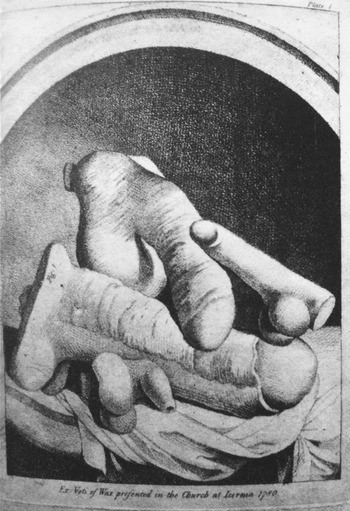
In 1779, an engineer surveying a site for a new road near Isernia, a small village outside Naples, told Hamilton about the odd and slightly disturbing festival of Saint Cosmo, which was still celebrated each year on the feast days of Saint Cosmo and Saint Damian. On these days, women of the region presented ex-voto phalluses made of wax to be blessed at the altar by the priests. In their playful way, the Isernian villagers called the event the “Festival of the Big Toes,” but toes they were definitely not. Hamilton, intrigued by the possibility that old Dionysiac elements had survived well into Christian times, traveled to the village to observe, sketch, and acquire these latter-day phalloi. The first letter he wrote about the find, to Joseph Banks, betrays his enthusiasm: “Greville would have told you that I have actually discovered the Cult of Priapus in as full a vigor as in the days of the Greeks and Romans.”Footnote 45 Hamilton then wrote to Richard Knight, a fellow Dilettanti, fellow collector, and fellow trustee of the British Museum, and the two antiquarians returned to the village, acquired several of these wax “toes,” penned an academic study of the festival, and illustrated their findings. The work appealed to the ribald imagination of the Dilettanti Society, which published an illustrated edition: An Account of the Remains of the Worship of Priapus, Lately Existing at Isernia, in the Kingdom of Naples, in Two Letters.Footnote 46
The first letter of the book, from Sir William Hamilton, dated 30 December 1780, begins: “having last year made a curious discovery, that in a Province of this Kingdom, and not fifty miles from its Capital, a sort of devotion is still paid to PRIAPUS, the obscene divinity of the Ancients (though under another denomination), I thought it a circumstance worth recording” (3–4). To document the practice, Sir William enclosed with his letter “authentic proofs of this assertion” and sent over several specimens of the ex-voto wax phalloi. An illustration of a collection of wax phalloi graced the frontispiece of the published account (see Fig. 5).
The wax phalloi of Isernia, frontispiece of Richard Payne Knight, William Hamilton, and Sir Joseph Banks, An Account of the Remains of the Worship of Priapus, Lately Existing at Isernia, in the Kingdom of Naples: In Two Letters; One from Sir William Hamilton … to Sir Joseph Banks … and the Other from a Person Residing at Isernia: To Which Is Added, a Discourse on the Worship of Priapus (London: T. Spilsbury, 1786), British Library add. Ms. 34,048. © The British Library Board. Used by permission.

Hamilton had noticed that
women and children of the lower class, at Naples, and in its neighbourhood, frequently wore, as an ornament of dress, sort of Amulets, (which they imagine to be a preservative from the mal occhii, evil eye, or enchantment) exactly similar to those which were worn by the ancient inhabitants of this Country [Italy] … all of which have evidently a relation to the Cult of Priapus. (4–5)
Some, Hamilton noted, were “so visibly indecent” he thought them “long out of use in this civilized capital,” but this was not that case. “I have been assured it is but very lately that the Priests have put an end to the wearing of such Amulets in this Kingdom” (6). A new road had brought the village of Isernia into greater contact with the outside world, and the local festival of Saint Cosmo had suffered from the sudden exposure. “[T]he indecency of the ceremony having probably transpired, from the country's having been more frequented since the new road was made, orders have been given, that the Great Toe of the Saint should no longer be exposed” (7). And so the festival—and whatever tradition it represented— came to an end exactly as Hamilton was discovering it.
Hamilton described the festival of Saint Cosmo from 1779, the previous year:
One of the days of the Fair, the relicks of the Saints are exposed, and afterwards carried in procession for the Cathedral of the City to this Church, attended by a prodigious concourse of people. In the city, and at the fair, Ex Voti of wax, representing the male parts of generation of various dimensions, some even of the length of a palm, are publickly offered to sale. There are also waxen vows, that represent other parts of the body mixed with them, but of those there are few in comparison of the number of the Priapi. The devout Distributors of these Vows carry a basket full of them in one hand, and hold a plate in the other to receive the money… . The vows [sic] are chiefly presented by the female sex; and they are seldom such as represent legs, arms, &c, but most commonly the male parts of generation. (9)
One can sense Hamilton's excitement. He had found what he believed to be a remnant of the celebrations of the cult of Dionysus, a sort of living ritualistic link to the golden age that had survived in all its erotic paganism right under the nose of Rome.
Lest the connection of Priapus and Dionysus go unannounced, the second half of the book (Letter 2, Knight's contribution) is a tract on the relation of the Isernian cult of Saint Cosmo to the ancient phallus worship of Priapus and Dionysus entitled A Discourse on the Worship of Priapus. It is a catalogue of the eros protogonos, “the first begotten love” (26). Through Homer, Callimachus, the Orphic mysteries, and Dionysus down to the Roman god Priapus and the villagers who still celebrated him, Knight traced the collection of phallic sculptures and sources of antiquity—herms, satyrs, Dionsyiacs with phalloi—arguing for what would be called in the nineteenth century a universal culture of procreation. To Hamilton, Knight, and the Dilettanti, the god of the golden phallus had more than returned: he had never left.
In Which the Tomb Raider's Wife Becomes a Bacchante and Destroys Him
Those English Apelles Romney, Reynolds, Hamilton the painter, Hamilton the pastel painter, all competed to paint her in various guises, all beautiful, now draped on a sofa with book in hand, now in a thoughtful pose under the shade of a tree, and now half undressed, pulling a goat and preceded by a dog; in this guise she smiles and displays a certain wantonness which makes her resemble an antique Bacchante.Footnote 47
To recap: the English theatre, which had no architectural style of its own, borrowed the Greek Revival to refashion itself with a classical genealogy and promote itself as part of a new shared national high culture. (In this regard, the self-fashioning of the theatre differed little from that of any eighteenth-century country squire who made himself into gentry by appropriating the marks of high culture.) In adopting a classical heritage, the theatre also purged antiquity of its nonrational and immoral associations, substituted Apollo for Dionysus, sublimated the muses Thalia and Melpomene, and promoted the apotheosis of Shakespeare. Those who wished to rehabilitate the English theatre deployed the Greek Revival to promote its own social status, and when the embarrassing discovery of Dionysus and his ecstatic cult became public knowledge, they discretely retired the god.
The culminating moment of that intersection of circulation and retirement was riddled with irony of both a private and public nature. Sir William Hamilton, who had done so much to reintroduce Dionysus as a cultural force, married an actress late in life, and the new (young and attractive) Emma Hart (now Lady Hamilton) added her own singular talent to the theatre, the Greek Revival, and the modern installment of the cult of Dionysus. Emma had neither the station nor the requisite charm an ambassador's wife needed to entertain the Hamiltons' international guests at the Palazzo Sessa. She was poorly educated, of unrefined manners, and spoke a very imperfect Italian. Instead, she had some musical training, a singular talent for acting, and a very attractive face and figure. She was also, unfortunately, the former mistress of Sir William's nephew. For a knight, an ambassador, an influential dignitary, and a royal fellow, the marriage was a coarse arrangement. Sir William was a widower, and his nephew, Charles Greville, was bankrupt. When Greville went wife hunting to gain access to a fortune to repair his damaged estate, he passed off his mistress, Emma Hart, to his aged uncle. Emma, who was twenty years old at the time and without station or income, was duped from the beginning. Greville sent her to the Hamilton house in Naples with the expectation that he would follow. He never did. Angry letters passed from the hand of the betrayed, and Sir William consoled and proposed. The London gossip was unkind to all parties, and even the polite biographies suggest that “there was a great want of common decency in the whole transaction,” while the less decorous note of it that “everyone appears at his worst, behaves abominably, and is better off at the end.”Footnote 48
If English society was unwilling to accept the promotion of “the cast-off mistress of another man, and that too of his own nephew” to the position of Lady Hamilton, the ambassador's wife, European visitors to Italy were less reticent.Footnote 49 Naples allowed Emma Hart a new start. She took lessons in music, singing, and Italian; sat for portraits; received the traveling dignitaries and the grand tourists; and became very interested in using what she could of her new husband's passion for antiquity.
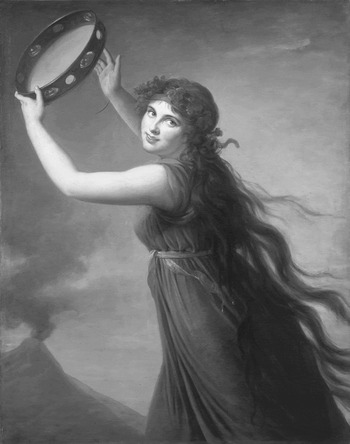
For his part, Sir William saw in Emma the ideal image of Greek beauty. So did his infatuated friend, George Romney, who painted Lady Hamilton more than sixty times in “Attic postures.” Emma sat for Romney as Ariadne, Alope, Cassandra, Circe, Calypso, a bacchante (several times), Daphne, Diana, Euphrosyne, Iphigenia, the Pythian priestess, a supplicant, the sibyl, a wood nymph, Venus, the three muses, the three graces, the muses singly, the muses quarreling over Shakespeare, the muses at the birth of Shakespeare, and again in two separate portraits as the classically allegorical figures of “Painting” and “Music,” among other subjects. The English translator of Greek tragedy, Dr. Robert Potter, chose the scenes, Emma sat for them, and Romney painted them. “I am now at work upon the Iphigenia at Aulis,” wrote Potter to Romney, “which I hope to finish before I come to town: if you wish to have the scene of her sacrifice, I will bring it with me.”Footnote 50 Romney's portraits of Lady Hamilton found further circulation when his work was copied by other painters (such as C. Knight, J. R. Smith, Gavin Hamilton, and Élisabeth Vigée-Le-Brun). Under such prolific brushwork, Lady Hamilton became the English face of antiquity. When Potter translated the Bacchae, he did not find a fitting scene for Emma, but Romney himself did. He painted Emma as a bacchante on three separate occasions. Sir Joshua Reynolds and Élisabeth Vigée-Le-Brun also painted her in this guise (see Fig. 6). That Sir William himself commissioned the paintings from Romney might speak to the appeal of bacchantes in Sir William's imagination.
Élisabeth Vigée-Le-Brun, Lady Hamilton as a Bacchante (1791). © National Museums Liverpool. Used by permission.

Lady Hamilton further developed the art of posing as classical figures even when no painter was present to record the image. Early on in her marriage, she began to assume “poses” directly inspired from her husband's antique vases. She entertained diplomatic guests by posing in a series of living portraits called “attitudes” to illustrate the classical figures of Sir William's collection. Sir William had a proscenium stage with a gilded frame constructed for these performances. Johann Goethe, who visited Naples in 1787, described it as “an open fronted box lined with black cloth and having a gold frame big enough to take a person standing upright.”Footnote 51 Within this private proscenium Lady Hamilton appeared in a white tunic and two or three cashmere shawls and with an occasional property (lyre or tambourine) to model tableaux from her husband's vase collection—first Medea, then a muse, then a bacchante—while her husband held a candle to light her performance. Horace Walpole remarked that Emma had become Hamilton's private “gallery of statues.”Footnote 52
Lady Hamilton developed her tableaux into a series of solo performances in which she became the living image of classical figures in moments of their greatest pathos. “Lady Hamilton's Attitudes,” as they came to be called, were private performances that nonetheless gained enormous attention outside the Palazzo Sessa in Naples as part of the bill of entertainment for any traveler of distinction. Goethe, who visited the Hamiltons in Naples, left an impressive description:
She lets down her hair and, with a few shawls, gives so much variety to her poses, gestures, expressions, etc. that the spectator can hardly believe his eyes. He sees what thousands of artists would have liked to express realised before him in movements and surprising transformations—standing, kneeling, sitting, reclining, serious, sad, playful, ecstatic, contrite, alluring, threatening, anxious, one pose follows another without a break.Footnote 53
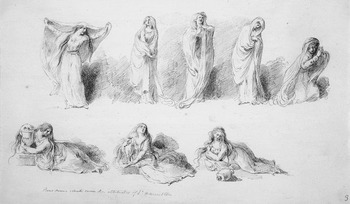
Hamilton's classical vases had become a living performance by Lady Hamilton, who drew her material directly from her husband's collection, including one as a “drunken bacchante, extending an arm to a lewd satyr.”Footnote 54 Like the paintings, her performances found a greater circulation than the immediate attendance. She performed her “attitudes” in many capitals outside Naples. She performed in London and in many of the prominent country seats of England on and off for ten years, but she also performed in Paris, Geneva, and Rome in 1791. Drawings of her in motion, moving between her poses, were published in serials. The “attitudes” of Lady Hamilton (see Fig. 7) were sketched, painted, circulated, and written about in newspapers and novels, with and without her consent.
Pietro Antonio Novelli, Attitudes of Lady Hamilton (1791), National Gallery of Art, Washington, DC.

Of all the figures in her living art gallery, it was her performance as the Greek maenad that most interests me, for the resonance it found in the London papers. She had first appeared as a bacchante when William Hamilton had commissioned private paintings of her in the guise of a young maenad, once from Romney in 1784 and again from Sir Joshua Reynolds the following year. She quickly added the drunken bacchante to her “attitudes.” This characterization found the greatest circulation for reasons that have much to do with Georgian imagination, desire, and sublimation, not least of which was the public's lively interest in Lady Hamilton's promiscuity.
Her social promotion from mistress to lady mimicked the social promotion of the English theatre and offered a transparent metaphor for exposing the loose application of classicism to both. Like the theatre, Emma performed herself into a simulacrum of antiquity. While the connoisseurs of antiquity—her husband and the portrait painters—used her to create a living image of the past, Lady Hamilton used antiquity to classicize herself, to describe the identical trajectory the English theatre had traveled, including its suppressions. Like the theatre, Emma Hart had traveled from disreputable to respectable. But the libertine status of her early years as mistress—like the stigma of Dionysus—never wholly disappeared, and her social advancement remained a cosmetic promotion, an architectural facade on a provincial playhouse. Her earliest biographers claimed it was the theatre that had corrupted her: “An inordinate attachment … to the playhouse, where the passions are inflamed rather than corrected, had the most baneful influence on the mind of this giddy adventurer on the perilous ocean of life.”Footnote 55
And who should sink her on such a perilous ocean but a naval commander? The lewd satyr to whom Emma the bacchante extended her arm was not her husband; it was Great Britain's naval hero, Horatio Nelson. Lady Hamilton's protracted liaison with Admiral Nelson kept all parties involved in the national spotlight and in the end threatened the downfall of all. Shortly after his decisive defeat of the French in Egypt in 1798, a badly wounded Nelson had arrived in Naples, where he was greeted as a hero and deliverer. At the invitation of the Hamiltons, Admiral Nelson restored his health at the ambassador's Palazzo Sessa, nursed by Lady Hamilton. A close friendship soon grew to exceed the bounds of politeness. Even in England the public read of the sordid business, and both Hamilton and Nelson were recalled to London. Emma was seven months pregnant with Nelson's child at the time when they left Naples. Back in London, Nelson estranged himself from his wife and continued the affair, often with little regard for the reputations of any of the parties involved. Indeed, at one point Hamilton the aged ambassador (then 69), his young wife, and her married lover, the nation's naval hero, were all living under the same roof in a ménage à trois at 23 Piccadilly, a house that still belonged to Emma's former lover, Charles Greville. When Lady Hamilton gave birth to Nelson's daughter and named her Horatia (lest the paternity be disputed), the admiral's military halo could not protect him from the caricatures that quickly marked him as a satyr and his lover Emma as a bacchante.
The career of the elder statesman, Sir William, was over. He was lampooned and lambasted for so ignominiously ignoring what was a matter of obvious cuckoldry. Suddenly his lifetime of collecting became an index of his madness. The newspapers were brutal, as were the periodicals. In Isaac Cruickshank's 1800 caricature, Lady Hamilton sits in her classical profile and dress attending to Nelson, who smokes from an enormous and erect pipe shaped remarkably like one of Hamilton's votos of Isernia.Footnote 56 James Gillray was less opaque in his print Dido in Despair! (1801). In that print, Nelson returns to the fleet and the despairing and overweight Emma (who tried to keep her second pregnancy a secret by claiming obesity) pines in a dramatic pastiche of her own postures, surrounded by phallic votives and statuary satyrs while Sir William dozes on. If the god from the grave desired revenge, it could take no sweeter form than that of watching Emma, the face of antiquity itself, become a bacchante in whose house, as in The Grecian Courtezan, “no distinction was kept between husbands and wives, all was unbounded freedom.”
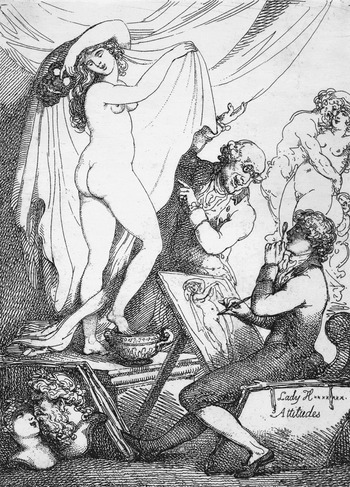
If there ever was a moment of revenge for desecrating a tomb—and this is only Gothic fantasy—it may well have been the transformation in the public's imagination of Emma Hart from Lady Hamilton to a bacchante. This image is best captured by a caricature of Lady Hamilton's “attitudes” by Thomas Rowlandson (see Fig. 8). In the sketch she is naked, both muse and bacchante, holding a Greek theatrical mask. Behind her a satyr embraces another nude maenad. Sir William himself is an old, balding, bespeckled collector displaying his Galatea on the personal stage that Goethe described; remnants of his collection adorn the floor. An ivy-crowned bust of Dionysus is on the ground, kissing a bust of another female figure. In Rowlandson's caricature, the bacchants are actresses, and the theatre—in spite of its classical makeover by national architects—had returned to its primordial core: the lascivious cult of Dionysus. The image exposes the downfall of the suppression of and return of the decadent world of Dionysus, that terrible-gentle god of performance and lust, and the downfall is overseen by the grinning god himself.
Thomas Rowlandson, Lady H****** Attitudes (ca. 1790), British Museum Prints and Drawings, 1981,U.258. © The Trustees of the British Museum. Used by permission.