The thing about dance that is so beautiful is that it disappears the minute you see it, and the frustrating thing about dance is that it disappears the minute you see it… To build something that is disappearing or absent is a paradox.
– Stephen PetronioFootnote 1
Has any other time-based art been so identified with its own impermanence?
– Mark FrankoFootnote 2The enigmatic status of dance extends far beyond its fleeting sense of presence. Dance synthesizes the embodied time of learning with multiple acts of memory and recall, embedding them in a living present.Footnote 3 But this negotiation between multiple layers of time is further complicated by another set of negotiations with an ever-changing assemblage of relations: exchanges among dancers, between dancers and choreographers; the navigation of the performance space; and the response to a live audience that in turn affects the dancer’s sense of self-presence.Footnote 4 Dance’s creative process is often collaborative, involving the transmission of knowledge from one body to another, the training, the remembering of steps, the recognizing of moves and gestures, the mimicking, and the improvising.Footnote 5 How is dance created and how can the knowledge of dance be transmitted if it disappears the moment it becomes visible?
To further complicate things, the ephemerality of dance – its embodied nature, its constant borrowing from past performances and traditions, and the collaborative and yet hierarchical settings from which it emerges – makes the relationship between dance and ownership problematic. What kind of thing is dance, if indeed it can be called a thing? As a generic term, dance may be applied from Martha Graham to Tik Tok, but copyright law’s concept of originality draws lines between protectable choreographies and unprotectable “social dance steps” (ballroom, line, square, folk, swing) or “common routines” as well as non-dance movements like athletic performances.Footnote 6 Putting emphasis on the act of writing over that of performing, the very concept of choreography – writing dance – embodies a hierarchical ordering of dance and its eligibility for property status. Even if we agree that ownership applies to dance, it is not immediately clear whether the choreographer or the company should hold it.Footnote 7 Also, under what circumstances could the dancer be considered a joint author in the copyright sense of the term?Footnote 8 Are the various dimensions of dance ownership best managed through communal norms of authorship, copyright in the choreography, performers’ rights, moral rights, licenses, or some other way?Footnote 9 And how well does the copyright notion of “work of authorship fixed in a tangible medium” fit the actual process of dance making?Footnote 10
Matthias Sperling’s Riff, which was released in 2007, directly addresses many of these questions and encourages us to explore more.Footnote 11 They not only inform the specific content of the piece but also frame its conceptualization, development, and legal underpinnings. While based on licenses concerning the use of other choreographers’ work that he incorporated, cited, and reworked, Riff is clearly conceived as a rite of passage, a dance through which a dancer becomes a choreographer, going from “riffing off” other choreographers’ work to developing dance movements and phrases that, while tied to those of his predecessors, he can claim as his own. This is a trajectory we like to analogize to that of early modern artists who, after years of guild apprenticeship, became their own masters by producing their “masterpiece.”Footnote 12 As such, Riff embodies, makes explicit, and articulates the rearrangement of professional relations and roles, the different ways in which dance is transmitted and reworked, and the property status of the work. It also questions whether such property travels through bodies or copyright licenses, and how property intersects with community norms and expectations of attribution.
Riff also provides an “embodied commentary” on the complex distinction between choreographic authorship and performance, asking us to think about the circumstances in which the performer (Sperling) will become himself the author (Sperling) and, more generally, about what constitutes a choreographic work: how it may be identified and demarcated from the other works and moves from which it emerges, and what are the media (in addition to Sperling’s body) that enable its coming into being. Riff offers a paradigmatic example of the problem of belonging: who can own such creations if they can only be non-objects, moves, and gestures articulated by multiple bodies and actors in response to each other? Finally, how can “belonging” evoke both a sense of being part of a culture or group as well as holding exclusive ownership in a work?Footnote 13
Dance as property or dance versus property?
Contrary to artforms like sculpture, painting, or photography that can come into being only by materially fixing an object or image, dance is a kind of work that fully exists without fixation. In those cases in which it is fixed, it is done by media (Labanotation, Benesh Dance Notation, film, video, and so on) that are essentially external to its creation.Footnote 14 No matter their specific technological nature, these proxy inscriptions reduce the complexity of the performance and change the viewer’s experience of it. As we will see through Riff, they also affect the forms of professional kinship within the dance community, enabling the dissemination of a dance not through in-person learning but, rather, through “detached” practices like watching a video.
Until the introduction of affordable high-quality video, the fixation of a dance by special notations or film was also beyond the budgets of all but the most established companies. One of the most influential choreographers of the twentieth century, George Balanchine, was notably lukewarm about their use.Footnote 15 They also make some dimensions more visible than others and, thus, more likely subject to discursive analysis. For instance, the camera allows us to focus on details – footwork, extensions, hand gestures – and the recording can be slowed down, sped up, and replayed. Being both more and less than a bodily performance has troubled, and continues to trouble, the way we construe discourses about dance as well as the ways in which we attribute property rights or other forms of credit to dancers and choreographers.Footnote 16
Dance is inherently embodied, and dancers have a right to their bodies and labor, and yet they rarely have a property right in the dance even though they possess (embody) or are possessed (inspired) by it.Footnote 17 Dancers do work, but the outcome of the hundreds of hours they spend training for, developing, and then performing a dance is not the kind of material outcome that, according to John Locke, constitutes private property. Unlike the field ploughed and seeded by the farmer’s labor, when the stage lights go out, there is nothing material left to show for the complex work that the dancers have conspicuously done.Footnote 18 The problem does not go away if one takes the choreographer to be the author of the dance, as is commonly done. A Lockean framing of the choreographer as the inventor and owner of the dance could be supported by saying that she or he modifies the dancers’ bodies in the same way a farmer cultivates a plot of land. Still, the dancers’ bodies are nothing like a field that has passively received the farmer’s proactive intervention. In any case, when the performance ends, the dancers walk away, and the stage looks as empty as it always does at the end of the day. Neither choreographers nor dancers can homestead a dance. That ontological uniqueness is part of what makes dance so attractive to both dancers and viewers but, by the same token, challenges the determination of what it is or if and how property should attach to it. Even when the law explicitly makes dance a potential object of property (as US copyright law did in 1976 by introducing the category of “choreographic works and pantomime”), it did not state what precisely those terms mean. That guidance, however sparse, came years later, but discussions about the boundaries of the definition are still ongoing.Footnote 19
Before then, US law had not treated dance as a copyrightable artform per se but categorized it as a form of “dramatic works,” which meant that it could be protected only insofar as it delivered a narrative, emotions, characters, and dramatic tensions.Footnote 20 Dance was seen as a variety of storytelling – storytelling through bodies – a notion that sounds remarkable restrictive in the age of modern dance, which is often non-narrative. The transition from seeing dance as a variety of dramatic works to construing it as its own movement-based artform independent from the music that may accompany it has produced some fascinating discussions about how to exactly define dance and what it “communicates” to its audience – a broadly construed “story,” a “thematic or emotional concept,” “some action, speech, passion, or character, real or imaginary,” or perhaps none of the above.Footnote 21 That said, is “composition and arrangement of dance movements and patterns” or “static and kinetic successions of bodily movement in certain rhythmic and spatial relationships,” a viable and sufficiently specific definitional alternative to “drama”?Footnote 22 If dance is defined so broadly, then what kind of movement is not a dance?Footnote 23 (Attempts to gain copyright protection for athletic movements, including snowboarding acrobatics and celebratory end-zone dances, show that this is not a rhetorical question.)Footnote 24
Fixation is another issue that brings up quite starkly the uniqueness of dance. According to US law, “[c]opyright protection subsists … in original works of authorship fixed in any tangible medium of expression … from which they can be perceived, reproduced, or otherwise communicated.”Footnote 25 Once fixed in a medium, the author’s expression becomes distinguishable from other works, making it possible for the law to protect it from appropriation. Most artforms meet copyright law’s fixation requirement as a direct consequence of their coming into being in their medium – painting, literature, sculpture, printmaking, photography, film, and so on. By contrast, all possible fixations of dance are inherently external to it. (Textual transcriptions are introduced post facto to create a record of the dance for teaching or legal purposes, but not as integral elements of the production of dance, given that few choreographers and fewer dancers can understand them.)Footnote 26 They are mainly bureaucratic objects that make dance manageable to the copyright office or archival records to help restage a dance at a later time.Footnote 27
Legal literature on the peculiar relationship between dance and copyright requirements has remarked on the externality of fixation, pointing to the fact that choreographers and dancers traditionally used the verb “to set” to indicate when a dance has become a work of authorship. This happens when, after many trials and rehearsals, the choreographer determines that a specific dance has come into being, that the dancers have performed it, and, most importantly, that they remember how to perform it again. The dance is “set” when it becomes fixed in the body and memory of the dancers as a collective, not in film, video, or notation: “The almost universal tradition that choreography is set and preserved in the minds and bodies of the dancers who originally learned it from the choreographer, or from other dancers in whose memories the choreography is set, is perhaps the most unique aspect of choreography as an art form.”Footnote 28 Interestingly, in the past, some large dance companies had a person on staff whose role was to remember all of the company’s dances – the archive being literally a “body of memories,” not a technological supplement.Footnote 29
Like other contemporary dancers and choreographers, Matthias Sperling shares this view of the dance being memorized in the body, but not as a fixed object. Similarly, he sees media-based choreographic archives not as technologies for total recall but, rather, as materials for creative reengagement. Following Siobhan Davies’s suggestion that “maybe we can see the archive as our compost,” he has argued that “there’s no need to try to exactly replicate a past form in order for its nourishment to be taken up and taken forward.”Footnote 30 From that point of view, the copyright requirement for an additional fixation beyond the setting of the dance in the dancers’ bodies would seem like a legal artifact that is not just expensive but also typically done by people – notators, videographers, or filmmakers – who are not part of the choreographic process.Footnote 31
This points to a mismatch between the law’s conceptualization of copyright and that of dance by both its makers and its viewers. Altogether different media (film, video, or textual notation) must be mobilized to produce a legally suitable fixation of dance. One could argue hypothetically that the movements of the dancers’ bodies “write” the dance but that such a tri-dimensional inscription would end up being “in the air” rather than in a tangible medium. (The “digital contrails” left behind by motion capture sensors in Bill T. Jones’s Ghostcatching give a glimpse of what this figure might look like).Footnote 32 But if air is ultimately a bad medium for fixation purposes, so is the dancer’s body, for very different reasons. While certainly tangible, the dancer’s body does not meet the stability requirements that copyright demands of the medium, which is expected to be “sufficiently permanent or stable to permit [the work] to be perceived, reproduced, or otherwise communicated for a period of more than transitory duration.”Footnote 33
More than a problem, this requirement describes an unavoidable predicament. The body cannot provide fixation because it does not leave behind any inscription as it moves in space in order for dance to exist and, furthermore, the body is not a stable and uniformly acting machine. That is, all dancers’ bodies move differently from each other, and, in fact, the value of dance to the public also hinges on the signature performativity of certain dancers. And dancers age. An analogy, but only a partial one, could be made with works of landscape art that use plants and flowers as their mediums – works that may then be found to be uncopyrightable because plants grow and flowers bloom and wilt after they have been planted in a certain pattern designed by the gardener. Yet, while they are not stable enough to fix his or her expression, the plants’ and flowers’ fleeting changes during the “horticultural performance” contribute to its attractiveness.Footnote 34 In sum, whether one sees the dancer’s body as pen or paper – as inscriber or as inscription – it cannot fulfill either function because of the various kinds of changes it needs to undergo for dance to come into being and be appreciated. The body is tangible but cannot be fixed, in different senses of the term.
Historically, copyright’s notion of fixation has been modelled on the act of writing – that is, a linear sequence of discrete alphabetic characters to fix the author’s speech. This sense of fixation, however, is rather alien to how dancers and choreographers develop and perform a dance – a process that involves moving much more than one’s voice box. When confronting dance, copyright law seems to recapitulate (without much improvement) Parmenides’s and Zeno’s struggles with the paradoxes posed by movement. Like those pre-Socratics, modern copyright law endorses the view that change cannot exist, at least not as property. Change is an illusion – a non-being – but property can be established only by showing that there is permanence underneath apparent change, like the discrete characters a speech can be broken down to, or the unchanging frames of a film of an ever-changing dance. In so doing, however, the law implicitly acknowledges that the stability of dance as an object of intellectual property can result only from turning it into something else “to fix” projects a sense of materialization of a specific form. The work is made tangible and stable, but it is not transformed in essence. (The identity of the work of authorship is tied to its form, not the medium, as the same authorial expression may be fixed in different media). Following this conceptualization, a film, video, or textual notation of a dance can be formally cast as its fixation – the inscription that brings into being the work as a thing, like an artist’s statue that emerges from a block of marble.
In fact, however, a film or video of a dance are copies of something that could have already been publicly witnessed and appreciated, over and over, without being fixed. Dancers who have been taught a dance can always dance it somewhat differently, and independently of whether the camera does or does not roll or whether somebody has produced a Laban script of it. Rather than fixations that bring the author’s expression into being in a tangible form, those are copies that can produce property by creating a de-animated proxy of the performance, reducing movement (both locomotion and different bodily performativities) to “stills” of different kinds – “stills” that then be reanimated to bring the performance back to life, for a fee.
We can understand how the law is able to conceptualize a film or video of a dance as intellectual property, but it is still unclear just what kind of “work” that dance may be. What we see is that change must be killed in order for copyright to be born and that, in the case of dance, this reduction of change to stability must be performed by other media, external to dance, that break down its movements into stable units of some sort. This transformation, we argue, is more proactive and specific than mere fixation – giving a material embodiment to a form that is assumed to predate its fixation and to then remain unchanged by it, the way a writer’s expression remains the same no matter whether it is embodied in a manuscript or in a printed book. The idiom of fixing projects the assumption that there is a specific thing, however intangible, that preexists fixation and is fixed once and for all. Because of its ontology, however, dance does not seem to be that kind of thing. Can we say for sure that videos, film, or notations of a dance can function as fixations of “the dance itself”? And if they are not fixations in the way a manuscript of a novel is the fixation of the author’s literary expression, then what is the dance, the thing those “fixations” are trying (and failing) to fix/freeze/inscribe?
It is worth remembering that the notion of dance as something that is eventually “set” in the dancers both acknowledges and bypasses these conceptual tensions, while introducing others. Traditionally, choreographers and dancers have argued that the dance does not exist simply in the body as a medium but, rather, in the memory of the dance’s movements in the bodies and minds of the whole troupe as it collectively performs that dance. The dance was “set” in muscle memory – neither fully body nor fully mind – and could thus be endlessly reactivated for as long as the dancer’s body and memory allowed for. But this rather strange – and fascinating – notion of memory is not merely representational, thus exceeding the logic of inscription, fixation, and copying that informs copyright law. “To set” does not involve remembering an image of something (the image of a dance that a dancer observed himself or herself performing in the past) but, rather, constitutes a proactive memory (or a composting one, as Siobhan Davies would put it) that allows for reproduction in the future – not the reproduction of the object one remembers (text, image, sculpture) but of a non-object, a movement to come that is bound to be always slightly different, as it is performed by specifically different bodies, at different moments of their lives.Footnote 35
The downside of the intriguing and rather radical notion of “setting” (which is in fact a misnomer) is that, while it may work well for a troupe to determine what their dance is when they perform it, it functions less well to demarcate that dance from other overlapping and potentially infringing ones. “To set” is a fully self-referential judgment that only the choreographer and the dancers can perform about “their” dance. It is private evidence that is not particularly effective to determine and manage property. One may like to agree with Martha Traylor’s intriguing claim that “the dancers themselves are living archives, indeed the only archives, of the choreographic work,” but would this statement imply that the forensics of infringement would boil down to the comparison of memories?Footnote 36 If so, should those conflicts be managed through copyright law or some other community-based norms? Is a focus on the intersection between dance and copyright getting in the way of understanding what kind of thing dance is to those who make it?
Authors and non-authors
Dancers are typically not represented as the owners of the dance, despite the fact that the dance would not exist without them and would not become visible unless the dancers showed that they “possess” the dance by performing it, by letting it set in their muscle memory. Dancers seem to be construed either as the “vectors” of the dance – performers of a thing that exist independently of them and “tells them” how to move – or, alternatively, as the choreographer’s “brushes,’ “pencils,” or “colors” that inscribe the dance in space, where it is then recorded by another medium – dance notation, video, photography, film.Footnote 37 This view may be reflected in the fact that dancers who join the studio of another choreographer are typically characterized as employees or contractors performing what US copyright law calls “work for hire.”Footnote 38 (That seems comparable to the legal framework in which Sperling operated prior to producing Riff.) In the United States, under the work for hire doctrine, dancers are not construed as authors who gain copyright in their work, which they then contractually transfer to their employer. They are, instead, cast as non-authors who execute the creative work of their employers, who are authors ab initio. Being cast as the “hands” that “write down” their employers’ inspiration in their bodies, the dancers’ claims to joint authorship are rather narrow.Footnote 39 As a result, ownership of a dancer’s creative contribution (even, in some cases, the footage of their dancing and/or participation in teaching workshops) will default to the studio.Footnote 40 In turn, this casts the dancers as potential appropriators in that they could bring the dance “set” in their bodies to other companies, the way an engineer could take his or her trade secrets and intellectual property to another employer or to his or her own startup. (We have not heard, however, of noncompete or nondisclosure agreements between dancers and dance studios.)
Legally speaking, conferring formal property rights to the studio or company is not affected by the fact that the dance community may refer to and remember some of those moves after the dancer’s name. Still, reliance on copyright has created tensions in the dance community, where the collaborative process often blurs authorship (in the sense of attribution) and ownership (in terms of copyright).Footnote 41 Copyright law makes dancers question the collaborative process and what their community holds in common, making them ask, instead, whether or not their contributions qualify them for legal ownership of the work. That does not depend so much on the extent of the contribution – how much individual dancers have put into this process – but, as we will see, it hinges on the kind of input that they have contributed and on whether the initial agreement among the collaborators gives them the authority to have their contribution included in the work. Ultimately, the technicalities of the law have reinforced that the choreographer, not the dancer, is the author, much like the film director whose artistic intent and control over the production of the work is interpreted and valued above all other contributors.Footnote 42 While the same rule applies to other performative arts like film and music, the case of dance is different because performance is its primary mode of existence and appreciation, while music is by now mostly appreciated in recorded form.Footnote 43 The more we try to fold dance into existing modes of copyright and conventional notions of property, the more it resists, even challenging some of the core assumptions of property rights.
Parenthetically, developments that promise to radically reframe the figure of the choreographer as author and owner of the dance are currently emerging in the area of short dance videos, like those one finds on Tik-Tok.Footnote 44 First of all, the new format and its close-ups tend to showcase the specific dancer’s performativity, tilting the scale of agency and contribution toward his or her recognition as joint author with the choreographer.Footnote 45 Furthermore, rather than propertizing dance through copyright in the choreography (held by the choreographer), we see a trend of dancers-choreographers who represent the dance they have created and performed as part of their “look,” which may be protected and monetized through publicity rights – the right that mostly famous people have to control the use of their image. The dance was thought to be set in the dancer’s body (and owned by the choreographer), but while it continues to be “in” his or her body, it is now also becoming part of the dancer’s personal look, which the dancer has the right to control provided she or he is famous enough to monetize it. In a sense, the dance remains in the dancer’s body, but the authorship follows the fame, moving from the choreographer to the dancer.
Riffing
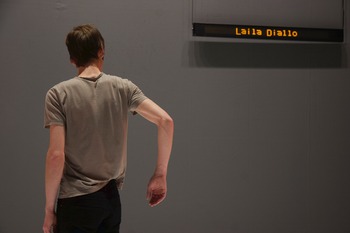
Sperling’s solo dance Riff opens with him standing on a dimly lit stage with his back turned to the audience. There is an almost imperceptible hum alerting the audience that the performance is about to begin. The dance commences slowly in silence with a simple gesture: the dorsal lift of the right arm that is bent at the elbow (almost perpendicular to the floor), accompanied by the extension of the right leg backward. With this initial movement, the liquid-crystal-display (LCD) banner (hung upstage to the left) announces the name “Laila Diallo,” the choreographer whose dance phrase Sperling is currently interpreting. The stage lighting drifts from a deep blue grey to a lighter shade of grey as virtually imperceptible sounds are woven into the performance, marking the beginning and end of what the spectator will come to clearly recognize as three distinct choreographic citations. After a 30-second sampling from Diallo’s Out of Sight in the Direction of My Body, Sperling pauses and appears to reset, striking a different pose, facing the audience with arms at his side, extending his left leg backwards. All of a sudden, we hear popping noises, and Shobana Jeyasingh’s name appears on the LCD banner. He again interprets roughly a 30-second phrase from Jeyasingh’s Transtep. This citation involves larger movements and its own eclectic mix of styles, merging contemporary dance methods with classical Indian-style Bharata Natyam. With the more distinct sound of chimes, this interpretation is followed, again, by a pause and another citation; this time of William Forsythe’s Evidentia Solo. In a few minutes, he manages to sample three distinct signature phrases from three unique and vastly different works. This opening phase signals to the audience that Riff will be reciting these works, but before riffing off them, Sperling clearly identifies the bodily movements and feel of each work, demarcating one from the other. The LCD banner does not leave it up to the audience to figure out whose work is being cited but offers what appears to be closed captioning of attribution.
As he pauses and resets the dance for the third time, it seems as if he were going to begin anew, starting with the original gestures that he has identified as Diallo’s, but he quickly shifts to the work of Forsythe, intercutting gestures from one dance and then returning to the other. This pattern continues, and the work of Jeyasingh is incorporated into the assemblage of movements. The sound mix has also noticeably altered. What was at first discrete ambient sounds has now become a layered, but unstructured, soundtrack that samples and incorporates various instruments, human voices, harmonies, and rhythms. As the dance is reset again for the fifth time, transitions between the three dances come more quickly, giving shape to Sperling’s own unique dance. Even if the LCD banner makes it appear as if he were only citing other choreographer’s movements, the dance no longer looks like any of the previously cited phrases. With this acceleration of movement, the names appearing on the LCD banner start to follow one after the other in a continuous spooling flow, until the banner can no longer keep up with the transitions (citations), and it ends up sputtering out partial names: “R je SA Sho” and “Lai a Di” (see Figure 1).
Matthias Sperling performs Riff. Photo by Neil Wissink, courtesy of the artist.

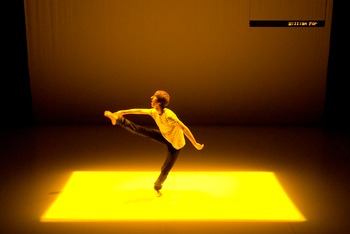
At the same time, the names on the LCD banner have become unreadable, the soundtrack has become distinctly more structured, with a distinguishable beat and consistent tempo that now guides Sperling’s movements that are becoming increasingly his own. The lighting has radically changed too – from downcast stage lights that produce shadows on the floor to a large bright yellow rectangle on the ground. The color of this light box matches the names of the choreographers running on the LCD banner, suggesting that he occupies the space and function of the author. At first, he seems to dance around the edges of the light, eventually stepping into its radiance. By bathing himself in the same yellow hue, Sperling points to both the absence of his name from the banner and his omni-presence in the dance. He is simultaneously dancer, choreographer, and author and yet not necessarily the owner of the dance. Finally, the stage lights darken, the yellow light dissolves, leaving only a single side light on him. There is no longer a clear reset, marking a new type of movement and dialog with the cited works, only the change of lighting and transformation of the soundscape that becomes once again unstructured, but significantly quieter. At this point, all the names have disappeared since it is no longer possible to distinguish gestures associated with Diallo, Jeyasingh, or Forsythe from Sperling’s own interpretation or modification of them, raising the question about who can claim to own a gesture or even identify gestures belonging to others (see Figure 2).Footnote 46
Matthias Sperling performs Riff. Photo by Neil Wissink, courtesy of the artist.

What attracts us to Riff, and to his more recent For Now (2014) – which responds to the question of how the body functions as an archive – is that they offer a unique way to think about authorship in dance, and, at the same time, ask us to think if it is possible to consider movement as an object that can be owned or archived outside of the body. Riff performs the intricate negotiations between what belongs to the body and what belongs to the presences that “possess” it. While Riff incorporates other choreographer’s intellectual property in the dance – even citing these other authors within the performance – by the end, it clearly identifies him as its author. His ultimate authorship of the work that would be generated from his specific use of other choreographers’ intellectual property was made clear in an agreement prior to the creation of the work. Yet, by exclusively using video documentation of these choreographic works, he develops a different kind of kinship in the dance community, putting an emphasis on the dance rather than on the choreographers (even if they are continually named in the process).
With the advice of Own-It (a free intellectual property resource center run by Creative London for the purpose of promoting intellectual property in the arts), Sperling devised a contract that was agreed upon and signed by each choreographer whose work contributed to the making of his own.Footnote 47 The contract stipulated that “[y]our contribution will be clearly identified in all literature pertaining to the work, described as ‘A work by Matthias Sperling, based on sampled excerpts of William Forsythe’s Evidentia Solo and others.’”Footnote 48 With each contract, the choreographer’s name and title of the work were clearly identified as well as the fact that he would only select a 30-second extract from that work.Footnote 49 In 2007, such contracts were not standard practice, but he points out that such arrangements are becoming more common.Footnote 50 Notice, however, that, while he offered symbolic honoraria to the choreographers who work he cited, they were explicitly presented as honoraria, not payments for licenses. Similarly, while these letters explicitly address the issue of attribution – “[a] work by Matthias Sperling, based on sampled excerpts of …” – they do not discuss any specific copyright arrangement, revenue sharing, and so on. In other words, they look more like a formalized version of customary arrangements concerning attribution than legal stipulations concerning intellectual property rights.
For Now, on the other hand, asks us to think about how a work that was once embodied (created to be embodied) can be transmitted as knowledge to other bodies while remaining the property of the original dancer or choreographer. Like Riff, For Now engages other choreographer’s iconic works. Yet For Now involves researching and selecting different forms of documentation from the Siobhan Davies Dance extensive online archives that date back from 1970 and “resetting” them in Sperling’s body. It is an exchange between two archives (the studio’s archive and the dancer’s bodily archive) and two modes of fixing dance (media-based and body-based). Sperling learned fragments of 15 different works that he could spontaneously perform. For Now begins with his assessment of which work would be the best to present in a given situation, and his pronouncement – “[w]hat if the right thing for now is” – is followed by his naming of the work and its choreographer. As he explains, “[a]lthough part of what I was trying to do was to be as faithful as possible to the material that I was inhabiting, For Now wasn’t aimed at displaying a preserved version of those materials … but was aiming to be a kind of laboratory for testing out if and how any of those past materials could be used flexibly, by me, as a resource for making something that is alive and meaningful for the present moment.”
Authorship as a process of detachment
Riff shows us not only the process of embodying other choreographers’ signature movements but also how those movements are themselves broken down, transposed, and used to create a whole new work. Sperling sculpts his own dance from these recognizable phrases, showing how much his originality is tied to the intimate but self-directed knowledge he has of the material he borrows. The speed at which he moves between borrowed phrases, mixing and blending them into his own unique physical articulations, makes those “original” pieces increasingly difficult to identify. The dance is structured in what appears to be progressive phases. And each phase seems to suggest a step away from attributed property toward the creation of a new work. Beginning slowly as if to make each choreographical citation legible to an audience, Sperling seems to want to teach the audience how to appreciate and identify the work of Diallo, Jeyasingh, and Forsythe. Their signature moves are noticeably repeated but in smaller and smaller increments as the dance progresses. At the point where the rectangular yellow light box appears on the stage, he is already rapidly blending and transposing movements as he moves around the edges of its frame – for instance, one upper body movement of Diallo is matched with a lower body movement of Jeyasingh. This series of moves is followed by the matching of what he calls “body quarters” – the right arm movement of Forsythe is matched with a left arm movement of Diallo. But soon the arms or legs may have switched from left to right. It is when he moves into the ochre-colored box of light that he starts using his legs to interpret arm movements and vice versa. Consequently, the visible traces of citation simply fade away, as does any clear sense of his dance’s property status. Finally, the last phase of the dance scans as more experimental, opening its own creative space beyond the cited references and the careful embodiment of attributed movements.
In the context of Sperling’s career, Riff represents a rift – the transformation from being a professional dancer with an internationally renowned studio to becoming a choreographer in his own right. He describes this transition as challenging, particularly because it involved breaking out of “ingrained habits of movement.”Footnote 51 This particular dance studio has a unique style. After five years of being immersed in the practice regime of this studio, he felt this way of working “deeply imprinted” on him. His first challenge, therefore, was to not replicate the choreographer’s aesthetic or her process, as many dancers associated with famous choreographers end up doing. To discover his own autonomous creativity, he decided he needed a “structured process.” He points out that “past experience will always be present in any dancer or choreographer’s practice,” which is why, when dancers improvise, what “spontaneously” emerges are movements that are drawn from their personal bodily archives. Dancers are often unaware of how the many actions, reactions, and memories they have absorbed will affect their future movements. Hence, what is spontaneous is not always autonomous. Counter-intuitively, Sperling’s process of “discovering his own autonomy” entailed embodying other choreographers’ work as a way of retraining or resetting his ingrained bodily responses. This process of unlearning bodily reactions undoes what Walter Benjamin might have termed the aura of the dance.Footnote 52
Keenly aware that his engagement with this other choreographer’s studio practice meant that he was embodying someone else’s intellectual property, he found that, to create his own practice, he had to develop a new mode of practice, which involved both learning and unlearning bodily practices and responses. Yet, with the three selected works, he did not learn by fully immersing himself in the different choreographers’ methods of practice. For example, he did not go and train with Forsythe or take one of his improvisation courses, nor did he join Jeyasingh’s studio to learn how she trained dancers to perform Transtep. Instead, he relied entirely on video recordings of all of these dance works. The trained eye can often distinguish not just who a dancer trained with but, more broadly, who they worked with. Perhaps this is why he chose such distinctively different pieces to practice and embody. Any combination of the three works would not look like any one in particular. Riff demonstrates how this structured process allows him to create his own work, beginning with clear precise citations that are identified on the LCD banner, which increasingly become less and less clearly identified until they disappear altogether.
Sperling explains the reason for choosing these three works: “I had contrasting degrees of separation – ranging from someone who is a close friend, colleague and peer, working in the same artistic networks as me, to someone who I have never met or directly worked with, but only admired from afar. I felt that my relationships with Diallo, Jeyasingh, and Forsythe embodied quite a wide-ranging spectrum in that regard.”Footnote 53 Diallo is someone who he considers a close colleague. She and Sperling danced and trained together in another choreographer’s studio, and he is intimately familiar with her both as a dancer and as a choreographer. Shobana Jeyasingh is personally and professionally less familiar to Sperling. Commissioned to choreograph a dance work for the dance studio where Sperling was working, Jeyasingh worked with him and other dancers in the studio. William Forsythe, on the other hand, is someone that he knows by reputation. While these choreographers’ works are all distinctly different, the movement from the familiar to the unfamiliar seems to coincide with Sperling’s own process of coming into his own creative practice.
It is almost as if he were training to shed engrained habits, a sort of un-training. Sperling admits that his mode of untraining is unconventional and that by focusing on apparent movements, gestures, and sequences of steps, he often misses how the choreographer used subjective points of view, feelings, or ideas to inspire dancers to collectively complete the choreography. These affective cues are missing from his practice in Riff, where he concentrates on mastering the external movements – a process that he describes as “copying without the proper feeling.”Footnote 54 (Motion sensor technologies, in the future, may actually be able to detect if a dancer is appropriating someone else’s moves or dance phrases, but even motion sensor technologies cannot distinguish copying as a form of assimilation from one that is a form of appropriation. Furthermore, motion capture suffers from the same dilemma of fixation as does film, video, and Labanotation.)
With respect to Out of Sight in the Direction of My Body, Transtep, and Evidentia Solo, Sperling identifies himself and his approach as that of an outsider. This outsider’s approach focuses only on “the shell of outer movement.”Footnote 55 He understands that any embodied memory of the creative process like the emphasis on a particular rhythm or working from a particular concept or feeling cannot be transmitted through video: “These are things you cannot pick up.” But learning or creating a work in studio would also mean that immersion is someone’s practice and aesthetics. He, instead, used their intellectual property – the video recording of their work – precisely to “cut the network,” to emphasize his simultaneous acknowledgment of distancing. What makes the video an impoverished copy of the performance turned it into a tool for his self-fashioning into a choreographer. Although “video documentation is lacking in what it records and transmits, it constitutes copyright” and engaging that propertization allows him to both acknowledge other dancers’ work while distancing himself from their practice. In the end, the “very modest honorarium” that he offered them may have marked both a debt and a separation that turned Sperling into “his own dancer.”
Sperling recalls the loud laughter coming from someone in the audience who was very familiar with Forysthe’s work. Evidentia Solo was part of Forysthe’s “improvisational technologies,” designed as a workshop exercise to train dancers to improvise. It was not intended to be choreography in the sense that it was not meant to be repeated exactly as it was originally performed. He read the spectator’s laughter as a sign of understanding that Evidentia Solo was about developing one’s own improvisational techniques, not copying exactly the movements of others. But Sperling treated Forysthe’s dance as if it were a choreography, painstakingly replicating its exact moves, thus undermining the very purpose of the original exercise. He demonstrates how improvisation is not always synonymous with invention since it often involves recalling what the body has already memorized. For example, no such laughter was drawn from his dancing Diallo’s Out of Sight in the Direction of My Body or Jeyasingh’s Transtep. Neither work was understood as being improvisational; yet Diallo expressed an uncanny feeling watching Sperling perform her dance. She recognized it as hers, and, yet, when embodied by him, it became unfamiliar.
Riff gives presence to dormant gestures (both Sperling’s and those of other dancers and choreographers), yet it offers another way of looking at embodiment and its relation to ownership and authorship by questioning how we distinguish intent from control, dance from its adaptation. It elucidates the process of dance making, challenging the view of the choreographic work as an object by showing that it is “always altered each time it is embodied by a living person” while asking: “Can the field of choreography have a generative history as opposed to a constant loss?Footnote 56 And if we can indeed trace out such a generative history, what kind of authorship can we recognize in the dancers’ individual and collective agency? Must we identify the choreographer as the dance’s author when it is the dancer that brings that dance to life?
Acknowledgments
We wish to thank Matthias Sperling, James Leach, Scott deLahunta, Tatiana Flessas, Alain Pottage, Philip Raucci, and the Dance, Digitisation, Ownership Research Group for all the conversations, inspiration, and support.