INTRODUCTION
Neuropsychological measures are potentially very useful in psychiatric research. Importantly, they may be endophenotypic measures. Biological, and particularly genetic, studies are heavily reliant on the precision and reliability of the phenotypes studied (Craddock & Owen, Reference Craddock and Owen1996). Clinical measures are usually distal from the suspected underlying biological cause of illness. Endophenotypes are of potential use because they are intermediate between clinical presentation and biological cause, and so can help our understanding of how the two relate (Gottesman & Gould, Reference Gottesman and Gould2003). Neuropsychological measures allow objective comparisons of individuals. This is more complex with clinical measures, such as symptom measures, which are often dependent upon subjective assessments of presence/absence or of relative severity.
In addition to being scientifically important, understanding and measuring an individual's cognitive function is also clinically relevant. Social interactions are cognitively complex, and so it is likely that cognitive impairments have an impact on social adaptation and quality of life. It may also be that cognitive impairments have a deleterious effect on psychological therapies, understanding of medical advice or treatment adherence (Crews & Harrison, Reference Crews and Harrison1995).
These promising applications of neuropsychological measures in psychiatry are dependent on demonstrating specific associations between illness and aspects of cognitive function (such as attention or executive function) and describing them in a manner that is precise, comprehensible and can be applied outside the immediate experimental paradigm.
Conceptualizing executive function and attention
We here define executive function as the process or system through which cognitive resource, in the form of attention, is allocated to multiple cognitive systems. There are a number of alternative ways of conceptualizing executive function and attention. Their exact delineation is unclear (and remains a source of much debate). However, in practice the desire to develop accurate models of cognitive control is often subsumed by the desire to group cognitive tests together within assessment batteries. Thus, most measures assessing one or more of the five situations described by Norman & Shallice (Reference Norman, Shallice, Davidson, Schwartz and Shapiro1986) as requiring the Supervisory Attention System (SAS) (i.e. planning or decision making, troubleshooting when automatic processes run into difficulty, novel situations, dangerous or technically difficult situations, situations where strong habitual responses need to be overcome) are referred to as executive function measures. The more complex conditions within these tests we treat as measures of executive function. However, as indicated by the Norman & Shallice model, performance on them is susceptible to attention impairment. Therefore, the cognitive control conditions for the measures used in this study are treated as attention measures, although they undoubtedly rely on other cognitive processes as well.
Evidence of neuropsychological impairments in affective illness
There is compelling evidence, including evidence from systematic reviews, that patients with affective illness show neuropsychological impairments that may persist outside mood episodes (Ferrier et al. Reference Ferrier, Stanton, Kelly and Scott1999; Clark et al. Reference Clark, Iversen and Goodwin2002; Quraishi & Frangou, Reference Quraishi and Frangou2002; Olley et al. Reference Olley, Malhi, Bachelor, Cahill, Mitchell and Berk2005; Thompson et al. Reference Thompson, Gallagher, Hughes, Watson, Gray, Ferrier and Young2005; Weiland-Fiedler et al. Reference Weiland-Fiedler, Erickson, Waldeck, Luckenbaugh, Pike, Bonne, Charney and Neumeister2005). The most commonly reported impairments are in measures of attention, memory and executive function, with bipolar patients showing some evidence of specific executive function impairments (Quraishi & Frangou, Reference Quraishi and Frangou2002).
In addition to the issues of small, unrepresentative and heterogeneous samples, a great difficulty with the existing literature is in interpreting diverse results from multiple neuropsychological measures. For example, it is not immediately clear whether observed impairments in measures described as assessing executive function are due to executive impairments or impairments in other cognitive systems. Further investigations and meticulous definitions of underlying impairments are clearly required.
The purpose of this study was to investigate the specificity of independent executive impairments in bipolar (BP) versus unipolar (UP) illness. Furthermore, multiple executive and attention measures were used to give some indication as to whether executive impairments are test specific or more general.
METHOD
Samples
We assessed attention and executive performance in three groups of participants: (1) individuals with a history of recurrent UP major depression; (2) individuals with a history of BP disorder; and (3) healthy controls with no history of psychiatric illness. Local Research Ethics Committees granted ethical approval for the study, and all participants gave fully informed written consent.
Participants (patients and controls) were included if they were between the ages of 18 and 65 years, had no known illness with neurological sequelae (including drug or alcohol misuse/dependency), were white Caucasian, and were native English speakers with good vision.
Patients
Patients were recruited from existing studies within the Department of Psychiatry at the University of Birmingham. Systematic recruitment occurred through local Community Mental Health Teams (CMHTs) and lithium clinics, while non-systematic recruitment was primarily achieved through newspaper and radio advertisements, patient support groups (Depression Alliance and Manic-Depression Fellowship), and contact with local clinicians. Of those patients who took part in the current study, 48% had originally been recruited systematically.
Sixty-two patients were approached to take part in the study. All patients approached were either out-patients or were no longer receiving regular psychiatric care. None of the patients were currently experiencing an episode of affective illness. Of these, 20 (32%) did not meet the study inclusion criteria as outlined above (n=11) or declined to take part (n=9). This resulted in a patient sample of 42 individuals, which was divided into two groups: UP and BP. The UP group consisted of 20 individuals with a DSM-IV diagnosis of recurrent major depression. The BP group consisted of 22 individuals with a DSM-IV diagnosis of bipolar I disorder (n=15), bipolar II disorder (n=4) or schizo-affective disorder (bipolar type) (n=3).
The patients were interviewed using Schedules for Clinical Assessment in Neuropsychiatry (SCAN; Wing et al. Reference Wing, Babor, Brugha, Burke, Cooper, Giel, Jablenski, Regier and Sartorius1990) and psychiatric/general practice case-notes were reviewed. These data were combined for each participant to form a written case-vignette, allowing independent rating of cases by multiple researchers. Best-estimate lifetime diagnoses were made according to DSM-IV (APA, 1994). We also rated three measures of current mental state: the Hamilton Rating Scale for Depression (HRSD; Hamilton, Reference Hamilton1967); the Young Mania Scale (YMS; Young et al. Reference Young, Biggs, Ziegler and Meyer1978); and the Global Assessment Scale (GAS; Endicott et al. Reference Endicott, Spitzer, Fleiss and Cohen1976). Each patient was diagnosed and had the current state scales rated, independently, by at least two members of the research team (psychiatrists or psychologists) and consensus was reached. Inter-rater reliability was high. This was formally assessed using 20 cases and resulted in a mean κ statistic of 0·85 for DSM-IV diagnosis. Mean intra-class correlation coefficients (ICCs) for HRSD total score, YMS total score and GAS score were 0·96, 1·00 and 0·92 respectively.
Controls
Forty control participants were recruited by the friends and partners of patients and by advertisements. Controls had no personal history of psychiatric illness and no known or suspected family history of psychiatric illness in first- or second-degree relatives.
Neuropsychological tests
Three neuropsychological measures were selected that each assessed both attention and executive function. These are described below.
The Colour-Word Interference Test (CWIT; Delis et al. Reference Delis, Kaplan and Kramer2001)
This is a modified version of the Stroop Test (Stroop, Reference Stroop1935). Three conditions are used. Condition 1 (colour naming) involves naming the colour of 50 coloured squares. Condition 2 (word reading) involves reading 50 colour words printed in black ink (e.g. RED). In condition 3 (inhibition), participants are presented with 50 colour words printed in a different colour (e.g. GREEN printed in red ink) and must name the colour of the ink and not read the word (in the example, the correct response would be red). The measures reported here are times taken to complete each of conditions 1, 2 (used here as attention measures) and 3 (executive measure).
The Hayling Sentence Completion Test (HSCT; Burgess & Shallice, Reference Burgess and Shallice1997)
This test consists of two conditions. In condition 1, the examiner reads 15 sentences with the last word missing. Participants must provide a single word to complete each sentence (used here as an attention measure). Condition 2 is identical except that participants must provide words that are unconnected to the sentences (executive measure). Response latency for each of conditions 1 and 2 and error measures are recorded.
The Trail Making Test (TMT; Delis et al. Reference Delis, Kaplan and Kramer2001)
This version of the TMT consists of five conditions. The basic task on which conditions 2–5 are based is a dot-to-dot test. In condition 1 (visual scanning), participants are given a sheet showing circles containing numbers and letters and must identify the circles containing the number 3 (24/54 circles). Condition 2 (number sequencing) involves connecting 16 circles containing numbers in order (1–2–3, etc.) on a page with a total of 32 circles containing numbers and letters. Condition 3 (letter sequencing) is identical except that 16 letters are connected (A–B–C, etc.). Conditions 2 and 3 are used here as attention measures. Condition 4 (number–letter switching) is the main executive test condition. Participants must alternate between connecting numbers and letters, so that they connect 1 to A, A to 2, 2 to B, B to 3, etc. Condition 5 (motor speed) involves following a dotted line as quickly as possible to connect a series of 32 empty circles. The measures reported here are times taken to complete each of conditions 1–5.
Covariate measures
The following potential confounders were included in statistical analyses where possible: pre-morbid IQ; state anxiety; age; and, gender. Pre-morbid IQ and state anxiety were measured using the National Adult Reading Test (NART; Nelson, Reference Nelson1982) and the State-Trait Anxiety Inventory (Spielberger et al. Reference Spielberger, Gorsuch and Lushene1983) respectively. Clinical variables, such as HRSD scores, were not included as covariates as data were only available for the patient groups.
Analysis
All analyses were carried out using SPSS for Windows 10.0.7 and 11.0.1 (SPSS Inc., Chicago, IL, USA). Four groups of statistical analyses were performed:
(1) Group differences. Neuropsychological differences between the three groups of participants were assessed, in the first instance, using Kruskal–Wallis (KW) tests due to distributional non-normality within the data. Where these produced statistically significant results, Mann–Whitney U tests were used to assess differences between pairs of groups, with a Bonferroni correction applied for multiple testing. Analyses of covariance (ANCOVAs) were then performed with the inclusion of the covariates as discussed above. Post-hoc tests were performed on the marginal means from these analyses. To assess the validity of the ANCOVAs, Kolmogorov–Smirnov (KS) tests were used to assess the normality of the residuals produced. Where the residual distributions differed significantly from normality, ANCOVA results were considered invalid and are not reported.
(2) Executive impairment. ANCOVAs were used to compare executive function measures between groups with the attention measures as covariates. Again, residual normality was tested using KS tests as a means of checking the validity of analyses.
(3) The effect of mental state on performance. The relationship between mental state measures and neuropsychological performance was assessed using Spearman's rank correlations.
(4) The effect of medication on performance. Given the small number of unmedicated patients, the expected power of these analyses was low. However, the potential influence of medication on performance is of concern, and so group comparisons (using KW tests) were performed using only unmedicated patients and controls. Paired comparisons were performed using Mann–Whitney U tests, which were not corrected for multiple comparisons due to the exploratory nature of the analyses. The specificity of executive impairments was assessed in two ways:
(a) Medication status was included as a covariate in addition to attention performance in a secondary analysis of executive performance.
(b) Covariate analysis of executive performance was conducted using only non-medicated patients.
To reduce the risk of Type II errors, these analyses were only performed where group differences were found in the whole (medicated and unmedicated) sample.
Power
The study had in excess of 80% estimated power to detect group differences of moderate to large size (Cohen, Reference Cohen1988).
RESULTS
Group characteristics
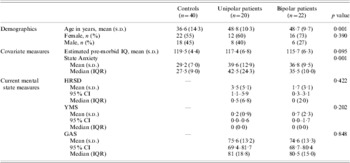
The demographic and covariate characteristics of the three study groups are presented in Table 1. There was a significant effect of group on age (H=14·03, df=2, p=0·001), with both UP (U=196·0, n=59, p=0·002) and BP patients (U=227·5, n=61, p=0·002) being significantly older than controls. There were no significant differences in sex distribution across the groups and the groups did not differ significantly in terms of pre-morbid IQ. However, the groups did differ in terms of state anxiety (H=14·357, df=2, p=0·001), with both UP (U=216·0, n=60, p=0·004) and BP patients (U=216·5, n=62, p=0·001) showing significantly higher state anxiety levels than controls.
Demographic and covariate characteristics of the study groups and current mental state measures of the patient groups

s.d., Standard deviation; IQ, intelligence quotient; IQR, interquartile range; CI, confidence interval; HRSD, Hamilton Rating Scale for Depression; YMS, Young Mania Scale; GAS, Global Assessment Scale.
p values are based on Mann–Whitney U tests for two-group comparisons and Kruskal–Wallis tests for three-group comparisons of ordinal data. Categorical data were assessed using χ2 tests.
The mean age of illness onset was not significantly different between the UP (25·1 years) and BP (28·4 years) groups. There was no significant difference between the mean number of episodes of major depression experienced (5·4 in the UP group and 7·7 in the BP group). The mean number of episodes of mania in the BP group was 5·3.
Nine of the patients (21%, four UP and five BP) were taking no psychiatric medication at the time of assessment. Twenty-three patients (55%) were taking antidepressants (mainly selective serotonin reuptake inhibitors, but also tricyclics and monoamine oxidase inhibitors). Fourteen (33%) were taking lithium. Ten (24%) patients were receiving antipsychotic medications. Other medications being taken by small numbers of patients included sodium valproate, carbamazepine and benzodiazepines. Most medicated patients were receiving a single medication (n=13, 39%). Seven (21%), five (15%) and seven (21%) patients were receiving two, three and four medications respectively. One patient was receiving a combination of seven different medications.
Levels of current depressive and manic symptoms were low, and current levels of overall functioning were high, as shown by the HRSD, YMS and GAS scores respectively (see Table 1). There were no significant differences in the measures of current mental state between the two patient groups.
Neuropsychological performance
Group differences
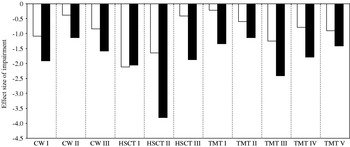
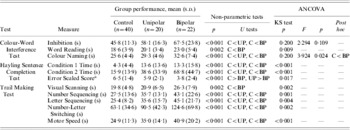
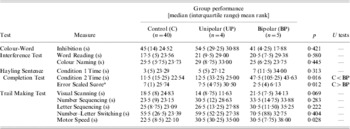
Table 2 shows the mean and standard deviation of each neuropsychological measure for each study group, together with the results of KW tests and ANCOVAs. The pattern of impairments, expressed as effect sizes for patient groups relative to controls, is illustrated in Fig. 1. Patients showed impaired performance relative to controls on all neuropsychological variables. The significant differences observed between the UP and BP groups were confined to a measure of executive function, specifically the error scaled score on the HSCT, with the BP group performing significantly worse than the UP group. The HSCT error score reflects the ability to successfully inhibit appropriate responses.
Effect sizes of impairments in unipolar (□) and bipolar (■) patients relative to controls. CW, Colour-Word Interference Test: I, Inhibition condition time; II, Word Reading condition time; III, Colour Naming condition time. HSCT, Hayling Sentence Completion Test: I, Condition 1 time; II, Condition 2 time; III, Error Scaled score. TMT, Trail Making Test: I, Visual Scanning time; II, Number Sequencing time; III, Letter Sequencing time; IV, Number–Letter Switching time; V, Motor Speed time.

Analysis of neuropsychological test results in unipolar patients (UP), bipolar patients (BP) and controls (C)

s.d., Standard deviation; ANCOVA, analysis of covariance; KS, Kolmogorov–Smirnov.
a Lower Hayling Sentence Completion Test (HSCT) error scaled scores indicate impaired performance and an increased error rate.
Following inclusion of the covariates, only two of the neuropsychological variables produced a valid ANCOVA (i.e. normally distributed residuals). These were the time taken on the colour-naming condition (a simple measure of attention) and the inhibition condition of the CWIT. The other ANCOVAs did not produce normally distributed residuals and so were not considered valid. Consideration of the valid ANCOVAs shows that after inclusion of the covariates, the significant difference between the UP group and controls on the colour-naming condition disappeared, but there remained statistically significant impairment in the BP group relative to controls. The significant group differences on the inhibition condition disappeared. Performance on the inhibition condition was significantly affected by age (F=16·301, p<0·001). Further investigation using Spearman's correlations showed that time taken on the inhibition condition was significantly correlated with age only in the controls (ρ=0·56, p<0·001).
The specificity of executive impairment
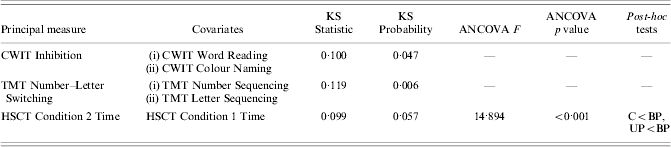
As shown in Table 3, there was a significant difference between the groups on the time taken to complete sentences with a word that does not fit, once the time taken to complete sentences with a word that does fit was taken into account (HSCT condition 2 time, covarying for condition 1 time) [F(2, 73)=14·894, p<0·001, MS(group)=9633·626]. Post-hoc analysis of the group marginal means showed that the BP patients took significantly longer than both UP patients and controls to complete sentences with a word that does not fit, even after controlling for the time taken by each group to complete sentences with words that do fit. There was no significant difference between the UP and control groups. The residuals for the other two ANCOVAs (see Table 3) were not normally distributed, and so the results were not considered valid and are not reported.
ANCOVA of executive performance following the inclusion of attention measures as covariates
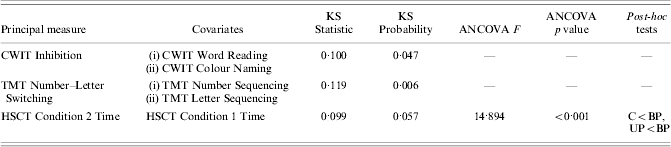
ANCOVA, Analysis of covariance; KS, Kolmogorov–Smirnov; CWIT, Colour-Word Interference Test; TMT, Trail Making Test; HSCT, Hayling Sentence Completion Test; C, controls; BP, bipolar patients; UP, unipolar patients.
The ANCOVA of HSCT condition 2 times (with condition 1 times as a covariate) was repeated with age, pre-morbid IQ, state anxiety and gender as additional covariates. The marginal means from this analysis indicated that BP patients remained impaired relative to both UP patients (mean difference=27·246, s.e.=8·855, p=0·009) and controls (mean difference=32·545, s.e.=8·408, p=0·001), even following Bonferroni correction [overall: F(2, 66)=8·415, p=0·001, MS(group)=5004·640].
The effect of current mental state on performance
The only measure that showed a significant correlation between mental state measures and performance was the HSCT condition 1 time, which correlated negatively with GAS score (ρ=−0·334, p=0·043). This means that poorer current levels of daily functioning were associated with longer response times on condition 1 of the HSCT, although the size of the correlation coefficient is modest. A complete set of correlation coefficients for these analyses is available, on request from the authors.
The effect of medication on performance
KW analyses limited to unmedicated patients are shown in Table 4. Statistically significant effects of group on performance were found for condition 2 of the HSCT, the error scaled score of the HSCT, and the motor speed condition of the TMT. Individual group comparisons showed that the unmedicated BP patients were significantly slower than controls on condition 2 of the HSCT (U=9·0, n=44, p=0·004) and produced more frequent and severe errors on the HSCT (U=12·0, n=44, p=0·003).
Analysis of neuropsychological test performance in unmedicated patients and controls

a Lower HSCT error scaled scores indicate impaired performance and an increased error rate.
Inclusion of medication status as an additional factor in assessing the independence of executive impairments of attention performance did not alter the results of the HSCT analysis. The BP group remained impaired relative to both the UP group (mean difference=37·887, s.e.=10·180, p<0·001) and controls (mean difference=45·296, s.e.=8·473, p<0·001). ANCOVA with unmedicated patients alone produced non-normal residuals (KS statistic=0·178, df=48, p=0·001).
DISCUSSION
In a well-described, representative and narrowly defined sample of individuals with a history of major affective illness, who were not currently experiencing an episode of affective illness, we have demonstrated attention and executive impairments compared to healthy controls with no history of affective disorder. Where we could make a valid assessment, the impairments remained in the BP group even when the potential confounding effects of gender, state anxiety and pre-morbid IQ were taken into account. However, age was significantly correlated with executive performance in controls on the inhibition condition of the CWIT, and differences between patients and controls disappeared after controlling for age on this condition.
Effects of mental state on performance
The relationship between mental state and neuropsychological performance was assessed within the patient groups using correlation analysis. This suggested that neuropsychological impairments were not attributable to mental state effects. These data corroborate existing evidence that these neuropsychological impairments may persist outside periods of acute illness (Ferrier et al. Reference Ferrier, Stanton, Kelly and Scott1999; Clark et al. Reference Clark, Iversen and Goodwin2002). The presence of neuropsychological impairments in a sample in relative clinical remission (as suggested by low HRSD, low YMS, and high GAS scores), which are largely not correlated with measures of current clinical state, supports the assertion that these impairments may be a core and enduring feature of affective illness and not simply secondary to mood pathology. As such, these cognitive impairments may be a consideration for health-care professionals when deciding the best way to provide information and advice to patients and may be a productive target for non-pharmacological interventions such as cognitive therapies.
Had mental state measures been available for the control group, it would have been possible to include mental state measures as covariates in the statistical analyses. This approach has been used, notably in a recent paper by Thompson et al. (Reference Thompson, Gallagher, Hughes, Watson, Gray, Ferrier and Young2005). The results of this study, which showed greater statistical power than previous studies, support the findings of previous studies as outlined above.
Effects of medication on performance
It may be that impairments, including impairments in executive function, were secondary to the effects of medications used either individually or in combination. Evidence of neuropsychological impairments in the relatives of those with affective illness (Gourovitch et al. Reference Gourovitch, Torrey, Gold, Randolph, Weinberger and Goldberg1999; Keri et al. Reference Keri, Kelemen, Benedek and Janka2001; Ferrier et al. Reference Ferrier, Chowdhury, Thompson, Watson and Young2004) and in unmedicated patients (Swann et al. Reference Swann, Katz, Bowden, Berman and Stokes1999; Den Hartog et al. Reference Den Hartog, Derix, Van Bemmel, Kremer and Jolles2003; Porter et al. Reference Porter, Gallagher, Thompson and Young2003) does exist, suggesting that neuropsychological impairments are not likely to be entirely attributable to medication status or history. However, Frangou et al. (Reference Frangou, Donaldson, Hadjulis, Landau and Goldstein2005a) have reported that current antipsychotic use predicts worse executive function performance in BP patients, although the effect of psychotic symptomatology is a potential confounder. Neuroleptics do appear to impair the performance of healthy volunteers (Peretti et al. Reference Peretti, Danion, Kauffmann-Muller, Grange, Patat and Rosenzweig1997), and lithium may slow reaction times in healthy individuals (Linnoila et al. Reference Linnoila, Rudorfer, Dubyoski, Rawlings and Eckardt1986).
We attempted to provide some assessment of the impact of medication effects on our results by assessing performance in unmedicated patients alone and by including medication status as a between-subjects factor in ANCOVA of executive performance. The patterns of impairment found were similar to those found in medicated patients, despite a very small unmedicated sample. While this is not conclusive, we consider it to be a strong indication that our main findings are robust to the possible effects of the medications used in this sample.
Executive function and bipolarity
An important distinction between this study and existing studies was the use of covariate analysis to control for the effects of attention impairment on executive performance. The finding that executive impairments, beyond those attributable to attention impairments, are both present and large in BP patients reinforces an emerging consensus within the literature that executive impairments are a key feature of BP disorder.
This is of interest because executive impairments in the BP group were significantly larger than those in the UP group, even once differences in attention performance had been included in the analysis. This suggests the possible presence of a single dissociation between UP and BP illness in terms of neuropsychological performance, although similar findings in a non-medicated sample would be needed to confirm this.
The potential importance of the HSCT findings is reinforced by a recent study by Frangou et al. (Reference Frangou, Donaldson, Hadjulis, Landau and Goldstein2005b). In this study, both BP patients and their unaffected relatives made more errors on the HSCT than healthy controls. This suggests that impaired HSCT performance may not be secondary to illness onset or medication, but may reflect an underlying feature of affective illness pathology and so constitute an endophenotype.
It should be noted that, while we report impairments on some measures of ‘executive function’, findings are heterogeneous both within and between studies. Frequently, the same sample will show large impairments on some executive function measures, with much smaller impairments, or none at all, on other executive measures. This is illustrated in a recent meta-analysis (Robinson et al. Reference Robinson, Thompson, Gallagher, Goswami, Young, Ferrier and Moore2006), which also reports that heterogeneity is much less pronounced within measures. This suggests that executive impairment in BP disorder is not a generalized feature of the illness but is likely to be associated with more specific cognitive systems.
One possible interpretation of the specific HSCT impairment in BP patients is that a perpetual failure of inhibitory control becomes, somehow, unmasked during periods of acute mania, resulting in symptoms such as pressured speech, reckless behaviour and distractibility. However, this interpretation needs to be tested, perhaps by correlating executive performance with lifetime measures of the presence and/or severity of manic symptoms.
The effect of attention on performance on executive function measures illustrates the importance of not considering neuropsychological measures as truly independent of one another. This is particularly important when considering higher-order cognitive functions; the measurement of higher-order cognitive functions is contingent on the integrity of lower-order processes. Hence, researchers must consider carefully the wealth of data obtained from neuropsychological test batteries. It is imperative that the data obtained from these tests and the relationships between measures of specific aspects of performance are looked at in greater detail to try to tease apart, with some precision, the specific cognitive deficits associated with different psychiatric illnesses.
Need for further research
Our demonstration of the presence of a possible single dissociation between UP and BP individuals clearly requires replication in similarly well-defined and unselected independent samples.
Our findings may have utility outside neuropsychological investigations in that knowledge of more specific impairments allows more refined analysis at both the neurological and the phenotypic level. We are currently investigating relationships between the clinical features of illness and neuropsychological performance in order to refine our understanding of the neuropsychological structure of affective illness.
Our study is cross-sectional and cannot determine whether the observed neuropsychological deficits, including the single dissociation, are a cause or consequence of the presence or course of affective illness. There is a need for longitudinal studies beginning in the pre-morbid state (using, for example, high-risk samples). Family studies of executive function and attention in UP and BP disorder may also help to assess whether the pattern of neuropsychological performance is an endophenotype (or vulnerability factor) in affective illness, or is secondary to illness development. If shown to be associated with liability to UP/BP, cognitive performance could be useful in aetiological studies, such as molecular genetic investigations, and early intervention studies.
Neuropsychological impairments may have an influence on functional recovery (e.g. Atre-Vaidya et al. Reference Atre-Vaidya, Taylor, Seidenberg, Reed, Perrine and Glick-Oberwise1998), and so may be considered as a target for pharmaceutical intervention. Given this, it is important to consider their role both independently of illness presentation and as a possible clinical feature of aetiological importance.
ACKNOWLEDGEMENTS
We thank Carly Cooper, Katherine Gordon-Smith, Jessica Heron and Sally Hyde for data collection, and Dr Sayeed Haque for statistical advice. We also thank the mental health professionals and staff of the patient support organizations who helped to recruit patients for these studies. We are indebted to the patients and controls for participating in this work. The financial support of Birmingham and Solihull Mental Health NHS Trust is gratefully acknowledged.
DECLARATION OF INTEREST
None.