Introduction
In most societies, care for older people who reside in the community is provided mainly by members of the family network (Etten Reference Etten1995; Sung Reference Sung2001; Willyard et al. Reference Willyard, Miller, Shoemaker and Addison2008). In traditional societies, care-giving by adult children is rooted in the notion of filial piety – a cultural belief that encourages children to ensure the continuance of their parents’ wellbeing (Lee and Mjelde-Mossey Reference Lee and Mjelde-Mossey2004). In such settings, parents expect a high level of filial piety, and caring for ageing parents is a commitment that is taken for granted by the adult children (Finley, Roberts and Banahan Reference Finley, Roberts and Banahan1988; Kao and Travis Reference Kao and Travis2005).
The current study investigates a possible decline in filial piety among traditional care-givers as a result of modernisation. The research attempts to clarify the factors impacting upon filial piety among Arab adult children care-givers of their elderly parents in Israel. As such, this inquiry fills the gaps in the existing professional literature on how filial obligation is perceived by an under-investigated traditional population, namely Arab-Israeli citizens, a group which is at the forefront of social change due to modernisation.
Theoretical framework
The conceptual framework for the present research stems from the construct of ‘modernisation’. Modernisation theory maintains that the status of elderly people in society decreases as the level of modernisation of that society rises (Cowgill Reference Cowgill and Gubrium1974). Aboderin (Reference Aboderin2004) maintains, further, that modernisation leads to the diminution of filial piety. However, empirical study of the relationship between modernisation and filial piety has received only limited attention thus far (Cheung and Kwan Reference Cheung and Kwan2009).
The literature cites three positive dominant indicators of modernisation that have implications for the practice of filial piety: urbanisation, secularisation and individualism (Aboderin Reference Aboderin2004). It is generally believed that adult children with a traditional and/or religious outlook fulfil greater filial responsibility than do more secular modernist offspring (Litwin Reference Litwin1994). Moreover, it is believed that decline in filial obligation is the result of a decline in the status and roles of older people. This decline is a consequence of the breakdown of the traditional extended family and the emergence of the ‘individualistic nuclear’ family, both of which are associated with urbanisation and industrialisation (Aboderin Reference Aboderin2004).
Filial piety
Filial piety in care-giving research is a term used to describe a set of family values and expectations regarding parental care and respect (Kao and Travis Reference Kao and Travis2005; Tsai, Chen and Tsai Reference Tsai, Chen and Tsai2008). The practice of filial parent care has traditionally been seen as the natural and normative obligation of adult children (Choi Reference Choi1996; Chou, La Montagene and Hepworth Reference Chou, La Montagene and Hepworth1999). The literature cites several motives that lead children to agree to care for their elderly parents (Kao and Travis Reference Kao and Travis2005). These include respect, desire to preserve family harmony, love and affection toward parents, sense of responsibility on the part of the children, and a desire to repay the parents for their physical and financial sacrifice (Hsu and Shyu Reference Hsu and Shyu2003; Tsai, Chen and Tsai Reference Tsai, Chen and Tsai2008).
A decline in children's obligation and commitment to their parents is occurring in various countries around the world, including those that have been based in filial piety norms. In Asian communities, for example, there is a noticeable decrease in children's willingness to come to the aid of their parents (Lam Reference Lam2006), and forms of expressing respect and fulfilling the norms of filial piety have changed as well (Lieber, Nihira and Mink Reference Lieber, Nihira and Mink2004; Lo and Russell Reference Lo and Russell2007; Sung Reference Sung2004). The family unit caring for the aged parent (the eldest son and his wife) has also changed in Asian families and has almost disappeared in some of them (Shi Reference Shi2009; Zhan Reference Zhan2004). In like manner, the norm according to which an elderly parent lives with the eldest son is also weakening (Hsu, Lew-Ting and Wu Reference Hsu, Lew-Ting and Wu2001).
The literature also notes that the association between modernisation and filial piety can be mediated by perceived care-giver burden. For example, investigators have noted a positive correlation between high urbanisation level, and individualistic lifestyle, on the one hand, and subjective care-giver burden, on the other hand (Bien, Wojszel and Sikorska-Simmons Reference Bien, Wojszel and Sikorska-Simmons2007; Dwyer and Miller Reference Dwyer and Miller1990). Others have found an inverse association between religiosity and care-giver burden (Herrera et al. Reference Herrera, Lee, Nanyonjo, Laufman and Torres-Vigil2009). Still other researchers have noted a negative correlation between care-giver burden and filial piety (Chou, La Montagene and Hepworth Reference Chou, La Montagene and Hepworth1999; Lai Reference Lai2007).
The literature also identifies background characteristics among care-givers that can directly or indirectly impact upon the practice of filial piety. For example, daughters show a higher degree of filial obligation than do daughters-in-law and sons (Cheung and Kwan Reference Cheung and Kwan2009; Chou, La Montagene and Hepworth Reference Chou, La Montagene and Hepworth1999). Close residential proximity of care-givers to their elderly parents has been linked to greater practice of filial piety (Chin and Loh Reference Chin and Loh2008; Litwin Reference Litwin1994). A number of investigators identify a negative correlation between educational level and the extent of filial piety (Finley, Roberts and Banahan Reference Finley, Roberts and Banahan1988). (However, others have found that the reduction in affirmations of filial piety that is associated with higher modernisation was less among adults with higher education; Cheung and Kwan Reference Cheung and Kwan2009.) In addition, advanced age is associated with a decrease in filial piety, while female gender and marital state is related to greater filial piety (Cheung and Kwan Reference Cheung and Kwan2009). Other care-giver factors, such as employment status, may indirectly affect filial piety through the mediator of perceived care-giver burden. The literature has pointed out that greater perceived burden is indeed associated with employment status (Pinquart and Sorensen Reference Pinquart and Sorensen2005).
The size of the family network has also been shown to impact directly upon filial obligations. For example, researchers have pointed out that care-givers who divided tasks with many other family care-givers felt greater filial obligation than those who were for the most part the sole providers of care (Finley, Roberts and Banahan Reference Finley, Roberts and Banahan1988). However, others have found that filial piety was significantly reduced by having more children (Cheung and Kwan Reference Cheung and Kwan2009). Finally, characteristics related to the nature of the care provided are additional factors that can influence filial piety indirectly through the mediator of care-giver burden. Some researchers cite a positive correlation between the number of weekly care-giving hours, years of care and number of care tasks (such as housekeeping, meal preparation and personal care needs), on the one hand, and care-giver burden, on the other hand (Chou, La Montagene and Hepworth Reference Chou, La Montagene and Hepworth1999; Pinquart and Sorensen Reference Pinquart and Sorensen2005).
Arab-Israeli society
The Arab populace, comprising about one-fifth of Israel's population, consists of three major religious groups. The largest is the Moslem population (84%) followed by Christians (8%) and Druze (8%). The majority lives in the north of the country, with some scattered communities located in the central districts (Central Bureau of Statistics 2008). The economy of the Arab population was historically based on subsistence agriculture. Political power was traditionally held by the heads of the Hamule (a group of families under patriarchal lineage structure), and by the heads of the more immediate extended family (Razek Reference Razek1979).
In recent decades, however, the Arab population in Israel has been experiencing major social and economic changes. The traditional agrarian multigenerational household in which the father lives with his married offspring is disappearing (Al-Haj Reference Al-Haj1995). Research has shown, moreover, that the predominant family-clan support network among Arabs in Israel is being replaced by smaller independent network structures (Litwin and Haj-Yahia Reference Litwin and Haj-Yahia1996), and that households that were formerly headed by an elder have split up into individual units (Meir and Ben-David Reference Meir and Ben-David1993).
Data from the Israeli Central Bureau of Statistics (2008) show that the majority of Arab men aged 15 and older are currently employed in the labour force (62%), and that 21 per cent of Arab woman are now employed. Construction constitutes the dominant contemporary employment field for Arab-Israeli men (25%), and only some 3 per cent still work in agriculture. There has also been a considerable rise in the level of education of the Arab population in the past three decades. The median years of schooling has increased from less than nine years in the late 1980s to 12 years in 2008, particularly among females. Women are also marrying a little later (since 1980, the average age of Arab brides at first marriage increased by 1.5 years). Finally, life expectancy in the Arab population has increased by nearly four years since the early 1980s (75.9 for male and 79.7 for females), and infant mortality has decreased – from 41 deaths per 1000 live births in 1970 to 6.5 in 2008 (Central Bureau of Statistics 2008).
In terms of services for the older Arab population, community facilities have become increasingly available in recent decades. Azaiza and Brodsky (Reference Azaiza and Brodsky2003) reported, for example, that there were some 68 social clubs functioning for older Arab adults in 2003, attended by about 11 per cent of the Arab elderly population (approximately 4,000 individuals). In addition, 15 day-care centres served close to 950 disabled older Arab adults (2.5% of the Arab elderly population). Such facilities in Israel are frequently municipality-based and hence geared to serve the local population. While few older Arabs sought institutional placement in 2003 (0.7%), according to Azaiza and Brodsky (Reference Azaiza and Brodsky2003), about 5,300 of them received home care services provided under the Community Long-term Care Insurance Law (approximately 14%).
Filial piety in Arab society
Studies of ‘filial piety’ have typically focused on societies in the Far East, such as Korea, China and Japan (Choi Reference Choi1996; Sung Reference Sung2001). In comparison, little research has been done on filial piety in Arab society. Some investigators have studied social support for elderly parents among Middle Eastern immigrants in the United States of America (Ajrouch Reference Ajrouch2008; Salari Reference Salari2002). For example, a study that employed focus group interviews in both English and Arabic found that immigrants aged 60 years and older feared nursing home placement but also wished not to burden their children (Ajrouch Reference Ajrouch2005).
Some studies have examined family care-giving and intergenerational co-residence in Arab countries, such as Lebanon and Egypt. Yount (Reference Yount2005) found that Reference Pinquart and Sorensenresidence with sons and daughters-in-law was preferred in Egypt, but that residence with daughters and sons-in-law also occurred. Yount and Khader (Reference Yount and Khadr2008) found, moreover, that the propensities of older Egyptians to live with ever-married children has declined, while the tendency to live alone or with unmarried children has risen. Séoud et al. (Reference Séoud, Nehmé, Atallah, Zablit, Yérétzian, Lévesque, Giroux and Ducharme2007) report that the majority of older persons in Lebanon live with their family and that the main care-givers are mostly female, including adult children and spouses.
Although there is some reported evidence on family care-giving for elderly parents within the Arab population in Israel (Azaiza, Lowenstein and Brodsky Reference Azaiza, Lowenstein and Brodsky1999; Lowenstein Reference Lowenstein1999; Lowenstein and Katz Reference Lowenstein and Katz2000), there are few studies that examine the motives for caring for elderly parents in this population. Earlier work has described the elder in rural Arab society as a person who was embedded in a broad social network that provided for his or her economic, emotional and physical needs according to fixed rules within a normative context (Razek Reference Razek1979). These rules obligated not only children and other family members, but also neighbours and friends. Caring for older family members and serving them was considered a binding and uncontested rule from both religious and social points of view (Jeraissy Reference Jeraissy1976).
In recent years, a decline in the status of the Arab elder within the family has been increasingly evident. This corresponds with a rise in individualist orientations among younger Arabs and a narrowing of collectivist orientations. Similarly, the bond between Arab children and their parents is becoming progressively ‘instrumental’, based more on practical needs than on traditional ideological commitment (Al-Haj Reference Al-Haj1995). The literature also points to an increase in the willingness of adult children to accept assistance for caring for their parents from formal social services (Azaiza, Lowenstein and Brodsky Reference Azaiza, Lowenstein and Brodsky1999) and reports a rise in elder abuse among Arabs by family members (Litwin and Zoabi Reference Litwin and Zoabi2003).
As noted, there is as yet little empirical data on how filial obligation is currently perceived by Arab-Israeli care-givers. A recent qualitative study on the motives for caring for demented elderly parents among this population revealed four motives for care-giving: (a) self rewards – care-givers perceived themselves as doing the right thing by following the norms for a good person, based on social and religious points of view; (b) rewards from family members – care-givers expected and desired to receive similar family care in the future; (c) rewards from Allah (God); and (d) lack of alternatives (Leichtentritt, Schwartz and Rettig Reference Leichtentritt, Schwartz and Rettig2004).
Hypotheses
Based upon the literature reviewed here, the present study considers the association between modernisation and filial piety among adult Arab children in Israel. Two major hypotheses are examined. The first is that urbanisation level, individualistic lifestyle and secularisation are negatively related to filial piety. The second hypothesis posits that perceived care-giver burden mediates the presumed association between modernisation and filial piety.
Methods
A cross-sectional, correlational study was used to achieve the purposes of the study. A probability random sample of informal care-givers was recruited from five community types in northern Israel, where 50 per cent of Arab-Israeli citizens reside, mostly Moslems. These community types range from (a) small isolated villages; to (b) large villages; (c) suburban villages; (d) rural cities; and (e) city. The division draws upon such criteria as population size, distance from the city and presence of municipal institutions. Twelve specific localities were selected randomly from among the five categories, including one city; two rural cities; two suburban villages; three large villages distant from the urban centre; and four small isolated villages. Geriatric social workers in each setting located all elderly persons in their caseloads that were defined as needing help for activities of daily living (ADL), and their family care-givers.
In line with sample size recommendations by Harrell, Lee and Mark (Reference Harrell, Lee and Mark1996), that is, ten participants per parameter for multivariate analysis, 250 informal care-givers were randomly recruited for the current study, 50 from each community type. Inclusion criteria were: adult children (>18 years old) from the Arab community in Israel who give care to their elderly relatives at home in at least one activity of ADL. (Fifteen additional families who declined to take part in the study represented all the five community types).
A preliminary pilot study was conducted with 25 Arab family care-givers from this same population. Issues related to both the content and the clarity of the questionnaire were addressed prior to data collection. Data in the main survey were collected over a 12-month period from November 2006 to October 2007. Each participant was interviewed face to face by one of two trained research assistants. All study participants gave informed consent. Interviews were conducted at the respondent's home at a time convenient to the interviewee. All measures were administered in Arabic. The interview required 1–1.5 hours to complete. None of the 250 care-givers had missing data on variables of interest and all were included in the present analysis.
The measures
The main variable – filial piety – was measured on a 26-item scale. Eight of the items were drawn from previously developed instruments with good psychometric properties (Such as ‘I feel a great responsibility and obligation to care for my parents’) (Kao and Travis Reference Kao and Travis2005; Seelback and Sauer Reference Seelbach and Sauer1977). The remaining 18 items were developed by the primary author (Khalaila Reference Khalaila2010). Sample items include ‘I never speak loudly to my parents, even when I am angry or irritated’, and ‘Every child should provide financial assistance to his parents even if it requires him to take out a bank loan’. The overall scale refers to an attitude, value and behavioural prescription for how adult children should interact with their parents. It refers to the adult children fulfilling their obligations and responsibility toward their parents through multiple behavioural norms associated with care and support for parents, harmonising family relations, maintaining family continuity, making payments, showing affection, and making sacrifices. Care-givers were asked to indicate on a five-step scale (from ‘Completely agree’ to ‘Completely disagree’) the extent to which each statement reflected their conception of the obligation of adult children to their aged parents. A higher score on this index indicates a greater degree of filial piety (α=0.83).
Characteristics of modernisation included three positive indicators: the extent of secularisation, urbanisation and an individualistic lifestyle. As noted earlier, community types were divided into five categories that reflected different degrees of urbanisation. A higher score on this variable refers to a higher level of urbanisation. An instrument for examining care-givers’ lifestyles was comprised of 27 statements that reflect various opinions on daily social, cultural and family behaviours, based on the Individualistic-Collectivist Lifestyle Questionnaire (Hui and Yee Reference Hui and Yee1994) and translated from English to Arabic. Respondents were asked to express their degree of agreement with the statements on a five-step scale, from ‘Completely agree’ to ‘Completely disagree’. Examples are, ‘A marriage becomes a model for us, when the husband loves what the wife loves and hates what the wife hates’, ‘Adult children should listen to their parents' advice on marriage/engagement’ and ‘When making important decisions, I seldom consider the positive and negative effects my decisions have on my parents’. A higher score on this scale reflects a more individualistic lifestyle (α=0.81).
Level of care-giver secularisation was examined through two indices: ‘Self-definition of religiosity’ and ‘Consolation and assistance through religion in times of distress’. The first was scored on a four-point scale ranging from 1 (‘Very religious’) to 4 (‘Secular’). The second was scored on a four-point scale, from 1 (‘All the time’) to 4 (‘Never’). A higher score on both of these indices reflected a higher level of care-giver secularisation.
Other variables addressed were care-giver characteristics, care-recipient characteristics, family care-giving network variables, care-giving variables and perceived care-giver burden. Care-giver data were obtained on age, gender, employment status, residential proximity to the elderly parent, years of education, and care-giver relationship. A dichotomous classification was used to measure the care-giver's employment status, presently employed (1) and not presently employed (0). Care-giver's marital status was assessed as married (1), and widowed, divorced or never married (0). Residential distance was measured on an ordinal scale which ranged from co-residence with their parent in the same apartment (1), co-residence with their parent in the same building (2), resides in a proximal house in the same neighbourhood (3), lives in distant house in the same neighbourhood (4), lives in a proximal neighbourhood (5), to resides in a distant neighbourhood (6). Finally, care-giver relationship was assessed as daughter, son, grandchild or daughter-in-law.
Information on the care recipient was obtained referring to age and two dependency measures concerning levels of functioning. The first was the ADL scale (Katz et al. Reference Katz, Downs, Cash and Grotz1970). The overall scale measures functional disability on a scale of 0 (highly independent) to 8 (highly dependent) in the following areas: transfer, dressing, bathing, eating or feeding, and continence. The scale achieved an acceptable degree of internal reliability in this study (α=0.78).
The second dependency measure was the instrumental activities of daily living (IADL) inventory developed by Lawton and Brody (Reference Lawton and Brody1969). Activities represented in the scale were use of telephone, shopping, housekeeping, laundry, transportation, managing medications, and managing finances. Total IADL scores ranged from 0 (highly independent) to 8 (highly dependent). The scale was found to be internally reliable on this study population (α=0.79).
The family network was assessed by the family network size. The number of care-givers in the network was obtained through a direct question to the primary care-giver as to the number of relatives who assist in care of the elderly parent. The primary care-giver was included in the count of family network members.
Three variables were used to assess the amount of help provided by the care-giver. These included the years of care-giving and the number of hours spent per week in currently helping the care recipient with his or her various dependency needs. The third variable was the number of care-giving tasks provided, from a list of 13 ADL and IADL tasks (e.g. housekeeping, meal preparation, shopping, personal care needs, and so on). Respondents indicated ‘yes’ or ‘no’ in each of the 13 tasks of ADL and IADL. A point was given for each task response.
Perceived care-giver burden was assessed on the Caregiver Burden Inventory (CBI) (Novak and Guest Reference Novak and Guest1989). This 24-item instrument provides measures of subjective burden in five dominant areas: time-dependence, developmental, physical, social and emotional. Questions include such items as ‘My care-receiver needs my help to perform many daily tasks’ and ‘I'm not getting enough sleep’. Respondents were asked to indicate on a scale of 1 (‘Not at all descriptive’) to 5 (‘Very descriptive’) the degree to which the statement reflected their own conception of the care-giving experience. A higher score on this scale reflects a higher level of perceived burden (α=0.92).
Finally, we also used a shortened version of the Marlowe–Crowne Social Desirability Scale to control for biased response (Reynolds Reference Reynolds1982). Social desirability is defined as a person's tendency to respond in culturally approved ways to statements that describe socially approved but relatively improbable behaviours. Respondents indicated whether each of 11 statements of personal attitudes and traits was true for them. A point was given for each socially desirable response. Examples are ‘I have never intensely disliked anyone’ and ‘I sometimes feel resentful when I don't get my way’. The higher the score on this measure, the more the subject is seen to be responding in a socially desirable manner. The scale achieved a modest, but nevertheless acceptable degree of internal reliability in this sample (α=0.63).
Data analyses
Variables were analysed on three levels. On the univariate level, means, standard deviations (SD) and ranges were examined. On the bivariate level, Pearson product moment correlations, and one-way analysis of variance (ANOVA) were computed to clarify the associations between the independent variables and filial piety. Finally, the multivariate analysis required several phases. In the first phase, we examined the tolerance and variance inflation factor (VIF) that identifies multicollinearity among the independent variables. Next, we analysed the first hypothesis by means of hierarchical multiple linear regression to determine the extent to which characteristics of modernisation predict filial piety after controlling for the effects of background and control variables. The predictors of filial piety were entered in the following three steps: (a) control variable, (b) background variables, and (c) characteristics of modernisation.
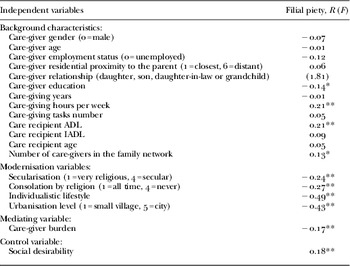
In the third phase, we addressed the second research hypothesis. Here, we applied hierarchical multiple linear regression to determine the extent to which the perceived care-giver burden mediates between characteristics of modernisation and filial piety, after controlling for the effects of the background and control variables. In order to demonstrate that care-giver burden has a mediating effect, it was necessary to carry out an additional regression beyond those employed in the previous analyses. In this subsequent model, the mediating variable – care-giver burden – was entered (Baron and Kenny Reference Baron and Kenny1986; Morano Reference Morano2003). To support a mediating hypothesis, it is necessary for a finding to show that the following relationships are all statistically significant: (a) the relationships between the predicting variables (modernisation variables) and the dependent variable (filial piety), (b) the relationships between the predicting variables and the hypothesised mediator (burden), and (c) the relationship between the hypothesised mediator and the dependent variable. It is also necessary to show that when paths (b) and (c) are controlled, a previously significant relation between the predicting variables and dependent variable is no longer significant (Baron and Kenny Reference Baron and Kenny1986; Morano Reference Morano2003). Partial mediation is demonstrated when the beta weights for predicting variables are reduced (but not to insignificance), from their beta weights in the equations that contained only the control variables, the background variables and the predicting variables (Baron and Kenny Reference Baron and Kenny1986; Morano Reference Morano2003). In all the regressions executed in the current inquiry, only independent variables that were identified earlier in the bivariate analyses as significant were included (see Table 1).
Bivariate tests of independent variables and filial piety: Pearson correlations and one-way analysis of variance

Notes: Sample size: 250. ADL: activities of daily living. IADL: instrumental activities of daily living.
Significance levels:
* p<0.05,
** p<0.01.
Results
A majority of the informal care-givers in the sample were women, mostly daughters (36.4%) or daughters-in-law (27.2%), about a third were sons and the remainder was comprised of other relatives. Ages ranged from 19 to 65 (mean=41.6, SD=9.8). Years of education ranged from 0 to 24 (mean=10.8, SD=3.6). Approximately 62% were unemployed, and most (60%) lived in the same apartment or building as the care recipient at the time of the data gathering.
The ages of care recipients ranged from 55 to 102 years (mean=77.8, SD=8.9). Most of them needed some degree of assistance in ADL (mean=4.9, SD=2.4) and IADL (mean=7.0, SD=0.9) activities. Care-givers reported providing from two to 80 hours of care per week to their elderly parents (mean=23.4, SD=18.5). In addition, they provided assistance for a relatively long period (mean=7.8 years, SD=5.0). On average, the family care-giving networks were made up of five children (SD=2.3).
Average scores on the filial piety measure ranged from 1 to 5, with a mean of 3.5 (SD=0.5), a relatively high level with little deviation. The score distribution on this measure was slightly skewed, but the skewedness was not significant. The bivariate data in Table 1 show the Pearson product moment correlations, and one-way ANOVA tests between the independent variables and the filial piety outcome. As is apparent from the data, none of the care-givers’ background variables were associated with the filial piety score, except for educational level (r=−0.14, p<0.05), and only the ADL measure was related among the care-recipient characteristics (r=0.21, p<0.001). Among the three care-giving variables, only the number of weekly care-giving hours was positively related to filial piety. Finally, the family care-giving network variable – number of care-givers in the family network – was positively related to the filial piety outcome measure.
Among the predicting variables representing modernisation, the two secularisation measures were negatively related to filial piety. Individualistic lifestyle and urbanisation level were also negatively related. With respect to the mediating variable, care-giver burden was negatively associated with filial piety.
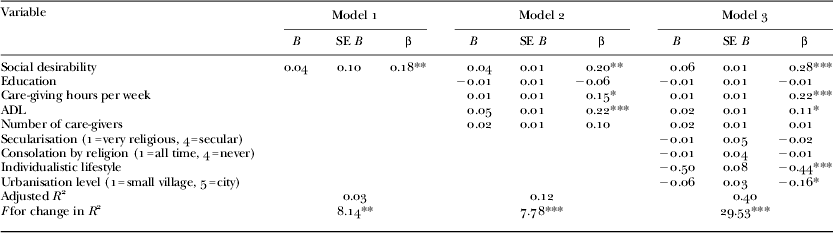
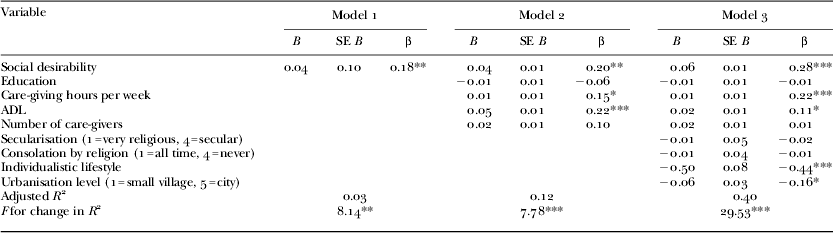
Table 2 displays the first hierarchical regression (Research Hypothesis 1). We entered ten independent variables in this analysis. The final model identified six significant predictors of filial piety with an adjusted R 2 of 0.43 (p<0.01). The control variable of social desirability was entered first and, although significant, contributed little to the dependent variable (3%). The greatest changes occurred when the characteristics of modernisation were entered (ΔR 2=0.28, p<0.001), followed by the effects of the background variables (ΔR 2=0.09, p<0.001).
Summary of hierarchical regression analysis for modernisation variables predicting filial piety
Notes: Sample size: 250. SE: standard error. ADL: activities of daily living.
Significance levels:
* p<0.05,
** p<0.01,
*** p<0.001.
Looking more closely at the final model in the first analysis, we see that among the background characteristics, only care-giving hours per week predicted filial piety. Care-givers who reported a higher number of weekly care-giving hours showed higher filial piety. Among the characteristics of modernisation, two variables stood out. The results revealed a negative correlation between both individualistic lifestyle and urbanisation, on the one hand, and filial piety, on the other hand. Secularisation characteristics did not prove to be independent predictors. In sum, Hypothesis 1, which examined the contribution of the characteristics of modernisation to filial piety, was confirmed for the most part.
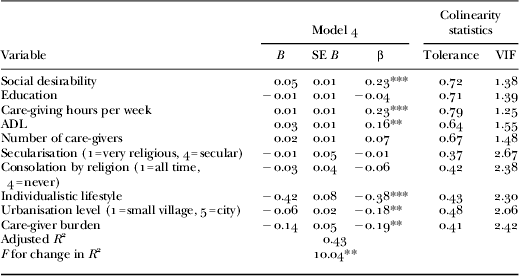
The second regression explored the extent to which the mediating variable – care-giver burden – mediates the effect of modernisation on filial piety (Hypothesis 2). To test this, we entered the relevant variable in step 4, following prior entry of the modernisation indicators. The results revealed that the mediating variable was found to be significant, but its inclusion added little explained variance to the model (ΔR 2=0.03, p<0.01). The results show that the standardised regression coefficients for individualistic lifestyle declined from step 3 (β=−0.44) to step 4 (β=−0.38). However, the standardised regression coefficient for urbanisation level was elevated, and for the secularisation variables did not prove to be significant. Thus, as suggested by Baron and Kenny (Reference Baron and Kenny1986), the perceived care-giver burden has partial mediation between individualistic lifestyle and filial piety, but not in the case of urbanisation or secularisation.
We also examined the tolerance and VIF that focuses on multicollinearity among the independent variables, and found that the values were under the generally acceptable limits (maximum less than 10) and that none of the tolerance statistics for the independent variables was less than 0.1 as recommended by Stevens (Reference Stevens2002) (see Table 3).
Summary of hierarchical regression analysis for variables mediating the association between modernisation variables and filial piety
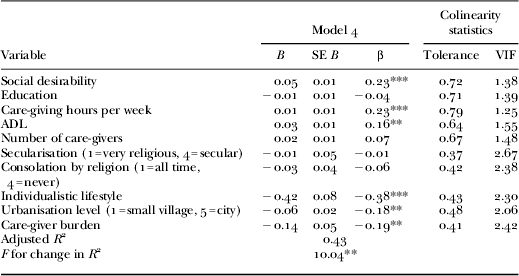
Notes: Sample size: 250. SE: standard error. VIF: variance inflation factor. ADL: activities of daily living.
Significance levels:
** p<0.01,
*** p<0.001.
In sum, almost all the variables significant in the first analysis (without the mediating variable) retained significance when subsequently entered with the mediating variables (step 4), except for number of care-givers. In this final model the variable ADL regained its significance. The mediating variable also emerged as an independent predictor – informal care-givers who had higher burden scores were more likely to have lower scores on the filial piety outcome measure.
Discussion
This study has shown that there is still a relatively high level of filial piety among adult children in Arab-Israeli society, reflecting on the one hand, cultural and religious values that shape the expected behaviour of children towards their aged parents, and on the other hand, the extent of social desirability that is involved in this sensitive cultural phenomenon. The analyses demonstrated that social desirability indeed contributes to the predictability of the filial piety outcome measure. Thus, it was necessary to neutralise this variable in the multivariate inquiry.
The expectation that the characteristics of modernisation are correlated with filial piety was confirmed, for the most part, in the current inquiry. The findings showed that individualistic lifestyle is the major (negative) predictor. Individualism lowers the level of filial piety above and beyond the impact of the control and background variables. In like manner, urbanisation level had a negative impact on the predictability of filial piety, but its effect was weaker. Still, it was found that care-givers residing in more urban communities reported less filial piety. These findings show that characteristics of modernisation have a negative association with filial piety among adult children care-givers, on both the individual and collective levels.
These results reinforce earlier claims regarding the potentially negative impact of modernisation processes on the status of the elderly in traditional Arab-Israeli society (Azaiza, Lowenstein and Brodsky Reference Azaiza, Lowenstein and Brodsky1999; Litwin and Haj-Yahia Reference Litwin and Haj-Yahia1996; Litwin and Zoabi Reference Litwin and Zoabi2003). The results obtained in the current study thus provide additional evidence in this area of study. Indeed, previous research has shown that modernisation reduces both filial piety and the status of the elderly in other traditional populations (Cheung and Kwan Reference Cheung and Kwan2009; Choi Reference Choi1996; Clark Reference Clark1992–93). However, those studies were carried out among non-care-giver respondents. They also tended to use more universal indicators of modernisation, such as average annual wage, and the state of the development of health technology.
In contrast to our assumption about the negative effect of secularisation, however, the present study found that such characteristics were not, in the end, independent predictors. It seems that the bivariate associations between secularisation variables and filial piety are not unique to the characteristics of secularisation, but are correlated with other processes common to both secularisation and other measures of modernisation. Consequently, it is likely that the impact of secularisation is blocked by other indices of modernisation with stronger predictability, such as individualistic lifestyle.
The second hypothesis examined in the current inquiry was based on the assumption that the correlation between modernisation and filial piety is mediated by perceived burden of care. As noted, this hypothesis was validated in part. That is, perceived burden did mediate the correlation between care-giver lifestyle and filial piety, but it did not mediate the correlation between other characteristics of modernisation (urbanisation and secularisation) and the level of filial piety.
Furthermore, it was found that filial obligation may also be predicted by perceived burden of care. However, we cannot determine whether a high sense of burden reduces filial piety or whether high filial piety mediates the feeling of burden. Nevertheless, it could be that lower perceived burden of care reinforces continued filial care of elderly parents by their children. This finding reinforces those of other studies conducted in various locations in the world (Chou, La Montagene and Hepworth Reference Chou, La Montagene and Hepworth1999; Lai Reference Lai2007, Reference Lai2010), but is not compatible with other claims that cultural values, such as familism and filial piety, are no protection against the burden of care and stress involved in care (Youn et al. Reference Youn, Knight, Jeong and Benton1999).
Beyond the mediating variable just discussed, the findings in this study point to two background variables that predict the outcome under study: number of weekly care-giving hours, and level of need for ADL assistance. As noted earlier, the findings underscored a positive association between hours of care-giving and filial piety. Interestingly, the findings also showed a positive relation between care-giving hours and perceived burden. It seems, therefore, that these two processes co-exist among respondents from the study population. It might be that care-givers who had a high degree of filial piety reported a greater extent of actual care-giving than they reported perceived burden. However, here too it is difficult to determine whether a greater scope of care produces greater feelings of commitment, or vice versa. Indeed, studies described in the literature review do not show a clear direction of the correlation between the two (Pinquart and Sorensen Reference Pinquart and Sorensen2005).
Need for ADL assistance is another background variable serving as a predictor of filial piety. This association is also not fully clear in the literature. However, several studies cited a possible indirect association between the two. One plausible explanation of this result is that, if the care-recipient experiences further deterioration in health and requires more care-giving hours, the care-giver will feel more filial responsibility. Indeed, our results show a positive association between hours of care-giving and filial piety. Another possible explanation for this association may be found in the basic assumptions of the adaptation-level theory of Lawton et al. (Reference Lawton, Moss, Hoffman and Perkinson2000). The theory holds that in time, adult children care-givers develop new adaptation levels suited to the severity of the elderly parent's functioning in activities of daily living. The feeling of burden of care lessens following the new adaptation. Indeed, the findings from the current research showed that a low burden of care is correlated with a high level of filial piety.
A final point of note is that, in contrast to what we expected, filial piety was not found in this sample to differ across daughters, sons, grandchildren and daughters-in-law. It seems, therefore, that traditional gender roles that dictate normative expectations are being modified in Arab-Israeli society. That is, daughters-in-law are no longer seen as the primary care-givers of their husband's frail elderly parents. Rather, all the children are viewed as responsible for the older generation. This trend mirrors, to some degree, the changes that have been observed in intergenerational housing expectations in Egypt (Yount Reference Yount2005).
There are some limitations of this study which should be addressed by further research. The first one is its cross-sectional design, which does not allow confirmation of causal inferences about the association between modernisation characteristics and filial piety and the mediating role of care-giving burden. The second limitation is the lack of a control group of adult Arab-Israeli respondents with no care-giving experience. Finally, although the study population was recruited from the north of Israel, where 50 per cent of Arab-Israeli citizens reside, this population does not completely represent the Arab population in other areas in Israel where customs, political characteristics and practices related to religiosity may be different. Despite these limitations, however, the study provides initial insights into the care-giving predilections of a traditionally oriented population that has not been widely studied in this respect thus far.
In conclusion, it seems that processes of modernisation that have been experienced over the past decades within Arab society in Israel have had a potentially negative effect on filial piety. Future research should continue to expand the knowledge about the factors that impact upon filial piety among adult children in different cultures. Further inquiry also should examine additional indicators of ‘modernisation’ in order to represent the content of the phenomemon in different traditional societies. These might include, for example, the number of children and the proportion of women employed.
On the practical level, the current research findings show that perceived burden among adult children care-givers may lessen filial piety towards aged parents even in traditional societies. Thus we recommend in this regard that decision-makers and service policy planners establish services that are uniquely suited to Arab society, in order to provide culturally relevant long-term support for the family network. This could include culturally appropriate day centres for older frail or impaired Arab parents and culturally sensitive long-term care facilities for parents who require skilled nursing care (Azaiza and Brodsky Reference Azaiza and Brodsky1996; Suleiman and Walter-Ginzburg Reference Suleiman and Walter-Ginzburg2005). Such initiatives will enable the changing Arab family to continue to support its elderly parents in a familiar, safe and caring environment.
Acknowledgements
We acknowledge the Israel National Institute for Health Services and Health Policy and the JDC-Brookdale Institute of Gerontology and Human Development for their assistance in support of this research.