THE ENDSTATE IN SLA
Much SLA research has held that cases of entirely successful SLA are rare, if they exist at all (Bley-Vroman, Reference Bley-Vroman, Gass and Schachter1989; Long, Reference Long1990). Most second-language learners (L2ers) remain somehow distinguishable from native speakers. One explanation is that first-language (L1) and second-language (L2) acquisition are driven by different cognitive processes (Bley-Vroman). According to this view, L1 acquisition proceeds from an innate language faculty, but SLA uses the same cognitive skills responsible for mathematical reasoning and other skills developed after childhood. Assuming that distinct mechanisms drive L1 and L2 acquisition, the results of SLA will predictably diverge from those of L1 acquisition. An opposing view, however, holds that the same universal principles guide both L1 and L2 acquisition. White (Reference White, Doughty and Long2003), for example, pointed to the systematic and constrained nature of L2 data. Schwartz and Sprouse (Reference Schwartz, Sprouse, Hoekstra and Schwartz1994, Reference Schwartz and Sprouse1996) argued that Universal Grammar remains fully available for L2ers, despite the massive presence of L1 influence. This view does not predict inevitably that any, or every, L2er will ultimately acquire a nativelike grammar: Even if SLA proceeds from innate universals, persistent L1 interference (Sorace, Reference Sorace1993) or processing difficulties (Hopp, Reference Hopp2010; Sorace & Filiaci, Reference Sorace and Filiaci2006) may continue to hinder endstate L2 performance. However, as argued by Herschensohn (Reference Herschensohn2000), entirely nativelike acquisition in L2 should be theoretically possible, especially by expert L2ers. Empirically, whether entirely nativelike performance across all domains of linguistic ability is possible in L2, some L2ers perform at very high levels, even passing for native speakers in some contexts (see Piller, Reference Piller2002).
Characterizing the sometimes nativelike behavior of L2ers—who are by definition not natives—presents terminological difficulties. The term near-native is commonly applied to L2ers whose competence or performance appears comparable to that of natives (Birdsong, Reference Birdsong1992; Coppieters, Reference Coppieters1987; Sorace, Reference Sorace1993); yet, as Sorace noted (1993), the term inherently seems to imply a failure or shortcoming vis-à-vis the target language. Such shortcomings may not be immediately evident, however, and differences between near-natives and natives sometimes manifest themselves only under close scrutiny (Hyltenstam & Abrahamsson, Reference Hyltenstam, Abrahamsson, Doughty and Long2003). Without a battery of evaluation criteria comparable to what Bartning (Reference Bartning1997) proposed for advanced levels of proficiency (in L2 French), characterizations of near-native proficiency predictably vary across studies. In the present study, near-natives are speakers who cannot by any definition be considered natives because of the late age at which they began acquiring their L2, but whose L2 abilities are advanced to the point where the only appropriate comparison to be drawn is to native abilities. This definition, admittedly subjective and nontechnical, implies neither global nativelikeness in the L2ers nor that they are entirely indistinguishable from natives.
Near-natives are usually understood to be late (or adult) learners. In Johnson and Newport (Reference Johnson and Newport1989), late learners were those whose first L2 exposure took place at age 7 or later. The data in Marinova-Todd (Reference Marinova-Todd2003) suggested a division between early and late learners around age 10. Abrahamsson and Hyltenstam’s (Reference Abrahamsson and Hyltenstam2009) data revealed a cutoff around age 8. Birdsong and Molis (Reference Birdsong and Molis2001), however, reported apparently nativelike performance in L2ers whose age of L2 exposure was in some cases older than 20.
THE SYNTAX-DISCOURSE INTERFACE
Whereas early studies on near-nativeness focused on properties of narrow syntax (Birdsong, Reference Birdsong1992; Birdsong & Molis, Reference Birdsong and Molis2001; Coppieters, Reference Coppieters1987; White & Genesee, Reference White and Genesee1996), much recent work has turned to the coordination of syntactic and discourse knowledge, especially since Sorace (Reference Sorace1993). According to the Interface Hypothesis (Sorace, Reference Sorace, Doughty and Long2003, Reference Sorace, Cornips and Corrigan2005), L2 grammars—even those of near-natives—are vulnerable at (external) interfaces between multiple types of linguistic knowledge and evince persistent L1 influence (Sorace, Reference Sorace1993) or other deficits (Tsimpli & Sorace, Reference Tsimpli, Sorace, Bamman, Magnitskaia and Zeller2006). Under this view, although narrow syntax (e.g., word order, licensing of pro-drop) may be intact, the L2 ability to felicitously deploy certain syntactic forms appropriately in discourse is not: A syntactic form or option may be used in a way that is grammatically correct but infelicitous in terms of its discourse pragmatics.
For example, L2 intuitions and interpretations of how syntax functions in discourse can differ from those of natives. In Sorace and Filiaci (Reference Sorace and Filiaci2006), L1 English near-native speakers of Italian differed from the native controls in how they resolved antecedents of referentially ambiguous overt and null subject pronouns. The near-natives omitted subject pronouns in Italian, which provides evidence that they had acquired the relevant parametric setting. Similarly, the near-natives’ assignment of antecedents to ambiguous null subject pronouns was nativelike. However, their interpretations of overt subject pronouns diverged from those of the natives. Whereas the natives preferentially identified the ambiguous overt subject pronoun with a prior extrasentential referent, the near-natives co-indexed the overt pronoun with the preceding intrasentential subject. Although the near-natives produced syntactically targetlike null and overt subject pronouns, their interpretations of overt subject pronouns reflected a nonnativelike preference that was probably attributable to the L1.
Belletti, Bennati, and Sorace’s (2007) study of L1 English near-native speakers of Italian illustrated another possibility: The near-natives did not evince violations of narrow syntax but at the same time either (a) failed to exploit the full range of word orders available for different discourse purposes or (b) infelicitously overused a syntactic option in a discourse environment in which it was not appropriate. The study examined overt subject pronouns, which signal a shift in discourse topic in Italian, and postverbal lexical subjects, which encode focus (in certain verb classes). In oral production data, the near-natives differed from the natives by producing significantly more overt subject pronouns where none were required discursively and significantly fewer postverbal subjects in focus contexts. The near-natives’ syntax was formally accurate but pragmatically infelicitous given the discourse context. The infelicities were relative rather than categorical: The near-natives did not invariably produce overt subject pronouns nor did they fail entirely to produce postverbal focused subjects. Rather, their proportions of null to overt subject pronouns and preverbal to postverbal focused subjects differed significantly from native Italian, reflecting overuse in the first case and underuse in the second.
Bohnacker and Rosén (Reference Bohnacker and Rosén2008) reported similar results for L1 Swedish learners of German. The participants were advanced rather than near-native, but the study is valuable because it investigated a syntax-discourse interface phenomenon via free production data. The area of inquiry was the German prefield (vorfeld), a left-peripheral position that can link a main declarative clause to the prior discourse. In most main declaratives, the verb-second (V2) grammar of German places the verb in the second position of the clause. The prefield (first clausal position) is flexible and can host a wide variety of constituents. Native German speakers, however, prefer to place focus information in the prefield. Given that Swedish is also V2, it is unsurprising that the L2ers did not have difficulty with the German V2 grammar itself. However, their use of the German prefield was not nativelike. Rather than using the prefield for focus, the L2ers preferred to fill this position with light constituents, topics, and expletives; they placed focus later in the clause. As in Belletti et al. (Reference Belletti, Bennati and Sorace2007), the L2ers’ divergence was gradient rather than categorical. The L2ers mastered the V2 syntax, and there was considerable overlap in the types of constituents that the natives and L2ers placed in the prefield, but the distribution of topic and focus information differed significantly between the L2ers and the natives. Importantly, the L2ers’ usage partially overlapped with native usage, in which the prefield can felicitously host both topic and focus information as well as adverbials and other constituents. The overall infelicity resulted from preferences for discourse organization, reflected in the rates of distribution of constituent types in the prefield.
Other studies have reported convergence between L2 and native performance. Hopp (Reference Hopp2009) examined advanced and near-native speakers of German from several L1 backgrounds: Dutch, English, and Russian. The study investigated the L2ers’ interpretations of sentence-medial scrambling in German, in which the base subject-object word order is reordered to object-subject. Scrambling serves a distinct discourse function—namely, to allow the subject to occupy a focus position. The choice of L1s reflected typological factors with respect to scrambling: English does not allow scrambling. Dutch has scrambling that is superficially similar to German but whose discourse properties differ from those in German. Finally, Russian scrambling resembles German scrambling. Hopp used an acceptability judgment task and a timed reading comprehension task. Although their L1 lacks scrambling entirely, the L1 English near-natives nonetheless evinced nativelike performance on both tasks, as did the Russian speakers. The data suggested that the L1 English participants were able not only to acquire a (marked) syntactic possibility with no equivalent in their L1 but also to felicitously interpret the relationship of this syntax to discourse. The L1 Dutch group, in contrast, showed evidence of L1 transfer.
LEFT DISLOCATION AND INFORMATION STRUCTURE
The present study examines the use of left dislocation (LD) in French.Footnote 1 LD involves a grammatically well-formed clause flanked to the left by an apparently redundant constituent (the LD), which can be a subject, direct or indirect object, tensed clause, infinitival phrase, prepositional phrase, or adjectival phrase (Delais-Roussarie, Doetjes, & Sleeman, Reference Delais-Roussarie, Doetjes, Sleeman, Corblin and de Swart2004). The LD is typically coindexed with a resumptive pronoun inside the clause, although unlinked LDs are possible, as are multiple LDs. In the example in (1), Marie is a left-dislocated subject, co-indexed (as represented by i) with elle “she.” In (2), the LD represents the direct object and in (3), the LD represents the indirect object.
(1) Mariei, ellei vient cet après-midi.
“Mariei, shei’s coming this afternoon.”
(2) Mariei, je lai vois souvent.
“Mariei, I see heri often.”
(3) Mariei, je luii ai envoyé une carte postale.
“Mariei, I sent heri a postcard.”
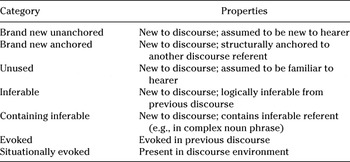
In French, LD is a pragmatically marked word order associated with topic-marking, and the types of discourse referents that can appear in LD are subject to restrictions.Footnote 2 Early approaches to discourse referents and information structure relied on a binary distinction between information that was given (or old) and information that was new (e.g., Chafe, Reference Chafe and Li1976; Kuno, Reference Kuno1972). Prince’s (Reference Prince and Cole1981) reformulation of this simple dichotomy yielded seven distinct categories of discourse referents, presented in Table 1.
Prince’s (Reference Prince and Cole1981) information status taxonomy

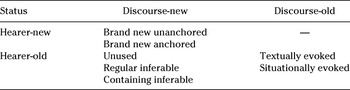
Prince (Reference Prince, Thompson and Mann1992) organized the information status of discourse referents along the axes discourse-new versus discourse-old and hearer-new versus hearer-old. Discourse-old or discourse-new indicates the referent’s presence or absence in the previous discourse, whereas hearer-old or hearer-new reflects the referent’s presence or absence in the hearer’s mental representation. Prince limited her discussion to brand new, unused, and evoked information, setting aside the category of inferables, whose classification she considered problematic (E. Prince, personal communication, April 14, 2007). Respectful of Prince’s position, I argue for the purposes of the present analysis that inferables are most appropriately considered hearer-old information, given that a speaker assumes that his or her interlocutor will be able to correctly identify the (inferable) referent. At the same time, inferables are discourse-new, lacking a prior mention in the discourse. This approach has two advantages. First, all of the members of Prince’s (Reference Prince and Cole1981) taxonomy can be classified in terms of discourse-new, discourse-old, hearer-new, and hearer-old information, as in Table 2. Second, it allows the behavior of French LDs to be neatly contrasted with that of English LDs.
Information status: Hearer and discourse status

Both English and French make use of LD. In this section, the discourse functions of LD and relevant restrictions on its use are presented for English (the L1 of the near-natives in the present study) and French (the L2). In English, LD occurs primarily in unplanned, informal, interactional spoken discourse (Geluykens, Reference Geluykens1992; Gregory & Michaelis, Reference Gregory and Michaelis2001). Two principal discourse functions have been identified. The first is to introduce referents that are new to the discourse (Gregory & Michaelis; Manetta, Reference Manetta2007; Ochs Keenan & Schieffelin, Reference Ochs Keenan, Schieffelin and Thompson1976; Prince, Reference Prince and Kamio1997, Reference Prince, Culicover and McNally1998). The LD referent has generally not been mentioned in previous discourse. According to Geluykens, it is often entirely irrecoverable based on the previous discourse. A secondary function of English LD is to introduce a referent that is inferable from the previous discourse (Geluykens; Gregory & Michaelis; Manetta; Ochs Keenan & Schieffelin; Prince, Reference Prince and Kamio1997, Reference Prince, Culicover and McNally1998). In such cases, the LD referent has not itself been mentioned in prior discourse but is directly related to previous discourse referents or stands in a partially ordered set relation to them (Geluykens; Prince, Reference Prince and Kamio1997, Reference Prince, Culicover and McNally1998).
In terms of Prince’s (Reference Prince and Cole1981, Reference Prince, Thompson and Mann1992) referent categories, English LDs are most compatible with discourse-new referents (i.e., brand new, unused, and inferable). Within these categories, corpus data show that the distribution is skewed in favor of irrecoverable referents (e.g., brand new and possibly unused), which account for 77% of Geluykens’s (Reference Geluykens1992) LD data. The remaining 23% of Geluykens’ LDs contain inferable referents. In Gregory and Michaelis (Reference Gregory and Michaelis2001), 62% of LD referents have not been previously mentioned in the discourse (i.e., they are not evoked). Inferable referents and a small number of evoked referents account for the remaining data. Likewise, in Manetta (Reference Manetta2007), new referent introductions account for the largest number of LDs.
The generalization that emerges from multiple corpus-based studies of English LD is consistent: LDs introduce referents that are either new to the discourse or inferable from previous discourse. Importantly, discourse-old referents (e.g., evoked) are rare in English LD (see Manetta, Reference Manetta2007, for further discussion). Because LDs in English do not strictly depend on prior discourse and can introduce discourse-new referents, they may occur at the start of a discourse (Geluykens, Reference Geluykens1992) when no prior discourse is available.
Once a referent appears in a LD, it typically becomes topical (Geluykens, Reference Geluykens1992; Gregory & Michaelis, Reference Gregory and Michaelis2001; but see Prince, Reference Prince and Kamio1997). Gregory and Michaelis argued that all English LDs mark topic. English LD thus serves the double function of introducing referents to the discourse and marking them as topical. As a result, most English LDs contain discourse-new referents; discourse-old referents are infrequent.
As in English, LD in French is found predominantly in informal, unplanned spoken discourse (Ashby, Reference Ashby1988; Barnes, Reference Barnes1985; Lambrecht, Reference Lambrecht1981). Again as in English, French LD marks topic (Ashby; Barnes; De Cat, Reference De Cat2007; Lambrecht, Reference Lambrecht1981, Reference Lambrecht1994). Although most constituent types can be left dislocated, subjects are the most frequent; they account for 81% of the LDs in Barnes’s corpus and 79% of the LDs in Ashby’s corpus. The close association of subjects—the most frequent type of topic—and a grammatical topic position is not surprising and is valid crosslinguistically (Reinhart, Reference Reinhart1981).
At first glance, LD appears to be quite similar in English and French. In both languages, LDs occur in informal spoken discourse and mark topic. However, the two languages differ fundamentally in the types of referents that LD can encode. Whereas the principal function of English LD is to introduce discourse-new referents, this is not the case in French: French LDs cannot encode discourse-new referents (Lambrecht, Reference Lambrecht1981). Rather, as Barnes (Reference Barnes1985) noted, the LD referent must show cohesion with the prior discourse (LDs may not occur at the beginning of a discourse), and the referent must be somehow present, or able to be activated, in the hearer’s consciousness. In Prince’s (Reference Prince, Thompson and Mann1992) terms, this entails that hearer-new information (i.e., brand new referents) is illicit—or at least highly dispreferred—in French LD. Spoken French possesses a separate construction—the avoir cleft—to introduce new referents to discourse (Lambrecht), as illustrated in (4), in which mon frère “my brother” is unanticipated and irrecoverable.
(4) Il y a mon frère qui vient ce soir.
“There is my brother who is coming tonight.”
These observations reveal a fundamental difference between how LDs are used in English and French. In English, LD introduces new referents—many of which are necessarily hearer-new—to the discourse. By contrast, French LDs may not introduce hearer-new referents—which are necessarily discourse-new as well—into the discourse; this function is mapped to avoir clefts.
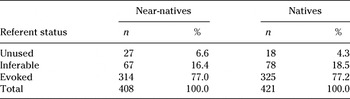
French LD fulfills a subset of the functions attributed to English LD in that it only marks topic. This difference in function has ramifications for the types of discourse referents found in French LD. As Ashby (Reference Ashby1988), Barnes (Reference Barnes1985), and the present study all demonstrate on the basis of corpus data, most native French LDs encode referents that have been mentioned in prior discourse—that is, evoked referents. Additionally, unused and inferable referents—which represent information that is discourse-new but hearer-old—occur regularly in French LDs, but brand new referents are virtually absent. Consider how different types of referents are distributed in the 473 LDs produced by the 10 French native speakers in the present study: Evoked referents account for a large majority (77.2%) of the LDs, inferable referents account for 18.5%, and unused referents represent the remaining 4.3%. No brand new referents appear in the French natives’ LDs. Similarly, Ashby’s French natives produced no examples of brand new referents in LD and used LD uniquely for evoked and inferable referents.Footnote 3
Two observations ensue: First, the principal function of French LD is not to simultaneously introduce a new referent and mark it as topical but simply to mark a referent as topical; referent introduction is preferentially left to avoir clefts. Second, English and French differ as to the distribution of referent types in LD. In English, LD referents are preferentially those that fall in the discourse-new column of Table 2: brand new, unused, and inferable referents. In French, the relevant category is hearer-old rather than discourse-new, in that the referent types attested in LDs are contained within the hearer-old row of Table 2: unused, inferable, and evoked. Among the native speakers in the present study, this observation is categorical. The conditions on use of LD in English and French overlap with respect to unused and inferable referents, which are felicitous in both languages. A crucial distinction arises with respect to brand new referents, frequent in English LD but strongly dispreferred in French LD, and evoked referents, dispreferred in English LD but extremely frequent in French LD.
English and French also differ markedly in how frequently LD is used: LD is far less frequent in English than in French. Comparisons between the frequency of LD in the data from the French natives in the present study and the frequency of English LD in the corpus-based studies of Geluykens (Reference Geluykens1992), Gregory and Michaelis (Reference Gregory and Michaelis2001), and Manetta (Reference Manetta2007) are revealing.Footnote 4 Geluykens’s spoken corpus contains approximately 225,000 words and 117 total LDs, which amounts to 1 LD per 1,923 words. By contrast, the French natives in the present study produced 473 LDs in only 38,726 words, a rate of 1 LD per 82 words. The French speakers used LD approximately 23 times more frequently than the English speakers in Geluykens’s work. Gregory and Michaelis’ corpus of spoken English contains 250,000 words and a total of 187 LDs, or 1 LD per 1,337 words. In this case, the frequency of LD is 16 times greater in French than in English. Manetta reported total length (in minutes) rather than a word count for her corpus of spoken English. In about 250 min of spontaneous conversation, there were 62 LDs—roughly 1 LD every 4 min. The frequency of LDs in the French data of the present study is again markedly higher: In the 495-min corpus, the natives produced 473 LDs. However, the natives accounted for only about half of the speech in the corpus, as they were paired with nonnative interlocutors. Given that the native speakers and nonnative speakers contributed equally to the conversations in the corpus (as shown subsequently), the natives’ speech arguably accounts for half (or 247.5 min) of the 495 min in the corpus. By this measure, the native French speakers produced about two LDs per minute, or eight times more than the English speakers in Manetta’s work. Although both English and French make use of LD in informal spoken discourse, LD is somewhere between 8 and 23 times more frequent in French than in English (Gregory & Michaelis, Reference Gregory and Michaelis2001, discussed the rarity of LD in English). Compared to French, LD is used only marginally in English.
STYLISTICALLY MARKED FEATURES
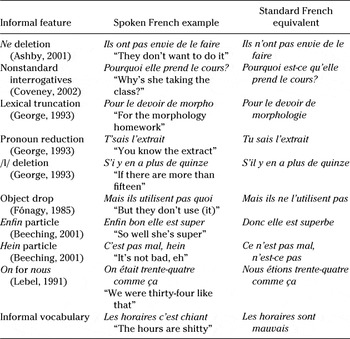
French LD is characteristic of spoken French, a term used here to denote a casual register like the everyday variety in Blanche-Benveniste and Jeanjean’s (Reference Blanche-Benveniste and Jeanjean1987) distinction between le français du dimanche “Sunday French” and le français de tous les jours “everyday French.” In addition to LD, spoken French presents some or all of the traits illustrated in Table 3.
Characteristic features of spoken French
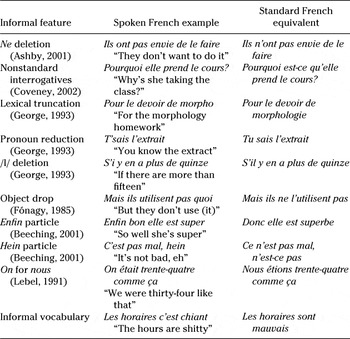
For L2 speech to be appropriate in context, it must show appropriate levels of formality or informality (see, e.g., Canale, Reference Canale, Richards and Schmidt1983; Canale & Swain, Reference Canale and Swain1980). Research on the SLA of stylistically marked features has generally revealed underuse of informal variants in informal contexts, leading to L2 speech that sounds overly formal. In informal spoken L2 French, rates of deletion of the negative particle ne “not” appear never to reach nativelike levels (Dewaele & Regan, Reference Dewaele and Regan2002; Regan, Howard, & Lemée, Reference Regan, Howard and Lemée2009; Sax, Reference Sax2003), even at very advanced levels of proficiency and after as long as 4 years of living abroad (Sax). Whereas native speakers omit ne “not” extremely frequently (sometimes nearly categorically) in informal speech (Ashby, Reference Ashby1981, Reference Ashby2001; Coveney, Reference Coveney2002), L2ers—even those with advanced proficiency—speak more formally by producing a stylistically infelicitous rate of ne “not.” Similar cases of underuse of informal variants have been documented in L2 French for /l/ deletion in subject pronouns (Howard, Reference Howard2006; Regan et al.; Sax), realization of the phoneme /ε/ (Valdman, Reference Valdman and Blyth2003), subject-verb agreement (Howard), and use of the subject pronoun on “one” instead of nous “we” (Regan et al.; Rehner, Mougeon, & Nadasdi, Reference Rehner, Mougeon and Nadasdi2003; Sax). Dewaele (Reference Dewaele1999) reported apparently nativelike use of a variety of interrogative structures by L2ers of French, but the bulk of the studies point to L2 underuse or avoidance of informal features. As Sax noted in the conclusion of her large-scale study, “No group, however, ever achieved the level of use of the informal variant found for native speakers” (p. 187). Although no study to my knowledge has examined LD use among advanced L2 French speakers, one may hypothesize that, as a stylistically marked construction (Ashby, Reference Ashby1982, Reference Ashby1988; Barnes, Reference Barnes1985; Lambrecht, Reference Lambrecht1981), LD will be subject to underuse by L2ers.
To the best of my knowledge, the use of LDs by near-native speakers of French has not yet been investigated, although previous work has examined earlier stages of interlanguage. Trévise (Reference Trévise, Kellerman and Sharwood Smith1986) studied English and Spanish classroom learners of French. Both groups of learners produced a limited number of LDs in interview data, with occasional formal errors. Trévise’s data are valuable because they are taken from authentic interactive communication, as are the data in the longitudinal study by Perdue, Deulofeu, and Trévise (Reference Perdue, Deulofeu, Trévise, Klein and Perdue1992), who studied four untutored adult learners (of L1 Moroccan Arabic and L1 Spanish backgrounds). All four learners used at least some LD in their early stages of French, but the forms were again not always targetlike, with instances of misplaced or missing resumptive pronouns. More recent studies have attempted to elicit LDs experimentally. Hendricks (2000) used oral picture retells with adult L1 Chinese learners of French. Hendricks speculated that task type led to the unexpectedly low use of LD: The learners encoded only 6% of animate entities with LDs, and the native rate was even lower at only 2%. As Hendricks suggested, the narrative nature of the picture-based task probably led to a formal register that was incompatible with LDs. Several of the L2ers’ 42 LDs infelicitously introduced brand new referents. Ferdinand (2002) studied French LD use by Dutch secondary school students, but the oral picture narration tasks yielded only a handful of tokens, thus precluding firm conclusions. Kerr (Reference Kerr, Gass, Bardovi-Harlig, Magnan and Walz2002) reported on the use of French LD by L1 English university students from four proficiency groups. Kerr’s data from oral retells of a short film showed an increase in the use of LD as proficiency increased. Likewise, increased exposure to authentic language (i.e., length of immersion experience) corresponded to a higher use of LD. As in previous studies, the native-speaker control group produced relatively little LD, despite the oral nature of the task. Sleeman (Reference Sleeman2004) studied L1 Dutch learners of French that met Bartning’s (Reference Bartning1997) criteria for advanced proficiency. The instrument, replicated from Ferdinand, yielded only a small number of LDs (18 L2 tokens and 18 tokens from the controls). Like Kerr, Sleeman found that LD use increased with exposure to native French.
Although these studies revealed that LD use in L2 French interlanguage increases with exposure to native French, their analyses of discourse function are not sufficiently detailed to allow predictions about how LDs might be used by highly proficient learners. The studies do, however, reveal insights for research method. Retell tasks elicited consistently low token counts from both the learner and the control groups. Although conducted orally, retells are limited by what Sorace (Reference Sorace1985) called a lack of “meaningful communicative interaction with an interlocutor” (p. 250). The difficulty is twofold: First, dyadic interaction and turn-taking are absent, because retells (as narratives) are essentially monologic. Second, as Hopper (Reference Hopper and Givón1979) observed, narrative structure involves a high degree of topic continuity, which largely eliminates the need for topic markers like LD. With this in mind, low LD token counts in L2 data might reflect either interlanguage limitations, or inefficient elicitation techniques, or both. Low token counts from native speakers, however, should speak only to task type, given the frequency of LD in spoken French. As Coppieters (Reference Coppieters1987) pointed out, the long tradition of prescriptivism and bon usage in French renders the examination of stylistically marked features like LD difficult.
STUDY
Hypotheses
This study investigates the use of LD by near-native speakers of French in spontaneous conversation. Additionally, two tasks probed intuitions concerning LD. Although LD appears in earlier stages of L2 French interlanguage, production may be subject to errors of form (Perdue et al., Reference Perdue, Deulofeu, Trévise, Klein and Perdue1992) and discourse function (Hendricks, 2000). Coordination of syntax and discourse may be delayed until advanced levels of proficiency (e.g., Hertel, Reference Hertel2003; Hopp, Reference Hopp2009; Rothman, Reference Rothman2009), or it may not be fully acquirable at all (Sorace, Reference Sorace, Doughty and Long2003, Reference Sorace, Cornips and Corrigan2005), even by near-natives.
The study is guided by two hypotheses. Hypothesis 1 reflects the tenets of the Interface Hypothesis (Sorace, Reference Sorace, Doughty and Long2003, Reference Sorace, Cornips and Corrigan2005) and predicts that LD in near-native French will be nonnativelike with respect to discourse function, as measured by the types of discourse referents placed in LD. The specific prediction is that the near-natives’ use of French LD will reflect the discourse functions of LD in their L1 English: LD will be used preferentially to introduce brand new, unused, and inferable referents into the discourse and only marginally to encode evoked referents. The distribution of types of discourse referents in LD is thus predicted to differ in a specific direction between near-natives and natives (for similar cases, see Bohnacker & Rosén, Reference Bohnacker and Rosén2008; Sorace & Filiaci, Reference Sorace and Filiaci2006; and the Dutch participants in Hopp, Reference Hopp2009).
Hypothesis 2 concerns frequency of LD use and rests on two observations: First, LD is markedly less frequent in English than in French. Second, French LD is stylistically marked. Previous research on stylistically marked features has routinely revealed stylistically infelicitous underuse of informal features by L2ers in informal registers. The near-natives are therefore predicted to use LD at a significantly lower rate than the natives.
Participants
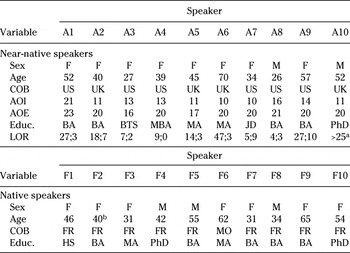
Adult learners of French were recruited in France via advertisements, personal networking, and contact with an English-speaking club. Because of the quantity of conversational data to be transcribed and analyzed, only the 10 most accomplished speakers were retained from an initial pool of approximately 20 candidates. Henceforth referred to as the near-natives, these participants were native speakers of American, British, or Canadian English and had lived continuously in France or a French-speaking area for longer than 4 years. All possessed a self-described very high-level mastery of French and were late learners according to the criteria used in Abrahamsson and Hyltenstam (Reference Abrahamsson and Hyltenstam2009), Johnson and Newport (Reference Johnson and Newport1989), and Marinova-Todd (Reference Marinova-Todd2003). Age at time of testing was not considered (a decision supported by the findings in Abrahamsson & Hyltenstam, Reference Abrahamsson and Hyltenstam2009). Nativelike phonology was not a criterion. The near-natives formed a homogeneous group only insofar as they were all native speakers of English who had, as late L2ers, become highly accomplished speakers of French. Table 4 presents the basic demographic details for the near-natives.
Basic demographic information

Note
COB = country of birth; AOI = age of first instruction in French; AOE = age of first major exposure to native speakers of French; Educ. = education; LOR = approximate total length of residency (years; months) in France; BTS = brevet de technicien supérieur (postsecondary technical degree); JD = Juris Doctor; HS = high school diploma (French equivalent); FR = France; MO = Morocco.
a Speaker A10’s LOR was greater than 25 years; however, the exact number was not provided.
b Estimate (speaker F2 declined to provide this information).
The near-natives were not rigorously prescreened and are intended to represent the range of attainment levels observable among highly proficient L2ers who have spent at least 4 years living in the L2 environment. Nevertheless, on a replication of Birdsong’s (Reference Birdsong1992) oft-cited grammaticality judgment task, which tested intuitions about seven subtle aspects of French grammar, the near-natives in the present study evinced more nativelike judgments than the near-natives in Birdsong’s study (Donaldson, Reference Donaldson2008). Assessing the comparability of near-native populations across studies remains problematic, but the near-natives of the present study possess a level of grammatical competence (as measured by grammaticality judgments) equal or superior to those in Birdsong’s study.
Native speakers of French were recruited to serve as a control group and as conversation partners for the near-natives. Each native speaker was suggested for inclusion in the study by his or her near-native counterpart. By design, the native speaker was, in each case, a friend, spouse, partner, or other close acquaintance of the near-native speaker with whom the near-native speaker typically spoke in French. All were from France; none were bilingual from birth, but some had knowledge of other languages. Because the near-native speakers nominated the native-speaker participants, to facilitate both as informal a register as possible as well as status equality within the dyads, the native-speaker group was necessarily heterogeneous. Table 4 presents the basic demographic information for the native speakers.
Procedure
Language Background Questionnaires. The near-natives completed two background questionnaires that covered basic demographic information; experience with French; self-evaluations of proficiency in reading, listening, writing, speaking, and pronunciation in French; attitudes toward French society and culture; and the amount of French used in daily activities. The questionnaires were based on Freed, Dewey, Segalowitz, and Halter’s (2004) Language Contact Profile and on the work of Piller (Reference Piller2002). The native speakers completed a separate questionnaire with demographic questions. Participants were reimbursed modestly at the end of the study.
Corpus of Spontaneous Conversations. The primary data come from recordings of spontaneous informal conversations between each near-native and his or her chosen native-speaker counterpart. The pairings were intended to naturally foster an informal register. The 10 dyadic conversations were digitally recorded in a casual environment (e.g., home, university lounge area) and lasted between 45 and 58 min. The researcher was present only to set up the recording equipment prior to the session and dismantle it at the end. No conversational topics were prescribed or suggested; the speakers were directed simply to enjoy the opportunity to catch up with a close acquaintance. The choice of unconstrained conversational data is not only justified by the types of contexts in which LD occurs naturally in French (extended informal discourse with multiple topic shifts; Barnes, Reference Barnes1985; Cadiot, Reference Cadiot1992; Carroll, Reference Carroll and Lefebvre1982) but also finds support in Bardovi-Harlig’s (Reference Bardovi-Harlig and Bouton1999b) discussion of research method and represents an attempt at using ecologically valid data (Piller, Reference Piller2002).
The recorded data were transcribed in their entirety, following the work of Jefferson (Reference Jefferson, Atkinson and Heritage1984, Reference Jefferson and Lerner2004). The corpus includes 8 hr 18 min of conversation, with a total of 77,300 words, excluding nonlexical backchannels (e.g., uhm, euh, mm hmm), nonlexical interjections (e.g., ah, oh, bah), and transcript notations (e.g., indications of exterior noise, coughing, and voice quality). Inaudible segments were counted as one word regardless of actual length. Once transcribed, each token of LD was coded for information structure and numerous grammatical properties. Ten percent of the data were recoded by an independent researcher, yielding an interrater reliability score of 93.1%.
Tasks. To measure intuitions regarding LD, secondary data were collected via two paper and audio tasks based on native-speaker production of LD and designed in collaboration with native-speaker consultants. Task 1 elicited felicity judgments about the use of LD in contexts designed to facilitate LD versus contexts designed to facilitate its subtly different right-hand counterpart—right dislocation (RD). Of the 60 items, 20 were distracters, 10 tested LD, and the remaining 30 tested other structures. In the LD contexts, half of the items were intended to facilitate a LD and half were intended to facilitate a RD, rendering the response—which always contained a LD—infelicitous. A sample item is given in the Appendix. Participants judged the felicity of the LD in each context by indicating whether the phrase seemed natural in the context. A response of “I don’t know” was also available. Each context was heard aurally on a prerecorded audio CD and presented visually on the paper response sheet.
On Task 2, presented in the same fashion, participants reported their preference for responses containing a LD versus a RD in contexts designed to facilitate either LD or RD. Of the 60 total items (including 20 distracters), 20 items involved dislocations. The responses always included a minimal pair whose members differed only by the use of a LD versus a RD (see the Appendix for a sample item). In the 10 items intended to facilitate LD, participants were anticipated to choose the LD response and reject the RD response. Likewise, in the 10 contexts designed to facilitate RD, participants were anticipated to reject the LD response in favor of the RD response. A response of “undecided” was also available.
All participants saw all of the items on each task, but three randomizations were used. Furthermore, on Task 2, each randomization had two versions: one with LD responses presented first and the other with RD responses presented first. All the materials were presented in French, with no English glosses. To avoid revealing the purpose of the study, the tasks were administered after the conversational recording.
RESULTS
Tasks
In both tasks, the native-speaker data were taken as a baseline, whether or not the native responses corresponded to the response that had been anticipated when designing the item. The near-native performance was thus evaluated in light of the actual native-speaker responses rather than a predetermined norm. For each individual item, the near-native and native response patterns were subjected to a χ2 analysis. On Task 1 (felicity judgment), a between-groups difference was found for only 1 of the 10 items, χ2(2, N = 6) = 6.171, p < .05. On this item, the near-native group chose the anticipated response (per the author’s and native-speaker consultants’ judgments), but the native control group chose the unanticipated response. On Task 2, no between-groups differences were found for any of the 20 target items.
Corpus
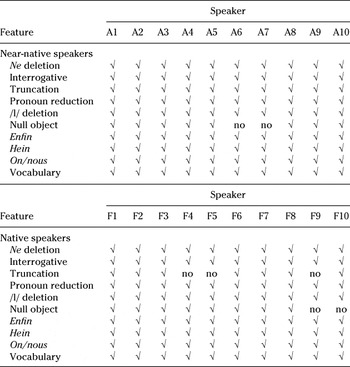
Register. Because the study aimed to elicit informal spoken French, each recording was analyzed for the presence of characteristics of spoken French. All 10 dyads appeared to have adopted an informal register. Table 5 presents the findings for the near-native speakers and native speakers, respectively. If a feature was attested at least once, a check mark (√) appears in the corresponding cell. Unattested features are marked no.
Informal features in corpus

The register in the dyads can be considered informal and casual, as each participant used at least 8 of the 10 characteristics adopted as criteria. The presence of these features suggests that the data are free from excessive influence of a prescriptive norm—a particular danger in studies of spoken French (see Coppieters, Reference Coppieters1987; Trévise, Reference Trévise, Kellerman and Sharwood Smith1986). Because LDs are most typical of this register of speech, the language in the corpus was anticipated to be favorable to their occurrence.
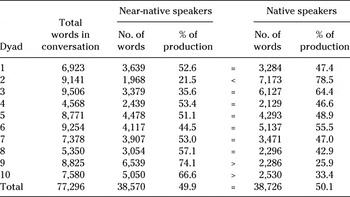
Quantitative Dominance. The extent to which each speaker participated in the conversation was assessed by using Itakura’s (Reference Itakura2001) notion of quantitative dominance—the number of words contributed by each speaker. Although quantitative dominance is only one of numerous measures of conversational dominance, it provides an overall impression of each speaker’s involvement. Nonlexical backchannels and hesitations, which do not contribute meaningfully to fluency, were excluded. Table 6 presents individual word counts and percentages of production for each participant.
Quantitative dominance by dyad (excluding nonlexical items)

Note
The symbol < indicates that the native speaker dominated the conversation, the symbol > means that the near-native speaker was dominant, and the symbol = represents a balance between the two speakers.
The total production (total words) of the near-native and native groups was roughly equal. A paired samples t test performed on the percentages of production (proportion of near-native to native production) revealed no between-group differences, t(18) = 0.203, p = .844, SD = 14.82. Speakers were considered dominant when their proportion of production exceeded the group mean by one standard deviation—that is, when they produced more than 64.82% of the words in the dyad. Dyads in which both speakers’ percentages of production fell within one standard deviation were considered to be evenly matched for conversational dominance. As a whole, quantitative dominance (as shown in Table 6) in the corpus was balanced: In seven of the dyads (1, 3, 4, 5, 6, 7, 8), the near-native and native speakers contributed essentially equally. In dyad 2, the native speaker was dominant, but in both dyads 9 and 10, the near-native speaker was dominant.
Left Dislocation
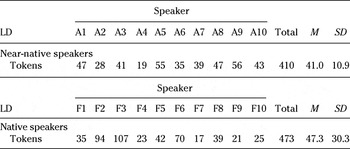
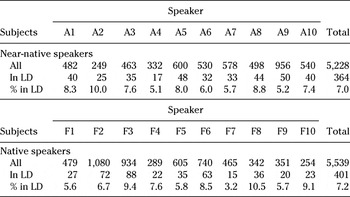
Production. Each participant produced multiple tokens of LD. For the near-natives, the individual production ran from a low of 19 tokens of LD to a high of 56. Among the natives, the range was wider, from a low of 17 to a high of 107 tokens. The corpus contained a total of 883 tokens of LD. Table 7 presents the production of LD by the near-native and native speakers.
Total production of LDs

The near-natives were more homogeneous in their production than the natives, but despite the difference in range of production, the two groups did not differ statistically in the overall number of LDs they produced, t(18) = 0.546, p = .598. In other words, in the same amount of time and in comparable quantities of discourse, the near-native and native speakers, as groups, produced comparable quantities of LD.
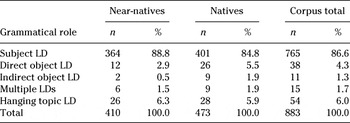
Left-Dislocated Constituents. The LDs in the corpus included subjects, direct and indirect objects, hanging topics with no overt grammatical link to the clause, and multiple LDs. Because LD encodes topic and because topics are typically associated with subjects (Prince, Reference Prince, Thompson and Mann1992; Reinhart, Reference Reinhart1981), it was anticipated that a large number of the LDs would encode subjects, as has been previously reported for French (Ashby, Reference Ashby1988; Barnes, Reference Barnes1985). Table 8 details the grammatical categories of the LD constituents for both the near-native and native speaker groups. There were no significant between-group differences in the distribution of grammatical categories in the LDs, χ2 (4, N = 10) = 7.62, p = .107. The natives produced slightly more LD overall than the near-natives, but the two groups did not differ in their proportions of LD used to encode subjects and direct and indirect objects and in multiple LDs and hanging topic constructions. As anticipated, the natives exhibited a strong tendency to use LD with subjects (84.8% of their LDs). The near-natives’ rate of 88.8% was similarly high.
Distribution of LDs across grammatical role in the corpus

Note
Multiple LDs are considered as a separate category, regardless of the possible grammatical roles of one or more of their constituents.
Grammatical Subjects. Although a large percentage of LDs encoded subjects, most subjects in the corpus were not left-dislocated, and LD subjects accounted for only a small proportion of the total grammatical subjects. Of the subjects (NPs and pronouns) with discourse referents that could potentially be topicalized (i.e., excluding expletive subjects in impersonal expressions like il faut que “it is necessary that” or il pleut “it’s raining”; see de Fornel, Reference de Fornel1988), only 7.1% (all persons and numbers combined) are left-dislocated. Table 9 presents the individual production of subjects eligible for topichood and the percentage of those subjects that are left-dislocated.
Percentage of LD subjects

Note
Range of subject LD in near-native speakers: 5.1–10.0%; M = 7.0%, SD = 1.65%. Range of subject LD in native speakers: 3.2–10.5%; M = 7.2%; SD = 2.22%.
To compare the rates at which the near-native and native speakers left-dislocated eligible subjects, the proportions of LD to canonical (non-LD) subjects were arcsine square root transformed to permit a parametric statistical test. An independent samples t test performed on the transformed proportions did not reveal significant differences between the two groups, t(18) = .086, p = .932, a finding that suggests that the near-native speakers left-dislocated eligible subjects at a rate comparable to the native speakers and, thus, did not overuse LDs.
Discourse Referents. The discourse function of French LD is to mark topic. Additionally, LDs with the first-person singular tonic pronoun moi “me” also serve as a turn-taking marker (Barnes, Reference Barnes1985; Carroll, Reference Carroll and Lefebvre1982). Because moi LDs also inherently mark topic like other LDs, they do not receive a separate analysis here. Similarly, LDs were treated as possessing comparable discourse functions regardless of the type of dislocated constituent, following Delais-Roussarie et al. (Reference Delais-Roussarie, Doetjes, Sleeman, Corblin and de Swart2004), who found no evidence of differences in discourse function for linked versus hanging topic LDs, pronominal versus full NP LDs, or single versus multiple LDs.
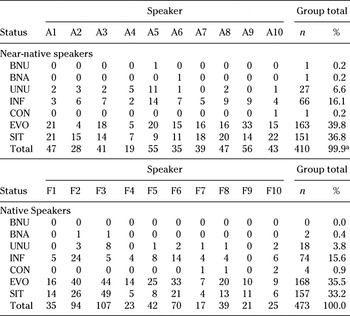
The information status of the discourse referent in each LD was coded according to Prince’s (Reference Prince and Cole1981) taxonomy. Table 10 presents the quantitative data for each type of referent found in the LDs produced by the near-natives and natives.
Information status of referents in all LDs

Note
BNU = brand new unanchored; BNA = brand new anchored; UNU = unused; INF = regular inferable; CON = containing inferable; EVO = textually evoked; SIT = situationally evoked.
a Percentages do not add to 100 because of rounding error.
As a topic marker, French LD serves principally to recall previous discourse referents to memory and establish them as topics. Highly recoverable referents, such as evoked referents, are the best candidate for topichood (Chafe, Reference Chafe and Li1976; Kuno, Reference Kuno1972). As a consequence, a high incidence of evoked referents and a low incidence of brand new referents are expected in the native LD data. The data in Table 10 show that this prediction is borne out: Evoked referents—both textually and situationally evoked—account for the largest proportion of the native LDs. As predicted, the natives uniformly avoided placing brand new unanchored information in LD and only rarely placed brand new anchored information in LD. The patterns in the near-native data (as shown in Table 10) very closely resemble those in the native data. Overall, both groups used LD to encode referents that fall neatly into the modified version of Prince’s (Reference Prince, Thompson and Mann1992) category of hearer-old information (i.e., unused, regular and containing inferable, evoked and situationally evoked). Hearer-new information (brand new anchored and unanchored) was virtually absent from the LDs in the corpus.
To test whether the two groups’ use of LD differed with regard to the information structure categories of the LD referents, aggregate group data were used. The marginal brand new information categories were excluded from analysis, the two subsets of inferable referents (regular and containing) were conflated, and textually evoked and situationally evoked referents were similarly combined. The resulting data are reported in Table 11.
Information status of referents in all LDs: All speakers

No between-group differences were revealed in the proportions of LD used to encode unused, inferable, and evoked referents, χ2(2, N = 6) = 2.621, p = .269. However, the information status of first- and second-person referents differs inherently from that of third-person referents, in that first- and second-person referents necessarily refer to the discourse participants, whereas third-person referents refer to all other entities. Following Prince (Reference Prince and Cole1981), discourse participants were uniformly coded as situationally evoked. Because speakers refer to themselves and to their interlocutors quite frequently, first- and second-person referents accounted for a large percentage of the situationally evoked LDs. To investigate the use of LDs with referents other than the discourse participants (e.g., third-person referents only), LDs with third-person referents were subsequently analyzed separately. The rates of situationally evoked referents dropped from 151 tokens to 5 for the near-natives and from 157 tokens to 4 for the natives. Neither group used LD robustly with situationally evoked entities apart from themselves and their interlocutors. Importantly, the analysis of only the LDs with third-person referents—as compared with the analysis of the entirety of the LDs—revealed no changes in the groups’ behavior. No between-group differences were found in the proportions of third-person LDs used to encode unused, inferable, and evoked referents, χ2(2, N = 6) = 4.749, p = .093.
DISCUSSION
This study reported on a group of L1 English near-native speakers of French. All were adult learners. Their performance on a replication of Birdsong’s (Reference Birdsong1992) grammaticality judgment task revealed that their intuitions about aspects of French grammar were equal or superior to those of Birdsong’s near-natives. No direct claims about the near-natives’ grammatical competence are made on the basis of these results. What is relevant here is that advanced or nativelike grammatical abilities do not necessarily entail concomitant discourse and pragmatic abilities of the same level (see Bardovi-Harlig, Reference Bardovi-Harlig1999a, Reference Bardovi-Harlig, Martínez, Usó Juan and Fernández Guerra2003), although grammatical mastery is probably a prerequisite for pragmatic (or discourse) development (Bardovi-Harlig, Reference Bardovi-Harlig, Martínez, Usó Juan and Fernández Guerra2003).
The study tested two hypotheses about the use of French LD by L1 English near-native speakers. Hypothesis 1 concerned the ability to coordinate syntactic and discourse-pragmatic information. On the basis of Sorace’s (Reference Sorace, Doughty and Long2003, Reference Sorace, Cornips and Corrigan2005) Interface Hypothesis and studies that have reported residual difficulties on interface phenomena, even at near-native levels, Hypothesis 1 predicted that the near-native speakers would use French LD in a demonstrably different way than native French speakers do. The results force a rejection of Hypothesis 1.
The crucial data come from how the near-native speakers behave with respect to the two types of discourse referents where English and French LD diverge: Brand new referents are found robustly in English LD but not in French LD, and the opposite situation obtains for evoked referents, which are rare in English LD but extremely frequent in French LD. The near-natives’ distribution of unused, inferable, and evoked referents is statistically indistinguishable from that of the natives and shows the nativelike preference for evoked referents in LD. Only in one example did a near-native place a brand new referent in a LD. A single isolated token cannot be taken as indicative of an infelicitous or English-based strategy, especially given that both Barnes (Reference Barnes1985) and Lambrecht (Reference Lambrecht1981) discussed isolated cases of brand new referents in native French. It bears mentioning that this use of LD, also noted for early learners of French in Hendricks (2000), did not generalize to the near-native group as a whole. To uphold Hypothesis 1, the near-natives would have had to use LD robustly for brand new referents and show a general preference for discourse-new referents rather than evoked referents. The data provide no evidence that the near-natives used LD (infelicitously) as a strategy to introduce new, irrecoverable referents into the discourse. Rather, the near-natives appear to have mastered the constraints on what types of discourse referents appear felicitously in French LD, as revealed by analyses of all of the LDs combined and a separate analysis of LDs with third-person referents only.
Previous research on interface phenomena in L2 has revealed that near-natives may possess intuitions that are indeterminate or that diverge from those of native controls with respect to the use or interpretation of a given syntactic feature. In Sorace’s (Reference Sorace1993) study of auxiliary selection in Italian, for example, the L1 English participants produced indeterminate judgments, whereas the L1 French participants produced judgments that were significantly above chance but differed from the Italian controls. In Sorace and Filiaci’s study (2006), English near-native speakers of Italian demonstrated indeterminate strategies in assigning an anaphor to ambiguous subject pronouns. The corpus data in the present study do not reveal indeterminacy with respect to the discourse functions of French LD. The results from Tasks 1 and 2, although limited in scope, point to the same conclusion. Both tasks tested intuitions regarding the use of LD with a subtly different topic construction, RD. On Task 1 (felicity judgments), the near-native judgments were statistically indistinguishable from the native judgments on 9 of the 10 items. On the remaining item, the near-natives responded as anticipated; the native speakers’ unanticipated response pattern remains unexplained but may be based on factors other than the LD in the target phrase. On Task 2 (preference), the fact that the near-natives’ responses were statistically indistinguishable from those of the natives on all 20 items suggests that the near-natives clearly distinguished between the form-function mappings of LD and those of RD. The near-natives’ intuitions were neither indeterminate nor divergent on either task.
Hypothesis 2 predicted that the near-natives would underuse LD in comparison with the natives—first, because LD use is relatively marginal in English compared to French and, second, because LD is stylistically marked in French. Hypothesis 2 is not supported for several reasons. The raw production of LDs in an equivalent amount of discourse did not differ between the near-natives and natives nor did the frequency with which the two groups left-dislocated different types of constituents (subjects, objects, etc.). Finally, grammatical subjects—the most likely type of discourse topic—were left-dislocated at comparable rates by both groups. The data provide no evidence for underuse (or overuse) of LDs by the near-natives, despite the relative rarity of LD in English and the fact that LD is a stylistically marked informal feature in French.
Individual variation in the use of LDs appeared in both the native and near-native data. The differences were more pronounced in native than in near-native production. For the native speakers, individual productions ranged from 17 tokens to a high of 107. The near-native production fit inside the range established by the natives: The near-natives produced between 19 and 56 tokens each. A more accurate sense of how frequently a speaker used LD may be gained by relating production of LD to his or her total production (in words). For example, in the native data, the individual proportions of left-dislocated subjects ranged from 3.2% to 10.5%; for the near-natives, the range was from 5.1% to 10.0%. The range of LD use observed in both speaker groups is probably best explained as the result of natural interparticipant variation rather than evidence for differences in discourse or grammatical competence or language register adopted during the conversations. None of the near-natives can convincingly be labeled as a high- or low-frequency user in light of the range of native production. In contrast, in Belletti et al. (Reference Belletti, Bennati and Sorace2007), the L2 group overused overt preverbal pronouns and underused postverbal lexical subjects in Italian. Similarly, in Bohnacker and Rosén (Reference Bohnacker and Rosén2008), the L2 group differed quantitatively from the L1 group with respect to the information status of referents placed in the German prefield.
In sum, the data from the present study revealed no evidence that the near-native speakers encountered difficulties coordinating the relevant syntactic and pragmatic information during the production of French LD. Evidence of nonnativeness could have taken the form of a robust incidence of brand new referents in LD, a dispreference for evoked referents in LD, failure to left dislocate constituents other than subjects, failure to use LD with all the subcategories of hearer-old information, global underuse or overuse of LD, or intuitions and preference judgments about LD that differed significantly from those of the native group. These types of evidence were absent from the data.
The objective of the conversational recordings was to elicit a large enough number of LDs in spontaneous informal speech to study how near-native speakers of French deploy LD in authentic communication. According to the Interface Hypothesis (Sorace, Reference Sorace, Doughty and Long2003, Reference Sorace, Cornips and Corrigan2005), the coordination of syntactic and discourse information presents difficulties for near-native speakers. Most of the supporting evidence has come from judgment tasks, as few studies of syntax-discourse interface phenomena in L2 have used data from the types of unconstrained discourse where the structures in question naturally occur (the story retell in Belletti et al., Reference Belletti, Bennati and Sorace2007, was oral but guided, in principle, by the events of the story). Given the centrality of discourse factors to this type of interface phenomenon, it is reasonable to expand the inquiry to extended discourse. It was reasoned that if systematic difficulties or optionality remain in the near-natives’ realization of interface phenomena such as French LD, some evidence of the difficulties should arise over the course of a 45-min conversation conducted entirely in the L2, either in the form of infelicities in discourse function (e.g., new referent introductions), purely formal errors, or underuse of LD with respect to the native group. The fact that LD is the most felicitous strategy to mark topic in spoken French (De Cat, Reference De Cat2007) meant that numerous tokens of LD were anticipated—correctly—to occur in the data. Furthermore, the choice of unconstrained production data receives support from previous research in which difficulties at interfaces have been accompanied by observable problems in actual production. Examples include residual V2 sentences in the L2 English of German speakers (Robertson & Sorace, Reference Robertson, Sorace, Klein and Martohardjono1999), the use of focus word order for topical referents in the L2 Spanish of Quechua speakers (Camacho, Reference Camacho1999), the overuse of overt subject pronouns in L2 Italian (Filiaci, Reference Filiaci2003, as cited in Sorace & Filiaci, Reference Sorace and Filiaci2006), the overuse of overt pronouns and underuse of postverbal subjects in L2 Italian (Belletti et al., Reference Belletti, Bennati and Sorace2007), and infelicitous distributions of topic and focus information in L2 German main clauses (Bohnacker & Rosén, Reference Bohnacker and Rosén2008).
In some respects, the use of spontaneous production data presents a clear advantage over a purely experimental approach. In numerous studies on the acquisition of LD in L2 French (e.g., Ferdinand, 2002; Hendricks, Reference Hendricks2000; Kerr, Reference Kerr, Gass, Bardovi-Harlig, Magnan and Walz2002; Sleeman, Reference Sleeman2004), the experimental design did not elicit robust LD token counts. In Ferdinand (2002), for example, picture narration tasks yielded only 10 LDs in the L2 data and 5 LDs in the native French data. Similarly, in Hendricks, the L2 French data—elicited in the same way—contained a total of 42 LDs from a group of 20 participants. In contrast, in the present study, the 10 near-natives produced a total of 410 tokens of LD, and the native-speaker controls produced 473. The difference in production is likely due to elicitation techniques: LDs are characteristic specifically of interactive spoken French. The necessity for topic shift is a requisite condition for LDs; in narratives (e.g., picture retells), conventional conversational structure is suspended (Hopper, Reference Hopper and Givón1979), and topic shifts conducive to the appearance of LDs are reduced drastically. The robust production of LD elicited from both the near-natives and the native controls in the present study lends support to Bardovi-Harlig and Hartford’s (Reference Bardovi-Harlig, Hartford, Bardovi-Harlig and Hartford2005) appeal for the use of production data elicited in the most authentic and consequential environment possible.
CONCLUSION
This study was a primarily discourse-based investigation of certain aspects of the syntax-pragmatics interface—specifically, the use of LD to mark topic—in near-native speakers of French. The claims are limited to one register of speech: the informal spoken French elicited in the recorded conversations. Because the study is based on fully transcribed conversational discourse, the data originate from a relatively modest number of speakers. Although these near-natives appear to have mastered elements of this particular register, no claims are made with respect to their ability to appropriately modify their language to conform to other registers or contexts; these questions and others remain for future research. Similarly, the results address only some of the potential difficulties associated with French LD. The scope of the discourse investigation as well as Tasks 1 and 2 was necessarily restricted and does not offer a broad view of near-native discourse abilities. However, the conversational data represent a sizable amount of production; each participant had at least 45 min to reveal infelicities. In Camacho (Reference Camacho1999), based on shorter stretches of oral interview data, the nonnative features were quite evident, as they were in Robertson and Sorace (Reference Robertson, Sorace, Klein and Martohardjono1999), who used written production data.
The question of how to qualify and characterize the highest levels of L2 attainment remains problematic. The present study did not directly address this difficulty but did attempt to establish a degree of interstudy comparability by reporting that the near-native participants in the study performed at a rate equal or superior to those in Birdsong (Reference Birdsong1992) on the same task. Studies on near-nativeness have differed in their approach to screening, and so have their claims about ultimate attainment. Hopp (Reference Hopp2009, Reference Hopp2010), for instance, who employed a rigorous and objective screening procedure, found evidence of convergence between near-native and native performance on sentence processing tasks. The performance of his advanced learners, however, differed significantly from that of the natives. In studies with only impressionistic screening procedures, whose selection criteria are necessarily difficult to replicate, caution seems of the essence in interpreting claims about near-native abilities, whether the results point to convergence or divergence with respect to native behavior. Whether or not the near-natives in the present study represent the most accomplished adult learners of L2 French possible, they appear comparable to other near-native speakers of French cited in the literature (Birdsong, Reference Birdsong1992) and represent the levels of attainment found in a population of adult learners of French recruited through a careful—but by no means exhaustively rigorous—screening process.
Finally, no claims are made about the near-natives’ ability to pass as native speakers, but the findings suggest that they were able to combine knowledge of syntax and discourse pragmatics in authentic spontaneous conversation to produce informal discourse that closely resembled that of their native speaker interlocutors with respect to the use of LD to mark topic. Although LD is rarely taught explicitly in instructed L2 French, the near-natives nonetheless appear to have acquired the relevant form-function correspondences, which differ crucially from those of English, and the near-natives’ performance across a range of measures converged on that of the natives, even in a lengthy stretch of spontaneous discourse subjected to considerable scrutiny. This level of performance is unanticipated under the tenets of the Interface Hypothesis. By offering an in-depth account of one area of near-native discourse, the present study partially corroborates the observations made in Ioup, Boustagui, El Tigi, and Moselle (Reference Ioup, Boustagui, El Tigi and Moselle1994), who qualified the discourse of one of their adult learners of Egyptian Arabic as nativelike.
APPENDIX
Task 1 sample item (designed to render LD felicitous)
Deux collègues, Sandrine et Fabien, se rencontrent par hasard dans l’ascenseur. Sandrine demande:
—Salut! T’as été voir le nouveau film de Luc Besson?
Fabien lui répond:
— Non. Mon fils, il l’a vu, mais pas moi.
La réponse (en gras) vous semble-t-elle naturelle dans ce contexte? OUI / NON / je ne sais pas
Gloss:
Two colleagues, Sandrine and Fabien, run into each other by chance in the elevator. Sandrine says:
—Hi! Have you been to see the new Luc Besson film?
Fabien responds:
—No. My son, he saw it, but not me.
Does the response (in bold) seem natural to you in this context? YES / NO / I don’t know
Task 2 sample item (anticipated preference for LD response over RD response)
Paul fait souvent de la randonnée le week-end. Une de ses collègues, Angélique, lui demande:
—Tu vas faire de la randonnée ce week-end?
Paul lui répond:
a. Je veux bien mais ma femme, elle veut pas.
b. Je veux bien mais elle veut pas, ma femme.
Laquelle de ces réponses est la plus naturelle dans ce contexte? A / B / je ne sais pas Gloss:
Paul often goes hiking on the weekend. One of his colleagues, Angélique, asks him:
—Are you going to go hiking this weekend?
Paul responds:
a. I’d really like to, but my wife, she doesn’t want to.
b. I’d really like to but she doesn’t want to, my wife.
Which of these responses is the most natural in this context? A / B / I don’t know