1. Introduction
In this paper, we are concerned with affective aspects of meaning conveyed in an implicit way by the use of specific linguistic structures. We assume that the formal structure of an utterance gives indications about its interpretation (Kaschak & Glenberg, Reference Kaschak and Glenberg2000). More precisely, we will focus on Creative Total Reduplication (henceforth, CTR), a structure frequently found in informal conversation, as in this French example: C’est un petit petit chat (meaning ‘It is a little little cat’). This expression can be interpreted as C’est un très petit chat ‘It is a very little cat’. Yet, as very little cats are generally cute, the idea is that, in addition to the meaning ‘very little’, CTR expresses an affective meaning, mignon petit ‘cute little’. Thus, our hypothesis is that the presence of a specific linguistic structure may indicate the presence of an additional affective meaning and generate the inference of that meaning.
Total Reduplication (henceforth, TR) is a well-known process of word formation, attested in a large number of languages. It consists in the copying of a base,Footnote 1 which can be a stem, a root, or a fully inflected lexical (or syntactic) word (Rubino, Reference Rubino and Hurch2005). However, as observed by Stolz (Reference Stolz2008) as well as by Stolz, Stroh, and Urdze (Reference Stolz, Stroh and Urdze2011), there is more to TR than mere iteration of stems, roots, or syntactic words; TR also conveys a meaning that is not entirely the same as the one of the simplex (the item that is reduplicated). In this respect, Stolz (Reference Stolz2008) defines TR as “[t]he adjacency of two phonologically, morphologically and semantically identical syntactic words which together have a meaning/function which is [sometimes only slightly] different from the one associated with the simplex”. This definition covers different kinds of phenomena, since TR can have a grammatical status (e.g., forming the plural, as in Sranan Creole, where saka means ‘bag’, and saka-saka means ‘many bags’; Kouwenberg & LaCharité, Reference Kouwenberg, LaCharité and Hurch2005),Footnote 2 a lexical status (as, e.g., in the French dare-dare, meaning ‘very quickly’, and train-train, meaning ‘routine’), or a semantic–pragmatic motivation, as in the French petit petit ‘little little’, meaning très petit ‘very little’, or vraiment petit ‘really little’, bleu bleu ‘blue blue’, meaning très bleu ‘very blue’ or complètement bleu ‘completely blue’. The last kind of TR, i.e., non-lexicalized expressions whose production is spontaneous in oral speech, is referred to as CTR. As those examples show, the meaning of CTR is not fully determined from a linguistic viewpoint; in other words, the CTR can be interpreted in different ways, depending on many factors, notably the context,Footnote 3 and the intentions of the speaker and hearer. The inference of one of these possible interpretations is necessary to the comprehension (Gygax, Reference Gygax2010) of the CTR, and constitutes its explicit meaning: without the inference of that meaning, the CTR would have no meaning at all.
In our view, CTR may be additionally used to convey an affective inference, namely an inference about an affective meaning. To illustrate this point, consider the following examples, the first involving a noun CTR, the second a verb CTR, the third an adjective CTR:
(1) Comment on prépare un café café avec la moka? Footnote 4
‘How should I use the moka to make a coffee coffee?’Footnote 5
(2) On a été se balader tu vois mais on a marché marché Footnote 6
‘We went for a walk you see but we have walked walked’
(3) It’s an old old church (Levinson, Reference Levinson2000, p. 151)
In (1), the explicit meaning of the CTR may correspond to ‘a real / an authentic / an Italian coffee’; in (2), it may correspond to ‘walked for a long time / for a long distance’; in (3), it corresponds to ‘very old’. These expressions cover the explicit meaning of the CTR and are necessary to its comprehension. However, the hearer can infer from them an additional, affective meaning resulting from the affective evaluation, in terms of values good/bad or pleasant/unpleasant, of the situation described (Scherer, Reference Scherer2005). Thus, for (1), (2), and (3), the affective aspect of meaning can be interpreted as follows:
(1) a.How should I use the moka to make a real good coffee?
→ affective evaluation GOOD
(2) a.We went for a walk you see but we walked for a long time / for a long distance, and it was pleasant
→ affective evaluation PLEASANT
b.We went for a walk you see but we walked for a long time / for a long distance, and it was unpleasant
→ affective evaluation UNPLEASANT
(3) a.It’s a very old church, pleasant to see
→ affective evaluation PLEASANT
b.It’s a very old church, unpleasant to see
→ affective evaluation UNPLEASANT
As we can see from examples (2) and (3), some attributions of an affective valence provide two values indicating a potential affective reaction. Thus, depending on the context of utterance and the communicative aim of the speaker, the same explicit meaning of the CTR can be used to convey different affective meanings. This context sensitivity is an important feature of CTR; but, as pointed out by Schwartz (2007, p. 649), it is also a main aspect of any adaptive system of evaluation: “[p]eople do not ‘have’ attitudes and hence also do not have ‘multiple’ attitudes toward the same object – they merely evaluate the same object differently in different context or while pursuing different goals, and so on”. Evaluations are thus context-sensitive, and there is no contradiction in saying that different contexts generate different evaluations of the same object/event/situation. Thus, to take example (2), the fact of walking for a long time / for a long distance can be pleasant or unpleasant depending on the context. Consequently, two different evaluations are contradictory if they are issued from the same context (including the same point in time and the same speaker): the fact of walking a lot will be pleasant in one context and unpleasant in another context, but not pleasant and unpleasant in the same context.
Unlike the inference of the explicit meaning of the CTR, the inference of this affective meaning does not seem to be necessary to the comprehension of the CTR, and can be characterized as an optional inference, allowed by the utterance (Cook, Limber, & O’Brien, Reference Cook, Limber and O’Brien2001; Gygax, Reference Gygax2010; McKoon & Ratcliff, Reference McKoon and Ratcliff1989; Singer, Reference Singer and Gaskell2007). However, this optionality does not mean that affective meanings are useless or trivial: in examples (2, 2a–b), knowing that walking for a long time / for a long distance is pleasant (or unpleasant) constitutes important information for the hearer, contributing to his/her mental representation of the utterance.
Obviously, CTR is far from being the only way for an utterance to generate affective inferences: we share information about our affective states in different ways, by using language, intonation, or gestures, and frequently all three (Besnier, Reference Besnier1990; Wharton, Reference Wharton2009). Consider the examples below:
(4) My childhood days are gone gone (Sperber & Wilson, Reference Sperber and Wilson1995, p. 219)
a.My childhood days are gone
It is self-evident that, uttered under appropriate circumstances, (4a) can express the same affective state as (4), i.e., an unpleasant affective state, like homesickness, or regret. However, other things being equal, our claim is that CTR is a more powerful linguistic tool for communicating both information about a situation and information about the affective reaction provoked by that situation.
In a first attempt to verify the efficiency of CTR in generating affective inferences, Rossi (Reference Rossi, Bochner, De Brabanter, Kissine and Rossi2011) ran an exploratory study involving a recognition task, inspired by the one used by Bransford and Francks (Reference Bransford and Francks1971) and Bransford, Barklay, and Francks (Reference Bransford, Barclay and Francks1972) to test the generation of pragmatic inferences and their integration into a global representation of a sentence (or string of sentences). In those studies, participants were presented with both sentences previously heard (OLD sentences) and sentences not previously heard but that were potential inferences with respect to the previously heard ones (NEW sentences). Results showed significantly higher rates of affirmative responses for NEW sentences, which means that participants have integrated potential inferences in the overall representation of the sentence string.
In Rossi’s (Reference Rossi, Bochner, De Brabanter, Kissine and Rossi2011) experiment, participants, divided into two groups, heard twice four short stories, two of which contained two CTRs. This material was counterbalanced across participants: CTRs presented to Group 1 were presented as simplex to Group 2, and conversely. After a break, a set of items appeared on the computer screen. The task was to decide whether or not the item occurred in the previously heard stories. The recognition material was composed of different kinds of items: OLD (items actually heard); OLD-CTR (CTRs actually heard), NEW Non-Inference (items not actually heard and that could not be inferred from the story), and, critically, NEW Potential Inference-CTR, namely items not actually heard but that were potential inferences triggered by the CTR that had been presented in the story (e.g., the potential inference beautiful hair potentially triggered by the CTR long long hair presented in the story; see ‘Appendix 1’ for more examples). The prediction was that participants would make more false recognitions (i.e., less correct NO responses) for items not actually heard when these correspond to potential inferences linked to the presence of the CTR in the story. Although this was not the case, as there were slightly but not significantly more false recognitions for the NEW Potential Inference-CTR items than for the NEW Non-Inference items (on average, 32% vs. 22%, respectively), response times (RTs) differed: participants were slower to answer correctly to (i.e., to reject) NEW Potential Inference-CTR items than to answer correctly to NEW Non-Inference items (on average, 4363 ms vs. 3188 ms, respectively). This result can be explained by attributing a triggering role to CTR: to reject the item, subjects have to inhibit the inference they made, and this takes time. The reasons why the expected effect on the number of false recognitions was not observed may be twofold: the number of CTRs in the stories was low, and, more crucially, the Potential Inference-CTR items were perhaps too constrained. Indeed, it is likely that some participants made an inference, but not the one presented in the recognition test.
2. The present study
In the present study, the main experiment was run in order to confirm and generalize Rossi’s (Reference Rossi, Bochner, De Brabanter, Kissine and Rossi2011) findings, using a different design. The procedure adopted consisted in a delayed verification task involving a judgment of consistency. Verification procedures, based on participants’ judgments about the truth or falsity of a statement relatively to a previous one, have been employed, for example by McKoon and Ratcliff (Reference McKoon and Ratcliff1988), to test the conditions under which implicit information retrieved from general knowledge is included in the mental representation of a story. Since affective inferences may carry different consistent affective values, we have opted, in the present study, for a judgment of consistency rather than a true/false judgment. Indeed, in many cases, such as example (3) above:
(3) It’s an old old church [repeated]
the affective evaluation inherent to the presence of the CTR can result in two different affective values:
(3) a.It’s a very old church, pleasant to see [repeated]
b.It’s a very old church, unpleasant to see [repeated]
The truth or falsity of (3a) and (3b) does not depend on general world knowledge (very old churches can be pleasant or unpleasant to see), but on the particular utterance context, which is absent in the experimental situation.
In order to better specify the effect of the reduplicated structure, CTRs were compared to their corresponding simplex form, as it is usually the case in theoretical linguistic analyses of TR (in addition to the authors quoted above, see also, e.g., Ghomeshi, Jackendoff, Rosen, & Russell, Reference Ghomeshi, Jackendoff, Rosen and Russell2004; Morgenstern & Michaud, Reference Morgenstern and Michaud2007; Wierzbicka, Reference Wierzbicka1991). This seems more advisable than comparing CTR to its explicit meaning (e.g., comparing black black to very black) since, as we have seen, the explicit meaning of a CTR is not univocally determined (it is already the result of an inference), and the length of its linguistic expression (in terms of number of words) may vary considerably (see examples (1)–(3) above).
In order to increase the number of items for the present and further experiments and overcome the limitations encountered by Rossi (Reference Rossi, Bochner, De Brabanter, Kissine and Rossi2011), we elaborated a consistent and exploitable corpus by running a pilot test.
3. Pilot test
As mentioned above (Rossi, Reference Rossi, Bochner, De Brabanter, Kissine and Rossi2011), the fact that the inferences suggested were too constrained and the number of CTRs too low entailed that the number of affirmative responses to potential inferences linked to CTRs was not significantly higher than the number of affirmative responses to potential inferences from the story only. This pilot study aimed at broadening the corpus of potential inferences and CTRs and to choose them in a more objective way. In this test, we used a verification task including a judgment of consistency between the meaning of a sentence previously heard and some alternative versions of this sentence, both for sentences containing CTRs and sentences containing the corresponding simplex.
3.1. method
3.1.1. Participants
The participants were 26 undergraduates enrolled in Psycholinguistics courses at the Université Libre de Bruxelles. They were randomly divided into two groups of equal number (Groups X and Y).
3.1.2. Materials
For the auditory task, materials consisted of 44 short sentences with CTR (target items, 11 for each grammatical category: verbs, nouns, adjectives, adverbs), 44 short sentences with the corresponding simplexes, and 11 filler sentences. The frequencies of the target items were controlled, following the Frantext database (Base textuelle FRANTEXT, ATILF – CNRS & Université de Lorraine, online: <www.frantext.fr>) and chosen within a range from 406.71 occurrences and 106.87 occurrences. To reach an equivalent number for all categories, two items, a noun (café café) and an adjective (petit petit), were added to the list. For the verification task, materials consisted of five variations with minor or major alteration of the initial meaning. These variations correspond to the following conditions: Same meaning, Associated meaning 1, Associated meaning 2, Antagonist meaning, Irrelevant meaning.
3.1.3. Procedure
Participants of Group X (23 participants) were presented with 11 adjectives CTRs, 11 adverb CTRs, 22 nouns and verb simplexes, and 11 fillers; those of Group Y (23 participants) were presented with 11 noun CTRs, 11 verb CTRs, 22 adjective and adverb simplexes, and 11 fillers. After hearing each sentence, for example, Un vieux vieux château ‘An old old castle’, participants were presented with five variations with respect to the initial meaning; these were presented one by one on a computer screen in random order. These variations correspond to the following conditions: Same meaning (Un très vieux château, ‘A very old castle’), Associated meaning 1 (Un château en ruine, ‘A ruined castle’), Associated meaning 2 (Un château touristique, ‘A tourist castle’), Antagonist meaning (Un château neuf, ‘A new castle’), Irrelevant meaning (Un château en Espagne, ‘A castle in Spain’). Participants had to judge the consistency of each variation relatively to the target sentence on a scale from 1 to 7 (1 = maximum consistency, 7 = minimal consistency). Target conditions were Same meaning, Associated meaning 1, Associated meaning 2.
3.2. results
Data concerning filler items were not analyzed. Average data were calculated for each of the five conditions. Means for CTR target sentences were compared with matching simplex sentences. We kept items for which difference in means between CTR and simplex was equal or superior to 1 in at least one target condition (16% of the total set of items). The items kept were:
Verbs: rester ‘stay’, partir ‘go away’, parler ‘talk’, aller ‘go’, prendre ‘take’, laisser ‘leave’, penser ‘think’, marcher ‘walk’.
Nouns: maison ‘house, home’, soleil ‘sun’, enfant ‘child’, nature ‘nature’, famille ‘family’, café ‘coffee’.
Adjectives: jeune ‘young’, français ‘French’, vieux ‘old’, vrai ‘true’, aucun ‘any’, petit ‘little’, noir ‘black’.
Adverbs: longtemps ‘longtime’.
4. Main experiment
The main experiment was designed to test the following two hypotheses. First, CTR generates valued affective inferences; these inferences are significantly more important than with the simplex form. Second, affective inferences are generated faster in the presence of a CTR than of the corresponding simplex form.
To devise an adapted experimental design, different elements have been taken into account. First, as mentioned above, French CTRs are almost exclusively used in oral speech; so the auditory modality has been chosen for item presentation. Moreover, though people are often unaware of CTRs in conversation, CTRs are easily and quickly noticed in an experimental environment, and this can be a bias. To avoid such bias, and to make the CTRs as unnoticed as possible, filler items have been added to target items.
The first hypothesis, according to which CTR generates valued affective inferences, so that such affective inferences are significantly more important with a CTR than with the simplex form, led to the following predictions:
a. Participants having heard a CTR will give significantly more ‘yes’ responses than participants having heard the simplex. In other words, the total number of ‘yes’ responses to possible inferences (affective valued inferences A, B, + neutral inferences) will be significantly higher in the CTR condition than in the simplex condition.
b. For CTR, a high number of sentences containing a non-neutral inference (A, B) will be judged as consistent with the story previously heard. In other words, the number of ‘yes’ responses to sentences A and B (possible affective inferences) will be significantly higher in the CTR condition than in the simplex condition.
The second hypothesis, that the presence of CTR may facilitate the generation of affective inferences, and that affective inferences are generated faster in the presence of a CTR than of the corresponding simplex, led to the following prediction:
RTs to sentences containing an affective inference (A, B) will be shorter for participants having heard a CTR than for those having heard the simplex.
4.1. method
4.1.1. Participants
The participants were 30 undergraduates enrolled in Psycholinguistics courses at the Université Libre de Bruxelles. They were randomly divided into two groups of equal number (Groups X and Y, see ‘Procedure’ section).
4.1.2. Materials
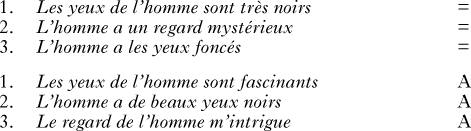
For the exposure phase, the material consisted of 24 target stories and 9 filler stories. This material was divided into three sets of stories, each one containing 12 stories with CTR (3 adjectives: noir noir, vieux vieux, petit petit; 4 verbs: parlé parlé, partie partie, laisse laisse, marché marché; 4 nouns: café café, enfant enfant, famille famille, nature nature; 1 adverb: longtemps longtemps), 12 stories with the corresponding simplex, and 9 filler stories. For the verification task, materials consisted of 10 sentences containing affective inferences linked to each target story: three sentences with affective valence A, three with affective valence B, three with neutral affective valence =, plus one control sentence with an inconsistent inference C, intended to control the accuracy of the participants’ responses. In other words, except for sentence C, all the sentences presented in verification are possible meanings of the sentence containing the CTR presented in the exposure phase, with an attributed value A, B, or =. Values A and B are affective values, while values = are neutral. An example of this kind of material is shown in (5a, b):
(5) a. Exposure phase:
CTR: Un homme avance le long du trottoir. Ses yeux sont noirs noirs. Il porte un pantalon et une veste en jeans
‘A man moves along the sidewalk. He has black black eyes. He wears denim trousers and jacket’
SIMPLEX: Un homme avance le long du trottoir. Ses yeux sont noirs. Il porte un pantalon et une veste en jeans
‘A man moves along the sidewalk. He has black eyes. He wears denim trousers and jacket’
b. Verification task (inferences):
1. Les yeux de l’homme sont très noirs
‘The man’s eyes are very black’ =
2. L’homme a un regard mystérieux
‘The man has a mysterious look =
3. L’homme a les yeux foncés
‘The man’s eyes are dark’ =
1. Les yeux de l’homme sont fascinants
‘The man’s eyes are charming’ A
2. L’homme a de beaux yeux noirs
‘The man has beautiful black eyes’ A
3. Le regard de l’homme m’intrigue
‘The man’s look is intriguing to me’ A
1. L’homme a un regard inquiétant
‘The man has a worrisome look’ B
2. Le regard de l’homme est menaçant
‘The man has a threatening look’ B
3. Le regard de l’homme fait peur
‘The man’s look is scary’ B
1. L’homme se rend à un cocktail chic
‘The man is going to a posh cocktail party’ C
The same kind of material was constructed for filler stories, but without paying attention to the affective valence (materials are presented in ‘Appendix 2’).
Given that the experiment required for each participant to hear a certain number of CTRs in a small period of time – which could sound weird to them and thus constitute a bias for the experiment – filler stories and filler sentences were elaborated so as to rule out that participants might notice the presence of CTRs.
4.1.3. Procedure
Participants of each group (X, Y) were presented with 6 CTR stories, 6 simplex stories, and 9 filler stories. This material was counterbalanced across groups: CTR stories presented to Group X were presented in their simplex version to Group Y, and conversely.
Each experimental session consisted of an exposure phase followed by a verification task. During the exposure phase, participants listened to the stories one by one, presented in random order. They were instructed to imagine the situation described by each story. During the verification task, after a 2-second pause (with the presentation of a fixation cross on the computer screen), sentences composing the verification material appeared on the computer screen one by one, in random order. For each sentence, participants were instructed to indicate whether it was consistent with the target story by pressing on the computer keyboard, either on the O key for a ‘yes’ answer (oui, in French) or on the N key for a ‘no’ response.
Item presentation and timing, as well as data collection (response and response times) were controlled using E-Prime 2.0 SP1 Professional software (Schneider, Eschman, & Zuccolotto, Reference Schneider, Eschman and Zuccolotto2002). Audio items were processed and presented using Praat, version 5.3.42 (Boersma Reference Boersma2001; Boersma and Weenink, Reference Boersma and Weenink2013) and Audacity version 1.3.13-beta free software.
4.2. results
Data concerning filler items as well as control items (sentences C) were not analyzed. Because of a technical problem, data concerning one item (marché marché / marché) had to be removed, so that responses were analyzed for 22 items (11 CTR, 11 simplex).
The two first predictions followed from the hypothesis for which CTR generates valued affective inferences, so that such affective inferences are significantly more important than with the simplex form.
To verify the first prediction, according to which the total number of ‘yes’ responses to possible inferences (neutral, A, B) will be significantly higher in the CTR condition than in the simplex condition, we computed the total number of inferences (the total number of ‘yes’ responses) and submitted this variable to a linear mixed effects model with dummy-coded reduplication (CTR/simplex) (0 = no reduplication, 1 = reduplication) as a fixed factor, and subject and sentence heard as random factors using the lme4 module (Bates, Maechler, & Bolker, Reference Bates, Maechler and Bolker2012) in the open source statistics software R (version 3.0.2, 2013). In other words, we took into account possible random variations in the ‘baseline’ tendency to make inferences as a function of the participant or the sentence heard. Note that this strategy involves treating the number of inferences as a continuous variable (M = 4.75, SD = 1.82, Min = 0, Max = 9, Skewness = –0.24, Kurtosis = –0.14). This analysis (AIC = 1241.513) revealed an effect of CTR (B = 1.00, t(318) = 6.43, p < .001), reflecting the fact that, on average, participants made approximately one more inference for CTR than for simplex sentences.
To verify the second prediction, according to which for CTR, a high number of sentences containing a non-neutral inference (A, B) will be judged as consistent with the story previously heard, and thus to determine if the effect above is effectively driven by affective inferences (and not by neutral inferences), we conducted separate analyses on affective inferences and neutral inferences, respectively (for affective inferences, M = 2.64, SD = 1.51, for neutral inferences, M = 2.10, SD = 0.79, Skewness = –0.54, Kurtosis = –0.31).
For affective inferences, we indeed found that people were more likely to make affective inferences for CTR sentences (B = 0.81) than for simplex sentences (t(318) = 6.175, p < .01, AIC = 1126.00). For neutral inferences, this was true as well, but to a lesser extent (B = 0.19, t(318) = 2.55, p = .01, AIC = 744.61).
To probe this interaction, we submitted the difference between affective and neutral inferences to the same model, and indeed participants were more likely to make affective than neutral inferences (F(1,318) = 4.91, p = .02), and this was especially true for CTRs (B = 0.61, t(318) = 4.178, p < .001, AIC = 1178.797).Footnote 7
Those results confirm our predictions.
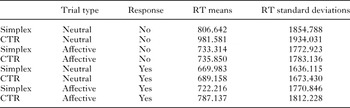
The last prediction followed from the hypothesis that affective inferences generated in the presence of a CTR are generated faster than affective inferences generated in the presence of the simplex. Consequently, RTs to sentences containing an affective inference were expected to be shorter for subjects having heard a CTR than for subjects having heard the simplex. To verify this prediction, we examined RTs by submitting this variable to a mixed model with reduplication (CTR/simplex), trial type (affective/neutral inference), and response (yes/no). One observation with an extreme value (10.065 ms) was excluded.
RTs were analyzed as a function of reduplication (CTR/simplex), dummy-coded trial type (1 = neutral vs. 2 = affective) and dummy-coded response (0 = No, 1 = Yes) as fixed factors, with subject and sentence as random factors. A first model included main effects only and showed an effect of response type (B = –45.69, t(2635) = 1.83, p < .05, AIC = 38435.45) only: RTs were shorter for ‘yes’ than for ‘no’ responses.
In a second model, we introduced the 2-way interactions: only the interaction between response and trial type (affective/neutral inference) was significant: participants were quicker to say ‘yes’ for affective than for neutral inferences (B = 244, t(2632) = 4.59, p < .001, AIC = 38399.39). We subsequently introduced the 3-way interaction, which proved non-significant (t < 1).Footnote 8 Note that the natural logarithm of the RTs was used in analyses, given the skewed distribution of the raw measures (M = 1765, SD = 749, Skewness = 1.66, Kurtosis = 4.3). After transformation, the distribution was indeed much closer to normal. However, the results did not lead to significant differences with respect to the former results, revealing a main effect on response type (‘yes’/‘no’): B = –0.02560, t = –2.10, p < .05. In the second model, where 2-way interactions were introduced, we found a significant interaction between response type and trial type (affective/neutral inference): B = 0.106628, t = 4.09, p < .001. Again, the 3-way interaction, introducing CTR/simplex variable, did not lead to significant results.
Thus, whereas people were more likely to make affective inferences for CTRs, this did not result in quicker responses for this type of stimuli.
5. Discussion
As far as we know, this study is a pioneer in testing the effects of a specific linguistic structure on inference generation. General theoretical intuitions about the ability of CTR to communicate affective (or emotional) meanings have been put forth by some researchers in pragmatics (notably, Ghomeshi et al., Reference Ghomeshi, Jackendoff, Rosen and Russell2004; Levinson, Reference Levinson2000; Sperber & Wilson, Reference Sperber and Wilson1995; Wierzbicka, Reference Wierzbicka1991). The specific interest of CTR lies in the fact that it is a fixed structure that can be filled with a great variety of linguistic items, allowing stability and flexibility at the same time: the range of possible inferences linked to CTR is only partially predictable, though not totally free, context sensitive but not totally context driven. Moreover, we assumed that CTR conveys two layers of meaning: an explicit meaning, necessary to the comprehension of the expression, and an optional affective meaning.
Our aim was to provide experimental support for specific theoretical assumptions. More precisely, this experiment was intended to test the production of affective inferences generated in the presence of a CTR. The hypotheses were the following: first, the presence of a CTR in the utterance gives rise to the production of valued affective inferences and such affective inferences are significantly less important with the simplex form; second, affective inferences are generated faster in the presence of a CTR than of the corresponding simplex form.
Results have strongly confirmed the first hypothesis: on the one hand, participants having heard a CTR made significantly more inferences than participants having heard the simplex; on the other hand, participants having heard a CTR judged as consistent significantly more sentences containing an affective inference than subjects having heard the simplex.
These results provide convincing evidence for the generation of affective inferences linked to the presence of CTR, which was the main aim of this study. Thus, CTR can be thought of as a linguistic device used in order to communicate different kinds of information in an economic way.
Yet our data disconfirmed the hypothesis according to which affective inferences are made faster for texts containing a CTR than for texts containing the corresponding simplex. This means that CTR has an influence on the quantity of inferences but not on the speed of the inferential process. The idea underlying this hypothesis was related to the role of trigger played by CTR, suggested by the results of our first experiment, where participants in a recognition task took more time to reject the sentence containing a potential inference linked to the CTR. We interpreted this result as showing that to reject the item subjects have to inhibit the inference conveyed by the CTR, which means that this inference has been previously made. This issue is related to the status of optional inferences, and notably the question whether they are generated on-line, that is to say automatically during comprehension, or off-line, that is to say at a later stage of interpretation (Graesser, Singer, & Trabasso, Reference Graesser, Singer and Trabasso1994; McKoon & Ratcliff, Reference McKoon and Ratcliff1992). Answering this question for what concerns affective inferences was not the aim of this study. Yet our results can give some indications: in fact, they show that positive response times for affective inferences are shorter than for neutral ones, suggesting a special status for such inferences.Footnote 9
The reason of the discrepancy between response times results in the first and the second experiment may relate to the different task involved: as pointed out in the literature (see McKoon & Ratcliff, Reference McKoon and Ratcliff1989; Singer, Reference Singer and Gaskell2007), verification is not a suitable design to test on-line inferences, and recognition is controversial. Yet before rejecting the hypothesis according to which CTR has no influence on the speed of the generation of affective inferences, further studies should be run with a more adapted experimental design.
The generation of context-sensitive inferences is a crucial topic of research both for pragmatics and psycholinguistics. In particular, the study of affective meanings implicitly conveyed by the presence of specific linguistic structures appears to be a promising field for further interdisciplinary research. This paper aims at taking a first step in this direction.
Examples of material used by Rossi (Reference Rossi, Bochner, De Brabanter, Kissine and Rossi2011)
Story
“L’inspecteur prend la photo et la regarde attentivement. C’est une photo carrée, montrant une femme et un homme en train de discuter. La femme est assez jeune, avec un manteau et des longs longs cheveux. Elle se tient debout sur le trottoir, près d’une maison. L’homme, de taille moyenne, porte une veste en jeans. Ses yeux sont noirs noirs, il est en train de parler. Autour d’eux, les voitures passent, rapides.”
Items presented in recognition
OLD + OLD RED: veste en jeans, photo, trottoir, femme, parler, manteau, jeune, en train de, inspecteur, maison, voitures, taille moyenne, debout, photo, rapides, maison, discuter, homme, jeans, longs longs, noirs noirs.
NEW Non-Inference: ville, orage, oiseau, général, lentement, chaussures, valise, tablier, tour, arrangement, canette, appétit, ciel bleu, ordinateur, manger, par la fenêtre, arbre, couleur, amour, vélos.
NEW Potential Inference Reduplication: beaux cheveux, yeux menaçants, soyeux, sombres.
Materials (examples)
Target texts + target sentences (examples)
1. Marie vient de quitter la ville. Elle a longtemps longtemps attendu son train sur le quai de la gare.
Inferences

2. Un homme avance le long du trottoir. Ses yeux sont noirs noirs. Il porte un pantalon et une veste en jeans.
Inferences
3. Hier, pendant leur voyage, Juliette et Kevin se sont arrêtés quelques heures. Ils ont visité un vieux vieux château.
Inferences

4. Cette fois, Anne est partie partie. Elle a pris l’avion hier soir, après avoir confié son chat aux voisins.
Inferences

5. « Robert, est-ce que tu prends quelque chose à boire? » « Oui, merci Jean, as-tu un café café ? »
Inferences

Fillers (examples)
1. Jean a perdu son boulot, il est au chômage depuis six mois. C’est un vrai problème.
1. C’est un problème grave
2. Jean a un problème d’argent
3. Jean a été licencié
4. C’est un petit problème
5. C’est un problème pénible
6. C’est un nouveau problème
7. Jean est au chômage depuis longtemps
8. Jean cherche du travail
9. Jean a du mal à trouver un travail
2. Pour gagner le tournoi, il faut beaucoup travailler et surtout aller jusqu’au bout.
1. Il faut vraiment aller jusqu’au bout
2. Il faut résister jusqu’au bout
3. Il faut vraiment réussir
4. Il faut aller jusqu’au bout du monde
5. Si on travaille, on gagnera
6. Il faut beaucoup s’impliquer pour gagner
7. Le tournoi est difficile à gagner
8. Il faut aller au bout des efforts
9. Il faut gagner à tout prix
3. Sur le tableau, il y a un chemin de campagne. Au bout du chemin, il y a ma maison.
1. C’est la maison où j’habite
2. C’est mon nid douillet
3. C’est ma maison de vacances
4. Le chemin mène à la maison
5. C’est une maison isolée
6. C’est une maison dans la campagne
7. Le tableau représente un paysage
8. C’est une maison difficile d’accès
9. Le chemin est étroit
Sums for affective inferences (SumAffl), neutral inferences (SumNeutre), and totals (SumTotal) with their respective standard deviations (SD) in Simplex and CTR condition

Means and standard deviations for response times (RT) for simplex/CTR condition, Trial Type (neutral/affective), and Response (‘yes’/’no’)