INTRODUCTION
Although parasite-induced changes in host phenotype are common (Moore, Reference Moore2002), experimental evidence of their adaptive value are still rare (Cézilly et al. Reference Cézilly, Thomas, Médoc and Perrot-Minnot2010, but see Lagrue et al. Reference Lagrue, Kaldonski, Perrot-Minnot, Motreuil and Bollache2007). For instance, acanthocephalan parasites appears as a bright yellow to orange spot visible through the translucent cuticle of their crustacean amphipod host. Acanthocephalan parasites thus modify host appearance, but the function of such visual alteration remains unknown. Amphipods serve as intermediate hosts where parasite larvae (cystacanths) develop while adults mature and reproduce sexually in vertebrate definitive hosts (Crompton, Reference Crompton, Crompton and Nickol1985; Kennedy, Reference Kennedy2006). The transmission to definitive hosts relies on a predation event (trophic transmission), a critical step in the life cycle that may be facilitated by parasite-induced alterations (Moore, Reference Moore2002). If a handful of studies have demonstrated a role of these alterations in enhanced transmission (e.g. Hinsbo, Reference Hinsbo1972; Holmes and Bethel, Reference Holmes, Bethel, Canning and Wright1972; Bethel and Holmes, 1977), very few have been able to disentangle the respective role of visual changes as compared with behavioural changes induced by the parasite (e.g. Bethel and Holmes, Reference Bethel and Holmes1977, but see Kaldonski et al. Reference Kaldonski, Perrot-Minnot, Dodet, Martinaud and Cézilly2009).
The colouration of acanthocephalans is due to the presence of carotenoid pigments obtained from the hosts (see Gaillard et al. Reference Gaillard, Juillet, Cézilly and Perrot-Minnot2004; Perrot-Minnot et al. Reference Perrot-Minnot, Gaillard, Dodet and Cézilly2011 and references therein). Three hypotheses have been proposed to explain cystacanths’ colouration (Bakker et al. Reference Bakker, Mazzi and Zala1997). First, carotenoid-based colourations may simply be by-products of metabolism (Gaillard et al. Reference Gaillard, Juillet, Cézilly and Perrot-Minnot2004) and play no adaptive role. Alternatively, colouration could act as a protection against the ultra-violet B (UVB) radiation passing through the translucent cuticle of intermediate hosts. However, Perrot-Minnot et al. (Reference Perrot-Minnot, Gaillard, Dodet and Cézilly2011) found only partial support for a photoprotective role of carotenoids when comparing carotenoid content and UVB resistance between different acanthocephalan species. Another hypothesis is that carotenoid-based colouration may be a parasite adaptation promoting the trophic transmission between intermediate and definitive hosts (Bakker et al. Reference Bakker, Mazzi and Zala1997). The visibility of cystacanths may indeed attract the attention of definitive host predators and hence favour transmission. Two previous studies used painted mimics to formally test this hypothesis and provided contrasting results. Bakker et al. (Reference Bakker, Mazzi and Zala1997) and Kaldonski et al. (Reference Kaldonski, Perrot-Minnot, Dodet, Martinaud and Cézilly2009) both painted a yellow spot on the cuticle of uninfected gammarids to mimic Pomphorhynchus laevis infection but while the former found an increased vulnerability to predation by sticklebacks, the latter did not observe any change in the vulnerability to predation by trouts. Kaldonski et al. (Reference Kaldonski, Perrot-Minnot, Dodet, Martinaud and Cézilly2009) also used orange-painted gammarids to mimic Polymorphus minutus infection and again found no effect on the vulnerability to predation by trouts. While both P. laevis and P. minutus use gammarids as intermediate hosts, fish predators are dead-end hosts for P. minutus, which completes its cycle in water birds such as mallards (Kennedy, Reference Kennedy2006). Consequently, if the results of Kaldonski et al. (Reference Kaldonski, Perrot-Minnot, Dodet, Martinaud and Cézilly2009) do not show any role of parasite colouration in transmission for P. laevis, the question remains open for P. minutus.
In the present study, we tested the role of P. minutus colouration in enhanced transmission to its suitable bird definitive host. Following the procedure of Kaldonski et al. (Reference Kaldonski, Perrot-Minnot, Dodet, Martinaud and Cézilly2009), we used painted mimics to specifically test the role of cystacanth colour on the feeding preference of the mallard Anas platyrhynchos, one of the main definitive hosts of P. minutus (Crompton and Harrison, Reference Crompton and Harrison1965; Kennedy, Reference Kennedy2006), independently of any effect of behavioural changes. Although mallards are viewed as filter feeders whose foraging is guided mainly by tactile cues (Bethel and Holmes Reference Bethel and Holmes1977; Guillemain and Martin, Reference Guillemain and Martin2002), they display a tetrachromatic colour vision with long-wavelength-sensitive (LWS) cones (Hart, Reference Hart2001), which should enable them to distinguish the orange spot of P. minutus-infected gammarids. Furthermore, depending on the season, aquatic invertebrates can represent a significant part of the diet of mallards (Alisauskas and Ankney, Reference Alisauskas and Ankney1992; Dessborn et al. Reference Dessborn, Brochet, Elmberg, Legagneux, Gauthier-Clerc and Guillemain2011). We thus hypothesized that the carotenoid-based colouration of P. minutus might represent a visual stimulus that influences the choice of mallards when foraging, with potential consequences for parasite transmission.
In addition to this, we aimed at testing whether the aggregation of gammarids together with the change in appearance could enhance their visibility towards mallards. Indeed P. minutus-infected gammarids display a patchy distribution in the field: they are found aggregated in floating materials while uninfected conspecifics are widespread among the natural habitats, with maximum abundances in benthic substrates (Médoc and Beisel, Reference Médoc and Beisel2009). Aggregation of infected gammarids may also be favoured by the fact that they display conspecific attraction under the threat of predation (Thünken et al. Reference Thünken, Baldauf, Bersau, Bakker, Kullmann and Frommen2010). Here, we hypothesized that such aggregation of infected specimens would magnify the visual signal induced by the parasite and enhance transmission to mallards.
MATERIALS AND METHODS
Housing conditions and painted mimics
To allow comparison of results with the work of Kaldonski et al. (Reference Kaldonski, Perrot-Minnot, Dodet, Martinaud and Cézilly2009), we used the same gammarid species and the same coloured paints. In April 2012, Gammarus pulex were collected from a tributary of the Suzon River (Côte d'Or, France, 47°24′N and 4°52′E) using the kick sampling method (Hynes, Reference Hynes1954). Gammarids harbouring parasites that could alter their appearance, such as the larval cestode Cyathocephalus truncatus (Franceschi et al. Reference Franceschi, Rigaud, Moret, Hervant and Bollache2007) and the muscle-wasting microsporidian Pleistophora mulleri were excluded to avoid any confounding effect. We also excluded gravid female amphipods that can differ in behaviour and appearance from non-gravid females. To avoid size-effect we kept only intermediate-sized gammarids (7 to 10 mm in total length). Gammarids were brought to the CEREEP field station (UMS CNRS ENS 3194 CEREEP Ecotron IleDeFrance, St-Pierre-lès-Nemours, France) and housed in aquaria filled with aerated water from the Suzon River and fed ad libitum with conditioned alder leaves (Alnus glutinosa).
To mimic P. minutus infection, we used the same painting as Kaldonski et al. (Reference Kaldonski, Perrot-Minnot, Dodet, Martinaud and Cézilly2009): we applied a 1 mm dot of quick-drying orange paint (RAL 2000, Cardist, Aureilhan France) to the cuticle of wild uninfected gammarids (orange-painted mimics hereafter). This paint was found to match the colour of the cystacanths as seen through the cuticle (Kaldonski et al. Reference Kaldonski, Perrot-Minnot, Dodet, Martinaud and Cézilly2009). Control uninfected gammarids were painted with a dark brown dot (mix of brown RAL 8025 and black Lechsys 29·081 paint, proportion 3:0·05, Cardist, Aureilhan France) mimicking cuticle colour (brown-painted mimics hereafter). Gammarids were randomly assigned to the orange-painting or brown-painting treatment. Gammarid cuticle was dried with an air pump and a spot of paint of 1 mm (approximate size of cystacanths; Dezfuli and Giari, Reference Dezfuli and Giari1999), was applied on one side (in a central location between the fourth and the sixth dorsal segments, where cystacanths are generally located; Dezfuli and Giari, Reference Dezfuli and Giari1999) and dried with an air pump. Overall handling time did not exceed 2 min per gammarid. Painted mimics were returned to their housing aquaria and tested within 20 h. Individuals that lost their painted dot (approximately 30%) were excluded from the experiment. To control whether colouration of the painted dots changed with time, we photographed both orange-painted and brown-painted gammarids (Nikon Coolpix 4500 digital camera mounted on a binocular Olympus Optical Co., SZH-ILLD) just after painting and after 20 h of housing. We obtained a mean value of hue, saturation and brightness for each painted mimic by taking 10 measurements at different locations on the dot of paint. A spectral analysis using the GIMP software showed that time had no significant effect on hue, saturation and brightness of the paint (orange colouration, paired Wilcoxon test, N=27, hue: V=190·5, P=0·71; saturation: V=194, P=0·91; brightness: V=154·5, P=0·41; brown colouration, N=30: hue V=173, P=0·34; saturation: V=252, P=0·69; brightness: V=233, P=1).
Predation experiments
To ensure that the two types of mimics differed only in their colouration, we checked that there was no difference in activity between them by monitoring in 30 individuals per type the number of movements across a line in a Petri dish similar to those used during the predation tests (3·6 cm diameter and 2 cm depth) during 5 min (t-test: t 1,28=0·60, P=0·54). The Petri dishes used for predation tests were only 2 cm depth, so that no differences in behaviour or location within the plate could confound predator preference.
Mallards (A. platyrhynchos, 10 females and 4 males) were housed in a 70-m2 aviary and fed ad libitum with a mix of maize peas and wheat. Predation tests were conducted in a 4-m2 enclosure within the aviary to permit eye contact between the experimental subject and the other individuals to limit stress during feeding (Guillemain et al. Reference Guillemain, Fritz and Blais2000). Mallards were individually presented with a plate (53·5×40 cm) containing 108 Petri dishes each filled with 10 mL of river water on a dark green background to be as close as possible to natural conditions.
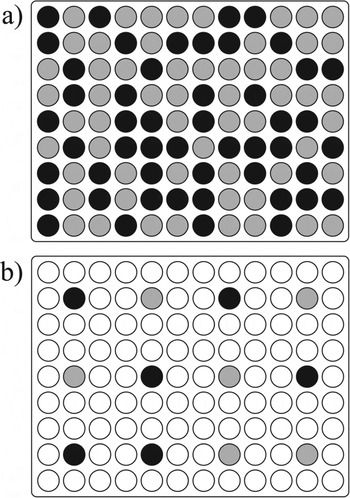
We used two-choice predation tests offering both orange and brown-painted gammarids to mallards. We conducted two successive experiments that differed in how gammarids were distributed among the dishes. In the first experiment, we offered isolated gammarids to mallards: all the 108 dishes received one gammarid, either orange or brown-painted (Fig. 1a). In the second experiment to test the assumption that aggregation may enhance mallards’ preference for infected prey through magnifying the visual cue associated with P. minutus’ colouration, we offered aggregated gammarids through filling only 12 dishes with groups of 9 orange or brown-painted gammarids (Fig. 1b). Each aggregate was considered a single prey item. As a result, there was a total of 12 prey items in the second experiment compared with 108 prey items in the first experiment.
Experimental designs used to test the selective predation of mallards feeding on 54 orange-painted gammarids (Polymorphus minutus infected mimics) and 54 brown-painted gammarids (control uninfected mimics). Gammarids were placed in small dishes and distributed either isolated in the first experiment (a) or grouped by 9 of the same infection status in a single dish in the second experiment (b). Grey and black dishes represent the dishes filled with brown-painted and orange-painted gammarids, respectively, while white dishes are those remaining empty.

The two types of mimics were offered in equal proportions (0·5 : 0·5) while their distribution among the dishes was randomly chosen and changed between tests to avoid any spatial effect (Fig. 1). Because the order by which mallards experienced the two tests (with isolated or aggregated gammarids) could influence the results, half of the mallards (i.e. 5 females and 2 males) experienced the test with isolated gammarids first while the others experienced the test with aggregated gammarids first. Each mallard was introduced into the experimental enclosure containing the plate of dishes and was allowed to predate until all dishes were empty (which took approximately 15 min). A camera (Logitech C910 HD pro Webcam) was fixed 1 m above the device to record mallards’ predation. Video-analyses enabled us to follow accurately the evolution of preference through time and to stop the trial a posteriori when the mallard had eaten half of the prey offered (i.e. the initial proportion of orange-painted gammarids) to calculate a preference index (see below).
Statistical analyses
Differential predation on orange-painted and brown-painted gammarids by mallards was assessed using Manly's alpha preference index (Manly et al. Reference Manly, Miller and Cook1972; Chesson, Reference Chesson1978), which allows for prey depletion during the course of the experiment. The preference index for orange-painted gammarids (α i) was calculated using the equation (Chesson, Reference Chesson1983):
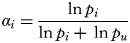 $$\alpha _i = \displaystyle{{\ln p_i} \over {\ln p_i{\rm} + {\rm} \ln p_u}} $$
where p i and p u are the proportions of orange and brown-painted gammarids, respectively, remaining after half of the available prey items were consumed (54 prey items with isolated gammarids and 6 prey items with aggregated gammarids). The index ranges from 0 (only brown-painted gammarids eaten) to 1 (only orange-painted gammarids eaten) with a value of 0·5 for an absence of preference. As the data did not meet the assumptions of parametric tests, observed values of preference index were compared with the threshold value of 0·5 (indicating an absence of preference), using a two-tailed Wilcoxon signed-rank test. The effect of aggregation on the preference index was also tested with a paired Wilcoxon test. To assess the variations of preference for infected gammarids across time with isolated gammarids, we conducted a generalized mixed model with the number of orange-painted and brown-painted gammarids consumed in bouts of 10 Petri dishes visited as response variable (lmer function with a binomial distribution; Zuur et al. 2009) and the number of trials as fixed factor, including the identity of mallards as a random factor, as observations within the same individual are not independent.
RESULTS
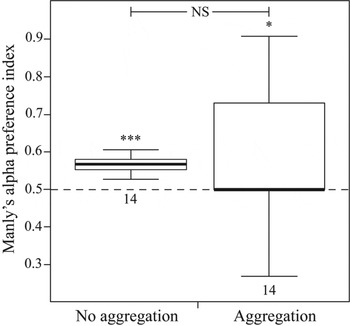
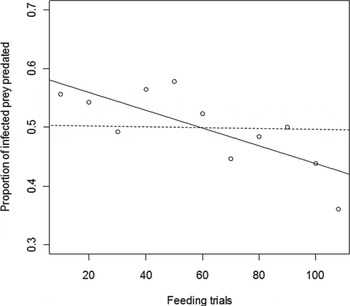
A total of 3024 G. pulex were consumed by the 14 mallards. In the first experiment offering isolated gammarids, the preference index significantly differed from the threshold value of 0·5 (Wilcoxon test: W=182, P<0·001, N=14, Fig. 2) meaning that mallards showed a selective preference for orange-painted gammarids. Such a selective predation was also found in the second experiment offering aggregated gammarids (Wilcoxon test: W=133, P=0·036, N=14). However, there was no difference in the level of preference for orange-painted gammarids between the first and second experiment, indicating that aggregation had no effect on mallards’ selective predation (paired Wilcoxon test on preference index: V=51, P=0·37, N=14, Fig. 2). Moreover, the proportion of orange-painted gammarids consumed out of 10 gammarids consumed significantly decreased over feeding trials (Fig. 3) reflecting the depletion of orange-painted gammarids across trials (Generalized Mixed Model, effect of trial number: estimate=−0·0055±0·0017, t 13,143=−3·22, P=0·0013) (Fig. 3).
Manly's alpha preference index (median, interquartile range, an minimum/maximum values) representing the selective predation of mallards on orange painted gammarids (Polymorphus minutus infected mimics) vs brown painted gammarids (control uninfected mimics). Two experimental designs were used in which gammarids were either isolated or aggregated (see text and Fig. 1 for further detail). The dotted line (alpha value of 0·5) indicates no predation bias toward one of the two prey types. A value above the dotted line means an overconsumption of orange painted gammarids, and vice versa. Asterisks above bars show significant differences with the theoretical value of 0·5 (*P<0·05; ***P<0·001; NS for non significant) and numbers below bars are sample sizes.

Proportion of orange-painted gammarids preyed upon by mallards over trials during the first experiment with isolated gammarids (one point per 10 gammarids consumed). A proportion of 0·5 orange-painted gammarids was offered to the mallards at the beginning of the experiment (broken line). Preference for orange-painted gammarids decreased over time reflecting their depletion over time (the solid line represents the regression line of the proportion of orange-painted prey consumed across trials).

DISCUSSION
We aimed at testing whether the carotenoid-based colouration of P. minutus parasites would have an adaptive value in terms of transmission through increasing the attractiveness of intermediate hosts (gammarids) to definitive hosts (water birds). In accordance with this hypothesis, mallards preferentially consumed orange-painted over brown-painted gammarids, regardless of how gammarids were distributed (i.e. isolated or aggregated). We used the same paint and the same gammarid species (i.e. G. pulex) as Kaldonski et al. (Reference Kaldonski, Perrot-Minnot, Dodet, Martinaud and Cézilly2009) who did not find such selective predation on orange-painted gammarids by trout, a non-host predator. This suggests that the change in appearance due to the colour of P. minutus cystacanths might predispose infected intermediate hosts to definitive host (water birds) predation but not to non-host (fish) predation (Mouritsen and Poulin, Reference Mouritsen and Poulin2003; Cézilly and Perrot-Minnot, Reference Cézilly and Perrot-Minnot2005). However, it is not clear yet whether this visual alteration is host specific. Indeed, other closely related acanthocephalan parasites such as Profilicollis altmani infecting sand crabs display a similar colouration, but with little role of this colouration for enhanced transmission to definitive hosts (i.e. Kolluru et al. 2011). Additional predation tests with definitive and dead-end hosts both presented to the same population of painted mimics are now needed to formally investigate the specificity of the visual changes induced by P. minutus for enhanced transmission.
However, in our experiment, the role of P. minutus’ colouration in its trophic transmission to definitive hosts may be overestimated by the use of controlled conditions compared with what happens in the field. In our experiments, mallards had no alternative food source than gammarids and behaved as visual feeders while they are known to rely mainly on tactile cues to forage in the field (Guillemain and Martin, Reference Guillemain and Martin2002). The increase in trophic transmission due to P. minutus’ colouration has thus to be balanced by the extent to which mallards use visual cues to consume invertebrates in their natural environment. Moreover, it remains to be determined to which extent infected gammarids are visible in their natural environments. Compared with uninfected gammarids, they are mostly found close to the water surface (Médoc et al. Reference Médoc, Bollache and Beisel2006, Reference Médoc, Rigaud, Bollache and Beisel2009; Médoc and Beisel, Reference Médoc and Beisel2009), which would increase their visibility to surface-dwelling predators, but at the same time they show increased refuge use (Médoc et al. Reference Médoc, Rigaud, Bollache and Beisel2009), which would decrease their visibility. However, this study suggests that, if infected and uninfected gammarids are equally visible in the field, mallards would prefer infected prey over uninfected ones. The extent to which this could play a role in enhanced parasite transmission needs further studies in natural conditions.
The magnitude of the visual cue associated with colouration may also depend on the spatial distribution of gammarids. We hypothesized that the higher the aggregation of infected specimens, the higher their conspicuousness. We found no significant difference in the preference index between isolated and aggregated gammarids, suggesting that aggregation of infected gammarids does not increase their conspicuousness. However, because we considered each aggregate as a single prey item, the number of eaten prey used to calculate the preference index was much lower in the experiment with aggregated gammarids than in the experiment with isolated gammarids (6 vs 54). The resulting high variability in preference index values may have made it difficult to detect an effect of aggregation on conspicuousness.
Despite the use of realistic colours to mimic infection, we do not exclude a potential difference in appearance between painted mimics and truly infected gammarids. However, repeating our experiments with P. minutus-infected gammarids means dealing with simultaneously occurring changes in appearance and behaviour. Multidimensionality is common among manipulative parasites and reflects the fact that they generally modify more than one single trait (dimension) in the phenotype of their host (Cézilly and Perrot-Minnot, Reference Cézilly and Perrot-Minnot2005; Thomas et al. Reference Thomas, Poulin and Brodeur2010). Specifically designed experiments are now needed to disentangle behavioural and visual dimensions of manipulation and hence investigate their respective contribution to increased trophic transmission. For instance, Kaldonski et al. (Reference Kaldonski, Perrot-Minnot, Dodet, Martinaud and Cézilly2009) found that masking the presence of P. laevis cystacanths with inconspicuous brown paint does not alter the selective predation of trout, which still preferentially consume infected gammarids. This, together with the result that mimicking infection with yellow paint does not increase the vulnerability of uninfected gammarids to trout (Kaldonski et al. Reference Kaldonski, Perrot-Minnot, Dodet, Martinaud and Cézilly2009), suggested that the adaptive value (in terms of transmission) of host manipulation by P. laevis relies on the behavioural dimension alone, the change in appearance playing no role. Concerning P. minutus, although the trophic facilitation due to geotaxis reversion remains to be formally proven, it is generally assumed that transmission opportunities from gammarids to waterfowls are more frequent close to the water surface than in the benthic area, because of a higher spatial overlap. Our result suggests that in addition to this, P. minutus’ colouration may help transmission once infected gammarids have reached the water surface. This calls for further studies comparing the effect size of visual changes alone compared with the effect size of the full manipulation induced by the parasite to formally quantify the contribution of each manipulation dimension to enhanced transmission. Moreover, this raises questions regarding infection avoidance by waterfowl. Indeed, if mallards can discriminate between uninfected and P. minutus-infected gammarids, then it would be possible for them to avoid infection. However, we observed a selective predation on orange-painted gammarids, which is consistent with the general observation that, often, there will be no selective pressure to avoid infected prey because infection increases their profitability. Therefore, the benefits of consuming infected prey are higher than the costs of avoiding them (Lafferty, Reference Lafferty1999). Although adult acanthocephalans are known to cause local damage to the intestine of definitive hosts, it is not clear whether they have more general effects on their fitness and the pathological significance of acanthocephalans remains difficult to interpret (Itämies et al. Reference Itämies, Valtonen and Fagerholm1980; Nickol, Reference Nickol, Crompton and Nickol1985). In our experiments, mallards were naïve hosts because they had never experienced P. minutus infection. A valuable perspective would be to repeat the experiments with non-naïve definitive hosts caught from the field to test whether heavily infected individuals adjust their foraging behaviour to cope with the potential negative effects of P. minutus infection.
ACKNOWLEDGEMENTS
We are grateful to M. Steffen, M. Pausé, C. Petit, S. Perret and B. St-Hilaire for help with the experiments. We thank the CEREEP biological station (UMS CNRS ENS 3194 CEREEP Ecotron IleDeFrance) for providing excellent working conditions.
FINANCIAL SUPPORT
L. Jacquin was supported by an ATER fellowship from the Versailles-St-Quentin University and a Fyssen fellowship.