1. Introduction
In the study of the energetics of stratified fluids, one of the criteria commonly assumed to control the importance of compressible effects and internal energy conversions relative to conversions with gravitational potential energy is the ratio
 ${\it\delta}z/H_{s}$
, where
 ${\it\delta}z$
is a typical vertical displacement and
 $H_{s}=c_{s}^{2}/g$
is the scale height of the fluid, where
 $c_{s}$
is the speed of sound and
 $g$
is the acceleration of gravity, e.g. see the discussion leading to equation (3.6.18) of Batchelor (Reference Batchelor1967). Moreover, Batchelor (Reference Batchelor1967) suggests that the criterion
 ${\it\delta}z/H_{s}\ll 1$
is one of out three that need to be satisfied for a fluid to be regarded ‘as if it were incompressible’. Physically, this ratio can be viewed as measuring the relative change in internal energy
 ${\rm\Delta}\text{IE}$
over gravitational potential energy
 ${\rm\Delta}\text{GPE}$
experienced by a fluid parcel in a hydrostatic vertical displacement
 ${\it\delta}z=z_{2}-z_{1}$
. Indeed, if
 $\text{d}m={\it\rho}\text{d}V$
denotes the mass of the fluid parcel considered,
 ${\rm\Delta}\text{GPE}$
and
 ${\rm\Delta}\text{IE}$
are given by
 $$\begin{eqnarray}\displaystyle & {\rm\Delta}\text{GPE}=\text{d}m\,g(z_{2}-z_{1}), & \displaystyle\end{eqnarray}$$
 $$\begin{eqnarray}\displaystyle & \displaystyle {\rm\Delta}\text{IE}=-\text{d}m\int _{p_{1}}^{p_{2}}p\left.\frac{\partial {\it\upsilon}}{\partial p}\right|_{\mathit{adiabatic}}\text{d}p=\text{d}m\frac{\overline{p}}{{\it\rho}^{2}c_{s}^{2}}(p_{2}-p_{1})\approx \text{d}m\frac{g^{2}\overline{z}(z_{2}-z_{1})}{c_{s}^{2}}, & \displaystyle\end{eqnarray}$$
 $$\begin{eqnarray}\frac{{\rm\Delta}\text{IE}}{{\rm\Delta}\text{GPE}}=\frac{\overline{z}}{H_{s}},\end{eqnarray}$$
where
 ${\it\upsilon}=1/{\it\rho}$
is the specific volume and
 $p$
is pressure. To obtain the expression (1.2) for
 ${\rm\Delta}\text{IE}$
, we defined
 $\overline{z}$
as the mean height/depth of the parcel considered, and used Boussinesq scaling to make the approximations
 ${\it\rho}\approx {\it\rho}_{0}$
,
 $\overline{p}\approx -{\it\rho}_{0}g\overline{z}$
and
 $p_{2}-p_{1}\approx -{\it\rho}_{0}g(z_{2}-z_{1})$
. In the atmosphere, the formula for the speed of sound is
 $c_{s}=\sqrt{{\it\gamma}RT}\approx 335~\text{m}~\text{s}^{-1}$
, which leads to
 $H_{s}\approx 12~\text{km}$
(based on using
 ${\it\gamma}=c_{p}/c_{v}=1006/719=1.4$
,
 $R=287~\text{J}~\text{kg}^{-1}~\text{K}^{-1}$
,
 $T\approx 280~\text{K}$
, where
 $c_{p}$
is the specific heat capacity at constant pressure,
 $c_{v}$
is the specific capacity at constant volume,
 $R$
is the perfect gas constant and
 $T$
is the in situ temperature in kelvins). As the latter value is comparable to the height of the troposphere, compressibility effects and internal energy are generally thought be important in discussions of atmospheric energetics. In the ocean, however, the speed of sound
 $c_{s}$
is
 $O(1500~\text{m}~\text{s}^{-1})$
; the associated scale height is
 $H_{s}=O(225~\text{km})$
, which is considerably larger than even the deepest parts of the ocean. Since typical ocean depths rarely exceed 5000 m, the ratio (1.3) should rarely exceed 2 %, suggesting that in contrast to the atmosphere, compressible effects and internal energy conversions should be unimportant in discussions of ocean energetics.
Although internal energy is now recognised to be essential to close the ocean energy budget, e.g. Young (Reference Young2010), Tailleux (Reference Tailleux2012) and Eden, Czeschel & Olbers (Reference Eden, Czeschel and Olbers2014), its exact role and importance still remain unclear, as is apparent in all recent reviews of ocean energetics, e.g. Wunsch & Ferrari (Reference Wunsch and Ferrari2004) and Kuhlbrodt et al. (Reference Kuhlbrodt, Griesel, Montoya, Levermann, Hofmann and Rahmstorf2007). The main difficulty appears to be the lack of a rigorous approach to quantify the thermodynamic work of expansion/contraction, e.g. Tailleux (Reference Tailleux2010). The main aim of this paper is to show that single-parcel energetics is not a solution to that end, as it is inconsistent with at least three counter-arguments detailed below. An understanding of the limitations of single-parcel energetics is important, as parcel-based arguments pervade the atmospheric and oceanic literature, e.g. McDougall (Reference McDougall1987), Thorpe, Hoskins & Innocentini (Reference Thorpe, Hoskins and Innocentini1989) and Gade & Gustafsson (Reference Gade and Gustafsson2004), while also being potentially very misleading when applied to liquids such as water or seawater.
Our first counter-argument suggests that it is the adiabatic lapse rate
 $(\text{d}T/\text{d}p)_{\mathit{adiabatic}}={\it\Gamma}={\it\alpha}T/({\it\rho}c_{p})$
, rather than the speed of sound
 $c_{s}$
or scale height, that is the most useful fundamental quantity for correctly assessing compressibility effects. Here,
 ${\it\alpha}$
is the isobaric thermal expansion coefficient,
 $T$
is the absolute temperature in kelvins,
 ${\it\rho}$
is the density and
 $c_{p}$
is the specific heat capacity at constant pressure. Indeed, it is
 ${\it\Gamma}$
, rather than
 $c_{s}$
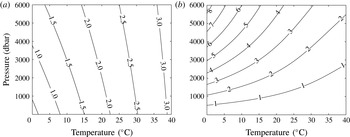
, that controls adiabatic temperature changes due to compression/expansion. The adiabatic lapse rate for seawater is illustrated in figure 1(a) as a function of temperature and pressure. This figure shows that
 ${\it\Gamma}$
primarily depends on temperature, and that its value typically lies between
 $10^{-8}$
and
 $3\times 10^{-8}~\text{K}~\text{Pa}^{-1}$
. We can therefore estimate that a fluid parcel being displaced from the ocean surface to the ocean bottom (assumed to lie at about
 $6000~\text{m}\approx 6000~\text{dbar}$
) would experience a temperature increase due to adiabatic compression of the order
 ${\rm\Delta}T\approx {\it\Gamma}{\rm\Delta}p=O(1\,^{\circ }\text{C})$
, based on using
 ${\rm\Delta}p\approx 6.10^{7}~\text{Pa}(=O(6000~\text{m}))$
and
 ${\it\Gamma}=2\times 10^{-8}~\text{K}~\text{Pa}^{-1}$
. While such a temperature difference is relatively small compared with vertical temperature contrasts
 $O(15^{\circ }{-}30^{\circ })$
characteristic of equatorial and mid-latitude regions, it is comparable with the vertical temperature contrast characteristic of polar regions, so that the ratio of
 ${\rm\Delta}T$
to the vertical temperature contrast can occasionally be much larger than the value of 2 % characterising the ratio
 ${\it\delta}z/H_{s}$
discussed above.
(a) Adiabatic lapse rate in
 $10^{-8}~\text{K}~\text{Pa}^{-1}$
for seawater, assuming absolute salinity
 $S_{A}=35~\text{g}~\text{kg}^{-1}$
. (b) The second derivative
 $-\partial ^{2}u/\partial p\partial {\it\eta}=p\partial {\it\Gamma}/\partial p~(\times 10^{9})$
, as a function of pressure and temperature for seawater, assuming absolute salinity
 $S_{A}=35~\text{g}~\text{kg}^{-1}$
, in SI units.

Our second counter-argument relies on an important result established by Huang (Reference Huang2005), which suggests that the available internal energy (AIE) is negative and approximately 40 % of the total available potential energy (APE) in the ocean. While the negative character of AIE has long been understood and rationalised, e.g. Reid, Elliott & Olson (Reference Reid, Elliott and Olson1981), the result that it could represent such a large fraction of the total APE is counter-intuitive and incompatible with our current understanding of ocean energetics, as discussed by Oort et al. (Reference Oort, Ascher, Levitus and Peixoto1989) for instance. Indeed, the APE is by definition the difference between the potential energy of the actual state and that of a reference state minimising the potential energy in an adiabatic (and iso-haline) rearrangement of the fluid parcels. It follows that the relative change in internal over gravitational potential energy of a fluid parcel moved adiabatically from its actual position to its reference position should be governed by the single-parcel energetics argument discussed above, so that it would be natural to expect the ratio AIE/APE to be
 $O(2\,\%)$
, as for the ratio
 ${\rm\Delta}\text{IE}/{\rm\Delta}\text{GPE}$
of a single parcel.
Our last counter-argument relies on the recent results on the energetics of turbulent stratified mixing by Tailleux (Reference Tailleux2009) and Tailleux (Reference Tailleux2013) obtained from rigorous analysis of the energetics of the fully compressible Navier–Stokes equations, which suggest that internal energy and compressibility effects in turbulent stratified fluids (especially liquids) are more important than previously assumed. Specifically, the change in background potential energy accompanying turbulent stratified mixing is found to occur at the expense of internal energy, rather than at the expense of the mechanical source of energy driving the mixing; moreover, the conversion between IE and background GPE is found to be a reversible one. With regard to the dissipation of APE by turbulent molecular diffusion, it is found to be fundamentally associated with the irreversible work of the divergent part of the velocity field against the pressure gradient, and to convert APE irreversibly into IE in the same way that viscous dissipation irreversibly converts kinetic energy into IE.
In view of the above evidence, it seems urgent to revisit the validity of the single-parcel energetics argument for predicting the relative magnitude of compressible effects and conversions with IE in (turbulent) stratified fluids. In this paper, we demonstrate that its key flaw is to overlook the fact that for any fluid parcel experiencing a vertical displacement, one parcel (or more) will have to move in the opposite direction to satisfy the requirement of mass conservation. As discussed in Tailleux & Grandpeix (Reference Tailleux and Grandpeix2004) in the context of moist atmospheric energetics, accounting for mass conservation can lead to a significant reduction of conditional instability estimates for an atmospheric sounding when compared with parcel-based convective available potential energy (CAPE) estimates. Thus, for a parcel moving up whose GPE increases, there must be a parcel moving down whose GPE decreases, so that the net change in GPE for the two-parcel system is actually much smaller than the GPE change attached to a single parcel. Obviously, the same is true for the IE changes, so that the key question is to what extent the ratio
 ${\rm\Delta}\text{IE}/{\rm\Delta}\text{GPE}$
predicted by two-parcel energetics differs from the ratio
 ${\rm\Delta}\text{IE}/{\rm\Delta}\text{GPE}$
predicted by single-parcel energetics. As shown in this paper, the difference may occasionally turn out to be quite considerable, although it strongly depends on the equation of state of the fluid considered. Section 2 establishes that inferences about the relative importance of internal and gravitational potential energy for global energetics must involve at least two fluid parcels in order to account for mass conservation properly. Section 3 revisits the role of IE and compressibility effects for the oceanic and atmospheric cases in the light of the results of § 2. Section 4 summarises and discusses the results.
2. The importance of mass conservation for global energetics
As stated above, upward motion is in general compensated by downward motion to ensure mass conservation. At least two parcels are therefore needed to investigate the effect of mass conservation on global energetics. To that end, the simplest approach is probably to consider the energetics of two parcels swapping position. Since a well-known result of algebra and combinatorics is that any permutation is the product of pairwise permutations, we can expect two-parcel energetics to also shed light on the global energetics of more complex parcel rearrangements.
Computation of the changes in gravitational potential and internal energy attached to each parcel requires the knowledge of height or depth for the former, and of temperature and pressure for the latter. The assumption that the pressure field is hydrostatic is therefore essential to link height or depth with pressure; as it turns out, the assumption also makes it possible to link GPE changes with those of the thermodynamic quantity
 $p{\it\upsilon}$
, where
 $p$
is the hydrostatic pressure and
 ${\it\upsilon}=1/{\it\rho}$
is the specific volume. This proves particularly useful, as
 $p{\it\upsilon}=h-u$
, i.e. it is equal to the difference between the specific enthalpy
 $h$
and the IE
 $u$
. This makes it possible to regard the enthalpy as the effective potential energy, and
 $p{\it\upsilon}=h-u$
as the effective GPE, which considerably facilitates the discussion of the energetics of two parcels swapping position, as discussed below.
2.1. Quasi-thermodynamic character of the GPE
We first outline the classical proof linking the GPE to
 $P{\it\upsilon}$
. Motivated by the oceanic case, let us consider a fluid bounded above by a free surface and below by an uneven bottom, respectively defined by the equations
 $z={\it\zeta}(x,y,t)$
and
 $z=-H(x,y)$
respectively. Let us also assume that at the surface, the atmospheric pressure is
 $p=p_{a}$
independent of position, and let us denote the bottom pressure by
 $p=p_{b}(x,y,t)$
. Assuming furthermore the pressure to be hydrostatic allows one to express the GPE as
 $$\begin{eqnarray}\displaystyle \text{GPE} & = & \displaystyle \int _{V}{\it\rho}gz\text{d}V=-\int _{S}[zp]_{-H}^{{\it\zeta}}\text{d}x\text{d}y+\int _{V}p{\it\upsilon}\text{d}m\nonumber\\ \displaystyle & = & \displaystyle -\int _{S}[{\it\zeta}p_{a}+Hp_{b}]\text{d}x\text{d}y+\int _{V}p{\it\upsilon}\text{d}m\nonumber\\ \displaystyle & = & \displaystyle -p_{a}V_{total}-\int _{S}H(p_{b}-p_{a})\text{d}x\text{d}y+\int _{V}p{\it\upsilon}\text{d}m\nonumber\\ \displaystyle & = & \displaystyle -p_{a}V_{tot}-M_{tot}g\overline{H}+\int _{V}p{\it\upsilon}\text{d}m,\end{eqnarray}$$
as discussed by Huang (Reference Huang2005) and Oliver & Tailleux (Reference Oliver and Tailleux2013), where
 $V_{tot}$
and
 $M_{tot}$
denote the total volume and total mass of the fluid respectively,
 $$\begin{eqnarray}V_{tot}=\int _{S}({\it\zeta}+H)\text{d}x\text{d}y,\quad M_{tot}=\frac{1}{g}\int _{V}(p_{b}-p_{a})\text{d}x\text{d}y.\end{eqnarray}$$
It follows that
 $$\begin{eqnarray}{\rm\Delta}\text{GPE}=-p_{a}{\rm\Delta}V_{tot}-M_{tot}g{\rm\Delta}\overline{H}+\int _{V}{\it\Delta}(p{\it\upsilon})\text{d}m\approx \int _{V}{\it\Delta}[(p-p_{a}){\it\upsilon}]\text{d}m.\end{eqnarray}$$
Although the term
 $M_{tot}g{\rm\Delta}\overline{H}$
vanishes and is therefore unimportant for a flat-bottom ocean (of constant mass), it may be significant in the actual (non-flat) ocean, as discussed by Huang (Reference Huang2005). This effect, however, is unrelated to that discussed in this paper, and is therefore not further considered. As a result, the sum of GPE and IE reads
 $$\begin{eqnarray}\text{PE}=\int _{V}h\text{d}m-p_{a}V_{tot}-M_{tot}g\overline{H},\end{eqnarray}$$
where
 $h$
is the specific enthalpy.
2.2. Local form of the GPE in pressure coordinates
The thermodynamic character of the GPE in the hydrostatic approximation can also be established directly by forming the evolution equation for the total energy for the hydrostatic primitive equations written in pressure coordinates, namely
 $$\begin{eqnarray}\displaystyle & \displaystyle \frac{\text{D}\boldsymbol{V}}{\text{D}t}+\boldsymbol{{\rm\nabla}}_{p}{\it\Phi}=\boldsymbol{F}, & \displaystyle\end{eqnarray}$$
 $$\begin{eqnarray}\displaystyle & \displaystyle \frac{\partial {\it\Phi}}{\partial p}=-{\it\upsilon}, & \displaystyle\end{eqnarray}$$
 $$\begin{eqnarray}\displaystyle & \displaystyle \boldsymbol{{\rm\nabla}}_{p}\boldsymbol{\cdot }\boldsymbol{V}+\frac{\partial {\it\omega}}{\partial p}=0, & \displaystyle\end{eqnarray}$$
 $$\begin{eqnarray}\displaystyle & \displaystyle \frac{\text{D}{\it\eta}}{\text{D}t}=\frac{\dot{q}}{T}, & \displaystyle\end{eqnarray}$$
 ${\it\Phi}=gz$
is the geopotential,
 ${\it\eta}$
is the specific entropy,
 $\boldsymbol{V}=(U,V)$
is the horizontal velocity field,
 ${\it\omega}=\text{D}p/\text{D}t$
is the analogue of vertical velocity, so that the substantial derivative becomes
 $\text{D}/\text{D}t=\partial /\partial t+\boldsymbol{V}\boldsymbol{\cdot }\boldsymbol{{\rm\nabla}}_{p}+{\it\omega}\partial /\partial p$
,
 $\boldsymbol{{\rm\nabla}}_{p}$
the isobaric gradient,
 $\dot{q}$
is the local rate of heating and
 $\boldsymbol{F}$
is a representation of horizontal forcing. Thus, multiplying (2.5) by
 $\boldsymbol{V}$
and adding it to (2.6) by
 ${\it\omega}$
yields
 $$\begin{eqnarray}\frac{\text{D}}{\text{D}t}\frac{\boldsymbol{V}^{2}}{2}+\boldsymbol{V}\boldsymbol{\cdot }\boldsymbol{{\rm\nabla}}_{p}{\it\Phi}+{\it\omega}\frac{\partial {\it\Phi}}{\partial p}=\boldsymbol{F}\boldsymbol{\cdot }\boldsymbol{V}-{\it\omega}{\it\upsilon}.\end{eqnarray}$$
Now, using the fact that the differential of the specific enthalpy is
 $\text{d}h=T\text{d}{\it\eta}+{\it\upsilon}\text{d}p$
yields
 $$\begin{eqnarray}\frac{\text{D}h}{\text{D}t}=T\frac{\text{D}{\it\eta}}{\text{D}t}+{\it\upsilon}\frac{\text{D}p}{\text{D}t}=\dot{q}+{\it\omega}{\it\upsilon},\end{eqnarray}$$
which allows one to rewrite the local energy equation as follows:
 $$\begin{eqnarray}\frac{\text{D}}{\text{D}t}\left(\frac{\boldsymbol{V}^{2}}{2}+h\right)+\boldsymbol{{\rm\nabla}}_{p}\boldsymbol{\cdot }({\it\Phi}\boldsymbol{V})+\frac{\partial ({\it\omega}{\it\Phi})}{\partial p}=\dot{q}+\boldsymbol{F}\boldsymbol{\cdot }\boldsymbol{V},\end{eqnarray}$$
or equivalently
 $$\begin{eqnarray}\frac{\partial }{\partial t}\left(\frac{\boldsymbol{V}^{2}}{2}+h\right)+\boldsymbol{{\rm\nabla}}_{p}\boldsymbol{\cdot }(\mathscr{B}\boldsymbol{V})+\frac{\partial (\mathscr{B}{\it\omega})}{\partial p}=\dot{q}+\boldsymbol{F}\boldsymbol{\cdot }\boldsymbol{V},\end{eqnarray}$$
where
 $\mathscr{B}=\boldsymbol{V}^{2}/2+h+{\it\Phi}$
is the Bernoulli head. Equation (2.12) states that
 $\boldsymbol{V}^{2}/2+h$
can be regarded as the total energy for the hydrostatic primitive equations, which implies that for all practical purposes,
 $h$
can be regarded as the effective potential energy and hence
 $p{\it\upsilon}=h-u$
as the effective GPE, in agreement with the above integral arguments. A similar result holds for the Boussinesq seawater approximation, e.g. Young (Reference Young2010), Tailleux (Reference Tailleux2012) and Eden et al. (Reference Eden, Czeschel and Olbers2014), and is therefore consistent with the duality between the Boussinesq and non-Boussinesq hydrostatic primitive equations demonstrated by de Szoeke & Samelson (Reference de Szoeke and Samelson2002).
2.3. Two-parcel energetics
The possibility of regarding the thermodynamic quantity
 $p{\it\upsilon}$
as the effective quantity measuring global changes in GPE makes it possible to assess the relative importance of IE and compressible effects by simply comparing any net change in IE
 ${\rm\Delta}u$
relative to any corresponding net change in enthalpy
 ${\rm\Delta}h$
. To simplify the analysis of the problem, we consider the following idealisation. We discretise the fluid into parcels of equal mass on a fixed grid, and assume that the fluid motion can be regarded as a series of permutations of the parcels in their initial state. Since any permutation can be expressed as the product of pairwise permutations involving only two fluid parcels, it follows that the energetics of two parcels swapping positions should form the building block of our understanding of the issue.
Let us first consider the net enthalpy change associated with the swap of two fluid parcels. Each parcel
 $i$
, with
 $i\in \{1,2\}$
, is initially characterised by its entropy
 ${\it\eta}_{i}$
and pressure
 $p_{i}$
. During the swap, each parcel retains its entropy but exchanges pressure values. As a result, the net change of enthalpy resulting from the swap is
 $$\begin{eqnarray}\displaystyle {\rm\Delta}h_{swap} & = & \displaystyle h({\it\eta}_{1},p_{2})-h({\it\eta}_{1},p_{1})+h({\it\eta}_{2},p_{1})-h({\it\eta}_{2},p_{2})\nonumber\\ \displaystyle & = & \displaystyle \int _{p_{1}}^{p_{2}}[{\it\upsilon}({\it\eta}_{1},p^{\prime })-{\it\upsilon}({\it\eta}_{2},p^{\prime })]\text{d}p^{\prime }=\int _{p_{1}}^{p_{2}}\int _{{\it\eta}_{2}}^{{\it\eta}_{1}}{\it\Gamma}({\it\eta}^{\prime },p^{\prime })\text{d}{\it\eta}^{\prime }\text{d}p^{\prime }\nonumber\\ \displaystyle & = & \displaystyle \int _{p_{1}}^{p_{2}}\int _{{\it\eta}_{2}}^{{\it\eta}_{1}}\frac{\partial ^{2}h}{\partial p\partial {\it\eta}}({\it\eta}^{\prime },p^{\prime })\text{d}{\it\eta}^{\prime }\text{d}p^{\prime }=\tilde{{\it\Gamma}}(p_{2}-p_{1})({\it\eta}_{1}-{\it\eta}_{2}),\end{eqnarray}$$
where
 ${\it\Gamma}=\partial {\it\upsilon}/\partial {\it\eta}={\it\alpha}T/({\it\rho}c_{p})$
is the adiabatic lapse rate previously introduced, while
 $\tilde{{\it\Gamma}}=\tilde{h}_{p{\it\eta}}$
is a suitably defined mean value of
 ${\it\Gamma}$
that makes the above relation exact. The above result was obtained by using the fact that
 $\text{d}h={\it\upsilon}\text{d}p$
and
 $\text{d}{\it\upsilon}={\it\Gamma}\text{d}{\it\eta}$
for isentropic specific enthalpy and specific volume changes respectively, which is equivalent to saying that
 ${\it\Gamma}=\partial ^{2}h/\partial p\partial {\it\eta}$
. By the mean value theorem, we know that
 $\tilde{{\it\Gamma}}$
must be bounded by the minimum and maximum values taken by
 ${\it\Gamma}$
over the entropy and pressure range considered. It should be noted that if the parcel swap is made from a fluid initially at rest and stably stratified, the pressure and entropy distribution are such that
 $\text{d}P/\text{d}z=-{\it\rho}g<0$
and
 $\text{d}{\it\eta}/\text{d}z>0$
. This implies
 $(p_{2}-p_{1})/({\it\eta}_{2}-{\it\eta}_{1})<0$
and hence
 ${\rm\Delta}h_{swap}>0$
, in which case
 ${\rm\Delta}h_{swap}$
represents the APE acquired by the fluid as the result of the parcel swap.
The next step is to compare
 ${\rm\Delta}h_{swap}$
with the corresponding IE change
 ${\rm\Delta}u_{swap}$
. Using the same approach, the latter is easily shown to be given by
 $$\begin{eqnarray}\displaystyle {\rm\Delta}u_{swap} & = & \displaystyle u({\it\eta}_{1},p_{2})-u({\it\eta}_{1},p_{1})+u({\it\eta}_{2},p_{1})-u({\it\eta}_{2},p_{2})\nonumber\\ \displaystyle & = & \displaystyle \int _{p_{1}}^{p_{2}}\int _{{\it\eta}_{2}}^{{\it\eta}_{1}}\frac{\partial u}{\partial p\partial {\it\eta}}({\it\eta}^{\prime },P^{\prime })\text{d}{\it\eta}^{\prime }\text{d}p^{\prime }\approx \tilde{u} _{p{\it\eta}}(p_{2}-p_{1})({\it\eta}_{1}-{\it\eta}_{2}),\end{eqnarray}$$
where
 $\tilde{u} _{p{\it\eta}}$
represents a suitably defined mean value of the following quantity (whose form is established in appendix A):
 $$\begin{eqnarray}\frac{\partial ^{2}u}{\partial p\partial {\it\eta}}=-p\frac{\partial {\it\Gamma}}{\partial p}.\end{eqnarray}$$
As a result, the ratio
 ${\rm\Delta}u_{swap}/{\rm\Delta}h_{swap}$
is given by
 $$\begin{eqnarray}\frac{{\rm\Delta}u_{swap}}{{\rm\Delta}h_{swap}}=\frac{\tilde{u} _{p{\it\eta}}}{\tilde{{\it\Gamma}}}=\frac{\tilde{u} _{p{\it\eta}}}{\tilde{h}_{p{\it\eta}}}.\end{eqnarray}$$
Equation (2.16) is the main result of this paper, and shows that the ratio of IE to enthalpy change is controlled by the cross partial derivatives of these two thermodynamic state functions with respect to pressure and entropy. In contrast, single-parcel (sp) energetics predicts that the ratio of the change in IE to the enthalpy of a parcel of entropy
 ${\it\eta}$
moving from pressure
 $p_{1}$
to
 $p_{2}$
is given by
 $$\begin{eqnarray}\frac{{\rm\Delta}u_{sp}}{{\rm\Delta}h_{sp}}=\frac{\tilde{u} _{p}}{\tilde{h}_{p}}=\frac{\overline{p}}{{\it\rho}c_{s}^{2}}\approx \frac{g|z|}{c_{s}^{2}},\end{eqnarray}$$
in agreement with the result presented in the introduction. This makes it clear, therefore, that the two ratios (2.16) and (2.17) obey radically different scalings, so that the key question is under what circumstances they can significantly differ from each other. As may be anticipated, the answer must depend significantly on the fluid considered and in particular on the physical properties of its equation of state, as is illustrated in more detail in the next section for the particular cases of the atmosphere and the ocean.
3. Application to the oceanic and atmospheric cases
3.1. Atmospheric case
The atmosphere appears to be a special case from the viewpoint of parcel energetics, in the sense that inferences about the importance of compressibility effects and conversions with IE based on single-parcel energetics are unchanged by multi-parcel energetics. This follows from the fact that for a dry atmosphere, the IE and enthalpy are both linear functions of the in situ temperature
 $e=c_{v}T$
and
 $h=c_{p}T$
respectively, which implies that the ratio of the IE change to the enthalpy change following a fluid parcel is equal to
 $\text{d}u/\text{d}h=c_{v}/c_{p}=1/{\it\gamma}$
and therefore constant and independent of the thermodynamic process considered. Due to the special form of the IE and enthalpy for a perfect gas, the above constant ratio also pertains to global changes, since the total changes in IE and enthalpy for a three-dimensional temperature change
 ${\it\delta}T={\it\delta}T(x,y,z)$
are given by
 $$\begin{eqnarray}{\rm\Delta}u=\int _{V}c_{v}{\it\delta}T\text{d}m,\quad {\rm\Delta}h=\int _{V}c_{p}{\it\delta}T\text{d}m,\end{eqnarray}$$
where
 ${\it\delta}T={\it\delta}T(x,y,z)$
is now a three-dimensional perturbation temperature field, and the single-parcel result
 ${\rm\Delta}u/{\rm\Delta}h=c_{v}/c_{p}$
is recovered.
The same result can of course be recovered from the scale height argument. To see this, first recall that for a perfect gas, the speed of sound is given by
 $c_{s}^{2}={\it\gamma}RT$
, where
 $R=c_{p}-c_{v}$
is the gas constant for dry air, yielding
 $H_{s}={\it\gamma}RT/g$
. Now, for a hydrostatic displacement
 ${\it\delta}z=-\text{d}P/({\it\rho}g)\approx -\text{d}h/g=-c_{p}\text{d}T/g$
, so that the ratio
 ${\it\delta}z/H_{s}=-c_{p}\text{d}T/[{\it\gamma}RT]=c_{v}\text{d}T/(RT)$
. Since
 $T={\it\theta}(P/P_{0})^{{\it\kappa}}$
, where
 ${\it\theta}$
is the potential temperature and
 ${\it\kappa}=R/c_{p}=(c_{p}-c_{v})/c_{p}$
, it follows that for adiabatic displacement
 ${\it\delta}T/T={\it\kappa}{\it\delta}P/P$
, as
 ${\it\theta}$
is conserved, so that
 ${\it\delta}z/H_{s}\approx (c_{v}/c_{p}){\it\delta}P/P$
. The case of interest is
 ${\it\delta}P/P=O(1)$
, in which case
 ${\it\delta}z/H_{s}=O(c_{v}/c_{p})$
, as expected.
3.2. Oceanic case
As mentioned in the introduction, the scale height
 $H_{s}=c_{s}^{2}/g=O(225~\text{km})$
in the ocean, which is much larger than the
 $O(5000~\text{m})$
mean ocean depth, so that according to single-parcel energetics arguments, IE changes should account for no more than 2 % of total energy changes. This is to be contrasted with multi-parcel energetics considerations, which predict that
 ${\rm\Delta}u_{swap}/{\rm\Delta}h_{swap}$
should scale as
 $$\begin{eqnarray}-\frac{p}{{\it\Gamma}}\left.\frac{\partial {\it\Gamma}}{\partial p}\right|_{{\it\eta}}=-\frac{p}{{\it\Gamma}}\left({\it\Gamma}\left.\frac{\partial {\it\Gamma}}{\partial T}\right|_{p}+\left.\frac{\partial {\it\Gamma}}{\partial p}\right|_{T}\right)\end{eqnarray}$$
for an ocean with uniform salinity. This quantity was estimated using the Gibbs Sea Water (GSW) software library (available at http://www.teos-10.org, see also IOC et al. (2010) and McDougall & Barker (Reference McDougall and Barker2011)) using an absolute salinity value of
 $S_{A}=35~\text{g}~\text{kg}^{-1}$
, and is illustrated in figure 1(b) as a function of temperature and pressure. This library naturally regards thermodynamic quantities as functions of (in situ) temperature, pressure and absolute salinity. Equation (3.2) shows how to evaluate the ‘adiabatic’ derivative of
 ${\it\Gamma}$
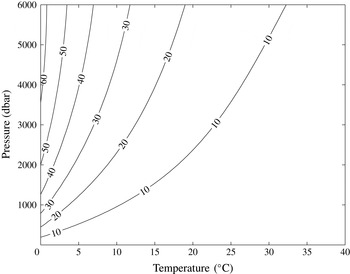
in terms of partial derivatives with respect to temperature and pressure. Figure 2 shows that while minus the ratio (3.2) is very small for ‘shallow systems’ (associated with low pressure values), this ratio dramatically increases as the pressure increases and the temperature decreases, to reach values as large as 50 % or even 60 %, which is in sharp contrast to single-parcel energetics, and which clearly establishes that compressible effects and conversions with IE are far from being negligible in systems as deep as the oceans, in agreement with Huang (Reference Huang2005).
Ratio of the AIE to the total APE (with a minus sign) expressed as a percentage for seawater, assuming absolute salinity
 $35~\text{g}~\text{kg}^{-1}$
, as defined by (3.2).

Extension of the above result to an ocean stratified in both temperature and salinity is relatively straightforward, but is not necessary to demonstrate the difficulties associated with single-parcel energetics, which are the main focus of this paper. Provisional results (Trevor McDougall, personal communication 2014) suggest that salinity gradients reinforce the effect established here, and will be discussed in more detail in a separate oceanographic publication aimed at rigorously quantifying the APE in the ocean.
4. Conclusion
We have demonstrated that single-parcel energetics considerations lead to incorrect inferences about the relative importance of IE and compressible effects when discussing the global energetics of stratified fluids. An exception is the perfect gas, but in this case, the correct answer arguably occurs for the wrong reason. In this regard, it appears to be worth pointing out that McDougall & Feistel (Reference McDougall and Feistel2003) found a similar difficulty with the conventional explanation for the adiabatic lapse rate, which appears to give the ‘correct’ answer only for a perfect gas but not for any other general fluid. In the most general case, a correct assessment of the role of IE and compressible effects can only be obtained from the consideration of mass-conserving parcel rearrangements, which need to involve two fluid parcels at the minimum. In contrast to single-parcel energetics, which assess the importance of adiabatic IE changes based on the smallness of the dimensionless parameter
 $g{\rm\Delta}z/c_{s}^{2}$
, multi-parcel energetics base such an assessment on a dimensionless parameter involving the pressure
 $p$
, the adiabatic lapse rate
 ${\it\Gamma}$
and its adiabatic partial derivative with respect to pressure
 $\partial {\it\Gamma}/\partial p|_{{\it\eta}}$
. Single- and multi-parcel energetics therefore rely on completely different physics, which seems to have been overlooked so far. This is an important result, as it provides a simple rationalisation of why the AIE appears to be such a large fraction of the total oceanic APE in the study of Huang (Reference Huang2005), which had not been satisfactory explained so far. Furthermore, two-parcel energetics confirm that
 ${\it\Gamma}$
, rather than
 $c_{s}$
, is the most fundamental quantity to assess the importance of compressibility effects, as per our first counter-argument given in the introduction.
Acknowledgements
The author gratefully acknowledges the comments of two anonymous referees, as well as detailed remarks and insights about how salinity affects the results by T. McDougall.
Appendix A. Thermodynamic relation
This appendix aims to establish the result
 $$\begin{eqnarray}\frac{\partial ^{2}u}{\partial p\partial {\it\eta}}=-p\frac{\partial {\it\Gamma}}{\partial p},\end{eqnarray}$$
where
 ${\it\Gamma}={\it\alpha}T/({\it\rho}c_{p})=\partial {\it\upsilon}/\partial {\it\eta}$
is the adiabatic lapse rate. We start with the differential of IE
 $\text{d}u=T\text{d}{\it\eta}-p\text{d}{\it\upsilon}$
, and switch to
 $({\it\eta},p)$
coordinates by regarding
 ${\it\upsilon}$
as a function of the specific entropy
 ${\it\eta}$
and pressure
 $p$
. The differential of IE becomes
 $$\begin{eqnarray}\text{d}u=T\text{d}{\it\eta}-p\text{d}{\it\upsilon}=\left[T-p\frac{\partial {\it\upsilon}}{\partial {\it\eta}}\right]\!\text{d}{\it\eta}-p\frac{\partial {\it\upsilon}}{\partial p}\text{d}p,\end{eqnarray}$$
which establishes that the first derivatives of
 $e$
with respect to
 ${\it\eta}$
and
 $p$
are given by
 $$\begin{eqnarray}\left.\frac{\partial u}{\partial {\it\eta}}\right|_{p}=T-p\left.\frac{\partial {\it\upsilon}}{\partial {\it\eta}}\right|_{p}=T-p{\it\Gamma},\quad \left.\frac{\partial u}{\partial p}\right|_{{\it\eta}}=-p\left.\frac{\partial {\it\upsilon}}{\partial p}\right|_{{\it\eta}}.\end{eqnarray}$$
Taking either the partial derivative of
 $\partial u/\partial {\it\eta}$
with respect to
 $p$
or the partial derivative of
 $\partial u/\partial p$
with respect to
 ${\it\eta}$
yields in both cases
 $$\begin{eqnarray}\frac{\partial ^{2}u}{\partial {\it\eta}\partial p}=\frac{\partial T}{\partial p}-p\frac{\partial {\it\Gamma}}{\partial p}-{\it\Gamma}=-p\frac{\partial {\it\Gamma}}{\partial p},\end{eqnarray}$$
as required, since by definition
 ${\it\Gamma}=\partial T/\partial p$
for adiabatic transformations.