INTRODUCTION
Despite their extreme species richness in terrestrial environments, insects are poorly represented in marine habitats and their occurrence on rocky shores has been previously underestimated (Neumann, Reference Neuman1976; Gullan & Cranston, Reference Gullan and Cranston2004). The few strictly marine species are rarely conspicuous members of this environment, and terrestrial species are rarely abundant in the intertidal zone except in salt marshes and estuaries (e.g. Garbary et al., Reference Garbary, Fraser, Ferguson and Lauff2004). Consequently, insects are typically ignored in general textbooks of marine biology (e.g. Levington, Reference Levington1995). Nevertheless, marine insects can be abundant (e.g. Cubit, Reference Cubit1982; Neumann, Reference Neumann1986; Johnson & Scheibling, Reference Johnson and Scheibling1987; Garbary et al., Reference Garbary, Jamieson and Taylor2008). The general lack of consideration given these organisms may be associated with their small size, often cryptic eclosion times (e.g. Neumann, Reference Neumann1986) or habitats associated with seaweeds in the upper intertidal zone (e.g. Robles & Cubit, Reference Robles and Cubit1981; McAllen, Reference McAllen1999) and short adult life spans (Neumann, Reference Neuman1976).
Among the most abundant and well represented of insects in saline environments is an array of non-biting midges (family Chironomidae), of which there are 15 genera and at least 50 described species (Hashimoto, Reference Hashimoto and Cheng1976; Neumann, Reference Neuman1976; Colbo, Reference Colbo1996). The chironomid genus Halocladius (Hirvenoja, Reference Hirvenoja1973) has five species, all of which are halophilic, and of which H. variabilis (Staeger, 1839) is the most widely distributed. This species has been extensively reported from the Holarctic of eastern and northern Canada to northern Europe and the Mediterranean and Black Seas (e.g. Hirvenoja, Reference Hirvenoja1973, Reference Hirvenoja1975; Santhakumaran et al., Reference Santhakumaran, Sneli and Sundnes1984; Colbo, Reference Colbo1996; Garbary et al., Reference Garbary, Jamieson, Fraser and Cranston2005b; Hirvenoja et al., Reference Hirvenoja, Palmén and Hirvenoja2006). The species may be best known as a larval stage from eastern Canada where numerous collections of larvae suggest a commensal and possibly mutualistic symbiosis with marine intertidal algae, in particular Elachista fucicola (Velley) Areschoug (Garbary et al., Reference Garbary, Deckert and Hubbard2005a, Reference Garbary, Jamieson and Taylor2008). In this symbiosis the insect feeds on the fouling diatoms that are abundant on its host, and may be delivering nutrients via faecal material. In the northern Baltic Sea the adult phase is best known and numerous adults have been observed (e.g. Hirvenoja et al., Reference Hirvenoja, Palmén and Hirvenoja2006). These observations, along with Santhakumaran et al. (Reference Santhakumaran, Sneli and Sundnes1984) suggested much wider habitat utilization by Halocladius than was assumed by Neumann et al. (Reference Neumann, Kaminsky and Heimbach1997) who placed larval habitat in the mid to high intertidal zones on rocky shores.
In 2006, one of us (E.T.) observed a single larva of H. variabilis associated with E. fucicola growing on Ascophyllum nodosum (Linnaeus) Le Jolis collected from the White Sea. In light of the previous observations from Nova Scotia of H. variabilis and E. fucicola (Garbary et al., 2005b, 2009), we undertook the present study to determine if the symbiosis characterized from eastern Canada was also present in the White Sea. In addition, we examined whether differences in the ecology of the primary and secondary host were also reflected in differences in the symbiotic association.
MATERIALS AND METHODS
Study sites
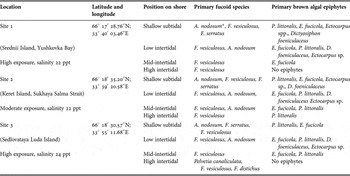
All observations were made in the Keret Archipelago (Kandalaksha Bay, White Sea) in August 2007 (Table 1). The Keret Archipelago has a tidal amplitude of 1.3 to 1.8 m for neap and spring tides, respectively, with surface water temperature reaching 17°C. The intertidal zones typically have extensive populations of Fucus vesiculosus Linnaeus (see AlgaeBase, Guiry & Guiry Reference Guiry and Guiry2008 for additional nomenclatural details on algal taxa), and the shallow subtidal zone is typically occupied by Ascophyllum nodosum (Zinova, Reference Zinova1953; Vozzhinskaya, Reference Vozzhinskaya1986). Three other fucoids were also observed in our study (Table 1): F. serratus Linnaeus, F. distichus Linnaeus and Pelvetia canaliculata (Linnaeus) Decaisne and Thuret; however H. variabilis was not observed with these secondary hosts.
Study sites in the White Sea where Halocladius variabilis was collected along with distribution of fucoid species and their epiphytes.

*, for all species names in full, see text.
Both F. vesiculosus and A. nodosum had extensive populations of filamentous or finely branched brown algae that included E. fucicola, Pylaiella littoralis (Linnaeus) Kjellman (most commonly) and Dictyosiphon foeniculaceus (Hudson) Greville and Ectocarpus sp. (less commonly). Algal nomenclature follows Guiry & Guiry (2008).
The study sites (Table 1) were all rocky shores of moderate to high wave exposure and a surface salinity of 22–24 ppt. We examined four shore zones at each site (from shallow subtidal to high intertidal) along a 50–70 m extent of shoreline. At each tidal height ten fronds of the fucoids, F. vesiculosus and A. nodosum with conspicuous epiphytic populations were selected haphazardly and returned to the laboratory. Where the two fucoids overlapped in the low intertidal zone and subtidal zones ten fronds of each species were collected.
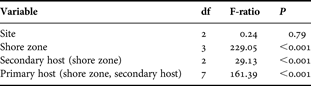
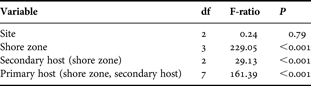
Algal epiphytes from the fucoid fronds were examined with a dissecting microscope. Each frond bore 5 to 15 epiphytic algal thalli that were identified to species and scored for occurrence and number of chironomid larvae or pupae. Data analysis was carried out using STATISTICA 7.1 (StatSoft Inc., USA). We used a nested ANOVA design with ‘secondary host (macrophyte)’ nested in ‘shore zone’ and ‘primary host (epiphyte)’ in ‘shore zone’ and ‘secondary host’. As there was no significant difference in larval distribution between sites (Table 3) we grouped data from all sites for comparison of larval occurrence on primary and secondary hosts. ANOVA was carried out using STATISTICA 5.5 (StatSoft Inc., USA).
Note on identification of Halocladius variabilis
While adults of Halocladius variabilis are required for definitive identification of the species, all chironomid larvae observed had morphology consistent with H. variabilis from eastern Canada. In addition, the paucity of chironomid species in marine habitats and the consistency of the association with filamentous brown algae (Colbo, Reference Colbo1996; Garbary et al., Reference Garbary, Jamieson, Fraser and Cranston2005b) as observed in eastern Canada, led us to assume that all larvae were H. variabilis. One other chironomid, Cricotopus vitripennis (Meigen, 1822), is widely distributed in the intertidal zone of the White Sea. Cricotopus is found in mud or with decaying algal mats, where its larvae are associated with mussel beds or with assemblages of tube-dwelling polychaetes (e.g. Khaitov et al., Reference Khaitov, Fokin and Nicolaeva1999).
RESULTS
The primary and secondary algal hosts were collected from three sites in the Keret Archipelago. These sites had conspicuous populations of F. vesiculosus and A. nodosum in the mid–low intertidal zone and the shallow subtidal zone (depth 1–1.5 m during the lowest tides) and these fucoids had extensive populations of brown algal epiphytes (Table 1). The two fucoids were typically in a continuous bed from the shallow subtidal to the mid intertidal zones. Fucus vesiculosus tended to occur in a dense band from the mid shore to the low intertidal zone. In the high intertidal zone F. vesiculosus cover degraded to separate beds about 0.5 m in diameter. Ascophyllum nodosum was common in the low intertidal zone where it was often mixed with F. vesiculosus, but it formed a more-or-less continuous bed to about 1.5 m below the low tide level.
Larvae of H. variabilis were present at every site. Larvae varied from 3 to 10 mm in length, and the smaller ones were more abundant. Each host epiphytic thallus typically had only one larva and never more than two. Egg masses were never observed. While adults were not observed, 5 pupae (8–10 mm) were found. All pupae were associated with E. fucicola, where they were embedded in the dense filamentous matrix at the base of the uniseriate filaments. The pupae were only found in the intertidal zone. The presence of pupae and the absence of egg masses suggests that eclosion, mating and egg laying was later in the season than our observations.
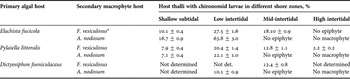
A total of ~2000 thalli of epiphytic algae representing three primary host species were scored for presence of H. variabilis. The primary hosts were E. fucicola, P. littoralis and D. foeniculaceus. Ectocarpus was only recorded infrequently and so was excluded from our study. These primary hosts occurred as epiphytes on the fucoid species A. nodosum and F. vesiculosus (secondary hosts). Halocladius was most prevalent in the low intertidal zone where it had the highest frequency on E. fucicola with A. nodosum as the secondary host and 64% of E. fucicola thalli had at least one larva. This was followed by E. fucicola on F. vesiculosus where 27% of thalli were colonized (Table 2). Halocladius on primary hosts other than E. fucicola was less abundant, as generally was the occurrence of the chironomid with the secondary host F. vesiculosus. Differences in occurrence between the three primary hosts and the two secondary hosts were significant at P < 0.01 (Table 3).
Distribution of larvae of Halocladius variabilis on different algae in intertidal and shallow subtidal zones in the Keret Archipelago. Figures indicate means±standard errors.

*, for all species names in full, see text.
Summary of ANOVA tables for analyses of data shown in Table 2.
DISCUSSION
Our observations clearly demonstrate that the symbiosis between the marine chironomid, H. variabilis, and its primary host E. fucicola described from Canada by Garbary et al. (2005a , 2009) also occurs in the White Sea. The relationship in the White Sea is more flexible than that in Nova Scotia in that a greater number of primary (i.e. algae other than E. fucicola) and secondary (i.e. hosts other than A. nodosum) hosts are available to the insect, even though the highest frequency of occurrence is still retained with E. fucicola (i.e. 64%) and A. nodosum. Garbary et al. (2005) described a close association between A. nodosum, E. fucicola and H. variabilis in Nova Scotia, Canada.
The occurrence of H. variabilis larvae in the subtidal zone of the White Sea is unusual considering that the adult stage of the insect flies (e.g. Hirvenoja et al., Reference Hirvenoja, Palmén and Hirvenoja2006), and cannot survive immersion in seawater. The occurrence of subtidal larvae presents two difficulties. First, how can hosts become colonized if this requires egg-laying, in situ, by the adult? Secondly, once the larvae have pupated and then emerged, can the new adults possibly survive seawater immersion to successfully mate and then lay eggs?
The first problem might be overcome by dispersal of individual larvae from an intertidal host thallus and then becoming reattached to another host clump. Given the high densities of both fucoid fronds and their brown algal epiphytes, this is plausible. The high proportion of colonized E. fucicola thalli, and the fact that the majority of these thalli host only a single larva, is consistent with dispersal rather than predation as the causal factor. Thus, if predation was the primary cause of larval loss for the host, then one would expect to see a greater variation in larval numbers per host, and many more host thalli with zero larvae. Dispersal and random reattachment to other primary hosts may also explain the much lower frequency on P. littoralis and D. foeniculaceus. An alternative explanation for the reduction to 1–2 larvae per host is the possibility of sibling cannibalism. This has been reported in the freshwater insect Hydropsyche slossonae (Banks, 1905) where there is a 92% loss of 1st instar larvae as a consequence of sibling cannibalism (Willis & Hendricks, Reference Willis and Hendricks1992).
It is also possible that during extreme neap tides in August the upper portions of the A. nodosum fronds with their epiphytic clumps may be floating at the surface, and this provides sufficient opportunity for both egg-laying and emergence of the adults. Subtidal populations of H. variabilis were reported previously (Santhakumaran et al., Reference Santhakumaran, Sneli and Sundnes1984); however, no explanations were offered here as to the origin of the larvae. The winged nature of Halocladius adults contrasts with the unwinged genera Pontomyia (Edwards, 1926) and Clunio (Haliday, 1855). These genera have extensive subtidal populations and the unwinged or flightless adults eclose, mate and lay eggs on the sea surface (Tokunaga, Reference Tokunaga1932; Cheng & Collins, Reference Cheng and Collins1980; Neumann, Reference Neumann1986). Since the egg masses we observed in Nova Scotia were deeply immersed in the filaments of E. fucicola, this must be an active process carried out by adult Halocladius.
While not representing obligate associations, the primary relationship of H. variabilis to E. fucicola and the secondary relationship to A. nodosum are the most prevalent in the White Sea. Symbioses involving A. nodosum as a host have been extensively studied and involve an obligate mutualistic association with an endophytic fungus, Mycophycias ascophyli (Cotton) Kohlmann & Volkmann-Kohlmeyer (Garbary & MacDonald, Reference Garbary and MacDonald1995; Garbary & London, Reference Garbary and London1995; Deckert & Garbary, Reference Deckert and Garbary2005; Xu et al., Reference Xu, Deckert and Garbary2008), a host-specific red algal epiphyte Vertebrata lanosa (Linnaeus) Christensen (Garbary et al., Reference Garbary, Burke and Tian1991, Reference Garbary, Deckert and Hubbard2005a; Tian & Garbary, Reference Tian and Garbary1992), as well as facultative symbioses with algae including E. fucicola (review by Garbary & Deckert, Reference Garbary, Deckert and Seckbach2001). While Johnson & Scheibling (Reference Johnson and Scheibling1987) did not identify H. variabilis specifically, the abundant chironomid associated with epiphytes of Fucus and Ascophyllum in their study from the south shore of Nova Scotia is likely to be this species.
Adults of H. variabilis have been found on sites other than the rocky intertidal zone. These include salt marshes (Giberson et al., Reference Giberson, Bilyj and Burgess2001) and terrestrial habitats some distance from the seashore (Hirvenoja et al., Reference Hirvenoja, Palmén and Hirvenoja2006). There are also occasional findings of the larvae of H. variabilis in fresh water habitats in northern Europe (Kuz'mina, Reference Kuz'mina2001). The abundance and degree of specificity of the H. variabilis symbiosis with brown algal hosts suggests that this is central to the biology of the species. That numerous adults were also observed in this rocky intertidal zone of Nova Scotia in August 2007 (Garbary, unpublished observations) confirms that the insect is completing its life cycle in this habitat. The observations of alternative habitats suggest a plastic ecology on the part of H. variabilis or the possibility of multiple divergent races with widespread distributions.
ACKNOWLEDGEMENT
We thank Dr Yuri Maslov and the administration of Marine Biological Station of St Petersburg State University for technical support.