1. Introduction
Close ties between politicians and businesses are prevalent in developing as well as advanced economies. Numerous studies have documented the variegated ways in which the public and private sectors are linked: connections range from ownership ties (La Porta et al., Reference La Porta, Lopez-de Silanes and Shleifer2002), over shareholdership (Bortolotti and Faccio, Reference Bortolotti and Faccio2008), to political board members in firms (Khwaja and Mian, Reference Khwaja and Mian2005; Markgraf and Rosas, Reference Markgraf and Rosas2019). We know that political connections matter for companies’ business decisions (Englmaier and Stowasser, Reference Englmaier and Stowasser2017), performance (Earle and Gehlbach, Reference Earle and Gehlbach2015), stock market valuation (Fisman, Reference Fisman2001), and the generosity of public bailouts (Faccio et al., Reference Faccio, Masulis and Mcconnell2006). In recent decades, privatization and stricter regulation have curtailed the most overt forms of those ties. Nonetheless, scholars continue to find political patterns in firms’ activities even when firms are not politically connected according to the existing measures of political connectedness (Illueca et al., Reference Illueca, Norden and Udell2014; Lavezzolo and Illueca, Reference Lavezzolo and Illueca2017). The mechanisms through which these firms are connected to the political process are unclear. I speculate that one channel of political control is the ability to sway appointments to key positions in firms. I study the case of Spanish savings banks (Cajas) that were considered to be intertwined with Spanish regional politics (e.g., Cunat and Garicano, Reference Cunat and Garicano2010), but for which the precise mechanisms of political interference were unclear. I test three hypotheses that follow from this: chairpersons’ turnover risk is pronounced (1) when new governments enter office, (2) shortly after political elections, and (3) under single-party governments when political veto players (coalition partners) do not inhibit political appointments of chairpersons. The empirical analysis considers data from all 90 Spanish savings banks between 1985 and 2010 and focuses on the careers of bank chairpersons. Chair positions are attractive for politicians who seek influence over banks because relatively loose eligibility requirements allow appointing less-than-ideally qualified candidates. I estimate Cox proportional hazard (PH) models with bank-level frailties to test whether dates of regional elections, the duration of governments, and the composition of governments affect the survival time of Cajas’ chairpersons. I find strong evidence that chairpersons’ survival is driven by political events. Bank chairpersons face a higher hazard shortly after regional elections and when new governments enter office, even after controlling bank profitability. I furthermore show that the effect is attenuated under coalition governments suggesting that political veto players can inhibit politicians’ ability to appoint new chairpersons.
2. Politics-bank linkages in Spain
Spanish savings banks underwent a fundamental transformation in the post-Franco era: Cajas’ focus shifted to Spanish autonomous regions and regional governments became one of the banks’ stakeholders, considerable consolidation in the savings bank sector in the 1980s reduced the number of banks from 90 to 46, and Cajas became an important element of the Spanish banking sector accounting for more than half of the credit volume and bank branches. Yet, when the global financial crisis hit Spain in 2009, almost all savings banks were privatized or liquidated (Sagarra et al., Reference Sagarra, Mar-Molinero and García-Cestona2015).Footnote 1 Although Cajas were widely assumed to have close ties with Spanish regional politics and anecdotes circulated about unfit Cajas chairpersons with influential political allies in regional governments as well as local savings banks that financed political pet projects, evidence about the mechanisms of political control is missing. In fact, Spain ranks low in existing databases on political connections: only 2% of bank assets were controlled by the public sector (La Porta et al., Reference La Porta, Lopez-de Silanes and Shleifer2002) and only 1.5% of firms were subject to significant political shareholdership (Faccio, Reference Faccio2006). Active politicians were banned from serving on the board of Cajas, let alone as bank chair or CEO, the most influential positions in a bank. Bank chairpersons, the heads of the Board, were elected by the bank's General Assembly, decided on strategic issues, such as the geographical expansion or large loans, and, hence, were pivotal for aligning banks with political interests. In contrast, bank CEOs had to meet eligibility requirements regarding banking expertise and were elected by the Board, not by the General Assembly (stakeholders). Corporate governance structures thus barred regional governments from directly accessing the decision-making bodies of Cajas. Nevertheless, Spanish Cajas are often cited as prime examples of politically-connected firms raising the question about the mechanisms of political control. One such channel are General Assemblies that consisted of Cajas’ stakeholders, including regional governments, bank depositors, employees, and founders. The General Assembly elected the Board, including the bank chairperson, hence providing a potential mechanism to align chairpersons’ incentives with the regional government's political agenda. Yet, it is not directly obvious that regional governments’ interests prevailed as appointment decisions had to be jointly taken with all stakeholders.
3. Empirical design & data
I collect a novel dataset on careers of chairpersons in 90 Spanish savings banks between 1985 and 2010 from Cajas’ annual reports that covers all savings banks and effectively the entire post-Franco era in Spain to the beginning of the financial crisis. The units of analysis are chairperson-year observations. The data are matched with electoral data from the 17 Spanish autonomous regions based on the location of Cajas’ headquarters. The unicameral parliaments in Spanish autonomous regions are elected based on a closed-list proportional–representation system for a four-year term. Regional governments in Spain can consist of single parties or coalitions of two or more parties, both of which can be minority governments. The sample consists of 1259 observations and 234 turnovers of chairpersons. Several banks were merged during the period of observation (44 banks).Footnote 2 Three types of political events are expected to matter for chairpersons’ appointments in Spanish Cajas: I speculate that corporate turnovers are more likely when new governments enter office (election outcome). Second, chairpersons’ turnovers occur predominantly early rather than later in the electoral term, because elections are associated with political reshuffles even in the absence of changes in government (election timing). Third, I argue that political veto players, namely coalition partners, inhibit politicians’ ability to appoint political allies to boards (political constellation): coalition partners need to agree on new chairpersons and might tie each others’ hands. Hence, chairpersons face a lower risk when coalition governments enter office. I use three variables to test these expectations: first, the continuous variable, Years in Government, measures the years since the government has changed and I expect that hazards decrease, the longer governments are in power. Second, a dummy variable, Post Election, is included that is 1 in years of regional elections t and t + 1 and 0 otherwise. It helps to assess whether chairpersons’ hazards follow a political cycle, independent of the political outcome; I expect that hazards are higher in post-election periods.Footnote 3 Third, I include a dummy, Coalition, that is 1 if the number of governing parties in the region is two or more. I expect that chairpersons face a higher risk when new single-party governments enter office (compared to new coalition governments) while political constellations matter less when governments are reelected. Information about election dates and election outcomes are measured at the regional level and come from the Spanish Ministry of the Interior. The empirical model controls for obvious confounders: to control for performance-related explanations of chairpersons’ turnovers, I include bank performance (Return on Assets) that measures the profit of a bank normalized by total assets (lagged by one year). Data for bank performance come from the annual balance sheets of savings banks. Moreover, I include a categorical variable, Party, that contains information about the main party in the regional government (single governing party or coalition partner with the largest vote share). Finally, the continuous variable Public-Sector Vote Share proxies the influence of the public sector in the General Assembly of a savings bank; higher values are presumably associated with more influence within banks’ General Assembly. The variable is measured at the regional level based on the time-varying de-jure cap on the public-sector vote in Cajas.Footnote 4 Summary statistics are presented in Table A3 in the online appendix. Survival models are powerful statistical tools when the dependent variable of interest is the time to the occurrence of a terminal event. The focus of the analysis is on the hazard function that gives the probability of a bank chairperson surviving in office up to time t. I do not have strong ex-ante expectations about the relationship between time and the risk of turnover and therefore employ a Cox PH model in which the baseline hazard function is unknown and left unparameterized. Cox models are based on the assumption that hazard ratios (HRs) are proportional to the baseline hazard; that is, the hazard function for each observation follows the same pattern over time and the effect of any covariate is proportional and invariant to when the covareriate's value changes. When hazards are non-proportional, PH models lead to biased coefficients and decreased power of significance tests (Box-Steffensmeier and Jones, Reference Box-Steffensmeier and Jones2004). The graphical inspection of the Schoenfield residuals and statistical tests of the non-proportional hazards assumption using the Grambsch–Thernau global test (Grambsch and Therneau, Reference Grambsch and Therneau1994) and Harrell's rho test show that the PH assumption is violated. To address non-proportional hazards, I interact the offending variable (Party) with a measure of duration (Box-Steffensmeier and Zorn, Reference Box-Steffensmeier and Zorn2001; Keele, Reference Keele2010; Licht, Reference Licht2011; Jin and Boehmke, Reference Jin and Boehmke2017). To account for potential bank-level heterogeneity in hazards, I include a frailty term for individual banks. The random-effects model assumes that chairpersons within the same bank share the frailty that differs across banks (McGilchrist and Aisbett, Reference McGilchrist and Aisbett1991; Therneau et al., Reference Therneau, Grambsch and Shane Pankratz2003).Footnote 5 Interpreting the empirical results from Cox models is not straightforward. As it becomes apparent from the formula for HRs in Cox models, $h_{i}( t) = h_{0}( t) {\rm e}^{( \beta {\bf X}_{i} + {\bf Z}_{i}{\boldsymbol \theta }) }$ , the baseline HR, h 0(t), is the probability that a case will fail at time t, while the exponential term gives the sensitivity of the hazard to covariates. The coefficient β represents the change in the log HR of a one-unit change in X.Footnote 6 The regression output presents non-exponentiated coefficients, that is, coefficients larger than zero indicate a higher HR relative to the baseline HR.
4. Results
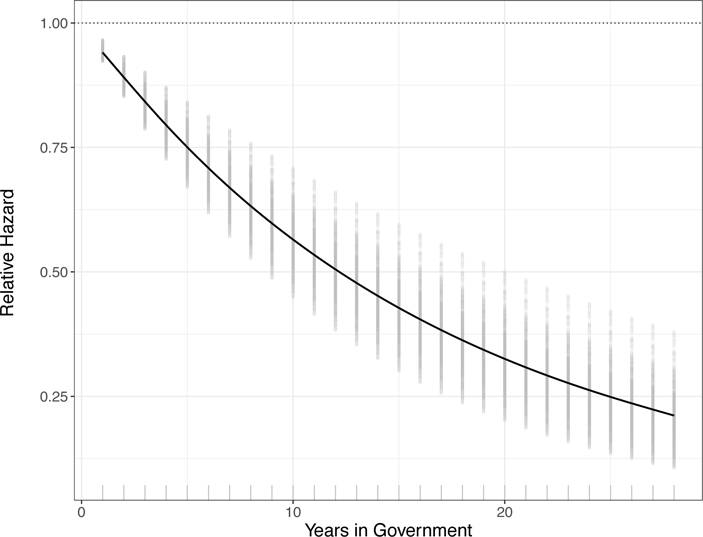
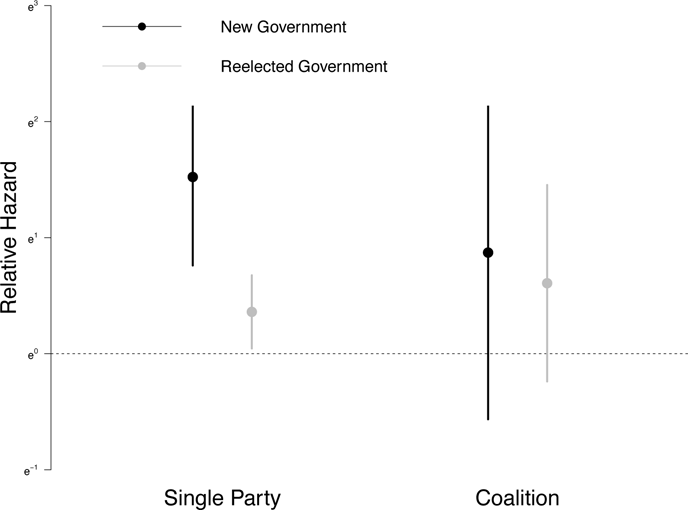
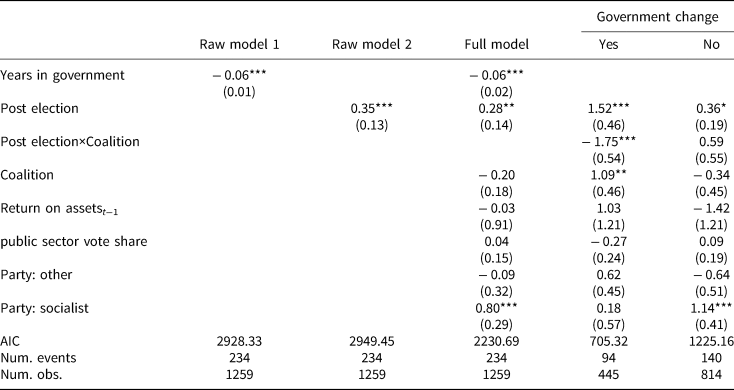
I estimate five models to test the three hypotheses: models 1–3 test the first two expectations, namely that Cajas chairpersons’ HR is affected by the outcome and timing of political elections. Models 4 and 5 separately analyze electoral terms under newly formed (model 4) and reelected governments (model 5) and interact the dummy Post Election with the dummy Coalition to examine the third hypothesis that political veto players (coalition partners) inhibit political appointments to bank boards.Footnote 7 Table 1 presents the results of the five models. Models 1 and 2 are bare-bone models that regress the survival time on Years in Government and Post Election. Model 3 jointly estimates models with both predictors and adds relevant controls. Throughout models 1–3 and in line with the expectation, I find that chairpersons’ hazards are highest shortly after new governments enter office and decrease the longer the incumbent government holds political office. The effect is statistically reliable and robust. The results also show that, as speculated, chairpersons face a higher risk to lose their job shortly after political elections, independent of the electoral outcome; in fact, chairpersons’ hazard in post-election periods is 1.32 times that of the baseline HR (relative hazards (RHs): e0.28 = 1.32). This provides strong empirical support for the claim that the timing and outcome of elections matter for chairpersons’ turnovers. Although interpreting coefficients of binary variables is intuitive (e.g., as RHs), grasping the substantive meaning of coefficients for continuous variables is more difficult (Licht, Reference Licht2011). Figure 1, therefore, plots the RHs for different values of the variable Years in Government. Table 1 also shows that turnover risk is lower under coalition than single-party governments (yet imprecisely estimated), that the public-sector vote share in banks’ General Assemblies is not systematically related to chairpersons’ hazard,Footnote 8 bank performance is negatively associated with corporate turnovers (imprecisely estimated and thus not statistically significant), and that new appointments of chairs are more likely under Socialist governments compared to the conservative party (baseline) or other governing parties.Footnote 9 Model 4 provides insight into how government composition affects chairpersons’ hazard after new governments are formed. For reading the results, note that the baseline is a chairperson's HR under single-party governments in non-post-election periods. Incoming single-party governments seem to replace bank chairpersons early in their political term (main effect Post Election; RH = 4.57). During terms when coalition governments enter office, chairpersons face a higher turnover risk later in the legislative term (main effect Coalition; RH = 2.97) and the hazard is generally flat over the electoral cycle (full interaction effect; RH = 2.83).Footnote 10 When incumbent governments are reelected (Table 1, model 5), a chairperson's HR is somewhat higher shortly after elections, but coalition dynamics do not change chairpersons’ hazard. To facilitate the interpretation of the findings of models 4 and 5, Figure 2 illustrates the RHs for single-party and coalition governments after elections with and without a change in government. Note that the scale of the RHs (y-axis) is logged to obtain symmetric confidence intervals. The graphical illustration shows that RHs are much higher shortly after single-party governments enter office; coalition governments tend to replace chairpersons at high rates, too, but the much wider confidence intervals indicate considerable variation across coalition governments (black lines). When elections did not lead to a change in government, the effects are much smaller, thus government composition mainly matters when new governments enter office (grey lines). This provides empirical support that political constellations moderate political appointment cycles in Cajas.
Plotting effect of variable Years in Government on RHs (Table 1, model 3).

Plotting changes in chairpersons' RHs in post-election periods under single-party and coalition government (Table 1, models 4 and 5, with 90% confidence intervals)

Cox PH model

***p < 0.01, **p < 0.05, $^\ast p< 0.1$
The validity of the setup rests on the identifying assumptions that (a) corporate turnovers are not causally prior to timing and outcome of political elections (reversed causality) and (b) that no unmeasured variable jointly causes corporate turnovers and timing and outcome of political elections (omitted variable). Political elections are predetermined by the electoral calendar and thus arguably exogenous to corporate turnovers and not affected by omitted variables.Footnote 11 Yet, omitted variables and reversed causality might be a concern for the second key predictor, Years in Government. For instance, macroeconomic downturns usually affect governments’ approval ratings and simultaneously increase bank chairpersons’ hazard. Similarly, bank chairpersons and governments may both be negatively affected by bank scandals, especially when political ties are suspected. Also, even if the causal arrow goes from political events to corporate turnovers, it is not readily obvious that politicians sway appointment decisions: it would be equally plausible that banks simply adapt to election-induced changes in fiscal and regulatory policies. To address those concerns, I present a number of placebo tests in the online appendix that show that only the hazard of Cajas’ chairpersons is affected by political elections, not that of Cajas’ CEOs (Table A6) and not that of chairpersons of commercial Spanish banks (Table A8). Bank CEOs are affected by the same bank-level factors (poor performance; scandals) as chairpersons, and commercial banks are subject to the same macroeconomic trends (regulatory changes; economic downturns), but regional politicians had no control over CEO appointments through the General Assembly of commercial banks. Furthermore, I show that events in regional politics, not at the national level where most regulatory and supervisory policies for banks were passed, mattered for Cajas’ chairpersons’ hazards (Table A7) indicating that appointment patterns were not driven by banks adapting to regulatory changes. For a more detailed discussion of alternative mechanisms and model specifications, such as a linear model with year- and region-fixed effects (Table A9), see the online appendix.
5. Conclusion
Capturing the channels through which politicians and firms interact became increasingly difficult in recent decades as state-owned enterprises were privatized and bank-politics ties became more strictly regulated. This paper looks at the relationship between political elections and corporate turnovers to uncover one mechanism of political control, namely to appoint influential chairpersons in banks, studying Spanish savings banks for which political ties were assumed, but it was not obvious how exactly banks were connected to the political process. Estimating Cox PH models, I show that bank chairpersons of Spanish savings banks were much more likely to be ousted shortly after elections and when new governments enter office. I further present evidence that the effect was moderated by the presence of political veto players (coalition partners). This provides strong empirical support for the claim that politicians had considerable influence over Spanish Cajas through controlling chairpersons’ appointments. The paper studied the case of Spanish savings banks, yet concealed forms of connections between firms and politicians are pervasive in many countries. Analyzing the timing of corporate appointments can thus be a fruitful approach to identify the channels of political connections in other institutional contexts, too. In Italy, for instance, the banking sector was privatized during the 1990s, but political control over banks persists (Sapienza, Reference Sapienza2004); in France, CEO appointments are influenced by companies’ (political) ownership structure (Nguyen, Reference Nguyen2011); and firms in Eastern Europe are traditionally closely linked to the political process (e.g., in Ukraine, Earle and Gehlbach, Reference Earle and Gehlbach2015). Furthermore, in various other countries, politicians retained control over privatized state-owned firms through connections to boards or “golden shares” (Boubakri et al., Reference Boubakri, Cosset and Saffar2008). Hence, indirect firm-politics ties are widespread and analyzing the timing of corporate turnovers does allow to study political connections well beyond the Spanish case.
Supplementary material
The supplementary material for this article can be found at https://doi.org/10.1017/psrm.2020.52.