The rise of China and the potential for conflict with democracies such as Japan or the United States has given fresh urgency to the old question of how regime types affect the likelihood of war. Although several studies have examined how regime types affect international conflicts, ranging from democratic peace (Dafoe Reference Dafoe2011; Dafoe, Oneal and Russett Reference Dafoe, Oneal and Russett2013; Levy Reference Levy1992; Levy Reference Levy1997; Peceny and Beer Reference Peceny and Beer2003; Peceny, Beer and Sanchez-Terry Reference Peceny, Beer and Sanchez-Terry2002; Reiter and Stam Reference Reiter and Stam2003) to audience costs (Fearon Reference Fearon1994; Schultz Reference Schultz2001; Weeks Reference Weeks2008), they have largely ignored one important institutional feature that might help explain the relationship between regime types and international conflicts: the role of political parties, particularly how they shape their core supporters' preferences related to international conflicts (see also Cukierman and Tommasi Reference Cukierman and Tommasi1988; Schultz Reference Schultz2005).Footnote 1
Violent international disputes most often break out between democracies and autocracies, given their lack of shared institutions and norms (Dafoe Reference Dafoe2011; Dafoe, Oneal and Russett Reference Dafoe, Oneal and Russett2013; Peceny and Beer Reference Peceny and Beer2003; Peceny, Beer and Sanchez-Terry Reference Peceny, Beer and Sanchez-Terry2002; Reiter and Stam Reference Reiter and Stam2003). In this article, we argue that differences in the nature of democratic and non-democratic political parties may be an additional source of potential conflicts between these regime types. In a democracy, core supporters of a political party may be more effective at demanding hawkish behavior compared to their counterparts in an autocracy. This asymmetry in pressure from below may explain why democracies sometimes initiate conflicts. This is counterintuitive because democratic citizens are better able to hold their governments accountable for the expected costs of war.
In a democracy such as Japan, partisan public opinion may pressure the leaders of a party with a nationalistic electoral base to take a hard line on conflicts. In a crisis, electoral imperatives can nudge democratic leaders towards conflict.Footnote 2 In a one-party autocracy such as China, however, the ruling party has tighter control over public discourse. In a crisis, autocrats can rely on party organizations that control political advancement to pressure regime insiders – however nationalistic they may be – to stay on their side, even if the government decides to discourage warmongering protests. In other words, in one-party autocracies, party loyalists have an incentive to express public support for dovish policies even when they cut against their true preferences.
We use a series of survey experiments to investigate how democratic and autocratic political parties shape their core supporters' preferences over international disputes. To do this, we draw on evidence from paired surveys across a substantively important potential conflict dyad: China and Japan. China and Japan's ongoing dispute over islands in the East China Sea has the potential to spiral into a conflict that could pull in the United States. The pairing of an autocracy and a democracy speaks to theories about how the public might differentially pressure the leaders of both types of regimes. We are aided in this task of assessing the role of political parties by the hawkishness of the supporters of the ruling parties in both countries.
This article examines two related empirical questions. First, how do the mass publics in China and Japan think about territorial, symbolic and short-term economic gains? To investigate this baseline question, we use a conjoint design that asks respondents to choose between and rate potential bargains between the two countries. In both contexts, we find that the public prioritizes standing firm on territorial disputes over making gains in trade or investment deals. This first finding suggests there is strong public pressure in both autocracies and democracies for a hawkish stance on nationalist conflict over territory (see also Vasquez Reference Vasquez2009). It shows an alarming dynamic in East Asia, where bellicose public opinion may push the leaders of China and Japan to prioritize the kind of issue most likely to lead to armed conflict.
The second question we examine is whether core supporters of ruling parties pressure their leaders to stand firm in territorial disputes even when these leaders are trying to reduce the likelihood of conflict. Based on (pre-registered) subgroup analysis, we find evidence that members of Japan's ruling Liberal Democratic Party (LDP) prioritize territorial disputes more than the general public. A vignette experiment shows that LDP members will punish party leaders for de-escalating during crises over territorial disputes, with no comparable punishment for economic issues. The findings suggest there is domestic political pressure on democratic leaders to maintain a hard line on territorial disputes, at least when they have a nationalist core constituency. However, members and aspirants of the Communist Party of China (CCP) – the key constituency for national leaders in that country – stay in line with party leadership over territorial disputes. A vignette experiment shows that, unlike in Japan, CCP insiders support the party when it seeks to de-escalate nationalist disputes. Our robustness checks confirm that the relationship holds even after controlling for alternative factors such as insiders' political conservatism. While their public support may belie their private beliefs (Kuran Reference Kuran1991), it is consistent with our argument that core supporters of an autocratic ruling party tend to toe the party line, presumably for their personal advancement and self-preservation.
Overall, our results suggest that while nationalism runs high in both China and Japan, in a crisis the leaders of the autocratic CCP may have more political latitude to defuse tensions than their democratic counterparts in the LDP. We do not claim that these two countries represent all democracies and one-party autocracies. Indeed, our results may be driven by the specific contexts that China and Japan face today.Footnote 3 However, our findings are also consistent with cross-national research that shows that one-party regimes are less likely than other types of autocratic regimes to engage in war (Lai and Slater Reference Lai and Slater2005; Peceny and Beer Reference Peceny and Beer2003). By focusing on political parties and comparing one-party China with democratic Japan, we shed light on the logic of why one-party autocracies may be less antagonistic in some cases. Our findings also help to explain the logic of the recent finding that when right-wing parties take power, democracies are more likely to go to war (Bertoli, Dafoe and Trager Reference Bertoli, Dafoe and Trager2017). Although democracies may have other mechanisms to prevent a war such as democratic norms and institutions (Schultz Reference Schultz1999), we suggest that in one-party autocracies – an important category given China's rise – party organizations can, in some cases, help to preserve an anti-democratic peace.
Theory
Democracies are disinclined to be belligerent, it has been argued, because democratic citizens are unwilling to pay for the physical and financial costs of war (De Heus, Hoogervorst and van Dijk Reference De Heus, Hoogervorst and van Dijk2010; Flores-Macías and Kreps Reference Flores-Macías and Kreps2017; Levy Reference Levy1992; Levy Reference Levy1997).Footnote 4 Democratic citizens are also more likely to punish leaders who back down (Fearon Reference Fearon1994; Kertzer and Brutger Reference Kertzer and Brutger2016; Nomikos and Sambanis Reference Nomikos and Sambanis2019; Schultz Reference Schultz2001; Tomz and Weeks Reference Tomz and Weeks2013). But the facts do not always bear out this optimistic view: democracies are not less bellicose, they are only less likely to fight each other and, importantly, violent international disputes are the most likely to break out between a democracy and an autocracy (Dafoe Reference Dafoe2011; Dafoe, Oneal and Russett Reference Dafoe, Oneal and Russett2013; Peceny and Beer Reference Peceny and Beer2003; Peceny, Beer and Sanchez-Terry Reference Peceny, Beer and Sanchez-Terry2002; Reiter and Stam Reference Reiter and Stam2003; Russett and Oneal Reference Russett and Oneal2001). This pattern also heightens concerns that an autocratic China with a hawkish public (Weiss Reference Weiss2019) and enormous military power might pick a fight with one of its democratic neighbors.
However, in a potential conflict between a democracy and a one-party autocracy – a pairing we believe is important to examine given China's current prominence – it may be a democracy that initiates conflict. Our argument complements some of Kant's predictions that democracies might be inclined to fight wars for popular reasons. He compares the warlikeness of democracies to peacefully inclined ‘republics’ that are becalmed – or impeded – by a variety of institutional checks (Kant Reference Kant1975). Doyle (Reference Doyle1986, 1152) captures this tension neatly by arguing that democracies ‘are indeed peaceful, yet they are also prone to make war’. Reiter and Stam (Reference Reiter and Stam2002) similarly argue that it is precisely because democratic populations may be motivated to fight that they are more likely to win when they do fight.
In the following section, we focus on core supporters of political parties to provide an additional explanation for why democracies may in some cases be more antagonistic than (one-party) autocracies. We argue that democratic parties' responsiveness to a hawkish electorate may lead to conflict between autocracies and democracies.
The Role of Political Parties
In this article, we consider how differences in democratic and non-democratic political parties can explain patterns of bellicosity across regime types. In some circumstances that we outline below, it can be harder for democratic than non-democratic governments to dismiss inflamed nationalistic sentiment. Authoritarian regimes, in these cases, may be less likely to initiate a conflict.
Political leaders in all kinds of regimes can be expected to dodge the blame for economic insecurity with trumped-up external threats and appeals to nationalist pride (Tir Reference Tir2010), but democratic and autocratic regimes face systematically and substantially different levels of foreign policy pressure from the general population. While party competition holds democratic governments publicly accountable, in authoritarian regimes the government uses parties to control resources and information. Partisan affiliation is vastly more contingent on voter satisfaction in democracies than in authoritarian regimes, which control information and the pathways to personal political and economic success.
In an ideal conception of democracy, political parties present voters with competing visions of the public good, translated into programmatic policies that voters then judge at the polls (Aldrich Reference Aldrich1995; Cox and McCubbins Reference Cox and McCubbins1993; Duch and Stevenson Reference Duch and Stevenson2008; Ferejohn Reference Ferejohn1986; Rohde Reference Rohde1991; Schattschneider Reference Schattschneider1942). Caillaud and Tirole (Reference Caillaud and Tirole2002) describe parties as ‘organizations that regulate competition among like-minded factions so as to enhance reputation building by, and voter trust in, the politicians standing for a given cause’. Party backbenchers delegate to party leaders the authority to formulate and enforce coherent party platforms, but retain the ability to replace electorally unsuccessful leaders. In a democratic party, centralization can facilitate a fundamentally competitive orientation towards voters.
To the extent that democratic governments are accountable to voters, it is conceivable that democratic voters aroused by nationalistic sentiment could pressure governments into hostile posturing that risks inadvisable war. If a governing democratic political party is disproportionately accountable to a subset of the population that favors conflict, the hoped-for democratic checks on war may falter.Footnote 5 Autocracies, by contrast, have often effectively eliminated partisan opposition and therefore rely less on accountability to stay in office. In this sense, autocratic leaders can relatively easily dismiss nationalistic groups that may prefer to engage in a war, although as Weiss (Reference Weiss2013) suggests, even autocrats face some costs from repressing nationalism, once unleashed.
Things could be different in one-party autocracies where there is some measure of political competition within the party.Footnote 6 For example, Weeks (Reference Weeks2008) expects autocrats to face audience costs to the degree that rival elites could potentially overthrow the autocrat: leaders could be blamed for backing down from threats. In China, the CCP has generally managed to quell competition with ruthless efficiency, but elites have been divided at times. For example, during the 1989 crisis, Party Secretary Zhao Ziyang supported student protesters while Deng Xiaoping and other hardliners did not, leading to competing coalitions. Ultimately, Deng Xiaoping purged the party's nominal leader from his position and placed him under effective house arrest for the rest of his life.Footnote 7 More recently, in 2012–13, the party purged and imprisoned Bo Xilai, a member of the Politburo who had attempted to gather influence and a broad popular following by advocating more leftist politics.Footnote 8 Indeed, the turmoil over the Bo affair and the 2013 leadership succession may have contributed to a rise in nationalist conflict in this period, which we discuss in more detail below.
In general, however, because these elite splits are rare, and because CCP members rely on the government for their careers, discontent over policies may take a back seat to calculations of personal advancement. The party controls the career progress and appointments of all officials, from the grassroots level to the Central Committee leadership (Edin Reference Edin2003; Shih, Adolph and Liu Reference Shih, Adolph and Liu2012). Party members who express opposition to the party may quickly find themselves outside the political system; non-politicians may lose access to important government resources. Party members are also selected partly based on their loyalty to the party and its ideology, and the additional ideological indoctrination they receive may deepen their loyalty.Footnote 9
By contrast, democratic accountability makes it hard for governments to disallow vocal protests by unhappy voters. It is important to note that democracy fosters tolerance for protest not only because voters can remove oppressive politicians from office, but also because of the low stakes: voters have ample opportunities to express dissatisfaction short of demanding a change in government (Davenport Reference Davenport2007). This is borne out empirically: democracies tend to be more accommodating of political opposition and less likely to suppress dissent (Carey Reference Carey2006).
The Cases of China and Japan
Assessing how political parties operate in China and Japan offers a window into one of the most complex and consequential bilateral relationships in the world. The relationship between the two countries is defined in part by the history of Japanese imperialism, which culminated in the brutal invasion and occupation of China during World War II. The occupation's legacy lives on in the form of several ongoing political issues. First, Japanese politicians regularly visit the Yasukuni shrine, which honors Japanese soldiers killed in the war – including a number of men subsequently ruled to be war criminals by the US-led post-war Tokyo War Crimes Trials. The current Japanese prime minister, Shinzo Abe, regularly visited the shrine until the early 2010s, and members of his party continue to do so. Chinese citizens and the Chinese government consider this an affront, and regularly lodge protests against this practice.
Secondly, Japan's defeat at the end of World War II led to the adoption of a pacifist constitution that limited the scope of its military. Still, Japan has developed one of the most advanced war fighting capacities in the world (called a ‘Self-Defense Force’ because of constitutional limitations). China has also been rapidly expanding and modernizing its fighting force. Its annual military expenditure is now the second largest in the world after the United States, which has fueled an East Asian arms race.Footnote 10 Prime Minister Abe and his LDP government have attempted to revise the pacifist constitution to acknowledge the Self-Defense Force as a formal military, which has worried the Chinese government.Footnote 11
Finally, the military issue is linked to territorial disputes over islands in the East China Sea, which China calls the Diaoyu Islands and Japan refers to as the Senkaku Islands. These are uninhabited rocky outcrops roughly equidistant between mainland China and the Ryukyu Islands. China claims ownership of the islands on the basis of Chinese maps dating to the Ming Dynasty. However, Japan annexed these islands in 1895 at the end of the Sino-Japanese War, and the 1952 US–Japan Security Treaty that ended the US occupation of Japan tacitly left these islands in Japanese control.Footnote 12 The Abe government has considered stationing troops on the contested islands to deter a Chinese invasion.
Both countries currently seek control over the islands for economic as well as symbolic reasons. The surrounding seabed may have untapped oil, natural gas and mineral resources. The nearby waters are rich in fish life. And the area's sea lanes are important for shipping and military operations. In recent years, a number of attempted landings have taken place in support of each country's claim over the islands. Chinese and Taiwanese activists tried to land on the islands in 2006, 2011 and 2013, and were stopped by the Japanese Coast Guard. Japanese activists attempting to land on the islands in 2012 were also blocked by the Japanese Coast Guard, prompting a number of activists to swim to shore and plant a Japanese flag.
Domestic protests in support of sovereignty claims have sprung up in China and Japan. Chinese and Japanese protesters took to the streets after a Chinese fishing trawler collided with two Japanese Coast Guard patrol ships in 2010. But the Chinese government tightly controlled the crowd of nationalists, and no protests took place in Beijing or Shanghai. Yet multiday protests exploded across China in 2012 following reports that the Japanese government was planning to purchase the islands from a private investor. One possible explanation for the spike in nationalist conflict in 2012, which is broadly in line with our reasoning, is that it was the outgrowth of a temporary lack of party unity in China. Hu Jintao's impending retirement and the publicity of the Bo Xilai affair provided an opening for party leaders to allow nationalist conflict. These protests escalated into violence and vandalism before eventually being disbanded by the government.
Even though these territorial and symbolic disputes remain unresolved, commerce between the countries has continued unimpeded. A recent China–Japan joint survey suggests that many Chinese citizens consider Japan an important trading partner, and both Chinese and Japanese respondents are optimistic about future bilateral economic relations.Footnote 13 Yet despite positive signs, citizens from both countries appear to be more focused on political and symbolic issues than on economic ones, which results in pressure on both governments to take a hardline stance on the bilateral relationship.
Hypothesis 1 In China and Japan, the general public prioritizes nationalistic disputes – including territorial disputes, the Yasukuni shrine and military reform – over short-term economic issues such as tariffs and economic co-operation.
We then hypothesize that China's autocratic party structure gives it more leeway to duck nationalist pressure than is possible for democratic Japan. The CCP controls many of the most significant pathways to upward mobility, including in the economic realm (Liu Reference Liu2018). Its official membership of about 6 per cent of the population, vetted for loyalty and competence, has an effective ‘auxillary’ of millions more in the Communist Youth League, past and present.Footnote 14
The LDP has ruled Japan for all but four years since 1955, making it a party of considerable heft, with deep penetration into society. Nevertheless, it rules Japan in the shadow of electoral upset, forcing it to be democratically accountable. These bottom-up mechanisms are much stronger than for the CCP, regardless of the degree of Chinese government responsiveness (Chen, Pan and Xu Reference Chen, Pan and Xu2016; Distelhorst and Hou Reference Distelhorst and Hou2017; Mattingly Reference Mattingly2019). Consider China and Japan from two dimensions of party institutionalization and political accountability based on data from the Varieties of Democracy Project (see https://www.v-dem.net/en/). As shown in Figure 1, China and Japan have similar levels of party institutionalization, but are sharply different in political accountability.Footnote 15 The contrast comports with expectations of consolidated autocracy under China's single-party rule compared to a mature democracy with a single dominant political party.
A comparison of China and Japan by party institutionalization

Hypothetically, even when one party is dominant, as in the case of the LDP in Japan, democratic competition forces the ruling party to anticipate the preferences of the electorate in order to remain in power. That is generally the case in Japan as in any democracy, with one interesting difference. Since 2012, it has lacked a consolidated opposition that can offer voters a plausible alternative to the incumbent government. Japan's electoral system, although restructured in 1994 to eliminate the intraparty competition that produced baleful corruption and waste, nevertheless continues to systematically favor the LDP's core constituents, as opposed to swing voters, for at least two reasons: (1) the upper house, which possesses a veto over most legislation, is biased towards the rural voters who favor the LDP (Lipscy Reference Lipscy, Funabashi and Nakano2013) and (2) the presence of a proportional representation tier in the lower house incentivizes opposition fragmentation. It would be powerful evidence of the importance of democratic elections if we find accountability to the general voter – and voter expectations of that accountability – even under such unfavorable conditions for partisan alternation in government. More likely, this lopsided configuration over-represents the LDP's base of support. Although swing voters are a latent concern, satisfying core voters remains the party's top concern in many circumstances. This motivates us to focus on ruling parties and their core supporters.
In the following sections, we empirically probe the relationship between regime type and the politics of nationalism from the point of view of citizens in China and Japan. Chinese members or affiliates of the CCP should be more accepting of government policies, even those with which they disagree such as state de-escalation of patriotic protests, compared to Japanese voters who support the ruling LDP. To the degree that this is true, we may reach the counter-intuitive but theoretically grounded conclusion that, at least in this pair of countries, the non-democratic regime is likely to be both more provocative and quicker than the democracy to shore up peaceful relations.
Hypothesis 2 In China, members of the ruling party are more likely to support measures that de-escalate conflict.
Hypothesis 3 In Japan, members of the ruling party are less likely to support measures that de-escalate conflict.
Empirical Strategy
We administered a survey in June and July 2018 to 3,335 respondents in Japan in 3,639 respondents in China.Footnote 16 To examine our research questions, we conducted two survey experiments.
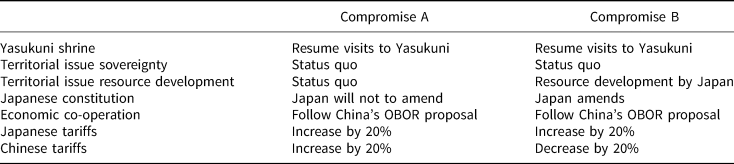
First, a conjoint experiment establishes the mass public's baseline attitudes towards the other country. We present a pair of hypothetical compromises on which the Chinese and Japanese governments are reported to agree. Each compromise portfolio includes a mix of political and economic issues ranging from territorial disputes to trade co-operation. The primary goal of the conjoint analysis is to ascertain how the publics of each country prioritize nationalistic issues such as territorial disputes compared to short-term economic issues.Footnote 17 Given the current strained relationship between the two countries, it is reasonable to expect that both groups of citizens care more about nationalistic issues than short-term economic policies. Table 1 reports all the conjoint attributes with an example of values for each attribute (see Appendix A for a full list of values). Each respondent assesses three pairs of possible compromises, leading to a sample size of 10,005 in Japan and 10,917 in China. We use the same conjoint design in both countries. Chinese and Japanese translations are provided in Appendices B and C, respectively, and a trilingual third party ensured that the translations are comparable.
Conjoint table example

We then conduct a vignette experiment to examine the conditions under which people approve of government concessions on highly nationalistic issues. We have a particular interest in gauging how each country's core political constituencies assess their own government's steps to ratchet up or ratchet down the likelihood of conflict.
We use the government's discouragement of anti-foreign protests to examine public support for government attempts to de-escalate a conflict. In two separate vignettes – only one of which is seen by each respondent – we lay out two types of government action. In the first, the government officially speaks out against nationalistic protests. In the second, the government denounces workers demanding better working conditions, to help untangle whether the government's discouragement of nationalist protests differs from its interference with other kinds of protest. In a 2 × 2 matrix, we explore the costs of interference by country and issue type. For each vignette, we also consider a baseline in which the government does not try to discourage either type of protest. See Table 2 for an overview of the experimental design. Our main expectation is that core supporters of the ruling party in Japan are more likely to oppose government discouragement of nationalistic protest compared to their counterparts in China. Of course, Japanese citizens are also likely to report greater antipathy towards any government interference with private expressions of free speech. Our analysis does not capture absolute levels of support for the freedom to protest in each regime type, since respondents are likely to imagine events in their own experience. We instead seek to gauge relative support, and by whom, for government interference across types of protest.Footnote 18 Prior to fielding the surveys, we registered a pre-analysis plan. As expected by random assignment, subjects in each of the treatment conditions in both countries were similar on values of all covariates to subjects in each of the control conditions in both countries (see Appendix Tables A.4 andA.5).
Experimental design

The symbolic politics scenario (‘Nationalist protests’ in Table 2) depicts nationalists from the respondent's own country protesting in support of their county's sovereignty claims over the Diaoyu/Senkaku Islands. In the control group, the government takes a neutral ‘non-response’ to the protests. Respondents in the treatment group are presented with the same protest scenario, but their government discourages the protests, citing a lack of requisite permits.
In the economic scenario (‘Economic protests’ in Table 2), protesters from the respondent's own country protest deteriorating labor conditions. In the control group, the government takes a neutral ‘non-response’ to the protests. Respondents in the treatment group are presented with the same protest scenario, but their government discourages the protests, citing a lack of requisite permits. Note that protests over territorial disputes and labor conditions can happen even in Japan and are covered by major media outlets,Footnote 19 ensuring that both scenarios can be considered realistic. Moreover, there have been recent cases in which government officials in Japan have denied permits to protests and attempted to disperse them, as occurred in 2016 in Kawasaki.Footnote 20 The LDP has also attempted to revise the constitution to give the government broader powers over the freedom of expression (Matsui Reference Matsui2018).Footnote 21 However, these cases are much rarer in Japan than in China.
All possible survey questions are provided below. Chinese and Japanese translations are provided in Appendix B and Appendix C, respectively, and the compatibility of the translations has been confirmed by a trilingual third party.
Government Interference
Control
Japan and China have both claimed sovereignty over the Diaoyu [Senkaku] Islands. Major Chinese [Japanese] media reported today that in response to the ongoing dispute, several thousand Chinese [Japanese] citizens planned to demonstrate to claim China's [Japan's] sovereignty in several cities. The Chinese [Japanese] government did not interfere with the protests.
Treatment
Japan and China have both claimed sovereignty over the Diaoyu [Senkaku] Islands. Major Chinese [Japanese] media reported today that in response to the ongoing dispute, several thousand Chinese [Japanese] citizens planned to demonstrate to claim China's [Japan's] sovereignty in several cities. The Chinese [Japanese] government discouraged the protests, citing a lack of the requisite permits.
Government Interference with Economic Protest
Control
Major Chinese [Japanese] media reported today that several thousand Chinese [Japanese] citizens planned to demonstrate against deteriorating labor conditions at Chinese [Japanese] companies in China [Japan] in several cities. The Chinese [Japanese] government did not interfere with the protests.
Treatment
Major Chinese [Japanese] media reported today that several thousand Chinese [Japanese] citizens planned to demonstrate against deteriorating labor conditions at Chinese [Japanese] companies in China [Japan] in several cities. The Chinese [Japanese] government discouraged the protests, citing a lack of the requisite permits.
Conjoint Analysis
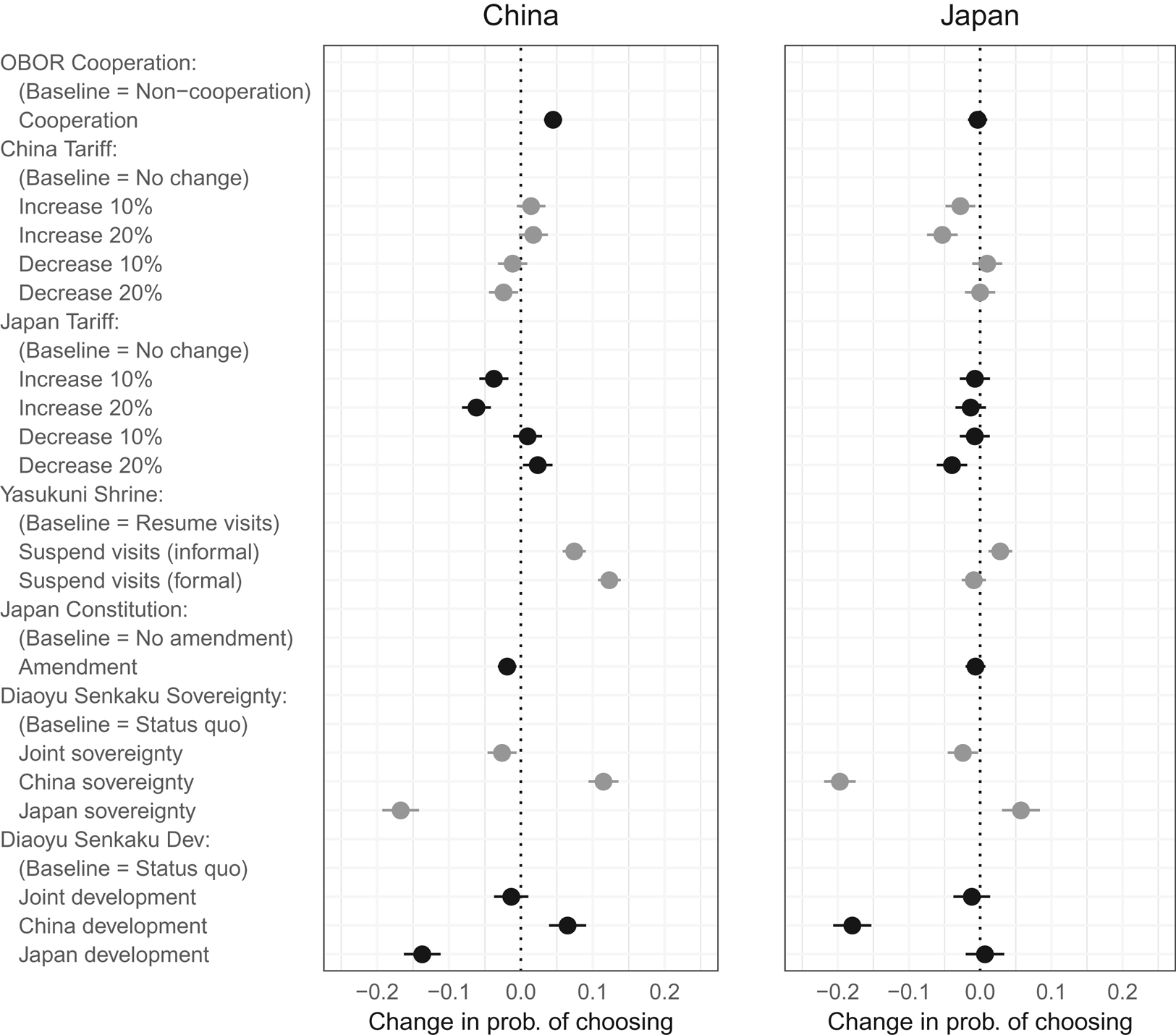
We first present average marginal component effects (AMCE) in the manner of Hainmueller, Hopkins and Yamamoto (Reference Hainmueller, Hopkins and Yamamoto2014). AMCEs depict the marginal effect of a given attribute over the joint distribution of all other attributes. For example, the AMCE of Diaoyu/Senkaku sovereignty represents the average effect of the sovereignty claim on the probability that a respondent will prefer a deal, where the average is defined over the distribution of all other possible combinations of attributes. In practice, AMCEs are calculated by regressing a dummy variable indicating whether a respondent preferred a particular deal on indicators for attributes of the deal, using cluster-robust standard errors to account for within-respondent clustering.
The détente between China and Japan over the past few years, which is a noticeable recovery from the hostile standoff in 2012, is likely to increase the salience of economic co-operation and may drive positive findings. The harmonious political context could also magnify the incentives for respondents to emphasize peace and de-escalation, downgrading the importance of territorial disputes and historical issues relative to economic issues.
Despite bilateral rapprochement, the conjoint analysis points to ongoing nationalistic sentiment in both countries; respondents across the straits gave more weight to territorial disputes than to trade or economic co-operation (see the AMCE plot in Figure 2). Compared to Japanese respondents, Chinese respondents support hypothetical economic co-operation led by the Chinese government in the One-Belt-One-Road (OBOR) Initiative. Nevertheless, the magnitude of those effects remains small compared to that of territorial disputes. Most coefficients for tariffs are in the expected direction, but are small. Not surprisingly, Chinese respondents react adversely to visits by Japanese prime ministers to the Yasukuni shrine, which is loaded with historical meaning.
Testing the effects of deal attributes on respondent preference

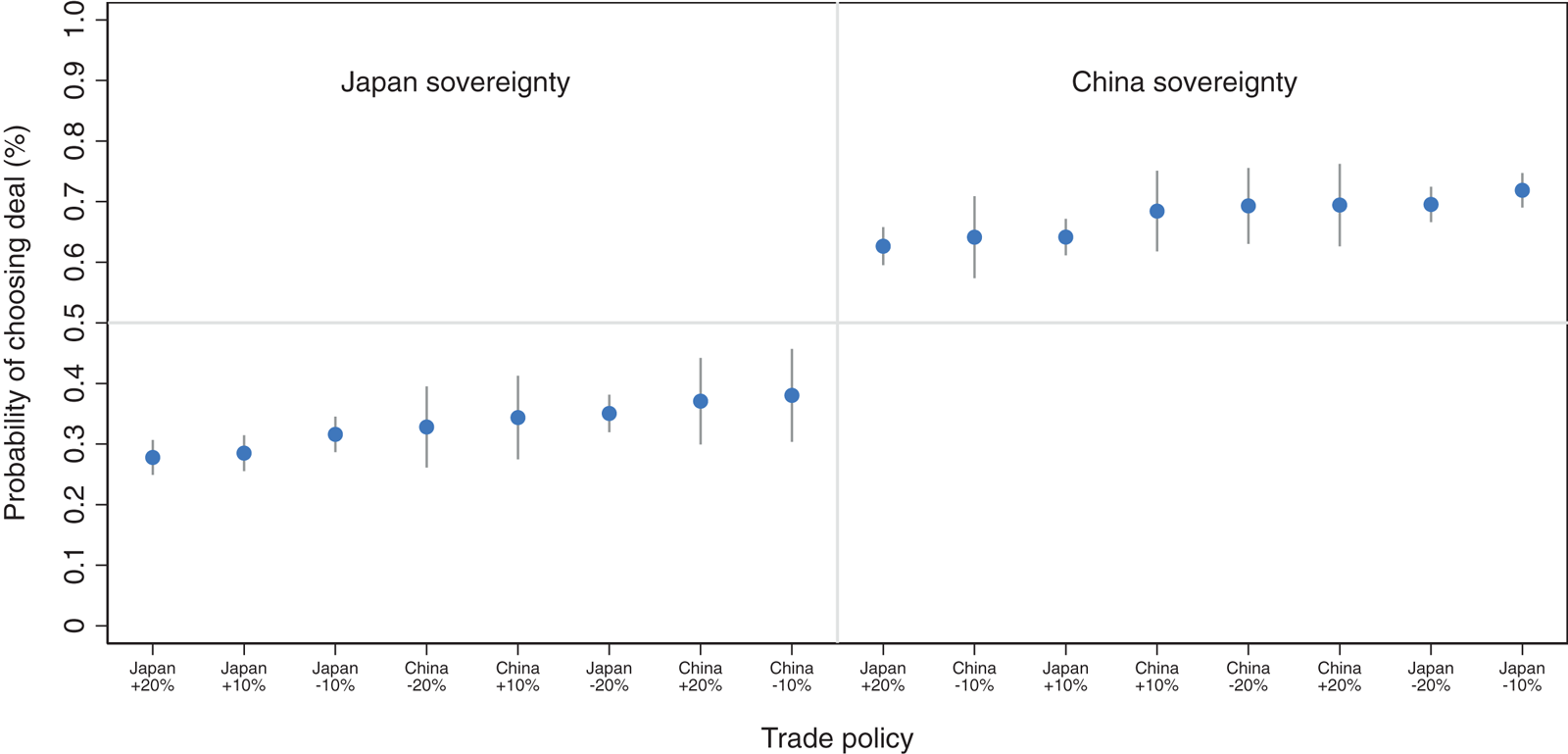
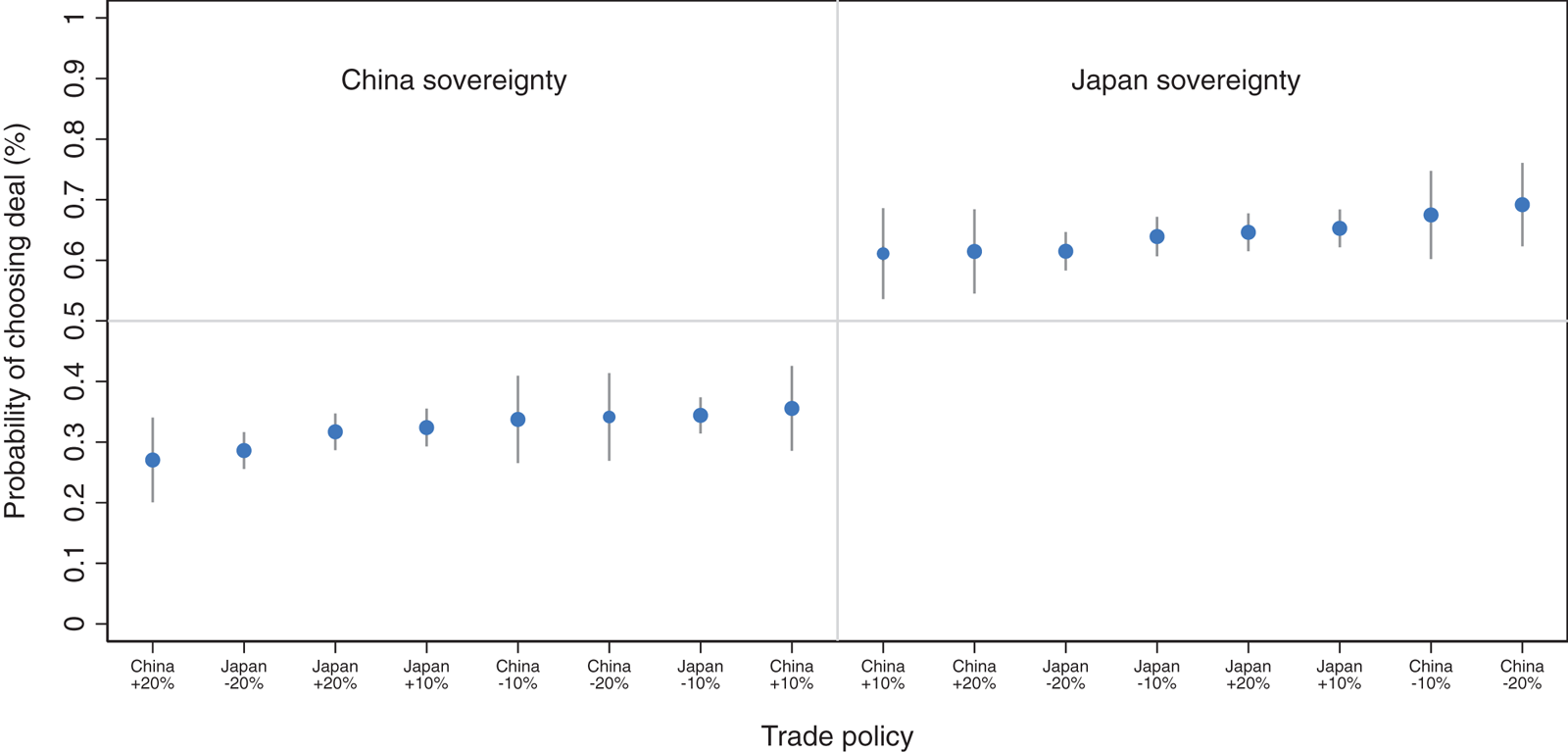
Additional analysis shows an increasing probability of preferring a deal based on changes in tariff levels and territorial concessions, holding all other attributes at their means. Figures 3 and 4 present point estimates and confidence intervals for the probability that an agreement will be preferred by a respondent in each country as tariff levels change and island sovereignty switches hands.Footnote 22 As expected, respondents tend to prefer deals that do not come with an increase in tariffs from the other country. However, changes in preferences due to shifts in tariff levels are relatively minor. By contrast, the probability that a deal will be preferred jumps remarkably when the respondent's country gains territorial sovereignty. These figures therefore show that no amount of tariff concessions in our experiment can overcome the impact of territorial concessions for respondents in either country.Footnote 23 For example, the maximum probability that a Chinese respondent will prefer a deal with Japanese island sovereignty is 38 per cent, while the minimum probability of preferring a deal with Chinese sovereignty is 63 per cent. For Japanese respondents, the maximum probability of preferring a deal with Chinese island sovereignty is 36 per cent, while the minimum probability of preferring a deal with Japanese sovereignty is 61 per cent.
Chinese respondents: can trade concessions overcome territorial attachments?

Japanese respondents: can trade concessions overcome territorial attachments?

Notably, the territorial loss can also have major economic implications, as one side is permanently blocked from valuable land and resources. For our results, we do not interpret the large negative effect of unilateral development by the other side (comparable to that of losing sovereignty) as the conclusive evidence unveiling people's economic calculations of territorial disputes. This is because the scenario of unilateral development also implies the de facto right to govern, and may similarly provoke people's sovereignty concerns. We also find that neither Chinese nor Japanese respondents strongly oppose sharing the economic benefits equally with the other side relative to the status quo, which further indicates that pure economic considerations are likely to be secondary.Footnote 24
Support for Government-led De-escalation across Regime Types
The conjoint analysis reveals that citizens of both countries care more about highly salient territorial disputes than about short-term economic ties. Having found evidence of strong nationalism, we test our second set of hypotheses: supporters of the ruling party in China should be more supportive of government interference with protests than their counterparts in Japan.
To gain insight into how parties affect the government's ability to quell hawkishness across regime types, we constructed a five-point disagreement scale (1 = strong disagreement with the government's response, 2 = disagreement, 3 = neutrality, 4 = agreement, 5 = strong agreement). We calculate treatment effects as the difference in means of support for the government in the treatment group minus the difference in means of support for the government in the control group.Footnote 25 In order to determine how likely these differences are to have appeared by chance, we calculate p-values using randomization inference under the sharp null hypothesis of no treatment effect for all observations.
The political costs of interfering with economic protests serve principally to understand the foreign policy latitude afforded by regime type. For our purposes, a separate vignette on government interference with economic protests is a useful way to investigate how accountability operates when national pride has not been triggered. At least in theory, democratic citizens are free to express support or disaffection for government heavy-handedness towards workers, depending on whether or not they are sympathetic to workers' rights. In the Japanese context, LDP supporters tend to identify with business and freedom of enterprise, and would likely support government action against worker protests (within bounds of civility), whereas supporters of opposition parties are more likely to side with workers. In China, CCP supporters would likely remain loyal to the government despite the party's pro-worker rhetoric.
We estimate the differential costs of government interference with protests across regime type by comparing the magnitude and precision of our treatment effects in each of our treatment arms – nationalist and economic. We test to see if the treatment effect estimates from our nationalist and economic protest scenarios are significantly different from one another in order to establish whether there are differential costs of government interference in protests by issue type.
We then estimate the differential costs of government suppression of protests by regime type by comparing the magnitude of our treatment effect estimates in our surveys in China and Japan. We test if the treatment effect estimates of each issue type (nationalist and economic) are significantly different from one another in China and Japan in order to establish whether or not there are differential costs of interference with citizens’ protests by regime type.
Heterogeneous Treatment Effects
In addition to differential costs of government interference in protests across regime types, we might also expect that people with pre-existing levels of nationalism (as measured using a selection of questions from the World Values Survey) would disapprove of government action against nationalist protests.Footnote 26
Our tests take the form of regressing our outcome variable on treatments conditional upon the data representing the covariate of interest. In other words, we split our sample by subject attributes, then estimate conditional average treatment effects (CATEs) separately for each of these attributes.Footnote 27 As an additional robustness check, we calculate all p-values of interest using randomization inference. We also report treatment-by-covariate interaction effects. Importantly, these covariates are not randomly assigned, so the treatment-by-covariate interaction must be interpreted as a descriptive association between the covariate and the treatment effect, not as the causal effect of a change in the value of the covariate.
Since the search for heterogeneous treatment effects often suffers from the multiple comparisons problem,Footnote 28 we report p-values corrected for false discovery rates in the appendix using the Bonferroni, Holm-Bonferroni and Benjamin-Hochburg procedures. As noted above, we also reduce the possibility that our study suffers from the multiple comparisons problem by pre-registering our heterogeneous treatment effects of interest. We therefore only conduct tests for heterogeneous effects on the covariates mentioned here, not our entire battery of pre-treatment covariates.
Main Findings
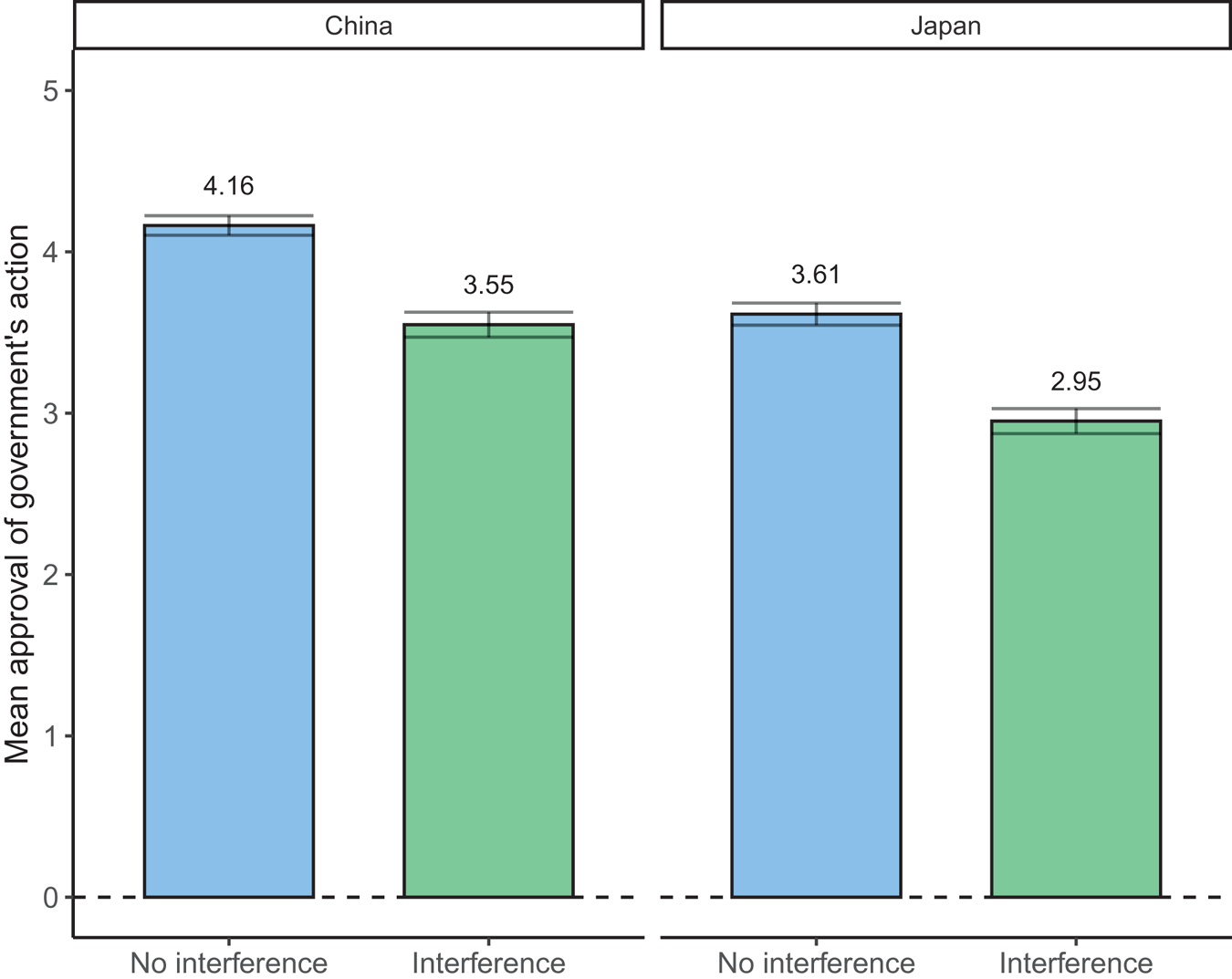
At first glance, Figure 5 shows that respondents in China and Japan appear to have reacted similarly to our vignettes.Footnote 29 On average, respondents from both countries applauded their respective government's hypothetical decision to allow protests in support of territorial sovereignty claims. Chinese respondents record higher rates of baseline government approval (that is, in both control scenarios) than their Japanese counterparts.
Nationalism treatment
Note: figure displays group means and 95 per cent confidence intervals.

In Japan, the average treatment effects of government suppression of protests are –0.66 in the nationalist scenario and –0.62 in the economic scenario. In China, the average treatment effects are –0.61 in the nationalist scenario and –0.56 in the economic scenario.Footnote 30 In percentage terms, government interference with nationalist protests causes an approximately 15 per cent decrease in government approval in China, and an approximately 18 per cent decrease in government approval in Japan. As Figure 6 shows, interference with economic protests causes an approximately 14 per cent decrease in approval in China, and an approximately 18 per cent decrease in approval in Japan. Respondents in the treatment groups in both countries express displeasure at government interference in both kinds of protests; both display slightly higher displeasure at interference in nationalistic protests, albeit not at a significantly different level.Footnote 31 These findings indicate that for both governments, efforts to stymie citizen protest would likely provoke backlash, suggesting the generalizability of interference costs across both regimes: suppressing protest is costly in both countries.
Economic treatment
Note: figure displays group means and 95 per cent confidence intervals.

Our results support the claim that, even for China's strong authoritarian regime, state leaders cannot simply dictate an anti-mass agenda without suffering from the loss of popularity (Weiss Reference Weiss2013). While we do not deny the possibility that the strong state may manipulate public preferences through propaganda and sophisticated messaging, outright suppression is not an effective tool for enforcing obedience. The comparable magnitude of the treatment effects across China and Japan suggest that, even using a mature democracy as the benchmark, Chinese respondents disapprove of government suppression of popular protest. Fear of political punishment or self-censorship do not seem to have a noticeable impact, although Chinese respondents on average display higher rates of government approval than Japanese respondents in both the control and treatment groups.
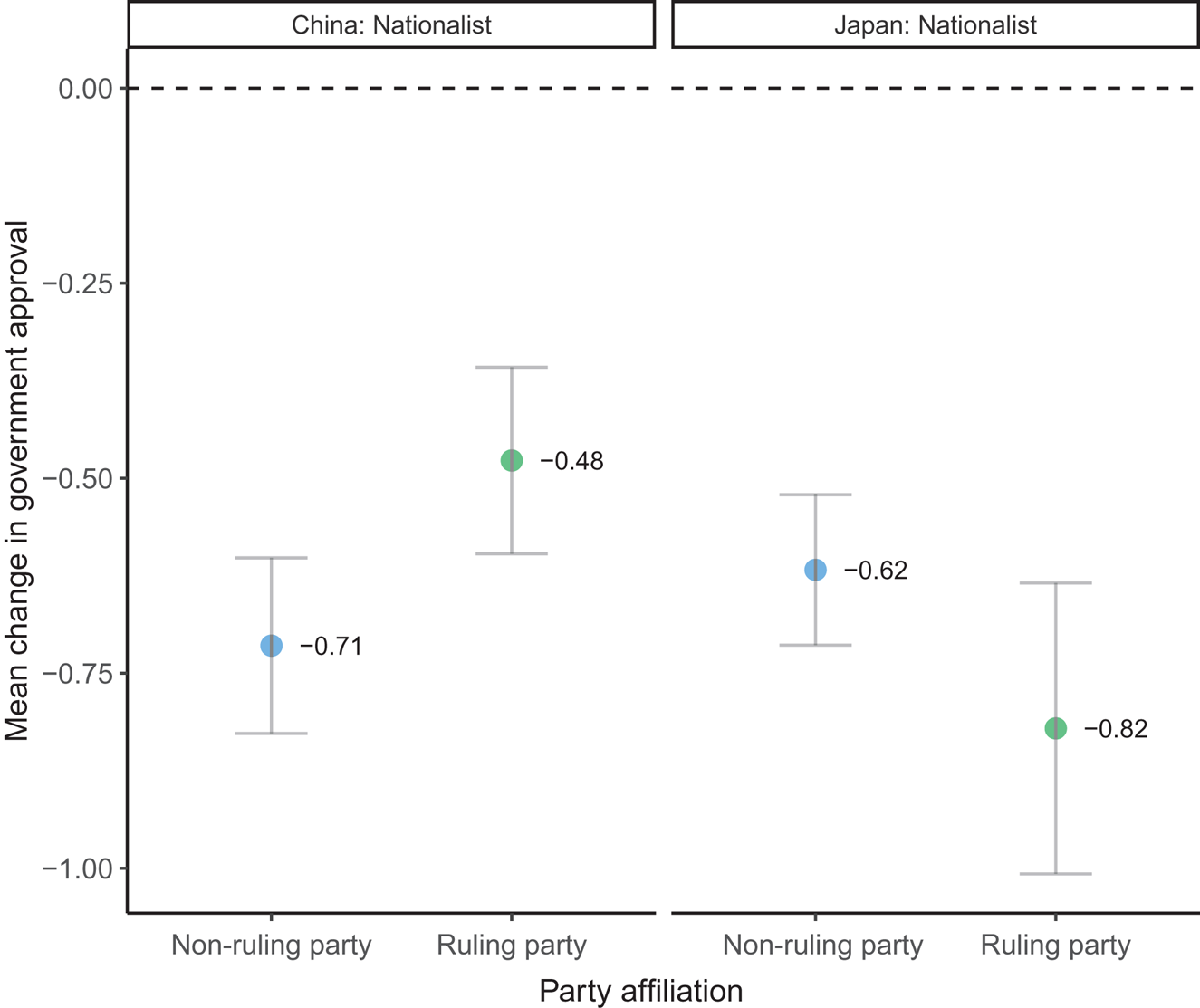
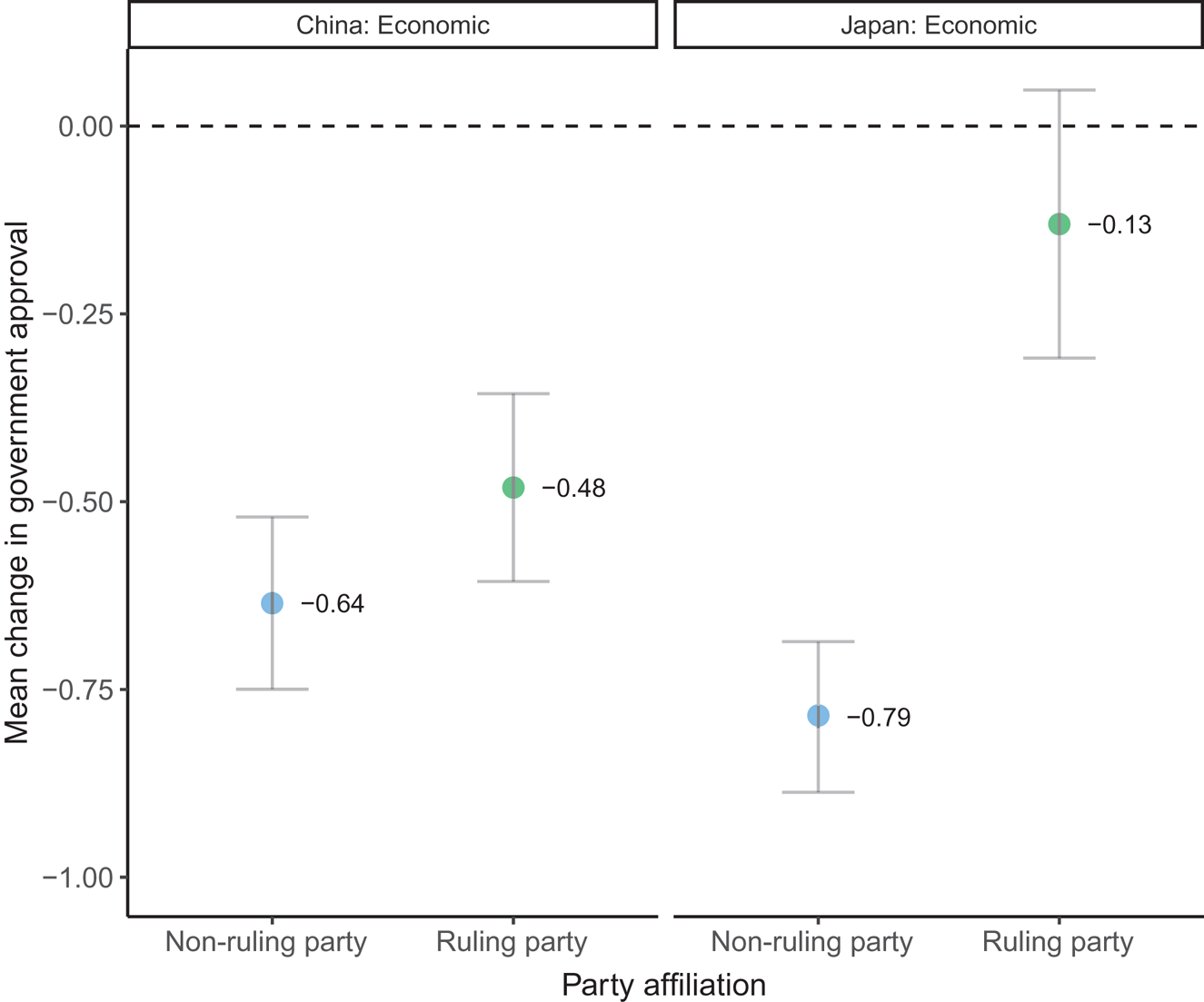
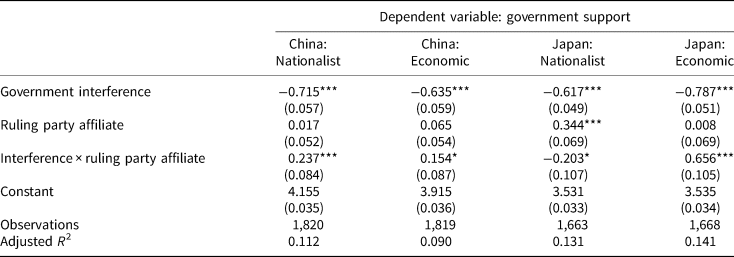
Important differences between China and Japan emerge when we examine sub-samples of the population by party, which are the key organs of political accountability in democracies. Table 3 shows that political accountability flows in opposite directions in these two countries (see Figures 7 and 8). Japanese supporters of the LDP (Ruling party affiliate in the table, operationalized as members of the LDP and its coalition partner), compared to Chinese supporters of the CCP, are less accepting of government interference with nationalist protests.Footnote 32 However, Japan's LDP supporters do not express dismay at government interference with labor protests, reflecting party members' allegiance to business interests and free enterprise. In fact, the treatment effect is so small in the economic scenario for LDP members that we fail to reject the null hypothesis of no treatment effect among this group.Footnote 33
Nationalism treatment by party affiliation
Note: figure displays treatment effects and 95 per cent confidence intervals.

Economic treatment by party affiliation

Conditional average treatment effects by party
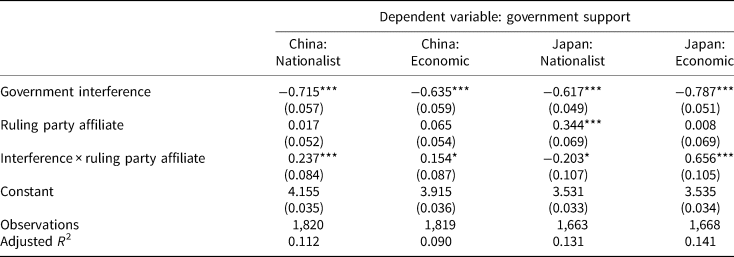
Note: robust SEs in parentheses. *p < 0.1; **p < 0.05; ***p < 0.01
In order to gain additional understanding of the partisanship mechanism, we conduct an exploratory analysis of affiliates of Japan's opposition party, the Constitutional Democratic Party of Japan (CDPJ), and the LDP's coalition partner, the Komeito. CDPJ members show their center-left orientation by judging the government more harshly for discouraging labor protests (see Figure A.6).Footnote 34 These findings suggest that Japanese subjects respond to our experiment in a partisan way, reacting to discouragement of protests in line with their policy beliefs.Footnote 35 As a member of the ruling coalition, Komeito supporters are included as ‘ruling-party affiliates’ in each of the analyses presented above. Its government role notwithstanding, the Komeito is more dovish than its coalition partner, and vocally opposes changes to Japan's pacifist constitution. As a relatively minor party, our sample only contains sixty-one self-identified Komeito supporters, making statistical analysis at conventional significance levels impossible. Still, the suggestive evidence lines up with the Komeito's status as a dovish member of the ruling coalition: the Komeito respondents (slightly) favor government interference with nationalist protests, while respondents who are LDP supporters strongly oppose interference of that kind. In addition, Komeito supporters express decidedly less nationalism than LDP supporters in our pre-treatment survey. This additional analysis suggests that partisanship matters, and that being part of a ruling coalition does not influence citizens' preferences over interference of protests.
By contrast, in the Chinese sample CCP members and affiliates are discernibly more supportive than average citizens of government interference with protest movements. At the same time, as in Japan, these insiders lowered their assessment of the government, suggesting resignation to an inevitable – if, to some, distasteful – situation.Footnote 36 More concretely, the average treatment effect (ATE) of the discouraging protest treatment among subjects who are not CCP affiliates is –0.715 and the ATE of the discouraging protest treatment among subjects who are CCP affiliates is –0.478. The direction of this effect is the same in the economic scenario, but the magnitude is reduced and the interaction term is only significant at the 10 per cent level.Footnote 37 This is perhaps a sign that even if party members disagree with government actions, they do not feel comfortable expressing their disapproval, especially on matters sensitive to international diplomacy.
We have suggested that the organization of the CCP induces party members to follow the party line and deters open opposition. Political loyalty is an important facet of political selection in China (Bian, Shu and Logan Reference Bian, Shu and Logan2001; Liu Reference Liu2018), reinforced by Xi Jinping's recent changes that strengthen the central government's authority over personnel and policy decisions. While China and other regimes may have various institutional constraints (Gehlbach and Keefer Reference Gehlbach and Keefer2011; Malesky, Abrami and Zheng Reference Malesky, Abrami and Zheng2011; Shirk Reference Shirk1993), our results suggest important caveats. Contrary to Weeks’ (Reference Weeks2008) argument about constraints on government action, the CCP typically has the necessary organizational power to discipline its membership in line with central policy. Indeed, in the 2008 anti-France boycott and the 2010 anti-Japan protest, local elites readily accepted government interference with protests despite possible popular backlash.
Recognizing that partisanship may be connected to other subject characteristics, in the appendix we report the results of exploratory analysis of correlations between partisanship and other subject attributes. We find that political conservatismFootnote 38 is positively associated with higher levels of government approval irrespective of government interference with protests, but that even after controlling for political conservatism, the cushioning effect of party membership remains strong. This finding indicates that party organization plays an important independent role.Footnote 39
Conclusion
Chinese and Japanese citizens' attitudes towards nationalist symbols and territorial disputes largely conform to previous scholarly work on the costs of government interference with protests across regime types (Weeks Reference Weeks2008; Weiss Reference Weiss2013). In both China and Japan, citizens attach greater weight to territorial issues than to tariffs, trade concessions or economic co-operation. Given the level of disapproval in both countries of government interference with nationalist protests, these governments suppress popular expression at some cost. Nationalism may be a potent and mobilizing issue in democracies and authoritarian countries alike, but governments of either kind that whip up nationalist sentiment as a cheap diversionary alternative to good public policy pay some price if and when they must tamp down diplomacy-threatening levels of public outrage.
Our study suggests, however, a vital difference in how nationalist sentiment plays out in these two countries, which has important implications for how to understand the costs of government interference with popular expression across regime types. Affiliates of the ruling party in China accept government heavy-handedness, whereas they do not in Japan. We have argued that this difference reflects foundational differences in the functioning of political parties in the two settings. In China, where the CCP controls opportunities for political and economic advancement, party loyalists challenge their leaders at great potential personal cost. In Japan, members and supporters of the LDP feel free to denounce government interference with nationalist protest.
One remaining puzzle is why democracies are empirically less likely to fight against each other if, as we theorized, it can be hard for them to contain nationalist ambitions. If we are right, we should expect to see democracies with nationalist partisans also fight against each other. One potential reason why they do not may be that stable borders tend to precede democratization and thereby dampen conflicts among democracies (Gibler Reference Gibler2007; Gibler Reference Gibler2012).Footnote 40
We acknowledge that our results may be driven by specific contexts of current Japanese and Chinese politics. Because democratic citizens are sensitive to the costs of war, including casualties (Gartner Reference Gartner2008; Gelpi, Feaver and Reifler Reference Gelpi, Feaver and Reifler1993; Mueller Reference Mueller2005), LDP supporters might back off quickly from confrontation if they perceive more imminent military threats from China over the disputes. Our study does not offer a full test of the costs of government suppression of free speech given regime-type differences in political accountability. Two countries represent an extremely small sample: a fuller model would investigate variation in party functions within democracies and non-democracies. Japan's LDP in the current era has a relatively free hand to cater to its electoral base because the opposition parties are fragmented. In democracies with more robust party competition, governments would be forced to consider the full range of voter preferences, from core to swing voters. Given that many Japanese voters are less nationalistic than the government, a strong opposition would more ably check the LDP's impulses, and the government would have to moderate in order to anticipate opposition demands. It is nevertheless significant to have found that CCP loyalists self-censor their own nationalist impulses for the sake of their standing in the party, thereby cutting off the key channel of accountability that operates in democracies.
A fruitful avenue of future research could seek to align democracies along a continuum of accountability over time. We have shown here that LDP supporters feel free to disapprove of government policy in Japan's one-party dominant system. This offers a strong case for a certain kind of democratic accountability, however skewed it might be away from the interests of the median voter. Our finding of lower levels of backing from LDP supporters compared to CCP supporters for government interference with nationalist protests underscores a democratic difference.
In addition to identifying differences in political accountability across regime types, which is of interest to scholars of comparative politics, our study also has implications for diplomacy and international relations. To the extent that authoritarian regimes control the pathways of political advancement and economic success, party membership is a weak vehicle for political accountability. In authoritarian regimes where influence flows down rather than up the accountability chain, governments should be able to resort to nationalist priming more easily than democratic regimes. It is important to explore the conditions under which nationalist mobilization might spiral out of control. At least in some circumstances, authoritarian governments may cut short nationalist protests when the cause of peace requires.
Supplementary material
Supplementary material. Data replication sets are available in Harvard Dataverse at: https://doi.org/10.7910/DVN/S4YXQB and online appendices at: https://doi.org/10.1017/S0007123420000095.
Acknowledgements
We thank the Japan Foundation Center for Global Partnership (CGP) for generous support of this project. We are grateful to the editor, Tobias Böhmelt, and the anonymous reviewers for helpful comments. We would also like to thank Graeme Davies, Ursula Daxecker, Mike Medeiros, and audiences at the Chinese Politics Mini-Conference of the 2018 American Political Science Association Annual Conference and the National University of Singapore East Asian Institute seminar for their comments and suggestions. The human subject protocol of the research was evaluated and approved by ethics committees at Yale University and the University of Amsterdam. We registered our survey experiments at Evidence in Governance and Politics (EGAP) (ID: 20180615AA). The authors are listed in alphabetical order, implying equal authorship.