Men wanted: advertising Antarctica as extreme
The phrase ‘going to the ends of the earth’ is usually used in a metaphorical sense, but when it comes to the recruitment of Antarctic personnel, the term can be taken quite literally. Antarctica is located at the frozen ends of the earth, out of reach and out of mind for most people. Yet it is also a workplace for scientists, field staff, cooks, mechanics, pilots and a wide range of other support personnel. This has been the case ever since the first expeditions ventured south towards Terra Australis Incognita, in search of marine mammals or geographical ‘firsts’. Those who work in Antarctica, and ensure that the stations function effectively all year round, have been described by Maddison (Reference Maddison2015, p.1) as ‘the krill in the food chain of Antarctic discovery’. Personal motivations for heading south vary, but recruitment advertisements play an important role in attracting personnel and shaping expectations.
It is telling that a job announcement, supposedly written by Ernest Shackleton, has endured as one of the most famous Antarctic texts. The much-circulated (and oft-reproduced) recruitment notice read as follows:
Men Wanted for Hazardous Journey. Small wages, bitter cold, long months of complete darkness, constant danger, safe return doubtful. Honour and recognition in case of success.
The advertisement itself is most likely to have been apocryphal – the first printed reference dates to 1944 (Elmore, Reference Elmore1944), and exhaustive searches of newspapers of the period have revealed no sign, despite offers of rewards (Stephenson, Reference Stephenson2016). And yet, the famed lines continue to appear in popular culture: they have been reproduced on t-shirts, posters and mugs, and served as the central idea in campaigns for unrelated products and locations, such as the city of Detroit (Burn, Reference Burn2009). As Leane (Reference Leane2012, p.85) puts it, the advertisement is ‘a Heroic-Era fiction that has entered into communal memory’. ‘Men Wanted’ has come to be used as shorthand for the ‘Heroic Era’ of Antarctic exploration, evoking at a glance ideas of heroism, masculinity and endurance.
The ideas of extremity and adventure that have been associated with Antarctica have also been valuable in a marketing context. Early expeditions had media backing, and received funds in exchange for newsworthy narratives of derring-do. For instance, Carsten Borchgrevink's 1899 Southern Cross expedition was financed by newspaper baron George Newnes (Borchgrevink, Reference Borchgrevink1901). Richard Byrd's 1933 expedition has been described as ‘the most media-saturated event in the history of the geographical exploration of Antarctica’ (Matuozzi, Reference Matuozzi2002, p.234) thanks to associations with The New York Times, Paramount Pictures and radio broadcasters. The ability to sell a story was vital to an expedition's finances – and adventure, danger and extremity were central to the expected drama. For this reason, most Antarctic expedition leaders of the Heroic Era enlisted ghost-writers to help them write their official accounts, and to foreground elements of drama and extremity. Such accounts – and accompanying photographs – then circulated amongst wide reading publics.
Most people will never actually visit Antarctica, so the imagined version of the place they carry in their minds is far more real for them than the actual ice. This representation is informed by various cultural inputs, including diaries, literature, film, music, photography and theatre. Scholars such as Philpott & Leane (Reference Philpott and Leane2016), Glasberg (Reference Glasberg2012) and Yusoff (Reference Yusoff2007) have examined representations of Antarctica across a range of media, teasing out the common associations and themes, including heroism, extremity, fragility and transformation. Berger (Reference Berger2005, p.166) explains how ‘in scholarly discourse about works of art of all kinds, the subjects of analysis are generally referred to as texts.’ In the Antarctic context, primary texts are also powerful; Robert Falcon Scott's diaries continue to capture imaginations, while Frank Hurley's iconic 1912 photograph of Mawson's men bent double as they battled the blizzard at Cape Dennison neatly encapsulates the idea of men taking on nature. Such texts have helped to shape the imaginary Antarctic of the extreme that still persists today.
Antarctica has been framed in various ways over the course of its human history. The continent has been regarded as a place for profit (by early whalers and sealers), a place for heroes (evident in the term Heroic Era), a place of purity and wilderness (wilderness and aesthetic values are both enshrined in the 1991 Protocol on Environmental Protection to the Antarctic Treaty, or the ‘Madrid Protocol’), but also as a fragile place in need of protection (particularly pertinent in the age of the Anthropocene, with the spectre of climate change ever present) (Nielsen, Reference Nielsen, Dodds, Hemmings and Roberts2017, p.193). Such themes are not mutually exclusive – they can operate simultaneously, with various frames more or less dominant within different temporal or national contexts. As ‘ways of seeing are historically, geographically, culturally and socially specific’ (Rose, Reference Rose2007, p.12), the context in which a particular representation occurs also needs to be accounted for. Nevertheless, notions of heroism and extremity remain closely associated with the far south, and both play an important role in the cultural imagination.
The idea of Antarctica as a place of extremes continues to manifest in the frequently cited description of the continent as the highest, driest, coldest and windiest place on earth (Ackley, Reference Ackley, Barry and Gan2012; Barbarito, Baldanza, & Peri, Reference Barbarito, Baldanza and Peri2001; Palinkas, Reference Palinkas1989, Reference Palinkas1992, Reference Palinkas2003; Palinkas, Gunderson, Johnson, & Holland, Reference Palinkas, Gunderson, Johnson and Holland2000; Peri, Barbarito, Barattoni, & Abraham, Reference Peri, Barbarito, Barattoni and Abraham2000). For vehicle, machinery and clothing manufacturers, such superlatives represent the ultimate testing ground, and this has proved to be a valuable association for a number of companies that have capitalised on their Antarctic connections. Examples include the Singer sewing machine that accompanied Robert Falcon Scott on the Terra Nova expedition and survived ‘severe tests’ (Singer advertisement, 1913), the Everready Prestone antifreeze that protected Byrd during three expeditions ‘under the worst possible freeze-up conditions’ (Byrd & Poulter, Reference Byrd and Poulter1935, p.20), the Rolex that survived ‘the worst winter in the world’ (Rolex advertisement, 1987) and the Ray-Ban sunglasses that were styled for fashion but ‘proven in the Antarctic’ (Vintage Sunglasses Shop, n.d.). Such products leverage their Antarctic association in order to impress audiences in less extreme parts of the world. Van der Watt and Swart (Reference Van der Watt, Swart, Roberts, Van der Watt and Howkins2016, p.137) write how ‘like in other extreme environments’ the domination over nature ‘became and remained a key sign of masculine fitness in Antarctica.’ This association with toughness is also manifest in reports of Antarctic ‘firsts’, such as the first car to cross the continent (Hyundai) (Fung, Reference Fung2017), or the first band to play concerts on all seven continents within one year (Metallica) (Coleman, Reference Coleman2013). Such representations of Antarctica in marketing continue to reprise and reinforce the extremity theme.
Antarctica today
The explorers of the Heroic Era lived in draughty wooden huts and travelled south to endure years of no contact with the outside world. However, these days, Antarctica is much less ‘out of reach’, and far more comfortable for those who come to stay. Many parts of the continent are accessible by aircraft, and daily flights serve Antarctica during the summer season (weather permitting). Transport by land has also been facilitated by infrastructure developments. For instance, those travelling to the South Pole from McMurdo Station can travel along the ‘South Pole Traverse’, a 1,600 km long packed snow trail where crevasses have been filled and terrain has been levelled for safer and easier rides (Lyne, Reference Lyne2004). Whereas Amundsen took more than two months to reach the South Pole from the Ross Ice Shelf in 1911, Maria Leijerstam took just under 11 days to travel a similar distance on a tricycle in 2013 (Guinness World Records, n.d.). Thanks to advances in both technology and infrastructure, the continent is more accessible than ever before.
Today's Antarctic stations stand in stark contrast to the first shelters built by early explorers. They offer almost all the comfort of a holiday resort: private rooms, laundry facilities, all meals catered for by a chef, and a wide variety of leisure options such as a gym, reading area, television, and in some cases even a pool table (Jacob, Reference Jacob and Ross2012, p.72). Some stations also have a greenhouse, allowing for the consumption of fresh fruits and vegetables even in the middle of the Antarctic winter (Bamsey et al., Reference Bamsey, Zabel, Zeidler, Gyimesi, Schubert, Kohlberg and Graham2015). Modern stations are not only heated, but also have warm showers, and Wi-Fi access makes it possible for expeditioners to continue ‘liking’ their friends’ party pictures on social media throughout their Antarctic stay. In addition, many National Antarctic Programmes have payed particular attention to the architectural design of stations, and aim to make those who live there feel good. For instance, for the construction of Halley VI, Lebanese cedar was chosen for its special scent, and spaces were opened to feel more inclusive (Broughton, Reference Broughton2013). Several other stations have been designed specifically to ensure expeditioners come into contact with each other on a regular basis throughout the long winter months, in light of work on environmental cognition and perception (Carrère, Reference Carrère1990; Suedfeld, Reference Suedfeld1998). The sum of these changes means that Antarctica is no longer a place to endure, but rather a place to enjoy.
The investment of energy and money to ensure winter-overs in research stations are comfortable is not motivated purely by altruism; an Antarctic station is foremost a workplace. Given the cost and the time of recruiting, training and transporting employees, National Antarctic Programmes have to make sure that, once on site, personnel will perform at their best. This is particularly true when it comes to selecting year-round teams. As Walton (Reference Walton and Ross2013, p.49) puts it, ‘a small community can be a difficult place to live, so selecting the right people to overwinter is crucial.’ So, how do National Antarctic Programmes recruit the individuals who will work best together as a team in the southern polar regions? The text in recruitment advertisements may have advanced since the ‘Men Wanted’ advertisement first appeared, but the function is similar. When it comes to recruitment advertisements, ‘the product is the job offer’ (Ryan, Gubern, & Rodriguez, Reference Ryan, Gubern and Rodriguez2000, p.355), and that job must be framed to appeal to desired candidates. The following section analyses two recent examples of advertisements designed to attract potential employees to positions in Antarctica, before examining the experiences of those who have responded to such calls.
Antarctic roles: ‘Like no other job in the world’
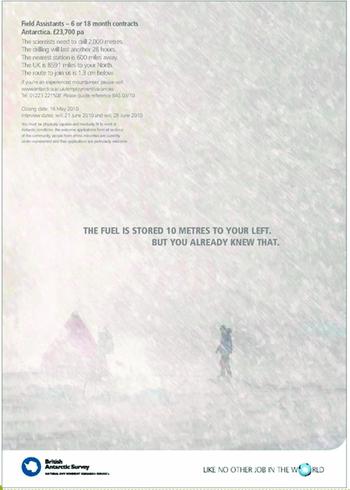
Taking a closer look at modern-day Antarctic recruitment advertisements reveals that the theme of Antarctic extremity is alive and well – and is being used to actively encourage people into positions with National Antarctic Programmes. (It is also present in advertisements for positions such as postmaster at Port Lockroy, the ‘Penguin Post Office’ (Antarctic Heritage Trust, 2017), but advertisements published by trusts and private companies are outside the scope of this particular study). The award-winning 2010 ‘Field Assistants’ advertisement for the British Antarctic Survey (BAS) (Fig. 1) brings notions of extremity to the fore. The full-page advertisement is dominated by an image of a blizzard, with a solitary figure and a partially obscured tent in the bottom third. This echoes imagery familiar from the Heroic Era of exploration, such as Frank Hurley's photograph of men doubled over against the wind at Cape Dennison. The main text appeals to the viewer's assumed capability, reading ‘The fuel is stored 10 metres to your left. But you already knew that.’ In order to understand what the advertisement is for, it is necessary for the viewer to push the image to the edges of their attention. By focusing instead on the fine print in the body text, the reader will find further details of the job, and contact details (while ‘The UK is 8591 miles to your North’, the advertisement reveals that ‘the route to join us is 1.3 cm below’, directing attention to the contact details section). In this regard, the advertisement presents a first test for prospective applicants. Art Director De Mornay Davies (n.d.) described how this specific ‘ad captured the excitement and challenge of the role by showing how deserted you are out on the field.’ The advertisement's ability to evoke the harsh Antarctic environment was recognised by others in the advertising industry. ‘Field Assistants’ won a prize for Best Copywriting at the Recruitment Business Awards 2010 (The Drum, 2010), and was a finalist in the 2011 RAD Recruitment Advertising Awards in the Print Advertising category (De Mornay Davies, n.d.).
‘Field Assistants’ advertisement for the British Antarctic Survey (De Mornay Davies, n.d.) Image: British Antarctic Survey.

This BAS recruitment advertisement ran with the slogan ‘Like no other job in the world’ in the lower right corner. The ‘o’ features an image of the globe, centred on Antarctica. This combination of slogan and image builds upon the idea of Antarctic exceptionalism that sets the continent apart from other parts of the world. As Chaturvedi (Reference Chaturvedi2011, p.22) explains, the underlying reasoning for Antarctic exceptionalism ‘has been that specific polar attributes and issues related to the Antarctic demand and deserve an exclusive treatment on their own merit.’ This exceptionalism is problematic in today's society, because as Hemmings (Reference Hemmings2009, p.55) puts it, ‘globalisation now denies us the capacity to treat anywhere differently and thereby disables the principle of Antarctic exceptionalism.’ Writing from a historian's perspective, Maddison (Reference Maddison2015, p.198) too urges his readers to see Antarctica as a place ‘joined to the wider history of humanity’. Nevertheless, Antarctic exceptionalism remains a selling point, imbuing the continent with an aura of uniqueness. The imagery used in the BAS advertisement sets up the expectation that the job advertised will be exceptional, and different to jobs anywhere else in the world. While field assistants do get to spend plenty of time in remote field camps, for many other staff this is not the case – most jobs at Antarctic stations are mundane, consisting of routine maintenance of the station and its surrounds. Such tasks are neither glamorous nor exotic enough to warrant being depicted on a poster. Given this, the combination of the extreme image and the ‘like no other’ slogan could lead to false expectations of what working in Antarctica is really like; snowstorms and spread sheets are tackled with very different skills.
Imagery as an invitation: ‘Picture yourself here?’
Imagery is a powerful tool for attracting potential employees. When recruiting for the 2017/18 season the Australian Antarctic Division (AAD) used the tagline ‘Picture yourself here?’ The phrase was superimposed over Antarctic landscapes that featured ice cliffs, penguins, sunsets and trekking expeditioners, and appeared in social media postings, on recruitment websites and in print advertisements. A full-page AAD advertisement in Virgin Australia's inflight magazine Voyeur (circulation 429,000) showcased emperor penguins in front of a towering ice face (Australian Antarctic Division, 2017). The headline invites the viewer into the scene, by asking a direct question, whilst also evoking the urge to photograph the Antarctic. It then offers a way to make that imagined experience of standing amongst the penguins into a reality, thanks to the subheading: ‘Work and live in Antarctica’. Smaller text clarifies the jobs available: ‘Now recruiting for electricians, chefs, carpenters, plumbers, diesel mechanics, communications officers, plant operators, aircraft support and other professional and support roles.’ Unlike job advertisements on recruitment websites, which are usually very specific, this is a broad sweep of positions. It targets personalities rather than specific skill sets, by implying that those who like adventure and beautiful scenery should come and practise their job in the far south, regardless of profession.
Rather than appeal to a small number of technically competent applicants, the AAD advertisement is designed to prompt the viewers to imagine themselves in the Antarctic, with all of the wildlife and sublime icescapes that entails. Tellingly, the buildings, airstrips, motor vehicles and offices that will feature in the work (and living) environment of successful candidates are not mentioned at all. The imagery used in the recruitment advertisement is instead designed to catch the viewer's attention, and to resonate with their existing notions of Antarctica. While it is possible that recruits will find themselves in these kinds of situations (visiting a penguin colony at the face of a glacier), for most this would be an exceptional experience, and a far cry from their everyday jobs around the station. Sisodia and Chowdhary (Reference Sisodia and Chowdhary2012, p.81) argue that companies need to view their recruitment advertisements as being just as ‘powerful as corporate and brand advertising’; in addition to promoting vacant positions, recruitment material can help shape attitudes towards the business itself. In this case, the recruitment advertisement stands as an advertisement for the available roles, as well as for the AAD and the country's wider interests in the continent. Australia considers 42% of Antarctica to be ‘Australian Antarctic Territory’ (Geoscience Australia, n.d), so those interests are not insignificant. Given that very few people will ever visit Antarctica – let alone work there – the advertisement serves a further function: to keep Antarctica alive in the imaginations of the wider Australian public. That imagined version is overwhelmingly visual, characterised by penguins and ice – hence the use of such imagery here, where instantly recognisable visual elements act as shorthand for the continent.
Reading the fine print
Should the Antarctic imagery in the initial advertisements prove appealing, potential applicants are usually offered a link to the National Antarctic Programme's website where they can learn more about the specific job descriptions. One might think that, at this point, the information would provide a more realistic depiction of what the position in question actually entails. However, the detailed job descriptions often sound equally as dramatic as the initial imagery has suggested, meaning those who have been hooked by the initial imagery encounter language that further reinforces extreme or heroic stereotypes about Antarctica. For instance, on its website the British Antarctic Survey asks potential applicants whether they could imagine ‘working thousands of miles from home experiencing life in one of the most extreme places on earth’ (British Antarctic Survey, n.d. a) and promises that ‘people who go to Antarctica are often amazed by what they see and do’ (British Antarctic Survey, n.d. b). The Australian Antarctic Division (n.d. a) informs plumbers that their job will be ‘constantly varied and interesting’ and recommends that their electricians should come prepared with ‘a sense of adventure’ (Australian Antarctic Division, n.d. b).
The description of Antarctica as the ‘highest, driest, windiest and coldest continent’ has been used by National Antarctic Programmes in the UK, Norway, Australia, India and the USA (Australian Antarctic Division, 2002; British Antarctic Survey, n.d. c; National Centre for Antarctic and Ocean Research, n.d.; Norwegian Polar Institute, n.d.; United States Antarctic Program, n.d.), while the French Polar Institute (n.d.) informs those who visit its website that, with the coldest temperatures in Antarctica, any person dressed in normal clothing would die of cold in less than a minute. These descriptions of the Antarctic environment, although true, can be misleading and set certain expectations relating to the everyday environment in which employees will have to work. False expectations, created in part by advertising recruitment imagery and language, can lead to problems further down the track. Job advertisements can be dense with both visual and verbal cues that call upon pre-existing notions, including that of Antarctica the extreme; Ryan et al. (Reference Ryan, Gubern and Rodriguez2000, p.359) observe that ‘in most cases, recruitment advertising has more information to convey to the reader than commercial or product advertising.’ But how does this notion of extremity in the Antarctic stack up against the reality for those who respond to modern day Antarctic recruitment advertisements?
Contrasting reality
When asked about their motivations for heading to Antarctica, winter-over staff have used similar language to that deployed in recruitment material. In an unpublished study by Jaksic (2017), in which former winter-overs were interviewed regarding their social experience in Antarctica, respondents reported a desire to go to Antarctica based variously upon narratives of polar heroes (a ‘childhood awe of Admiral Byrd’), the desire to ‘assist in exploration’, a fascination with wildlife (‘to live among wild animals’), or simply because they ‘like a good adventure’. In this same study, the majority of the winter-overs reported an adventure-related motivation, such as to ‘challenge myself’, for a ‘sense of adventure’ or to experience ‘wilderness’. That these responses reflect the dominant ways Antarctica has been advertised is not surprising – when adventure and challenge are advertised, adventure and challenge are expected. As we have seen, both brands and National Antarctic Programmes have employed in their advertising heroic imagery and the promise of a far-away continent full of excitement and heroism. The well-established idea of Antarctica as a place for ‘soul-searching and personal transformation’ (Leane, Reference Leane2012, p.133) can also be a motivating factor; in Jaksic's 2017 study, one person reported going to Antarctica because they saw it as a way to ‘enter the adulthood’ (sic). This reveals that even those who are informed enough to be applying for such jobs still anticipate an experience that will test them, push them to the limits and force them to grow up.
Those who head south for the first time need to reconcile their own imagined version of the place with the reality they encounter. Pre-existing representations of Antarctica in the minds of prospective employees must therefore be taken into account, as the contrast between imagined versions of Antarctica and the encountered reality can come as a surprise. For example, in Jaksic's unpublished study (2017), a former winter-over described McMurdo Station as being ‘just like a military base anywhere in the world,’ rather than an exceptional place unlike any other. As a result, some winter-overs have found that ‘McMurdo [station] is not hard enough’ (Cravalho, Reference Cravalho1996, p.633), or voiced the opinion that ‘small towns – all-male [. . .] mining towns – in Wyoming are more difficult than McMurdo’ (Cravalho, Reference Cravalho1996, p.633). Assistant fire chief Andre Fleuette, who has been deployed to Antarctica 16 times, also notes the discrepancy between peoples’ imagined version of Antarctica and the reality encountered. In a 2017 interview he observed how ‘people go to Antarctica for the adventure, but sometimes they forget they have a job’; once down there, ‘they have to mop a floor or roll up a hose line. Combating the routine in such an amazing place can be challenging’ (Niiler, Reference Niiler2017). Such observations are more revealing of pre-existing attitudes to the place as being somewhere tough than of any shortcoming in the facilities themselves. Discrepancy between the imagined and real life in an Antarctic station is arguably not necessarily detrimental; the individual will simply adjust or the reality may actually be better than anticipated. It could, for instance, come as a pleasant surprise that the living conditions are, in fact, as comfortable as in a hotel back home. However, when the reality offers a less pleasant experience than expected, one is likely to experience a cognitive dissonance (Festinger, Reference Festinger1962). A cognitive dissonance is a state of discomfort experienced when there is inconsistency between one's belief, values and/or behaviour. In the case of individuals being deployed to Antarctica, they might experience a cognitive dissonance when balancing the time, the effort and the resources they mobilised to go Antarctica (e.g. recruitment process, leaving one's home) and the mundane experience at a comfortable station. In such a state, it is common to rationalise one's behaviour to justify it as a strategy to reduce the discomfort (Elliot & Devine, Reference Elliot and Devine1994). An expeditioner might, for instance, focus on the one-day trip to a penguin colony and the numerous pictures taken that day and neglect the time passed doing repetitive tasks at the station to justify their trip to Antarctica. In such a scenario, one will come back satisfied from one's expedition. This is not always the case, however; if an individual is hooked by the promise of an adventure that does not eventuate, it can be, and has been reported as, detrimental, as discussed below.
Errors of motivation
The discrepancy between one's motivation for going to Antarctica and what is actually waiting for them there has been termed by Cazes and Bachelard (Reference Cazes and Bachelard1989) an ‘error of motivation’. These authors noted three ‘wrong’ motivations for going to Antarctica, all of which negatively impact upon one's adaptation to the unusual environment. The motivation from lack of prior information (‘erreur de motivation par défaut d'information préalable’) states that people expecting grand voyages and adventure are less able to cope with the constraints and chores inherent to life in a small community. The motivation of self-overestimation (‘motivation de surestimation de soi’), on the other hand, is concerned with the expectation that individuals will be able to test themselves against the elements and the isolation; this desire is often frustrated by the necessity to depend on others and to take part in a group life. Finally, the motivation of escape (‘motivation de fuite’) refers to the motivation to flee the dissatisfaction of daily life back home by going to a radically different environment – the sources of dissatisfaction, however, often remain at the forefront of people's thoughts.
The first two errors of motivation can both be fuelled by the use of extreme imagery and language in job recruitment campaigns. These errors of motivation are not merely academic constructs, but rather have been observed and remarked upon by Antarctic expeditioners themselves. For example, Solignac (Reference Solignac2004, p.132, translated from French) mentions a winter-over who reported that ‘they [other winter-overs] had misconceptions, we should remove all misconceptions [. . .] about ideal life in polar environment or the adventurous life.’ While many studies and interviews to date relate to expeditioners who winter-over, the discrepancies between expected experience and the embodied reality are also relevant for seasonal Antarctic staff.
If those motivations are considered as ‘errors’ and some winter-overs think those misconceptions should be removed, it is because they can be detrimental. Expectations of adventure can lead a winter-over to experience boredom more easily. We know that boredom occurs in capsule habitats, such as Antarctic stations (Suedfeld & Steel, Reference Suedfeld and Steel2000). For those whose very motivation for going to Antarctica is the thrill of going on an adventure, the monotonous routine of a station can be at odds with the drive for excitement that led them to apply for the job. As a result, such an individual could be expected to experience more frustration and boredom than someone who headed south expecting to have plenty of quiet time for themselves, in a low-stimulation environment. One former winter-over interviewed during Jaksic's unpublished study (2017) summarises it by saying that ‘If you're someone who gets bored easily [. . .] you might have a hard time [during a winter-over]’.
Becoming bored is not as trivial as it might sound. We know, for example, that boredom in the workplace is positively related to counterproductive behaviour (van Hooff & van Hooft, Reference van Hooff and van Hooft2014). Van Hooff and van Hooft also found a positive relationship between boredom and depressive complaints, one symptom often observed amongst winter-overs (Palinkas, Cravalho, & Browner, Reference Palinkas, Cravalho and Browner1995). This correlation has also been observed in Antarctica, where Biersner and Hogan (Reference Biersner and Hogan1984) found that winter-overs who reported a higher degree of boredom tended to present with higher levels of depression. This could come down to the fact that they were expecting plenty of excitement, and found it difficult to reconcile such preconceptions with the low-stimulation environment. As a result, they experienced negative emotions because their dream of an Antarctic adventure remained elusive, and this in turn could have a negative impact on others working at the station. It should be noted that health and safety regulations put in place by National Antarctic Programmes in order to ensure the well-being of staff can also have a restrictive effect on the range of activities permitted, and lead to frustration. Rules do vary between programmes, with perceptions of risk mediated through the lens of each home nation.
If one individual happens to be a poor fit within the Antarctic environment, it can affect other team members. For instance, it is well documented that a depressive state and irritability can reduce group harmony (Gunderson, Reference Gunderson1968), and that the performance and satisfaction of each crew member is influenced by group dynamics and an individual's interaction with others (Palinkas, Reference Palinkas2003; Sarris & Kirby, Reference Sarris and Kirby2005). If an individual fails to adjust well, it can wear down a whole team. One former winter-over, interviewed by Jaksic in 2017 (unpublished), reported the case of a nurse whose ‘challenge was that no one was getting sick’, and who was excessively bored and became depressed as a result. The interviewee recalled that all crew members were affected by the situation and tried to reach out to help, and concluded by saying ‘if one of us is struggling, we tend to struggle, all of us’. Boredom in a remote environment can therefore also have a negative effect on all members of the team. As a result, if a whole crew is struggling to deal with a situation at the station, crew members might be less able to focus on their work. This is a significant concern for National Antarctic Programmes, as they rely on all team members being able and willing to give their best to their jobs. With so many resources being injected in each expedition, the stakes are high, and failing to obtain the expected outcomes could be disastrous.
Given the problems that can arise as a result of a disconnect between expectation and reality, choosing the best people for Antarctic roles is all the more important. Studies have found that some indicators should be used to screen candidates during recruitment, in order to minimise problems further down the track. For instance, characteristics such as being easily bored (Palinkas et al., Reference Palinkas, Gunderson, Johnson and Holland2000), or scoring high on the indicators for ‘experience seeking’ and ‘need for challenge’ (Biersner & Hogan, Reference Biersner and Hogan1984) have all been shown to lead to poorer job performance in remote environments. Boredom not only results in negative consequences for the individuals themselves, who might feel more depressed, but also for the National Antarctic Programme that employs them. It is thus important for a National Antarctic Programme to avoid hiring candidates who show a high expectation regarding the adventurous remote continent and to favour those who seem to have a more realistic representation of daily life on a remote station.
Framing an experience
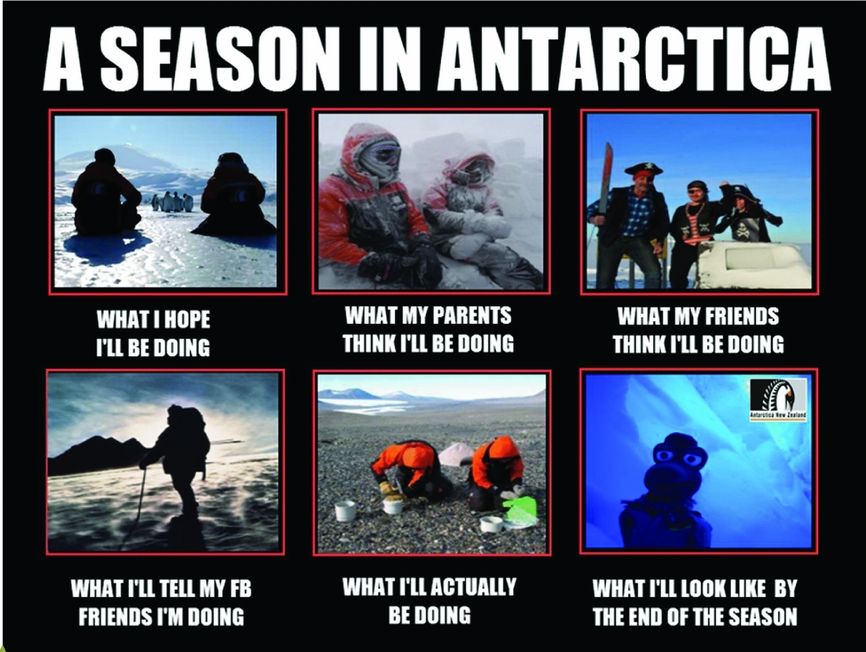
A humorous image posted on Antarctica New Zealand's Facebook page in October 2016 demonstrates that National Antarctic Programmes are aware of the differences between the perceived experiences of working in Antarctica and the reality. The six images presented under the headline ‘A Season in Antarctica’ (Fig. 2) are variously captioned ‘what my parents think I'll be doing,’ ‘what I'll tell my FB [Facebook] friends I'm doing,’ and ‘what I'll actually be doing,’ representing different views of what a job in the far south entails. This image is based on a famous ‘What I Do’ Internet meme, where people illustrate their jobs through the eyes of others, including their parents, their boss and society. While these memes are designed to provoke a laugh, in the context of Antarctic employment this example carries serious undertones, and illustrates the differences between the perceptions of various stakeholders and the reality encountered.
Internet meme ‘a season in Antarctica’ by Antarctica New Zealand. Image: Antarctica New Zealand

The representations of various perceptions of the Antarctic workplace shown in the Antarctica New Zealand meme call upon common themes that have emerged in recruitment advertising. The penguin imagery in the first box (‘what I hope I'll be doing’) recalls the wildlife imagery used in the AAD's 2017 campaign, while the second image (‘what my parents think I'll be doing’) shows icy expeditioners sitting in blizzard conditions, linking strongly to the extremity theme. The inclusion of an image to represent ‘what I'll tell my FB friends I'm doing’ demonstrates how one curates an Antarctic experience for those back home. In this instance, the image of a solo figure gazing out over an icy landscape is strongly reminiscent of Heroic Era imagery, and evokes the themes of heroism and extremity. In contrast, the photograph captioned ‘what I'll actually be doing’ depicts the much less exciting and far more painstaking collection of samples. Although this instance shows scientists out in the field, it could just as easily have been taken back at base, where staff members ensure the station remains operable year round. The meme succinctly illustrates the idea that when it comes to Antarctica, what is expected and what will be encountered can be very different. It is noteworthy that this has not prevented images of ice caves, field camps, and figures trekking across a frozen landscape from featuring in recruitment materials for the New Zealand Antarctic Programme in recent times – such imagery continues to harbour great imaginative appeal. The chance to take photographs of penguins and snowstorms, even if rare, also holds appeal for those working in the Antarctic. Although these images may not best represent expeditioners’ everyday activity, they do come from a long visual tradition of depicting Antarctica as a wild and extreme location.
Although most job advertisements for Antarctica draw from the collective representation of the continent to attract potential applicants, there are examples of recruitment material in which the mundane nature of the job is depicted visually. These are not as common, and also tend to be created in-house by National Antarctic Programmes rather than by outside contractors. A recent example for a Communications and IT role with the Australian Antarctic Division (posted on their Facebook page on 6 January 2017) includes a photograph of a smiling woman sitting at a desk with two computer monitors, a phone, and a highlighted list pinned to the wall. Such imagery depicts the role far more realistically than examples where wildlife or blizzards are foregrounded, and could therefore offer a way to mitigate false expectations. This kind of imagery, which steers clear of clichéd representations of Antarctica as a place of extremes, offers new ways of framing the continent as a workplace.
The recruitment advertisements examined in this paper are by no means exhaustive, nor do they represent the only ways Antarctica has been depicted in recruitment material. They do, however, clearly demonstrate the recurrent themes of heroism and extremity, and offer a useful starting point for discussions about the links between such representations and the experiences of workers who fill the roles. Ryan et al. (Reference Ryan, Gubern and Rodriguez2000, p.364) have suggested that
‘links between human resources departments and the marketing people [need] to be developed if firms wish to produce effective recruitment advertising which benefits from the methods and devices employed in effective consumer or commercial advertising.’
This advice is particularly pertinent in the Antarctic context, in which recruitment material can serve the dual purpose of promoting the Antarctic Programme and finding station personnel.
Conclusion
This paper highlights the dual themes of heroism and extremity that are present in a number of Antarctic recruitment advertisements, and argues that more could be done to ensure that Antarctic recruitment advertisements accurately reflect the job positions in question. Imagery and language are both powerful rhetorical devices, and their deployment in recruitment material needs to be considered carefully. This is the case particularly when it comes to advertising roles in Antarctica, because of the ‘Antarctic imaginary’, or ‘cluster of values, tropes and ideas’ (Nielsen, Reference Nielsen, Dodds, Hemmings and Roberts2017, p.183) people carry in their minds. This version of the place, informed by books, films, photographs, expedition accounts, and advertising, is often built upon common tropes of Antarctic heroism, extremity and wilderness. Although living and working conditions in Antarctica have improved markedly since the first explorers headed south over a hundred years ago, representations of the white continent continue to reprise nostalgic Heroic Era imagery, and to depict people in exceptional situations. When it comes to Antarctic recruitment material, this kind of representation comes with a price. The discrepancy between expectation and reality has implications for individuals, who may be at risk of boredom; for the team as a whole, where dynamics are impacted by the actions and attitudes of team members; and for National Antarctic Programmes, who invest heavily in logistics and training for staff, and require focused and dedicated workers who are ready to perform their best.
Penguins and snowstorms may be eye-catching, but the repetition of such imagery – and language that draws out the extremity theme – can lead to unrealistic expectations. When confronted with an isolated and confined environment and living a monotonous routine, rather than a life of excitement, adrenalin seekers can easily lapse into boredom. The consequences of this affect all those on the station; they include staff not performing well, colleagues suffering, and ultimately lead to a less efficient operation. For this reason, National Antarctic Programmes could make an effort to depict Antarctica as it really is in order to recruit people who would be better suited to the Antarctic work environment. By perpetuating the representation of Antarctica as a place of extremes, National Antarctic Programmes risk attracting people who are drawn to extreme situations but are not well suited to the mundane nature of many of the tasks required. By framing Antarctica as a comfortable workplace, rather than an extreme place for undertaking adventure, better outcomes could be expected for both the employing National Antarctic Programmes and the employees who are being deployed to the far south.