Introduction
Fructose is a monosaccharide naturally found in honey, fruits, and vegetables. Until the 1970s, the most common source of fructose was sucrose, a glucose-fructose disaccharide refined from sugarcane and beets. Reference Rippe, White, Bendich and Deckelbaum1 However, since high-fructose corn syrup (HFCS) was developed, fructose has become the main sweetener used by the food industry in a wide variety of processed products and carbonated beverages. There is an estimation that added sugars can contribute to approximately 39% of the total caloric intake, based on a 2000 kcal/day diet, Reference Toop and Gentili2 which largely originate from processed foods, soft drinks, and fruit juices. Currently, sugar-sweetened beverages are considered the main source of added sugars in several countries. Reference Parker, Salas and Nwosu3 Twenty-five percent of the US population consumes more than 1 can of soda and 5% more than 4 on a given day. Reference Malik and Hu4 On average, a 12-fluid ounce sweetened beverage contains 38 g of sugars, of which 22 g is fructose. Reference Ventura, Davis and Goran5 Thus, considering that 45% of fructose consumption by young adults comes from sugary beverages and the remaining 55% comes from processed foods, the total daily fructose ingestion in certain segments of the population could be higher than the reported 60 g/day. Reference Vos, Kimmons, Gillespie, Welsh and Blanck6
Numerous clinical and experimental animal studies have demonstrated a clear link between high-fructose consumption and the development of metabolic syndrome, a complex group of medical conditions that include obesity, dyslipidemia, hyperglycemia, hepatic steatosis, insulin resistance, and hypertension. Reference Stanhope, Schwarz and Keim7–Reference Theytaz, de Giorgi and Hodson9 Metabolic syndrome is considered the gateway to the development of several chronic-degenerative diseases, also known as noncommunicable diseases (NCDs), which include type 2 diabetes, cardiovascular disease (CVD), and cancer, among others. NCDs are responsible for approximately 70% of deaths worldwide every year. Reference Esmailnasab, Moradi and Delaveri10
These metabolic diseases are multifactorial, and both genes and the environment play etiological roles in the development of metabolic disorders; however, these factors do not sufficiently explain the alarming incidence of these metabolic disorders in recent decades. Reference Ojha, Fainberg, Sebert, Budge and Symonds11 According to the developmental origins of health and disease (DOHaD) hypothesis, many behavioral and environmental factors interacting during the earliest stages of a developing organism may predispose an individual to the development of a metabolic disease later in life through a mechanism known as developmental programming. This hypothesis has created a new research paradigm to understand the risk of chronic diseases that goes beyond simplistic explanations based on genetic and lifestyle influences. Reference Calkins and Devaskar12–Reference Vickers14 Several experimental and epidemiological studies have demonstrated that changes in maternal nutrition during the periconceptional period, such as nutrient restriction, low-protein diets, or high-fat or high-sugar diets, predispose offspring to develop obesity or other metabolic disorders in adulthood. Reference Howie, Sloboda, Kamal and Vickers15–Reference Williams, Seki, Vuguin and Charron17
A number of rodent studies conducted in mothers and their offspring to explore the short- and long-term metabolic consequences of inappropriate maternal nutrition have shown that high-fructose consumption during gestation and lactation causes hypertension, insulin resistance, dyslipidemia, and hepatic steatosis, among other disorders typical of metabolic syndrome. Reference Sarı, Yeşilkaya and Bolat18–Reference Rodríguez, Otero and Panadero21 However, most of these studies have focused on assessing the effects of maternal fructose consumption provided in their drinking water without considering that in the ileum, fructose absorption is higher when administered in drinking water than its absorption when provided in food, and this increased absorption decreases solid food intake. Reference Ritze, Bárdos and D’Haese22 Furthermore, most of the studies that aimed to evaluate the effects of maternal fructose consumption were performed on male offspring, but relatively little is known about long-term metabolic consequences in female offspring. Growing evidence indicates that maternal overnutrition or undernutrition may contribute to sex-specific metabolic programming, which may also be transmitted to future generations in the absence of further environmental stressors. Germ cells in the developing female and male gonads appear to be similarly vulnerable to early life events and thus are likely to contribute to transgenerational disease risk among the offspring during reproductive stages. Reference Vickers23–Reference Jazwiec and Sloboda25 Hence, the aim of this study was to evaluate the effect of a high-fructose maternal diet during pregnancy and lactation on the programming of metabolism in female offspring in comparison to that of male offspring.
Methods
Animals and experimental protocol
Male and virgin female Sprague-Dawley rats from our animal facilities were used. Upon arrival, rats were fed ad libitum with standard 5001 rat chow (PMI Nutrition International L.L.C. Brentwood, MO, USA) and tap water. Animals were housed collectively under controlled light and temperature conditions (12-h light–dark cycle; 22°C ± 2°C) and relative humidity (40%–60%). Female rats weighing 220–240 g were assigned to either the control diet 5008 (PMI Nutrition International L.L.C. Brentwood, MO, USA) (SD; n = 8) or the high-fructose diet (HFD; n = 8) treatment groups. The HFD was elaborated in the laboratory to reach a similar composition as the standard chow except that the complex carbohydrates and sucrose were replaced with 50% fructose (Archer Daniels Midland, Decatur IL, USA; w/w). The main components of the two diets are shown in Table 1. All rats were fed with the corresponding experimental ad libitum diet starting 2 weeks before pregnancy until sacrifice, which occurred 3 days after weaning.
Main components of the two diets given to pregnant and lactating Sprague Dawley dams

Mineral (AIN 93 G) and vitamin (AIN 93 VX) mixtures met the American Institute of Nutrition AIN-93G recommendations for rodent diets.
Each female rat was mated with one male rat. On the day of partum, the litter size was documented. On postnatal day (PND) 1, the body length and weight were registered. Then, the litter size was adjusted to eight pups per litter (four males and four females) to ensure standardized nutrition until weaning. At weaning (PND 21), the dams were removed to finish the suckling period, and all pups from both groups were separated by sex and fed ad libitum with standard rat chow (5001) and tap water until the end of the experiment (PND 90).
Intraperitoneal glucose tolerance test
Metabolic responses to a high-glucose solution (35%) injected intraperitoneally (2.5 g/kg body weight [BW]) were assessed in one male and one female offspring per litter at PND 87, as described below. After an overnight fast (10–12 h), a small volume of blood was obtained from the tail tip under basal conditions (time 0) and 15, 30, 60, and 120 min after glucose administration. Blood glucose concentrations were measured using a handheld glucometer (Accu-Chek Performa, Roche). Additionally, 0.2-ml blood samples were collected and heparinized at each time point, and the blood plasma was separated and kept frozen (−20°C) until determination of insulin concentrations (see below). The area under the curve (AUC) values for glucose and insulin concentrations were calculated by the trapezoidal method. Insulin sensitivity was determined using the homeostatic model assessment of insulin resistance (HOMA-IR) and calculated as the product of the fasting glucose level [mg/dl] and fasting insulin level [ng/ml]) divided by a constant, 22.5. Reference Matthews, Hosker and Rudenski26
Blood and tissue sample collections
At postpartum day 24 (dams) or PND 90 (offspring), after an overnight fast (10–12 h), 10 μl of blood from the tail tip was drawn, and glucose was measured by a handheld glucometer (Accu-Chek Performa, Roche). Then, rats were euthanized by decapitation after anesthesia with sodium pentobarbital (60 mg/kg, i.p.). Heparinized blood samples were collected and centrifuged at 2500 rpm for 15 min at 4°C for plasma collection; then, the samples were stored (−20°C) for later measurements of circulating metabolites. Liver, retroperitoneal, and gonadal adipose tissues were obtained and weighed. Additionally, the liver was stored at −70°C for later lipid analysis.
Determination of plasma hormone and metabolite concentrations
All hormone and metabolite analyses described below were performed on the dams and one male and one female offspring per litter. Plasma aliquots stored at −20°C were used to measure uric acid (UA230), total cholesterol (CH200), and triglyceride concentrations (TR210) with enzymatic colorimetric tests using commercial kits (Randox Laboratories Ltd., Crumlim, UK). Insulin (EZRMI-13K; Millipore, Billerica, MA, USA), leptin (EZRL-83K; Millipore, Billerica, MA, USA), and adiponectin (Sigma; RAB1136-1KT, St. Louis, MO, USA) concentrations were assayed in plasma samples using specific enzyme immunoassay (ELISA) kits for rats, and all of these analyses were performed according to the manufacturers’ specifications.
Hepatic lipid determination
Liver lipid concentrations (total cholesterol and triglycerides) were measured in dam and offspring liver samples using commercial enzymatic reagents from Randox Laboratories (Crumlim, UK), as described previously. For liver lipid extraction, an accurately weighed 100 mg sample was manually homogenized in 450 μl of cold phosphate-buffered saline (PBS) before the addition of 900 μl of chloroform/methanol (2:1 v/v ratio) and then vortexed for 1 min. The homogenate was kept refrigerated for 12 h and was then centrifuged at 4000 × rpm for 15 min at 4°C. The organic phase was recovered into a new tube and then dried for 24 h at room temperature. Finally, the remaining organic phase was resuspended in 500 μl of absolute ethanol, and 10 µl aliquots were used for quantification.
Statistical analysis
Sample size was calculated based on the expected minimal difference with biological significance in mean plasma triglycerides and standard deviation for the experimental groups. The β-value should not be higher than 0.2, and the calculated minimal power was 0.8. Using an analysis of variance (ANOVA) test and an α-probability of 0.05, seven animals per group were required to obtain these effects. Reference Barrientos, Racotta and Quevedo27 The power and sample calculations and the statistical analyses were carried out using SigmaPlot 12.0 software (Systat Software Inc., Chicago, IL, USA). All data are expressed as the mean ± SEM or median and interquartile range (IQR, 25th–75th). For dams, data from metabolite plasma concentrations, HOMA index, tissue weights, and lipid liver concentrations were analyzed by Student’s t-test; when normality and/or equal variance tests failed, a Mann–Whitney rank sum test was used as was the case to determine the significance of the adiponectin plasma concentration and triglyceride liver concentration. A two-way repeated-measures (RM) ANOVA with one between-subjects factor (diet) and one within-subjects factor (time) was applied to the BW and water and energy intake data. A two-way ANOVA was conducted for metabolite plasma concentrations, HOMA index, tissue weights, lipid liver concentration, and AUCs of glucose and insulin from offspring of dams fed a standard diet (SD) or HFD, with diet and sex as between-subjects factors. When normality and/or equal variance tests failed, a Kruskal–Wallis ANOVA on ranks was used, as was the case for adiponectin and leptin plasma concentrations. BW, food intake, and blood glucose and insulin concentrations throughout the intraperitoneal glucose tolerance test (IP-GTT) were analyzed by a three-way RM ANOVA (an Excel ad hoc worksheet was used), with one within-subjects factor (time) and two between-subjects factors (diet and sex). When appropriate, a Student–Newman–Keuls post hoc test was performed for multiple comparisons. A p-value of <0.05 was considered statistically significant.
Results
Effect of HFD consumption on maternal BW gain and food and water intake
Maternal BW and food and water intake were measured two times per week during the 9 weeks of experimentation. As shown in Fig. 1a, HFD consumption significantly increased the BW gain of dams in the second week of pregnancy, while a significant decrease in weight gain was observed from week 8 onward in HFD-fed dams compared with SD-fed dams. The average energy intake was significantly lower in weeks 1 and 2 of lactation but increased in week 3 (Fig. 1b). Additionally, water consumption decreased from the second week of pregnancy onward in HFD-fed dams compared with SD-fed dams (Fig. 1c).
Body weight gain (a) and food (b) and water (c) intake of SD- and HFD-fed dams during the 9 weeks of the study. Data are expressed as the mean ± SEM (n = 8). Mean values significantly differ from those of the SD group, *P < 0.05 tested by two-way RM ANOVA with diet as a between-subjects factor and time as a within-subjects factor.

Effect of HFD consumption on maternal plasma metabolites and hormone concentrations
Maternal fructose intake significantly increased the glucose, cholesterol, triglyceride, and uric acid concentrations in comparison to the corresponding levels in control rats fed a SD. While adiponectin and leptin plasma concentrations were not affected by the maternal HFD, the fasting plasma insulin concentration was also significantly increased in HFD-fed dams compared with that in SD-fed dams (Table 2). As a consequence, the HOMA index of insulin resistance was higher in HFD-fed dams than in control dams (Table 2).
Plasma concentrations of several metabolites under basal conditions and HOMA index in dams fed with a SD or HFD, evaluated one day after weaning

Data are expressed as the mean ± SEM or median and IQR (25–75) (n = 7–8). Mean values differ significantly from those of the SD group, *P < 0.05 and **P < 0.001, tested by a Student’s t or Mann–Whitney rank sum test with diet as the between-subjects factor.
Effect of HFD consumption on dam adipose tissue and liver weights and hepatic lipid concentrations
Dams were sacrificed at postpartum day 24; although there was no significant difference in BW between both groups, the masses of retroperitoneal and parametrial adipose tissue depots were significantly greater in HFD-fed dams than in SD-fed dams. Additionally, the dams fed the HFD showed significantly higher relative liver weight and triglyceride and cholesterol levels compared to the same parameters in the SD-fed dams (Table 3).
Relative weight of retroperitoneal and gonadal adipose tissue and liver expressed a percentage of body weight and lipid liver concentrations in dams fed a SD or HFD evaluated at day of sacrifice

Data are expressed as the mean ± SEM or median and IQR (25–75) (n = 8). Mean or median values differ significantly from those of the SD group, *P < 0.05 and **P < 0.001, tested by a Student’s t or Mann–Whitney rank sum test with diet as the between-subjects factor.
Effects of maternal HFD consumption on pups at PND 1
There were no significant differences in the litter size (pup numbers: SD, 13 ± 0.9; HFD, 11 ± 1.0); BW (females: SD, 6.76 ± 0.11 g; HFD, 6.82 ± 0.11 g and males: SD, 7.19 ± 0.04 g; HFD, 7.09 ± 0.09 g), or length (females: SD, 5.05 ± 0.03 cm; HFD, 5.05 ± 0.04 cm and males: SD, 5.16 ± 0.02 cm; HFD, 5.15 ± 0.04 cm) of the offspring at PND 1 between the SD and HFD groups.
Impact of maternal HFD consumption on BW and food intake of female and male offspring
When weaned, female and male rat food intake and BW were measured from PND 21 through day 60. As expected, the BW and food intake of male offspring from both groups were significantly higher than those of the corresponding female offspring. The BW of the HFD female offspring rats was significantly higher than that of the SD female offspring rats beginning on PND 29 (Fig. 2a), while for male rats, there were differences between the HFD and SD groups from PND 53 onward (Fig. 2a). Furthermore, food intake in HFD female offspring was significantly higher than in SD females on PND 29 and from PND 51 onward (Fig. 2b), whereas for the male offspring, there was a significant difference in food intake between the HFD and SD groups from PND 49 onward (Fig. 2b).
Body weight (a) and food intake (b) in SD and HFD female and male offspring rats after weaning. The variables were recorded from postnatal day 21 until postnatal day 60. Data are expressed as the mean ± SEM (n = 8). Mean values significantly differ from those of the SD group, *P < 0.05, or from the female group, #P < 0.05, tested by three-way RM ANOVA, with time as a within-subjects factor and diet and sex as between-subjects factors.

Effects of maternal HFD consumption on female and male offspring IP-GTT
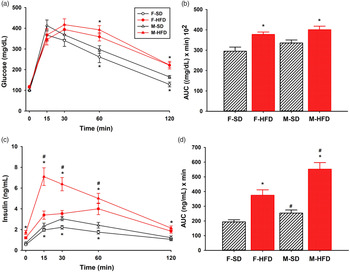
The circulating glucose levels after the intraperitoneal administration of a glucose solution were significantly higher at 60 and 120 min in female and male offspring from dams fed an HFD, and the peak value of glycemia was found at 30 min in the offspring of fructose-fed rats, which was 15 min later than in the control rats (Fig. 3a). Similar increases were observed for the AUC of glucose (Fig. 3b). Male and female offspring from the SD group tended to return to basal circulating levels of glucose 120 min after the glucose load. However, the blood glucose concentration remained above 200 mg/dl at 120 min in the offspring of dams from the fructose group, in contrast with the findings in the SD group. Likewise, significantly increased insulin levels were found at 15, 30, and 60 min between the female groups and at all the tested times between the male offspring of HFD-fed dams and the SD-fed dams after the intraperitoneal glucose load (Fig. 3c). In addition, the insulin levels of the male offspring in the HFD group were significantly higher than those of the female offspring of the HFD group. Accordingly, the AUC of insulin values increased approximately twofold in the offspring of HFD-fed dams compared to that of insulin values of the SD-fed dams. Additionally, the AUC of the male offspring was significantly higher than that of the female offspring of dams from the SD and HFD groups (Fig. 3d).
Blood glucose (a) and insulin (c) concentrations before (time zero) and 15, 30, 60, and 120 min after i.p. administration of a glucose load in 87-day-old SD (n = 7) or HFD (n = 7) female and male rats. The areas under the curve (AUCs) of glucose (b) and insulin (d) values throughout the IP-GTT in both female and male offspring are shown. Data are expressed as the mean ± SEM. Mean values significantly differ from those of the SD group, *P < 0.05; or from the female group, # P < 0.05 tested by three-way RM ANOVA (with time as a within-subjects factor and diet and sex as between-subjects factors) and two-way ANOVA (with diet and sex as between-subjects factors).

Impact of maternal HFD consumption on plasma levels of metabolites in female and male offspring
At PND 87, female and male offspring from HFD-fed dams showed higher plasma concentrations of glucose, cholesterol, and triglycerides than the SD offspring. Additionally, plasma concentrations of cholesterol in the female offspring in the HFD and SD groups were significantly higher than those in the male offspring of both groups (Table 4). There were no differences in circulating levels of uric acid. Likewise, peripheral levels of several adipokines were measured in these rats. Maternal HFD feeding significantly enhanced peripheral concentrations of leptin and reduced those of adiponectin in both female and male offspring under basal conditions. Interestingly, male offspring from the HFD-fed dams showed higher alterations in these variables compared to the females of this group. Additionally, male offspring from both groups showed higher fasting insulin levels and insulin resistance HOMA index values compared to those of the female offspring. The insulin levels and the insulin resistance HOMA index were higher in female and male offspring of dams fed an HFD than in their respective control groups (Table 4).
Plasma concentrations of several metabolites under basal conditions and HOMA index in female and male offspring of dams fed a SD or HFD evaluated at postnatal day 87

Data are expressed as the mean ± SEM or median and IQR (25–75) (n = 7–8). *P < 0.05 vs its respective SD group; #P < 0.05 vs its respective female group. Two-way ANOVA (with diet and sex as between-subjects factors) or Kruskal–Wallis ANOVA on Ranks followed by Student–Newman–Keuls post hoc test were performed as appropriate.
Effects of maternal HFD consumption on liver and adipose tissue weights and hepatic lipid concentrations in female and male offspring
As previously observed in the dams, at PND 90, the BW and relative weights of the retroperitoneal and gonadal adipose tissues of both females and males in the HFD group were higher than those of females and males in the SD group (Table 5). In addition, relative liver weight was not different between the groups, but an increase in liver concentrations of cholesterol and triglycerides in both female and male offspring of dams in the HFD group compared with the corresponding concentrations of the offspring in the SD group was found (Table 5). Interestingly, the relative weights of liver and gonadal adipose tissue of males from both groups were significantly lower than in the female offspring.
Relative weight of retroperitoneal and gonadal adipose tissue and liver, expressed a percentage of body weight and lipid liver concentrations in female and male offspring of dams fed a SD or HFD evaluated on the day of sacrifice

Data are expressed as the mean ± SEM (n = 8). *P < 0.05 vs its respective SD group; #P < 0.05 vs its respective female group. Two-way ANOVA (with diet and sex as between-subjects factors) followed by Student–Newman–Keuls post hoc test were performed as appropriate.
Discussion
The present study provides new findings that demonstrate that the consumption of a HFD by pregnant and lactating dams leads to the developmental programming of the metabolic syndrome phenotype in offspring. This phenotype is characterized by the development of several metabolic abnormalities, including obesity, dyslipidemia, increased liver fat content, and insulin resistance in adult life. Additionally, offspring of fructose-fed dams showed strong predictors of metabolic dysfunction, such as insulin resistance, increased leptin, and reduced adiponectin plasma levels. These effects were more pronounced in adult male offspring than in adult female offspring. One of the most important results of this work is that metabolic programming produces sex-specific effects on progeny.
During lactation, an increase in BW is expected due to the characteristic physiological changes of this stage, such as hypertrophy of the liver, intestine, and mammary gland. In contrast, in this study, the dams fed a HFD during pregnancy and lactation showed a decrease in BW at weeks 2 and 3 of lactation which was associated with a significant decrease in energy and water intake during lactation. It is known that energy requirements for milk production are mainly satisfied through increased energy intake and mobilization from body fat deposits. Reference Ayala, Racotta, Hernández-Montes and Quevedo28 Therefore, the lack of BW gain of fructose-fed dams in the last 2 weeks of lactation and the reduction in food and water consumption suggested the use of energy from fat deposits or a reduction in basal metabolism to produce enough milk to support offspring nutrition. Given that no significant differences were observed in the BWs of the offspring at weaning, it is possible to indicate that dams fed fructose showed increased food efficiency regardless of the level of food consumption. Therefore, it would be interesting to determine the amount and composition of milk produced by the dam19 and to evaluate whether the offspring were born dehydrated. On the other hand, the maternal increase in energy intake shown in the third week of lactation in fructose-fed dams, with respect to the first 2 weeks, could be due at least in part to the intake of the offspring, which are known to begin eating solid food at PND 18 Reference Sengupta29 ; however, this shift from the mother’s milk to independent intake of solid food is a rather gradual process, and it is not until PND 28 that the solid food intake of pups reaches asymptotic values; nevertheless, pups have continued to suckle until PND 34. Reference Thiels, Alberts and Cramer30 Here, the pups were weaned at PND 21, and it is possible that they consumed some solid food; thus, a few quantity of fructose from mother’s food could have contributed to the effects on adult offspring metabolism. Therefore, further studies are required to address this possibility.
Few animal studies have reported that fructose in the food supply simultaneously decreases food consumption and BW. Reference Zou, Arentson and Teegarden19 Furthermore, there are no reports of rat water consumption when fructose is administered in food; thus, we can establish that the decrease in water consumption observed in this study is a novel finding. The effect of high-fructose consumption on rat hydration levels is not fully understood, although there are studies that support that fructose intake stimulates vasopressin secretion and urine concentration due to water retention, Reference Johnson, Stenvinkel and Jensen31 which supports decreased water intake requirements. Further studies are needed to interpret our results; thus, it would be interesting to quantify the volume and composition of urine in dams fed fructose. Some similar works in which sugars, such as sucrose, glucose, fructose or HFCS, were administered through tap water reported a decrease in standard laboratory chow consumption, which has been explained as a normal mechanism of the animal to compensate for excess calories when another food source is available. Reference Lindqvist, Baelemans and Erlanson-Albertsson32–Reference Toop, Muhlhausler, O’Dea and Gentili34 Ritze et al. Reference Ritze, Bárdos and D’Haese22 compared the consequences of providing liquid versus solid high-sugar diets (including fructose) regarding the intestinal uptake of monosaccharides and metabolic parameters, finding that the liquid HFD caused an increased expression of GLUT2, GLUT5, and cholecystokinin (CCK) in the ileum in comparison to the solid high-fructose and the control diets. CCK is a satiety hormone that suppresses carbohydrate intake via the CCK-A receptor, thus decreasing solid food intake. Reference Bellissimo and Anderson35 However, what has not been considered in many cases, especially in studies designed to evaluate the consequences of malnutrition in a developing organism, is that when food consumption decreases due to the intake of fructose from drinking water, the overall intake of protein, vitamins and minerals is also reduced, thus representing an additional variable that might have other metabolic implications on offspring development. Several models of metabolic programming through maternal protein restriction result in a decrease in the BW of the newborn. Reference Zou, Arentson and Teegarden19,Reference Moretto, Ballen and Gonçalves36 For these reasons, we decided to supplement fructose in food by partial substitution of carbohydrates without altering the other micro- and macronutrient and caloric contents. Most of the studies in which fructose was administered to pregnant and/or lactating mothers in food used amounts of 60%–70% w/w fructose. Because these percentages are considered supraphysiological, we decided to use an amount of 50%, which is lower and close to the caloric contribution from the total daily added sugars (40%) ingested by some populations. Reference Toop and Gentili2,Reference Lee, Wu, Leu and Tain37
In the United States, fructose consumption accounted for an average of 10% of dietary energy intake between the years of 1988–1994. However, fructose intake in the 95th percentile segment of the population reached a 19.5%, about twofold the average caloric intake of fructose. Reference Vos, Kimmons, Gillespie, Welsh and Blanck6 In this study, rats were fed a HFD, in which fructose provided 52% of total calories. This indicates that the calories provided from fructose in our diet were 2.5 times higher in comparison to those provided by fructose in the western diet.
Finally, despite the unfavorable changes observed in the BWs of the HFD-fed mother rats, there was no difference between the two groups on the day of sacrifice, but the relative weights of the liver, retroperitoneal, and gonadal adipose tissues were significantly higher in the HFD group than in the SD group. This is a clear indication of metabolic alterations caused by high-fructose consumption. Reference Jürgens, Haass and Castañedana38
It is known that 50%–70% of consumed fructose is metabolized in the liver through the 1-phosphate fructose pathway, and this fructose can be converted to lactate and glucose or can be oxidized to CO2. Reference Tappy and Lê39 However, once liver glycogen stores are full, excess fructose is used for de novo lipid synthesis. This ultimately promotes the synthesis and release of VLDL into the bloodstream, thus contributing to dyslipidemia, increased adipose tissue, and hepatic accumulation of lipids, as was observed in HFD-fed mother rats. Reference Rutledge and Adeli40 Likewise, uric acid, which is considered an important predictor of metabolic damage caused by a HFD, was also found to be elevated in the plasma of dams fed a HFD. Reference Regnault, Gentili, Sarr, Toop and Sloboda41 As previously reported, we also found that dams fed a HFD during gestation and lactation showed significantly higher blood glucose and insulin levels, and the HOMA insulin resistance index was also found to be elevated in these rats. Reference Mukai, Kumazawa and Sato42–Reference Johnson, Perez-Pozo and Sautin44
Here, it was found that maternal HFD consumption caused an increase in BW in female offspring starting from the prepuberty stage onward. This increase in BW was correlated with an increase in food intake. Furthermore, retroperitoneal and gonadal adipose tissue mass was also found to be increased in these rats, which may help to explain the phenotypical changes observed. Similar results have been reported only in male offspring. Reference Alzamendi, Castrogiovanni, Gaillard, Spinedi and Giovambattista45 In this study, we also found a significant increase in BW from postnatal day 53 onward in males. Taken together, these data support that excess weight induced by maternal HFD consumption was observed earlier in female offspring than in male offspring. Consistent with the observed increases in adipose tissue depots, changes in peripheral concentrations of leptin, triglycerides, and adiponectin in both female and male offspring were also found. Reference Harvey and Ashford46,Reference Reynolds and Vickers47 The increased circulating triglyceride concentration contributes to the accumulation of adipose tissue and BW gain, while excess cholesterol can be deposited in the coronary arteries, which can eventually lead to the development of atherosclerosis. Reference Mann48 Here, it was found that plasma cholesterol levels were significantly higher in both female and male offspring from HFD mothers. These data support the fact that high maternal consumption of fructose during gestation and lactation induces excess weight gain in female and male offspring.
Regarding the capacity of blood glucose regulation, both females and males from the HFD group showed higher levels of fasting glucose and insulin than those of offspring from the SD group, as well as higher insulin resistance HOMA index values, and they showed increases in glucose concentration at 60 and 120 min of the IP-GTT, with glucose values at 120 min that exceeded 200 mg/dl. Delgado et al. Reference Delgado, Barosa and Nunes49 reported that the first phase increase in glucose levels in the blood in the IP-GTT is due in great part to the glucose load and hepatic glucose production, suggesting that an increase in the later mechanism might be responsible for the differences between groups. Furthermore, plasma insulin levels in both females and males from the HFD group were higher than those in offspring from the SD group from 15 to 120 min in the IP-GTT. Similar results were reported in the work of Alzamendi et al. Reference Alzamendi, Castrogiovanni, Gaillard, Spinedi and Giovambattista45 in the male offspring of dams that consumed a 10% solution of fructose during lactation, but the intravenous glucose tolerance test showed no alterations in glucose tolerance. However, it should be noted that there are important differences between their study and our study regarding the quantity and method of providing fructose. In the case of females, similar results were observed, although the magnitude of the alterations in our study is greater than that of others reported previously. Reference Wu, Wu and Tain50 Our results also showed that fructose consumption in dams caused a different response of insulin secretion between female and male offspring, with a lower and delayed increase in insulin secretion and persistent late hyperinsulinemia in the IP-GTT observed in the female offspring in comparison to male offspring, which also showed a higher AUC of insulin. These changes in the first phase of insulin release indicate insulin resistance mainly at the level of the liver, which may lead to an insufficient suppression of glucose production, which is common in type 2 diabetes. Reference Del Prato and Tiengo51,Reference Kim and Yoon52 These results support the hypothesis that a maternal diet high in fructose not only results in hyperinsulinemia and hyperglycemia but also causes insulin resistance in male and female offspring. The changes in adiponectin and leptin serum levels shown by the offspring were consistent with what would be expected. Reference Mann48,Reference Sánchez-Muñoz, García-Macedo, Alarcón-Aguilar and Cruz53
Another important aspect of this work was that we found elevated concentrations of cholesterol and triglycerides in the liver, although we found no differences in liver weights. This indicated that the consumption of a high-fructose maternal diet during gestation and lactation produced fatty livers in adult offspring. However, only few studies have evaluated the lipogenic pathway in similar models to ours. In a previous study, Clayton et al. Reference Clayton, Vickers, Bernal, Yap and Sloboda54 evaluated the expression of some genes related to lipogenesis in the offspring from fructose fed dams on postnatal day 10, showing an increase on SRBP1c mRNA expression in liver, suggesting an upregulation of this pathway. On the other hand, Kaur et al. Reference Kaur, Toop, Muhlhausler and Gentili55 found no difference in this transcription factor and other lipogenic genes expression in the liver of the offspring from dams feed with a 10% solution of HFCS-55. Therefore, further studies should be performed to clarify the suggested upregulation of genes related to the lipogenic pathway activation in the young adult offspring of dams fed with fructose.
Most of the experimental models regarding diet manipulations use male rats as the subject of study because they are easier to manipulate, and typical hormonal changes of female animals are avoided. However, the importance of performing studies of developmental programming on both female and male offspring is becoming increasingly clear. Recently, it has been reported that germ cells of both males and females are affected by developmental programming Reference Jazwiec and Sloboda25 in addition to metabolic alterations. Early nutritional changes and the interaction between genes and hormones will determine the different metabolic homeostatic responses between males and females. Reference Chowen, Freire-Regatillo and Argente56 In conclusion, the results obtained in this study regarding the metabolic programming of health and disease resulting from providing fructose in the maternal diet demonstrated that some metabolic alterations are more pronounced in a specific sex, with female offspring being particularly susceptible to accumulating excess intra-abdominal fat mass and developing excess weight gain and male offspring being more prone to developing insulin resistance, hyperleptinemia, and hypoadiponectinemia.
Acknowledgments
The authors gratefully acknowledge Consejo Nacional de Ciencia y Tecnología (CONACYT) for the doctoral scholarship to FAT (grant number 554590). SRZ and LQ are SNI-CONACYT and COFAA-IPN fellows. The authors would also like to acknowledge Dr. Eduardo Ramírez for his expert technical support with the statistical analysis and the assistance of the undergraduate student Daniela X. Cuevas with the animal studies. The authors would like to thank American Journal Experts (Certificate Verification code: B-316-7C79-467A-48BA-CC7C) for editing the English language of this text. The authors are completely responsible for the scientific content of the paper.
Financial support
This work was supported by funds from the IPN (SIP 20195713 and SIP 20190202).
Conflicts of interest
None.
Ethical standards
The authors assert that all procedures contributing to this work comply with the ethical standards of the relevant national guidelines on the care and use of laboratory animals of the Mexican Council for Animal Care (NOM-062-ZOO-1999) and have been approved by the institutional Ethics Committee of Research on Animal Studies of the Escuela Nacional de Ciencias Biológicas (CEI-ENCB, approval number ZOO-013-2019).