In this article I am concerned with the life and death of Phra Pho Pan, a saintly and charismatic hermit of northern Thailand. Phra Pho Pan's religious thinking and aspirations, in particular his utopianism, was significantly shaped by the holy man tradition of KhrubaFootnote 1 Siwichai (1878–1938) and his principal disciple Khruba Khao Pi (1889–1977). This holy man tradition needs to be located within the context of Lanna Buddhism as a whole.
The Lanna Buddhist tradition flourished under the influence of Chiang Mai rulers Kuena (1355–85), Tilokarat (1441–87) and Muang Kaeo (1495–1525). The spread of Lanna Buddhism to the Shan and Khuen of Chiang Tung, the Lue of Muang Yong and Sipsong Panna, and the Lao of Lan Xang went hand-in-hand with Tilokarat's political expansion and hegemony over these neighbouring regions. Tham (Dhamma) script manuscripts were the major medium of a literary genre called tamnan (narratives comprising a mixture of myth, legend and history) and of Lanna Buddhist culture.Footnote 2 Lanna Buddhism was characterised by distinctive rituals and festivals and meditation practices (kammathan Lanna) influenced by the Tantric yogavacara tradition within Theravada Buddhism.Footnote 3 The Lanna monastic order (sangha) was also more independent of state control than the central Thai sangha and more ‘embedded’ in local comunities.Footnote 4
Lanna narratives reflected Buddhist cosmology and Buddhist conceptions of time. The Buddhist view of the cosmos is not linear but cyclical, involving periods of progressive evolution and devolution.Footnote 5 Lanna narratives consistently followed the prophecy of Buddhaghosa, the Buddhist commentator of the fifth century CE. Buddhaghosa predicted a 5,000-year period of gradual decline of Buddhism after Buddha's death, followed by a period of evolution that would culminate in a utopian golden age of peace and prosperity and advent of the future Buddha (Pali: Ariya Metteyya; Sanskrit: Arya Maitreya).Footnote 6 The Lanna Buddhist prophecy of decline was expressed in popular ‘calamity cosmological narratives’ that depicted the present as a dark age (Kali Yuga) or period of immorality (adhamma). Betty Nguyen comments on the tension in these calamity cosmological narratives between ‘constraint’ (that underscores Buddhaghosa's prediction of inexorable cosmic degeneration) and ‘moral agency’.Footnote 7 It is the ‘holy man’ (ton bun, literally ‘a person of merit’) who personifies this agency to intervene in history to restore peace, order and morality and prepare the way for the future Buddha.
Calamity cosmological narratives were written and disseminated and used for public sermons between the early nineteenth and mid-twentieth centuries but were most numerous in the later half of the nineteenth century.Footnote 8 Notably, according to Nguyen, these texts do not represent a court-centred but rather a popular tradition, and they ‘place the village temple community at the heart of the Buddhist social world’.Footnote 9 Calamity narratives of the nineteenth century highlighted a dark age of political turmoil, political oppression and social fragmentation, the hardships caused by natural disasters, and the imposition of Siamese rule and centralisation policies in the north. These policies included new taxes, compulsory labour, military conscription,Footnote 10 and the incorporation of the Lanna sangha into a hierarchical, centralised national sangha subject to regulation by secular authorities and standardised Buddhist observances.
It was the determination of Khruba Siwichai and Khruba Khao Pi to protect the independence of the Lanna sangha and the populace against Siamese state exactions (in particular military conscription) that led authorities to discipline them in a number of ways.Footnote 11 Khruba Siwichai was detained in temples in Lamphun, Chiang Mai and Bangkok, forced to surrrender his administrative positions, and sent under police guard to Bangkok for investigation in 1930 and 1935.Footnote 12 Khruba Khao Pi was compelled to disrobe three times by local officials. He thereafter wore white robes to replace the maroon robes of the Lanna sangha; hence the incorporation of the word ‘khao’ (white) into his name and the conduct of all his religious activities outside the official sangha. According to Kwanchewan Srisawat, the attacks against Khruba Khao Pi were ‘intended to showcase the newly promoted sangha law which stated that a monk can be brought to trial in a secular court if he was found to have violated the state law’.Footnote 13 In his writings Khruba Khao Pi vehemently attacked the centralised sangha and the process of rationalised and standardised practices promoted by the Sangha Act of 1902 as an ‘alien religion’ (sasana phai nok).Footnote 14
In this perceived dark age both Khruba Siwichai and Khruba Khao Pi were widely identified in the north as ton bun — bodhisattas Footnote 15 believed to have accumulated much merit in their past lives — who strove to protect the populace against injustice and oppression and restore a moral community based on Lanna Buddhism. One aspect of their Buddhist revivalism was the prolific construction or renovation of Buddhist monuments (pagodas, temples, etc.), creating a kind of proto-utopia as a precursor to the eventual advent of the utopia of the future Buddha. The building of particular monuments, supported by the voluntary labour of lay devotees, was often preceded by visions (nimit; Pali: nimitta) during meditative trances (chan; Pali: jhana), which functioned as auspicious signs or omens and also as detailed visualisation of the architectural form of the monument. Religious construction sometimes spilled over into ‘development’ works (such as the building of roads, bridges and schools) that were also seen as an expression of the holy man's charisma (barami) and loving-kindness (metta). Another distinctive feature of the holy man tradition of Khruba Siwichai and Khruba Khao Pi was that many followers were from non-Tai ethnic minorities, in particular the Karen of the western highlands of northern Thailand.
I should emphasise that while Phra Pho Pan was at times praised for his bodhisatta-like qualities, he was never identified as a ton bun. He had been an opium trader and prisoner when young and this nefarious past hardly qualified him as Buddhist saint who had acquired great merit in past lives. However, the ton bun Khruba Khao Pi had a profound influence on Pan. In 1970 and 1971 Pan spent a short period with Khao Pi at Wat Phra Phuttha Bat Pha Nam in Li district in neighbouring Lamphun province. Pan's contact with Khruba Khao Pi as his ‘teacher’ (Phra achan) strongly reinforced his utopian beliefs. The deterioration of Buddhism and the intervention of a meritorious ton bun as a harbinger of the future Buddha and his utopia is recounted in some detail in several of Khruba Khao Pi's writings: Pusati Sutta, Legend of Pho Cao Rai, and Legend of Yonok Lok.Footnote 16
In this article I will highlight the way in which Phra Pho Pan's utopianism, centred on the future Buddha, was manifested in three locations in the district of Mae Wang, Chiang Mai province: the village of Ban Mai Sawan, the meditation retreat of Doi Sapphanyu, and the King's Mountain hermitage. I propose to trace the intersection of his life with that of a female ascetic and spirit medium whose own religious quest reflects the more independent role of women in the Thai religious landscape. I consider how this female ascetic, with the support of a neophyte Thammayut monk (and former hermit), has fostered the realignment of the King's Mountain hermitage to the royalist and conservative Thammayut sect, to a renowned Thammayut monk of central Thai origin, and to the nationalistic cult of King Naresuan. I argue that prior to and after Phra Pan's death in April 2016 this realignment threatened the autonomous and dissident legacy of the hermitage and led to dissension within the Buddhist community (comprising both the village and hermitage established by Phra Pho Pan), and dramatically revealed in the commemorative ceremonies held one year after his death.Footnote 17
Phra Pho Pan's active utopianism and moral renewal in an age of crisis
From opium trader to hermit
Phra Pho Pan was born in 1932 in Ban Kat, a small market town about 30 kilometres southwest of Chiang Mai city in the district of Sanpatong (now Mae Wang district). His name at birth was Khampan Thawong. For more than 30 years his followers and local people have referred to him as ‘Phra Pho Pan Ruesi’ (Father Pan the Hermit)Footnote 18 or simply as ‘Phra Pho Pan’.
Pan's parents were relatively prosperous farmers who owned about two hectares of fertile wet-rice land. His father was both a farmer and a local healer (mo muang). From the age of 13 Pan spent four years as a novice (samanen) at a local Buddhist temple, Wat Ampharam. By his early 20s Pan had come to see himself as a man of action, an adventurer and a daredevil.Footnote 19 It was probably these manly character traits that attracted him as a young man to the opium trade. During the 1950s and 1960s northern Thailand experienced a boom in opium cultivation and trafficking. Ban Kat was well positioned to exploit the new economic opportunities offered. The town was located close to the opium-growing villages of the western highlands and a large section of the town's population were Shan who had a long history of trading with highlanders (such as the Karen and the Hmong). At the age of about 25 Pan became involved in opium trading as a client of a local patron (pho liang). Pan prospered for a while until his opium cache was discovered and he was sentenced to six months imprisonment. The hardships of prison life had a traumatic effect and served as a catalyst for introspection and moral transformation. After his release from prison in 1961 he retreated to the nearby forest where for three years as a hermit (ruesi) he practised austerities and systematic meditation.
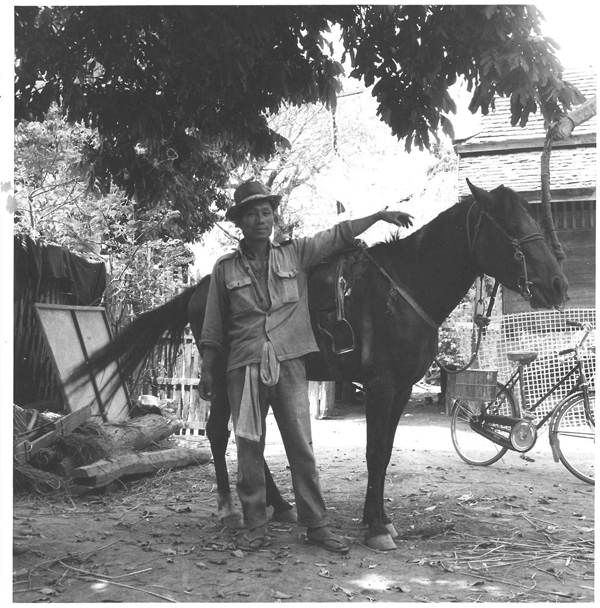
Pan ended his voluntary period of seclusion as a hermit determined to free local farmers from poverty and exploitation. For many years he maintained a regular discipline of eating one meal a day and retreated for seven days each year for meditation. Consequently, he retained his reputation as a hermit and was commonly identified as ‘Noi Pan the Hermit’ (Noi Pan Ruesi).Footnote 20 However, he did not relinquish his self-image as a virile man of action, exemplified by his riding of a magnificent stallion everywhere he went, day and night (see Fig. 1).
‘Noi Pan the Hermit’ as a dam chief and farmers’ group leader in 1968 (photograph by Paul Cohen)

Pan's achievements in political life were considerable. Beginning in 1965 he encouraged the formation of farmers’ groups (klum chao na) in Ban Kat sub-district, which were independent of government farmers’ associations. Soon after he was elected as dam chief (kae muang) of the nearby Khun Khong dam on the Wang River. He subsequently established two irrigation associations that aimed to improve and democratise the local irrigation system, assist dispute settlement, facilitate the marketing of cash crops, and lobby the government for funds to build a large reservoir in the highlands to increase the supply of water in the dry season. Both irrigation associations had become defunct by the mid-1970s, but this was largely due to opposition by the government bureaucracy, which was intolerant of organisations that attempted to assert autonomy from state control.Footnote 21
From the New Heavenly Village to Doi Sapphanyu
In November 1970 Pan established a utopian village about four kilometres northwest of Ban Kat. He named the village ‘Ban Mai Sawan’ (New Heavenly Village). He invited poor landless farmers (Northern Thai, Hmong and Karen) from Chiang Mai and neighbouring provinces to settle there.
Ban Mai Sawan was governed by Pan's Buddhist social ethics and utopian visions.Footnote 22 Pan proclaimed: ‘Everything must come under the rule of the dhamma’ (thammatipatai). That is, Buddhist universal ethics must subordinate and encompass political and economic life. Throughout the village crudely painted signs exhorted villagers to live virtuously: ‘The dhamma protects those who live righteously’, ‘Desire endangers the dhamma’, ‘He who meditates is an exemplary person’, ‘He who does good, receives good’, and so on. Ban Mai Sawan was ruled by numerous committees — for irrigation and agriculture, education, health, animal protection, commerce and marketing, etc., all under the authority of a Committee for the Protection of Sacred Things (Kammakan Phitak Sing Saksit). Village life in Ban Mai Sawan was also controlled by strict ‘village laws’ (kot mu), many with moral undertones. For example, it was forbidden to make loud noises after eight o'clock in the evening; no illegal objects could be brought into the village; and it was forbidden to victimise anyone in the village and to kill any wild animals.
Pan bemoaned that this was an ‘age in which rocks rise up and water sinks’ (yuk hin fu nam com) — a dark age of confusion and immorality in which people no longer respected religion, and no longer practised the dhamma. Footnote 23 By contrast Pan proclaimed that the dhamma is sovereign in the age of the future Buddha, but that this utopia would only be realised if humans became ‘enlightened people’ (arayachon) who are ‘good people who understand the dhamma and understand themselves’.Footnote 24 His was not a form of apocalyptic millennialism that envisages imminent transformation but of active utopianism, that is, a voluntaristic philosophy that postulates gradual moral renewal. It is apparent also that Pan viewed Ban Mai Sawan as a kind of proto-utopia — a utopia in the making that prefigured the future Golden Age.
One part of Pan's utopian project in Ban Mai Sawan was the communal ownership of land that had been eventually allocated by ballot in 1978 in a state land allocation scheme (khrongkan catsan thidin).Footnote 25 To Pan communal land ownership was an expression of the virtues of cooperation (samakhi), loving-kindness (metta) and generosity (dana). However, villagers vehemently opposed Pan's proposal, causing friction between him and villagers and even a threat on his life. Also, once state land was allocated it was imperative that Ban Mai Sawan become a state-administered village with an elected headman. Thus by the end of the 1970s Ban Mai Sawan had become a normal Thai village; the Buddhist institutions and moral governance under ‘village law’ established by Pan had collapsed.
These events prompted Pan in 1979 to ordain as a Buddhist novice for a second time. He remained resident in Ban Mai Sawan for about two years, though with occasional wanderings (doen thudong) to nearby highland villages, accompanied by his brother and brother-in-law. He then moved to a plateau about one kilometre to the east of Ban Mai Sawan, which he named Doi Sapphanyu.Footnote 26 Pan's failure to instil the ‘rule of the dhamma’ (thammatipatai) in the ‘New Heavenly Village’ did not by any means quell his utopian ardour and project. Doi Sapphanyu was the site of a deserted temple (wat rang) with an ancient ordination hall (ubosot) and a holy well (nam bo thip) that Pan regarded as having sacred power (amnat khwam saksit). Eventually he took up permanent residence there. Accompanying this change was an increasing dedication to the building of religious monuments. With the assistance of villagers nearby he restored (burana) the ancient ordination hall and resided there for some time with three recently ordained monks. Later, following a vision (nimit) during meditation, he began the construction of a Phra That Ketkaeo Chulamani, modelled on the reliquary in the Tavatimsa heaven where the god Indra resides and where Phra Malai (Pali: Maleyya) guards the future Buddha, Ariya Metteyya.Footnote 27
Doi Sapphanyu developed as a meditation retreat (samnak patibat tham) for Buddhist monks and some chi phram Footnote 28 under Pan's guidance and as a new utopian community governed strictly according to Khruba Khao Pi's ascetic regimen: vegetarianism, walking meditation, and vows of silence. In doing so Pan believed he was contributing to the ‘slowing down of the conditions of crisis by calling for the restoration of morality’ (pen kanchalor phawa wikrit doi kanriakrong hai sintham klap khuen ma).Footnote 29 Pan eventually handed over (mop hai) Doi Sapphanyu samnak to Wat Phra That Doi Suthep temple with its close symbolic association with Khruba Siwichai.Footnote 30 Doi Sapphanyu has subsequently developed into a major forest temple (wat pa) and meditation centre.Footnote 31
King's Mountain hermitage
Pan returned to Ban Mai Sawan for a number of years. In 1992 he disrobed permanently as a Buddhist novice and resumed the life of a hermit. In 1997 he moved to establish a hermitage on a hill about three kilometres to the west of Ban Mai Sawan, after making some earlier reconnoitring visits there. He named the site ‘King's Mountain’ (Khao Phra Racha). When I first visited the site a sign in front of his residence displayed the name ‘pavilion of the righteous ruler’ (phlapphla phanyatham). The residence was later reconstructed around a central cyclindrical pillar which Pan named ‘Sao Inthakhin’ (Indra's pillar) and also ‘sao lak muang Mae Wang’. The pillar extends from the ground (protected by the Earth Goddess [Nang Thorani]) and is topped by a Buddha image at the fourth level of the building. As in the case of the Sao Inthakhin in Wat Chedi Luang in Chiang Mai city it exemplifies a Buddhist transformation of a pre-Buddhist pillar embodying the tutelary spirit of the domain (muang) and the ancestors of local princes propitiated with animal sacrifice and spirit possession. In this transformation Buddhist kings came to identify themselves as ‘righteous rulers’ (phanyatham; Pali: dhammaraja) rather than in terms of lineage.Footnote 32 Notably the ‘Lanna people’ use the terms phanyatham and ton bun interchangeably.Footnote 33
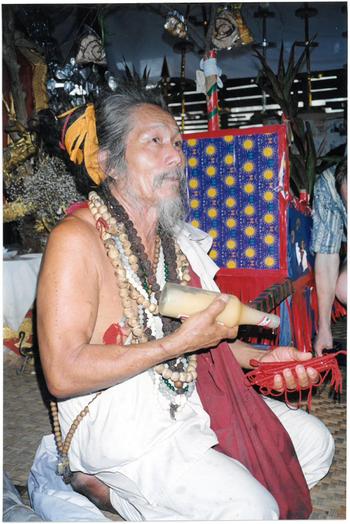
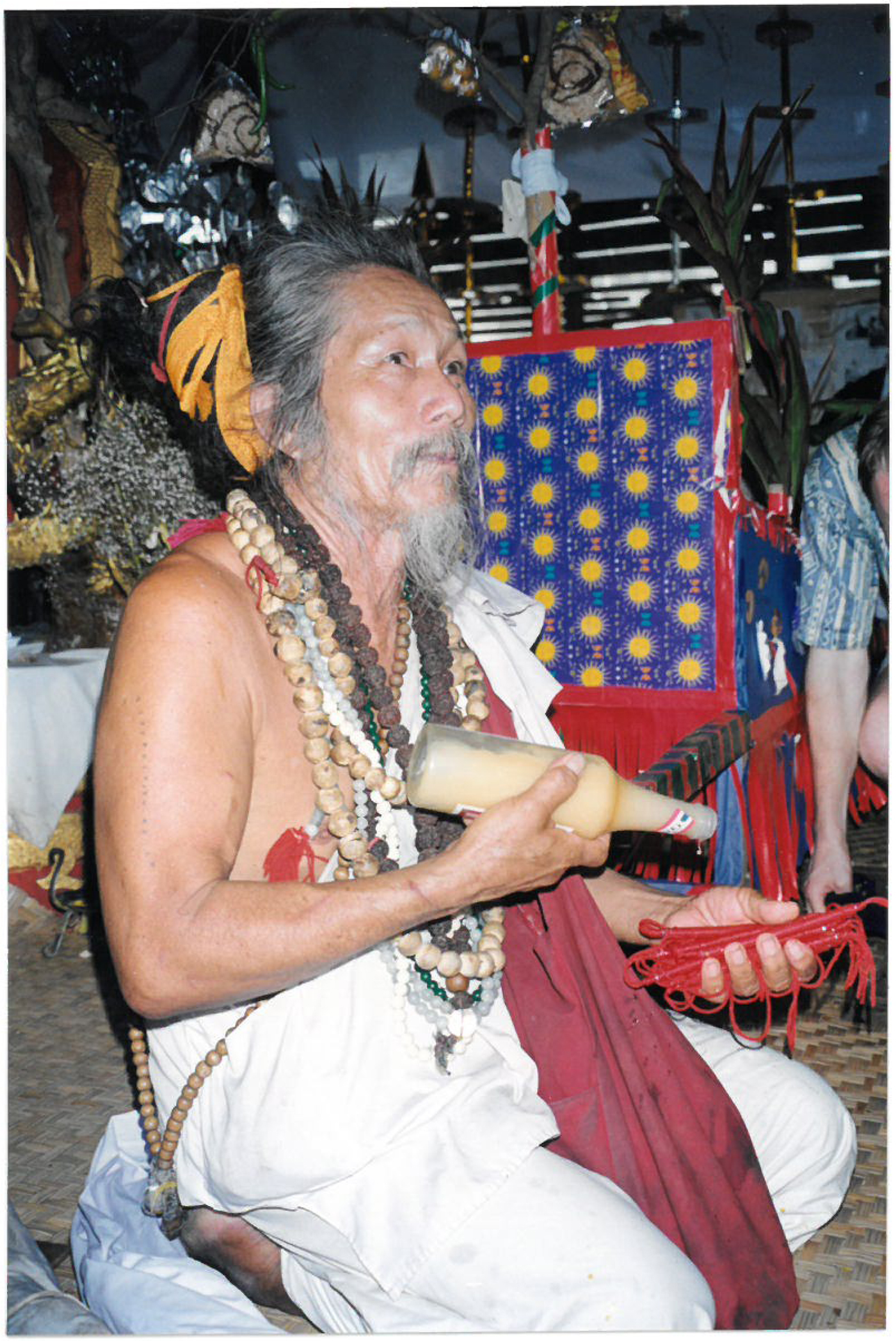
Phra Pho Pan's reasoning for continuing the life of a hermit was to pursue more freedom and an ascetic lifestyle independent of the Buddhist monastic order (sangha), with rituals and practices based more on sayings and proverbs (suphasit) rather than formal precepts and prescriptions transmitted in Buddhist temples. In this religious endeavour Pan was joined in the hermitage by like-minded hermits (male and female) and occasionally by Buddhist monks. Some of the hermits had experienced troubled pasts and some had suffered from mental disorders. Pan's charismatic authority at the hermitage and beyond was enhanced by his skill in meditation,Footnote 34 his inspired and creative visions, his esoteric spells, his healing rituals, his divination and fortune telling (see Fig. 2), and his moral influence as a teacher (achan, khru) on the lives of his disciples (luk sit) and some lay devotees.
Phra Pho Pan at King's Mountain hermitage in 2001 (photograph courtesy of Julai Cohen).
The presence of female hermits (ruesi maeying, mae pha khao or yogi Footnote 35) in their own separate residence (samnak satri or samnak yogi), represents a significant transformation in Pan's Buddhist practice and utopian quest, given his early masculine self-image and misogynist attitudes. In Pan's speeches I recorded in the late 1960s he often made demeaning remarks about women. Women do things half-heartedly, don't struggle and take risks, like ‘warriors’ (chai chatri) and ‘real men’ (phu chai thae thae).
The female hermits of King's Mountain chant prayers (suat mon) every evening and make bai sri offeringsFootnote 36 to deities and to the Buddha on orders from local Buddhist temples and ritual specialists. These female hermits are under the tutelage of a female spirit medium and yogi, Yogi D. Prior to moving to King's Mountain Yogi D. had already established a small independent samnak for Buddhist nuns (mae chi) in neighbouring Lamphun province. She made periodic visits to Doi Sapphanyu where a monk ordained her as a chi phram.Footnote 37 She settled permanently at King's Mountain in 2004. There Phra Pho Pan consecrated her as a hermit in a Brahmanic rite of ‘embodying the teacher’ (khrop khu).Footnote 38 Pan subsequently had a profound moral and psychological influence on Yogi D. In early 2017 she showed me a notebook which she had kept for more than ten years. It is full of Pan's moral lessons and exhortations, advice on meditation, proverbs, and Buddhist chants, spells and rituals.
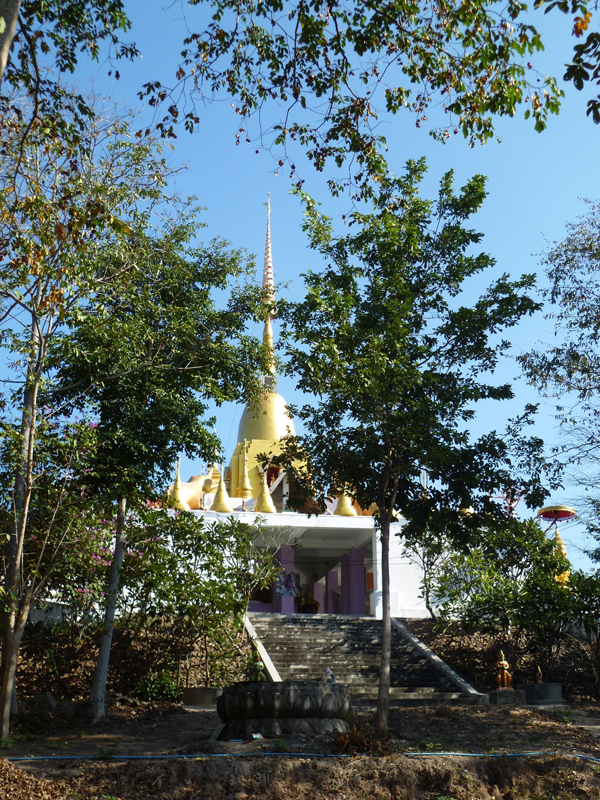
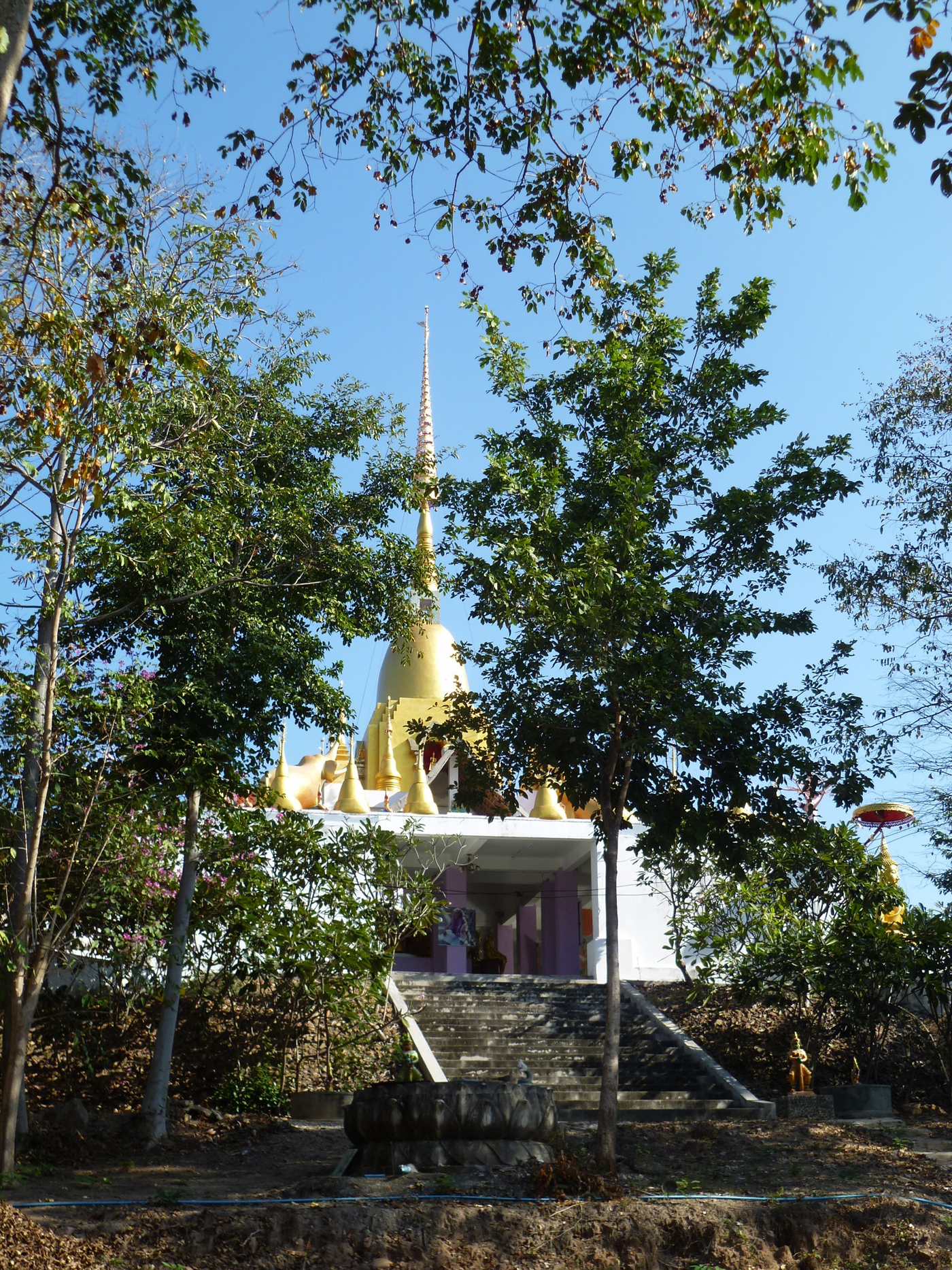
King's Mountain has also developed as a more elaborate and bizarre expression of a proto-utopia. The lay utopian community of Ban Mai Sawan of the 1970s (also a kind of proto-utopia) was governed by religious committees and strict religious rules, and numerous signs, nailed to trees, carried Buddhist proverbs. But there were no Buddhist statues or buildings (except the local temple). By contrast, the King's Mountain hermitage was spatially distinguished by a proliferating and seemingly discordant mixture of religious statues, images and buildings: a large entrance gate, statues of Buddha, the future Buddha, Khruba Siwichai, Indra, Hindu deities (including Shiva and Ganesha), Kuan Yin, hermits, the Earth Goddess and Rice Goddess — all dominated by a large and elaborate pagoda (Chedi Mahachakraphat) (see Fig. 3).Footnote 39 These are mostly products of Pan's visions (nimit) over many years during meditation.
Chedi Mahachakraphat and entrance to the temple-hall (wihan), King's Mountain hermitage, 2015 (photograph by Paul Cohen).
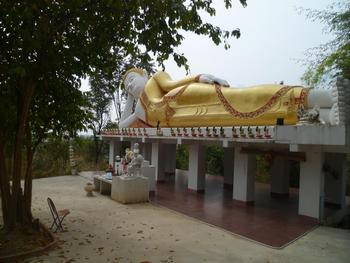
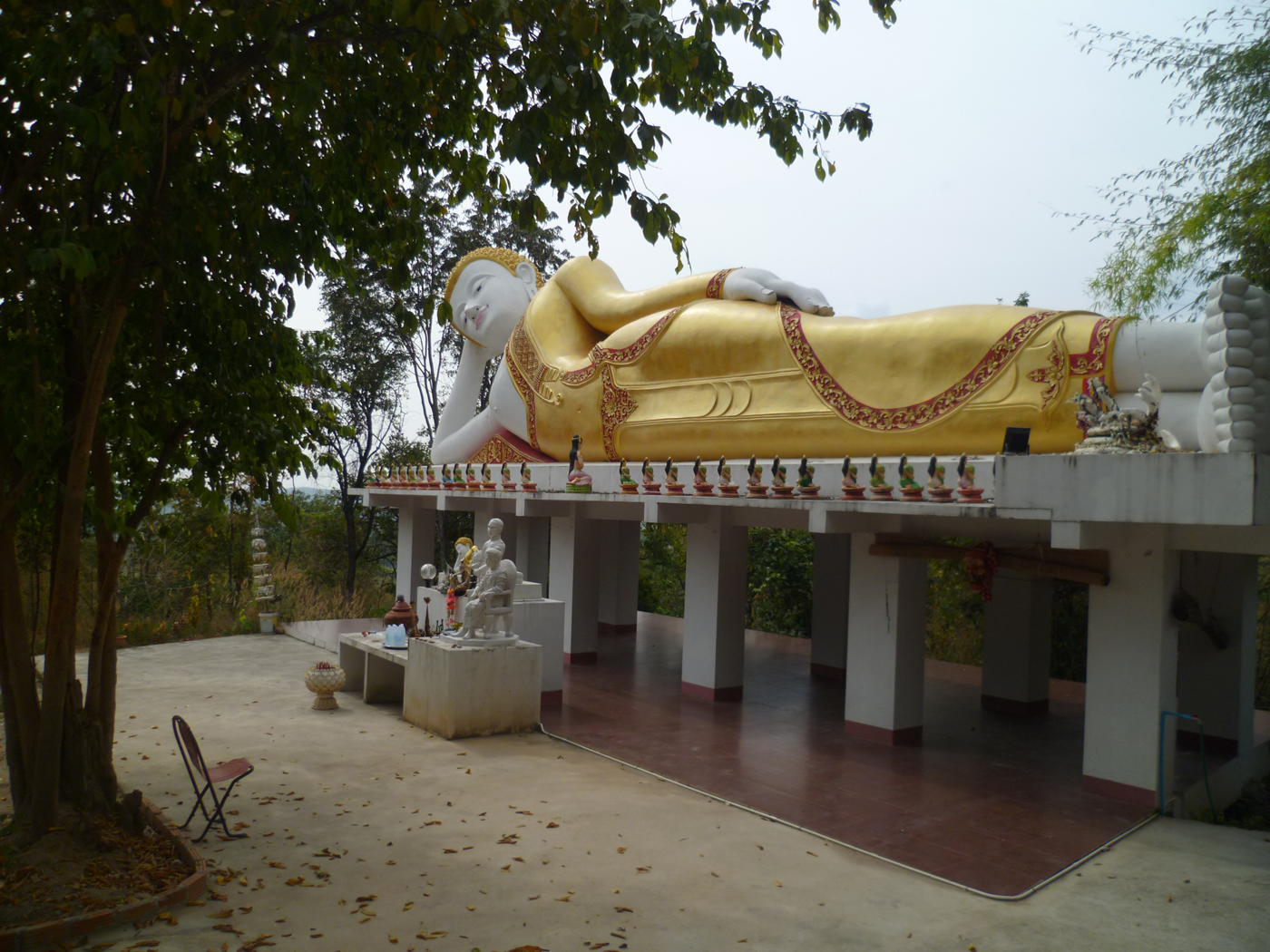
The relatively recent construction (completed in 2012) of the reclining statue of the future Buddha, Ariya Metteyya (see Fig. 4), reflected Pan's growing preoccupation with his utopian aspirations and his impatience with the predicted utopia. He was well aware of Buddhaghosa's standard prediction of 5,000 years of cosmic decline before the advent of the Ariya Metteyya, informing Shigeharu Tanabe in 1986 that only 2,472 years remained.Footnote 40 However, at King's Mountain he proclaimed to me that the future Buddha would arrive in 500 years and that the Ariya Metteyya had already entered the hearts of men.Footnote 41 This reflects Pan's active utopianism, his overwhelming desire to fast-forward the Buddhist utopia of the future Buddha, and his faith in human agency.
Statue of the future Buddha (Ariya Metteyya), King's Mountain hermitage, 2015 (photograph by Paul Cohen).
Yogi D.
Yogi D.’s career of self-transformation intersected with that of Phra Pho Pan when they first met briefly at Doi Sapphanyu and later when she settled permanently at King's Mountain. Her spiritual journey was inspired and realised through her dual roles as a female ascetic and as a spirit medium and complemented by Phra Pho Pan's role as moral exemplar and counsellor.
In this respect she reflected the trend in the more independent role of female ascetics in Thai Buddhism. Monica Lindberg Falk has contested Charles Keyes’ argument that women's nurturing role in Thai Buddhism precluded an inferior status.Footnote 42 She claims that ‘throughout history patriarchal norms have permeated Buddhist institutions’Footnote 43 and cites Rita Gross that women's inferior status in Buddhism is based on the belief that rebirth as a female is due to negative karma and that Buddha is male, so rebirth is necessary for women.Footnote 44 In Thailand in particular the inferiority of women is confirmed by the persistent refusal of the Thai sangha to sanction the full ordination of women as bhikkhuni. Footnote 45 Lindberg Falk notes that traditionally Buddhist nuns (mae chi) resided only at temples and as such were seen more or less as ‘housekeepers’ for (male) monks.Footnote 46 This negative attitude towards mae chi was reinforced by popular Thai views of female renunciation as simply a refuge from life's misfortunes rather than a genuine spiritual quest.Footnote 47 Female renunciants have also had to contend with early Buddhist male-authored texts that ‘demonize women as immoral and dangerous temptresses out to divert male renunciants from the path’ as well as denigrating the female body as impure and polluting through biological processes such as menstruation.Footnote 48 Such misogynist attitudes perisist in contemporary Thailand, particularly in northern Thailand where women are not allowed to enter ordination halls or pagodas where relics are located.Footnote 49 However, Lindberg Falk describes the formation in recent decades of self-governed samnak mae chi independent of monks, their agency in altering their religious position and their increasing acceptance from the laity as fields of merit.Footnote 50 This religious agency and ‘gendered religious shift’ has been supported by a changing religious, social and economic environment. Joanna Cook argues that a critical factor has been the widespread adoption of vipassana (insight) meditation by the laity since the 1950s. This movement has encouraged women to ordain as mae chi as well as to practice and teach meditation (gaining them respect and prestige).Footnote 51 Other factors conducive to the sizeable increase in the number of mae chi in Thailand include the expansion of female education, the diversification of the labour market and the growth of the service sector.Footnote 52
Yogi D.’s career follows a similar trajectory of a ‘gendered religious shift’ from the establishment of her own samnak mae chi in Lamphun and culminating in her creation of a relatively independent residence (samnak satri) of female ascetics in 2004 within the grounds of King's Mountain. However, there is considerable variation in the practice and status of female ascetics throughout Thailand.Footnote 53 Yogi D.’s role as a female ascetic (mae chi, chi phram and later as a hermit) has been complemented by her practice as a spirit medium. In this hybrid role her status has diverged significantly from the highly educated and ‘professional female celibates’ who teach Pali in major urban monasteries and monastic universitiesFootnote 54 or in the highly regulated ‘monasticism’ of Wat Bonamron in Sankampaeng district, Chiang Mai province.Footnote 55
Yogi D.’s initiation as a spirit medium began in the late 1980s when she became gravely ill and was possessed by a spirit called Chao Pu during songkran (the Thai New Year festival).Footnote 56 Tanabe comments: ‘At the time she felt her entire body come under the control of a strong force which ordered her to recite sutras and worship the Buddha.’Footnote 57 She then became a spirit medium, operating from her house in a village in nearby Sanpatong district, before moving to Doi Sapphanyu. Since moving to King's Mountain she has functioned as the spirit medium (chao song, ma khi) for a variety of spirits, including Qigong masters and the nationalist hero King Naresuan, whose spirit she channels in her own shrine (phlapphla thi prathap). In this role she closely fits Walter Irvine's analysis of ‘modern’ spirit mediums of northern Thailand who ‘are associated with the noble and courageous princely warriors of the past’, and who claim high status by emphasising their Buddhist virtues, and whose ‘incursion into masculine space is far more assertive and far-reaching than that occurring in “traditional” spirit mediumship’.Footnote 58 Irvine claims that the reputation of ‘modern’ spirit mediums depends on moral value, both of the spirit medium and possessing spirit. In the last half of the twentieth century, statements about moral excellence have included anticommunist, Buddhist and nationalist elements to avoid the charge against mediums of being backward and superstitious.Footnote 59 In a study of urban mediums in Chiang Mai city Rosalind Morris speaks of the ‘empowered appropriation of Buddhist ideology’Footnote 60 by these mediums and that they have ‘allied themselves at least momentarily with nationalist discourse’.Footnote 61
Yogi D.’s experience of running her own independent samnak mae chi in Lamphun was reflected in the organisational character of King's Mountain. Tanabe aptly describes the male hermitage and ‘nunnery’ of King's Mountain as comprising an ‘assemblage’ in which the two parts can forge separate connections with outside religious institutions and persons.Footnote 62 The unity of King's Mountain as a moral community depended much on Phra Pho Pan's reputation and charismatic authority. It was this ‘relative autonomy’ that contributed to growing discord and the religious reorientation of King's Mountain during the critical stage of Phra Pho Pan's illness and after his death.
Before moving to King's Mountain Yogi D. was introduced to Luang Ta Ma (Phra Worongkot Wiriyatharo) of Wat Tham Muang Na in Chiang Dao district, Chiang Mai. Luang Ta Ma was a disciple (luk sit) of Luang Pu Du Phromapanyo (1904–90) of Wat Sakae in Ayutthaya, central Thailand, who was renowned for his strict morality and as a meditation master. Luang Pu Du in turn held Luang Pho Thuat (1582–1682) in great esteem and considered him to have realised the ten perfections of a bodhisatta. Luang Pu Du advised Luang Ta Ma to seek a cave in the north for the purpose of meditation. He eventually discovered a suitable cave near the Shan village of Ban Muang Na, Chiang Dao district, where he resided continuously for four years. Subsequently, he has developed Wat Tham Muang Na into a major forest monastery and meditation centre (catering for more than 100 meditators in a single day). Meditators are encouraged to chant seven times a day, but only the cakkavatti mantra (suatmon chakraphat), and advised to concentrate their minds either on the image of the cakkavatti (wheel-turning emperor) or of Luang Pu Du. Wat Tham Muang Na has many branches (sakha) throughout Thailand. In the main temple (Wat Tham Muang Na) and the several branches I have visited, images and photos of the cakkavatti and of Luang Pu Du are ubiquitous (and often accompanied by images of Luang Pho Thuat).
Why was Yogi D. initially attracted to Luang Ta Ma and why did she eventually become his devotee? One factor was their shared devotion to King Naresuan, the one as a spirit medium for this heroic king and the other due to the geographical intersection between Luang Ta Ma's cave temple and Naresuan's last military expedition. Another reason I believe is to be found in this monk's tolerant and all-inclusive philosophy that is reflected in his single-minded focus on cakkavatti iconography and symbolism.Footnote 63 The universalism of the wheel-turning emperor is underscored in Luang Ta Ma's main temple of Wat Tham Muang Na, by the casting of the cakkavatti image in the styles of various regions within Thailand (Lanna, Sukothai, Phitsanulok) and of neighbouring Buddhist countries (Cambodia, Burma).Footnote 64 In practice this all-encompassing philosophy is expressed in Luang Ta Ma's acceptance of all comers who are dedicated to meditation, that is, pious lay men (ubasok) and lay women (ubasika), mae chi, chi phram, and male and female hermits. Notably, the day I visited Wat Tham Muang Na the great majority of meditators I saw were women.
Luang Ta Ma and the nationalistic cult of King Naresuan
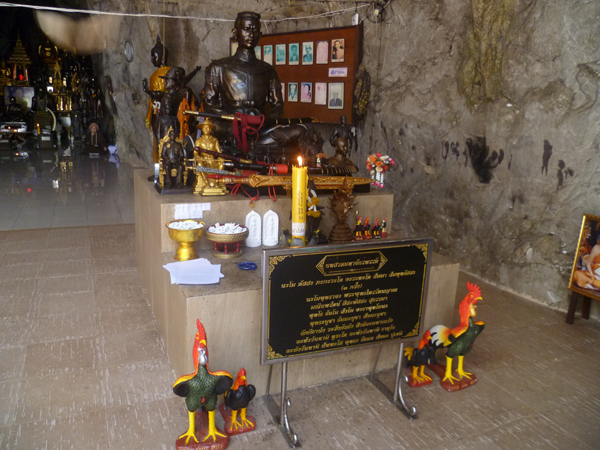
The lineage of Luang Ta Ma, Luang Pu Du and Luang Pho ThuatFootnote 65 has little connection with Lanna Buddhism and the Khruba Siwichai tradition. It is very much a national tradition and is also strongly nationalistic. The pivotal figure in this nationalism is the warrior king of Ayutthaya Phra Naresuan (born in 1553 and reigned 1590–1605) who is eulogised (in history books, imagery and film) for defeating the Burmese crown prince in an elephant duel at Nong Sarai in 1593 and freeing Ayutthaya from the vassalage of the Taungoo dynasty of Burma.Footnote 66 Irene Stengs describes Naresuan, Chulalongkorn, and Taksin (the Three Kings triumvirate) as national heroes and ‘fighters for independence’ against colonial and Burmese oppression.Footnote 67 Public veneration of King Naresuan began in the early twentieth century following the publication of Prince Damrong's Thai Rop Phama (Thai wars with Burma). Field Marshal Sarit Thanarat, prime minister and military strongman from 1958 to 1963, unveiled a huge monument of Naresuan at Don Chedi in Suphanburi province, central Thailand, in 1958. In so doing Sarit and the army ‘associated their militaristic rule with the legacy of the esteemed king’.Footnote 68 Naresuan's victory is celebrated on 18 January each year on Royal Thai Army Day with military parades and ceremonies at the many Naresuan monuments throughout Thailand. Naresuan also has a strong historical association with northern Thailand as he traversed this region with his troops. A version of this history related on Luang Ta Ma's websiteFootnote 69 has Naresuan passing through Muang Na on his way to do battle with the Burmese army from Ava, contracting disease (possibly smallpox) at Thung Kaeo (in Mong Ton, eastern Burma), and retreating to one of the caves at Muang Na where he died. This event is now commemorated by a prominent image of Phra Naresuan in the main meditation cave of Wat Tham Muang Na (see Fig. 5).Footnote 70
Statue of warrior king Phra Naresuan, Wat Tham Muang Na, 2017 (photograph by Paul Cohen).
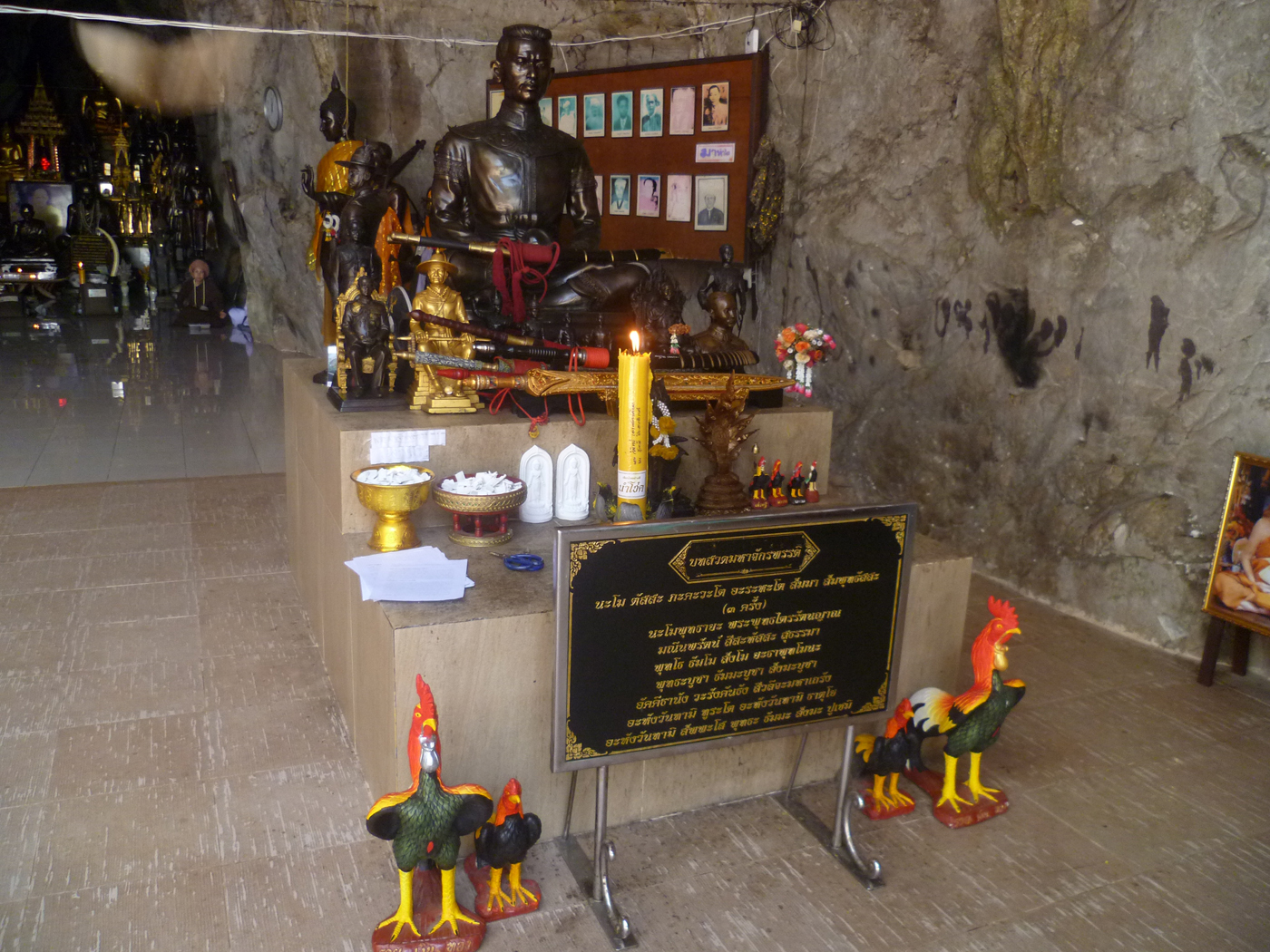
Luang Ta Ma is also connected to Thai nationalism through his spiritual links with Luang Pho Thuat. Luang Pho Thuat was born in Songkhla province, southern Thailand, but travelled to Ayutthaya in central Thailand to further his studies before returning to the south to promote Buddhism.Footnote 71 Luang Pho Thuat is famous for his miraculous powers and for the power of his amulets to protect the nation. Stengs mentions the ‘explosive nation-wide development’ of the Luang Pho Thuat cult from the early 1970s when Luang Pho Thuat amulets saved Thai soldiers from ambush by Malayan rebels.Footnote 72 And Patrick Jory claims Luang Pho Thuat ‘had a special relationship with the country's armed forces’, noting that in 2002 the Ministry of Defence produced a batch of Luang Pho Thuat amulets which were distributed to soldiers, police and government officials operating on the southern Thai border.Footnote 73 Furthermore, according to Phra K. (see over), Luang Ta Ma's devotees include many army officers. At two ceremonies I attended for the casting of large Buddha images at Wat Pa Thara Phirom a senior army officer was present as a guest of honour and was accompanied by a large number of rank-and-file soldiers from a nearby army camp to assist in the construction process. This army camp, Wat Pa Thara Phirom (a branch of Wat Tham Muang Na) and a major Phra Naresuan shrineFootnote 74 are in close proximity in Chiang Dao district.
Luang Ta Ma and the religious realignment of King's Mountain hermitage
Yogi D. has reproduced the dominant iconography of Wat Tham Muang Na in her residence (samnak) and in and near Chedi Mahachakraphat at King's Mountain. In her residence there are large photos of Luang Pu Du, but only a small composite photo of Pan with Khruba Siwichai and Khruba Khao Pi. In the new temple-hall (wihan) under Chedi Mahachakraphat images and photos of the cakkavatti and Luang Pu Du dominate. Notably the image of Khruba Siwichai in distinctive maroon robes that was once up front on the main platform has been relegated to the back. Moreover, a large glossy poster to mark the casting (lo) of a cakkavatti bronze image (on 24 September 2016) has photos of Phra Pho Pan inserted alongside those of the cakkavatti, Luang Pho Thuat, Luang Pu Du and Luang Ta Ma. Thus in the iconography of this poster Phra Pho Pan has been detached from the Lanna Buddhist heritage of Khruba Siwichai and repositioned into the lineage of Luang Pho Thuat.
Actually, this realignment began before Pan's death. Pan's health deteriorated as from about mid-2015. A longer-life (suep chata) ceremony was held for him in October that year. Yogi D. came to play a dominant role in caring for Pan, in the day-to-day organisation of King's Mountain, and in shaping its religious orientation through her close relationship as a luk sit of Luang Ta Ma. According to Phra K., a Thammayut monk and former hermit disciple of Phra Pho Pan, Luang Ta Ma had visited King's Mountain and Phra Pho Pan a number of times at the behest of Yogi D. About three months before Pan died Luang Ta Ma visited an ailing Pan. Phra K. recalls that Yogi D. asked Pan: ‘Do you want Luang Ta Ma to take care of (dulae raksa) King's Mountain and that Pan muttered ‘yes’ (khrap). Phra K. and Yogi D. interpreted Pan's response as his desire to bequeath (mop hai) King's Mountain hermitage to Wat Pa Dara Phirom, a first-class royal temple in the Mae Rim district of Chiang Mai, and for it to become an official forest temple (wat pa) of the Thammayut sect. Wat Tham Muang Na and its many branchesFootnote 75 are closely connected to Wat Pa Dara Phirom and are ultimately under the supervision of Dara Phirom's abbot, Phra Chao Khun Rithirong, who is responsible for all Thammayut temples in Chiang Mai, Maehongson and Lamphun provinces.
The Thammayut (‘Adhering to the Dhamma’) sect was established by Prince Mongkut when he was a monk (1824–51). Mongkut's radical reformism derived from his concern with monastic discipline and was influenced by the strict asceticism of the Raman (Mon) sect of southern Burma.Footnote 76 His ‘scriptualism’ and ‘obsession with orthodoxy’ reflected his preoccupation for the ‘true canon’ and hostility to ‘unfounded myths, fantastic cosmologies, and superstitions’.Footnote 77 According to Stanley Tambiah, in the nineteenth and early twentieth centuries the Thammayut movement had a political aspect in that it was linked to ‘a hierarchical society with “absolute” kingship and privileged royalty, intimately linked with a powerful nobility’.Footnote 78 Thammayut reforms also formed the basis for the Sangha Act of 1902 and subsequent interconnected centralisation of the ecclesiastical and civil administrations at a national level.
Phra K.
Phra K., after ordaining as a Thammayut monk, also became a devotee of Luang Ta Ma and Luang Pu Du and to cakkavatti symbolism. As a boy Phra K. lived in Chiang Mai city. He was a novice (samanen) at Wat Umong for more than two years. He had visited Phra Pho Pan many times with his parents. Later he came to live a dissolute life. He had a particular problem with alcohol, which was solved by Pan's counsel to light a sacred candle (thian bucha) every night at home. This life change prompted him to become a hermit and devout luk sit of Pan at King's Mountain for five years. He informed Phra Pho Pan the day before Pan died that he would ordain as a monk as an act of merit. As vowed he ordained at Wat Pa Thara Phirom, a branch of Wat Tham Muang Na, and which has faithfully reproduced the iconography and symbolism of the parent temple.Footnote 79
Phra K.’s ordination as a Buddhist monk immediately after Phra Pho Pan's death was undoubtedly an act of devotion and of merit-making. It was also a critical factor in the process of realigning King's Mountain as a Thammayut forest temple. Yogi D. has a close relationship with Luang Ta Ma as a disciple; as a lay female ascetic, however, she has no position or authority within the Thai sangha. As an ordained Thammayut monk Phra K. now has the authority to deal directly with the abbot of Wat Pa Dara Phirom. By March 2017 he had managed to secure the approval and signature of the Wat Pa Dara Phirom abbot as well as some local secular officials (including the senior forestry officer of Mae Wang district). As part of this approval the grounds of the new forest temple will be expanded from its current 15 rai to 61 rai Footnote 80 that will be cared for (raksa) by the temple on behalf of the Royal Forest Department (Krom Pa Mai).
Yogi D. and Phra K. also believe they are Phra Pho Pan's legitimate successors, fulfilling Pan's vision and goals. And they still seek his approval through signs (nimit) in their meditation. They believe, perhaps with good reason, that King's Mountain would disappear altogether if it did not become a legal forest temple. When Pan was alive King's Mountain had no legal status and was vulnerable to land appropriation by wealthy capitalists (nai thun). Only after Pan's death did Phra K. move to have the hermitage registered as a samnak song (Buddhist residence). Phra K. reiterated that it was important for King's Mountain to become a legitimate forest temple (wat pa) with a land title, otherwise Phra Pho Pan's legacy would be lost and it could end up being taken over and turned into a resort. Also, when Phra Pho Pan is reborn, perhaps in 60 to 70 years, he could return to the sacred holy place he established!
The affiliation of King's Mountain with the well-endowed Thammayut temples of Wat Tham Muang Na and Wat Pa Dara Phirom offers secure and ongoing funding for King's Mountain and the ending of the past partial dependence on unpredictable individual donations. Indeed substantial funding has already been received either directly from Luang Ta Ma, from branch temples of Wat Tham Muang Na and from individual devotees of Luang Ta Ma. Through these funding sources more images associated with Luang Ta Ma have been cast and positioned outside the pagoda — in August 2017 of Luang Pu Du and Luang Pho To to the north and a year later of the cakkavatti to the south (replacing a number of hermit images constructed there when Phra Pan was alive).Footnote 81 And King's Mountain has also been able to raise funds independently as a franchised branch of Wat Tham Muang Na by replicating its brand-like iconography (the cakkavatti image and the trinity of Luang Pho Thuat, Luang Pu Du and Luang Ta Ma). Yogi D. has already set up a small shop to sell a wide range of Buddhist memorabilia (images, rosaries, amulets, T-shirts, etc.).Footnote 82
At this stage it is uncertain just how much control the Thammayut sect will exert on King's Mountain, either from Luang Ta Ma or from the more senior Phra Chao Khun Rithirong (the abbot of Wat Pa Dara Phirom). Phra K. remarked that some Thammayut senior monks are indeed strict (khemnguat) but others are ‘easy-going’ (sabai sabai), an attitude that Justin McDaniel has also observed for some Thammayut ‘forest’ temples in Bangkok.Footnote 83 In July 2017 a female Hindu rishi and devotee of Shiva visited King's Mountain. She is Brazilian by birth but resides in Nepal. She announced her intention to return to King's Mountain at the end of the year. I asked Phra K. whether permission from Luang Ta Ma and/or Phra Chao Khun Rithirong was needed for her to operate at King's Mountain. He replied that permission was not necessary provided she restricted her religious activities to teaching meditation and not Hindu philosophy. Nevertheless, despite Phra K.’s own broad-minded attitude he had himself already experienced disciplinary censure from Phra Chao Khun Rithirong. In September 2016 as a newly ordained monk he organised the casting of a bronze cakkavatti image to be placed in the temple-hall of the King’s Mountain pagoda. In his devotion and love for Phra Pho Pan, Phra K. playfully fashioned the face of the image to resemble that of his teacher! He received a stern rebuke from Phra Chao Khun Rithirong, who declared that such a composite image was not permissible and that the face would require changing! In short, as a Thammayut temple King's Mountain is unlikely to have the religious freedom it once experienced as an autonomous hermitage under Phra Pan's tutelage.
Trouble in utopia
Phra Pho Pan's exemplary Buddhist qualities and his charismatic appeal elicited the unwavering devotion of his King's Mountain disciples. And they have each continued to seek his guidance through meditation. Tanabe attests to the ‘collective communitas or utopian communality’ of the King's Mountain hermits that prevailed between 2011 and 2014.Footnote 84 Krishan Kumar comments that ‘practical utopians’ strive to accomplish certain things thought impossible, foolish or naively idealistic to their fellow men. He adds:
Success for them may be measured not by how far they match up to the ideal of theory, but by how far they may have shown the possibility of living — even if only for a relatively short time — in ways that refuse the compromises and corruptions generally thought inevitable in human society.Footnote 85
Actually, the utopian communality of King's Mountain was short-lived. The relationship between Pan's disciples became acrimonious, and more so after his death. The main divide was between the monk Phra K. and the Yogi D., on the one hand, and the remaining hermit, Ruesi H., who continued to reside at Pan's former dwelling in King's Mountain.
Ruesi H.
Ruesi H. was born in Lamphun. After divorcing his wife he was ordained as a monk at a Lampang temple at the age of 38. Here he began to practice meditation. He later suffered from mental illness and was advised by a senior monk to seek Pan's help. He moved to King's Mountain in 2009. Tanabe describes Ruesi H. as a ‘master of meditation’.Footnote 86 In one crucial meditation episode he had a vision (nimit) inspiring a lifelong goal ‘to construct a monastery by tracing the footsteps of Khuba Khao Pi, Khuba Siwichai and Chao Mae Chamthewi (legendary Queen of Haripunchai kingdom at Lamphun)’.Footnote 87 Ruesi H.’s dedication to meditation has served to transform him and also to heal others. Like Phra Pho Pan in the past, his healing comprises a variety of ritual services for visitors, such as spells (katha) and yantras (yan), fortune telling (poet kam) and reversing fortune (kae kam). He also now runs a project dedicated to Phra Pho Pan to help poor and disabled children in nearby villages, with start-up money of 30,000 baht (about US$940) provided by Pan before he died.
In a casual encounter with me in Ban Kat town in April 2017 Ruesi H. disparaged the prospect of King's Mountain becoming a Thammayut temple. He told me that what Phra Pho Pan really wanted was a community of hermits dedicated to the practice of meditation (samnak patibat) and the nurturing of loving-kindness (metta) for others. He declared that he would not join the commemorative ceremony for Phra Pho Pan on 25 April at King's Mountain but would only attend a separate ceremony on 23 April at Ban Mai Sawan.
Ruesi H. was being marginalised in King's Mountain. However, he saw himself as the legitimate successor to Phra Pho Pan and therefore was reluctant to leave King's Mountain and said that in his meditative visions that Pan did not want him to leave!
Ruesi H. was supported by Ban Mai Sawan villagers and village leaders. As a community Ban Mai Sawan was oriented to annual Buddhist festivals and to merit-making at the village temple but individual villagers often visited Phra Pho Pan for ritual services, to provide him with food and to help with his constructions. They do not share Phra Pho Pan's utopian visions — as the collapse of his ‘New Heavenly Village’ experiment in the late 1970s demonstrates — but they believe that the King's Mountain hermitage is an integral part of the village Phra Pho Pan founded and therefore should not be surrendered to outside influence and control.
Commemorative ceremonies as social dramas
The holding of two separate ceremonies to commemorate the first anniversary of Phra Pho Pan's death highlights the heightening tensions among his disciples. The ceremony at Ban Mai Sawan was a modest affair held in the morning at the village temple. The temple abbot (chao awat) presided and was joined by another six monks from neighbouring temples in Buddhist chanting. This was followed by the presentation of gifts to the monks (thawai phra). A photo of Phra Pho Pan (dressed in the white garb of a hermit and riding a horse!) and joss-sticks had been placed on a small table, and one-by-one the villagers approached to pay their respects with the traditional Thai salutation (wai). Phra Pho Pan's three sons and his elder brother were present. One son, now the district police-chief, was the host (chao phap) of the ceremony. Ruesi H. also attended and, at the conclusion of the ceremony, was approached by village children for blessing in the form of the traditional wrist-tying (mat mue) — an indication that he was both well known and popular in Ban Mai Sawan and, in a sense, following in the footsteps of Phra Pho Pan in relation to the village and King's Mountain.
By contrast the ceremony at King's Mountain was a grand and extravagant affair and it was as much a commemoration of the death of King Naresuan (who died on 25 April 1605) as it was a memorial tribute to Phra Pho Pan. There were more than 20 Buddhist monks and novices there. Some were from Wat Tham Muang Na and Wat Pa Thara Phirom (including the abbot) in Chiang Dao district, Chiang Mai, and from Wat Phra Phuttha Bat Pha Nam, Lamphun. Also, a number of the novices were from the highland Karen village of Thung Luang, accompanied by fellow villagers. Thung Luang had had a long association with the Khruba Siwichai tradition, but it was evident that Yogi D. was active in recruiting these villagers as devotees of Luang Ta Ma. Others in attendance included lay devotees of Luang Ta Ma from Wat Tham Muang Na and Wat Pa Thara Phirom. Notably absent were Ruesi H., Phra Pho Pan's three sons and his brother.
Luang Ta Ma was scheduled to arrive at about 1 p.m. but was delayed in the city for a couple of hours. In the interim a temple leader (acan wat) and Yogi D. occasionally addressed the audience on microphone. The acan wat announced, perhaps tongue-in-cheek, that Yogi D. was the abbot (chao awat) of King's Mountain. Yogi D. responded demurely that she was not the abbot but only the caretaker (phu du lae). She went on to mention Phra Pho Pan's special relationship with Khruba Khao Pi and drew attention to the presence at the ceremony of the abbot of Wat Phra Phuttha Bat Pha Nam, the former residence of Khruba Khao Pi. However, the ceremonial iconography told a different story. In front of the pagoda (Chedi Mahachakraphat) were positioned two large photos rimmed with flowers — one on the left of the trinity of Luang Ta Ma, Luang Pu Du and Luang Pho Thuat under an effulgent cakkavatti image and one on the right of King Naresuan. At the centre was a smaller photo of Phra Pho Pan. Neither here nor anywhere else in the ceremonial space were photos or images of Khruba Siwichai or Khruba Khao Pi.
Luang Ta Ma arrived at King's Mountain at about 3 p.m. and was led in procession to the ceremonial site by two traditional dance troupes. He then presided over the installation of a cakkavatti spire for the pagoda (yok chat chakraphat). Many in attendance chanted the cakkavatti mantra as the spire was being raised by pulleys to the top of the pagoda. Then followed the casting of a large bronze image of the cakkavatti (to be later installed inside the temple-hall) and of 50 smaller images each of Luang Pu Du and of Phra Pho Pan. These were to be offered for purchase as acts of merit-making (tham bun) at the cost of 3,000 baht (US$94) each and as a source of funds for the reconstruction of King's Mountain. At 6 p.m. the chanting of the cakkavatti mantra resumed, followed by a sermon from Luang Ta Ma.
These ceremonies had many of the characteristics of social dramas, as defined by Victor Turner.Footnote 88 Social dramas are ‘a well-nigh universal processual form’ and found in small-scale societies at the village level and in complex nations alike. A social drama ‘first manifests itself as a breach of a norm, the infraction of a rule of morality, law, custom, or etiquette, in some public arena’ and the breach ‘is seen as an expression of a deeper division of interests and loyalties’.Footnote 89 This may lead to a ‘state of crisis’ which may ‘split the community into contending factions and coalitions’. The fact that the ceremonies to commemorate the first anniversary of Phra Pho Pan's death were held on different days, at separate locations, with a divergent composition of those in attendance (and the absence of Pan's close relatives at the King's Mountain ceremony) highlights in dramatic form a widening breach in the local Buddhist community that had spread to create a ‘dominant cleavage’ and a state of crisis.Footnote 90
Some nine months later a state of crisis remained in the absence of ‘redressive means’ to seal off the conflict. At a meeting I attended in Ban Mai Sawan in January 2018 the village headman's adviser (and a former monk) proclaimed that Ban Mai Sawan villagers did not want King's Mountain to become a Thammayut temple. And the headman stated emphatically that he had not signed any agreement to support this change. He said that villagers wanted King's Mountain to remain a meditation retreat (thi patibat tham) as it was under Phra Pho Pan's tutelage. King's Mountain was within the territorial boundaries of Ban Mai SawanFootnote 91 (of which Pan was the honoured founder) and should remain the responsibility of the village and, as such, would not inevitably fall into decay (sueamlong). However, only a few days earlier Phra K. told me that he did not want to appear to be too ambitious and that he was prepared to wait because ultimately Thammayut and provincial authorities (including the Chiang Mai Provincial Office of Buddhism, Samnakngan Phra Phutthasasana Changwat Chiang Mai) could override local opposition.
According to Turner, a final phase of social drama consists either of ‘reconciliation of the conflicting parties’ (by judicial, ritual, or military processes) or ‘consensual recognition of irremediable breach, usually followed by the spatial separation of the parties’.Footnote 92 When I returned to Chiang Mai towards the end of 2018 it was apparent that an ‘irremediable breach’ had been avoided and that some sort of reconciliation had been achieved. Dissension within King's Mountain had been averted when Ruesi H. departed earlier that year in March despite his previous avowal to stay on. Also, an interview with the adviser to the headman of Ban Mai Sawan revealed an awareness that opposition to King's Mountain becoming a Thammayut forest temple could be inevitably thwarted by higher authorities. Furthermore, he remarked, with seeming approval, that construction activity at King's Mountain was now providing employment for many Ban Mai Sawan villagers. Notably, a few days later Phra K. told me that the village headman of Ban Mai Sawan was now ‘cooperating’ (ruammue).
Conclusion
Phra Pho Pan's coincidental encounter and subsequent intimate, platonic relationship with Yogi D. had significant consequences for the future development of King's Mountain. Her own religious experience and moral journey of self-transformation reflects the more assertive role of women — ‘a gendered religious shift’ — both as female ascetics and as spirit mediums in Thailand. Her previous role in running a self-governing nunnery in Lamphun province provided the foundation for the relative autonomy of her residence (samnak) in the King's Mountain hermitage and her capacity to forge independent external religious connections, in particular as a disciple of Luang Ta Ma. This connection, with the ongoing support of the Thammayut monk Phra K., has led to the detachment of Phra Pho Pan's identification with regional Lanna Buddhism and the dissident and utopian holy man tradition of Khruba Siwichai and Khruba Khao Pi. The changing iconography of King's Mountain reveals Phra Pho Pan's posthumous incorporation into Luang Ta Ma's lineage and expanding Buddhist movement, which are both national and manifestly nationalistic through linkages to famous charismatic monks from other regions of Thailand, to the royalist Thammayut sect, and to the military-promoted cult of King Naresuan.
The main protagonists in this conflict fervently believed they were fulfilling Pha Pho Pan's wishes — on the one hand, to preserve King's Mountain as a hermitage and meditation retreat free of sangha control and, on the other hand, to establish the site as a Thammayut forest temple to ensure legal and economic security. The incompatibility of these aspirations and visions was highlighted dramatically in the separate ceremonies to commemorate Phra Pho Pan's death a year earlier and that generated a crisis and schism in the Buddhist community of King's Mountain and the village of Ban Mai Sawan. However, a kind of reconciliation was eventually reached through the departure of the hermit Ruesi H. and the realisation of Ban Mai Sawan villagers of the futility of opposition to higher authorities linked to the royalist and influential Thammayut sect.