




No CrossRef data available.
Article contents
Temperament profiles associated with internalizing and externalizing problems in preadolescence
Published online by Cambridge University Press: 01 June 2004
Abstract
This study investigates how temperament factors are linked to internalizing and externalizing problems in a Dutch population sample of preadolescents (N = 2230). Internalizing and externalizing problems were assessed by the Child Behavior Checklist and the Youth Self-Report and temperament was evaluated by the parent-version of the Revised Early Adolescent Temperament Questionnaire. Temperament profiles were examined in children with (a) neither internalizing nor externalizing problems, (b) only internalizing problems, (c) only externalizing problems, and (d) both internalizing and externalizing problems. The results suggest clearly diverging temperament profiles for these groups of children, with High-Intensity Pleasure and Shyness (representing the broad dimension of Surgency) steering the conditional probability of internalizing and externalizing problems (direction markers), Frustration mainly being related to maladaptation in general (severity marker), and Fear and Effortful Control being associated with both the severity and the direction of internalizing and externalizing problems, respectively. Girls and boys differed in the distribution across the problem groups, but the associations between temperament and psychopathology were comparable for both genders.This research is part of the Tracking Adolescents' Individual Lives Survey (TRAILS). Participating centers of TRAILS include various Departments of the University of Groningen, the Erasmus Medical Center of Rotterdam, the Vrije University of Amsterdam, the University of Nijmegen, and the Trimbos Institute, The Netherlands. TRAILS is financially supported by grants from the Netherlands Organization for Scientific Research (GB-MW 940-38-011, GB-MAG 480-01-006, ZonMw 100-001-001) and the Ministry of Justice (to F.C.V.) and by the participating centers.
Information
- Type
- Research Article
- Information
- Copyright
- © 2004 Cambridge University Press
Temperament research has indicated that different children may respond to similar environmental challenges in predictably divergent ways, with the individual characteristics of the child influencing pathways to both successful and maladaptive outcomes (Rothbart & Putnam, 2002).
Maladaptive outcomes of person–environment interaction can result in mental health problems. The most common disorders are anxiety disorders, attention-deficit/hyperactivity disorder (ADHD), mood disorders, and conduct disorder. Prevalence rates of mental health problems in the Dutch population of children and adolescents range from 12 to 18% (Verhulst, 1995), and about 7% suffer from psychiatric disorders with significant impairment (Verhulst, Van der Ende, Ferdinand, & Kasius, 1997). Problem behavior in children and adolescents can be distinguished into internalizing behavior, which reflects the child's internal distress (e.g., anxiety and depression), and externalizing behavior, which brings the child into conflict with others (e.g., rule-breaking/aggressive behavior and ADHD).
Based on Gray's (e.g., 1981, 1987) neuropsychological model of brain functioning, internalizing and externalizing problems have been described in terms of inhibition and facilitation of behavior. In Gray's model, behavior is seen as resulting from two different brain systems: a behavioral activation system (BAS) that generates appetitive and aggressive behavior and is sensitive to reward, and a behavioral inhibition system (BIS) that mediates the inhibition of behavior in novel situations and in the presence of cues signaling impending punishment. A BIS that is more active than the BAS will increase the likelihood of behavior to be inhibited. A BAS that is more active than the BIS will cause behavior to be initiated more readily (e.g., Kochanska, Murray, Jacques, Koenig, & Vandegeest, 1996; Kooijmans, Scheres, & Oosterlaan, 2000; Quay, 1988, 1993, 1997; Rubin & Asendorpf, 1993). Sensitivities of the BIS and the BAS are assumed to be independent (Gray, 1987; Quay, 1993), hence both systems have an independent probability of activation given a stimulus, and all combinations of high and low BIS and BAS sensitivity may exist in the population. When an individual actually faces a punishment or reward cue, however, activation of the BIS and the BAS is mutually inhibitory (Avila, 2001; Gray, 1982).
Gray's notion of the BIS and the BAS encompasses some of the basic dimensions of child and adolescent temperament. However, we doubt whether these systems are directly associated with internalizing or externalizing problem behavior: most children, including those with relatively high BIS or BAS activation, are quite capable of mastering the sociodevelopmental challenges they encounter on their way to adulthood. In other words, BIS and BAS activation seems to relate to the probable direction of psychopathological problems, if they occur (the conditional probability of internalizing or externalizing problems, given that problems arise), but it is unclear whether they are associated with the severity of the problems (the absolute probability that problems arise). It is important to distinguish between conditional and absolute probabilities, because absolute probabilities reflect risk of psychopathology, while conditional probabilities do not. If the relative overactivation of the BIS or BAS indicates the conditional probability of either internalizing or externalizing problems, then additional factors are needed to distinguish between adaptive and maladaptive developments, i.e., to indicate the absolute probability of problem behavior (Elliot & Thrash, 2002).
A promising approach to a multidimensional representation of constitutionally based individual differences in reactivity and self-regulation is the temperament model developed by Rothbart and colleagues (e.g., Rothbart, Ahadi, & Evans, 2000). Putnam, Ellis, and Rothbart (2001) investigated this model in early adolescents, and found four broad temperament factors: Surgency, Negative Affectivity, Effortful Control, and Affiliation. Surgency, manifested as orientation to and exploration of novelty, was comprised of high-intensity pleasure (positive loading), shyness (negative loading), and fear (negative loading), indicating that this factor largely reflects the relative activation of the BIS and BAS system (Panksepp, 1998). High levels of Surgency (i.e., high activation and/or low inhibition) may result in externalizing problems, for instance if goals are blocked (Derryberry & Reed, 1994; Rothbart & Putnam, 2002). Low levels of Surgency (low activation and/or high inhibition) may lead to internalizing symptoms (Fowles, 1993; Windle, 1994). However, as indicated before, we propose that high and low levels of Surgency are associated with the conditional probability (direction) rather than with the absolute probability (severity) of behavioral problems.
Negative Affectivity has been found to predict both externalizing and internalizing problems, especially in combination with adverse environmental factors (e.g., Bates, 2001; Maziade, 1989; Sanson, Oberklaid, Pedlow, and Prior, 1991). This suggests that Negative Affectivity is a potentially negative constitutional factor that may be exacerbated through dysfunctional patterns of interaction (Sameroff & Chandler, 1975). In children, Negative Affectivity encompasses both fear and frustration, in adolescents mainly frustration (Putnam et al., 2001). The correlation between fear and frustration has been found to decrease during early stages of development (Rothbart & Putnam, 2002); the shift of fear from Negative Affectivity to Surgency suggests that something similar may occur between childhood and adolescence.
Effortful Control, denoting the ability to regulate attention and behavior, is believed to make major contributions to social adaptation (Kochanska, Murray, & Harlan, 2000; Rothbart & Putnam, 2002). Whereas it is evident that the ability to restrain undesirable urges may prevent externalizing problems (Lengua, West, & Sandler, 1998; Wachs & Bates, 2001), the association with internalizing problems is less obvious. On the one hand, children high on Effortful Control may be able to regulate their emotional state by deploying their attention (Shoda, Mischel, & Peake, 1990), and thus reduce the probability of internalizing problems. On the other hand, Rothbart, Ahadi, and Hershey (1994) found that children high in Effortful Control were also high in guilt/shame, which may predispose to feelings of anxiety and depression.
The final broad temperament dimension is Affiliation, which refers to the desire for closeness with others, independent of extraversion or shyness. The affiliation system is supposed to play a role in maternal behaviors, attachment, pair bonding, and sexual behaviors (Cyranowski, Frank, Young, & Shear, 2000; Panksepp, 1998). Girls tend to display a stronger affiliative style than boys, a difference that becomes more salient during adolescence (Brooks–Gunn & Warren, 1989; Insel & Hulian, 1995; Richards, Crowe, Larson, & Swarr, 1998). This increase in affiliative need has been proposed to make girls more sensitive to interpersonal stressors than boys (Cyranowski et al., 2000; Hoffmann & Su, 1998), which might explain why they show higher prevalence rates of internalizing disorder (Bebbington et al., 1998; Oldehinkel, Wittchen, & Schuster, 1999), starting in midpuberty (Angold, Costello, & Worthman, 1998). By contrast, high affiliative need might, through social support, protect against maladaptive outcomes (DeVries, Glasper, & Detillion, 2003).
The aim of this study was to investigate how the joint configuration of temperament factors as proposed by Rothbart et al. (2000) was associated with internalizing and externalizing behavioral problems in a large population cohort of Dutch preadolescents. Based on the above-described findings from previous studies, we hypothesized that (a) High Surgency is associated with the conditional probability (i.e., the direction, given that problems arise) of externalizing problems, low Surgency with the conditional probability of internalizing problems; (b) Negative Affectivity is associated with the absolute probability (the severity) of maladaptation; and (c) (low) Effortful Control is associated with both the conditional and the absolute probability (direction and severity) of externalizing problems. We did not have clear expectations with regard to the role of Affiliation and the association of Effortful Control and internalizing problems.
Studies linking temperament to child or adolescent psychiatric problems have often focused on children with either internalizing or externalizing problems. In practice, however, internalizing and externalizing problems often occur in concert (Newman, Moffitt, Caspi, Magdol, Silva, & Stanton, 1996; Verhulst & Van der Ende, 1993), and comorbidity of internalizing and externalizing psychopathology must be taken into account when examining correlates of mental health problems (Krueger, Caspi, Moffitt, Silva, & McGee, 1996; Mesman & Koot, 2000). This is particularly true in this study, where we aim to disentangle absolute and conditional probabilities of problem behavior.
We examined temperamental profiles of children with (a) neither internalizing nor externalizing problems, (b) internalizing but no externalizing problems, (c) externalizing but no internalizing problems, and (d) both internalizing and externalizing problems. Compared to the more common variable-centered approaches, this typological approach, identifying groups of persons based on the (probable) presence or absence of disturbed behavior, provides a straightforward and easily interpretable way to address the above research questions, and is more closely related to clinical practice.
Because temperament and mental health problems are known to show gender differences (e.g., Feingold, 1994; Verhulst et al., 1997), we checked whether associations were similar for boys and girls. The purpose of the study was to elucidate which temperament factors are associated with internalizing problems, externalizing problems, or both. Linking temperament and psychopathology may not only help to identify high-risk groups, but also yield clues about the etiology of several kinds of problem behavior and potentially effective prevention and intervention actions.
Methods
Sample
The Tracking Adolescents' Individual Lives Survey (TRAILS)
TRAILS is a new prospective cohort study of Dutch preadolescents, who will be measured biennially at least until they are 24 years old. The present study involves data from the first assessment wave of TRAILS, which ran from March 2001 to July 2002. The key objective of TRAILS is to chart and explain the development of mental health from preadolescence into adulthood, both at the level of psychopathology and the levels of underlying vulnerability and environmental risk. A detailed description of the sampling procedure and methods can be sent upon request. Briefly, the TRAILS target sample involved 10- to 12-year-olds living in five municipalities in the north of The Netherlands, including both urban and rural areas.
Sample selection
The sample selection involved two steps. First, the municipalities selected were asked to give names and addresses of all inhabitants born between October 1, 1989 and September 30, 1990 (first two municipalities) or October 1, 1990 and September 30, 1991 (last three municipalities), yielding 3,483 names. Second, primary schools (including schools for special education) within these municipalities were simultaneously approached with the request to participate in TRAILS: that is, pass on students' lists, provide information about the children's behavior and performance at school, and allow class administration of questionnaires and individual testing (neurocognitive, intelligence, and physical) at school. School participation was a prerequisite for eligible children and their parents to be approached by the TRAILS staff. Of the 135 primary schools within the municipalities, 122 (90.4% of the schools accommodating 90.3% of the children) agreed to participate in the study.
If schools agreed to participate, parents (or guardians) received two brochures, one for themselves and one for their children, with information about the study; and a TRAILS staff member visited the school to inform eligible children about the study. Approximately 1 week later, a TRAILS interviewer contacted them by telephone to give additional information, answer questions, and ask whether they and their son or daughter were willing to participate in the study. Respondents with an unlisted telephone number were requested by mail to pass on their number. If they reacted neither to that letter, nor to a reminder letter sent a few weeks later, staff members paid personal visits to their house. Parents who refused to participate were asked for permission to call back in about two months to minimize the number of refusals due to temporary reasons. If parents agreed to participate, an interview was scheduled, during which where they were requested to sign an informed consent form. Children were excluded from the study if they were incapable of participating because of mental retardation or a serious physical illness or handicap, or if no Dutch-speaking parent or parent surrogate was available and it was not feasible to administer part of the measurements in the parent's language. Of all children approached for enrollment in the study (i.e., selected by the municipalities and attending a school that was willing to participate, N = 3,145), 6.7% were excluded because of incapability or language problems. Of the remaining 2,935 children, 76.0% (N = 2230, mean age = 11.09, SD = 0.55, 50.8% girls) were enrolled in the study (i.e., both child and parent agreed to participate), of whom 1,978 completed the questionnaires used in this paper. Responders and nonresponders did not differ with respect to proportion of single-parent families, teacher-rated problem behavior, or school absence; but children in the nonresponse group needed additional help for learning difficulties more frequently and were (slightly) more often boys.
Measures
Data collection
Well-trained interviewers visited one of the parents or guardians (preferably the mother, 95.6%) at their homes to administer an interview covering a wide range of topics, including the child's developmental history and somatic health, parental psychopathology, and care utilization. Besides the interview, the parent was asked to fill out a written questionnaire. Children were measured at school, where they filled out questionnaires, in groups, under the supervision of one or more TRAILS assistants. In addition to that, information processing capacities (neurocognitive tasks), intelligence, and a number of biological parameters were assessed individually (also at school). Teachers were asked to fill out a brief questionnaire for all TRAILS children in their class. Measures that were used in the present study are described more extensively below.
Internalizing and externalizing problems
Internalizing and externalizing problem behaviors were assessed by the Child Behavior Checklist (CBCL), which is one of the most commonly used questionnaires in current child and adolescent psychiatric research (Achenbach, 1991a; Verhulst and Achenbach, 1995). The CBCL contains a list of 112 behavioral and emotional problems, which parents can rate as being not true, somewhat or sometimes true, or very or often true in the past 6 months. Syndromes covered by the CBCL are Anxious/Depressed, Withdrawn/Depressed, Somatic complaints, Social problems, Thought problems, Attention (hyperactivity) problems, Aggressive behavior, and Rule-breaking behavior.
For the present study, we constructed two broad-band dimensions: (a) internalizing problems, consisting of items measuring Anxious/Depressed, Withdrawn/Depressed, and Somatic complaints; and (b) externalizing problems, with items measuring Attention problems and Aggressive and Rule-breaking behavior. Originally, the CBCL Externalizing syndrome consisted of only Aggressive and Rule-breaking behavior (Achenbach, 1991a). However, Attention problems are generally considered as belonging to the group of externalizing (disruptive) behaviors as well (e.g., DSM-IV; APA, 1994) and were highly correlated with Aggressive/Rule-breaking behavior (r = .64), so we felt it was justified to treat them as aspects of a single dimension. Because our research purposes required as valid and pure dimensions as possible, we performed a principal components analysis (two components, oblique rotation) and included only items with factor loadings greater than .25 that were at least twice as high as the loading on the other dimension. This relatively lenient selection criterion was chosen to ensure a sufficient variety of symptoms within the broad-band dimensions and to eliminate symptoms that were (also) associated with the other dimension and hence might contaminate the groups with only internalizing and only externalizing problems. The correlation between the two components was .34. Of the 32 items that belonged to the three internalizing scales of the CBCL, eight did not have a factor loading greater than .25 that was at least twice as high as the loading on the externalizing component. These items were excluded, leaving 24 items on the internalizing dimension. Of the 44 items that belonged to the three externalizing scales, 13 did not have a factor loading greater than .25 that was at least twice as high as the loading on the internalizing component, leaving 31 items. The items of both dimensions are listed in Appendix A.
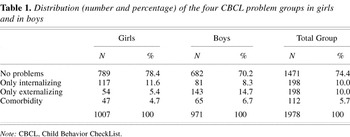
Because the scores between the 82nd and 90th percentile appeared to be the most efficient discriminators between normal and disturbed behavior (Achenbach, 1991a), we used 1 SD above the mean as the cutoff point, resulting in 15.7 and 15.6% high scorers on the internalizing and externalizing dimensions, respectively. We did not use gender-specific percentile scores because we felt that would erroneously obscure gender differences in the prevalence of problem behavior. Subsequently, the children were categorized into four groups, with each combination of low or high scores on the two dimensions of problem behavior: (a) no problems (NO), (b) only internalizing problems (INT), (c) only externalizing problems (EXT), and (d) comorbidity of internalizing and externalizing problems (COM). Table 1 shows the gender-specific distribution across the groups.
Distribution (number and percentage) of the four CBCL problem groups in girls and in boys

Although the core of our analyses was based on the CBCL, the self-report version of this questionnaire, the Youth Self-Report (YSR; Achenbach, 1991b), was also used to see to what extent the findings would hold across informants. YSR problem groups were made following the same procedure as described above for the CBCL. The two YSR components correlated .39. The YSR internalizing dimension contained 28 items and the externalizing dimension 23 items. As opposed to the CBCL, YSR items measuring Attention problems did not load on the externalizing dimension, hence the YSR externalizing dimension consisted only of items measuring Aggressive and Rule-breaking behavior. Consistent with other reports (e.g., Achenbach, McConaughty, & Howell, 1987; Jensen, Traylor, Xenakis, & Davis, 1988; Renouf & Kovacs, 1994; Verhulst & Van der Ende, 1992), the agreement between parent and children was only moderate: r = .32 for the externalizing dimension and r = .28 for the internalizing dimension.
Temperament
Temperament was assessed by the parent and the child version of the short form of the Early Adolescent Temperament Questionnaire—Revised (EATQ-R; Ellis, 2002; Putnam et al., 2001). We used the parent version, because its factor structure was superior to that of the child version in our sample. The EATQ-R is a 62-item questionnaire based on the temperament model developed by Rothbart and colleagues (e.g., Putnam et al., 2001; Rothbart et al., 2000). Rothbart's model distinguishes eight temperament dimensions in early adolescence (ages 9–16), namely, High-Intensity Pleasure, Shyness, Fear, Frustration, Activation Control, Attention Control, Inhibitory Control, and Affiliation, reflecting the four broad dimensions of Surgency, Negative Affectivity, Effortful Control, and Affiliation (Putnam et al., 2001). In addition to these temperament scales, the EATQ-R includes two behavioral scales (Aggression and Depressed Mood, meant to examine possible relationships between temperament and social–emotional functioning), which are not considered here. Because the scales as proposed by Rothbart and her group had not been verified empirically in large population samples, we investigated to what extent they reflected the structure of the EATQ-items in the TRAILS sample appropriately. Principal components analysis (PCA) on the 50 items of the eight temperament scales yielded 10 components with an eigenvalue > 1, with a scree (break in the slope of the plot of the total variance associated with each component) at the sixth component. The eigenvalue > 1 rule may overestimate the number of factors when the number of variables in the analysis is 40 or more (Linn, 1968). We examined the interpretability of the five-, six-, seven-, and eight-component solution of PCA with oblique (oblimin) rotation. With a few minor exceptions, all four solutions resulted in comparable components for Frustration, Shyness, and Affiliation. Furthermore, we consistently found a strong Effortful Control dimension, mainly encompassing Attention and Activation Control items. With one exception, Inhibitory Control items did not load on this component, nor made up a separate one. High-Intensity Pleasure items loaded on one component at the five-, six-, and seven-component solution and spread over two components in the eight-factor solution. Fear did not emerge in the five-component solution and was relatively weak in the other solutions. The seven- and eight-component solutions had one or more components that could not be interpreted properly. All things considered, six components, explaining 42.6% of the variance, seemed to capture the internal structure of the data best (Oldehinkel & Hartman, 2003).
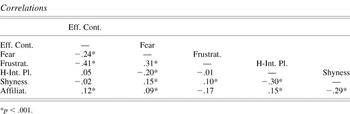
An item was assigned to a scale if the loading on the component was greater than |.40| (Stevens, 2002) and at least .15 greater than the loadings on all other components. For validity's sake (temperament factors were conceptually, rather than empirically derived), items could only be assigned to their “own” scale; in other words, we did not assign items to any scale other than the one they had been selected for initially. The resulting scales are (a) High-Intensity Pleasure: the pleasure derived from activities involving high intensity or novelty (6 items, Cronbach's α = 0.77); (b) Shyness: behavioral inhibition to novelty and challenge, especially social (4 items, α = 0.84); (c) Fear: worrying and unpleasant affect related to the anticipation of distress (5 items, α = 0.63); (d) Frustration: negative affect related to interruption of ongoing tasks or goal blocking (5 items, α = 0.74); (e) Effortful Control: the capacity to voluntarily regulate behavior and attention (11 items, α = 0.86); and (f) Affiliation: the desire for warmth and closeness with others, independent of shyness or extraversion (6 items, α = 0.66). The scale items are described in Appendix B. In general, the (absolute) correlation between the scales was low to moderate (average r = .17), with the strongest association between Effortful Control and Frustration (r = −.41).
Based on (higher order) factor loadings, Putnam et al. (2001) found that in early adolescents High-Intensity Pleasure, (low) Shyness, and (low) Fear were assumed to be indicators of the broad dimension of Surgency and Frustration was assumed to be the only indicator of Negative Affectivity. In our sample, however, Fear had a high loading on Negative Affectivity as well, consistent with findings in younger children. Otherwise, our findings were similar to Putnam et al.'s (2001). In the case of Effortful Control and Affiliation, the scales and broad dimensions are similar.
Analysis
Differences in mean temperament scores between the four problem groups were tested by simple contrasts in univariate analyses of variance (ANOVAs). With a large sample like ours, many effects, including trivial ones, tend to get statistically significant; particularly comparisons with the largest subgroup of children without behavioral problems. Hence, significance was not an appropriate criterion for tracing meaningful differences. We used Cohen's d, an effect size measure that is independent of group size. Cohen's d is (M1 − M2)/σpooled, where M1 is the mean of the first group, M2 is the mean of the second group, and σpooled is the square root of the mean variance of the two groups
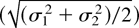
. Cohen (1988) defined effect sizes that were smaller than .2 as small, effect sizes of .5 as medium, and effect sizes greater than .8 as large effects. We decided to focus on effect sizes of .5 or greater, which, when normally distributed, correspond to at least 33% nonoverlap of the scores.
After the bivariate analyses, a discriminant analysis was performed to find which combination of temperament factors described differences between the four problem groups best. Discriminant analysis breaks down the total between association in ANOVA into additive pieces, through the use of uncorrelated linear combinations of the original variables (the discriminant functions). Subsequently, analyses stratified on gender were performed to see whether the results were similar for girls and boys. Interactions between gender and discriminant scores were tested by means of ANOVAs.
To examine whether the associations found might be due to content overlap between EATQ and CBCL items, we used the empirical approach described by Lemery, Essex, and Smider (2002), involving series of exploratory (EFA) and confirmatory factor analyses (CFA) for every combination of CBCL and EATQ measures (12 total). The maximum likelihood algorithm was used for extraction, and the factors were allowed to covary. Items that were identified as problematic through EFA, that is, with loadings >.30 on the wrong factor or <.30 on right factor, were allowed to load on both factors in the confirmatory model; all other items were fixed to zero on the wrong factor. The criterion of .30 was used in imitation of Lemery et al. (2002) and prior work on item-content overlap (Lengua et al., 1998). Problematic items resulting from CFA, according to these criteria, were dropped. The resulting shortened scales were then resubjected to EFA and the process was repeated until all remaining items loaded >.30 on the correct factor, and did not load >.30 on the wrong factor. The remaining items were used to construct “purified” scales, with which we reanalyzed the data. CFA was performed using Mplus 2.11 software; all other analyses were conducted with SPSS 11 software.
Results
Mean internalizing and externalizing problems in the four problem groups
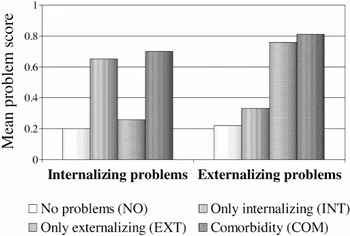
Before analyzing the association between problem behavior and temperament, we first checked whether the four CBCL problem groups reflected children with clearly different amounts of internalizing and externalizing problems. The results are presented in Figure 1. Please note that average, rather than total, problem scores were used in order to even up the problem scores for internalizing (24 problems) and externalizing (31 problems) dimension.

Mean Child Behavior Checklist internalizing and externalizing problem scores for the four problem groups.
As becomes apparent from Figure 1, we managed to construct four distinct groups quite well. Differences between internalizing scores of the EXT group and the COM group, as well as differences between externalizing scores of the INT group and the COM group are all small (Cohen's d < 0.50); indicating that the COM group is not characterized by considerably higher symptom levels within each problem dimension. Furthermore, the EXT group has relatively low levels of internalizing problems (Cohen's d for difference with the NO group <0.50), and the INT group has relatively low levels of externalizing problems. Although the latter group had more externalizing problems than the NO group (d = 0.76), differences with the NO group were much larger for the EXT and the COM group (d = 3.15 and 3.34, respectively).
Mean temperament scores in the four problem groups
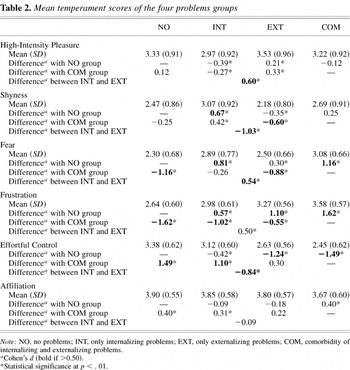
Table 2 shows, for each of the problem groups, mean scores on the six temperament factors, differences (in terms of p value and Cohen's d) with the NO group, differences with the COM group, and the difference between the INT and the EXT group.
Mean temperament scores of the four problems groups
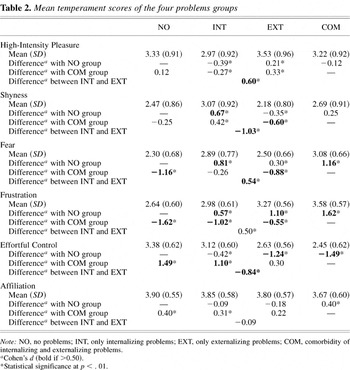
Three patterns emerge from Table 2, each relating to two temperament factors.
- Shyness and High-Intensity Pleasure were associated with the relative rather than with the absolute amount of problems: differences between the NO and the COM group were small, and differences between the INT and the EXT group were large.
- Scores on the Frustration factor steadily increased from the NO group through the INT and EXT group, to the COM group. The same was true for low Affiliation but to a much lesser extent: all effects were small.
- Low Effortful Control was mainly associated with externalizing problems: relatively large differences were found between the INT and the COM group, between the EXT and the NO group, and between the INT and the EXT group; other differences were small. Similarly, Fear was mainly associated with internalizing problems (i.e., large differences between the EXT and the COM group, between the INT and the NO group, and between the INT and the EXT group, other differences small).
Because scores on the Frustration scale, hypothesized to be a general marker of maladaptation, were lower in the INT group than in the EXT group, we examined whether the INT group (i.e., the 15.7% of the children with the highest scores on the internalizing dimensions) included more children with relatively mild problems than the EXT group. The data confirmed that average item scores on the internalizing dimension were lower than those on the externalizing dimension, both in the total sample (internalizing items M = .28, SD = .22; externalizing items M = .32, SD = .25; t (1977) = 7.62, p < .01) and in the groups of high scorers (internalizing items M = .67, SD = .17; externalizing items M = .78, SD = .19; not testable; see also Figure 1). Furthermore, compared to the EXT group, a lower percentage of the INT group had visited a mental health professional for their problems (32.4 vs. 19.0%, respectively; χ2 = 8.87, df = 1, p < .01).
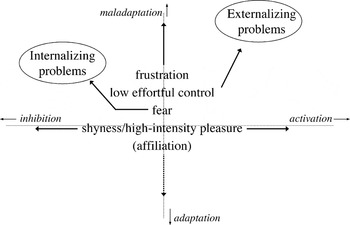
In an attempt to visualize the above-described findings, we located internalizing and externalizing problems, as well as their association with the six temperament factors, in an area defined by two axes, a severity axis and a direction axis (Figure 2). Although the latter was labeled to range from inhibition to activation, we do not pretend that it exactly represents BIS and BAS activation as defined by Gray (1981). Internalizing problems were positioned somewhat lower on the maladaptation dimension than externalizing problems to reflect the assumed severity differences in our sample. Comorbidity is supposed to be located somewhere in the middle between left and right and relatively high on the severity dimension.
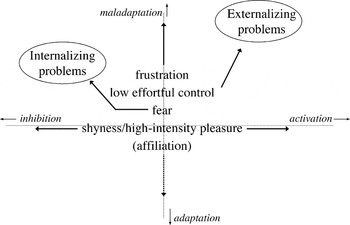
An overview of the assumed association of temperament factors with internalizing and externalizing roblems.
Aggressive behavior versus Attention problems
Originally, the CBCL Externalizing syndrome consisted of only Aggressive and Rule-breaking behavior (Achenbach, 1991a); the externalizing dimension used in this study includes Attention problems as well. To examine to what extent inclusion of Attention problems might have influenced our findings, we compared children with Aggressive behavior (without Attention problems, n = 132) to those with Attention problems (without Aggressive behavior, n = 120). One standard deviation above the mean was used as the cutoff point to distinguish between normal and disturbed behavior. Effortful Control was significantly (p < .01) lower for those with Attention problems, both in the group without and in the group with comorbid internalizing problems. Frustration was higher for Aggressive behavior in the group without comorbid internalizing symptoms. Other differences were small and not statistically significant. It should be noted, however, that more than half of the children with Aggressive behavior also had Attention problems and vice versa; hence, these “pure” groups represent only part of the children with externalizing problems.
Discriminant analyses
Discriminant analysis was done to find out which combination of temperament factors discriminated best between the four problem groups (i.e., NO, INT, EXT, and COM) in order to assess the effect of temperament factors adjusted for each other.
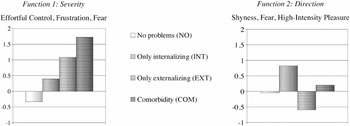
With four groups, the maximum number of possible discriminant functions is three. Two of these had significant values of Wilks' λ (χ2 = 841.36, df = 18, p < .01; and χ2 = 203.29, df = 10, p < .01), meaning they yielded significant group differences. The first function consisted mainly of Effortful Control and Frustration, and to a lesser extent Fear. (Pooled within-group correlations between the variables and the discriminant functions were −.77, .77, and .46, respectively; other correlations were ≤|.16|.) The second function was formed primarily by Shyness, Fear, and, to a lesser degree, High-Intensity Pleasure (variable-function correlations of .75, .63, and −.44, respectively; other correlations were ≤|.19|). Figure 3 displays the canonical discriminant functions evaluated at the means of the four problem groups. Each group had its own typical profile on these two functions: the NO and the COM group had low and high scores, respectively, on the first function and average scores on the second; the INT and the EXT group had intermediate scores on the first function and high and low scores, respectively, on the second.

The discriminant functions at the group centroids of the four problem groups.
These results support the aforementioned findings in that Effortful Control, Frustration, and Fear are important to distinguish between adaptive and maladaptive behavior and Shyness, High-Intensity Pleasure, and Fear to denote the conditional probability of mainly internalizing or externalizing problems. The results further suggest that, compared to the axis drawn in Figure 2, the discriminant functions may reflect dimensions that are slightly (15°–25°) rotated to the right.
Girls and boys
Stratification on gender revealed discriminant functions that were quite similar in girls and boys and comparable to those found in the total group; hence, the same (total-group) discriminant functions could be used to compare the discriminant scores of both genders. Girls and boys did not differ significantly with respect to their scores on the first discriminant function, F (1, 1970) = 2.61, p = .11, nor did we find a significant Gender × Problem-Group interaction, F (3, 1970) = 1.17, p = .32. Girls scored significantly higher, F (1, 1970) = 14.69, p < .01, than boys on the second discriminant function; we also found a trend for the interaction of Gender × Problem Group, F (3, 1970) = 2.36, p = .07, which was mainly caused by relatively high scores for girls in the NO group and the INT group.
Item-content overlap
Associations between temperament and psychopathology may partly be accounted for by item overlap between the questionnaires that are used. To trace overlapping items we performed a series of CFA and EFAs and removed items that loaded higher than .30 on the wrong factor or lower than .30 on the right factor (cf. Lemery et al., 2002). Concerning the CBCL internalizing dimension, no items were removed in combination with Frustration, one CBCL item (Fears going to school) was removed in combination with High-Intensity Pleasure and Effortful Control, and two CBCL items were removed in combination with Shyness (Fears going to school and Too shy or timid) and Affiliation (Fears going to school and Secretive). The largest overlap was found in combination with Fear, where we removed four items from the CBCL (Fears certain animals/situations/places, Fears going to school, Too fearful or anxious, Nightmares) and one from the EATQ (Worries about getting in trouble). With regard to the CBCL externalizing dimension, we found no problematic items for the combination with Affiliation; four CBCL items in combination with High-Intensity Pleasure, Shyness, and Fear (Physically attacks people, Sets fires, Steals outside the home, Thinks about sex too much); five CBCL items in combination with Frustration (Physically attacks people, Prefers being with older kids, Sets fires, Steals outside the home, Thinks about sex too much); and seven CBCL items in combination with Effortful Control (Sets fires, Steals outside the home, Thinks about sex too much, Doesn't finish what s/he starts, Can't concentrate or pay attention for long, Poor school work, Inattentive or easily distracted). Most often, items were removed because they (just) failed to reach the criterion of a loading > .30; items with high loading on the wrong dimensions were scarce. The fact that more CBCL than EATQ items were removed is conceivable considering the fact that the original item-selection criterion was more lenient for the dimensions of the CBCL (.25) than for the EATQ scales (.40).
Analyses with the purified scales (i.e., with items removed that might confound the association) yielded results that were very similar to the ones based on the full scales: the purified means were approximately the same in size as the original ones and the same effects were significant and had an effect size > .50. The only difference was found for Fear, where the purified scales had higher means in the NO and the EXT group, resulting in a reduced difference between the INT and the EXT group (purified effect size .27, p < .01).
The discriminant analysis was based on scales exclusive of all items that were found to be problematic in combination with at least one of the temperament scales, that is, 6 items (25%) from the internalizing dimension and 9 items (29%) from the externalizing dimension, leaving 18 and 22 items, respectively; and 1 item from the EATQ-Fear scale. Discriminant analysis yielded results comparable to that based on the scales including the (potentially) problematic items. As in the original analysis, two discriminant functions had significant values of Wilks' λ (χ2 = 638.51, df = 18, p < .01; and χ2 = 111.36, df = 10, p < .01); in other words, they yielded significant group differences. The first function consisted mainly of Effortful Control and Frustration, and to a lesser extent Fear. (Pooled within-group correlations between the variables and the discriminant functions were −.71, .84, and .38, respectively; correlations of Shyness and Surgency ≤|.02|; Affiliation .20.) The second function was formed primarily by Shyness, Fear, and, to a lesser degree, High-Intensity Pleasure (variable-function correlations of .64, .68, and −.43, respectively; correlations of Effortful Control and Frustration ≤|.13|; Affiliation .24). The pattern of canonical discriminant functions evaluated at the means of the four problem groups closely resembled the one presented in Figure 3. The NO and the COM group had low and high scores, respectively, on the first function and average scores on the second and the INT and the EXT group had intermediate scores on the first function and high and low scores, respectively, on the second. A complete report is available from the first author.
Self-reported problems
To examine to what extent the results held across informants, we also examined temperament scores in problem groups constructed on the basis of self-reported (instead of parent-reported) problems, using the YSR. Despite the partly different content of the externalizing dimension (excluding attention problems), we found similar patterns, though with smaller effect sizes, as in the CBCL problem groups for High-Intensity Pleasure (equal in the NO and COM group, lower in the INT group, higher in the EXT group), Frustration (scores increasing with severity), and Effortful Control (strong marker of externalizing problems). On average, the effect sizes were about two to three times smaller, but statistically significant (p < .01), and greater than .20, which Cohen (1988) defined as small. For Shyness, Fear, and Affiliation, differences were partly statistically insignificant, but all in the expected direction, with the exception of Fear in the COM group (lower than in the INT group), and Affiliation in the INT group (higher than in the NO group). A complete overview of means and effect sizes is available upon request.
Discussion
The aim of this study was to elucidate which temperament factors are associated with preadolescents' internalizing problems, externalizing problems, or both. The results suggest clearly diverging temperament profiles for these groups of children, with High-Intensity Pleasure and Shyness (representing the broad dimension of Surgency) steering the conditional probability of internalizing and externalizing problems (direction markers), Frustration (and perhaps also low Affiliation) mainly being related to maladaptation in general (severity markers), and Effortful Control and Fear being associated with both the severity and the direction of the problems. Girls and boys differed in the distribution across the problem groups, but the associations between temperament and psychopathology were comparable for both genders. Consistent with previous reports (e.g., Lemery et al., 2002; Lengua et al., 1998), the relation between temperament and psychopathology was unlikely to be confounded by item-content overlap between the questionnaires.
The results largely confirmed our hypotheses that Surgency would be associated with the conditional probability of internalizing (low Surgency) or externalizing problems (high Surgency), Negative Affectivity with the absolute probability of maladaptation, and Effortful Control with externalizing problems. The role of Fear deviated slightly from the expectations. Based on Putnam et al.'s (2001) study on early adolescents, Fear was assumed to be part of the broad factor of Surgency. In our sample of 10- to 12-year olds, i.e., in the transitional stage between childhood and adolescence, Fear appeared to have a high loading on Negative Affectivity as well, which is consistent with patterns found in younger children. This may explain why Fear was associated with both direction and severity, rather than with direction only, and was part of both discriminant functions.
Much previous research on (temperamental) correlates of child psychopathology took place within the framework of Gray's (1981, 1987) BIS and BAS. Quay (1988, 1993, 1997) found that externalizing behavior could be accounted for by (a) an underactive BIS, causing the BAS to initiate inappropriate behavior that would normally be inhibited by the BIS, (b) an overactive BAS, causing it to prevail over the BIS, or (c) both. More specifically, it has been suggested that a deficiency in the ability to inhibit behavior is the central deficit in ADHD (Barkley, 1997; Iaboni, Douglas, & Ditto,1997; Kooijmans et al., 2000), whereas oppositional defiant disorder (ODD) and conduct disorder (CD) are associated with a heightened sensitivity to cues for reward, leading to an increase in BAS behavior (Quay, 1993). Oosterlaan, Logan, and Sergeant (1998) reviewed studies on the relation between inhibitory control (e.g., measured by the stop signal task; Logan, Cowan, & Davis, 1984) and externalizing behavior. In most studies, normal children outperformed children with ADHD and ODD or CD, with the most marked effects for children with ADHD. In our sample, we found that the broad-band dimension of externalizing problems was associated with both low Shyness, pointing at an underactive BIS, and High-Intensity Pleasure, suggesting high BAS activation, which is consistent with Quay's (1988, 1993, 1997) previously mentioned notion. Within the externalizing dimension, children with attention (hyperactivity) problems and those with aggressive behavior did not differ with respect to Shyness and High-Intensity Pleasure, but children with attention problems had lower scores on Effortful Control, and children with aggressive problems showed higher levels of Frustration. These findings suggest that a reduced capacity to regulate behavior and attention may mediate the association between low BIS and ADHD; and that negative affect related to interruption of tasks or goal blocking, rather than the mere presence of an overactive BAS, may predispose to ODD or CD.
Concerning internalizing problems, a number of investigations (reviewed by Oosterlaan, 2001) showed that children high on the temperamental trait of inhibition are at increased risk to develop anxiety disorders later in their lives, and Quay (1988) suggested that overinhibition could be the underlying cause of anxiety disorders. The few studies that investigated the possible link between inhibitory control as measured by the stop task and internalizing problems yielded virtually no (Daugherty, Quay, & Ramos, 1993; Oosterlaan et al., 1998) or only partial (Kooijmans et al., 2000) support for this association. It is not yet known to what extent findings based on a stop task (measuring the ability to inhibit a prepotent response) are generalizable to other forms of inhibition (Nigg, 2000). Our results suggest that it might be important to distinguish between Shyness, which may be both a risk (with respect to internalizing problems) and a protective (with respect to externalizing problems) factor; and temperamental Fear, which seems to be more detrimental than beneficial.
Our analyses add to earlier studies that we were able to disentangle factors associated with the probability of problem behavior and factors codetermining the nature and direction of the problems, if any. Factors associated with the BIS and the BAS, which are Shyness and High-Intensity Pleasure (Surgency), appeared to be primarily indicators of direction (manifestation): they increased the probability of internalizing problems and decreased the probability of externalizing problems, or vice versa. The assumed dual nature of behavioral inhibition and activation (i.e., both risk-enhancing and protective, depending on the outcome) is in line with studies by Pliszka (1989), where children with concurrent ADHD and anxiety showed reduced impulsivity compared to children with ADHD alone; Bates, Pettit, & Dodge (1995), where internalizing behavior restrained the development of aggressiveness; and Walker et al. (1991), who found that boys with CD and comorbid anxiety were markedly less socially impaired than boys with CD alone. Only partly comparable, but seemingly contradictory, are results from the Pittsburgh Youth Study, where impulsive and disagreeable boys (so-called undercontrollers) were likely to have externalizing, but also comorbid internalizing and externalizing problems (Robins, John, Caspi, Moffitt, & Stouthamer–Loeber, 1996).
Whereas Surgency indicated the direction of the problems, Negative Affectivity (in this age group mainly Frustration) was associated with their severity: Frustration scores steadily increased from the group with no problems, through the internalizing and the externalizing group, to the comorbidity group. The assumption that Frustration is a general marker for maladaptation would imply that, in our sample, externalizing problems were more serious than internalizing problems. Higher average symptom scores and mental health care utilization rates in the externalizing group compared to the internalizing group supported the assumption. The severity of internalizing problems is likely to increase substantially in the years to come: the incidence of internalizing disorders rises sharply in adolescence (Oldehinkel et al., 1999).
As hypothesized, low Effortful Control was associated with a high probability of externalizing problems. We found only limited support for the protective role of Effortful Control with respect to internalizing problems: children with only internalizing problems scored lower on Effortful Control than those without problems, but the difference was small. This may be due to the fact that the protective effect of the ability to regulate emotional state (Shoda et al., 1990) and the risk to experience guilt or shame (Rothbart, Ahadi, & Hershey, 1994) largely counterbalance each other.
The affiliation system is supposed to play a role in maternal behaviors, attachment, pair bonding, and sexual behaviors (Panksepp, 1998). The fact that Affiliation was only weakly, if at all, associated with the (mal)adaptation and inhibition/activation may indicate that a third dimension, for example, reflecting sociality/individuality, is required to position this factor appropriately. It is also possible that the role of Affiliation will rise during adolescence, particularly in girls, which have been found to show an increase of affiliative need in this stage of life (e.g., Brooks–Gunn & Warren, 1989; Cyranowski et al., 2000; Insel & Hulian, 1995; Richards, Crowe, Larson, & Swarr, 1998).
Both psychopathology and temperament data were based on the same informant, i.e., the parent (usually the mother). Because people tend to describe other people in a less differentiated way than themselves (e.g., Mirels, Stevens, Greblo, and Yurek, 1998) and answers may suffer from response sets such as acquiescence and social desirability, this brings along the risk of inflated associations. Therefore, we checked whether the associations of temperament with parent-rated problem behavior could also be found for self-reported problems. Despite the low agreement between multiple informants of psychopathology (e.g., Achenbach et al., 1987; Verhulst & Van der Ende, 1992) and the partly different content of the externalizing dimension (excluding attention problems in the self-report version), we found comparable patterns, though with smaller effects, in the self-reported problem groups as in the parent-reported groups for all temperament factors, with only two exceptions: relatively low fear scores in children with comorbid problems, and relatively high affiliation in those with only internalizing problems.
Our study has a number of notable assets: it was based on a large population sample of preadolescents, covered several domains of psychopathology and individual (temperamental) differences, and employed multiple informants. Hence, we feel that it is an excellent starting point for further research. We propose three lines of extension. First, the range of problem behaviors could be extended with (mild) pervasive developmental problems such as social-interaction problems and stereotyped behaviors (e.g., Luteijn, Luteijn, Jackson, Volkmar, & Minderaa, 2000). Second, it will be interesting to see to what extent the cross-sectional associations reported here will also hold prospectively, so that high-risk groups can be identified and preventive actions targeted more precisely. For example, we may investigate whether the association between Negative Affectivity and future internalizing or externalizing psychopathology is modified by the presence or absence of adverse environments (e.g., Bates, 2001; Sanson et al., 1991). The longitudinal nature of our survey, TRAILS, allows us to investigate these questions in the future. A third extension is to include environmental factors, such as parenting behavior and life events, in the model. Earlier research on temperament–environment interactions (e.g., Bates, Pettit, Dodge, & Ridge, 1998; Kochanska, 1995) has revealed that this is an exciting and promising research area, which will help to improve our understanding of pathways to adaptive and maladaptive development.
Appendix A

Appendix B
Early Adolescent Temperament Questionnaire: Revised scale assignments
Effortful Control: The capacity to voluntarily regulate behavior and attention
Has a hard time finishing things on time. (reverse item [R])
Usually does something fun for a while before starting her/his homework, even though s/he is not supposed to. (R)
Finds it easy to really concentrate on a problem.
When interrupted or distracted, forgets what s/he was about to say. (R)
Has a difficult time tuning out background noise and concentrating when trying to study. (R)
Usually finishes her/his homework before it's due.
Usually gets started right away on difficult assignments. Usually puts off working on a project until it's due. (R)
Is often in the middle of doing one thing and then goes off to do something else without finishing it. (R)
Is usually able to stick with his/her plans and goals.
Pays close attention when someone tells her/him how to do something.
Fear: Worrying and unpleasant affect related to the anticipation of distress
Worries about getting into trouble.
Worries about our family when s/he is not with us.
Is afraid of the idea of me dying or leaving her/him.
Feels scared when entering a darkened room at night.
Is nervous being home alone.
Frustration: Negative affect related to interruption of ongoing tasks or goal blocking
Is annoyed by little things other kids do.
Gets very irritated when someone criticizes her/him.
Gets irritated when I will not take her/him someplace s/he wants to go.
Gets irritated when s/he has to stop doing something s/he is enjoying.
Hates it when people don't agree with him/her.
High-Intensity Pleasure: The pleasure derived from activities involving high intensity or novelty
Thinks traveling to Africa or India would be exciting and fun.
Would be frightened by the thought of skiing fast down a steep slope. (R)
Wouldn't be afraid to try a risky sport like deep sea diving.
Expresses a desire to travel to exotic places when s/he hears about them.
Would like driving a racing car.
Wouldn't want to go on the frightening rides at the fair. (R)
Shyness: Behavioral inhibition to novelty and challenge, especially social
Can generally think of something to say, even with strangers. (R)
Is shy.
Is not shy. (R)
Feels shy about meeting new people.
Affiliation: The desire for warmth and closeness with others
Likes taking care of other people.
Likes to be able to share his/her private thoughts with someone else.
Would like to be able to spend time with a good friend every day.
Enjoys exchanging hugs with people s/he likes.
Wants to have close relationships with other people.
Is quite a warm and friendly person.
References
REFERENCES
Achenbach, T. M.
(1991a).
Manual for the Child Behavior Checklist/4–18 and 1991
profile.
Burlington, VT:
University of Vermont.
Achenbach, T. M.
(1991b).
Manual for the Youth Self-Report and 1991 profile.
Burlington, VT:
University of Vermont.
Achenbach, T. M.,
McConaughty, S. H., &
Howell, C. T.
(1987).
Child/adolescent behavioral and emotional problems:
Implications of cross-informant correlations for situational
specificity.
Psychological Bulletin
101,
213–232.CrossRefGoogle Scholar
American Psychiatric Association.
(1994).
Diagnostic and statistical manual of mental disorders
(4th ed.).
Washington, DC:
Author.
Angold, A.,
Costello, E. J., &
Worthman, C. M.
(1998).
Puberty and depression: The roles of age, pubertal status and
pubertal timing.
Psychological Medicine
28,
51–60.CrossRefGoogle Scholar
Avila, C.
(2001).
Distinguishing BIS-mediated and BAS-mediated disinhibition
mechanisms: A comparison of disinhibition models of Gray (1981, 1987)
and of Patterson and Newman (1993).
Journal of Personality and Social Psychology
80,
311–324.CrossRefGoogle Scholar
Barkley, R. A.
(1997).
Behavioral inhibition, sustained attention, and executive
functions: Constructing a unified theory of ADHD.
Psychological Bulletin
121,
65–94.CrossRefGoogle Scholar
Bates, J. E.
(2001).
Adjustment style in childhood as a product of parenting and
temperament. In
T. D. Wachs &
G. A. Kohnstamm (Eds.),
Temperament in context (pp.
173–200).
Mahwah, NJ:
Erlbaum.
Bates, J. E.,
Pettit, G. S., &
Dodge, K. A.
(1995).
Family and child factors in stability and change in
children's aggressiveness in elementary school. In
J. McCord (Ed.),
Coercion and punishment in long-term perspective (pp.
124–138).
New York:
Cambridge University Press.
Bates, J. E.,
Pettit, G. S.,
Dodge, K. A., &
Ridge, B.
(1998).
Interaction of temperamental resistance to control and restrictive
parenting in the development of externalizing behavior.
Developmental Psychology
34,
982–985.CrossRefGoogle Scholar
Bebbington, P. E.,
Dunn, G.,
Jenkins, R.,
Lewis, G.,
Brugha, T.,
Farrel, M., &
Metzer, H.
(1998).
The influence of age and sex on the prevalence of depressive
conditions: Report from the National Survey of Psychiatric
Morbidity.
Psychological Medicine
28,
9–19.CrossRefGoogle Scholar
Brooks–Gunn, J., &
Warren, M. P.
(1989).
Biological contributions to affective expression in young
adolescent girls.
Child Development
60,
372–385.Google Scholar
Cohen, J.
(1988).
Statistical power analysis for the behavioral sciences
(2nd ed.).
Hillsdale, NJ:
Erlbaum.
Cyranowski, J. M.,
Frank, E.,
Young, E., &
Shear, K.
(2000).
Adolescent onset of the gender difference in lifetime rates of
major depression.
Archives of General Psychiatry
57,
21–27.CrossRefGoogle Scholar
Daugherty, T. K.,
Quay, H. C., &
Ramos, L.
(1993).
Response perseveration, inhibitory control, and central
dopaminergic activity in childhood behavioral disorders.
Journal of Genetic Psychology
154,
177–188.CrossRefGoogle Scholar
Derryberry, D., &
Reed, M. A.
(1994).
Temperament and the self-organization of personality.
Development and Psychopathology
6,
653–676.CrossRefGoogle Scholar
DeVries, A. C.,
Glasper, E. R., &
Detillion, C. E.
(2003).
Social modulation of stress responses.
Physiology and Behavior
79,
399–407.CrossRefGoogle Scholar
Elliot, A. J., &
Thrash, T. M.
(2002).
Approach–avoidance motivation in personality: Approach and
avoidance temperaments and goals.
Journal of Personality and Social Psychology
82,
804–818.CrossRefGoogle Scholar
Ellis, L. K.
(2002).
Individual differences and adolescent psychosocial development.
Unpublished doctoral dissertation,
University of Oregon.
Feingold, A.
(1994).
Gender differences in personality: A meta-analysis.
Psychological Bulletin
116,
429–456.CrossRefGoogle Scholar
Fowles, D. C.
(1993).
Biological variables in psychopathology: A psychobiological
perspective. In
P. B. Sutker &
H. E. Adams (Eds.),
Comprehensive textbook of psychopathology
(2nd ed., pp.
57–82).
New York:
Plenum Press.
Gray, J. A.
(1981).
A critique of Eysenck's theory of personality. In
H. J. Eysenck (Ed.),
A model of personality (pp.
246–276).
New York:
Springer.
Gray, J. A.
(1982).
The neuropsychology of anxiety: An enquiry of the septo-hippocampal
system.
Oxford:
Oxford University Press.
Gray, J. A.
(1987).
The psychology of fear and stress.
Cambridge:
Cambridge University Press.
Hoffmann, J. P., &
Su, S. S.
(1998).
Stressful life events and adolescent substance use and depression:
Conditional and gender differentiated effects.
Substance Use and Misuse
33,
2219–2262.CrossRefGoogle Scholar
Iaboni, F.,
Douglas, V. I., &
Ditto, B.
(1997).
Psychophysiological response of ADHD children to reward and
extinction.
Psychophysiology
34,
116–123.CrossRefGoogle Scholar
Insel, T. R., &
Hulian, T. J.
(1995).
A gender-specific mechanism for pair bonding: Oxytocin and partner
preference formation in monogamous voles.
Behavioral Neuroscience
109,
782–789.CrossRefGoogle Scholar
Jensen, P.,
Traylor, J.,
Xenakis, S. N., &
Davis, H.
(1988).
Child psychopathology rating scales and interrater agreement I:
Parents' gender and psychiatric symptoms.
Journal of the American Academy of Child & Adolescent
Psychiatry
27,
442–450.CrossRefGoogle Scholar
Kochanska, G.
(1995).
Children's temperament, mothers' discipline, and security
of attachment: Multiple pathways to emerging internalization.
Child Development
66,
597–615.CrossRefGoogle Scholar
Kochanska, G.,
Murray, K., &
Harlan, E. T.
(2000).
Effortful control in early childhood: Continuity and change,
antecedents, and implications for social development.
Developmental Psychology
36,
220–232.CrossRefGoogle Scholar
Kochanska, G.,
Murray, K.,
Jacques, T. Y.,
Koenig, A. L., &
Vandegeest, K. A.
(1996).
Inhibitory control in young children and its role in emerging
internalization.
Child Development
36,
220–232.Google Scholar
Kooijmans, R.,
Scheres, A., &
Oosterlaan, J.
(2000).
Response inhibition and measures of psychopathology: A dimensional
analysis.
Child Neuropsychology
6,
175–84.CrossRefGoogle Scholar
Krueger, R. F.,
Caspi, A.,
Moffitt, T. E.,
Silva, P. A., &
McGee, R.
(1996).
Personality traits are differentially linked to mental disorders: A
multitrait-multidiagnosis study of an adolescent birth cohort.
Journal of Abnormal Psychology
105,
299–312.CrossRefGoogle Scholar
Lemery, K. S.,
Essex, M. J., &
Smider, N. A.
(2002).
Revealing the relation between temperament and behavior problem
symptoms by eliminating measurement confounding: Expert ratings and
factor analyses.
Child Development
73,
876–882.Google Scholar
Lengua, L. J.,
West, S. G., &
Sandler, I. N.
(1998).
Temperament as a predictor of symptomatology in children: Assessing
contamination of measures.
Child Development
69,
164–181.CrossRefGoogle Scholar
Linn, R. L.
(1968).
A Monte Carlo approach to the number of factors problem.
Psychometrika
33,
37–71.CrossRefGoogle Scholar
Logan, G. D.,
Cowan, W. B., &
Davis, K. A.
(1984).
On the ability to inhibit thought and action: A model and method.
Journal of Experimental Psychology
10,
276–291.Google Scholar
Luteijn, E.,
Luteijn, F.,
Jackson, S.,
Volkmar, F., &
Minderaa, R.
(2000).
The Children's Social Behavior Questionnaire for milder
variants of PDD problems: Evaluation of the psychometric
characteristics.
Journal of Autism and Developmental Disorders
30,
317–330.CrossRefGoogle Scholar
Maziade, M.
(1989).
Should adverse temperament matter to the clinician? In
G. A. Kohnstamm,
J. E. Bates, &
M. K. Rothbart (Eds.),
Temperament in childhood (pp.
421–435).
New York:
Wiley.
Mesman, J., &
Koot, H. M.
(2000).
Common and specific correlates of preadolescent internalizing and
externalizing psychopathology.
Journal of Abnormal Psychology
109,
428–437.CrossRefGoogle Scholar
Mirels, H. L.,
Stevens, F.,
Greblo, P., &
Yurek, D. L.
(1998).
Differentiation in personality descriptions of the self and others.
Personality and Individual Differences
25,
663–681.CrossRefGoogle Scholar
Newman, D. L.,
Moffitt, T. E.,
Caspi, A.,
Magdol, L.,
Silva, P. A., &
Stanton, W. R.
(1996).
Psychiatric disorders in a birth cohort of young adults:
Prevalence, comorbidity, clinical significance, and new case incidence
from ages 11 to 21.
Journal of Consulting and Clinical Psychology
64,
552–562.CrossRefGoogle Scholar
Nigg, J. T.
(2000).
On inhibition/disinhibition in developmental psychopathology:
Views from cognitive and personal psychology and a working inhibition
taxonomy.
Psychological Bulletin
126,
1–27.Google Scholar
Oldehinkel, A. J., &
Hartman, C. A.
(2003).
Early Adolescent Temperament Questionnaire—parent version.
Constructs and scales.
Unpublished manuscript,
University of Groningen, Groningen, The Netherlands.
Oldehinkel, A. J.,
Wittchen, H.-U., &
Schuster, P.
(1999).
Prevalence, 20-month incidence and outcome of unipolar depressive
disorders in a community sample of adolescents.
Psychological Medicine
29,
655–668.CrossRefGoogle Scholar
Oosterlaan, J.
(2001).
Behavioural inhibition and the development of childhood anxiety
disorders. In
W. K. Silverman &
Ph. D. A. Treffers (Eds.),
Anxiety disorders in children and adolescents: Research, assessment
and intervention (pp.
45–71).
New York:
Cambridge University Press.
Oosterlaan, J.,
Logan, G. D., &
Sergeant, J. A.
(1998).
Response inhibition in ADHD, CD, comorbid ADHD+CD, anxious and
normal children: A meta-analysis of studies with the stop task.
Journal of Child Psychology and Psychiatry
39,
411–425.CrossRefGoogle Scholar
Panksepp, J.
(1998).
Affective neuroscience: The foundations of human and animal
emotions.
New York:
Oxford University Press.
Pliszka, S. R.
(1989).
Effect of anxiety on cognition, behavior, and stimulant response in
ADHD.
Journal of the American Academy of Child & Adolescent
Psychiatry
28,
882–887.CrossRefGoogle Scholar
Putnam, S. P.,
Ellis, L. K., &
Rothbart, M. K.
(2001).
The structure of temperament from infancy through adolescence. In
A. Eliasz &
A. Angleitner (Eds.),
Advances/proceedings in research on temperament (pp.
165–182).
Berlin:
Pabst Scientist Publisher.
Quay, H. C.
(1988).
Theories of ADHD.
Journal of the American Academy of Child & Adolescent
Psychiatry
27,
262–263.CrossRefGoogle Scholar
Quay, H. C.
(1993).
The psychobiology of undersocialized aggressive conduct disorder: A
theoretical perspective.
Development and Psychopathology
5,
165–180.CrossRefGoogle Scholar
Quay, H. C.
(1997).
Inhibition and attention deficit hyperactivity disorder.
Journal of Abnormal Child Psychology
25,
7–13.CrossRefGoogle Scholar
Renouf, A. F., &
Kovacs, M.
(1994).
Concordance between mothers' reports and children's
self-reports of depressive symptoms: A longitudinal study.
Journal of the American Academy of Child & Adolescent
Psychiatry
33,
208–216.CrossRefGoogle Scholar
Richards, M. H.,
Crowe, P. A.,
Larson, R., &
Swarr, A.
(1998).
Developmental patterns and gender differences in the experience of
peer companionship during adolescence.
Child Development
69,
154–163.CrossRefGoogle Scholar
Robins, R. W.,
John, O. P.,
Caspi, A.,
Moffitt, T. E., &
Stouthamer–Loeber, M.
(1996).
Resilient, overcontrolled, and undercontrolled boys: Three
replicable personality types.
Journal of Personality and Social Psychology
70,
157–171.CrossRefGoogle Scholar
Rothbart, M. K.,
Ahadi, S. A., &
Evans, D. E.
(2000).
Temperament and personality: Origins and outcomes.
Journal of Personality and Social Psychology
78,
122–135.CrossRefGoogle Scholar
Rothbart, M. K.,
Ahadi, S. A., &
Hershey, K. L.
(1994).
Temperament. In
W. Damon &
N. Eisenberg (Eds.),
Handbook of child psychology. Social, emotional, personality
development (pp.
105–176).
New York:
Wiley.
Rothbart, M. K., &
Putnam, S. P.
(2002).
Temperament and socialization. In
L. Pulkkinen &
A. Caspi (Eds.),
Paths to successful development (pp.
19–45).
Cambridge:
Cambridge University Press.
Rubin, K. H., &
Asendorpf, J. B.
(1993).
Social withdrawal, inhibition, and shyness in childhood.
Hillsdale, NJ:
Erlbaum.
Sameroff, A. J., &
Chandler, M. J.
(1975).
Reproductive risk and the continuum of caretaking causality. In
F. Horowitz (Ed.),
Review of child development research (pp.
187–244).
Chicago:
University of Chicago Press.
Sanson, A.,
Oberklaid, F.,
Pedlow, R., &
Prior, M.
(1991).
Risk indicators: Assessment of infancy predictors of pre-school
behavioral maladjustment.
Journal of Child Psychology and Psychiatry
32,
609–626.CrossRefGoogle Scholar
Shoda, Y.,
Mischel, W., &
Peake, P. K.
(1990).
Predicting adolescent cognitive and self-regulatory competencies
from preschool delay of gratification: Identifying diagnostic
conditions.
Developmental Psychology
26,
978–986.CrossRefGoogle Scholar
Stevens, J. P.
(2002).
Applied multivariate statistics for the social sciences
(4th ed.).
Mahwah (NJ):
Erlbaum.
Verhulst, F. C.
(1995).
A review of community studies. In
F.C. Verhulst &
H.M. Koot (Eds.),
The epidemiology of child and adolescent psychopathology (pp.
146–177).
London:
Oxford University Press.
Verhulst, F. C., &
Achenbach, T. M.
(1995).
Empirically based assessment and taxonomy of psychopathology:
Cross-cultural applications.
European Child and Adolescent Psychiatry
4,
61–76.CrossRefGoogle Scholar
Verhulst, F. C., &
Van der Ende, J.
(1992).
Agreement between parents' reports and adolescents'
self-reports on problem behavior.
Journal of Child Psychology and Psychiatry
33,
1011–1023.CrossRefGoogle Scholar
Verhulst, F. C., &
Van der Ende, J.
(1993).
“Comorbidity” in an epidemiological sample: A
longitudinal perspective.
Journal of Child Psychology and Psychiatry
34(5),
767–783.CrossRefGoogle Scholar
Verhulst, F. C.,
Van der Ende, J.,
Ferdinand, R. F., &
Kasius, M. C.
(1997).
The prevalence of DSM-III-R diagnoses in a national sample of Dutch
adolescents.
Archives of General Psychiatry
54,
329–336.CrossRefGoogle Scholar
Wachs, T. D., &
Bates, J. E.
(2001).
Temperament. In
G. Bremmer &
A. Foge (Eds.),
Blackwell handbook of infant development (pp.
465–502).
Malden, MA:
Blackwell.
Walker, J. L.,
Lahey, B. B.,
Russo, M. F.,
Frick, P. J.,
Christ, M. A.,
McBurnett, K.,
Loeber, R.,
Stouthamer–Loeber, M., &
Green, S. M.
(1991).
Anxiety, inhibition, and conduct disorder in children: I. Relations to
social impairment.
Journal of the American Academy of Child & Adolescent
Psychiatry
30,
187–191.CrossRefGoogle Scholar
Windle, M.
(1994).
Temperamental inhibition and activation: hormonal and psychosocial
correlates and associated psychiatric disorders.
Personality and Individual Differences
17,
61–70.CrossRefGoogle Scholar
Distribution (number and percentage) of the four CBCL problem groups in girls and in boys
Mean Child Behavior Checklist internalizing and externalizing problem scores for the four problem groups.
Mean temperament scores of the four problems groups
An overview of the assumed association of temperament factors with internalizing and externalizing roblems.
The discriminant functions at the group centroids of the four problem groups.
 You have
Access
- 268
- Cited by