




No CrossRef data available.
Article contents
Complete sequence and structure of the mitochondrial genome of the human tapeworm, Taenia asiatica (Platyhelminthes; Cestoda)
Published online by Cambridge University Press: 03 February 2005
Abstract
The complete Taenia asiatica mitochondrial genome was amplified by long extension polymerase chain reaction (long PCR) to yield overlapping fragments that were then completely sequenced. The whole mitochondrial genome was 13703 bp long and contained 12 protein-encoding, 2 ribosomal RNA (small and large subunits), 22 transfer RNA genes and a short non-coding region. Thus, its gene contents are like those typically found in metazoan animal mitochondrial genomes (apart from the absence of atp8). All the genes were transcribed from the same strand. The 3′ end 34 bp region of nad4L overlapped with the 5′ end portion of nad4. The tRNA genes were 61–69 bp long, and the secondary structures of 18 tRNAs had typical clover-leaf shapes with paired DHU arms. However, trnC, trnS1, trnS2 and trnR had unpaired DHU arms that were 7–12 bp in length. The tRNAs that transferred serine lacked a DHU arm, as is also observed in a number of parasitic platyhelminths and metazoans. However, the trematode trnRs have paired DHU arms. The T. asiatica mtDNA non-coding region was like that in other cestodes since it was composed of a short non-coding region of 72 nucleotides and a long non-coding region of 176 nucleotides separated by a trnL1/, trnS2/, trnL2/, trnR/, nad5 gene cluster. The sequences of the cox1 genes between T. asiatica and T. saginata differ by 4·6%, while the T. asiatica cob gene differs by 4·1% and 12·9% from the cob genes of T. saginata and T. solium, respectively. In conclusion, the T. asiatica mitocondrial genome should provide a resource for comparative mitochondrial genomics and systematic studies of parasitic cestodes.
Keywords
Information
- Type
- Research Article
- Information
- Copyright
- © 2005 Cambridge University Press
INTRODUCTION
Taenia solium (Linnaeus, 1758), T. saginata (Goeze, 1782) and T. asiatica (Eom & Rim, 1993) are human-infecting taeniid tapeworms that use cattle or swine as intermediate hosts. T. asiatica has been described on the basis of the morphological characteristics of its adult worms, which bear an unarmed rostellum, a large number of uterine twigs, and a posterior protuberance on the gravid proglottids (Eom & Rim, 1993). The life-cycle of this cestode differs from that of T. saginata in that it uses a different intermediate host for the completion of its life-cycle. T. saginata infects the skeletal muscle of cattle while, the larval stages of T. asiatica infects the visceral organs such as the liver, omentum, serosa and lung, but not the muscle of pigs (Eom, Rim & Geerts, 1992; Eom & Rim, 1992a,b). The metacestode of T. asiatica (Cysticercus viscerotropica) also differs morphologically from that of T. saginata (C. bovis) since its diameter differs and it induces wart-like formations on the external surface of the bladder wall (Eom & Rim, 1993). Thus, on the basis of the morphology of the metacestodes and the adult worms, their life-cycles, their host ranges, and various molecular characteristics, T. asiatica appears to differ substantially from T. saginata. Despite this, it has been suggested that T. asiatica is a subspecies of T. saginata (Bowles & McManus, 1994; Fan & Chung, 1998). However, another view advocated by Eom & Rim (1993) is that it is a new species of human-specific Taenia. Supporting the latter classification are the phylogenetic studies involving morphological and molecular analyses, which have indicated that T. asiatica is indeed a distinct species, but one that is closely related to T. saginata and more distantly related to T. solium (Zarlenga et al. 1991; Zarlenga & George, 1995; Galan-Puchades & Mas-Coma, 1996; De Queiroz & Alkire, 1998; Galan-Puchades & Fuentes, 2000; Hoberg et al. 2000; Schantz, 2000; Eom et al. 2002; Ito, Nakao & Wandra, 2003).
Recently, complete mitochondrial genomes of various members of the phylum Platyhelminthes have been characterized in detail, namely, Fasciola hepatica (Le, Blair & McManus, 2001), Hymenolepis diminuta (Von Nickisch-Rosenegk, Brown & Boore, 2001) and Echinococcus granulosus (Le, Blair & McManus, 2002). In addition to these, more than 100 complete or nearly complete mitochondrial genomes of various Metazoa from differential phyla have been reported (Boore, 1999; Saccone et al. 1999). The comparative analysis of mitochondrial genomes has often been used in phylogenetic studies over the last decade. The mitochondrial gene sequence and gene order are believed to be very useful molecular markers for not only studying evolutionary relationships among distantly related taxa (Boore, 1999), but also for investigating the phylo-biogeography of closely related species, including species-level taxonomy (Le et al. 2002). Here, we describe our characterization of the complete mitochondrial genome of T. asiatica. We also compare this mitogenomic information with that of other platyhelminths, i.e., T. saginata, T. solium, T. crassiceps, E. multilocularis, E. granulosus G1 and G4, H. diminuta, F. hepatica and Paragonimus westermani.
MATERIALS AND METHODS
Isolation of T. asiatica mtDNA
T. asiatica adults were collected from infected Korean patients after treatment with niclosamide and then purgation with MgSO4. The samples were each divided into 2 parts, which were then preserved in a −70 °C deep freezer and in 70% ethanol. About 10 gravid proglottids were longitudinally disrupted and the living eggs were collected from terminal proglottids in distilled water and kept at 4 °C.
In this study, frozen terminal proglottid specimens were used for DNA extraction. Total genomic DNA was extracted from a single frozen specimen that was chopped into small pieces and digested for 30 min in DNA extraction buffer (20 mM Tris base-HCl pH 7·5, 25 mM EDTA, 75 mM NaCl, 0·1% SDS, 0·5 mg/ml proteinase K) at 65 °C. The cellular debris was removed and the genomic DNA was extracted using the phenol/chloroform extraction protocol. DNA was then precipitated in 3 M sodium acetate (pH 5·2) and 2 volumes of 95% ethanol were added, after which the DNA was dried. The pellet was subsequently dissolved in 50 μl TE buffer.
PCR amplification and DNA sequencing
The total length of the mitochondrial genome was amplified in 3 overlapping fragments by the long PCR technique using ‘Expand long template PCR system (5 units/μl, Roche, Mannheim, Germany)’. Three overlapping fragments of T. asiatica mtDNA were amplified by using 6 oligonucleotide primers based on the mtDNA sequences of T. crassiceps (Le, Blair & McManus, 2000). These were mtf2 (CAT ATG TTT ACG GTT GGG TTA GA) and mtr3 (GGG TGA CGG GCG GTG TGT AC); mtf1 (GAC TGG TAA GTT AAT TTA AAC TGT) and mtr2 (CAT ATG TTT ACG GTT GGG TTA GA); and mtf3 (GCC AAG TCT ATG TGA TGA TTA T) and mtr1 (CCA CAG TTT AAA TTA ACT TAC CAG). These primers were used in long PCR, which first employed 40 cycles of 96 °C for 20 s, 58 °C for 40 s, 68 °C for 6 min and incubation at 68 °C for 4 min. This resulted in 2·5 kb, 3·7 kb and 7·5 kb DNA fragments, which were isolated on a 1·0% agarose gel, excised under long-wave UV light, and extracted using a QIAquick PCR purification kit (Qiagen Co.).
The purified PCR-amplified overlapping fragments of the mitochondrial DNA were then separately cloned. Ligation of the fragments was performed overnight at 15 °C using the pGEM-T easy vector kit (Promega Co.). The ligates were transformed into the DH5α cell line. Plasmid DNA was then purified by using a QIAprep spin miniprep kit (Qiagen Co.). The primer walking method was employed to obtain overlapping sequences for each of the amplified fragments. Cyclic sequencing from both ends of the fragments was performed by using a Big-Dye Terminator sequencing kit (Applied Biosystems Co.) and the reaction products were electrophoresed on an ABI 3100 automated DNA sequencer.
Sequence analysis
The sequences were assembled and aligned by using Clustal X (Thompson et al. 1997) and BioEdit (BIOSOFT CO.) programs. The sequenced regions were identified by comparing them using BLAST searches with those of Platyhelminthes that had been deposited in the GenBank database. The presence of 12 protein-encoding genes in the mtDNA was confirmed by multiple comparisons with mitochondrial gene sequences available in the GenBank database. The Platyhelminthes mitochondrial genetic code (Garey & Wolstenholme, 1989; Le et al. 2000; Nakao et al. 2000) was used to translate the mitochondrial protein-coding genes. Two ribosomal RNA genes (12S and 16S) were determined based on their sequence similarity with those found in other parasitic Platyhelminthes. Twenty-two tRNA genes were identified by preliminary screening with tRNAscan-SE (Lowe & Eddy, 1997) and their final secondary structures were predicted by RNAdraw (Matzura & Wennborg, 1996) program. The mitochondrial genome sequence of T. asiatica was compared with that of T. saginata (GenBank Accession numbers AF031285, AB066495, AB066581 and AY195858), T. solium (AB086256), T. crassiceps (AF216699), E. multilocularis (AB018440), E. granulosus G1 genotype (AF297617), E. granulosus G4 genotype (AF346403), H. diminuta (AF314223), F. hepatica (AF216697) and Paragonimus westermani (AF219379).
RESULTS
Gene content and organization
The complete mtDNA sequence of T. asiatica is 13703 bp in length (Fig. 1). The proportion of the mitochondrial genome of T. asiatica that consists of protein-coding genes is around 74%, which is similar to that observed in other cestodes. Table 1 shows the positions of the gene loci in the mitochondrial genome of T. asiatica. The mitochondrial gene arrangement of T. asiatica is presented in Fig. 2. This mitochondrial genome is composed of 36 genes, which is also true for the other platyhelminth mitochondrial genomes that have been analysed to date. The mitochondrial genome contains the genes for 12 proteins (3 subunits of cytochrome c oxidase, cox1, cox2 and cox3; 1 subunit of cytochrome b, cob; 7 subunit of NADH dehydrogenase, nad1, nad2, nad3, nad4, nad4L, nad5 and nad6; and 1 subunit of ATP synthase, atp6); 22 tRNAs (trns) and the small and large subunit ribosomal RNAs, rrnS and rrnL. All are transcribed in the same direction. Like the mtDNAs of the other flatworms reported to date (Le et al. 2000, 2002; von Nickisch-Rosenegk et al. 2001), the atp8 gene is absent from the T. asiatica mtDNA. The mitochondrial gene arrangements of the cestodes are identical to that of T. asiatica, with the exception of H. diminuta, whose trnL1 and trnS2 genes are reversed (von Nickisch-Rosenegk et al. 2001). The mtDNA non-coding region of the human-infecting taeniid tapeworms T. asiatica is composed of 2 regions, namely, a short non-coding region (SNR; 72) and a long non-coding region (LNR; 176). Notably, however, while the 34 bp region at the 3 end of nad4L in T. asiatica overlaps with the 5′ end portion of the nad4 gene. Nevertheless, the overlaps of up to 10 bp that are observed between the 3 ends of cox1 and trnT in all the cestode mitochondrial genomes published to date, including T. solium (M. Nakao, AB086256) are also found in T. asiatica (14 bp; T. solium shows a 9 bp overlap). In contrast to the other cestodes, however, the mtDNAs of T. asiatica do not show an overlap between the trnQ and trnF genes.

Fig. 1. Arrangement of the mitochondrial genome of Taenia asiatica. All genes are coded by the same strand and are transcribed in a clock-wise direction. All genes follow the standard nomenclature except for the 22 tRNA genes, which are designated by one letter code for the corresponding amino acid. The leucine and serine tRNA genes are respectively denoted as L1 and L2 (for codon families CUN and UUR, respectively) and S1 and S2 (for codon families AGN and UCN, respectively). SNR and LNR refer to the short and long non-coding regions, respectively.

Fig. 2. Schematic presentation of the complete coding sequence of the Taenia asiatica mitochondrial genome. The genome consists of 12 protein-coding genes, 2 ribosomal (large and small subunits), 22 transfer RNA genes and 2 non-coding regions. The fully annotated sequence can be found in the GenBank under Accession number AF445798.

Protein genes and codon usage
The mitochondrial genome of T. asiatica appears to use the flatworm mitochondrial code, namely, ATA for isoleucine, TGA for tryptophan, and AGR for serine. All the ORFs of the 12 protein-coding genes of T. asiatica mtDNA start and end by utilizing complete codons. TAG or TAA is used for termination, with 5 genes (cox3, nad4L, nad4, nad3 and cox2) using the TAG stop codon and the remaining 7 genes (cob, atp6, nad1, nad2, nad5, nad6 and cox1) using TAA (Table 1). The protein-coding genes of T. solium are also exclusively terminated with TAG or TAA, although 3 genes (nad4L, cox1 and nad6) are terminated with TAG instead of TAA or vice versa compared to the same genes in the mtDNA of T. asiatica (Table 1). With regard to the initiation codon, ATG is used in the 12 protein-coding genes of T. asiatica and GTG is used as the initiation codon by 11 of the 12 genes in T. solium. The 10 most used codons (Phe (TTT), Leu (TTA), Ile (ATT and ATA), Tyr (TAT), Leu (TTG), Asn (ATT), Cys (TGT), Val (GTT), Ser (AGT), and Gly (GGT)) are all AT rich and 8 contained a thymidine in the 3rd position. In contrast, the least used codons (Leu (CTT and CTC), Ile (ATC), Pro (CCC), Thr (ACC), Ala (GCC), His (CAC), Arg (CGT), Cys (TGC), Gly (GGC)) mostly contain a cytidine at the 1st or 3rd position.
Nucleotide and amino acid composition
The A+T content of the complete mtDNA genome of T. asiatica is 71·4% (Table 3). The nucleotide composition of the mitochondrial genome of T. asiatica is 24·3% A, 48·1% T, 20·6% G. Platyhelminths use the AAA codon to specify asparagine and AGA or AGG to specify serine and TGA to specify tryptophan. The amino acid compositions of the protein-coding mtDNA sequences of T. asiatica and T. solium are shown in Table 2. Phenylalanine (TTY; 12·3%), leucine (TTR; 14·7%), serine (AGN, TCN; 10·7%) and valine (GTN; 10·4%) constitute almost 50% of all the amino acids of both species. This is due to the high T and low C content in the genes, as the frequency of codons ending with T, A, G and C is 53·2%, 21·3%, 14·4% and 6·9%, respectively (Table 2). The high usage of T-ending codons in T. asiatica and T. solium is responsible for the high frequent use of phenylalanine (TTT; 11·7%). The mitochondrial genomes of the Platyhelminths generally use codons that can end in either T or A quite frequently. Consistent with this is that phenylalanine, leucine and valine are frequently used in the mitochondrial proteins of T. asiatica (Table 2).


Transfer RNAs
The mitochondrial genome of T. asiatica contains 22 tRNA-encoding genes, like other metazoans, and their putative secondary structures are illustrated in Fig. 3. The lengths of these tRNA genes vary from 61 bp to 69 bp. The inferred putative secondary structures of the 18 of the tRNAs have the typical clover-leaf shape. However, the secondary structure of trnA, trnC, trnS1 and trnS2 have unpaired DHU-arms with a 7–12 bp long loop. The tRNAs that are specific for serine in other parasitic platyhelminths also lack a DHU arm, like the trnS genes in a number of other metazoan mitochondrial genomes. For example, the secondary structure of trnS in trematodes has an unpaired DHU arm, although in contrast their trnA has a paired DHU arm that is lacking in cestodes. Although the amino-acyl acceptor arms in all the predicted tRNA secondary structures of T. asiatica consist of 7 bp, trnN, trnG, trnP, trnS1, trnS2 and trnT were found to contain one or two non-canonical base pairs in this arm. The anticodon stems of 21 genes are all 5 bp-long, which is typical, except that of trnN, which is 4 bp long; a T[ratio ]T mispair could form a fourth pair at the base of this latter stem. The anticodon loop consists of 7 bp in all of the mitochondrial tRNAs of T. asiatica. The trnA, trnN, trnA, trnG, trnL, trnP, trnS1, trnS2, trnT and trnY have 4-fold degenerate codons and trnN, trnA and trnK have C, A and G in their wobble positions in that order, as has also been found in other flatworms. The lengths of the tRNAs in the 5 cestode mitochondrial genomes are almost identical to those of T. asiatica. The largest length of tRNAs is almost same among 5 cestode mitochondrial genomes. The largest length difference (8 bp) was found in the trnL1 tRNAs of T. asiatica (73 bp long) and T. crassiceps (65 bp long).

Fig. 3. DNA sequences of the 22 tRNA genes of Taenia asiatica and their inferred secondary structures. All have paired DHU arms except for the cysteine, arginine, serine 1 and serine 2 tRNAs, which have unpaired DHU arms. The unpaired DHU arms in serine tRNAs are also observed in most other cestodes and trematodes. The unpaired DHU arm in the arginine tRNA is also observed in most other cestodes, although trematodes have a paired DHU arm in their arginine tRNAs.
Non-coding regions
Sequence comparisons of the Taenia mtDNA non-coding regions revealed that their A+T contents exceed 77%. As mentioned above, the mtDNA non-coding region of T. asiatica is composed of the 72 bp SNR between trnL1 and trnS and the 176 bp LNR between trnY and nad5 (Fig. 4). The sequences of the mtDNA non-coding regions of T. asiatica were compared with those in the 5 cestodes, namely, E. multilocularis (M. Nakao, AB018440), E. granulosus (Le et al. 2002), T. crassiceps (Le et al. 2000), T. solium (M. Nakao, AB086256) and H. diminuta (von Nickisch-Rosenegk, Brown & Boore, 2001). The non-coding regions of these species varied in size from 65–183 bp in the SNR and from 176–443 bp in the LNR. The SNRs were all almost the same length except for the unusually long SNR (183 bp) in E. multilocularis. Thus, the SNR of T. asiatica was 72 bp while those of T. solium, T. crassiceps and E. granulosus were 70, 65 and 66 bp long, respectively. The LNRs in the cestodes were 176, 192, 194, 184, and 177 bp long in T. asiatica, T. solium, T. crassiceps, E. granulosus G1 and E. multilocularis, respectively.

Fig. 4. The putative secondary structures of the non-coding regions of Taenia asiatica that are found between nad5 and trnG or between trnY and trnL1. SNR has 1 hairpin and LNR has 4 hairpin structures. The 5′ flanking sequences have the consensus sequences TATA, while the 3′ flanking sequences share the sequence consensus GAT.
Mitochondrial sequence differences in human-infecting Taenia tapeworms
We compared 3 species by percentage pair-wise comparison of nucleotide and amino acid composition for cox1, cob and nad4 genes. The sequences of the cox1 genes (1620 bp) between T. asiatica and T. saginata differ by 4·6%, while the T. asiatica cob gene (1067 bp) differ by 4·1% and 12·9% from the cob genes of T. saginata and T. solium, respectively. The nad4 gene exhibits greater levels of sequence differences (Table 4). The previous study by Bowles & McManus (1994) reported that the sequences of partial cox1 genes of 366 bp at the position of 742 to 1107 between T. asiatica and T. saginata differed by 2·2%, whereas Zarlenga & George (1995) reported that the banding fragments observed between T. asiatica and T. saginata differed by 4·6%. When we compared partial sequence of cox1 gene, the sequence differences of our data varied from 2% at the conserved position of 742 to 1107 to 7% at the variable position of 25 to 340. This means the partial sequences of cox1 gene may lead us to biased analysis and do not provide better information on genetic identity of these species than complete sequence data of whole 1620 bp that exhibits 4·6% difference. These features of mtDNA suggest that T. asiatica and T. saginata are considered to be sister species.

DISCUSSION
The mitochondrial genome of the parasitic cestodes, reported to date, ranges from 13503 to 13900 bp in length: T. solium is 13709 bp long (GenBank Accession number AB086256), T. crassiceps is 13503 bp (AF216699), E. mutilocularis is 13737 bp (AB018440), E. granulosus G1 genotype is 13588 bp (AF297617), E. granulosus G4 genotype is 13598 bp (AF346403), and H. diminuta is 13900 bp (AF314223). In addition, the partial sequence of the mitochondrial DNA of T. saginata is also available (AY195858).
The genetic code of the platyhelminth mitochondrial genome has been investigated by Garey & Wolstenholme (1989). The peculiar codon usage has been observed in several of the other cestode mitochondrial genomes. While most of the genes in these mitochondrial genomes use ATG for initiation, like in other metazoans, GTG is used as the initiation codon by some of the protein-encoding genes in E. granulosus G1 genotype (nad1, nad4L, cox1 and cox2), E. multilocularis (nad4L and cox1), T. crassiceps (cox3, nad4L and nad3) and T. solium (nad4). In addition, GTA is utilized as the initiation codon in the cox1 gene of E. multilocularis. It is interesting to note that while GTG or GTA specifies valine in all known metazoan universal genetic codes, it is also known to initiate transcription in metazoan mitochondrial genes (Wolstenholme, 1992). Other unusual initiation codons, such as ATA or ATT and TTG or GTT, have been reported to specify translation initiation in nematode mitochondrial genomes (Okimoto et al. 1992; Keddie, Higazi & Unnasch, 1998).
Two conserved sequence motifs, TATA and GAA(A)T or G(T)nA, were found in the 5′ and 3′ end regions, respectively, of a stem-and-loop structure in the SNR and LNR of T. asiatica mtDNA. These motifs have a conserved secondary hairpin structure and are known to serve as the initiation sites of second L-strand synthesis in other metazoan animal groups, including mammals (Clary & Wolstenholme, 1987). These conserved sequence motifs are also evident in the control regions of most of the other cestode mitochondrial genomes that have been examined. The gene arrangement in the mitochondrial genome of T. asiatica was the same as that in the T. solium, T. crassiceps, E. multilocularis and E. granulosus mitochondrial genomes. However, it differed from that in H. diminuta but only in the sense that the positions of the trnS2 and trnL1 tRNA genes were reversed. With the exception of schistosomes, the gene arrangement of the T. asiatica mitochondrial genome was like that of other cestodes and trematodes, including T. solium, T. crassiceps, E. granulosus, E. multilocularis, H. diminuta, F. hepatica and P. westermani.
Finally, the complete sequence differences we report here among cox1, cob and nad4 genes of T. asiatica and T. saginata are consistent with the conclusion that T. asiatica is a sister species (Zarlenga et al. 1991; Zarlenga & George, 1995; Galan-Puchades and Mas-Coma, 1996; Alkire et al. 1998; Galan-Puchades and Fuentes, 2000; Hoberg et al. 2000; Schantz, 2000; Eom et al. 2002; Ito et al. 2003). This information will add to the knowledge of mitochondrial genomics of parasitic cestodes, provides a resource for the comparative mitochondrial genome analyses of cestodes, and may yield genetic markers for molecular epidemiological investigations into taeniid parasites.
One author (H. K. Jeon) was supported by a research intern programme in Korean employment sponsored by the engineering foundation from KOSEF (M02-2001-000-10076-0). The authors thank Dr Joong-Ki Park for his critical reading of this manuscript. Thanks are also due to Mr Kum-Dong Kim for provision of a private grant.
References
REFERENCES
BOORE, J. L. (
1999).
Animal mitochondrial genomes.
Nucleic Acid Research
27,
1767–1780.CrossRefGoogle Scholar
BOWLES, J. &
McMANUS, D. P. (
1994).
Genetic characterization of the Asian Taenia, a newly described taeniid cestode of human.
American Journal of Tropical Medicine and Hygiene
50,
33–44.CrossRefGoogle Scholar
CLARY, D. O. &
WOLSTENHOLME, D. R. (
1987).
Drosophila mitochondrial DNA: conserved sequences in the A+T-rich region and supporting evidence for a secondary structure model of the small ribosomal RNA.
Journal of Molecular Evolution
25,
116–125.CrossRefGoogle Scholar
DE QUEIROZ, A. &
ALKIRE, N. (
1998).
The phylogenetic placement of Taenia cestodes that parasitize humans.
Journal of Parasitology
84,
379–383.CrossRefGoogle Scholar
EOM, K. S.,
JEON, H. K.,
KONG, Y.,
HWANG, U. W.,
YANG, Y.,
LI, X.,
XU, L.,
FENG, Z. &
RIM, H. J. (
2002).
Identification of Taenia asiatica in China: molecular, morphological and epidemiological analysis of a Luzhai isolate.
Journal of Parasitology
88,
758–764.CrossRefGoogle Scholar
EOM, K. S. &
RIM, H. J. (
1992 a).
Natural infection of Asian Taenia saginata metacestodes in the livers of Korean domestic pigs.
Korean Journal of Parasitology
30,
15–20.Google Scholar
EOM, K. S. &
RIM, H. J. (
1992 b).
Experimental human infection with Asian Taenia saginata metacestodes obtained from naturally infected Korean domestic pigs.
Korean Journal of Parasitology
30,
21–24.Google Scholar
EOM, K. S. &
RIM, H. J. (
1993).
Morphologic descriptions of Taenia asiatica sp. n.
Korean Journal of Parasitology
31,
1–6.CrossRefGoogle Scholar
EOM, K. S.,
RIM, H. J. &
GEERTS, S. (
1992).
Experimental infection of pigs and cattle with eggs of Asian Taenia saginata with special reference to its extrahepatic viscerotropism.
Korean Journal of Parasitology
30,
269–275.CrossRefGoogle Scholar
FAN, P. C. &
CHUNG, W. C. (
1998).
Taenia saginata asiatica: epidemiology, infection, immunological and molecular studies.
Journal of Microbiology, Immunology and Infection
31,
84–89.Google Scholar
GALAN-PUCHADES, M. T. &
FUENTES, M. V. (
2000).
Human cysticercosis and larval tropism of Taenia asiatica.
Parasitology Today
16,
174.Google Scholar
GALAN-PUCHADES, M. T. &
MAS-COMA, S. (
1996).
Considering Taenia asiatica at species level.
Parasitology Today
12,
123.CrossRefGoogle Scholar
GAREY, J. R. &
WOLSTENHOLME, D. R. (
1989).
Platyhelminth mitochondrial DNA: evidence for early evolutionary origin of a tRNAserAGN that contains a dihydrouridine arm replacement loop, and of serine-specifying AGA and AGG codons.
Journal of Molecular Evolution
28,
374–387.CrossRefGoogle Scholar
HOBERG, E. P.,
JONES, A.,
RAUSCH, R. L.,
EOM, K. S. &
GARDNER, S. L. (
2000).
A phylogenetic hypothesis for species of the genus Taenia (Eucestoda: Taeniidae).
Journal of Parasitology
86,
89–98.CrossRefGoogle Scholar
ITO, A.,
NAKAO, M. &
WANDRA, T. (
2003).
Human taeniasis and cysticercosis in Asia.
Lancet
362,
1918–1920.CrossRefGoogle Scholar
KEDDIE, E. M.,
HIGAZI, T. &
UNNASCH, T. R. (
1998).
The mitochondrial genome of Onchocerca volvulus, sequence, structure and phylogenetic analysis.
Molecular and Biochemical Parasitology
95,
111–127.CrossRefGoogle Scholar
LE, T. G.,
BLAIR, D. &
McMANUS, D. P. (
2000).
Mitochondrial DNA sequences of human schistosomes: the current status.
International Journal for Parasitology
30,
283–290.CrossRefGoogle Scholar
LE, T. G.,
BLAIR, D. &
McMANUS, D. P. (
2001).
Complete DNA sequence and gene organization of the mitochondrial genome of the liver fluke, Fasciola hepatica. (Platyhelminthes; Trematoda).
Parasitology
123,
609–621.Google Scholar
LE, T. G.,
BLAIR, D.,
AGATSUMA, T.,
HUMAIR, P. F.,
CAMPBELL, N. J. H.,
IWAGAMI, M.,
LITTLEWOOD, D. T. J.,
PEACOCK, B.,
JOHNSTON, D. A.,
BARTLEY, J.,
ROLLINSON, D.,
HERNIOU, E. A.,
WARLENGA, D. S. &
McMANUS, D. P. (
2000).
Phylogenies inferred from mitochondrial gene orders-a cautionary tale from the parasitic flatworms.
Molecular Biology and Evolution
17,
1123–1125.CrossRefGoogle Scholar
LE, T. H.,
BLAIR, D. &
McMANUS, D. P. (
2002).
Mitochondrial genomes of parasitic flatworms.
Trends in Parasitology
18,
206–213.CrossRefGoogle Scholar
LE, T. H.,
PEARSON, M. S.,
BLAIR, D.,
DAI, N.,
ZHANG, L. H. &
McMANUS, D. P. (
2002).
Complete mitochondrial genomes confirm the distinctiveness of the horse-dog and sheep-dog strains of Echinococcus granulosus.
Parasitology
124,
97–112.CrossRefGoogle Scholar
LOWE, T. &
EDDY, S. R. (
1997).
tRNAscan-SE: a program improved detection of transfer RNA genes in genomic sequence.
Nucleic Acids Research
25,
955–964.CrossRefGoogle Scholar
MATZURA, O. &
WENNBORG, A. (
1996).
RNAdraw: an integrated program for RNA secondary structure calculation and analysis under 32-bit Microsoft Windows.
Computer Applications in the Biosciences (CABIOS)
12,
247–249.CrossRefGoogle Scholar
NAKAO, M.,
SAKO, Y.,
YOKOYAMA, N.,
FUKUNAGA, M. &
ITO, A. (
2000).
Mitochondrial genetic code in cestodes.
Molecular and Biochemical Parasitology
11,
415–424.CrossRefGoogle Scholar
OKIMOTO, R.,
MACFARLANE, J. L.,
CLARY, D. O. &
WOLSTENHOLME, D. R. (
1992).
The mitochondrial genome of two nematodes, Caenorhabditis elegans and Ascaris suum.
Genetics
130,
471–498.Google Scholar
SACCONE, C.,
DE GIORGI, C.,
GISSI, C.,
PESOLE, G. &
REYES, A. (
1999).
Evolutionary genomics in Metazoa: the mitochondrial DNA as a model system.
Gene
238,
195–209.CrossRefGoogle Scholar
SCHANTZ, P. (
2000).
Taeniasis. In
Hunter's Tropical Medicine and Emerging Infectious Disease, 8th edn (
ed. Strickland, G. T.), pp.
856–859.
W. B. Saunders Company,
Philadelphia,
USA.
THOMPSON, J. D.,
GIBSON, T. J.,
PLEWNIAK, F. &
HIGGINS, D. G. (
1997).
The Clustal X windows interface: flexible strategies for multiple sequence alignment aided by quality analysis tools.
Nucleic Acids Research
25,
4876–4882.CrossRefGoogle Scholar
VON NICKISCH-ROSENEGK, M.,
BROWN, W. M. &
BOORE, J. L. (
2001).
Complete sequence of the tapeworm Hymenolepis diminuta: gene arrangements indicate that platyhelminths are eutrochozoans.
Molecular Biology and Evolution
18,
721–730.CrossRefGoogle Scholar
WOLSTENHOLME, D. R. (
1992).
Animal mitochondrial DNA, structure and evolution.
International Reviews of Cytology
141,
173–216.CrossRefGoogle Scholar
ZARLENGA, D. S. &
GEORGE, M. (
1995).
Taenia crassiceps: cloning and mapping of mitochondrial DNA and its application to the phenetic analysis of a new species of Taenia from Southeast Asia.
Experimental Parasitology
81,
604–607.CrossRefGoogle Scholar
ZARLENGA, D. S.,
McMANUS, D. P.,
FAN, P. C. &
CROSS, J. H. (
1991).
Characterization and detection of a newly described Asian taeniid using cloned ribosomal DNA fragment and sequence amplification by polymerase chain reaction.
Experimental Parasitiology
72,
174–183.CrossRefGoogle Scholar
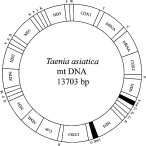
Fig. 1. Arrangement of the mitochondrial genome of Taenia asiatica. All genes are coded by the same strand and are transcribed in a clock-wise direction. All genes follow the standard nomenclature except for the 22 tRNA genes, which are designated by one letter code for the corresponding amino acid. The leucine and serine tRNA genes are respectively denoted as L1 and L2 (for codon families CUN and UUR, respectively) and S1 and S2 (for codon families AGN and UCN, respectively). SNR and LNR refer to the short and long non-coding regions, respectively.
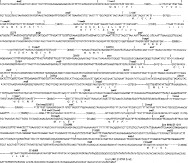
Fig. 2. Schematic presentation of the complete coding sequence of the Taenia asiatica mitochondrial genome. The genome consists of 12 protein-coding genes, 2 ribosomal (large and small subunits), 22 transfer RNA genes and 2 non-coding regions. The fully annotated sequence can be found in the GenBank under Accession number AF445798.
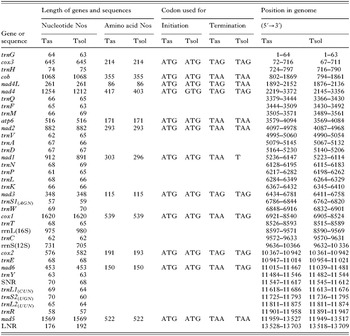
Table 1. Position in the genome and characteristics of the mitochondrial genes of Taenia asiatica and T. solium (Tas: T. asiatica; Tsol: T. solium; SNR: short non-coding region; LNR: long non-coding region)
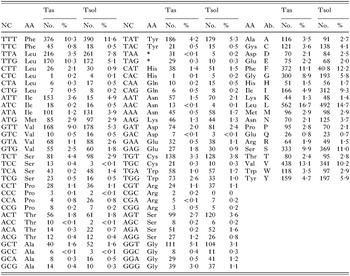
Table 2. Genetic code and codon usage pattern for the mitochondrial protein-coding genes of Taenia asiatica and T. solium (Tas: T. asiatica; 3187 codons were used for 3010 amino acids and 12 stop codons. Tsol: T. solium; 3355 codons were used for 3254 amino acids and 12 stop codons. NC: Nucleotide; AA: Amino acid; Ab: Abbreviation; No: Number of codons; *: termination codons)

Table 3. Nucleotide composition of the complete mitochondrial genome, the protein-coding genes and the ribosomal RNA sequences in Taenia asiatica and T. solium (Tas: T. asiatica; Tsol: T. solium)
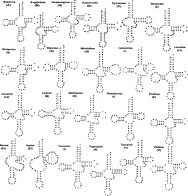
Fig. 3. DNA sequences of the 22 tRNA genes of Taenia asiatica and their inferred secondary structures. All have paired DHU arms except for the cysteine, arginine, serine 1 and serine 2 tRNAs, which have unpaired DHU arms. The unpaired DHU arms in serine tRNAs are also observed in most other cestodes and trematodes. The unpaired DHU arm in the arginine tRNA is also observed in most other cestodes, although trematodes have a paired DHU arm in their arginine tRNAs.
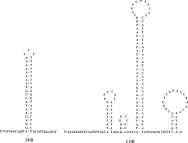
Fig. 4. The putative secondary structures of the non-coding regions of Taenia asiatica that are found between nad5 and trnG or between trnY and trnL1. SNR has 1 hairpin and LNR has 4 hairpin structures. The 5′ flanking sequences have the consensus sequences TATA, while the 3′ flanking sequences share the sequence consensus GAT.
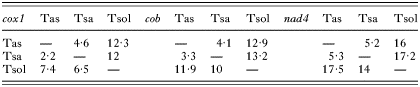
Table 4. Percentage pairwise divergences of the nucleotides (above diagonal) and amino acids (below diagonal) of the cox1, cob and nad4 genes of Taenia asiatica, T. saginata and T. solium (Tas: T. asiatica (present study); Tsa: T. saginata (AB031285 and AB066581); Tsol: T. solium (AB086256))
 You have
Access
- 51
- Cited by